Printed in the Republic of Korea http://dx.doi.org/10.5012/jkcs.2014.58.1.49
Synthesis of Novel Pyrazolines of Medicinal Interest
Ravindra M. Gol,Kamlesh M. Khokhani†, Taslimahemad T. Khatri*, and Jyotindra J. Bhatt Department of Chemistry, KSKV Kachchh University, Bhuj-Kachchh 370 001, Gujarat, India.
*E-mail: [email protected]
†Department of Chemistry, M M Science College, Morbi 363641, Gujarat, India (Received October 13, 2013; Accepted December 17, 2013)
ABSTRACT. Different pyrazoline derivatives (6a−h and 7a−h) were synthesized by cyclization of substituted chalcones with hydrazine hydrate in acidic as well as basic conditions. Both the reactions were performed under conventional heating and microwave irradiation and percentage yields were compared. All the reactions were accelerated in acidic and basic conditions under microwave irradiation, with higher yields. All the synthesized compounds were characterized by their spectral study (IR, MS, 1H and 13C NMR) and were tested for their antibacterial and antifungal activity. The compounds 6g and 7g exhibited significant activity against S. aureu, 7g against E. faecalis, 6b and 7b against E. coli and 6b, 6c, 7b, 7c against S. typhi. The compounds 6d and 7d exhibited significant activity against C. albicans and 6c against M. luteus. Rest of the synthesized com- pounds showed moderate to poor activity against tested species with compared to standard.
Key words: Microwave irradiation, Chalcones, Pyrazolines, Antimicrobial activity
INTRODUCTION
Pyrazolines are well known and important nitrogen containing 5-membered heterocyclic compounds and var- ious methods have been worked out for their synthesis.
The ring is quite stable and has inspired chemists to carry out various structural variations in the ring.1 Numerous pyrazoline derivatives have been found to possess con- siderable biological activities, which stimulated the research activity in this field.2−5 Amongst all the nitrogen contain- ing five member heterocycles, it have proved to be the most useful framework for biological activities and have attracted attention of medicinal chemists for both with regard to heterocyclic chemistry and the pharmacological activities associated with them. The dihydropyrazoles have been reported to possess some interesting biological activ- ities such as anti-inflammatory, antimicrobial and analgesic agents,6,7 antitumor,8,9 cannabinoid CB1 receptor agonists,10 BRAF inhibitors,11 monoamine oxidase inhibitor,12 antide- pressant13 etc.
In the last few years microwave organic reaction enhance- ment chemistry has gained popularity as a non-conventional technique for rapid organic synthesis and many researchers have described accelerated organic reactions14 and a large number of research articles have proven the importance of microwave synthesis as synthetic utility for routine organic synthesis.15,16 It can be termed as ‘e-chemistry’ because it is easy, effective, economical and eco-friendly and is believed to be a step towards green chemistry. Under the framework
of, “Green Chemistry” we have developed an environ- mentally benign solvent-free approach for the synthesis of pyrazolines inspired by Loupy et al.17,18
Herein we report the synthesis of α, β-unsaturated ketones (chalcones), by Claisen-Schmidt condensation of differ- ent aromatic aldehydes with ketone19−23 and their cyclization with hydrazine hydrate in acidic as well as basic conditions.
Both the reactions were performed under microwave irra- diation and conventional heating.
EXPERIMENTAL Materials
Melting points were determined in open capillary on an electro thermal apparatus and were uncorrected. Samsung MW83Y Microwave Oven was modified locally to perform all the reactions. TLC was performed on silica gel PF254 plates (Merck).
Methods
General procedure for the synthesis of 3-(4-((4-fluo- robenzyl)oxy)phenyl)-1-phenylprop-2-en-1-one (5a−h)
(a) A mixture of 10 mmol of p-hydroxy benzaldehyde (1) and 10 mmol of 1-(chloromethyl)-4-fluorobenzene (2) in DMF was stirred at 120oC for 12 hours using K2CO3 as a catalyst. The reaction mixture was poured in crushed ice.
The crude product 4-((4-fluorobenzyl)oxy) benzaldehyde (3) was isolated and recrystallized from absolute hot eth- anol. Yield: 84% M.P: 99oC.
(b) A mixture of 10 mmol of 3 and 10 mmol of sub- stituted acetophenone (4a−h) in methanol (30 ml) was stirred at room temperature for 24 hours using 20% NaOH as a catalyst to make the solution alkaline. The reaction mix- ture was poured in ice cold water. The crude 3-(4-((4-flu- orobenzyl)oxy)phenyl)-1-phenylprop-2-en-1-one (5a−h) was isolated and recrystallized from hot absolute ethanol.
General procedure conventional synthesis of 5-(4- ((4-fluorobenzyl)oxy)phenyl)-3-phenyl-4,5-dihydro-1H- pyrazole derivatives (6a−h)
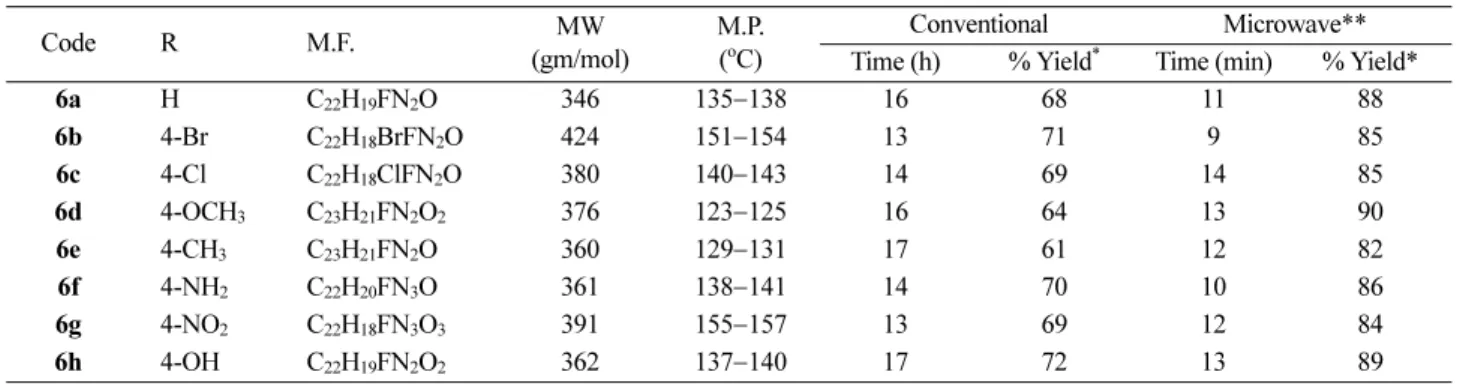
A mixture of 10 mmol of 5 and 50 mmol of hydrazine hydrate in 25 ml Ethanol was refluxed for under catalytic amount of KOH. The solution was poured into crushed ice and neutralize with dilute HCl solution. Product 6 was iso- lated and crystallized from hot ethanol. Same reaction was carried out under microwave irradiation which resulted in poor yields. The physical data are recorded in Table 1.
General procedure microwave assisted synthesis of 1-(5-(4-((4-fluorobenzyl)oxy)phenyl)-3-phenyl-4,5-dihy- dro-1H-pyrazol-1-yl)ethanone derivatives (7a−h).
A mixture of 10 mmol of 5 and 50 mmol hydrazine
hydrate were dissolved in 20 ml of acetic acid which was used as self solvent. The reaction mixture was subjected to MWI for a 5−10 min. at low power (180 W). The progress of the reaction was monitored by TLC. After completion of the reaction, the reaction mixture was cooled to room temperature; separated product 7 was filter washed with methanol and crystallized from hot ethanol. The same reaction was carried out on oil bath. The 7 was also synthesized by usual acetylating process of 6. The physical data are recorded in Table 2.
Characterization
1H and 13C NMR spectra were recorded on a Bruker AC-200 MHz FT NMR spectrometer. Chemical shifts are expressed in δ ppm downfield from internal TMS as ref- erence. 1H NMR data are reported in order: multiplicity (bs, broad singlet; s, singlet; d, doublet; t, triplet; m, mul- tiplet). IR spectra were recorded on a Shimadzu FTIR- 8400 instrument in KBr disc and only noteworthy absorp- tion levels (cm−1) are listed. Mass spectra were recorded on a GCMS QP 2010 spectrophotometer. Elemental anal- ysis was performed on a Carlo Erba EA 1108 elemental analyzer. The results of elemental analyses (C, H, and N)
Table 2. Synthesis of pyrazolines in acidic condition under conventional heating and microwave irradiation (7a−h)
Code R M.F. MW
(gm/mol)
M.P.
(oC)
Conventional Microwave**
Time (h) % Yield* Time (min) % Yield*
7a H C24H21FN2O2 388 140−143 20 56 8.5 73
7b 4-Br C24H20BrFN2O2 466 177−180 19 59 9 70
7c 4-Cl C24H20ClFN2O2 422 155−158 16 61 10.5 75
7d 4-OCH3 C25H23FN2O3 418 138−141 20 68 8.5 71
7e 4-CH3 C25H23FN2O2 402 159−152 15 60 7.5 68
7f 4-NH2 C24H22FN3O2 403 164−168 19 54 11 67
7g 4-NO2 C24H20FN3O4 433 178−182 20 62 11.5 75
7h 4-OH C24H21FN2O3 404 151−153 16 69 7.5 78
*Isolated yield in DMF.
**Continuous irradiation.
Table 1. Synthesis of pyrazolines in basic condition under conventional heating and microwave irradiation (6a−h)
Code R M.F. MW
(gm/mol)
M.P.
(oC)
Conventional Microwave**
Time (h) % Yield* Time (min) % Yield*
6a H C22H19FN2O 346 135−138 16 68 11 88
6b 4-Br C22H18BrFN2O 424 151−154 13 71 9 85
6c 4-Cl C22H18ClFN2O 380 140−143 14 69 14 85
6d 4-OCH3 C23H21FN2O2 376 123−125 16 64 13 90
6e 4-CH3 C23H21FN2O 360 129−131 17 61 12 82
6f 4-NH2 C22H20FN3O 361 138−141 14 70 10 86
6g 4-NO2 C22H18FN3O3 391 155−157 13 69 12 84
6h 4-OH C22H19FN2O2 362 137−140 17 72 13 89
*Isolated yield in ethanol.
**Continuous irradiation.
were within ± 0.4% of the theoretical values.
5-(4-((4-fluorobenzyl)oxy)phenyl)-3-phenyl-4,5-dihy- dro-1H-pyrazole (6a)
IR (νmax, cm−1): 3355 (N−H str. of Sec. Amine) 3034 (C=C−H str.), 2938 (C−H str.), 1509 (C=C− str), 1231 (C−O−C str. of ether), 1180 (C−F str); 1H NMR (200 MHz, CDCl3), 1.30 (1H, t, J = 7.00 Hz), 4.20 (1H, dd, J = 4.3, 15.7 Hz), 4.45 (1H, dd, J = 7.1, 14.8 Hz), 5.46 (2H, s, CH2), 7.08−7.89 (m, 14H); 8.23 (1H, s, NH); 13C NMR (200 MHz, CDCl3, δ): 41.4, 50.2, 72.0, 114, 125.9, 127.2, 128.2, 131.1, 136.7, 137.2, 151, 160.1,162.8; MS, m/z (%) = 346, 317, 251, 269, 237, 221, 201, 144, 125; Elemental Anal- ysis: Calculated: C, 76.26; H, 5.53; N, 8.09%, Found: C, 76.22; H, 5.50; N, 8.10%.
3-(4-bromophenyl)-5-(4-((4-fluorobenzyl)oxy)phenyl)- 4,5-dihydro-1H-pyrazole (6b)
IR (νmax, cm−1): 3355 (N-H str. of Sec. Amine) 3034 (C=C−H str.), 2938 (C−H str.), 1509 (C=C− str.), 1231 (C−O−C str. of ether), 1185 (C−F str.), 825 (C−H .p. def.) 547 (C−Br str.); 1H NMR (200 MHz, CDCl3), 1.35 (1H, t, J = 6.98 Hz), 4.14 (1H, dd, J = 3.5, 14.8 Hz), 4.35 (1H, dd, J = 7.2, 15.2 Hz), 5.46 (2H, s, CH2), 7.08−7.89 (m, 13H); 8.20 (1H, s, NH);
13C NMR (200 MHz, CDCl3, δ): 41.2, 50.4, 74.4, 114.1, 125.4, 125.9, 127.1, 128.6, 131.4, 136.8, 137, 151, 159, 161.2; MS, m/z (%) = 424, 405, 345,329, 326, 299, 222, 201, 144, 125;
Elemental Analysis: Calculated: C, 62.13; H, 4.27; N, 6.59; %, Found: C, 62.10; H, 4.25; N, 6.60%.
3-(4-chlorophenyl)-5-(4-((4-fluorobenzyl)oxy)phenyl)- 4,5-dihydro-1H-pyrazole (6c)
IR (νmax, cm−1): 3355 (N−H str. of Sec. Amine) 3034 (C=C−H str.), 2938 (C−H str.), 1509 (C=C− str.), 1231 (C−O−C str. of ether), 1185 (C−F str.), 825 (C−H .p. def.) 710 (C−Cl str.); 1H NMR (200 MHz, CDCl3), 1.33 (1H, t, J = 6.80 Hz), 4.08 (1H, dd, J = 4.2, 14.3 Hz), 4.25 (1H, dd, J = 7.1, 14.9 Hz), 5.52 (2H, s, CH2), 7.08−7.89 (m, 13H); 8.12 (1H, s, NH); 13C NMR (200 MHz, CDCl3, δ): 41.4, 50.2, 72.2, 114.1, 127.1, 127.6, 128.9, 134.5, 134.8, 151.7, 159.1, 162.8; MS, m/z (%) = 380, 361, 345, 326, 285, 269, 255, 201, 179, 144, 125,111; Elemental Analysis: Calcu- lated: C, 69.38; H, 4.76; N, 7.36%, Found: C, 69.32; H, 4.74; N, 7.39%.
5-(4-((4-fluorobenzyl)oxy)phenyl)-3-(4-methoxyphenyl)- 4,5-dihydro-1H-pyrazole (6d)
IR (νmax, cm−1): 3355 (N−H str. of Sec. Amine), 3034 (C=C−H str.), 2938 (C−H str.), 1509 (C=C− str.), 1231 (C−O−
C str. of ether), 1184 (C−F str.), 825 (C−H .p. def.); 1H NMR (200 MHz, CDCl3), 1.35 (1H, t, J = 7.02 Hz), 3.45 (3H, s, CH3), 4.17 (1H, dd, J = 3.8, 14.3 Hz), 4.39 (1H, dd, J = 6.9, 15.3 Hz), 5.48 (2H, s, CH2), 7.08−7.90 (m, 13H); 8.14 (1H, s, NH); 13C NMR (200 MHz, CDCl3, δ): 42.1, 51.1, 56.2, 72.0, 114.2, 128.1,128.5, 128.9, 137.1, 152.8, 158.2, 162.1, 163.4; MS, m/z (%) = 376, 357, 345, 281, 269, 251, 201, 175, 144, 125; Elemental Analysis: Calculated: C, 73.39; H, 5.62; N, 7.44%, Found: C, 73.42; H, 5.60; N, 7.40%
5-(4-((4-fluorobenzyl)oxy)phenyl)-3-(p-tolyl)-4,5-dihy- dro-1H-pyrazole (6e)
IR (νmax, cm−1): 3355 (N-H str. of Sec. Amine), 3034 (C=C− H str.), 2938 (C−H str.), 1509 (C=C− str.), 1231 (C−O−C str.
of ether), 1185 (C−F str.), 825 (C−H .p. def.); 1H NMR (200 MHz, CDCl3), 1.89 (1H, t, J = 7.1 Hz), 2.1 (3H, s, CH3), 4.23 (1H, dd, J = 4.3, 14.2 Hz), 4.45 (1H, dd, J = 7.2, 14.5 Hz), 5.21 (2H, s, CH2), 7.08−7.98 (m, 13H); 8.22 (1H, s, NH);
13C NMR (200 MHz, CDCl3, δ): 22.1, 41.4, 52.0, 71.0, 114.7, 125.8, 128.9, 135.2, 137.3, 142.5, 151.7, 158.1, 162.2;
MS, m/z (%) = 360, 345, 341, 269, 235, 201, 159, 144, 125;
Elemental Analysis: Calculated: C, 76.64; H, 5.87; N, 7.77%, Found: C, 76.61; H, 5.42; N, 7.56%.
4-(5-(4-((4-fluorobenzyl)oxy)phenyl)-4,5-dihydro-1H- pyrazol-3-yl)aniline (6f)
IR (KBr, cm−1): 3450 (N-H str. of Pri. Amine), 3355 (N−H str. of Sec. Amine), 3034 (C=C−H str.), 2938 (C−H str.), 1509 (C=C− str.), 1231 (C−O−C str. of ether), 1185 (C−F str.), 825 (C−H .p. def.); 1H NMR (200 MHz, CDCl3), 1.56 (1H, t, J = 6.80 Hz), 4.15 (1H, dd, J = 4.6, 14.2 Hz), 4.23 (1H, dd, J = 6.8, 13.9 Hz), 5.42 (2H, s, CH2), 5.9 (1H, s, NH), 7.10−7.99 (m, 13H); 8.12 (1H, s, NH); 13C NMR (200 MHz, CDCl3, δ): 41.3, 52.4, 57.2, 114.2, 114.6, 126.4, 130.1, 136.7, 152.1, 158.7, 161.9;
MS, m/z (%) = 361, 345, 342, 269, 256, 236, 201, 160, 144, 125; Elemental Analysis: Calculated: C, 73.11; H, 5.58; N, 11.63%, Found: C, 73.08; H, 5.50; N, 11.59%.
5-(4-((4-fluorobenzyl)oxy)phenyl)-3-(4-nitrophenyl)- 4,5-dihydro-1H-pyrazole (6g)
IR (νmax, cm−1): 3355 (N−H str. of Sec. Amine), 3034 (C= C−H str.), 2938 (C−H str.), 1540 (N=O Str.), 1509 (C=C− str.), 1231 (C−O−C str. of ether), 1185 (C−F str.), 821 (C−H .p. def.); 1H NMR (200 MHz, CDCl3), 1.83 (1H, t, J = 6.92 Hz), 4.11 (1H, dd, J = 4.1, 15.2 Hz), 4.21 (1H, dd, J = 6.8, 14.2 Hz), 5.47 (2H, s, CH2), 7.08−7.97 (m, 13H); 8.20 (1H, s, NH); 13C NMR (200 MHz, CDCl3,
δ): 41.8, 51.4, 70.2, 114.1, 126.5, 128.7, 138.2, 142.5, 150.7, 152.1, 157, 162.2; MS, m/z (%) = 391, 372, 345, 282, 269, 266, 201, 190, 144, 125; Elemental Analysis:
Calculated: C, 67.51; H, 4.64; N, 10.74%, Found: C, 67.43; H, 4.66; N, 10.78%.
4-(5-(4-((4-fluorobenzyl)oxy)phenyl)-4,5-dihydro-1H- pyrazol-3-yl)phenol (6h)
IR (νmax, cm−1): 3480 (−OH str. of Phenolic OH), 3355 (N−H str. of Sec. Amine), 3034 (C=C−H str.), 2938 (C−H str.), 1509 (C=C− str.), 1231 (C−O−C str. of ether), 1180 (C−F str.), 830 (C−H .p. def.); 1H NMR (200 MHz, CDCl3), 1.45 (1H, t, J = 7.2 Hz), 4.16 (1H, dd, J = 4.2, 14.8 Hz), 4.42 (1H, dd, J = 7.2, 15.6 Hz), 5.46 (2H, s, CH2), 5.98 (1H, s, OH), 7.00−7.99 (m, 13H); 8.28 (1H, s, NH); 13C NMR (200 MHz, CDCl3, δ): 42.2, 51.7, 71.1, 114, 125.4, 128.7, 135.6, 137.4, 151.9, 158.4, 162.0,162.9; MS, m/z (%) = 362, 345, 343, 269, 267, 201, 161, 144, 125; Elemental Analysis: Calculated: C, 72.91; H, 5.28; N, 7.73%, Found:
C, 72. 88; H, 5.32; N, 7.70%.
1-(5-(4-((4-fluorobenzyl)oxy)phenyl)-3-phenyl-4,5-dihy- dro-1H-pyrazol-1-yl)ethanone (7a)
IR (νmax, cm−1): 3037 (C=C−H str.), 2931 (C−H str.), 1705 (C=O str.), 1509 (C=C− str.), 1230 (C−O−C str. of ether), 1172 (C−F str.); 1H NMR (200 MHz, CDCl3) 2.40 (3H, s, CH3), 2.90 (1H, dd, J = 5.2, 18.6 Hz), 3.10 (1H, dd, J = 12.3, 16.2 Hz), 5.10 (2H, s, CH2), 5.74 (1H, dd, J = 3.7, 12.3 Hz), 6.90−7.85 (m, 14H); 13C NMR (200 MHz, CDCl3, δ): 23.2, 40.1, 66.4, 71.1, 114.1, 127.1, 128.2, 127.6, 128.8, 131.1, 134, 136.4, 136.7, 151.9, 158.7, 161.1, 169.1; MS, m/z (%) = 388, 369, 345, 311, 293, 263, 201, 187, 125; Anal.
cacld: C, 74.21; H, 5.45; N, 7.21%, Found: C, 74.17; H, 5.40; N, 7.25%.
1-(3-(4-bromophenyl)-5-(4-((4-fluorobenzyl)oxy)phe- nyl)-4,5-dihydro-1H-pyrazol-1-yl) ethanone (7b)
IR (νmax, cm−1): 3034 (C=C−H str.), 2931 (C−H str.), 1702 (C=O str.), 1505 (C=C− str.), 1231 (C−O−C str. of ether), 1175 (C−F str.), 822 (C−H .p. def.) 540 (C−Br str.);
1H NMR (200 MHz, CDCl3) 2.24 (3H, s, CH3), 2.83 (1H, dd, J = 4.9, 18.2Hz), 2.98 (1H, dd, J = 11.2, 17.3 Hz), 5.25 (2H, s, CH2), 5.70 (1H, dd, J = 4.2, 11.9 Hz), 6.90−7.85 (m, 13H); 13C NMR (200 MHz, CDCl3, δ): 23.4, 41.2, 65.8, 71.1, 114.1, 125.4, 126.2, 127.4, 128.7, 128.9, 134.1, 136, 151.8, 158.8, 161.4, 168.7; MS, m/z (%) = 466, 447, 387, 368, 325, 311, 265, 201, 186, 125; Elemental Analysis: Cal- culated: C, 61.68; H, 4.31; N, 5.99% Found: C, 61.63; H, 4.28; N, 6.03%.
1-(3-(4-chlorophenyl)-5-(4-((4-fluorobenzyl)oxy)phe- nyl)-4,5-dihydro-1H-pyrazol-1-yl) ethanone (7c)
IR (νmax, cm−1): 3034 (C=C−H str.), 2931 (C−H str.), 1710 (C=O str.), 1515 (C=C− str.), 1231 (C−O−C str. of ether), 1170 (C−F str.), 822 (C−H .p. def.) 710 (C−Cl str.);
1H NMR (200 MHz, CDCl3) 2.37 (3H, s, CH3), 2.87 (1H, dd, J = 5.6, 17.8 Hz), 3.05 (1H, dd, J = 12.8, 17.7 Hz), 5.34 (2H, s, CH2), 5.68 (1H, dd, J = 4.8, 12.4 Hz), 6.90−7.85 (m, 13H); 13C NMR (200 MHz, CDCl3, δ): 23.1, 40.1, 65.8, 70.9, 114.1, 127.1, 128.2, 128.9, 134.5, 136.6, 136.7, 151.7, 159.1, 162.3, 168.7; MS, m/z (%) = 422, 403, 387, 327, 313, 297, 292, 221, 201, 178, 125; Elemental Analysis:
Calculated: C, 68.17; H, 4.77 N, 6.62% Found: C, 68.16;
H, 4.72; N, 6.65%.
1-(5-(4-((4-fluorobenzyl)oxy)phenyl)-3-(4-methoxyphe- nyl)-4,5-dihydro-1H-pyrazol-1-yl) ethanone (7d)
IR (νmax, cm−1): 3030 (C=C−H str.), 2931 (C−H str.), 1702 (C=O str.), 1508 (C=C− str.), 1240 (C−O−C str. of ether), 1181 (C−F str.), 829 (C−H .p. def.); 1H NMR (200 MHz, CDCl3) 2.39 (3H, s, CH3), 2.85 (1H, dd, J = 3.9, 18.8 Hz), 3.01 (1H, dd, J = 11.9, 16.9Hz), 4.26 (3H, s, CH3), 5.20 (2H, s, CH2), 5.67 (1H, dd, J = 3.9, 12.2 Hz), 6.90−7.85 (m, 13H); 13C NMR (200 MHz, CDCl3, δ):
23.4, 40.7, 55.7, 65.9, 71.7, 114.1, 114.7, 126.6, 127.1, 127.6, 128.9, 134.1, 138.2, 151.7, 158.2,161.6, 162.9, 168.7;
MS, m/z (%) = 418, 399, 387, 311, 309, 293, 266, 217, 201, 174, 143, 125; Elemental Analysis: Calculated: C, 71.76;
H, 5.54; N, 6.69% Found: C, 71.78; H, 5.52; N, 6.74%.
1-(5-(4-((4-fluorobenzyl)oxy)phenyl)-3-(p-tolyl)-4,5-dihy- dro-1H-pyrazol-1-yl)ethanone (7e)
IR (νmax, cm−1): 3034 (C=C−H str.), 2931 (C−H str.), 1712 (C=O str.), 1512 (C=C− str.), 1228 (C−O−C str. of ether), 1178 (C−F str.), 823 (C−H .p. def.); 1H NMR (200 MHz, CDCl3) 1.9 (3H, s, CH3) 2.40 (3H, s, CH3), 2.82 (1H, dd, J = 4.3, 17.3 Hz), 3.05 (1H, dd, J = 11.4, 18.2 Hz), 5.10 (2H, s, CH2), 5.27 (1H, dd, J = 3.2, 12.2 Hz), 6.90−7.85 (m, 13H); 13C NMR (200 MHz, CDCl3, δ): 22.7, 23.7, 40.7, 66.1, 71.1, 114.1, 126.6, 127, 129.1, 128.8, 133.4, 134, 140.7, 152.1, 158.6, 162.4, 169.7; MS, m/z (%) = 402, 387, 383, 368, 311, 293, 277, 201, 186, 125, 91; Elemental Analysis: Cal- culated: C, 74.61; H, 5.76; N, 6.96% Found: C, 74.68; H, 5.72; N, 7.00%.
1-(3-(4-aminophenyl)-5-(4-((4-fluorobenzyl)oxy)phe- nyl)-4,5-dihydro-1H-pyrazol-1-yl) ethanone (7f)
IR (νmax, cm−1): 3405 (N−H str.), 3034 (C=C−H str.), 2931 (C−H str.), 1701 (C=O str.), 1500 (C=C− str.), 1228
(C−O−C str. of ether), 1172 (C−F str.), 820 (C−H .p. def.);
1H NMR (200 MHz, CDCl3) 2.35 (3H, s, CH3), 2.70 (1H, dd, J = 5.2, 17.8 Hz), 3.13 (1H, dd, J = 9.9, 18.1 Hz), 5.32 (2H, s, CH2), 5.70 (1H, dd, J = 3.2, 12.1 Hz), 5.95 (2H, s, NH2), 6.90−7.96 (m, 13H); 13C NMR (200 MHz, CDCl3, δ):
23.1, 40.1, 65.9, 71.6, 114.1, 114.3, 126.6, 130, 134.1, 136.7, 150.7, 158.6, 161.9, 168.7; MS, m/z (%) = 403, 387, 384, 368, 308, 311, 278, 202, 186, 125; Elemental Analysis: Calculated: C, 71.45; H, 5.50; N, 10.42% Found:
C, 71.48; H, 5.54; N, 10.43%.
1-(5-(4-((4-fluorobenzyl)oxy)phenyl)-3-(4-nitrophenyl)- 4,5-dihydro-1H-pyrazol-1-yl) ethanone (7g)
IR (νmax, cm−1): 3039 (C=C−H str.), 2931 (C−H str.), 1702 (C=O str.), 1540 (N=O Str.), 1504 (C=C− str.), 1228 (C−O−C str. of ether), 1170 (C−F str.), 825 (C−H .p. def.);
1H NMR (200 MHz, CDCl3) 2.20 (3H, s, CH3), 2.67 (1H, dd, J = 4.6, 17.4 Hz), 2.98 (1H, dd, J = 12.1, 17.9 Hz), 4.90 (2H, s, CH2), 5.10 (1H, dd, J = 3.9, 12.2 Hz), 6.90−8.50 (m, 13H); 13C NMR (200 MHz, CDCl3, δ): 22.7, 39.9, 70.1, 114.1, 126.6, 127.0, 127.7, 134.9, 142.7, 151.1, 157.9, 162.1, 168.7; MS, m/z (%) = 433, 414, 387, 368, 324, 262, 232, 219, 189, 125; Elemental Analysis: Calculated: C, 66.51; H, 4.65; N, 9.69% Found: C, 66.52; H, 4.61; N, 9.73%.
1-(5-(4-((4-fluorobenzyl)oxy)phenyl)-3-(4-hydroxyphenyl)- 4,5-dihydro-1H-pyrazol-1-yl) ethanone (7h)
IR (νmax, cm−1): 3494 (−OH str. of Phenolic OH), 3034 (C=C−H str.), 2931 (C−H str.), 1708 (C=O str.), 1540 (N=O Str.), 1504 (C=C− str.), 1228 (C−O−C str. of ether), 1185 (C−F str.), 825 (C−H .p. def.); 1H NMR (200 MHz, CDCl3) 2.04 (3H, s, CH3), 2.97 (1H, dd, J = 4.2, 17.8 Hz), 3.43 (1H, dd, J = 10.8, 17.1 Hz), 5.05 (1H, s, OH), 5.20 (2H, s, CH2), 5.42 (1H, dd, J = 4.9, 14.5 Hz), 6.90−7.85 (m, 13H); 13C NMR (200 MHz, CDCl3, δ): 23.4, 40.4, 65.9, 70.7, 114.1, 116.0, 126.6, 129.1, 134.0, 157.7, 161.4, 162.9, 168.9; MS, m/z (%) = 404, 387, 385, 309, 292, 279 236, 203, 186, 160, 125; Elemental Analysis: Calculated:
C, 71.27; H, 5.23; N, 6.93% Found: C, 71.23; H, 5.24; N, 7.00%.
Biological Activity
The antibacterial activity was determined applying the cup-plate agar-diffusion method24 and antifungal activity was determined applying the agar plate technique method.25 Results were obtained in duplicate, and results with dif- ferences higher than 5% were discarded and the measure- ment repeated.
RESULTS AND DISCUSSION Chemistry
In the initial step 4-((4-fluorobenzyl)oxy) benzaldehyde (3) was synthesized by reacting 4-hydroxy benzaldehyde (1) and benzyl chloride (2) using K2CO3 as catalyst. Chal- cone (5a−h) were synthesized by condensing 3 with appropriate para substituted acetophenones (4a−h) in eth- anolic NaOH solution at room temperature (Scheme 1).
The cyclization of 5a−5h with hydrazine hydrate in presence of KOH and ethanol as a solvent and with hydra- zine hydrate in presence of glacial acetic acid as self sol- vent led to the compounds 6a−6h and 7a−7h respectively.
Both the reactions were performed in conventional heat- ing and microwave irradiation. The cyclization took place via nucleophillic attack of hydrazine hydrate on carbonyl carbon of 5a−h with removal of water molecule followed by inter molecular cyclization reaction to afford products 6a−6h and 7a−7h respectively.
The products 7a−h were than synthesized from 6a−h by usual acetylation process using acetic anhydride (Scheme 2).
All the reactions were accelerated in acidic and basic conditions under microwave irradiation with slightly better percentage yields. The reaction time was up to ten times
Scheme 1. Synthesis of Chaclones.
Scheme 2. Synthesis of dihydropyrazoles.
shorter than for comparable reactions under conventional heating. There was a clear improvement in using micro- wave heating over conventional heating in the acidic con- dition for all of our studied substrates (Table 1, 2).
The structures of the products (6a−h and 7a−h) were determined by spectroscopic as well as elemental analyt- ical data. The compounds 6a−6h showed IR absorption bands at 3355 cm−1 of cyclic secondary amine (−NH) stretch- ing of pyrazoline ring system and 7a−7h showed 1710 cm−1 of acetyl group stretching. The 1H NMR spectra of all the synthesized compounds (6a−h and 7a−h) showed char- acteristic doublet of doublet at 4.10−4.50 ppm for sub- stituted pyrazol ring system. Measured chemical shift and coupling constant values unequivocally proved the pyra- zoline structure. Moreover the etheric protons (−O−CH2) showed singlet at 5.40−5.50 ppm. The aromatic ring pro- tons and J value were found to be in accordance with sub- stitution pattern on phenyl ring.
Biological Activity
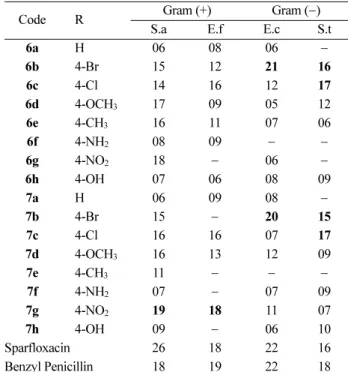
Lack of development of new antimicrobial agents is a serious problem these days because the microorganisms are getting more and more ‘use to’ to the drugs available in the market.26 The wide range of activity profile of pyra- zole probes us to test and study the biological activities of some of the synthesized novel analogues. The newly syn- thesized compounds 6a−h to 7a−h were tested in vitro for their antibacterial activity against two gram positive bacteria Staphylococcus aureus, Enterococcus faecalis and two gram negative bacteria Escherichia coli, Salmonella typhi by the cup-plate agar-diffusion method. DMSO was used as a control solvent, Sparfloxacin and Benzyl Penicillin as standard drugs.
After 24 h incubation at 37oC, the zone of inhibition was measured in mm. The results are depicted in Table 3.
The results showed that almost all compounds were active against the microorganism tested. It is worth noting here that compounds 6g and 7g exhibited significant activity against S. aureu, 7g against E. faecalis, 6b and 7b against E. coli and 6b, 6c, 7b, 7c against S. typhi The other com- pounds showed moderate-to-low activity. Over all, in both the series conpounds with R = NO2 (6g, 7g) found to be more active against the gram positive bacteria and com- pounds with R = Cl, Br (6b, 6c, 7b and 7c) were found to be more active against the gram negative bacteria. Com- pounds with R = H, NH2, OH (6a, 6f, 6h, 7a, 7f and 7h) were found to be least active against all the tested bac- terial species with respect to standard (Fig. 1).
Compounds 6a−h to 7a−h were also screened in vitro
for their antifungal activity against four species using the agar plate technique. The linear growth of the fungus was obtained by measuring the diameter of the fungal colony after 7 days. The amount of growth inhibition in each case was calculated as percentage inhibition. The results shown in Table 4 indicated that 6d and 7d exhibited significant activity against Candida albicans and 6c against Micro- coccus luteus. Moreover no compound exhibited signif- icant activity against Trichphyton longifusus. It is worth noting that compounds with R = OCH3 and Cl (6d, 7d and 6c respectively) showed good antifungal activities, rest of the compounds showed poor activity against the fungal Figure 1. Antimicrobial activity of 6a−h and 7a−h.
Table 3. Antimicrobial activity of pyrazoline derivatives (6a−h and 7a−h)
Code R Gram (+) Gram (−)
S.a E.f E.c S.t
6a H 06 08 06 −
6b 4-Br 15 12 21 16
6c 4-Cl 14 16 12 17
6d 4-OCH3 17 09 05 12
6e 4-CH3 16 11 07 06
6f 4-NH2 08 09 − −
6g 4-NO2 18 − 06 −
6h 4-OH 07 06 08 09
7a H 06 09 08 −
7b 4-Br 15 − 20 15
7c 4-Cl 16 16 07 17
7d 4-OCH3 16 13 12 09
7e 4-CH3 11 − − −
7f 4-NH2 07 − 07 09
7g 4-NO2 19 18 11 07
7h 4-OH 09 − 06 10
Sparfloxacin 26 18 22 16
Benzyl Penicillin 18 19 22 18
Zone diameter of growth inhibition (mm) after 24 h, ≤ 05 mm (−), Concentration 1 mg/mL in DMSO. Microorganisms selected are as follows: S.a, Staphylococcus aureus; E.f, Enterococcus faecalis;
E.c, Escherichia coli; S.t, Salmonella typhi.
species tested with respect to standard (Fig. 2).
CONCLUSION
In the present article, we report the synthesis, spectral studies, antibacterial and antifungal activities of a novel series of substituted pyrazoles. These were characterized by IR, NMR, mass spectrometry study and elemental anal- yses. The substrates were obtained in good yield in acidic and basic conditions. Moreover microwave conditions gave advantages in terms of short reaction time and slight higher yield when compared to usual conventional methods. The compounds 6g and 7g exhibited significant (maximum) antibacterial activity against gram positive bacterial species,
6b, 6c, 7b, 7c against gram negative bacterial species and 6c, 6d and 7d exhibited significant (maximum) antifun- gal activities, which may develop into the potential class of antimicrobial agents.
Acknowledgments. The publication cost of this paper was supported by the Korean Chemical Society.
REFERENCES
1. Marella, A.; Ali, M. R.; Alam, M. T.; Saha, R.; Tanwar, O.; Akhter, M.; Shaquiquzzaman, M.; Alam. M. M. Mini Rev. Med. Chem. 2013, 13, 921−931.
2. Chimenti, F.; et al. Curr. Med. Chem. 2006, 13, 1411−1428.
3. Kumar, S.; Bawa, S.; Drabu, S.; Kumar, R.; Gupta, H. Recent Pat. Antiinfect. Drug Discov. 2009, 4, 154−163.
4. Secci, D.; Bolasco, A.; Chimenti, P.; Carradori, S. Curr.
Med. Chem. 2011, 18, 5114−5144.
5. Sharma, S.; Sharma, P. K.; Kumar, N.; Dudhe, R. Biomed.
Pharmacother. 2011, 65, 244−251.
6. Gawad, N. M.; Georgey, H. H.; Ibrahim, N. A.; Amin, N.
H.; Abdelsalam, R. M. Arch. Pharmacal Res. 2012, 35, 807−821.
7. Keche, A. P.; Hatnapure, G. D.; Tale, R. H.; Rodge, A. H.;
Kamble, V. M. Bioorg. Med. Chem. Lett. 2012, 22, 6611−
6615.
8. Congiu, C.; Onnis, V.; Vesci, L.; Castorina, M.; Pisano, C.
Bioorg. Med. Chem. 2010, 18, 6238−6248.
9. Liu, X. H.; Ruan, B. F.; Liu, J. X.; Song, B. A.; Jing, L.
H.; Li, J.; Yang, Y.; Zhu, H. L.; Qi, X. B. Bioorg. Med.
Chem. Lett. 2011, 21, 2916−2920.
10. Lange, J. H.; Attali, A.; Van Der Neut, M. A.; Wals, H. C.;
Mulder, A.; Zilaout, H.; Duursma, A.; Van Aken, H. H.;
Van Vliet, B. J. Bioorg. Med. Chem. Lett. 2010, 20, 4992−
4998.
11. Liu, J. J.; Zhang, H.; Sun, J.; Wang, Z. C.; Yang, Y. S.; Li, D. D.; Zhang, F.; Gong, H. B.; Zhu, H. L. Bioorg. Med.
Chem. 2012, 20, 6089−6096.
12. Maccioni, E.; et al. Eur. J. Med. Chem. 2010, 45, 4490−
4498.
13. Palaska, E.; Aytemir, M.; Uzbay, I. T.; Erol, D. Eur. J.
Med. Chem. 2001, 36, 539−543.
14. Mohan, S. B.; Ravi Kumar, B. V.; Dinda, S. C.; Naik, D.;
Prabu Seenivasan, S.; Kumar, V.; Rana, D. N.; Brahmk- shatriya, P. S. Bioorg. Med. Chem. Lett. 2012, 22, 7539−
7542.
15. Rodriguez, H.; Martin, O.; Suarez, M.; Martin, N.; Albericio, F. Molecules 2011, 16, 9620−9635.
16. Martinez, J.; Romero-Vega, S.; Abeja-Cruz, R.; Alvarez- Toledano, C.; Miranda, R. Int. J. Mol. Sci. 2013, 14, 2903−
2915.
17. Kidwai, M.; Dave, B.; Venkataramanan, R. Indian J. Chem.
2002, 41B, 2414.
18. Modern Solvents in Organic Synthesis; Loupy A., Knochel, P., Ed.; Springer Verlag: New York, 1999, 206, 153.
Figure 2. Antifungal activity of 6a−h and 7a−h.
Table 4. Antifungal activity of pyrazoline derivatives (6a−h and 7a−h)
Code R T.l C.a M.c
6a H 20 34 −
6b 4-Br − − −
6c 4-Cl 58 48 88
6d 4-OCH3 67 82 40
6e 4-CH3 25 − −
6f 4-NH2 − − −
6g 4-NO2 − 42 −
6h 4-OH 75 − −
7a H 22 24 −
7b 4-Br − − 13
7c 4-Cl 47 60 37
7d 4-OCH3 76 90 62
7e 4-CH3 45 − −
7f 4-NH2 − 23 −
7g 4-NO2 − − −
7h 4-OH 67 38 27
Fluconazole 100 90 90
Conc. of sample 200 lg/mL in DMSO at 27oC, Incubation period 7 days. Microorganisms selected are as follows: T.l, Trichphyton longifusus; C.a, Candida albicans; M.c, Microsporum canis.
19. Aly, M. R.; Ibrahim, S. I.; Shahed F. A.; Soliman, H. A.;
Ibrahim, Z. S.; Shazly, S. A. Bioorg. Khim. 2012, 38, 489−
495.
20. Abonia, R.; Insuasty, D.; Castillo, J.; Insuasty, B.; Quiroga, J.; Nogueras, M.; Cobo, J. Eur. J. Med. Chem. 2012, 57, 29−40.
21. Bukhari, S. N.; Jasamai, M.; Jantan, I. Mini Rev. Med. Chem.
2012, 12, 1394−1403.
22. Hsieh, H. K.; Tsao, L. T.; Wang, J. P.; Lin, C. N. J. Pharm.
Pharmacol. 2000, 52, 163−171.
23. Yadav, N.; Dixit, S. K.; Bhattacharya, A.; Mishra, L. C.;
Sharma, M.; Awasthi, S. K.; Bhasin, V. K. Chem. Biol.
Drug. Des. 2012, 80, 340−347.
24. Reeves, D. S.; White, L. O. Principles and Methods of Assaying Antibiotics; Blackwell: Oxford, 1983, 140–162.
25. Collins C. H. Microbiological Methods; Butterworths: Lon- don, 1967.
26. Norrby, S. R.; Nord, C. E.; Finch R. Lancet Infect. Dis.
2005, 5, 115−119.