Received: January 8, 2018 Revised: July 5, 2018 Accepted: July 28, 2018
Address for Correspondence: Masumeh Ghazanfarpour, Department of Midwifery, Razi School of Nursing and Midwifery, Kerman University of Medical Sciences, Kerman 7616913555, Iran
Tel: +98-91-3633-0656, Fax: +98-51-1859-7313, E-mail: [email protected]
Original Article
pISSN: 2288-6478, eISSN: 2288-6761 https://doi.org/10.6118/jmm.2018.24.2.127 Journal of Menopausal Medicine 2018;24:127-132
J MM
Introduction
Depression as a common and serious mood disorder im- pose huge socioeconomic burden, so that can be developed in about 1 per 5 people in the USA. Females, particularly peri- and postmenopausal women, experience the depres- sive disorders more than the males.1
The peri- and postmenopausal women are suffering from several stressful situations related to family, social behav- iors, occupation, sexuality, and healthcare and economic, resulting in high risk of mood disorders.2,3 Menopausal symptoms can significantly impact on quality of life.4
According to the previous studies, the main possible rea- son for mood variations is decrease in estradiol level and its
Effect of Aromatherapy on the Treatment of Psychological Symptoms in Postmenopausal and Elderly Women:
A Systematic Review and Meta-analysis
Masoudeh Babakhanian1, Masumeh Ghazanfarpour2, Leila Kargarfard3, Nasibeh Roozbeh4, Leili Darvish4, Talat Khadivzadeh5, Fatemeh Rajab Dizavandi6
1Social Determinant of Health Research Center, Semnan University of Medical Sciences, Semnan, Iran, 2Department of Midwifery, Razi School of Nursing and Midwifery, Kerman University of Medical Sciences, Kerman, Iran, 3Department of Fatemeh School Nursing and Midwifery, Shiraz University of Medical Science, Shiraz, Iran, 4Mother and Child Welfare Research Center, Hormozgan University of Medical Science, Bander Abbas, Iran, 5Evidence-Based Care Research Center, Department of Midwifery, School of Nursing and Midwifery, Mashhad University of Medical Sciences, Mashhad, Iran, 6Department of Community Health and Psychiatric Nursing, School of Nursing and Midwifery, Mashhad University of Medical Sciences, Mashhad, Iran
Objectives: To critically assess the effect of aromatherapy on the psychological symptoms as noted in the postmenopausal and elderly women.
Methods: Three following databases were systematically searched: MEDLINE, Scopus and Cochrane Library (Cochrane Central Register of Controlled Trials) from inception to January 2018. The search keywords included ‘menopause’ AND (aromatherapy), without language restrictions.
Results: In this study, 4 trials were included which fit into our systematic review. The findings demonstrated that the aromatherapy massage have significantly improved psychological symptoms in menopausal and elderly women as compared to the control group (standardized mean difference [SMD] = -1.24; 95% confidence interval, -0.188 to -0.606; P < 0.001 random effect model;
3 trials, moderate to high heterogeneity, I2 = 0.76; P = 0.028). According to 1 of the trials, the aromatherapy oil massage was no more effective than the untreated group regarding their experience of symptoms such as nervousness.
Conclusions:The aromatherapy may be beneficial in attenuating the psychological symptoms that these women may experience, such as anxiety and depression, but it is not considered as an effective treatment to manage nervousness symptom among menopausal women. This finding should be observed in light of study limitations. (J Menopausal Med 2018;24:127-132) Key Words: Anxiety · Aromatherapy · Depression · Menopause
Journal of Menopausal Medicine 2018;24:127-132
J MM
relationship with the monoamineoxidase level of platelet.5~7 Hormone replacement therapy is reportedly widely used treatment to alleviate the depression symptoms.8~10
In 2004, in follow-up 6.8 years, the side effect of con- jugated equine estrogen (CEE) comparted to placebo. The Women’s Health Initiative reported hazard ratios of 0.91 for coronary heart disease (CHD), 0.77 for cancer breast and 1.39 for stroke. Based on the result, the administration of CEE can lead to an increased risk of stroke. However, it did not impact CHD incidence. In addition to, potential decreased risk of breast cancer need to further research works.11
Also, some medications such as benzodiazepines and an- tidepressants are employed to heal the mood disturbances but they give adverse effects.8 Benzodiazepines are associ- ated with side effects such as anterograde amnesia, physical dependence and also in long term may cause physical de- pendence.12 Antidepressant may indicate side effects such as weight gain, sexual dysfunction and suicidality.13~15
Due to public misunderstanding of issues “cancer and hormone therapy” and concern about side effect of benzodi- azepines and antidepressant, many health care provider and people has been has interested in complementary and alter- native medicine.16~18
The aromatherapy is defined as an essential oil therapy, referringto science of utilizing aromatic essential oils natu- rally extracted from plants that penetrate into the body through the skin or the olfactory system. Consequently, many changes can occur in the physiological indices like blood pressure, muscle tension, pupil dilation, blink mag- nitude, skin temperature and blood flow, pulse rate, and cerebral function.19
In this regard, we found only one meta-analysis focusing on the effect of aromatherapy on perceived stress and de- pression in middle-aged women. Three reasons can justify the necessity for a new comprehensive meta-analysis. First, 2 related studies were detected that were not included in the previous meta-analysis. Second, the previous meta-analysis has not considered the elderly population. Third, all of those studies included in the depression meta-analysis had been extracted from the Korean database. Hence, the aim of this study is to assess the effect of aromatherapy on the treat- ment of the psychological symptoms among the postmeno- pausal and elderly women.
Materials and Methods
1. Search strategy
Three following databases were systematically searched:
MEDLINE, Scopus and the Cochrane Library (Cochrane Central Register of Controlled Trials) from inception to Jan- uary 2018. The search keywords included ‘menopause’ AND (aromatherapy), without language restriction.
2. The inclusion criteria
(1) Randomized Controlled Trials (RCTs) that compared the effect of aromatherapy massage either in mono/combined preparations with placebo or treatment group as control.
(2) Trials should report at least one psychological symptom such as anxiety and depression.
3. Data extraction
Two reviewers using predefined checklist independently extracted the following data from each study: year of publi- cation, first author, menopausal status, sample size, dura- tion of treatment, the dose and the outcome for both the intervention and control groups including the mean and standard deviation of pre- and posttreatment or mean dif- ference with the baseline (Table 1).
4. Quality assessment of the included studies Two independent reviewers assessed the RCT quality us- ing Cochrane Collaboration’s tool for achieving the risk of research bias, including random sequence generation, allo- cation concealment, blinding of participants and personnel, blinding of outcome assessment, incomplete outcome data, selective reporting and other sources (Table 2).
5. Standardized difference mean (SMD)
The SMD of each study was calculated as the main effect in our analysis. Due to high heterogeneity, the random- effects model was applied to pool the aromatherapy effect on the psychological symptoms. Cochrane Q test and I2 in- dex were used to calculate the degree of heterogeneity and significance level. Comprehensive meta-analysis version 2 calculated the SMD and other statistical analysis. Sensitivity analysis were carried out to detect the potential resource of heterogeneity.
Journal of Menopausal Medicine 2018;24:127-132 Masoudeh Babakhanian, et al. Aromatherapy and Psychological Symptoms
Table 1. Characteristics of 4 studies included to the psychological symptoms meta-analysis ReferencesYearCountyLength of inter- ventionDesign of studyAge of subjectsMenopaus- al/Elderly statusLevels of compliantMeasurement outcomeAroma oilNo. of interven- tion/controlDrop out (%)Main result Rho et al.192006Korea20 minutes three times a week for two 3 weeks peri- ods separated by a 1 week break
Random- ized clini- cal trial
-Elderly-STAI-X1Lavender, chamo- mile, rosemar
y, and lemon
Aromatherapy group (n = 20), contr
ol group (n = 16)
0%ANCOVA showed a significant difference between two groups Lotfipur- Rafsan- jani et al.20
2015Iran30 minutes once a week for 8 weeks
Random- ized clini- cal trial
Aroma-
therapy massage (54.00), massage therapy (55.63), contr
ol (54.78)
Postmeno- pausalBDI ≥ 14BDI
Geranium oil (2%) in almond oil Massage using geranium oil (2%) (n = 40), massage with sw
eet almond
oil (n = 38), usual daily car
e (n = 40)
Massage therapy gr
oup (5%)
Paired t-test showed a significant improve- ment in both aro-
matherapy massage and massage therapy
. However, aroma-
therapy massage and we found be more er effectiveness than massage therapy Taavoni 2013Iran30 minutes 16eek et al.twice a w for 4 weeks
Random- ized clini- cal trial
Aroma-
therapy massage (53.35), massage therapy (52), con
- trol (53.70)
Postmeno- pausal-
MRS, items four sympt
oms (depressed
mood, irritability
, anxiety, and physical)
Lavender,
geranium, rose, and rosemar
y/ evening primrose oil
Aromatherapy massage (n = 30), massage therapy (n = 30), no tr
eatment (n = 30)
Aromatherapy massage (13%), mas
-
sage therapy (6%), no tr
eat- ment (0%)
Paired t-test showed a significant improve- ment in both aro-
matherapy massage and massage therapy
. However, aroma-
therapy massage and we found be more er effectiveness than massage therapy 21 aes 30 minut2008reKoHur et al. once a week for 8 weeks
Pilot- controlled clinical trial
45-54Climacteric womenClimac-
teric women,
no clear defini
- tion
Item depres- sion of KILaven- der, rose geranium, rose, and jasmine
Aroma oil (n = 25), no tr
eat- ment (n = 27)
0%No statistical significant difference between groups regarding nervousness BDI: Beck Depression Inventory, STAI: Spielberg’s State-Trait Anxiety Inventory, MRS: Menopause Rating Scale, KI: Kupperman Index, ANCOVA: analysis of covariance
Journal of Menopausal Medicine 2018;24:127-132
J MM
Results
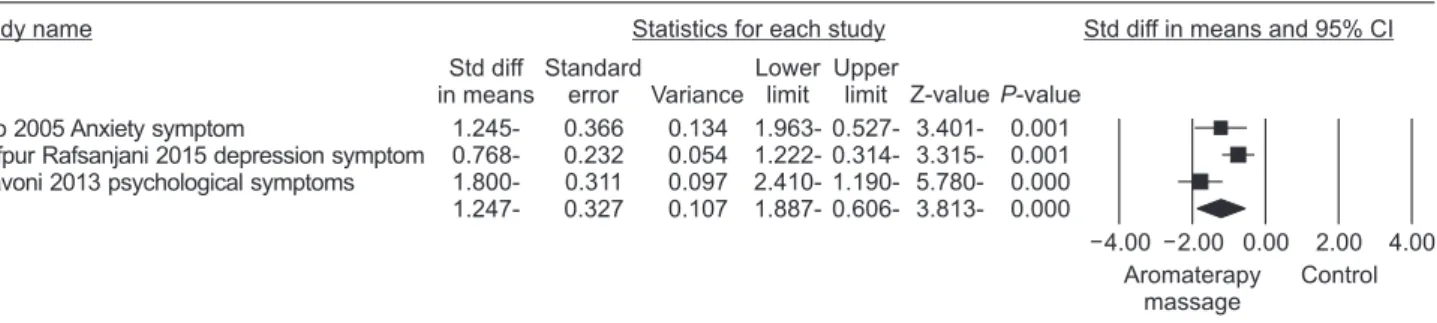
Figure 1 illustrates the selection process of studies to in- clude into the current systematic review. As shown, 4 tri- als were included finally into our systematic review. Table 1 shows the summary of profiles related to the include stud- ies. We found 3 trials16,19,20 matched with our objectives and also appropriately reported data to include in the meta- analysis. According to the searches, the aromatherapy mas- sage improved significantly the psychological symptoms in the menopausal and elderly women compared to the control group (SMD = -1.24; 95% confidence interval [CI], -0.188 to -0.606; P < 0.001; random effect model; 3 trials, moder- ate to high heterogeneity, I2 = 0.76; P = 0.028) (Fig. 2).
One trial21 had no appropriate data to include in the psy- chological aromatherapy meta-analysis. Therefore, we re- ported it as qualitative. Hur et al.21 assessed the effects of aromatherapy massage using mixture oil containing laven- der, rose geranium, rose and jasmine in almond and prim- rose oils on the nervousness using Kupperman Index. Fifty- two Korean climacteric women were divided into 2 groups of aromatherapy (n = 25) and untreated (n = 27). The aroma- therapy oil massage was no more effective than untreated group regarding nervousness. In addition, the comparison of results from pre- and posttreatmentwith aromatherapy oil showed no statistically significant difference between the 2 groups.
Discussion
To the best of our knowledge, this is the first meta- analysis evaluating the effect of aromatherapy on the psychological symptoms. The meta-analysis showed the aromatherapy massage improved significantly psychological symptoms in and elderly and menopausal women compared to control group.
Kim et al.22 recently conducted a meta-analysis to assess the effect of the aromatherapy on the psychological symp- toms of stress and depression among middle-aged females.
The mean difference of depression was significantly lower in the aromatherapy massage group (SMD = -4.24; 95% CI, -12.61 to 4.12; heterogeneity, I2 = 80% 2 trials) and inhala- Table 2. The quality assessment using Cochrane Collaboration’s tool
References Random sequence generation (selection bias)
Allocation concealment (selection bias)
Blinding participants and personnel (performance bias)
Blinding of outcome assessment (detection bias)
Incomplete outcome data
(attrition)
Selective
reporting Other biases
Rho et al.19 ?‡ -† - - +* + +
Lotfipur-Rafsanjani
et al.20 - - - ? + + +
Taavoni et al.16 - - - - + + +
Hur et al.21 - - - - + + ?
*+: low risk of bias
†-: high risk of bias
‡?: unclear risk of bias
Fig. 1. The process of selection of studies.
Relevant trial found in the search three data bases
n = 147
Trials assessed in detail n = 16
Number of trials included in the review systematic
n = 4 In the meta analysis
n = 3
131 studies exclude after reading titles and abstracts
12 trials were excluded because authors did not assess psychological
symptoms
Journal of Menopausal Medicine 2018;24:127-132 Masoudeh Babakhanian, et al. Aromatherapy and Psychological Symptoms
tion of aromatherapy group (SMD = -7.44, 95% CI, -10.87 to -4.01) compared to the control group these findings are consistent with our meta-analysis. The aromatherapy mas- sage can attenuate depression through improving the blood flow in the frontal cortex of the brain, stimulating the body soft tissues causing metabolic balance and enhancing a sense of caring and expressing love to the patient.19
There are some limitations in the present review that should be taken into account in the future research. The 4 studies included in systematic review only reported short- term effect of aromatherapy on the psychological symptoms, and long-term effects remain unknown. The emotional supports of the patients received from researcher dur- ing aromatherapy might influence the treatment response, which were not provided for the control group. The methods of allocation were inappropriate or clearly descriptive, hereby the emergence of possible bias. There is need for future tri- als with high-quality methodology, more clear explanation, blinding and reporting the intent-to treatment analysis.
Conclusion
The aromatherapy may be beneficial in improving the psychological symptoms among menopausal women. This finding should be observed in the light of mentioned limita- tions.
Conflict of Interest
No potential conflict of interest relevant to this article was reported.
References
1. Soares CN. Depression and menopause: Current knowledge and clinical recommendations for a critical window. Psychi- atr Clin North Am 2017; 40: 239-54.
2. Lipovac M, Chedraui P, Gruenhut C, Gocan A, Stammler M, Imhof M. Improvement of postmenopausal depressive and anxiety symptoms after treatment with isoflavones derived from red clover extracts. Maturitas 2010; 65: 258-61.
3. Ghazanfarpour M, Kaviani M, Abdolahian S, Bonakchi H, Najmabadi Khadijeh M, Naghavi M, et al. The relationship between women’s attitude towards menopause andmeno- pausal symptoms among postmenopausal women. Gynecol Endocrinol 2015; 31: 860-5.
4. Parsa P, Tabesh RA, Soltani F, Karami M. Effect of group counseling on quality of life among postmenopausal women in Hamadan, Iran. J Menopausal Med 2017; 23: 49-55.
5. Heidari M, Ghodusi M, Rafiei H. Sexual self-concept and its relationship to depression, stress and anxiety in post- menopausal women. J Menopausal Med 2017; 23: 42-8.
6. Kim TH, Lee HH. Alternative therapy trends among Korean postmenopausal women. J Menopausal Med 2016; 22: 4-5.
7. Enkhbold T, Jadambaa Z, Kim TH. Management of meno- pausal symptoms in Mongolia. J Menopausal Med 2016; 22:
55-8.
8. Soares CN, Almeida OP, Joffe H, Cohen LS. Efficacy of estradiol for the treatment of depressive disorders in peri- menopausal women: a double-blind, randomized, placebo- controlled trial. Arch Gen Psychiatry 2001; 58: 529-34.
Statistics for each study Study name
Rho 2005 Anxiety symptom
Lotfpur Rafsanjani 2015 depression symptom Taavoni 2013 psychological symptoms
Std diff in means and 95% CI
4.00 4.00
Aromaterapy massage
Control Std diff
in means 1.245- 0.768- 1.800- 1.247-
Standard error 0.366 0.232 0.311 0.327
Variance 0.134 0.054 0.097 0.107
Lower limit 1.963- 1.222- 2.410- 1.887-
Upper limit 0.527- 0.314- 1.190- 0.606-
Z-value 3.401- 3.315- 5.780- 3.813-
P-value 0.001 0.001 0.000 0.000
2.00 0.00 2.00
Meta Analysis
Fig. 2. Effect of the aromatherapy on the noted psychological symptoms, the horizontal lines denote the 95% confidence interval (CI), ■:
point estimate (size of the square corresponds to its weight), ♦: combined overall effect of intervention.
Journal of Menopausal Medicine 2018;24:127-132
J MM
9. Rudolph I, Palombo-Kinne E, Kirsch B, Mellinger U, Bre- itbarth H, Gräser T. Influence of a continuous combined HRT (2 mg estradiol valerate and 2 mg dienogest) on post- menopausal depression. Climacteric 2004; 7: 301-11.
10. Schmidt PJ, Nieman L, Danaceau MA, Tobin MB, Roca CA, Murphy JH, et al. Estrogen replacement in perimenopause- related depression: a preliminary report. Am J Obstet Gy- necol 2000; 183: 414-20.
11. Anderson GL, Limacher M, Assaf AR, Bassford T, Beres- ford SA, Black H, et al. Effects of conjugated equine es- trogen in postmenopausal women with hysterectomy: the Women’s Health Initiative randomized controlled trial.
JAMA 2004; 291: 1701-12.
12. Uzun S, Kozumplik O, Jakovljević M, Sedić B. Side effects of treatment with benzodiazepines. Psychiatr Danub 2010; 22:
90-3.
13. Culpepper L, Davidson JR, Dietrich AJ, Goodman WK, Kroenke K, Schwenk TL. Suicidality as a possible side ef- fect of antidepressant treatment. Prim Care Companion J Clin Psychiatry 2004; 6: 79-86.
14. Haberfellner EM. A review of the assessment of antide- pressant-induced sexual dysfunction used in randomized, controlled clinical trials. Pharmacopsychiatry 2007; 40:
173-82.
15. Fava M. Weight gain and antidepressants. J Clin Psychiatry 2000; 61 Suppl 11: 37-41.
16. Taavoni S, Darsareh F, Joolaee S, Haghani H. The effect of aromatherapy massage on the psychological symptoms
of postmenopausal Iranian women. Complement Ther Med 2013 21: 158-63.
17. Ghazanfarpour M, Sadeghi R, Roudsari RL. The application of soy isoflavones for subjective symptoms and objective signs of vaginal atrophy in menopause: A systematic review of randomised controlled trials. J Obstet Gynaecol 2016; 36:
160-71.
18. Abdi F, Ramezani Tehrani F, Mobedi H, Dolatian M, Mo- saffa N. Nanomedicine approaches for treatment of meno- pausal symptoms. J Menopausal Med 2016; 22: 127-8.
19. Rho KH, Han SH, Kim KS, Lee MS. Effects of aromather- apy massage on anxiety and self-esteem in korean elderly women: a pilot study. Int J Neurosci 2006; 116: 1447-55.
20. Lotfipur-Rafsanjani SM, Vaziri-Nejad R, Ismailzadeh S, Ansari-Jaberi A, Bekhradi R, Ravari A, et al. Compari- son of the efficacy of massage therapy and aromatherapy massage with geranium on depression in postmenopausal women: A clinical trial. Zahedan J Res Med Sci 2015; 15:
29-33.
21. Hur MH, Yang YS, Lee MS. Aromatherapy massage af- fects menopausal symptoms in korean climacteric women:
a pilot-controlled clinical trial. Evid Based Complement Al- ternat Med 2008; 5: 325-8.
22. Kim S, Song JA, Kim ME, Hur MH. Effects of aroma- therapy on menopausal symptoms, perceived stress and depression in middle-aged women: A systematic review. J Korean Acad Nurs 2016; 46: 619-29.