INTRODUCTION
Resilient lining materials are used on dental prostheses to absorb some of the energy produced by masticatory impact.1A soft liner would distribute the functional and parafunctional stress- es more evenly and thus have a dampening effect due to their elastic behavior, thus acting like a “shock absorber”.2,3 Because of their ability to restore health to inflamed and distorted mucosal tissues, soft liners are used in the manage- ment of frail and chronically irritated tissues, thin and non resilient mucosal tissues, etc.4,5Plasticized acrylic resins, silicones, vinyl resins, polyurethane and polyphosphazines have been tried as soft liners, of which the first two were selected for this study since they have a long term successful record of clinical application. One of the most common problems encountered with the soft liners is the failure of adhesion between the lin- er and the denture base.6-9Such adhesive failure creates an envi- ronment for potential bacterial growth and accelerated break- down of the soft liner.8Since failure of soft liner often results from breakdown of bond between liner and denture base,
measurement of bond strength is very important.10
Researchers have suggested various methods to improve bond strength, e.g. mechanical roughening by sandblasting or lasers, treatment with denture base monomer, etc.2,5,11The effect of roughening the surface of denture base on the bond strength of soft liner is controversial, e.g. Craig et al.11advo- cated a roughened surface to improve the adhesive bond whereas Amin et al.12reported that roughening the acrylic resin base by sandblasting before applying a lining material had a weakening effect on the bond. Jacobsen reported that laser treat- ment of denture base before liner application resulted in reduction of bond strength.5al-Athel et al. reported the effect of test methods on bond strengths of the liners.7Tensile bond strength (TBS) of sandblasted surface specimens decreased when compared with the smooth surface while the shear bond strength increased, implying that the bond strength will depend on the test method used.7 In case of testing shear strength; the frictional force was increased when the surface was roughened, since more force was required to push the ele- vation of one surface through the other as compared to
DOI:10.4047/jap.2011.3.1.16
The effect of denture base surface pretreatments on bond strengths of two long term resilient liners
Rahul Shyamrao Kulkarni*, BDS, MDS, Rambhau Parkhedkar, BDS, MDS
Department of Prosthodontics, Government Dental College & Hospital, Nagpur, Maharashtra, India
PURPOSE. Purpose of this study was to evaluate effect of two surface treatments, sandblasting and monomer treatment, on tensile bond strength between two long term resilient liners and poly (methyl methacrylate) denture base resin. MATERIALS AND METHODS. Two resilient liners Super-Soft and Molloplast-B were selected.Sixty acrylic resin (Trevalon) specimens with cross sectional area of 10×10 mm were prepared and divided into two groups of 30 specimens each. Each group was surface treated (n = 10) by sandblasting (250 μalumina particles), monomer treatment (for 180 sec) and control (no surface treatment). Resilient liners were processed between 2 poly(methyl methacrylate) surfaces, in the dimensions of 10×10×3 mm. Tensile strength was determined with Instron Universal testing machine, at a crosshead speed of 5 mm/min;
and the modes of failure (adhesive, cohesive or mixed) were recorded. The data were analyzed using one-way ANOVA, followed by Tukey HSD test (α= 0.05). RESULTS. Monomer pretreatment of acrylic resin produced significantly higher bond strengths when compared to sandblasting and control for both resilient liners (P < .001). Sandblasting significantly decreased the bond strength for both the liners when compared to monomer pretreatment and control (P < .001). Mean bond strength of Super-Soft lined specimens was significantly higher than Molloplast-B in various surface treatment groups (P < .05). CONCLUSION. Surface pretreatment of the acrylic resin with monomer prior to resilient liner application is an effective method to increase bond strength between the base and soft liner. Sandblasting, on the contrary, is not recommended as it weakens the bond between the two. [J Adv Prosthodont 2011;3:16-9]
16
ORIGINAL ARTICLE J Adv Prosthodont 2011;3:16-9
KEY WORDS. Resilient liners, Bond strength
Corresponding author: Rahul Shyamrao Kulkarni
Department of Prosthodontics, Government Dental College & Hospital, GMC Campus, Medical Square, Nagpur, Maharashtra, India. 440003.
Tel. + 919823874645: e-mail, [email protected]
Received January 15, 2011 / Last Revison January 31, 2011 / Accepted February 13, 2011
ⓒ 2011 The Korean Academy of Prosthodontics
This is an Open Access article distributed under the terms of the Creative Commons Attribution Non-Commercial License (http://creativecommons.org/licenses/by- nc/3.0) which permits unrestricted non-commercial use, distribution, and reproduction in any medium, provided the original work is properly cited.
smooth surface.7 When the soft liner was applied to the untreated surface, the friction between the two surfaces was reduced, and therefore, the failure was seen at a lower load.
Effect of liner thickness on tensile strength was studied by al- Athel et al.7A significant difference was noted in the TBS of specimens with 4.5 mm and 3 mm liner thickness. A positive correlation was reported between the tensile strength values and rate of deformation of specimens.7The tensile strength of lining material increased significantly with increasing rate of deformation to a limit of 40 mm/minute, beyond which the strength of the bond decreased. While information is available about mechanical surface roughening of denture base, there is paucity of information about the chemical treatment, partic- ularly with denture base monomer. This study was undertaken to evaluate the effect of sandblasting and monomer pretreat- ment of denture base resin (Trevalon) on TBS of two long term resilient liners viz. Super-Soft, and Molloplast-B.
MATERIALS AND METHODS
A heat activated poly (methyl methacrylate) (PMMA) resin (Trevalon, Dentsply India Pvt. Ltd., Gurgaon, India); and two resilient liners, Super-Soft (GC America Inc, IL, USA) and Molloplast-B (Detax GmbH & Co, Germany) were used.
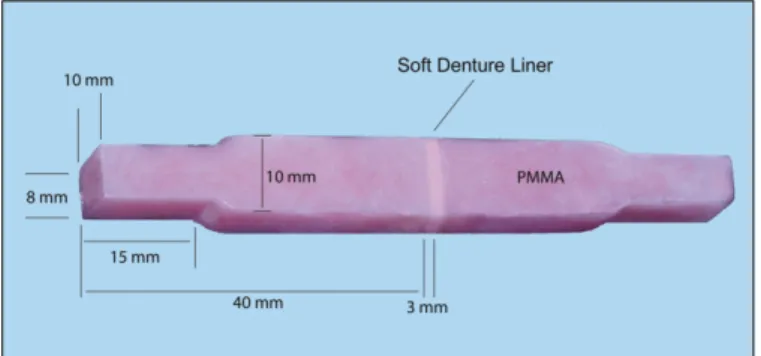
Super-Soft is a long term acrylic based resilient liner and chem- ically binds to acrylic denture base owing to similar chemistry whereas Molloplast-B is silicone based liner. A total of 60 PMMA resin specimens with cross sectional area of 10×10 mm were prepared from 120 blocks of acrylic resin (two acrylic resin blocks were required to form one specimen). The dimensions of specimen were such that they could be produced in conventional denture flasks and gripped easily in the Instron machine (Fig. 1), as described in a previous study.8To standardize fabrication of specimens, six equal sized brass dies were prepared and utilized to fabricate a silicone rubber mold (MP Sai Enterprises, Mumbai, India). Wax blocks of equal size were prepared in mold, invested in dental stone in a denture-processing flask, followed by de-waxing, and pack- ing of mold cavity with resin. After curing, blocks were
retrieved from the flask and smoothed on 240 grit aluminum oxide paper.10They were randomly divided into 2 groups, each group containing 60 blocks (to fabricate 30 specimens per group), which were followed by their surface treatment as follows. Ten specimens in each group acted as control, i.e. the surfaces were left untreated. Ten specimens from each group were treated by sandblasting; the nozzle measuring about 1.0 mm in diameter was held in light contact with each specimen, for 30 seconds.5 Aluminum oxide particles measuring about 250 μm was used as the sandblasting medium at a pressure of 0.62 MPa.5Ten sam- ples, for each liner to be tested, were swabbed with the monomer of the denture base resin (Trevalon) for 180 sec.2To prepare one Super-Soft lined specimen, two acrylic resin blocks, separated by a brass spacer of dimension 10×10×3 mm (to standardize the thickness of liner), were invested in a dental flask.8 The spacer was removed once flasking was over.5 Super-Soft was mixed according to manufacturer’s instructions, packed into the space created by brass spacer, and curing was done. After curing, the flask was brought to room temperature, samples were retrieved, and excess liner was removed with a sharp scalpel.2 Molloplast-B lined speci- mens were fabricated similarly, except that Primo (Detax GmbH & Co, Germany) adhesive was applied uniformly on surfaces to be bonded and allowed to dry for 60 minutes. The specimens were subjected to the tensile stress on an Instron uni- versal testing machine (Instron-4467, Instron Corporation, UK) and deformed using a cross head speed of 5 mm per minute.7,13 The load at which failure occurred was recorded, together with the type of failure. Failure mode was recorded optically14 (Stereomicroscope SV8, Carl Zeiss, Oberkochen, Germany) although it can be recorded visually15or by Scanning Electron Microscope.10 The maximum tensile stress before failure divided by cross sectional area of interface produced the tensile strength value for the specimen. Regarding modes of failure, adhesive failure refers to total failure occurred at the denture base soft liner interface; cohesive failure refers to tear within the liner, and mixed failure refers to both.7Mean, standard deviation and coefficient of variation were determined for all groups. Results for each group (Super-Soft and Molloplast-B) were tested by one-way ANOVA to measure the variation between the three subgroups, i.e. control, sand- blasting, and monomer; followed by Tukey HSD test. The sur- face treatment groups of the Super-Soft and Molloplast-B were compared using unpaired t-test.
RESULTS
Means and standard deviations for Super-Soft are reported in Table 1; maximum mean TBS was observed with monomer treated group (4.025±0.616 MPa). These values are in agree- ment with those obtained by Kawano et al.,14and Emmer et al.3 One-way ANOVA (Table 2) revealed significant differences
17
The effect of denture base surface pretreatments on bond strengths of two long term resilient liners
J Adv Prosthodont 2011;3:16-9
Kulkarni RS et al.
Fig. 1. Acrylic resin specimen lined with 3 mm thickness of resilient liner.
among surface treatment groups of Super-Soft (P < .001).
Maximum mean TBS of Molloplast-B was observed in monomer treated group (2.570±0.361 MPa) (Table 1). One- way ANOVA (Table 2) revealed significant differences among various surface treatment groups for Molloplast-B (P < .001).
Mean TBS of Super-Soft in various surface treatment groups (Table 1) was significantly higher (P < .05) than Molloplast- B. The modes of failure (observed together for both liners) were predominantly of mixed type in control category (60%).
Adhesive modes were maximum (75%) in sandblast treated spec- imens, while cohesive failures were reported in 70% of monomer treated specimens (Fig. 2).
DISCUSSION
This study was planned to evaluate the effect of mechanical and chemical surface treatments on TBS between two resilient
liners and PMMA resin. The tests developed by numerous inves- tigators include peel test,5,7,15,16tensile test,3,7,10,14-16and shear test7,15; amongst these peel test closely simulates the intraoral forces encountered at the soft liner-denture base junction.14However, during actual testing, forces will not be applied directly at the liner acrylic resin interface because direct gripping of the soft liner in the peel test may damage the integrity at the gripped region.14In this study, tensile test was performed because it gives information on strength of bond in comparison to tensile strength of the materials and also because tensile properties are regarded as a general guide to the quality of rubbers.9,12 Fowler and Cantor et al. pointed out that, tensile failure was not caused by tensile forces alone as some shear forces devel- oped because of the high Poisson’s ratio of silicone lining mate- rials.15Khan et al. reported that soft denture liners should have a minimum of 0.44 MPa (4.5 kg/cm2) bond strength to be accept- able for clinical use.17
The surface treatment of denture base by monomer enhanced bond strength of both the liners. Super-Soft forms a strong bond with acrylic resin, even without a bonding agent as both have a similar composition.14Molloplast-B, being a silicone based liner, requires an adhesive MMA,5a solvent that dissolves the PMMA surface, and the bond strength of silicone liners will depend on tensile strength of the materials and the adhesive used.18 Therefore, using monomer and adhesive together prior to the resilient liner application may effectively increase the dissolution of the PMMA surface. It enables added fluid to pen- etrate between polymer chains and become entangled when the added monomer or solvent is evaporated.6Sandblasting result- ed in reduction of bond strength of both materials. Theoretically, sandblasting increases surface area and provides mechanical locks at bond site and should result in stronger bonds.
According to Amin et al.,12lower bond strengths were due to stresses that occurred at the interface of the PMMA and soft liner. Jacobsen et al.5have considered the ability of soft lin- ing material to penetrate into the irregularities of the PMMA.
18
The effect of denture base surface pretreatments on bond strengths of two long term resilient liners
J Adv Prosthodont 2011;3:16-9 Kulkarni RS et al.
Table 1. Means and standard deviations for Super-Soft & Molloplast-B and comparison of their surface treatment groups
Groups Material N Mean (MPa) SD P* value
Control Super-Soft 10 2.622 0.223 .000
Molloplast-B 10 1.587 0.207
Sandblasting Super-Soft 10 1.313 0.424 .013
Molloplast-B 10 0.998 0.239
Monomer pretreatment Super-Soft 10 4.025 0.616 .000
Molloplast-B 10 2.570 0.361
*P < .05 - significant.
Table 2. Result of one-way ANOVA for tensile strength between various surface treatment groups of Super-Soft & Molloplast-B
Resilient liner Source of variation Sum of squares df Mean square F P value
Super-Soft Between Groups 36.791 2 18.396
90.329 < .001
Within Groups 5.498 27 0.203
Molloplast-B Between Groups 12.612 2 6.306
81.785 < .001
Within Groups 2.0819 27 0.077
Fig. 2. Displays mixed type of failure were more predominant (60%) in control group while adhesive modes were maximum (75%) in sandblasting group. In monomer group, cohesive failures were 70%.
The penetration coefficient for liquids into a space is given by:
PC = γcos θ/2η
Where γ= surface tension, θ= contact angle, η= viscosity.
If this logic is applied to penetration of liners into the irreg- ularities produced by sandblasting, increasing the viscosity of resilient liners for a given contact angle and surface tension reduces the penetration of the liner.5This could explain the low- er tensile strengths of sandblasted specimens observed in the study.
The bond failures were classified according to the criteria giv- en by al-Athel et al.7as adhesive, cohesive and mixed, and were considered together for both materials. Adhesive failures occurred when tensile strength of the soft liner was greater than its bond strength to PMMA14and were mainly exhibited by sand- blasted specimens. Cohesive failures occurred when tensile strength of the soft liner was less than bond strength and were mainly exhibited by monomer treated specimens. Control group mainly showed mixed type of failure indicating that the bond strength of the liner was nearly equal to the tensile strength of the liner. Results of this testing must be interpreted with caution as there are numerous factors which affect test results e.g. liner thickness, duration of application of monomer, strain rate, test methods, etc.2,7,19
This study may serve as a benchmark for the study of new resilient liners. Water sorption may also affect bond strength and further investigation is required to determine the influence of this factor.3,10 This study was entirely laboratory based and because the most appropriate testing environment is the mouth, long-term clinical studies of these materials are required.
CONCLUSION
Within the limitations of this in-vitro study, the following con- clusions were drawn:
1. Monomer pretreatment of the resin surface produced higher bond strengths (P < .001), whereas sandblasting reduced the bond strength between the two liners and PMMA resin (P < .001).
2. Mean bond strength of Super-Soft was significantly (P <
.05) higher than Molloplast-B in various surface treatment groups; although all subgroups tested had mean bond strength values greater than the minimum acceptable standard (0.44 MPa)17for clinical application.
3. Mixed type of failures were more predominant in control specimens (60%), while adhesive modes were maxi- mum (75%) in sandblasted specimens. In monomer treat- ed specimens, 70% of failures were cohesive in nature.
REFERENCES
1. Anusavice KJ. Phillips' science of dental materials. 11th ed.
Saunders; Elsevier; 2003. p. 750-1.
2. Sarac D, Sarac YS, Basoglu T, Yapici O, Yuzbasioglu E. The evaluation of microleakage and bond strength of a silicone-based resilient liner following denture base surface pretreatment. J Prosthet Dent 2006;95:143-51.
3. Emmer TJ Jr, Emmer TJ Sr, Vaidynathan J, Vaidynathan TK.
Bond strength of permanent soft denture liners bonded to the den- ture base. J Prosthet Dent 1995;74:595-601.
4. El-Hadary A, Drummond JL. Comparative study of water sorption, solubility, and tensile bond strength of two soft lining materials. J Prosthet Dent 2000;83:356-61.
5. Jacobsen NL, Mitchell DL, Johnson DL, Holt RA. Lased and sand- blasted denture base surface preparations affecting resilient liner bonding. J Prosthet Dent 1997;78:153-8.
6. Saraç YS, Bas¸oğlu T, Ceylan GK, Saraç D, Yapici O. Effect of denture base surface pretreatment on microleakage of a silicone- based resilient liner. J Prosthet Dent 2004;92:283-7.
7. al-Athel MS, Jagger RG. Effect of test method on the bond strength of a silicone resilient denture lining material. J Prosthet Dent 1996;76:535-40.
8. Kawano F, Dootz ER, Koran A 3rd, Craig RG. Comparison of bond strength of six soft denture liners to denture base resin. J Prosthet Dent 1992;68:368-71.
9. Bates JF, Smith DC. Evaluation of indirect resilient liners for den- tures: Laboratory and clinical tests. J Am Dent Assoc 1965;70:344- 53.
10. Kulak-Ozkan Y, Sertgoz A, Gedik H. Effect of thermocycling on tensile bond strength of six silicone-based, resilient denture liners. J Prosthet Dent 2003;89:303-10.
11. Craig RG, Gibbons P. Properties of resilient denture liners. J Am Dent Assoc 1961;63:382-90.
12. Amin WM, Fletcher AM, Ritchie GM. The nature of the interface between polymethyl methacrylate denture base materials and soft lining materials. J Dent 1981;9:336-46.
13. Brown D. Resilient soft liners and tissue conditioners. Br Dent J 1988;164:357-60.
14. Kawano F, Dootz ER, Koran A 3rd, Craig RG. Bond strength of six soft denture liners processed against polymerized and un- polymerized poly(methyl methacrylate). Int J Prosthodont 1997;10:178-82.
15. Al-Athel MS, Jagger RG, Jerolimov V. Bone strength of resilient lining materials to various denture base resins. Int J Prosthodont 1996;9:167-70.
16. Kutay O. Comparison of tensile and peel bond strengths of re- silient liners. J Prosthet Dent 1994;71:525-31.
17. Khan Z, Martin J, Collard S. Adhesion characteristics of visible light-cured denture base material bonded to resilient lining materials. J Prosthet Dent 1989;62:196-200.
18. Dootz ER, Koran A, Craig RG. Physical property comparison of 11 soft denture lining materials as a function of accelerated aging. J Prosthet Dent 1993;69:114-9.
19. Vallittu PK, Lassila VP, Lappalainen R. Wetting the repair surface with methyl methacrylate affects the transverse strength of repaired heat-polymerized resin. J Prosthet Dent 1994;72:639- 43.
19
The effect of denture base surface pretreatments on bond strengths of two long term resilient liners
J Adv Prosthodont 2011;3:16-9
Kulkarni RS et al.