• 검색 결과가 없습니다.

Management of Patients with Traumatic Rupture of the Diaphragm Sang-Won Hwang, M.D.*, Han-Yong Kim, M.D.*, Jung Hun Byun, M.D.*

N/A
N/A
Protected

Academic year: 2021

Share "Management of Patients with Traumatic Rupture of the Diaphragm Sang-Won Hwang, M.D.*, Han-Yong Kim, M.D.*, Jung Hun Byun, M.D.*"

Copied!
7
0
0

로드 중.... (전체 텍스트 보기)

전체 글

(1)

http://dx.doi.org/10.5090/kjtcs.2011.44.5.348 ISSN: 2233-601X (Print) ISSN: 2093-6516 (Online)

*Department of Thoracic and Cardiovascular Surgery, Samsung Changwon Hospital, Sungkyunkwan University, School of Medicine Received: June 9, 2011, Revised: July 11, 2011, Accepted: August 24, 2011

Corresponding author: Han-Yong Kim, Department of Thoracic and Cardiovascular Surgery, Samsung Changwon Hospital, Sungkyunkwan University School of Medicine, 50, Hapseong-dong, Masanhoewon-gu, Changwon 630-723, Korea

(Tel) 82-55-290-6021 (Fax) 82-55-290-6785 (E-mail) [email protected]

C

The Korean Society for Thoracic and Cardiovascular Surgery. 2011. All right reserved.

CC
This is an open access article distributed under the terms of the Creative Commons Attribution Non-Commercial License (http://creative- commons.org/licenses/by-nc/3.0) which permits unrestricted non-commercial use, distribution, and reproduction in any medium, provided the original work is properly cited.

Management of Patients with Traumatic Rupture of the Diaphragm

Sang-Won Hwang, M.D.*, Han-Yong Kim, M.D.*, Jung Hun Byun, M.D.*

Background: Traumatic rupture of the diaphragm is an unusual type of trauma. In addition, it is difficult to diag- nose because it can be accompanied by injuries to other organs. If it is not detected early, the mortality rate can increase due to serious complications. Diaphragmatic rupture is an important indicator of the severity of the trauma.

The aim of this study was to investigate the factors affecting the incidence of complications and mortality in pa- tients who had surgery to treat traumatic rupture of the diaphragm. Materials and Methods: The subjects were patients who had undergone a diaphragmatic rupture by blunt trauma or stab wounds except patients who were transferred to other hospitals within 3 days of hospitalization, from January 2000 to December 2007. This study was a retrospective study. 43 patients were hospitalized, and 40 patients were included during the study period.

Among them, 28 were male, 12 were female, and the average age was 42 (from 18 to 80). Outcome predictive factors including hypoxia, ventilator application days, revised trauma score (RTS), injury severity score (ISS), age, herniated organs, complications, and the mortality rate were investigated. Results: Causes of trauma included motor vehicle crashes for 20 patients (50%), falls for 10 (25%), stab wounds for 8 (20%), and agricultural machinery ac- cidents for 2 (5%). Most of the patients (36 patients; 90%) had wound sites on the left. Diagnosis was performed within 12 hours for most patients. The diaphragmatic rupture was diagnosed preoperatively in 27 patients (70%) and in 12 patients (30%) during other surgeries. For surgical treatment, thoracotomy was performed in 14 patients (35%), laparotomy in 11 (27.5%), and a surgery combining thoracotomy and laparotomy in 15 patients (37.5%).

Herniated organs in the thoracic cavity included the stomach for 23 patients (57.5%), the omentum for 15 patients (37.5%), the colon for 10 patients (25%), and the spleen for 6 patients (15%). Accompanying surgeries included splenectomy for 13 patients (32.5%), lung suture for 6 patients (15%), and liver suture for 5 patients (12.5%). The average hospital stay was 47.80±56.72 days, and the period of ventilation was 3.90±5.8 days. The average ISS was 35.90±16.81 (11∼75), and the average RTS was 6.46±1.88 (1.02∼7.84). The mortality rate was 17.5% (7 patients). Factors affecting complications were stomach hernia and age. Factors affecting the mortality rate were ISS and RTS. Conclusion: There are no typical symptoms of the traumatic rupture of the diaphragm by blunt trauma. Nor are there any special methods of diagnosis; in fact, it is difficult to diagnose because it accompanies injuries to other organs. Stab wounds are also not easy to diagnose, though they are relatively easy to diagnose compared to blunt trauma because the accompanying injuries are more limited. Suture of the diaphragm can be performed through the chest, the abdomen, or the thoracoabdomen. These surgical methods are chosen based on accompanying organ injuries. When there are many organ injuries, there are a great number of complications.

Significant factors affecting the complication rate were stomach hernia and age. ISS and RTS were significant as

factors affecting the mortality rate. In the case of severe trauma such as pelvic fractures, frequent physical exami-

nations and chest X-rays are necessary to confirm traumatic rupture of the diaphragm because it does not have

specific symptoms, and there are no clear diagnosis methods. Complications and the mortality rate should be re-

duced with early diagnosis and with treatment by confirming diaphragmatic rupture in the thoracic cavity and the

(2)

abdomen during surgery.

Key words: 1. Diaphragm 2. Trauma 3. Thoracotomy 4. Rupture

INTRODUCTION

The diaphragm is an important muscle for respiration.

Functional damage of the diaphragm is caused by dia- phragmatic rupture. Moreover, respiratory distress occurs by atelectasis and mediastinal displacement, which are caused by the herniation of intraperitoneal organs into the intrathoracic cavity. However, diaphragmatic rupture by blunt wounds is difficult to diagnose because of unstable vital signs in the ER, and it accompanies other injuries in the chest, abdomen, and extremities. There are few cases of stab wounds by fire- arm accidents in Korea. Instead, stab wounds by knives or sharp objects are frequent, and the accompanying injuries to other organs are limited to the chest and the abdomen. Thus, a straightforward diagnosis can be performed. Diaphragmatic rupture is diagnosed by chest X-ray, computed tomography (CT), abdominal angiography, and ultrasound. However, the diagnosis is not easy because its specificity and sensitivity are low. Shah et al. [1] reported that 43.5% cases of dia- phragmatic rupture were diagnosed presurgically, 41.4% dur- ing surgery or autopsy, and 14.6% postsurgically. It is re- ported that 77∼95% of cases of diaphragmatic rupture were caused by blunt wounds, and 12.3% were caused by stab wounds [2]. Another study showed that the morbidity of dia- phragmatic rupture was low, at 0.8∼1.6%, though it has been concluded that the morbidity rate is likely higher than reported statistics because it is difficult to compile accurate statistics on diaphragmatic rupture by chest radiographs and other findings [3]. Diaphragmatic rupture by blunt wounds is an indicator of the severity of injury because it generally ac- companies injuries to other organs. To treat diaphragmatic rupture in the early stage, the diaphragm is sutured, and the accompanying injuries in other organs are treated by lapa- rotomy, thoracotomy, or a combination of laparotomy and

thoracotomy. However, thoracotomy is recommended when late-stage diagnosis is performed. Thus, this study inves- tigated the factors affecting the complications of and mortal- ity rate from diaphragmatic rupture by blunt trauma and stab wounds.

MATERIALS AND METHODS

In this study, 40 out of 43 patients who underwent surgery for the traumatic rupture of the diaphragm between January 2000 and December 2007 in the Thoracic Surgery Depart- ment of Samsung Changwon Medical Center of Sungkyun- kwan University were included. The 3 patients during that period who were transferred to other hospitals within 3 days of hospitalization were excluded. This study was a retro- spective study.

To investigate factors affecting the complication and mor- tality rates, initial medical records of the Emergency Medical Center, simple chest X-rays, and chest computed tomography findings were reviewed to obtain the following information:

sex, age, causes of trauma, locations of trauma, hemopneumo- thorax, intrathoracic injuries such as stab wounds to the lung, injuries to the abdominal organs, herniated organs, accom- panying injuries to other organs, periods of ICU stay, number of ventilator application days, hospitalization days, injury se- verity score (ISS), revised trauma score (RTS), complications, and mortality rate.

All patients were hospitalized through the Emergency

Medical Center. Chest CT and abdominal ultrasound were

performed for diagnosis after stabilizing the patients’ vital

signs with the following treatments: administration of fluids,

blood transfusion, and vasopressors; ventilation; and insertion

of intubation and a chest tube. A physical examination, sim-

ple chest X-ray, chest CT, and abdominal ultrasound were

(3)

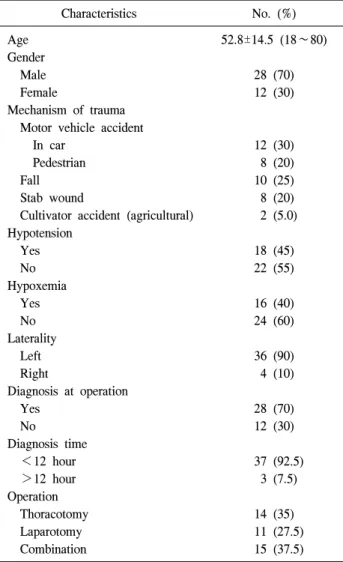
Table 1. Clinical characteristics of patients with traumatic dia- phragmatic rupture

Characteristics No. (%)

Age Gender Male Female

Mechanism of trauma Motor vehicle accident In car

Pedestrian Fall Stab wound

Cultivator accident (agricultural) Hypotension

Yes No Hypoxemia Yes No Laterality Left Right

Diagnosis at operation Yes

No

Diagnosis time <12 hour >12 hour Operation Thoracotomy Laparotomy Combination

52.8±14.5 (18∼80)

28 (70) 12 (30)

12 (30) 8 (20) 10 (25) 8 (20) 2 (5.0)

18 (45) 22 (55)

16 (40) 24 (60)

36 (90) 4 (10)

28 (70) 12 (30)

37 (92.5) 3 (7.5)

14 (35) 11 (27.5) 15 (37.5) performed in patients who had stable vital signs. If dia-

phragm rupture was diagnosed, thoracotomy and laparotomy were performed based on intrathoracic and abdominal injuries. The diaphragm was restored by simple interrupted suture or double layer suture methods with nonabsorbable su- ture materials. Intubation was removed when patients had res- piration without assistance and stable vital signs after surgery.

However, patients who had weak self respiration and unstable vital signs had ventilators applied in the ICU. Outpatient fol- low-up was performed within 3 months for most patients.

However, long-term follow up was not observed because of the characteristics of trauma treatment.

The chi-square test was used for categorical variables, and the Mann-Whitney test was used for continuous variables in univariate analysis. Multiple logistic regression analysis was performed in multivariate analysis. All data are shown as means±standard deviation. p<0.05 was considered statisti- cally significant. Data analysis was performed by SPSS 12.0K for Windows

.

RESULTS

Patients were aged 18 to 90; the average age was 42.0±14.5. Among them, 28 (27%) were male and 12 (30%) were female. Causes of the diaphragmatic rupture were most- ly motor vehicle crashes, with 20 cases (50%); falls during work, with 10 cases (25%); stab wounds, with 8 cases (20%);

and tractor accidents in agricultural areas, with 2 cases (5%).

Most cases (n=36; 90%) of diaphragmatic rupture were lo- cated on the left side. There were 18 (45%) hypotension cas- es by other accompanying organ injuries, and 16 (40%) hypo- xia cases by diaphragmatic rupture, atelectasis, or lung injury.

37 cases (92.5%) were diagnosed within 12 hours, 2 cases within 24 hours, and one case within 72 hours. 28 cases (70%) were diagnosed presurgically, and the other cases were found during other surgeries for hemothorax, hemoper- itoneum, etc. As for surgical methods, thoracotomy (n=14;

35%) and laparotomy (n=11; 27.5%) were performed , and these methods were chosen based on the type of organ injury (Table 1). The diaphragm was restored by a simple inter- rupted suture and double layer suture with nonabsorbable su- ture materials. Herniation of organs in the intra-abdominal

cavity mostly occurred in left side injuries. The herniated or- gans were the stomach in 23 cases (57.5%), omentum in 15 cases (37.5%), colon in 10 cases (25%), spleen in 6 cases (15%), and liver in 5 cases (12.5%). Accompanying surgeries were splenectomy in 13 cases (43.5%), lung suture in 6 cases (15%), liver suture in 5 cases (12.5%), nephrectomy in 4 cas- es (10%), and omentoplasty in 4 cases (10%).

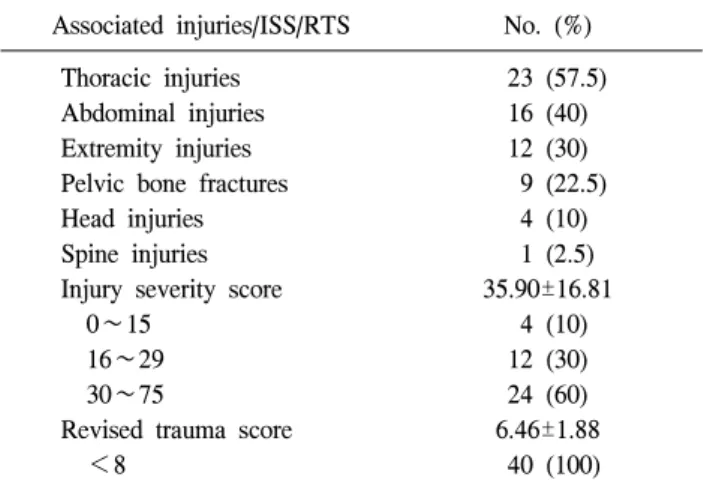
Accompanying injuries in other organs were hemopneumo-

thorax in 23 cases (57.5%), abdominal injuries including he-

moperitoneum and retroperitoneal hematoma in 16 cases

(40%), and extremity injuries including femoral fractures and

scapular fractures in 12 cases (30%). An ISS score, represent-

ing the severity of trauma, of over 16 was assigned to 36 of

(4)

Table 2. Associated injuries, injury severity scores (ISS), and re- vised trauma scores (RTS)

Associated injuries/ISS/RTS No. (%) Thoracic injuries

Abdominal injuries Extremity injuries Pelvic bone fractures Head injuries Spine injuries Injury severity score 0∼15

16∼29 30∼75

Revised trauma score <8

23 (57.5) 16 (40) 12 (30) 9 (22.5)

4 (10) 1 (2.5) 35.90±16.81

4 (10) 12 (30) 24 (60) 6.46±1.88 40 (100)

Table 3. Complications and outcomes in the management of dia- phragmatic rupture

Complications No. (%)

Pulmonary Pleural effusion Pneumonia ARDS Empyema Atelectasis

Non-pulmonary complications Ileus

Wound infection DIC

Compartment syndrome Gastrointestinal bleeding Arrhythmia

Delirium Outcomes Hospital days ICU days Ventilator days Operation time Deaths

5 (12.5) 2 (5.0) 3 (7.5) 1 (2.5) 1 (2.5)

4 (10) 4 (10) 3 (7.5) 2 (5.0) 1 (2.5) 1 (2.5) 1 (2.5)

47.80±56.72 (2∼255) 11.90±15.23 (1∼71) 3.90±5.83 (0∼25)

186.35±91.56 7 (17.5%) ARDS=Acute respiratory distress syndrome; DIC=Disseminate intravascular coagulation; ICU=Intensive care unit.

Table 4. Factors for complications

Factor p-value

Age ISS RTS Hospital days ICUt days Ventilator days Diagnosis time Transfusion Operation time Stomach herniation Rupture size

<0.05 NS NS NS NS NS NS NS NS

<0.05 NS

ISS=Injury severity score; RTS=Revised trauma score; ICU=

Intensive care unit.

Table 5. Factors associated with mortality

Factor p-value

GE ISS RTS Hospital days ICUt days Ventilator days Diagnosis time Transfusion Operation time Stomach herniation Rupture size

NS

<0.05

<0.05 NS NS NS NS NS NS NS NS

ISS=Injury severity score; RTS=Revised trauma score; ICU=

Intensive care unit.

the cases (90%), and the RTS score, representing indicators of severity, was under 8 in all 40 cases (Table 2). The aver- age length of hospitalization was relatively long, at 47.80±

56.72 days (2∼255 days) for the following reasons: ex- tensive accompanying injuries in other organs, a long period

of insertion of the chest tube due to an extended period need-

ed for drainage of the pleural fluid, delayed recovery because

of poor oral feeding due to abdominal complications, and an

extended rehabilitation period due to extremity fractures. The

average ICU stay was 11.90±15.233 days (1∼71 days). In

24 (60%) cases, ventilation was applied for respiratory failure

or unstable vital signs, and the average application period

was 3.90±5.83 days (0∼25 days). Complications were div-

ided into thoracic related complications and non-thoracic

complications. Thoracic related complications were pleural ef-

fusion in 5 cases (12.5%), and other complications were

pneumonia and acute respiratory failure. Non-thoracic compli-

cations included 4 cases (10%) of paralytic ileus and 4 cases

(5)

(10%) of wound infection; however, most cases were treated conservatively. The mortality rate was high, at 17.5% (7 cas- es). Causes of death were respiratory failure in 3 cases (5.7%), hypovolemic shock in 2 cases (5%), and multiple or- gan failure in 2 cases (5%) (Table 3).

Stomach hernia and age were the factors affecting the pres- ence of complications that were statistically significant (p<

0.05) (Table 4). ISS and RTS were the factors affecting the mortality rate that were statistically significant (p<0.05) (Table 5).

DISCUSSION

The diaphragm plays an important role in separating the chest from the abdomen, and it is also an essential muscle for breathing. Thus, careful observation is necessary, because diaphragmatic rupture affects the chest and the abdomen, and this can have serious results. Diaphragmatic rupture is caused by blunt trauma in 0.8∼7% of cases and stab wounds in 10∼

15% of cases [4], while 90% of cases occur on the left side [5]. Desforges et al. [6] reported that the reasons for such a high percentage of diaphragmatic rupture cases on the left side were the following: the liver buffered external forces ap- plied to the abdomen or flank and delivered to the diaphragm through the intra-abdominal organs, the diaphragm is natu- rally stronger on the right side than on the left side, and the detection of diaphragmatic rupture on the right side is more difficult than detection on the left side. In this study, the dia- phragmatic rupture was on the left side in 90% of the cases.

Rupture of the diaphragm often occurs in young people who participate in many social activities. The most frequent cause is a motor vehicle crash (86% of which are car accidents, 11% of which are pedestrian accidents, and 3% of which are motorcycle accidents), while other causes of blunt trauma are falls and assault [7]. Stab wounds are caused by firearm acci- dents, knives, and sharp objects. Although there are no spe- cific symptoms leading directly to the diagnosis of dia- phragmatic rupture, there are symptoms that indicate the pos- sibility, such as abdominal pain, shortness of breath, chest pain, and hematuria. Signs of diaphragmatic rupture can also include abdominal tenderness and decreased breathing sounds [8]. Accompanying injuries to other organs occurred in 94%

of cases, including 72∼79% of cases with intra-abdominal injuries and 81% with extra-abdominal injuries. Pelvic frac- ture was the most frequent accompany injury. Injuries to the liver and spleen were frequent intra-abdominal injuries, and extra-abdominal injuries included injuries to the bladder, ribs, lung, brain, intestines, kidney, and major vessels [9]. Diagno- sis methods include plan chest roentgenogram, CT-scan, mag- netic resonance imaging, gastrointestinal contrast studies, ul- trasound, fluoroscopy, thoracoscopy, and laparoscopy. Howev- er, there are no methods with high sensitivity or specificity.

So far, there is no gold-standard diagnostic test. Plan CXR is a useful method for diagnosing diaphragmatic rupture, and its sensitivity for diaphragmatic rupture with herniation is over 94% and without herniation is 30∼60% [10]. To diagnose diaphragmatic rupture by CXR, pictures are taken at 6-hour intervals with or without dye after insertion of a nasogastric tube [11]. Specificity for diaphragmatic rupture by CT is high in patients with blunt wounds; specificity and sensitivity are increased by helical CT in particular [12]. Specificity and sensitivity for diaphragmatic rupture by thoracoscopy are al- most 100%, and thoracoscopy is used for restoration of the diaphragm as well. However, it can only be used in patients with stable vital signs [13]. In this study, thoracoscopy was used in 2 cases. Operation time was long because the visual field was too narrow, and the surgeon’s experience using thoracoscopy was limited. However, the outcome of thoraco- scopy should improve with repeated trials. We plan to use thoracoscopy in the future in patients with stable vital signs.

Diaphragmatic rupture is found during 27.2% of emergency operations for hemothorax or hemoperitonium without enough time for preoperative tests because of patients’ unstable vital signs [14]. In this study, the diaphragmatic rupture was not diagnosed, even though it was suspected, in 30% of patients (12 cases). The diaphragm was restored during emergency surgery for other organ injuries. Diaphragmatic rupture should be suspected in patients with other organ injuries because there are no specific symptoms or diagnostic methods.

Surgery is necessary for treatment, and an immediate oper-

ation is needed if it is diagnosed in the early stage. The sur-

gery can be performed through the chest, abdomen, or thor-

acoabdomen, and the priority of the surgery is decided based

on the urgency of pathologic processes. The left side of the

(6)

diaphragm is restored easily in laparotomy with severe ab- dominal injuries. However, additional thoracotomy may be needed because injuries on the right side could be hidden by the liver [15]. Thoracotomy is recommended over laparotomy to restore the diaphragm in the late stage [16]. In this study, surgical methods were chosen by the severity of the thoracic or abdominal injuries, and the choice of method was similar in cases of thoracotomy and laparotomy. Surgeries through the thoracoabdomen were mostly performed to treat organ in- juries in the chest and abdomen. Nonabsorbable surgical su- ture materials were used to restore the diaphragm. However, absorbable surgical suture materials were sometimes used [16]. The diaphragm was restored by simple interrupted su- ture or double layer suture with nonabsorbable surgical suture.

Post operative complications were found in 11∼62.9% of cases, and the most frequent complications were lung-related.

It is known that significant factors for the occurrence of com- plications are the severity of injuries, accompanying injuries, hemodynamic status during hospitalized stays, and diagnosis time [17]. In this study, age and stomach hernia were sig- nificant factors for the occurrence of complications. The mor- tality rate from diaphragmatic rupture varies from 1% to 28%, and the mortality rate from accompanying injuries is higher than from the diaphragmatic rupture itself. Factors ex- pected to increase the mortality rate are the following: age over 55, major comorbid illness, and the number and severity of associated injuries to major body systems along with cen- tral nervous, cardiovascular, and intra-abdominal injuries. In this study, the statistically significant factors affecting the mortality rate were ISS and RTS.

CONCLUSION

Diaphragmatic rupture is likely to occur more often than the statistical data reflects because there are no typical symp- toms of it, no specific methods for diagnosis, and many cases are not detected. Diaphragmatic rupture occurs most often in young people who have high social activity, and it has in- creased with the increasing rate of motor vehicle crashes.

Most injuries occur by blunt wounds and are found on the left side. Early diagnosis is most important, but evaluations

of diaphragmatic rupture are not easy because diaphragmatic rupture often accompanies injuries to other organs, and in- tensive care such as a ventilator is necessary due to unstable vital signs. In this study, diaphragmatic rupture was found and treated during other surgeries in around 30% of cases. If a diaphragm injury is diagnosed in the early stage, surgery for diaphragm restoration should be performed through the chest, the abdomen, or the thoracoabdomen quickly. If it is diagnosed late or it is found in a chronic condition, surgery through the chest is recommended. Death by diaphragmatic rupture alone is rare, and the main cases of death are hypo- volemic shock and acute respiratory failure caused by accom- panying injuries to other organs. In a previous study, the mortality rate was reported to be quite high, at 28%. In the present study, it is also relatively high, at 17%. The mortality rate is high in patients with a high ISS score and low RTS score. Thus, the mortality rate can be reduced by early diag- nosis and treatment. The limitations of this study were that the subjects included only trauma patients and long-term fol- low up could not be performed. Moreover, the number of subjects was not large enough. Thus, debates on the factors shaping complication and mortality rates remain. To conclude, this study should be helpful in managing patients with trau- matic rupture of the diaphragm.

REFERENCES

l. Shah R, Sabanathan S, Mearns AJ, Choudhiry AK. Traumat- ic rupture of the diaphragm. Ann Thoracic Surg 1995;60:

1444-9.

2. Mihos P, Poataris K, Gakidis J, et al. Traumatic rupture of the diaphragm: experience with 65 patients. Injury 2003;34:

169-72.

3. Troop B, Myers RM, Agarwal N. Early recognition of dia- phragmatic injuries from blunt trauma. Ann Emerg Med 1985;14:97-101.

4. Meyers BF, McCabe CJ. Traumatic diaphragmatic hernia:

occult marker of serious injury. Ann Surg 1933;218:783-90.

5. Wiencek RG, Wilson RF, Steger Z. Acute injuries of the di- aphragm: an analysis of 165cases. J Thorac Cardiovascular Surg 1986;92:989-93.

6. Desforges G, Strieder JW, Lynch JP, et al. Traumatic rup- ture od diaphragm. J Thorac Surg 1957;34:779.

7. Boulanger BR, Milzman DP, Rosati C, Rodriguez A. A com-

parison of right and left blunt traumatic diaphragmatic rup-

(7)

ture. J Trauma 1993;35:255-60.

8. Sukul DM, Kata E, Johannes EJ. Sixty-three cases of trau- matic injury of diaphragm. Injury 1991;22:303-6.

9. Athanassiadi K, Kalavrouzotis G, Athanassiou M, et al.

Blunt diaphrarmatic rupture. Eur J Cardiothorac Surg 1995;

15:469-74.

10. Hanna W, Ferri L, Fata P, Razek T, Mulder D. The current status of traumatic diaphragmatic injury: lessons learned from 105 patients over 13 years. Ann Thorac Surg 2008;85:

1044-8.

11. Reda E, Ebrahim A, Ehab M. Blunt traumatic diaphragmatic rupture: a retrospective observational study of 46 patients.

Interact Cardiovasc Thorac Surg 2009;9:45-9.

12. Nchimi J, Szapiro D, Ghaye B, et al. Helical CT of blunt di-

aphragmatic rupture. AJR 2005;184:24-30.

13. Navarro J, Cuesta J, Alaron J, et al. Traumatic rupture of the diaphragm. Arch Bronchoneumol 2008;44:197-203.

14. Roa G, Madoff HR. Bilateral rupture of diaphragm with de- layed strangulation. Chest 1989;95:244-5.

15. Ilgefritz FM, Stewart DE. Blunt trauma of the diaphragm: a 15-county private hospital experience. Am Surg 1992;58:334- 9.

16. Bryant LR, Schechter FG, Rees R, Albert HM. Bilateral dia- phragmatic rupture due to blunt trauma: a rare injury. J Trauma 1978;18:280-2.

17. Boulanger BR, Milzman DP, Rosati C, Rodriquez A. A com-

parison of right and left blunt traumatic rupture. J Trauma

1993;35:255-60.

수치

Table 1. Clinical characteristics of patients with traumatic dia- dia-phragmatic rupture Characteristics No
Table 3. Complications and outcomes in the management of dia- dia-phragmatic rupture Complications No

참조

관련 문서

The purpose of this study is to explore the necessity of technology commercialization aiding service from government-supported R&D institutions and find key success

Sandberg D, Lavyne M (1999) Symptomatic spinal epidural lipomatosis after local epidural corticosteroid injections:

The close substitutes are R&D efforts, technologies, and goods that significantly constrain the exercise of market power with respect to the relevant

This treatise deals with the view of Dasan( 茶山 ) Jung, Yak-Yong about the eight grand masters in Dang Song dynasties, and the contents he had praised ․ and censured of Han,

One might try to solve the problem by copying the first d elements of x to a temporary array, moving the remaining n − d elements left d places, and then copying the first d

1 John Owen, Justification by Faith Alone, in The Works of John Owen, ed. John Bolt, trans. Scott Clark, "Do This and Live: Christ's Active Obedience as the

Sang - pil Yoon, Hyeok - jung Kwon, Han - sung Kim, Yong - sub Cho, Bo - hyun Chung, Kyung - tae Seol, Young - gi Song, Dae - il Kim, and Yi - sub Min(KAERI). Current Design

The purpose of this descriptive correlational study was to identify the factors affecting sleeping patterns among hospitalized elderly patients.. The findings