Journal of Information Science Theory and Practice http://dx.doi.org/10.1633/JISTaP.2014.2.1.2
Publication Trends and Citation Impact of Tribology
Research in India: A Scientometric Study
P. Rajendran*
SRM University, India E-mail: [email protected]
B. Elango
IFET College of Engineering, India E-mail: [email protected]
J. Manickaraj
SRM University, India E-mail: [email protected]
Open Access
Accepted date: March 14, 2014 Received date: December 17, 2013 *Corresponding Author: P. Rajendran Librarian
SRM University, India E-mail: [email protected]
All JISTaP content is Open Access, meaning it is accessible online to everyone, without fee and authors’ permission. All JISTaP content is published and distributed under the terms of the Creative Commons Attribution License (http:/ creativecommons. org/licenses/by/3.0/). Under this license, authors reserve the copyright for their content; however, they permit anyone to unrestrictedly use, distribute, and reproduce the content in any medium as far as the original authors and source are cited. For any reuse, redistribution, or reproduction of a work, users must clarify the license terms under which the work was produced.
ABSTRACT
This paper analyzes India’s contribution to world tribology research during the period 2001–2012 based on SCOPUS records. India’s global publication share, annual output, and its citation impact of Indian contribution, partner countries, leading contributors, leading institutes, and highly cited papers were analyzed. Additionally, a cloud technique is used to map frequently used single words in titles. It is observed that India ranks in the 7th
position with a global publication share of 3.83% and an annual average growth rate of 25.58% during the peri-od 2001–2012. The citation impact of India’s contribution is 6.05 which decreased from 12.74 during 2001–2006 to 4.62 during 2007-2012. 17.4% of India’s total research output was published with international collaboration.
Keywords: Tribology Research, Scientometrics, Word Cloud, India
1. INTRODUCTION
Tribology is the science and technology of two interacting surfaces in relative motion and of related subjects and practices. The term was coined by Jost (1966) in a report and derives from the Greek word
tribos. Tribology is a multidisciplinary field which
lubricants, and the selection and design of lubrication systems and contact properties.1 The application of
tribological principles is essential for reliability of motor vehicles, in order to reduce friction and wear with minimum adverse impact on the environment. A study estimated that the cost of friction and wear in India is Rs.78.67 billion, and 50-60% of equipment damage is caused by poor lubrication and severe wear (Singh, Vimal & Chaturvedi, 2012). Mukhopadhyay (2011) estimated that savings up to 20% of gross national product can be achieved by paying proper attention to tribology especially in the areas of edu-cation, research, and application. New areas of tribo-logical studies have been developed at the interfaces of various scientific disciplines, like nanotribology, biotribology, and green tribology (Assenova et al., 2013). BHEL was the first industry in India to start a department of tribology for analyzing its journal and bearings failure used in rotating machines. In the education field tribology is not a subject in the curriculum although some attempts have been made by IITs to introduce tribology course at the masters’ level (Biswas, 2007). With this background, the pres-ent study is designed to examine the Indian status on tribology research at a global level and to explore the leading Indian contributors (authors and institutes) during the period of 12 years from 2001 to 2012.
2. RELATED STUDIES
Various quantitative studies on different branches of learning analyzing India’s contribution have been carried out in the past. Gupta, Kshitij, and Verma (2011) analyzed the Indian contribution in com-puter science published during 1999-2008 based on the bibliographic records retrieved from SCOPUS. Kaur and Gupta (2010) studied 1380 Indian dental science papers published during 1999-2008 as cov-ered in SCOPUS. They focused on research output and quality, identification of leading authors and institutions, and major collaborating partners. Vara-prasad and Ramesh (2011) analyzed the growth of
Indian chemical research published during 1987-2007 based on the SCOPUS records with a focus on quantifying the national contribution and identifying the most productive institutions. Gupta, Kaur, and Kshitig (2011) analyzed the contributions of India in dementia research as reflected in SCOPUS for the period of 10 years from 2002 to 2011. Gupta, Kaur, and Bala (2011) mapped the Indian diabetes research output published during 1999-2008. They focused on pattern of international collaboration and char-acteristics of highly cited papers. Kademani, Sagar, and Bhanumurthy (2011) conducted a quantitative assessment on materials science publications in India for a period of 10 years from 1999-2008 based on the SCOPUS database. They studied growth of publica-tions, national and international collaboration, highly productive institutions and authors, and highly cited publications.
Karpagam et al. (2011) mapped the nanoscience publications contributed by Indian authors for a peri-od of 20 years from 1990 to 2009 based on the SCO-PUS database. They measured the growth rate, pattern of author collaboration, and pattern and impact of Indian institutions contributions by various scien-tometric measures. Rajagopal et al. (2013) analyzed the growth and development of pheromone biology research output in India based on the Science Citation index for the period 1978-2008. Sinha & Joshi (2012) examined the status of solar PV research in India for the 10 year period 2000-2009. Rajendran, Manickaraj, and Elango (2013) analyzed research output in the field of wireless communication contributed by Indian scientists for the period of 12 years from 2001 to 2012. They focused on growth of literature, collaboration of authors, and pattern of research communication. Gupta and Bala (2011) analyzed the research activities of India in medicine during 1999-2008 based on the SCOPUS database. Their focus was on evaluating the research performance of different Indian medical col-leges, hospitals, research institutes, universities, and research foundations. However, we did not find any studies which reported on tribology research in the past from the above research literature.
3. OBJECTIVES
This study aims to analyze: • India’s global publication share • Growth of Indian contribution
• Share of international collaborative papers and preferred partner countries
• Productivity of prolific authors and institutes; and
• Analysis of words in title.
4. METHODOLOGY
A total of 1,293 papers contributed by Indian au-thors to world tribology research during the period of 12 years from 2001–2012 has been considered for the present analysis. The bibliographic records relat-ed to the tribology research have been retrievrelat-ed and downloaded from the SCOPUS (Elsevier) database. The keyword *tribolog* has been used in the com-bined fields of Title, Abstract, and Keyword.
Further searches were refined to Indian affilia-tions where the papers were attributed to at least one Indian author. Only articles, conference papers, and reviews (Elango, Rajendran & Bornmann, 2013) have been considered for the present study. The bibliographic details and citations profile were downloaded on April 25, 2013. A straight count method is applied where the corresponding author of a paper receives the full credit (Moya-Anegón et al., 2013; Tellez & Vadillo, 2010). The h-index (Hirsch, 2005; Schubert & Glänzel, 2007) is applied to evaluate publication output along with tradi-tional bibliometric indicators, such as number of papers, share of international collaborative papers, internationalization index, number of citations re-ceived, and citations per paper. Additionally a cloud technique is used to analyze the frequency of single words in titles.
4.1. Word Cloud Visualization
A word cloud is a beautiful informative image that communicates much in a single glance. Tag-crowd specializes in making word clouds easy to read, analyze, and compare for a variety of useful
purposes. It was created by David Steinbock and is a handy website that allows anyone to create a tag cloud from a file or pasted text (3 MB of data). To visualize the hot topics in Indian tribology research, the word cloud online tool Tagcrowd was used. The controls allow you to add a numerical frequency display, group similar words, and turn off common word filters. To generate a word cloud, the following steps (Zhang, Huang, & Li, 2011) are followed:
• All of the titles from the research output are ex-tracted and entered into an online word cloud generator, Tagcrowd (http://www.tagcrowd. com).
• Set the maximum number of words and exclu-sion criteria.
• Visualize.
5. RESULTS
5.1. Share of Top Ten Countries
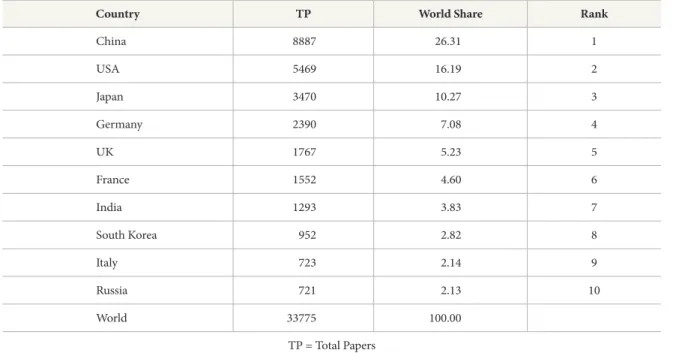
The global publication share of the top ten coun-tries in tribology research varies from 2.13% to 26.31% during the period 2001–2012 (Table 1). The top ten countries together produced 68% of world tribology research output. China tops the list with a share of 26.31% followed by the USA with 16.19% and Japan with 10.27%. These top three countries together produced 53% of world publications. India ranked seventh among the top ten most productive countries with a global publication share of 3.83%. 5.2. Indian Publication Output and its Citation Impact
Table 1. Research Output and Share of Top Ten Countries in Tribology 2001-2012
Country TP World Share Rank
China 8887 26.31 1 USA 5469 16.19 2 Japan 3470 10.27 3 Germany 2390 7.08 4 UK 1767 5.23 5 France 1552 4.60 6 India 1293 3.83 7 South Korea 952 2.82 8 Italy 723 2.14 9 Russia 721 2.13 10 World 33775 100.00 TP = Total Papers
Table 2. Annual Output and Citation Impact of Indian Tribology
Year TP TC CPP 2001 21 260 12.38 2002 33 460 13.94 2003 32 660 20.63 2004 39 496 12.72 2005 48 532 11.08 2006 54 484 8.96 2007 70 1285 18.36 2008 98 631 6.44 2009 199 1257 6.32 2010 285 1053 3.69 2011 248 612 2.47 2012 166 87 0.52 2001 - 06 227 2892 12.74 2007 - 12 1066 4925 4.62 2001 - 12 1293 7817 6.05
Table 3. Share of International Collaborative Papers
Block period TP ICP % ICP
2001–2006 227 28 12.33
2007–2012 1066 197 18.48
Total 1293 225 17.40
TP = Total Papers, ICP = International Collaborative Papers
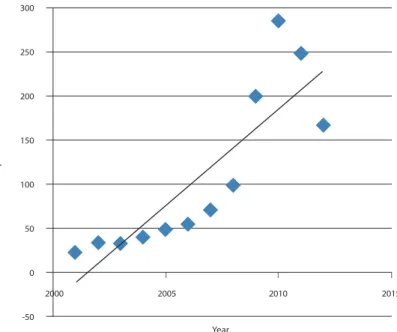
Papers Year 300 250 200 150 100 50 0 -50 2005 2010 2015 2000 y = 21.91x–43860 R2 = 0.727 Papers Linear (Papers)
Fig. 1 Linear Model of Papers from 2001–2012
The annual number of papers in tribology research contributed by Indian scientists increased from 21 in 2001 to 166 in 2012 with a peak of 285 in 2010. The coefficient of determination of number of pub-lications is found to be R2 = 0.7276 which indicates
that the literature was expanding at a considerable growth rate (Fig. 1). The linear best fit was found to be y = 21.913x–43860 where y is number of papers and x is the predicting year. With this, the predicted number of papers is 339 for the year 2017 which is twice that in 2012.
5.3. International Collaborative Papers India published 17.40% of its total papers with international collaboration during the period 2001–
2012 which has increased from 12.33% in 2001–2006 to 18.48% in 2007–2012 (Table 3).
Table 4. Major Partner Countries
Partner Countries No. of Articles %
USA 81 31.64 Germany 22 8.59 UK 18 7.03 South Korea 15 5.86 France 14 5.47 Austria 12 4.69 Australia 12 4.69 Japan 9 3.52 Portugal 8 3.13 Switzerland 7 2.73 China 6 2.34 Singapore 6 2.34 Others 46 17.97 Total* 256 100
*Since some papers (#28) have international partners from more than one country, this number exceeds the total of international collaborative papers (225).
5.4. No. of Countries by Line and Citation Impact
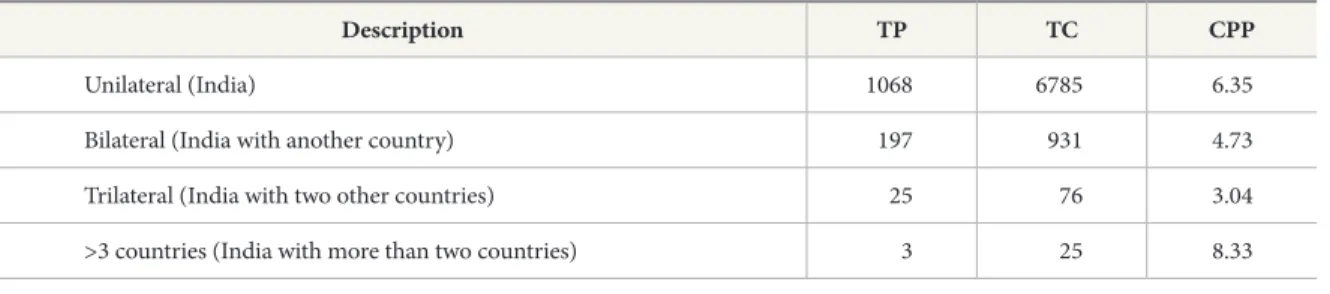
India published papers with a maximum of three countries during the period 2001–2012 (Table 5). Ci-tation impact of papers with three or more countries received the highest score with 8.33 followed by na-tional output with 6.35. Papers with three countries registered a lowest citation impact of 3.04.
5.5. Prolific Indian Authors in Tribology Re-search (2001–2012)
Authors contributing more than 0.5% of the country’s output during 2001–2012 are considered prolific authors and listed in Table 6. Among the 17 most productive authors, 7 authors are from IIT’s and 3 from IISc. B. Basu of IIT Kanpur was the most productive author with 46 papers (3.56%) followed
Table 5. Collaboration Type and its Impact
Description TP TC CPP
Unilateral (India) 1068 6785 6.35
Bilateral (India with another country) 197 931 4.73
Trilateral (India with two other countries) 25 76 3.04
>3 countries (India with more than two countries) 3 25 8.33
by J. Bijwe of IIT Delhi and S.V. Kailas of IISc. A.K. Agarwal of IIT Kanpur had the highest CPP of 63.89 followed by G. Sundararajan of IARCPMNM Hyder-abad (37.1) and D.K. Dwivedi of IIT Roorkee (12.5). The prolific authors had h-index in range from 3.97 to 33.24. The author A.K. Agarwal had the highest h-index value of 33.24 while B.K. Prasad had the lowest at 3.97.
5.6. Prolific Indian Institutes in Tribology Research (2001–2012)
Institutes contributing more than 1% of the coun-try’s output during 2001–2012 are considered pro-lific institutes and listed in Table 7. These 17 propro-lific institutes contributed 688 publications (53%) of the country’s output with a range of 14 and 93 papers. Papers contributed by these prolific institutes
re-ceived 5,437 citations (~ 70%) from their time of publication of a total 7,817 citations. The top five in-stitutes for production (IISc, IIT Delhi, IIT Kanpur, IIT Madras, and Anna University) contributed 391 papers accounting for 30% of the country’s output. The CPP of these prolific institutes varies from 1.19 to 29. Among the prolific institutes, the International Advanced Research Centre for Powder Metallurgy and New Materials, Hyderabad received the highest CPP of 29 followed by IIT Kanpur (15.17) and IIT Delhi (8.72). Only two universities, namely Anna University and Jadavpur University, are listed among the prolific institutes. Four research institutes are listed among the prolific institutes. IITs and IISc together published 461 (36% of the country’s out-put) papers related to tribology during 2001–2012 and this suggests that these are the specialized In-Table 6. Prolific Authors and their Citation Impact
Author Affiliation TP (%) TC CPP (R) h (R)
Basu, B. IIT Kanpur 46 (3.56) 547 11.89 (5) 18.67 (3)
Bijwe, J. IIT Delhi 44 (3.4) 519 11.80 (6) 18.3 (4)
Kailas, S.V. IISc 27 (2.09) 129 4.78 (13) 8.51 (12)
Biswas, S.K. IISc 26 (2.01) 169 6.50 (11) 10.32 (8)
Kumar, N. Indira Gandhi Centre for Atomic Research 19 (1.47) 20 1.05 (16) 2.76 (16) Suresha, B. National Institute of Engineering 16 (1.24) 156 9.75 (7) 11.5 (5)
Balasubramanian, V. Anna University 15 (1.16) 122 8.13 (10) 9.97 (9)
Menezes, P.L. IISc 13 (1.01) 29 2.23 (15) 4.01 (14)
Ramesh, C.S. PES Institute of Technology 12 (0.93) 102 8.50 (9) 9.54 (11)
Gnanamoorthy, R. IIT Madras 12 (0.93) 105 8.75 (8) 9.72 (10)
Prasad, B.K. Advanced Materials and Processes Research In-stitute 10 (0.77) 25 2.5 (14) 3.97 (15) Sundararajan, G. International Advanced Research Centre for Pow-der Metallurgy and New Materials, Hyderabad 10 (0.77) 371 37.10 (2) 23.97 (2)
Sahoo, P. Jadavpur University 9 (0.7) 111 12.33 (4) 11.1 (6)
Agarwal, A.K. IIT Kanpur 9 (0.7) 575 63.89 (1) 33.24 (1)
Satapathy, B.K. IIT Delhi 8 (0.62) 40 5 (12) 5.85 (13)
Jangid, R.S. IIT Bombay 8 (0.62) 40 5 (12) 5.85 (13)
dian institutes in tribology research. The highest h-index was achieved by IIT Kanpur, followed by International Advanced Research Centre for Powder Metallurgy and New Materials, Hyderabad (h-index = 25.19) and IIT Delhi (h-index = 18.4), while the lowest is by the Indira Gandhi Center for Atomic Re-search (h-index = 3.57) among the prolific institutes. 5.7. Most Preferred Journals
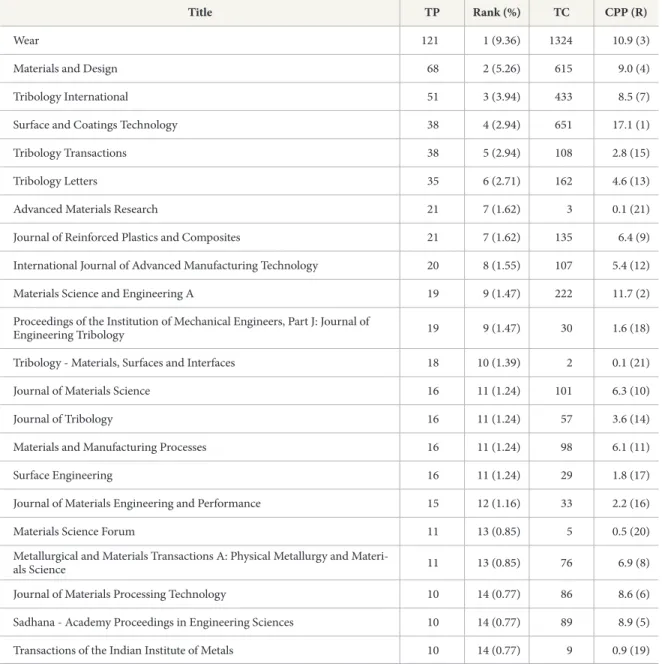
The most productive journals published at least 10 papers contributed by Indian authors are listed in Table 8. These top 22 journals together produced 600 papers contributed by Indian authors comprising 46% of the total Indian output. Only 2 journals orig-inated from India (Sadhana and Transactions of the
Indian Institute of Metals) and the remaining
jour-nals originated from different countries. It indicates
that Indian authors prefer to publish their research findings in international journals more than in Indi-an ones. Wear rIndi-anked top with 121 papers in terms of number of papers while this journal ranked third in terms of CPP. Surface and Coatings Technology received the highest CPP with 17.1 while it is ranked fourth in terms of number of papers. Sadhana ranked fifth in terms of CPP while it is ranked 14th in
terms of number of papers. 5.8. Highly Cited Papers
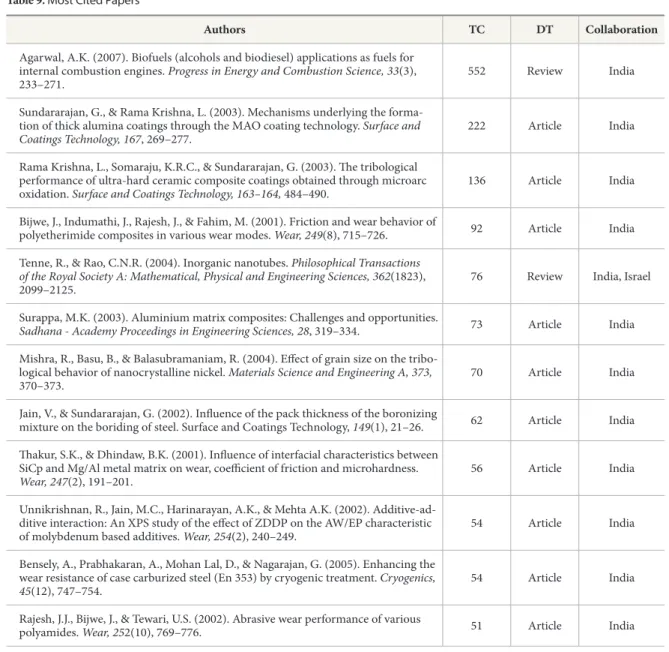
Characteristics of highly cited papers (having >50 citations) of Indian tribology research during the pe-riod 2001–2012 are presented in Table 9. 12 papers received 50 or more citations and these 12 papers have been published in 7 different journals. Of these 7 journals, one journal originates from India while Table 7. Performance of Prolific Institutes
Institute TP (%) TC CPP (R) h (R)
Indian Institute of Science 92 (7.12) 606 6.59 (10) 15.87 (4)
IIT Delhi 83 (6.42) 715 8.72 (3) 18.4 (3) IIT Kanpur 81 (6.26) 1229 15.17 (2) 26.5( 1) IIT Madras 69 (5.34) 360 5.22 (13) 12.34 (8) Anna University 66 (5.1) 408 6.18 (11) 13.61 (5) IIT Kharagpur 49 (3.79) 341 6.96 (9) 13.34 (6) IIT Roorkee 46 (3.56) 325 7.07 (8) 13.2 (7) NIT Trichy 35 (2.71) 192 5.49 (12) 10.18 (11)
Indira Gandhi Center for Atomic Research 32 (2.47) 38 1.19 (17) 3.57 (17)
IIT Bombay 23 (1.78) 82 3.57 (14) 6.64 (14)
International Advanced Research Centre for Powder Metallurgy and New
Ma-terials, Hyderabad 19 (1.47) 551 29 (1) 25.19 (2)
IIT Varanasi 17 (1.31) 141 8.29 (6) 10.53 (9)
The National Institute of Engineering, Karnataka 16 (1.24) 120 7.5 (7) 9.65 (13) Advanced Materials and Processes Research Institute India 16 (1.24) 52 3.25 (16) 5.53 (16)
National Aerospace Laboratories India 15 (1.16) 128 8.53 (4) 10.3 (10)
NITHamirpur 15 (1.16) 51 3.4 (15) 5.58 (15)
Table 8. Most Preferred Journals
Title TP Rank (%) TC CPP (R)
Wear 121 1 (9.36) 1324 10.9 (3)
Materials and Design 68 2 (5.26) 615 9.0 (4)
Tribology International 51 3 (3.94) 433 8.5 (7)
Surface and Coatings Technology 38 4 (2.94) 651 17.1 (1)
Tribology Transactions 38 5 (2.94) 108 2.8 (15)
Tribology Letters 35 6 (2.71) 162 4.6 (13)
Advanced Materials Research 21 7 (1.62) 3 0.1 (21)
Journal of Reinforced Plastics and Composites 21 7 (1.62) 135 6.4 (9)
International Journal of Advanced Manufacturing Technology 20 8 (1.55) 107 5.4 (12)
Materials Science and Engineering A 19 9 (1.47) 222 11.7 (2)
Proceedings of the Institution of Mechanical Engineers, Part J: Journal of
Engineering Tribology 19 9 (1.47) 30 1.6 (18)
Tribology - Materials, Surfaces and Interfaces 18 10 (1.39) 2 0.1 (21)
Journal of Materials Science 16 11 (1.24) 101 6.3 (10)
Journal of Tribology 16 11 (1.24) 57 3.6 (14)
Materials and Manufacturing Processes 16 11 (1.24) 98 6.1 (11)
Surface Engineering 16 11 (1.24) 29 1.8 (17)
Journal of Materials Engineering and Performance 15 12 (1.16) 33 2.2 (16)
Materials Science Forum 11 13 (0.85) 5 0.5 (20)
Metallurgical and Materials Transactions A: Physical Metallurgy and
Materi-als Science 11 13 (0.85) 76 6.9 (8)
Journal of Materials Processing Technology 10 14 (0.77) 86 8.6 (6)
Sadhana - Academy Proceedings in Engineering Sciences 10 14 (0.77) 89 8.9 (5)
Transactions of the Indian Institute of Metals 10 14 (0.77) 9 0.9 (19)
others are from international locations. Out of 12 papers, two were contributed by a single author while others have collaborators. Cumulative citations of these 12 papers are 1,498 accounting for 19% of all citations. One paper has been published with in-ternational collaboration (Israel) while others have domestic collaboration (India). The top-cited paper is “Biofuels applications as fuels for internal
combus-tion engines,” authored by A.K. Agarwal for Progress
in Energy and Combustion Science in the year 2007
Table 9. Most Cited Papers
Authors TC DT Collaboration
Agarwal, A.K. (2007). Biofuels (alcohols and biodiesel) applications as fuels for internal combustion engines. Progress in Energy and Combustion Science, 33(3),
233–271. 552 Review India
Sundararajan, G., & Rama Krishna, L. (2003). Mechanisms underlying the forma-tion of thick alumina coatings through the MAO coating technology. Surface and
Coatings Technology, 167, 269–277. 222 Article India
Rama Krishna, L., Somaraju, K.R.C., & Sundararajan, G. (2003). The tribological performance of ultra-hard ceramic composite coatings obtained through microarc
oxidation. Surface and Coatings Technology, 163–164, 484–490. 136 Article India Bijwe, J., Indumathi, J., Rajesh, J., & Fahim, M. (2001). Friction and wear behavior of
polyetherimide composites in various wear modes. Wear, 249(8), 715–726. 92 Article India Tenne, R., & Rao, C.N.R. (2004). Inorganic nanotubes. Philosophical Transactions
of the Royal Society A: Mathematical, Physical and Engineering Sciences, 362(1823),
2099–2125. 76 Review India, Israel
Surappa, M.K. (2003). Aluminium matrix composites: Challenges and opportunities.
Sadhana - Academy Proceedings in Engineering Sciences, 28, 319–334. 73 Article India
Mishra, R., Basu, B., & Balasubramaniam, R. (2004). Effect of grain size on the tribo-logical behavior of nanocrystalline nickel. Materials Science and Engineering A, 373,
370–373. 70 Article India
Jain, V., & Sundararajan, G. (2002). Influence of the pack thickness of the boronizing
mixture on the boriding of steel. Surface and Coatings Technology, 149(1), 21–26. 62 Article India Thakur, S.K., & Dhindaw, B.K. (2001). Influence of interfacial characteristics between
SiCp and Mg/Al metal matrix on wear, coefficient of friction and microhardness.
Wear, 247(2), 191–201. 56 Article India
Unnikrishnan, R., Jain, M.C., Harinarayan, A.K., & Mehta A.K. (2002). Additive-ad-ditive interaction: An XPS study of the effect of ZDDP on the AW/EP characteristic
of molybdenum based additives. Wear, 254(2), 240–249. 54 Article India
Bensely, A., Prabhakaran, A., Mohan Lal, D., & Nagarajan, G. (2005). Enhancing the wear resistance of case carburized steel (En 353) by cryogenic treatment. Cryogenics,
45(12), 747–754. 54 Article India
Rajesh, J.J., Bijwe, J., & Tewari, U.S. (2002). Abrasive wear performance of various
polyamides. Wear, 252(10), 769–776. 51 Article India
TC = Total Citations, DT = Document Type
5.9. Analysis of Words in Title
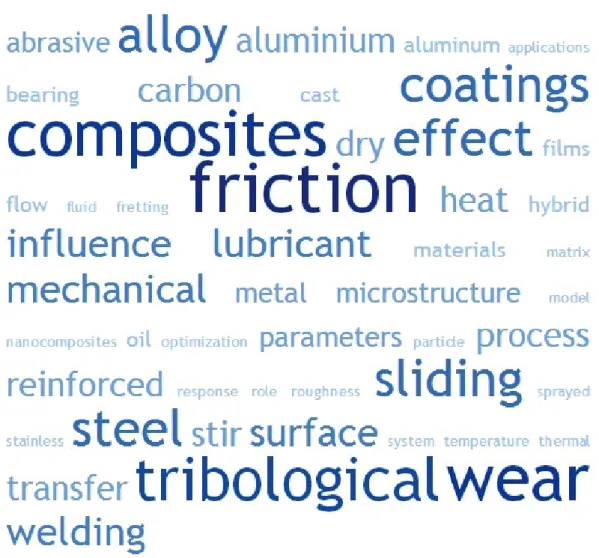
Article titles contain information about the whole paper which can express the authors’ attitude to the readers, and analysis of words in title gives the ex-act trend of particular research fields (Malarvizhi, Wang, & Ho, 2010; Sun, Wang, & Ho, 2012; Ma, Ho, & Fu, 2011). Fig. 2 provides information about the frequency of single word in titles of research papers contributed by Indian tribologists. Some
preposi-tions such as of, and, the, and or are discarded from the display. Common words like during, analysis,
study, performance, investigation, behavior, exper-iment, tool, characteristics, properties, evaluation, conditions and based were omitted from the analysis.
The font size of the text indicates how often the word is used. It can be observed that Composites and
Fric-tion are high frequency words followed by Tribology
Fig. 2 Word Cloud of Single Words in Title Created through Tagcrowd.com
6. DISCUSSION AND CONCLUSION
This paper analyzed the growth of tribology re-search output, international collaborative share, part-ner countries, citation profile, and prolific authors and institutes, and identified highly cited papers in India’s contribution to world tribology research out-put during 2001–2012. Indian scientists published 1,293 papers during the period 2001–2012 with a global publication share of 3.83% and with 225
(17.40%) papers produced by international collabo-rations. Compared to the research fields of dementia (Gupta, Kaur, & Kshitij, 2011) and pheromone biol-ogy (Rajagopal et al., 2013), the publication output in this field is in a better position. Indian literature in tribology has grown by 369% between 2001-2006 and 2007-2012, which shows that there is an increas-ing trend of research activities in tribology research. India was 7th among the top ten most productive
2001–2012. Compared to South Korea, Italy, and Russia, the world share of India’s publication output is in a better position. However, India produced a small quantity of publications in comparison to China, the USA, and Japan, which produced 10% or more of world publications. 17.4% of the country’s papers were contributed with international collaboration and the USA was the most preferred partner. The share of international collaborative papers in India’s contribution is greater than for materials science (14.75%) (Kademani, Sagar, & Bhanumurthy, 2011) and medicine (11.87%) (Gupta & Bala, 2011). The internationalization index is 19.8 for Indian tribolo-gy research, which is greater than for neuroscience research in India (Shahabuddin, 2013) where it was 16.14. 67% of the country’s output received citations in a range between 1 and 552. The citation rate of In-dian contribution was 6 which is better than comput-er science (1.13) (Gupta, Kshitij, & Vcomput-erma, 2011) and dental science (1.38) (Kaur & Gupta, 2010). Almost 67% of papers received one or more citations (ranges: 1–552) since their time of publication. Prolific insti-tutes produced 53% of the country’s output which indicates that the number of institutes engaged in tribology research was limited. Prolific authors pro-duced 22.5% of the country’s output which indicates that Indian tribology research is diffused with many authors. Analysis of single words in titles shows that
composites, friction, tribology, and wear are frequently
used words by Indian tribologists. The present study concludes that the Indian contribution to world tri-bology research has increased greatly in the last six years (369%). However, it is noted that world tribol-ogy research is presently led by China, the USA, and Japan based on the number of publications.
REFERENCES
Assenova, E., Polzer, G., Tsermaa, Dr., & Kandeva, M. (2013). Selective transfer of materials in the aspect of green tribology. Paper presented at the 13th International Conference on
Tribolo-gy, Kragujevac, Serbia.
Biswas, S. K. (2007). Research and development in Tribology in India. Tribology Online, 2(1), 1–4. Elango, B., Rajendran, P., & Bornmann, L. (2013).
Global nanotribology research output (1996– 2010): A scientometric analysis. PLOS ONE
8(12): e81094.
Frame, J. D., & Carpenter, M. P. (1979). International research collaboration. Social Studies of
Sci-ence, 9, 481–497.
Gupta, B. M., & Bala, A. (2011). A scientometric analysis of Indian research output in Medicine during 1999–2008. Journal of Natural Science,
Biology and Medicine, 2(1), 87–100.
Gupta, B. M., Kaur, H., & Bala, A. (2011). Mapping of Indian diabetes research during 1999–2008: A scientometric analysis of publications output.
DESIDOC Journal of Library and Information Technology, 31(2), 143–152.
Gupta, B. M., Kaur, H., & Kshitij, A. (2011). Demen-tia research in India: A scientometric analysis of research output during 2002–11. Annals
of Library and Information Studies, 59(4),
280–288.
Gupta, B. M., Kshitij, A., & Verma, C. (2011). Map-ping of Indian computer science research output, 1999–2008. Scientometrics, 86(2), 261–283.
Hirsch, J. E. (2005). An index to quantify an individ-ual’s scientific research output. Proceedings
of the National Academy of Sciences, 102(46),
16569–16572.
Jost, P. (1966). Lubrication (Tribology). A report on the
present position and industry’s needs.
Depart-ment of Education and Science, H.M. Station-ary Office, London.
Kademani, B. S., Sagar, A., & Bhanumurthy, K. (2011). Research and impact of materials science publications in India: 1999–2008. Malaysian
Journal of Library and Information Science, 16(2), 63–82.
Karpagam, R., Gopalakrishnan, S., Natarajan, M., & Ramesh Babu, B. (2011). Mapping of nanosci-ence and nanotechnology research in India: A scientometric analysis, 1990–2009.
Sciento-metrics, 89(2), 201–522.
Kaur, H., & Gupta, B. M. (2010). Mapping of dental science research in India: a scientometric analysis of India’s research output, 1999–2008.
Scientometrics, 85(1), 361–376.
related research in Science Citation Index Ex-panded. Archives of Environmental Science, 5, 89–100.
Malarvizhi, R., Wang, M. H., & Ho, Y. S. (2010). Re-search trends in adsorption technologies for dye containing wastewaters. World Applied
Sciences Journal, 8(8), 930–942.
Moya-Anegón, F., Guerrero-Bote, V. P., Bornmann, L., & Moed, H. F. (2013). The research guarantors of research papers and the output counting: A promising new approach. Scientometrics,
97(2), 421–434.
Mukhopadhyay, A. (2011). Tribology: A potential source of energy savings in industry.
Propa-gation – A Journal of Science Communication, 2(2), 165–168.
Rajagopal, T., Archunan, G., Surulinathi, M., & Ponmanickam, P. (2013). Research output in pheromone biology: a case study of India.
Sci-entometrics, 94(2), 711–719.
Rajendran, P., Manickaraj, J., & Elango, B. (2013). Scientometric analysis of India’s research out-put on wireless communication (2001–2012).
Journal of Advances in Library and Informa-tion Science, 2(3), 105–111.
Schubert, A., & Glänzel, W. (2007). A systematic analysis of Hirsch-type indices for journals.
Journal of Informetrics, 1(2), 179–184.
Shahabuddin, S. M. (2013). Mapping of neuroscience research in India – A bibliometric approach.
Current Science, 104(12), 1619–1626.
Singh, V., Vimal, J., & Chaturvedi, V. (2012). A study on development of industrial tribology in In-dia with some future prospects. International
Journal of Mechanical and Industrial Engineer-ing, 2(4), 31–34.
Sinha, B., & Joshi, K., (2012). Analysis of India’s solar photovoltaics research output. Annals of
Li-brary and Information Studies, 59(2), 106–121.
Sun, J., Wang, M. H., & Ho, Y. S. (2012). A historical review and bibliometric analysis of research on estuary pollution. Marine Pollution
Bulle-tin, 66(1), 13–21.
Tellez, H., & Vadillo, J. M. (2010). Bibliometric study of journal publications on analytical chemis-try 2000–2007: Publication productivity and journal preferences by country. Analytical and
Bioanalytical Chemistry, 397, 1477–1484.
Varaprasad, S. J. D., & Ramesh, D. B. (2011). Activ-ity and growth of chemical research in India during 1987–2007. DESIDOC Journal of
Library and Information Technology, 31(5),
387–394.
Zhang, X, C., Huang, D. S., & Li, F. (2011). Cancer nursing research output and topics in the first decade of the 21st century: Results of a
bibliometric and co-word cluster analysis.
Asian Pacific Journal of Cancer Prevention, 12,