Cox-2 and IL-10 Polymorphisms and Association with Squamous Cell Carcinoma of The Head and Neck in a Korean Sample
Cyclooxygenase-2 (COX-2) is involved in inflammation and carcinogenesis. Interleukin-10 (IL-10) is also regarded as anti-inflammatory factors with the multi-functional ability to positively and negatively influence functional immunity and tumor development. Genetic polymorphisms of COX-2 and IL-10 might contribute to the development of squamous cell carcinoma of the head and neck (SCCHN). The purpose of this study was to evaluate the association of COX-2 and IL-10 single nucleotide polymorphisms (SNPs) with the risk of SCCHN in a Korean sample. We analyzed the COX-2 SNPs, -1329A>G, +1266C>T, and +6365T>C, and the IL-10 SNPs, -1082A>G, +920T>G, and +3917T>C, in 290 Korean SCCHN patients and 358 healthy controls. There was no significant association between the risk of SCCHN and the three COX-2 or three IL-10 SNPs. We analyzed three haplotypes (ht1, ht2, ht3) for COX-2 and found that COX-2 ht3+/+ was associated with a decreased risk of SCCHN in a Korean sample, compared with the COX-2 ht3 -/- genotype (P=0.03). Two haplotypes (ht1, ht2) of IL-10 were analyzed and there was no statistical significance in the distribution of haplotypes. Based on these results, the COX-2 haplotype ht3 can be used as a molecular biomarker to predict low risk groups of SCCHN in a Korean sample.
Key Words: Carcinoma, Squamous Cell; Head and Neck Neoplasms; Cyclooxygenase 2;
Interleukin-10; Polymorphism, Genetic; Polymorphism, Single Nucleotide Seung Won Jeong1, Kyung Tae1,
Seung Hwan Lee1, Kyung Rae Kim1, Chul Won Park1, Byung Lae Park2, and Hyoung Doo Shin2
Department of Otolaryngology-Head and Neck Surgery1, School of Medicine, Hanyang University, Seoul; Department of Genetic Epidemiology2, SNP Genetics, Inc., Seoul, Korea
Received: 13 July 2009 Accepted: 30 December 2009 Address for Correspondence:
Kyung Tae, M.D.
Department of Otolaryngology-Head and Neck Surgery, School of Medicine, Hanyang University, 345 Wangsimni-gil, Seongdong-gu, Seoul 133-792, Korea
Tel: 82.2-2290-8585, Fax: 82.2-2293-3335 E-mail: [email protected]
DOI: 10.3346/jkms.2010.25.7.1024 • J Korean Med Sci 2010; 25: 1024-1028 Oncology & Hematology
INTRODUCTION
Squamous cell carcinoma of the head and neck (SCCHN) is the fifth most common cancer worldwide and accounts for 3.5% of the cancers registered in Korea during 2001 (1). SCCHN is be- lieved to be induced by environmental and host factors. The main causative environmental factors are tobacco or alcohol use, viral infection, nutritional deficit, mineral inhalation and history of radiation exposure (2, 3). Accumulating evidence has shown that genetic polymorphisms influence the risk of envi- ronmental carcinogenesis (4-6), and that genetic susceptibility plays an important role in the development of SCCHN. There- fore, it has been suggested that susceptibility to SCCHN may be due to genetic polymorphisms in genes controlling carcinogen metabolism, repair of DNA damage, or genes related to cancer development, such as various cytokine genes and cyclooxygen- ase-2 (COX-2) (7-11).
Cyclooxygenase (COX) is a key enzyme that mediates the con- version of free arachidonic acid to prostaglandin. COX consists of two isoforms, COX-1 and COX-2 (12). COX-1 is constitutively expressed in most tissues for physiologic homeostasis. In com- parison, COX-2 is rapidly activated by growth factors and mito- gen and plays an important role in inflammation and tumor
development (13).
Interleukin-10 (IL-10) is an important immunoregulatory cy- tokine in humans that is secreted by helper T-cells and synthe- sized by activated macrophages (14). IL-10 has the inhibitory properties of inflammatory cytokines like interferon gamma, IL- 2, and IL-3, which are produced by macrophages and helper T- cells (14). The functions of IL-10 in humans range from the anti- inflammatory activity associated with auto-immune disease to tumor development and growth, as demonstrated by reports of increased IL-10 levels in cancer patients (14, 15).
Recently, several polymorphisms in COX-2 and IL-10 have been found to be associated with inflammation and tumor de- velopment. It is also thought that these polymorphisms may cause the differential expression of these genes, resulting in sus- ceptibility to cancer development. Many studies have linked COX-2 and IL-10 genetic polymorphisms with various types of carcinoma (16, 17), but the COX-2 and IL-10 genetic polymor- phisms have not been studied in cases of SCCHN in a Korean sample. In this study, we investigated the frequencies of single nucleotide polymorphisms (SNPs) in COX-2 and IL-10 between SCCHN patients and controls in a Korean sample and evaluat- ed the effect of the COX-2 and IL-10 polymorphisms on the risk of SCCHN.
MATERIALS AND METHODS Study population
For our hospital-based case-control study, we recruited subjects from the Department of Otolaryngology, Hanyang University Hospital, Seoul, Korea from 1997 to 2004. The case group con- sisted of 290 cases with pathologically-verified SCCHN. The cas- es were newly-diagnosed SCCHN patients, with the following primary sites: larynx (n=148), oral cavity (n=69), oropharynx (n=
39), hypopharynx (n=39) and other (n=4). For the control group, we enrolled 358 hospital-based chronic otitis media, chronic si- nusitis, and chronic tonsillitis patients. Cases and controls with a history of previous malignant disease or a genetic disease were excluded. The mean age of the case group was 62.6 yr (range, 28-90), with 252 males and 38 females. The mean age of the con- trol group was 38.8 yr (range, 21-76), with 339 males and 19 fe- males. All patients and controls were of Korean ethnicity. All par- ticipants provided informed consent. The Institutional Review Board of College of Medicine, Hanyang University approved the study protocol (December 15, 2008). Peripheral blood specimens were collected from all the subjects and stored at -80°C before DNA isolation.
Genotyping
We performed DNA extraction from peripheral blood using the WizardTM Genomic DNA purification kit (Promega, Madison, WI, USA). We analyzed three SNPs of COX-2 (-1329A>G, +1266C>T, and +6365T>C) and three SNPs of IL-10 (-1082A>G, +920T>G, and +3917T>C). We performed single base extension (SBE) for genetic analysis of all SNPs, except for COX-2 +6365T>C. The polymerase chain reactions (PCR) included primers (1.25 pM each), 5 ng genomic DNA, 250 μM dNTPs and 0.15 U Taq DNA polymerase (Applied Biosystems, Foster City, CA, USA) and were run using the GeneAmp PCR System 9700 Thermocycler (Ap- plied Biosystems). The primers used are listed in Table 1. Using the SNaPshot ddNTP primer extension kit (Applied Biosystems), we performed the primer extension reaction. To clean-up the primer extension reaction products, 1 U shrimp alkaline phos- phatase (Amersham Life Science, Cleveland, Ohio, USA) was added to the reaction mixture, and the mixture was incubated at 37°C for one hour, followed by 15 min at 72°C for enzyme inac- tivation. We added the amplified material and Genescan 120Liz size-standard solution (Applied Biosystems) in Hi-Di formamide (Applied Biosystems) and incubated the reaction at 95°C for five minutes, followed by incubation on ice for five minutes. Elec- trophoresis was performed using the reaction mixture with an ABI Prism 3100 Genetic Analyzer (Applied Biosystems). We used ABI Prism GeneScan and Genotyper to perform the genetic analyses.
The analysis of the COX-2 +6365T>C SNP was performed us- ing the TaqMan assay. The forward and reverse primers were:
5’-GCATCTTCCATGATGCATTAGAAGTAAC-3’, 5’-GCACTGA–
TACCTGTTTTTGTTTGATGA-3’. The probe for the wildtype (T allele) was 5’-AAGTACTTTTGGTTATTTTT-3’. The 5’ end was conjugated with VICTM fluorescent dye and the 3’ end was con- jugated with TAMRATM quencher dye. The probe for the mutant type (C allele) was 5’-ACTTTTGGTCATTTTT-3’, with the 5’ end bound to FAMTM fluorescent dye and the 3’ end bound to TAM- RATM quencher dye. PCR was performed in a 5 μL reaction that consisted of a mixture of TaqMan universal PCR master mix (Applied Biosystems), UNG, primers (900 μM), probe (200 nM) and genomic DNA (20 μg). The PCR reaction conditions were as follows: 50°C for two minutes, 95°C for ten minutes and then 15 sec denaturing, final annealing and extension at 60°C for one minute, for 40 amplification cycles. The TaqMan assay plate was transferred to a Prism 9700HT instrument and genetic analysis was performed by measuring the fluorescence level in each well.
Statistical analyses
Statistical verification of the associations of COX-2 and IL-10 genetic polymorphisms with SCCHN and with the normal con- trol group was performed using a chi square test. The odds ra- tios (OR) and 95% confidence intervals were obtained using a logistic regression model. All statistical analyses were performed using the SPSS statistical package (SPSS, version 12.0, Inc., Chi- cago, IL, USA).
RESULTS
COX-2 polymorphisms
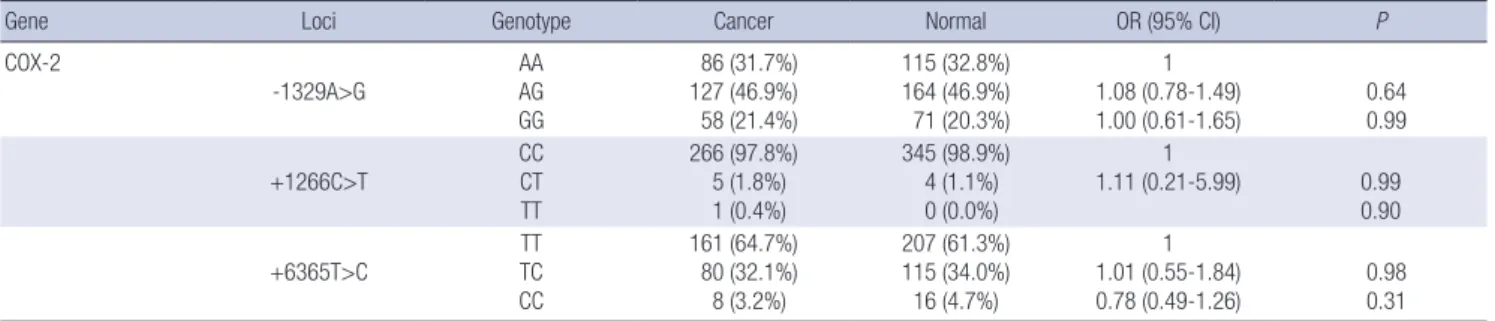
For the COX-2 -1329A>G SNP (genotyping was available in 621 of 648 subjects), the frequency of variant allele G was 44.2% and heterozygosity was 46.8%. The frequency of the COX-2 geno- types, -1329 AA, AG and GG, were 31.7%, 46.9%, 21.4% in the case group and 32.9%, 46.9%, and 20.3% in the control group respectively. The odds ratio and respective 95% confidence in- Table 1. Primer sequences for COX-2 and IL-10 SNP genotyping using the single- base extension method
Locus Primer Sequence (5´-3´)
COX-2 -1329A>G forward reverse extension
TCCTCCCTGAGCACTACCCAT CAGTTGCCTGGGCTTATTGG GTTAAACAAAAGCAAAGATGAAATTCCA
COX-2 +1266C>T forward reverse extension
CTTCCTTCGAAATGCAATTATGAGT TGAGCAGACTGTATAAACTGGATGG
CATGTAAGTACAAGTGTCTTTCTAAGGTTTTTAGC
IL-10 -1082A>G
forward reverse extension
CCCAACTGGCTCCCCTTAC GGAGGCTGGATAGGAGGTCC
ATGATGATACTTTCCTCTTACCTATCCCTACTTCCCC
IL-10 +920T>G
forward reverse extension
TGCTTTCCCTTCAAAATCGG CCTTCATTTGCTGCAGGAAGA ATGATTTTTTTGGGCCAGAGCCAATTT
IL-10 +3917T>C
forward reverse extension
GAGACATCAGGGTGGCGACT GGCTCCCCAAAGAACATTTTT
GACCCAGCCCCTTGAGAAACCTTATTGTACCTCTCT
tervals for the genotype AG and GG in reference to AA were 1.08 (0.78-1.49) and 1.00 (0.61-1.65), respectively. For the COX- 2 +1266C>T SNP (genotyping was available in 621 of 648 sub- jects), the frequency of variant allele T was 0.7% and the hetero- zygosity was 1.4%. The frequency of the COX-2 genotypes, +1266 CC, CT, and TT, were 97.8%, 1.8%, and 0.4% in the case group and 98.9%, 1.1%, and 0% in the control group, respectively. The relative risk of CT to CC was 1.11 (0.21-5.99). For the COX-2 +6365T>C SNP (genotyping was available in 587 of 648 subjects), the frequency of variant allele C was 20.8% and heterozygosity was 33.2%. The frequency of the COX-2 genotypes, +6365 TT, TC, and CC, were 64.7%, 32.1%, and 3.2% in the case group and 61.2%, 34%, and 4.7% in the control group, respectively. The rel- ative risks of TC and CC to TT were 1.01 (0.55-1.84), and 0.78 (0.49-1.26), respectively. We found no statistical significance in our analyses (Table 2).
COX-2 haplotypes
We identified six haplotypes (GCT, ACT, ACC, ATC, GCC, GTT) for COX-2 -1329A>G, +1266C>T, and +6365T>C and analyzed the three most common haplotypes, which we abbreviated as ht1 (GCT), ht2 (ACT), and ht3 (ACC) (Table 3). The haplotype distributions are summarized in Table 4.
The frequencies of ht3 -/-, +/-, and +/+ were 69.3%, 27.8%, 2.9%
in the case group and 62.4%, 33.0%, and 4.6% in the control group, respectively. The relative risk of ht3 +/- to -/- was 1.05 (0.55-2.01) and the relative risk of ht3+/+ to -/- was 0.60 (0.38-0.96). So, com- pared with the ht3-/- genotype, the ht3+/+ genotype was signif- icantly associated with a decreased risk of HNSCC in Koreans
(P=0.03).
IL-10 polymorphisms
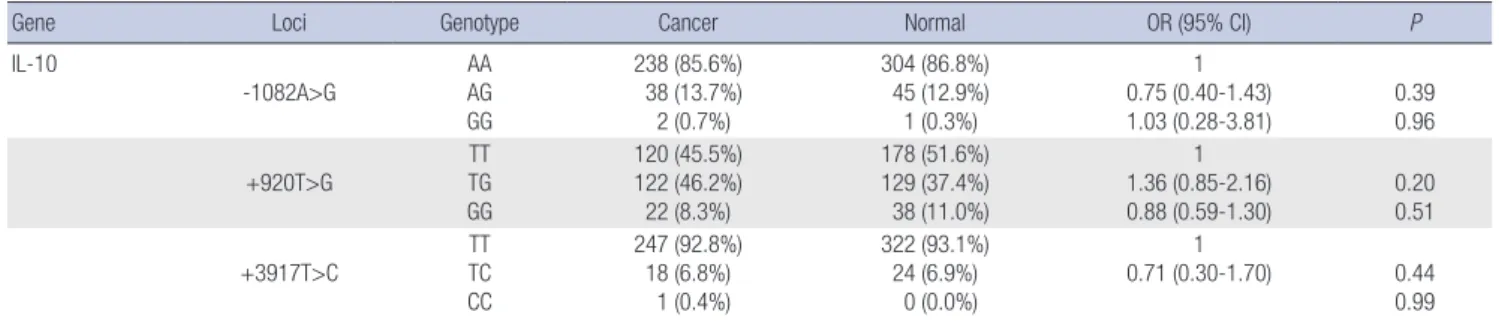
For the IL-10 -1082A>G SNP (genotyping was available in 628 of 648 subjects), the frequency of the variant allele G was 7% and the heterozygosity was 13.2%. The frequencies of IL-10 genotypes, -1082 AA, AG, and GG, were 85.6%, 13.7%, and 0.7% in the case group and 86.9%, 12.9%, and 0.3% in the control group, respec- tively. The relative risks of genotypes AG and GG to AA were 0.75 (0.40-1.43) and 1.03 (0.28-3.81), respectively. For the IL-10 +920T>
G SNP (genotyping was available in 609 of 648 subjects), the fre- quency of the variant allele G was 30.3% and the heterozygosity was 41.2%. The genotype frequencies of TT, TG and GG were 45.5%, 46.2%, and 8.3% in the case group and 51.6%, 37.4%, and 11.0% in the control group, respectively. The relative risks of TG and GG to TT were 1.36 (0.85-2.16) and 0.88 (0.59-1.30), respec- tively. For the IL-10 +3917T>C SNP (genotype was available in 612 of 648 subjects), the variant allele C was 3.5% and the het- erozygosity was 6.8%. The genotype frequencies of TT, TC, and
Table 2. Logistical analysis of the COX-2 gene in Korean head and neck squamous cell carcinoma patients and normal control subjects
Gene Loci Genotype Cancer Normal OR (95% CI) P
COX-2
-1329A>G
AA AG GG
86 (31.7%) 127 (46.9%) 58 (21.4%)
115 (32.8%) 164 (46.9%) 71 (20.3%)
1 1.08 (0.78-1.49)
1.00 (0.61-1.65) 0.64 0.99
+1266C>T
CC CT TT
266 (97.8%) 5 (1.8%) 1 (0.4%)
345 (98.9%) 4 (1.1%) 0 (0.0%)
1
1.11 (0.21-5.99) 0.99 0.90
+6365T>C
TT TC CC
161 (64.7%) 80 (32.1%) 8 (3.2%)
207 (61.3%) 115 (34.0%) 16 (4.7%)
1 1.01 (0.55-1.84)
0.78 (0.49-1.26) 0.98 0.31 OR, odds ratio; CI, confidence interval.
Table 3. The frequencies of COX-2 gene haplotypes in Korean head and neck squamous cell carcinoma patients and normal control subjects
Haplotype -1329A>G +1266C>T +6365T>C Frequency
ht1 G C T 0.438
ht2 A C T 0.357
ht3 A C C 0.192
ht4 A T C 0.008
ht5 G C C 0.004
ht6 G T T 0.001
Ht, haplotype.
Table 4. Analysis of haplotypes in the COX-2 gene in Korean head and neck squamous cell carcinoma patients and normal control subjects
Gene Loci Genotype Cancer Normal OR (95% CI) P
COX-2
ht1 -/-
ht1/- ht1/ht1
89 (32.1%) 129 (46.6%) 59 (21.3%)
114 (32.5%) 171 (48.7%) 66 (18.8%)
1 0.91 (0.66-1.26) 0.88 (0.54-1.43)
0.56 0.61
ht2 -/-
ht2/- ht2/ht2
113 (40.8%) 124 (44.8%) 40 (14.4%)
152 (43.3%) 153 (43.6%) 46 (13.1%)
1 0.32 (0.92-1.89) 1.35 (0.86-2.13)
0.13 0.19
ht3 -/-
ht3/- ht3/ht3
192 (69.3%) 77 (27.8%) 8 (2.9%)
219 (62.4%) 116 (33.0%) 16 (4.6%)
1 0.15 (0.55-2.01) 0.60 (0.38-0.96)
0.89 0.03 OR, odds ratio; CI, confidence interval; ht, haplotype.
CC were 92.9%, 6.8%, and 0.4% in the case group and 93.1%, 6.9%, and 0% in the control group, respectively. The relative risk of TC to TT was 0.71 (0.30-1.70). No significant statistical results were obtained in our analyses of IL-10 polymorphisms (Table 5).
IL-10 haplotypes
Two haplotypes, ht1(ATT) and ht2(AGT) for the IL-10 SNPs -1082A>G, +920T>G, and +3917T>C were analyzed. The haplo- type distributions are summarized in Table 6. There was no sig- nificant difference in the distribution of the two IL-10 haplotypes in the SCCHN patient and normal control groups.
DISCUSSION
Development of cancer is dependent on individual genetic sus- ceptibility. For example, genetic polymorphisms, activation of cancer genes and alterations of the immune system are deter- minants of individual genetic susceptibility (18). The most com- mon genetic polymorphism in the population is SNP, which are single nucleotide substitutions within genes. These small chang- es in DNA can cause significant alterations in normal genetic function, metabolism, repair of DNA, personal sensitivity and ultimately malignant tumor development (19).
COX-2 expression and activity is induced by growth factors, carcinogens and oncogenes (20). COX-2 overexpression and its association with cancer development have been reported espe- cially in colorectal cancer and SCCHN (21). The COX-2 gene is located at 1q25.2-q25.3 and is encoded by 10 exons (22). To date, 25 polymorphisms in the COX2 gene have been identified in a Korean sample.
Our study analyzed the association of COX-2 SNPs 1329A>G,
+1266C>T, +6365T>C with SCCHN in a Korean sample. There was no definite statistical significance between cancer risk and genetic polymorphism for three COX-2 SNPs. However, the fre- quency of the haplotype ht3 (ACC) differed significantly. Haplo- type ht3 +/+ (ACC/ACC) was associated with a significantly de- creased risk of SCCHN, compared with the ht3-/- group, suggest- ing a possible involvement of ht3 in the development of SCCHN.
There has been no study that evaluates COX-2 SNPs that were analyzed in our study in SCCHN. In a study that examined the association of COX-2 -765 G>C polymorphism with the risks of oral squamous cell carcinoma in a Taiwan population, the au- thors reported that COX-2 -765C allele was a protective factor against oral squamous cell carcinoma (23). However, in other study in the Netherlands, there was no risk-modifying effect of COX-2 -1195 A>G and -765 G>C polymorphisms in head and neck carcinogenesis (24).
IL-10 is an important immune regulatory cytokine in humans that is mainly secreted by helper T-cells and synthesized by ac- tivated macrophages (14). The predominant effect of IL-10 is reduced inflammation, and it contributes to the control of im- mune-related cellular proliferation and differentiation (14, 15).
The IL-10 gene is located on chromosome 1q31-32 and is en- coded in 5 exons. Numerous genetic polymorphisms in IL-10 have been reported and nearly all of them are SNPs (25). In Ital- ian patients with undifferentiated carcinoma of the nasopharynx, it has been reported that IL-10 -1082A>G, -819C>T, and -592A>C SNPs were not associated with cancer development (26). In our study, we analyzed three IL-10 SNPs and two haplotypes. The IL-10 -1082A>G, +920T>G, and +3917T>C SNPs and their re- spective haplotypes were not associated with the risk of SCCHN in a Korean sample.
Table 5. Logistical analysis of the IL-10 gene in Korean head and neck squamous cell carcinoma patients and normal control subjects
Gene Loci Genotype Cancer Normal OR (95% CI) P
IL-10
-1082A>G AA
AG GG
238 (85.6%) 38 (13.7%) 2 (0.7%)
304 (86.8%) 45 (12.9%) 1 (0.3%)
1 0.75 (0.40-1.43)
1.03 (0.28-3.81) 0.39 0.96
+920T>G TT
TG GG
120 (45.5%) 122 (46.2%) 22 (8.3%)
178 (51.6%) 129 (37.4%) 38 (11.0%)
1 1.36 (0.85-2.16)
0.88 (0.59-1.30) 0.20 0.51
+3917T>C TT
TC CC
247 (92.8%) 18 (6.8%) 1 (0.4%)
322 (93.1%) 24 (6.9%) 0 (0.0%)
1 0.71 (0.30-1.70)
0.44
0.99 OR, odds ratio; CI, confidence interval.
Table 6. Analysis of IL-10 haplotypes in Korean head and neck squamous cell carcinoma patients and normal control subjects
Gene Loci Genotype Cancer Normal OR (95% CI) P
IL-10
ht1
ht1/ht1 ht1/-
-/-
117 (45.3%) 121 (46.9%) 20 (7.8%)
176 (51.8%) 129 (37.9%) 35 (10.3%)
1 1.38 (0.86-2.19)
0.81 (0.53-1.23) 0.18 0.32
ht2
-/- ht2/- ht2/ht2
239 (92.6%) 9 (3.5%) 10 (3.9%)
306 (90.0%) 14 (4.1%) 20 (5.9%)
1 0.65 (0.18-2.34)
0.76 (0.46-1.26) 0.51 0.29 OR, odds ratio; CI, confidence interval; ht, haplotype.
In conclusion, COX-2 ht3+/+ was associated with a significant- ly decreased risk of SCCHN in a Korean sample, compared with the COX-2 ht3-/- genotype. Based on this result, the COX-2 hap- lotype ht3 can be used as a molecular biomarker to predict low risk groups of SCCHN in a Korean sample.
REFERENCES
1. Kim KM, Kim YM, Shim YS, Kim KH, Chang HS, Choi JO, Rho YS, Kim MS, Choi EC, Choi G, Sung MW, Kim SY, Lee YS, Baek JH, Kim SH, Kim YH, Im JH, Choi SH, Kim JH; Study Group of Korean Society of Head and Neck Surgeons. Epidemiologic survey of head and neck cancers in Korean. J Korean Med Sci 2003; 18: 80-7.
2. Blot WJ, McLaughlin JK, Winn DM, Austin DF, Greenberg RS, Preston- Martin S, Bernstein L, Schoenberg JB, Stemhagen A, Fraumeni JF Jr.
Smoking and drinking in relation to oral and pharyngeal cancer. Cancer Res 1988; 48: 3282-7.
3. McKaig RG, Baric RS, Olshan AF. Human papillomavirus and head and neck cancer: Epidemiology and molecular biology. Head Neck 1998; 20:
250-65.
4. Zheng Y, Shen H, Sturgis EM, Wang LE, Shete S, Spitz MR, Wei Q. Hap- lotypes of two variants in p16(CDKN2/MTS-1/INK4a) exon3 and risk of squamous cell carcinoma of the head and neck: a case-control study.
Cancer Epidemiol Biomarkers Prev 2002; 11: 640-5.
5. Shen H, Zheng Y, Sturgis EM, Spitz MR, Wei Q. P53 codon 72 polymor- phism and risk of squamous cell carcinoma of the head and neck: a case- control study. Cancer Lett 2002; 183: 123-30.
6. Zheng Y, Li L, Shen H, Sturgis EM, Eicher SA, Strom SS, Spitz MR, Wei Q.
Polymorphism hCHK2/hCdsl codon 84 allele and risk of squamous cell carcinoma of the head and neck- a case-control analysis. Carcinogenesis 2001; 22: 2005-8.
7. Yang M, Kim WH, Choi Y, Lee SH, Kim KR, Lee HS, Tae K. Effects of ERCC1 expression in peripheral blood on the risk of head and neck can- cer. Eur J Cancer Prev 2006; 15: 269-73.
8. Yang M, Kang MJ, Choi Y, Kim CS, Lee SM, Park CW, Lee HS, Tae K. As- sociation between XPC expression, genotype, and the risk of head and neck cancer. Environ Mol Mutagen 2005; 45: 374-9.
9. Tae K, Lee HS, Park BJ, Park CW, Kim KR, Cho HY, Kim LH, Park BL, Shin HD. Association of DNA repair gene XRCC1 polymorphism with head and neck cancer in Korean population. Int J Cancer 2004; 111: 805-8.
10. Shin CS, Ahn KS, Tae K, Lee HS, Kim HJ, Kong G. Genetic susceptibilities of Cytochrome P4501A1 and Glutathione S-transferase M1 to the risk for Korean head and neck squamous cell carcinoma patients. Korean J Oto- laryngol - Head Neck Surg 1999; 42: 202-8.
11. Ko KM, Ahn KS, Tae K, Lee SH, Kong G. Genetic polymorphism of Cyto- chrome P4501A1 Exon7 and Glutathione S-transferase M1 in the head
and neck squamous cell carcinoma patients. Korean J Otolaryngol - Head Neck Surg 1999; 42: 1405-12.
12. Ondrey FG. Arachidonic acid metabolism: a primer for head and neck surgeons. Head Neck 1998; 20: 334-49.
13. Tsujii M, DuBois RN. Alterations in cellular adhesion and apoptosis in epithelial cells overexpressing prostaglandin endoperoxide synthase 2.
Cell 1995; 83: 493-501.
14. Mocellin S, Marincola FM, Young HA. Interleukin-10 and the immune response against cancer: a counterpoint. J Leukoc Biol 2005; 78: 1043-51.
15. Howell WM, Rose-Zerilli MJ. Interleukin-10 polymorphism, cancer sus- ceptibility and prognosis. Fam Cancer 2006; 5: 143-9.
16. Shahedi K, Lindstrom S, Zheng SL, Wiklund F, Adolfsson J, Sun J, Au- gustsson-Bälter K, Chang BL, Adami HO, Liu W, Grönberq H, Xu J. Ge- netic variation in the COX-2 gene and the association with prostate can- cer risk. Int J Cancer 2006; 119: 668-72.
17. Howell WM, Turner SJ, Bateman AC, Theaker JM. IL-10 promoter poly- morphism influence tumour development in cutaneous malignant mel- anoma. Genes Immun 2001; 2: 25-31.
18. De Andrade M, Amos CI, Foulkes WD. Segregation analysis of squamous cell carcinoma of the head and neck: Evidence for a major gene determin- ing risk. Ann Hum Genet 1998; 62: 505-10.
19. Nussbaum RL. Genetic variation in individuals: mutation and polymor- phism. In: Nussbaum RL, Mcinnes RR, Willard HF. eds. Thompson &
Thompson genetics in medicine. W.B.Saunders 2002; 79-94.
20. Lands WE. Biosynthesis of prostaglandins. Annu Rev Nutr 1991; 11: 41-60.
21. Eberhart CE, Coffey RJ, Radhika A, Giardiello FM, Ferrenbach S, Du- Bois RN. Up-regulation of cyclooxypgenase 2 gene expression in human colorectal adenomas and adenocarcinomas. Gastroenterology 1994; 107:
1183-8.
22. Hedelin M, Chang ET, Wiklund F, Bellocco R, Klint A, Adolfsson J , Sha- hedi K, Xu J, Adami HO, Grönberg H, Bälter KA. Association of frequent consumption of fatty fish with prostate cancer risk is modified by COX-2 polymorphism. Int J Cancer 2006; 120: 398-405.
23. Lin YC, Huang HI, Wang LH, Tsai CC, Lung O, Dai CY, Yu ML, Ho CK, Chen CH. Polymorphisms of COX-2 -765G>C and p53 codon 72 and risks of oral squamous cell carcinoma in a Taiwan population. Oral Oncol 2008; 44: 798-804.
24. Peters WH, Lacko M, Te Morsche RH, Voogd AC, Oude Ophuis MB, Manni JJ. COX-2 polymorphisms and the risk for head and neck cancer in white patients. Head Neck 2009; 31: 938-43.
25. Moore KW, O’Garra A, de Waal Malefyt R, Vieira P, Mosmann TR. Inter- leukin-10. Annu Rev Immunol 1993; 11: 165-90.
26. Pratesi C, Bortolin MT, Bidoli E, Tedeschi R, Vaccher E, Dolcetti R, Gui–
doboni M, Franchin G, Barzan L, Zanussi S, Caruso S, De Paoli P. Inter- leukin-10 and interleukin-18 promoter polymorphisms in an Italian co- hort of patient with undifferentiated carcinoma of nasopharyngeal type.
Cancer Immunol Immunother 2006; 55: 23-30.