INTRODUCTION
The majority of the serious alloimmune hemolysis cases are still due to RhD incompatibility, although ABO mater- nal-fetal incompatibility is a much more commonly seen disorder. A much smaller fraction of the patients with hemo- lytic disease of the newborn (HDN) are due to sensitization to Kell, Duffy, Kidd and other Rh antigens (1, 2). The admin- istration of rhesus immunoglobulin (Ig) prophylaxis to the RhD-negative pregnant patients has dramatically decreased the frequency of HDN. At the same time, the proportion of cases that has been caused by Kell, Duffy, Kidd and other Rh antigen incompatibility has increased from the previous estimates of 1% to 3% (3).
Among these antigen groups, the Kidd blood group sys- tem was discovered by Allen et al. in 1951 in a mother who had no history of transfusion, and the women had given birth to an infant with mild hemolytic disease that was due to anti- Jka(4). The antithetical anti-Jkbwas reported by Plaut et al.
(5) in 1953. Anti Jkbcan cause hemolytic disease that is usually a mild and has a benign prognosis (6). In contrast the authors of this study experienced a fatal case of a newborn who exhibi- ting severe HDN associated with anti-Jkb.
CASE REPORT
A female patient having the AB, Rh(D)-positive boodtype was admitted for jaundice on the fourth day after being born.
The baby was born following a normal vaginal delivery by 39-yr-old mother having birth history of gravida 4, para 2.
Her body weight was 3,000 g, and her gestational age was 37 weeks and 5 days. The mother’s past history was unremark- able. There was no history for transfusions of blood, plasma or any blood derivatives. The first and second siblings were treated with phototherapy due to neonatal hyperbilirubin- emia. At the time of admission, the patient was lethargic and exhibited high pitched crying, she had a normal Moro-reflex, but there was decreased respond to stimulation. The labora- tory data indicated a hemoglobin value of 11.4 mg/dL, a reticulocyte count of 14.9% and the appearance of moderate anisocytosis and severe polychromasia in the peripheral blood smear. The seroanalysis showed a total bilirubin of 46.1 mg/
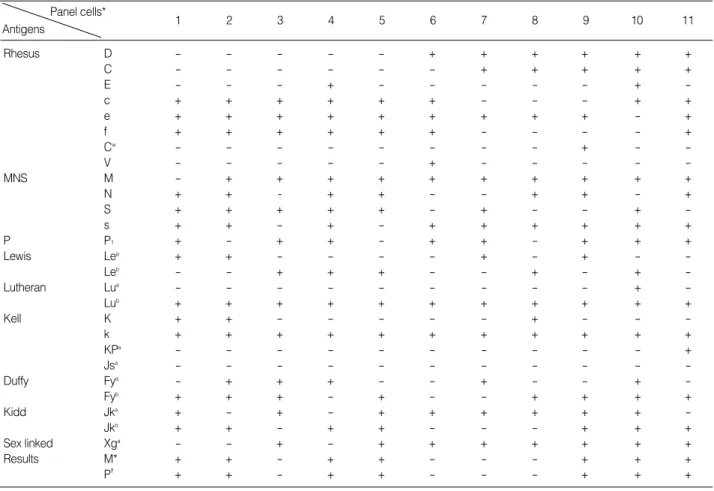
dL, a direct bilirubin of 1.1 mg/dL, blood urea nitrogen (BUN) 16 mg/dL, creatinine 0.5 mg/dL, sodium 143 mEq/L, potas- sium 3.8 mEq/L, chloride 112 mEq/L and a strong positive result (+++) on the direct Coombs test. As a result of the identification of irregular antibody from the maternal serum, anti-Jkbwas detected by the Median Diagnostic GmbH Data-
Won Duck Kim, Young Hwan Lee*
Department of Pediatrics, Dongguk University, College of Medicine, Gyeongju; Department of Pediatrics*, Yeungnam University, College of Medicine, Daegu, Korea
Address for correspondence Young Hwan Lee, M.D.
Department of Pediatrics, Yeungnam University Hospital, 317-1 Daemyung-dong, Nam-gu, Daegu 705-717, Korea
Tel : +82.53-620-3535, Fax : +82.53-629-2252 E-mail : [email protected]
151 J Korean Med Sci 2006; 21: 151-4
ISSN 1011-8934
Copyright � The Korean Academy of Medical Sciences
A Fatal Case of Severe Hemolytic Disease of Newborn Associated with Anti-Jk
bThe Kidd blood group is clinically significant since the Jk antibodies can cause acute and delayed transfusion reactions as well as hemolytic disease of newborn (HDN).
In general, HDN due to anti-Jkbincompatibility is rare and it usually displays mild clinical symptoms with a favorable prognosis. Yet, we apparently experienced the second case of HDN due to anti-Jkbwith severe clinical symptoms and a fatal out- come. A female patient having the AB, Rh(D)-positive boodtype was admitted for jaundice on the fourth day after birth. At the time of admission, the patient was lethar- gic and exhibited high pitched crying. The laboratory data indicated a hemoglobin value of 11.4 mg/dL, a reticulocyte count of 14.9% and a total bilirubin of 46.1 mg/dL, a direct bilirubin of 1.1 mg/dL and a strong positive result (+++) on the direct Coomb’s test. As a result of the identification of irregular antibody from the maternal serum, anti-Jkbwas detected, which was also found in the eluate made from infant’s blood.
Despite the aggressive treatment with exchange transfusion and intensive photother- apy, the patient died of intractable seizure and acute renal failure on the fourth day of admission. Therefore, pediatricians should be aware of the clinical courses of hemolytic jaundice due to anti-Jkb, and they should be ready to treat this disease with active therapeutic interventions.
Key Words : Anemia, Hemolytic, Autoimmune; Erythrobastosis, Fetal; Infant, Newborn; Anti-Jkb
Received : 18 October 2004 Accepted : 11 February 2005
152 W.D. Kim, Y.H. Lee
Cyte Plus Kit (Median Diagnostic GmbH, Dudingen, Switzer- land) (Table 1), which was also found in the eluate made from infant’s blood.
She was treated with exchange transfusion and intensive phototherapy for 3 days. A total bilirubin was decreased (16
mg/dL), but she had a convulsion with azotemia and elec- trolytes imbalance; BUN 41 mg/dL, creatinine 2.2 mg/dL, sodium 134 mEq/L, potassium 8.2 mEq/L, chloride 98 mEq/
L. The emergent peritoneal dialysis was initiated under the diagnosis of acute renal failure. Despite the aggressive treat-
Panel cells*
Antigens 1 2 3 4 5 6 7 8 9 10 11
Rhesus D - - - - - + + + + + +
C - - - - - - + + + + +
E - - - + - - - - - + -
c + + + + + + - - - + +
e + + + + + + + + + - +
f + + + + + + - - - - +
Cw - - - - - - - - + - -
V - - - - - + - - - - -
MNS M - + + + + + + + + + +
N + + - + + - - + + - +
S + + + + + - + - - + -
s + + - + - + + + + + +
P P1 + - + + - + + - + + +
Lewis Lea + + - - - - + - + - -
Leb - - + + + - - + - + -
Lutheran Lua - - - - - - - - - + -
Lub + + + + + + + + + + +
Kell K + + - - - - - + - - -
k + + + + + + + + + + +
KPa - - - - - - - - - - +
Jsa - - - - - - - - - - -
Duffy Fya - + + + - - + - - + -
Fyb + + + - + - - + + + +
Kidd Jka + - + - + + + + + + -
Jkb + + - + + - - - + + +
Sex linked Xga - - + - + + + + + + +
Results M* + + - + + - - - + + +
P� + + - + + - - - + + +
Table 1.Results for antibody identification testing in the maternal serum and the patient’s eluate
+, positive; -, negative; M*, mother; P�, patient.
*Commercial panel cell series by the Median Diagnostic GmbH Data-Cyte Plus Lot No. DC-962.
Kornstad &
Halvorsen (11)
Geczy &
Eslie (15)
Wagman &
Bove (16)
Zodin &
Anderson (17)
Lange et al.
(18)
Kim et al.
(19)
Merlob et al.
(20)
Tomar et al.
(21)
Park et al.
(22)
Present case
GA (weeks) 41 Full-term 37 Full-term Full-term 38 38 Full-term 37 37
Onset of jaundice (hr) 4 Early (?) 2 Early (?) NM 24 Birth 30 24 Early (?)
Day of peak T-bilirubin (day) 2 2 1 2 1 3 2 2 4 4
Peak T-bilirubin (mg/dL) 10.3 9.0 4.9 8.4 8.0 24.5 16.8 14.4 24.0 46.1
Hemoglobin (g/dL) 12.0 14.8 21.2 NM 17.0 13.1 12.4 18.8 9.7 11.4
Hematocrit (%) NM NM 61.0 60.5 NM 39 37.4 NM 28.1 36.8
Reticulocyte (%) 6.4 4.6 NM NM NM 5.8 6.7 6.0 5.0 14.9
Treatment None None None None None PT PT & TF NM PT PT & ETF
Outcome Good Good Good Good Good Good Good Good Good Fatal
Gravida-para 5-4 2-1 3-3 5-4 NM 1-0 3-3 4-3 2-1 4-2
Previous HDN siblings 2nd child None NM None NM None 2nd child None None Suspected 1st and 2nd child Table 2.Summary of the clinical and laboratory data from the published cases of hemolytic disease of newborn due to anti-Jkb
GA, gestational age; NM, not mentioned; PT, phototherapy; TF, transfusion; ETF, exchange transfusion.
. .
Severe Hemolytic Disease with Anti-Jkb 153
ment with peritoneal dialysis and anticonvulsant therapy, the patient died of intractable seizure and acute renal failure on the fourth day of admission. The results of tandem mass screening for metabolic disease revealed normal values. All the specimen cultures showed no growth.
Consequently, the HDN was very likely due to Jkbincom- patibility since the fetal bloodtype was AB, Rh-positive and Jkb(+), while the mother was indicated as AB, Rh-positive and Jkb(-).
DISCUSSION
The Kidd blood group is a major antigenic system in human erythrocytes, and this antigen system is defined by two antithetical specificities, Jka and Jkb, and a third rare recessive gene, Jk, that produces neither Jkanor Jkbantigens (7). The Kidd antigens are localized on a 43 kDa red blood cell integral membrane protein that functions as a urea trans- porter (8). JKA and JKB are alternate, autosomally inherit- ed codominant alleles. The Kidd blood group is clinically significant since Jk antibodies can cause acute and delayed transfusion reactions as well as HDN.
Anti-Jkbwas first described by Plaut et al. in 1953 (5).
Most of the reports on anti-Jkbhave stated that this condi- tion followed after repeated blood transfusions (9, 10). The first case of anti-Jkbrelated HDN was reported by Kornstad and Halvorsen in 1958 (11). Up to the present time, only eleven cases of anti- Jkbrelated HDN have been reported in the medical leterature. Although approximately 20-29% of the Caucasian and Asian population have the phenotype Jk(a+b-) (12-14), introduction of the Jkbantigen into such individuals is rarely associated with clinically manifesting disease. This is apparently due to the fact that Jkbis a poor antigen. Table 2 summarizes the pertinent clinical and sero- logic data concerning the cases of HDN due to anti-Jkbthat have been reported to date (15-22). In all the reported cases, the disease was usually mild to moderate with a benign prognosis. Although all the infants exhibited a strongly positive direct Coombs test, any anemia was either absent or present to only a slight degree.
An additional case of HDN that was apparently due to anti-Jkbhas been reported by Kanner (23). This case radically differs from those reported previously in that the woman’s third baby was ‘‘very jaundiced and anemic’’, and the baby died at the second day after birth. No other information about the baby was reported. This case has not been included in Table 2 because of insufficient data. The baby in our case was also severely affected at the time of admission and she suffered the neurologic consequences of kernicterus. Despite the medical management with exchange transfusion and inten- sive phototherapy, the baby died of intractable seizure and acute renal failure at the fourth day after admission.
The pathogenesis of HDN due to anti-Jkbis similar to
that of other antibodies. Maternal alloimmunization occurs when a woman’s immune system is sensitized to foreign ery- throcyte surface antigens that stimulate the production of immunoglobulin G (IgG) antibodies. The most common routes of maternal sensitization are via blood transfusion or by fetomaternal hemorrhage (transplacental passage of fetal erythrocytes), which is associated with delivery, trauma, spon- taneous or induced abortion, ectopic pregnancy or invasive obstetrical procedures. In the event of a pregnancy subsequent to becoming alloimmunized, these antibodies can cross the placenta and result in hemolysis of fetal erythrocytes and also anemia, which in turn can lead to potentially disastrous consequences for the fetus (24). Our case and Kanner’s cases differ from other reported cases on the maternal history; Kan- ner’s and our case involved the third baby. The first and sec- ond babies had been jaundiced, yet they had never been trans- fused with blood, plasma or any blood derivatives. There- fore, the anti-Jkbantibody production apparently was initi- ated at the time of pregnancy. We can suggest that both women had three babies with HDN due to anti-Jkb.
Although HDN of anti-Jkbincompatibility is rare malady that generally shows mild clinical symptoms and a favorable prognosis, we experienced the second apparent case of HDN due to anti-Jkbthat had severe clinical symptoms and a fatal outcome. Therefore, HDN due to minor blood group insta- bility must be ruled out for all the cases of jaundice occur- ring 24 hr after birth. Screening and quantification of irreg- ular antibodies are required for early diagnosis as a medical measure to prevent kernicterus through phototherapy and exchange transfusion, and close attention should be paid for possible delayed hemolytic anemia.
As a therapeutic measure, prenatal genotyping for Jkbof the fetal amniotic cells should be done to identify those high risk pregnancies with HDN that are due to anti-Jkb incompatibility, and the genotyping can be done by allele- specific polymerase chain reaction. An allele-specific poly- merase chain reaction (ASPCR) assay for prenatal genotyp- ing of the Kidd antigen system in order to identify pregnan- cies at risk for HDN was developed. The availability of this assay, which can accurately genotype the Kidd blood group system, even in the presence of extensive maternal contami- nation, provides an important tool in managing pregnancies at risk for Kidd-related HDN (14). For the high risk fetus, intrauterine exchange transfusion (25), serial follow up of the serum bilirubin level and the use of erythropoietin for anemia (26) should be considered.
REFERENCE
1. Moise KJ Jr. Changing trends in the management of red blood cell alloimmunization in pregnancy. Arch Pathol Lab Med 1994; 118:
421-8.
2. Geifman-Holtzman O, Wojtowycz M, Kosmas E, Artal R. Female
154 W.D. Kim, Y.H. Lee
alloimmunization with antibodies known to cause hemolytic disease.
Obstet Gynecol 1997; 89: 272-5.
3. Mentzer WC, Glader BE. Erythrocyte disorders in infancy. In: Taeusch HW, Ballard RA, editors. Avery’s diseases of the newborn. 8th ed.
Philadelphia: W.B Saunders Co; 2004: 1080-92.
4. Allen FM, Diamond LK, Niedziela B. A new blood group antigen.
Nature 1951; 167: 482.
5. Plaut G, Ikin EW, Mourant AE, Sanger R, Race RR. A new blood- group antibody, anti Jkb. Nature 1953; 171: 431.
6. Weinstein L. Irregular antibodies causing hemolytic disease of the newborn: a continuing problem. Clin Obstet Gynecol 1982; 25: 321- 32.
7. Issitt PD, Anstee DJ. The Kidd blood group system. In: Issitt P, editor.
Applied Blood Group Serology. 4th ed. Durham, NC: Montgomery Scientific Publications; 1998: 655-70.
8. Olives B, Mattei MG, Huet M, Neau P, Martial S, Cartron JP, Bailly P. Kidd blood group and urea transport function of human erythro- cytes are carried by the same protein. J Biol Chem 1995; 270: 15607- 10.
9. Sanger R, Race RR, Rosenfield RE, Vogel P. A serum containing anti-s and anti-Jkb. Vox Sang 1953; 3: 115.
10. Rosenfield RE, Ley AB, Haber G, Harris JP. A further example of anti-Jkb. Am J Clin Pathol 1954; 24: 1282-4.
11. Kornstad L, Halvorsen K. Haemolytic disease of the newborn caused by anti-Jkb. Vox Sang 1958; 3: 94-9.
12. Kelton JG, Heddle NM, Blajchman MA. Blood transfusion. A con- ceptual approach. 1st ed. New York, Churchill Livingstone; 1984;
56.
13. Okubo Y, Yamaguchi H, Nagao N, Tomita T, Seno T, Tanaka M.
Heterogeneity of the phenotype Jk(a-b-) found in Japanese. Trans- fusion 1986; 26: 237-9.
14. Hessner MJ, Pircon RA, Johnson ST, Luhm RA. Prenatal genotyp- ing of Jk(a) and Jk(b) of the human Kidd blood group system by allele-specific polymerase chain reaction. Prenat Diagn 1998; 18:
1225-31.
15. Geczy A, Eslie M. Second example of hemolytic disease of the new- born caused by anti-Jk-b. Transfusion 1961; 1: 125-7.
16. Wagman E, Bove JR. Anti-Jkb. Hemolytic disease of the newborn caused by anti-Jkb. Am J Clin Pathol 1964; 41: 481-3.
17. Zodin V, Anderson RE. Hemolytic disease of the newborn due to anti-Kidd (Jkb): case report and review of the literature. Pediatrics 1965; 36: 420-2.
18. Lange MM, Lumare A, Corsi C. Hemolytic disease of the newborn caused by anti-Jk-b antibody. Minerva Pediatr 1974; 26: 1765-7.
19. Kim HO, Kwon OH, Lee SY, Lee YS, Kim SK. A case of hemolytic disease of the newborn due to anti-Jkb. Korean J Hematol 1986; 21:
319-22.
20. Merlob P, Litwin A, Reisner SH, Cohen IJ, Zaizov R. Hemolytic disease of the newborn caused by anti-Jkb. Pediatr Hematol Oncol 1987; 4: 357-60.
21. Tomar V, Dhingra N, Madan N, Faridi MM. Hemolytic disease of the newborn due to maternal anti-Kidd (anti-Jkb). Indian Pediatr 1998; 35: 1251-3.
22. Park DK, Kim YM, Bae CW, Choi YM, Lee WI. A case of hemolytic disease in a newborn due to Anti-Jkb. Korean J Pediatr 2003; 46:
718-21.
23. Kanner J. Anti-Jkbin erythroblastosis fetalis. Am J Obstet Gynecol 1962; 83: 1253.
24. Nathan DG, Orkin SH, Oski FA. Hematology of Infancy and Child- hood. 5th ed. Philadelphia, W.B Saunders; 1998; 61-2.
25. Millard DD, Gidding SS, Socol ML, MacGregor SN, Dooley SL, Ney JA, Stockman JA 3rd. Effects of intravascular, intrauterine transfusion on prenatal and postnatal hemolysis and erythropoiesis in severe fetal isoimmunization. J Pediatr 1990; 117: 447-54.
26. Moya FR, Grannum PA, Widness JA, Clemons GK, Copel JA, Hob- bins JC. Erythropoietin in human fetuses with immune hemolytic ane- mia and hydrops fetalis. Obstet Gynecol 1993; 82: 353-8.