A Systematic Review of Clinical Trials on Acupuncture on the Post-stroke Muscle Spasticity
Seo Byung-kwan, Baek Yong-hyeon and Park Dong-suk
Department of Acupuncture & Moxibustion, College of Oriental Medicine, Kyung-hee University
Objectives : The aim of this systematic review was to assess the efficacy of acupuncture and its relevant modality on post-stroke muscle spasticity
Methods : We included 7 randomized controlled trials(RCTs) and 1 crossover study on acupuncture on the post-stroke muscle spasticity. Articles searches were performed in various databases in October 2009.
Eight studies from 38 articles met the inclusion criteria and were used to assess the quality of clinical trials by means of Jadad scale, STRICTA, CONSORT statement and cochrane-handbook for systematic reviews of interventions.
Results : Electrical stimulation such as electroacupuncture and TENS on acupoints was used in five studies. Repeatition of electroacupuncture showed significant decrease of the post-stroke muscle spasticity and persistence of the effect. Only three studies were assessed high quality as the methodological assessment tool(Jadad scale) and none of the studies matched STRICTA recommendations.
Conclusions : This systematic review shows that there is beneficial effects of electroacupuncture on the post-stroke muscle spasticity. Further study of large population with high methodological quality will be needed.
Key words : Systematic review, Post-stroke muscle spasticity, Electroacupuncture, Randomized controlled trial, Jadad scale, STRICTA
1)
중풍 후 강직의 침구치료에 대한 계통적 연구
서병관⋅백용현⋅박동석
경희대학교 한의과대학 침구학교실
․접수 : 2010. 5. 25. ․수정 : 2010. 7. 19. ․채택 : 2010. 7. 19.
․교신저자 : 박동석, 서울시 강동구 상일동 149번지 경희대학교 동서신의학병원 침구과 Tel. 02-440-7702 E-mail : [email protected]
원 저
Abstract
Title Publisher URL PubMed National Center for Biotechnology Information www.pubmed.com
KTKP Korean Intellectual Property Office http://www.koreantk.com/JZ0100.jsp KISS Korean Studies Information Co, LTD http://search.koreanstudies.net/
KISTI Korean Institute of Science and Technology
Information http://society.kisti.re.kr/main.html
JKAMS Korean Acupuncture & Moxibustion Society http://www.acumoxa.or.kr/
JSMA Society of Meridian & Acupoint http://www.acupoint.org/
JKIHA Korean Institute of Herbal Acupuncture http://ocean.kisti.re.kr/IS_mvpopo001P.do?method=
multMain&poid=kpi&free=
Table 1. The List of Databases Included to Prepare for This Review
Ⅰ. 서 론
강직 spasticity이란 “tendon jerks의 강화에 동반 된 tonic stretch reflexes(muscle tone)의 velocity- dependent increase와 그에 의한 stretch reflex의 hyper- excitability를 유발하는, upper motor neuron synd- rome의 한 부분”으로 정의된다1). 정확한 강직의 유병 률은 알려져 있지 않으나 전세계적으로 약 1,200만 명 이상의 환자들이 강직에 의한 증상이 있는 것으로 보 고되고 있으며2), 중풍 환자의 약 65%에서 강직과 관 련된 증상이 있는 것으로 알려져 있다3).
중풍은 상위 운동 신경원에 손상을 가하며 결과적 으로 강직을 야기하게 된다. 상위 운동 신경원이 손상 되는 경우 alpha와 gamma motoneuron activity를 저 해하고 class Ia와 2 muscle spindle afferent에 대한 sensitivity를 증가시키게 된다4). 중풍환자 견관절의 adduction과 internal rotation pattern, 주관절의 flex- tion과 pronation, 손목과 손가락 관절의 flexion과 모 지 adduction, 슬관절의 extension, 그리고 족관절의 plantar flexion과 inversion pattern을 임상에서 전형 적으로 볼 수 있다5). 강직은 동통을 야기할 수 있으 며, 기능을 제한하고, 심미적으로 좋지 못하며 결과적 으로 삶의 질에 영향을 미치게 된다6). 우리나라에서 중풍은 소화기관의 악성 신생물에 이어 2007년 한국 인 사망 원인의 2위를 차지하고 있으며, 특히 50대 이 상 연령층의 사망원인 중 1위를 차지하고 있다7). 따라 서 중풍환자에서 강직에 의한 재활과정의 저해와 강 직 자체로 인한 의학적 문제점을 치료하기 위하여 많 은 비용이 지출되고 있으며 다양한 치료방법이 도입 되어 활용되고 있다.
강직의 치료는 첫 번째 단계로 염증 등의 nocice-
ptive input을 제거하고, 두 번째 단계로 passive range of motion, positioning 등을 포함하는 재활치료를 시 작하고, 세 번째 단계로 경구약물을 활용하며, 네 번 째 단계로 neuromuscular block, chemoneurolysis 등 의 국소 주사요법을 활용하고, 다섯 번째 단계로 intrathecal pump를 설치하거나 tendon lengthening or release procedure를 시행하거나 tendon transfer를 하는 등의 수술적 요법을 시행하게 된다8).
한의학에서는 TENS, manual acupuncture, moxibu- stion, electroacupuncture 등 다양한 modality를 활용 하여 중풍 후 강직을 치료하는 연구가 이루어져 왔으 나, 그 효과에 대한 계통적 연구는 이루어지지 않았다.
이에 저자는 2009년 10월까지 발표된 중풍 후 강직 에 침구치료를 시행한 임상연구들을 분석하여 침구치 료가 중풍 후 강직에 미치는 영향에 대한 보다 신뢰 성 있는 결론을 도출하기 위한 계통적 연구를 시행하 고자 한다.
Ⅱ. 대상 및 방법
1. 대상 및 방법
1) 논문 검색 및 선정
2009년 10월까지 PubMed, KTKP, KISS, KISTI,
≪대한침구학회지≫, ≪대한약침학회지≫, ≪대한경락 경혈학회지≫에 발표된 논문을 대상으로 검색어 ‘stroke’,
‘중풍’, ‘spasticity’, ‘강직’, ‘경직’, ‘acupuncture’, ‘ele- ctroacupuncture’, ‘침’을 활용하여 검색하되 English, Korean, human으로 제한하였으며 full text를 얻을 수 있는 연구만을 본 연구에 포함하였다(Table 1). 논
Question Score
A. Study described as randomized? 0/1
B. Study described as double-blind? 0/1
C. Withrawals and dropouts described? 0/1
D. Method of randomization described and appropriate? 0/1 E. Method of double-blinding described and appropriate? 0/1 Table 2. Jadad Scale
Intevention Item Description Score Total
Acupuncture
rationale 1
Does this trial have explicit rationale of diagnosis for acupuncture treat-
ment(analysis of symptoms)? 1/0
Does this trial have explicit rationale of the meridian or points selection 6
for the acupuncture treatment? 2/0
Does this trials suggest the name of acupuncture points for acupuncture
treatment? 3/0
Methods of
stimulation 2
The practitioner provoked each patient feeling for the de qi sensation
which muscle twitch or muscle contraction 1/0
The method includes the following 5 description
Numbers of needles inserted 0.5
Depths of insertion 0.5
Needle retention time 0.5
Needle type 0.5
Nedle direction 0.5
Ptient position 0.5
Is each of the factors inadquate? -0.5 The practitioner used Reinforcing-reducing method or any other sti-
mulation when he/she performed acupuncture? 1
Treatment
regimen 3
Number of treatment sessions 1/0
3
Incorrect number of treatment sessions -1
Frequency of treatment suitable for disease 1/0
Incorrect frequency of treatment suitable for disease -1
Treatment duration 1/0
Incorrect treatment duration -1
Practitioner background 4
He/She is a certified acupuncturist or specialist 3
3 He/She is a experienced or acknowledged acupuncturist 2 He/She is a surgeon or physician trained at the chinese traditional medi-
cal research institute 1
He/She is a only a regular basic surgeon, physician or acupuncturist 0.5 There is no explanation of practitioner’s background 0 Table 3. Scoring Systems According to FEAS
문이 중복되었거나, observational study, case report, review, letter, 기초 문헌고찰, 약물 등 비침구요법이 main treatment modality로 활용된 연구는 제외하 였다.
2) Data extraction and quality assessment Methodological quality assessment는 Moher의 기 준9)과 Jadad의 기준10)을 따라서, 미리 설정된 data extraction form을 활용하였으며, sample size, design,
intervention, control, primary outcome measure, 환 자군의 정보, concomitant medication recorded, com- pliance assessed, withdrawal, diagnostic criteria 등 이 포함되었고, Table에는 제1저자의 이름만을 표기 하였다.
(1) Jadad scale
Jadad score(Table 2)는 1996년 Jadad10) 등에 의해 고안된 methodological quality assessment로 rando- mization 및 blinding의 중요성에 따른 임상시험연구 의 quality를 평가하여 점수로 나타내는 방식이다. 총 5개 항목으로 구성되어 있으며, 해당항목에 만족할 경 우 1점, 만족하지 못할 경우 0점이다. 평가 받은 점수 의 총합으로 quality를 측정한다. Jadad score 2점 이 하를 low, 3점 이상을 high quality로 평가하였다.
(2) FEAS(the influencing Factors which affect the Effectiveness of Acupuncture Scale)
침의 대조군 실험에서 실험처치를 보고할 때에는 그 해석 및 분석을 위해 보다 명확한 기준이 필요하 다. 침을 이용한 임상연구에서는 침시술 자체의 특수 한 측면, 즉 acupuncture rationale, methods of sti- mulation, treatment regimen, practitioner background 등이 결론에 영향을 미치는 것을 평가하고 임상연구 의 질을 높이고자 침의 대조군 연구에서 실험처치 보 고에 대한 표준(STRICTA, STandards for Reporting Interventions in Controlled Trials of Acupuncture)이 마련되었다11). FEAS는 침구학 분야에서 10년 이상 다양한 임상경험을 갖춘 박사학위를 취득한 전문의의 조언으로 만들어 낸 것으로, STRICTA 권장안을 바 탕으로 침 효과에 영향을 미치는 인자로 4가지 항목 을 만들었다. 중요도에 따라 높은 점수를 배점했고 총 점은 17점이다(Table 3)12).
Ⅲ. 결 과
1. 논문의 선정
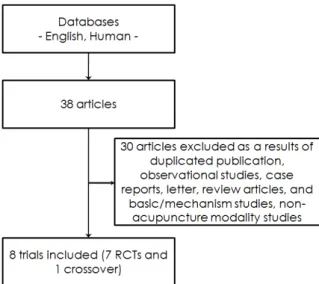
2009년 10월까지 database와 개별 journal들에 대 한 검색을 통해 총 38편의 논문이 검색되었으며 중복 게재되었거나, observational study, case report, review,
Fig. 1. Process of trial identification and selection
letter, 기초 문헌고찰, 약물 등 비침구요법이 main treat- ment modality로 활용된 연구를 제외하여 총 8편의 연구를 선정하였다(Fig. 1).
2. 논문의 특성 분석
중풍 발병 후 9.2±3.4일 경과한 이후의 환자를 모 집하여 연구를 진행한 Yan의 연구를 제외하고 다른 7편의 연구는 모두 만성기 중풍 환자를 대상으로 하 였다.
8편의 연구 모두 특별한 adverse event가 발견되지 않았으며, 실험군의 설정은 임상에서 활용되고 있는 치료방법을 기반으로 sham/placebo를 추가하는 방법 으로 설계되었다. Acupuncture modality의 종류로는 electroacupuncture 내지 경혈점에 대한 TENS 등 전 기자극을 이용한 연구가 5편으로 가장 많았으며, 나머 지 3편의 연구는 수기 침치료를 이용한 연구하였다 (Table 4).
3. 논문의 결과 분석
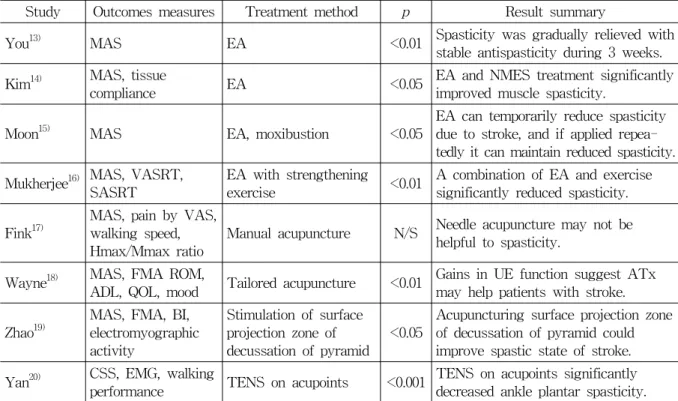
1회 전침자극으로 강직의 감소의 지속시간은 발침 후 30분13), 1시간까지14), 3시간까지15) 통계적으로 유의 하였다. 매일 반복하여 전침치료를 시행하면 5일차부 터 강직의 감소가 지속되며15), 매일 3주간 반복자극하 면 치료기간이 늘어나면서 강직의 감소효과가 유의하 게 강화되었다13).
전침과 운동요법을 병행하는 것이 운동요법만을 시행하는 것보다 강직의 정도를 현저하게 개선시키며,
Study Outcomes measures Treatment method p Result summary
You13) MAS EA <0.01 Spasticity was gradually relieved with
stable antispasticity during 3 weeks.
Kim14) MAS, tissue
compliance EA <0.05 EA and NMES treatment significantly
improved muscle spasticity.
Moon15) MAS EA, moxibustion <0.05
EA can temporarily reduce spasticity due to stroke, and if applied repea- tedly it can maintain reduced spasticity.
Mukherjee16) MAS, VASRT, SASRT
EA with strengthening
exercise <0.01 A combination of EA and exercise significantly reduced spasticity.
Fink17)
MAS, pain by VAS, walking speed, Hmax/Mmax ratio
Manual acupuncture N/S Needle acupuncture may not be helpful to spasticity.
Wayne18) MAS, FMA ROM,
ADL, QOL, mood Tailored acupuncture <0.01 Gains in UE function suggest ATx may help patients with stroke.
Zhao19)
MAS, FMA, BI, electromyographic activity
Stimulation of surface projection zone of decussation of pyramid
<0.05
Acupuncturing surface projection zone of decussation of pyramid could improve spastic state of stroke.
Yan20) CSS, EMG, walking
performance TENS on acupoints <0.001 TENS on acupoints significantly decreased ankle plantar spasticity.
MAS : modified ashworth scale. EA : electroacupuncture. NMES : neuromuscular electrical stimulation.
VAS : visual analog scale. ATx : manual acupuncture, FMA : Fugl-Meyer assessment. ROM : range of motion.
UE : upper extremity. ADL : activities of daily living. QOL : quality of life.
VASRT : velocity sensitivity of averaged speed-dependent reflex torque.
SASRT : segmented averaged speed-dependent reflex torque.
BI : Barthel Index. CSS : Composite Spasticity Scale.
EMG : electromyograph. TENS : transcutaneous electrical nerve simulator.
Table 5. Efficacy of Acup76cture and Relevant Modality on the Post-stroke Muscle Spasticity
Study Design Sample Age(Mx/Con) Intervention Control
Kim13) RCT 15/15/15 64.1 Electroacupuncture TENS, NMES
You14) RCT 19/29 61.0±9.9/60.7±9.4 Electroacupuncture Acupuncture
Moon15) RCT 15/15/10 58.2±10.8/63.9±9.2/
65.1±7.9
Electroacupuncture, moxibustion with routine acupuncture and ROM exercise
Routine
acupuncture and ROM exercise Mukherjee16) Cros-
sover 7 63.1±7.0 Electroacupuncture with
strengthen- ing exercise Exercise Fink17) RCT 12/13 61.3±8.4/56.0±11.8 Manual acupuncture Placebo
acupuncture
Wayne18) RCT 16/17 63/54 Acupuncture Sham acupuncture
Zhao19) RCT 67/64 58.5±11.6/60.3±11.7
Stimulation of surface projection zone of decussation of pyramid with TCM acupuncture
TCM acupuncture only
Yan20) RCT 19/19/18 68.4±9.6/72.8±7.4/
70.4±7.6
TENS on acupoints with standard rehabilitation(SR) method
Placebo with SR, SR only
RCT : randomized controlled trial. TENS : transcutaneous electrical nerve simulator.
NMES : neuromuscular electrical stimulation. TCM : traditional chinese medicine. SR : standard rehabilitation.
Table 4. Characteristics of Clinical Trials on Acupuncture and Relevant Modality on the Post-stroke Muscle Spasticity
Study Described as randomized
Described as double-blind
Withrawals and droupouts
Method of randomization
Method of
blinding Score
Kim13) 1 0 0 0 0 1
You14) 0 0 0 0 0 0
Moon15) 1 0 0 0 0 1
Mukherjee16) Crossover 0 0 0 0 0
Fink17) 1 Single 0 0 1 2
Wayne18) 1 Patient, assessor 1 1 1 5
Zhao19) 1 Single 1 1 0 3
Yan20) 1 0 1 1 1 4
Table 6. Jadad Scores for Clinical Trials on Acupuncture on the Post-stroke Muscle Spasticity
치료효과는 joint positions과 velocities of passive stretch에 따라 각각 다르게 나타났다16).
진짜침과 가짜침의 비교결과 환자 증상의 차이를 고려한 표준화 치료를 시행한 Fink17)의 연구에서는 modified Ashworth scale에는 유의한 차이가 없었으 나, Hmax/Mmax ratio는 유의하게 상승하였고, Wayne18) 의 연구에서는 active acupuncture group이 sham acu- puncture group에 비하여 wrist와 elbow의 spasticity 와 shoulder ROM, wrist ROM을 유의하게 개선시켰 다. Zhao19)는 surface projection zone of decussation of pyramid에 자극을 주면서 TCM acupuncture를 동 시 시행하는 경우 손목과 팔꿈치의 강직을 현저하게 개선시키며, 하지에서도 마찬가지 경향을 나타내는 것으로 보고하였다.
다만 뜸치료를 활용한 Moon15)의 연구에서는 spa- sticity 개선의 통계적 유의성은 없었다.
Kim13)은 단순 TENS를 활용한 경우 spasticity의 유의한 개선 효과가 없었다고 보고하였으며, Yan20)은 경혈점에 TENS를 시행한 group이 standard reha- bilitaion만을 시행한 group에 비해 normal tone으로 회복된 환자의 비율과 ankle dorsiflexor strength의 증가가 모두 유의하게 높았으며 antagonist의 co- contraction ratio를 유의하게 낮추는 것으로 보고하였 다. 또한 다른 그룹의 환자들에 비해서 2∼4일 정도 빠르게 걷기 시작하는 것으로 나타났다.
4. Jadad score에 의한 평가
5편의 연구가 Jadad score 2점 이하의 low quality 였으며, 3편의 연구는 Jadad score 3점 이상의 high quality를 나타냈다(Table 6).
Randomization은 6편의 연구에서 이루어졌으나 Wayne,
Zhao, Yan 3편의 연구에서만 randomization method 명시되었다. Wayne의 연구는 statistician이 computer- generated randomization하였고, Zhao의 연구는 random number table을 활용하였으며, Yan의 연구도 random number produced by a computer에 의해서 무작위 배분하였다.
Double blinding이 이루어진 연구는 한 편도 없었 으며, Fink, Wayne, Zhao의 연구는 single blinding으 로 진행되었으며, Fink, Wayne, Yan 3편의 연구에서 는 blinding method를 서술하였다.
Wayne의 연구에서는 study’s principal investi- gator(PMW)가 patient’s enrollment가 들어있는 봉투 를 개봉해서 acupuncturist에게 주어 patients, study staff, outcome assessors가 blinding되도록 연구를 진 행하였으며, 맹검의 적절성은 설문지를 활용하여 5- point Likert scale로 평가하였다. Fink는 investigator 와 환자들에게는 치료의 진위여부를 blinding 처리하였 고, acupuncture practitioner에게는 맹검처리하지 않 았다. 환자들은 누구도 치료의 진위를 구분하지 못하 였고, 별도의 questionnaire를 활용하여 credibility of treatment를 분석하였다. Yan은 모든 measurements 를 시행하는 연구 team이 환자의 군 분배에 대하여 맹검처리되었다.
5. FEAS에 의한 평가
FEAS의 항목을 모두 만족시킨 논문은 한 편도 없 었다(Table 7).
Fink와 Wayne의 연구 2편에서만 acupuncture ra- tionale가 명시되었는데, Wayne의 연구에서는 expert panel에 의해서 치료 혈위가 미리 선정되고 침시술자 가 四診으로 변증해서 선혈한 뒤 임상연구가 진행되
Intervention Kim13) You14) Moon15) Mukherjee16) Fink17) Wayne18) Zhao19) Yan20)
Acupuncture rationale 3 3 3 3 6 6 3 3
Method of stimulation 2.5 4.5 1.5 5 2.5 3.5 3.5 1
Treatment regimen 3 3 3 3 3 3 3 3
Practitioner’s background 3 3 3 0 2 3 3 3
Total 11.5 13.5 10.5 11 13.5 15.5 12.5 10
Table 7. FEAS Scores for Clinical Trials on Acupuncture on the Post-Stroke Muscle Spasticity
는 임상에서 활용되는 방법에 가깝게 연구가 진행되 었다.
Methods of stimulation의 경우 score가 1에서 5까 지 다양하게 나타났는데 침의 개수, 유침시간, 침의 종류에 대해서는 모든 연구에서 명시되고 있으나, 득 기에 대한 부분이 명시된 연구가 4편이었으며, 자침 깊이와 방향은 You, Mukherjee, Zhao 3편에서만 명 시되었고, 체위는 Mukherjee의 연구 한 편에서만 명 시되었다. 유침 도중 치료자극을 강화하는 부분에 대 해서는 5편에서 명시되었는데, 전침을 활용한 연구가 많았기 때문으로 보인다.
Treatment regimen 부분은 잘 기술되어 있었는데, 모든 연구에서 treatment sessions, frequency of treat- ment, treatment duration을 명시하였다.
Practitioner’s background를 명시하지 않은 Muk- herjee의 연구를 제외하면 나머지 7편의 연구에서는 침시술자의 자격요건을 명시하였거나 한방병원에서의 시행을 명시하고 있었다.
Ⅳ. 고 찰
Spasticity의 발생기전은 아직까지 명확하게 밝혀 져 있지 않다. 현재까지 spasticity는 비정상적이며 속 도-의존적인 muscle tone의 증가가 근육의 운동을 주 관하는 신경 회로의 손상에 수반되는 운동 장애를 말 하며 중풍, 뇌손상, 척수손상, 다발성경화증, 뇌성마비 등 다양한 질환의 흔한 합병증이다. Muscle stretch reflex가 spasticity 발생의 주요 기전으로 생각되며, tendon jerk가 증가된다21). 강직은 식사, 옷입기, 개인 위생활동, 방광과 대장의 조절, 활동성에 악영향을 미 치게 되며, 환자들의 타인에 대한 의존성을 높이며 결 과적으로 치료비용의 증가에 영향을 미치게 된다. 따 라서 이러한 환자들을 적절하게 치료하는 것이 매우
중요하다22). Spasticity의 치료는 환자와 보호자, 치료 자가 치료의 목표를 명확하게 정하는 것이 중요하다.
치료가 필요한 상태인지, 치료의 목적은 무엇인지, 치 료에 필요한 시간을 확보할 수 있는지, 치료가 환자의 생활에 악영향을 줄 수 있는지, 치료의 기능적인 목적이 무엇인지를 미리 정해야 한다22). 우선 염증 등의 noci- ceptive input을 제거하고, passive range of motion, positioning 등을 포함하는 재활치료를 진행하면서, 경 구약물과 neuromuscular block, chemoneurolysis 등 의 국소 주사요법을 활용하고, intrathecal pump를 설 치하거나, tendon lengthening or release procedure를 시행하거나, tendon transfer를 하는 등의 수술적 요 법을 시행하게 된다8).
2009년 10월까지 database와 개별 journal 들에 대 한 검색을 통해 총 38편의 논문이 검색되었으며 중복 게재되었거나, observational study, case report, re- view, letter, 기초 문헌고찰, 약물 등 비침구요법이 main treatment modality로 활용된 연구를 제외하여 총 8 편의 연구를 선정하고, 중풍 후 강직에 다양한 침구 치료의 효과에 대한 보다 신뢰성 있는 결론을 도출하 기 위한 계통적 연구를 시행하였다.
중풍 발병 후 9.2±3.4일 경과한 이후에 환자를 모 집하여 연구를 진행한 Yan의 연구를 제외하고 다른 7편의 연구는 모두 만성기 중풍 환자를 대상으로 하 였다. 8편의 연구 모두 기존의 연구 또는 경험을 기반 으로 임상에서 활용되는 치료법을 활용한 것이기 때 문에 특별한 adverse event가 발견되지 않았으며, 따 라서 대조군의 선정 역시 현재 활용되고 있는 치료방 법을 기반으로 sham/placebo를 추가하는 방법으로 설 계되었다. Intervention으로는 electroacupuncture 내 지 경혈점에 대한 TENS 등 전기자극을 이용한 연구 가 5편으로 가장 많았으며 3편의 연구는 침치료를 이 용한 연구였다(Table 4).
치료 횟수에 의한 강직의 감소효과는 You의 연구 에서는 1회의 체침 자극은 발침 직후에만 치료 직전에
비하여 유의한 강직의 감소를 보였으나, 전침 자극의 경우 발침 후 24시간까지 강직의 감소가 나타났으며, 이러한 감소효과가 1시간까지 유의하다고 보고하였으 며, Kim은 30분까지 유의하다고 보고하였고, Moon은 3시간까지 유의하다고 보고하였다. Moon은 매일 반 복해서 전침치료를 시행하여 5일차부터 spasticity의 감소가 지속되며, You는 전침을 매일 1회 3주간 반복 자극하였을 경우 강직의 감소효과가 치료기간의 반복 에 비례하여 유의하게 증가한다고 보고하였다.
Mukherjee는 전침과 운동요법을 병행하는 group 이 운동요법만을 시행하는 group보다 spasticity를 현 저하게 개선시키며 치료효과는 joint positions과 velo- cities of passive stretch에 따라 각각 다르게 나타난 다고 보고하였다.
또한 Fink는 미리 선정된 혈위와 환자의 증상에 따른 추가 혈위를 활용한 manual acupuncture를 시 행하였을 때, placebo group에 비하여 spasticity의 증 상 중증도 측정 지표인 modified Ashworth scale에는 유의한 변화를 나타내지 않았으며, spasticity의 신경 생리학적 지표인 Hmax/Mmax ratio는 유의하게 상승 하는 것으로 나타났다. 이는 침치료가 spinal alpha motoneuron excitability를 강화한 것으로 lower moto- neuron을 spinal(segmental) level에서 fascilitation 하 였다는 것을 의미한다고 볼 수 있다. Manual acu- puncture 치료가 운동성을 강화하는 방향으로 작용하 여 spasticity의 개선효과를 감쇄하였다고 볼 수 있다.
다른 연구들에서 전침 등 다른 modality를 활용한 경 혈점 자극요법을 활용하여 antispastic effect를 입증한 것과 차이가 있으며 추후 다른 modality를 활용한 연 구에서도 H-reflex 등의 neurophysiological assess- ment를 활용해 보아야 할 것이다. 다만 실험에 참여 한 환자들이 onset 7개월이 경과한 환자들로 motor 회복의 둔화 추세와 spasticity의 강화가 고착화되는 시기이며, placebo를 blunt tip의 needle로 비경혈점에 자극을 하는 방법을 택했으나, 환자들이 pricking sen- sation을 느끼며 피부에 자극을 받고 있다는 느낌을 느낄 수 있는 한계점이 있었다.
그러나 body acupoints에는 전침을 시행하고 scalp acupoints에는 수기자극을 시행한 Wayne의 연구에서 active acupuncture group이 sham acupuncture group (developed by Streitberger and Kleinhenz)에 비하여 wrist와 elbow의 spasticity와 shoulder ROM, wrist ROM을 유의하게 개선된다고 보고하였다. Zhao는 sur- face projection zone of decussation of pyramid에 자
극을 주면서 TCM acupuncture를 동시 시행하는 경 우 손목과 팔꿈치의 강직을 현저하게 개선하며, 하지 에서도 마찬가지 경향을 나타내는 것으로 보고하였다.
다만 뜸치료를 활용한 Moon의 연구에서는 spas- ticity의 감소가 통계적으로 유의하지는 않은 것으로 나타났다.
Kim은 단순 TENS를 활용한 경우 spasticity의 유 의한 개선 효과가 없었다고 보고하였으며, YAN은 경 혈점에 TENS를 시행한 group이 standard rehabi- litaion만을 시행한 group에 비해 normal tone으로 회 복된 환자의 비율과 ankle dorsiflexor strength의 증가가 모두 유의하게 높았으며 antagonist의 co- contraction ratio를 유의하게 낮추는 것으로 보고하였 다. 또한 다른 그룹의 환자들에 비해서 2∼4일 정도 빠르게 걷기 시작하는 것으로 나타났다.
Jadad scale을 활용한 methodological assessment 를 한 결과 5편의 연구가 Jadad score 2점 이하의 low quality였으며 3편의 연구는 Jadad score 3점 이 상의 high quality를 나타냈다(Table 6). Randomi- zation은 6편의 연구에서 이루어졌으나 Wayne, Zhao, Yan 3편의 연구에서만 randomization method가 명 시되었다. Wayne의 연구는 statistician이 computer- generated randomization하였고, Zhao의 연구는 random number table을 활용하였으며, Yan의 연구도 random number produced by a computer에 의해서 무작위 배분하였다. Double blinding이 이루어진 연구는 한 편도 없었으며 Fink, Wayne, Zhao의 연구는 single blinding으로 진행되었으며, Fink, Wayne, Yan 3편의 연구에서는 blinding method를 서술하였다. Wayne의 연구에서는 study’s principal investigator(PMW)가 patient’s enrollment가 들어있는 봉투를 개봉해서 acu- puncturist에게 주어 patients, study staff, outcome assessors가 blinding되도록 연구를 진행하였으며, 맹 검의 적절성은 설문지를 활용하여 5-point Likert scale로 평가하였다. Fink는 investigator와 환자들에 게는 치료의 진위여부를 blinding 처리하였고, acupunc- ture practitioner에게는 맹검처리하지 않았다. 환자들 은 누구도 치료의 진위를 구분하지 못하였고, 별도의 questionnaire를 활용하여 credibility of treatment를 분석하였다. Yan은 모든 measurements를 시행하는 연 구 team이 환자의 군 분배에 대하여 맹검처리되었다.
STRICTA의 기준을 따른 FEAS의 항목을 모두 만 족시킨 논문은 한 편도 없었다(Table 7).
Fink와 Wayne의 연구 2편에서만 acupuncture ra-
tionale가 명시되었는데, Wayne의 연구에서는 expert panel에 의해서 치료 혈위가 미리 선정되고 침 시술 자가 四診으로 변증해서 선혈한 뒤 임상연구가 진행되 는 임상에서 활용되는 방법에 가깝게 연구가 진행되었 다. Zhao의 연구에서는 선혈의 근거를 ‘TCM theory’라 고만 되어 있고, 경락학적․경혈학적인 한의학적 근 거가 제시되지 않았다.
Methods of stimulation의 경우 score가 1에서 5까 지 다양하게 나타났는데, 침의 개수, 유침시간, 침의 종류에 대해서는 모든 연구에서 명시되고 있으나, 득 기에 대한 부분이 명시된 연구가 4편이었으며, 자침 깊이와 방향은 You, Mukherjee, Zhao 3편에서만 명 시되었고, 체위는 Mukherjee의 연구 한 편에서만 명 시되었다. 유침 도중 치료자극을 강화하는 부분에 대 해서는 5편에서 명시되었는데, 전침을 활용한 연구가 많았기 때문으로 보인다.
Treatment sessions, frequency of treatment, treat- ment duration은 모든 연구에서 명시되고 있었다.
한의학이 한의사 또는 중의사에 의해 시술되는 한 국․중국의 경우에는 연구가 시행된 병원 또는 학교 가 명시되거나 IRB가 한의학 교육이 시행되는 병원 또는 학교인 경우에는 practitioner’s background를 명 시하지 않더라도 certified acupuncturist 또는 speci- alist로 인정하였다. 한국과 중국 이외의 지역에서 이 루어진 연구의 경우에는 치료자의 배경을 명시한 단 계에 맞추어 FEAS score를 부여하였는데, practitioner’s background를 명시하지 않은 Mukherjee의 연구를 제 외하면 나머지 7편의 연구에서는 침시술자의 자격요 건을 명시하였거나 한방병원에서의 시행을 명시하고 있었다.
Ⅴ. 결 론
본 연구에서는 2009년 10월까지 PubMed에서 검색 된 중풍 후 강직에 다양한 침구 치료를 시행한 8편의 연구에 대한 계통적 연구를 시행하였다. Intervention 으로는 electroacupuncture 내지 경혈점에 대한 TENS 등 전기자극을 이용한 연구가 5편으로 가장 많았으며, 전침 자극의 경우 일정시간 까지 강직의 감소효과가 지속되며, 강직의 감소효과가 치료기간의 반복에 비 례하여 유의하게 증가되었다. 단순 TENS보다는 경혈 점에 TENS를 시행하는 것이 강직의 감소에 효과적이
었다. Jadad scale에서는 3편의 연구만이 high quality 였으며, STRICTA의 기준을 따른 FEAS의 항목을 모 두 만족시킨 논문은 한 편도 없었다. 연구들의 metho- dological quality에서 double-blinding method가 명시 되지 않고 있는데, 보다 질 높은 연구결과를 위해서는 blinding method에 대한 추후 연구가 필요할 것으로 사료된다.
Ⅵ. 참고문헌
1. Lance JW. Symposium synopsis. In: Feldman FG, Young RR, Koella WPs, eds. Spasticity : Disorder of Motor Control. Chicago, Ill : Year Book Medical. 1980 ; 485-94.
2. Brin MF. Preface. Mescle Nerve Supple. 1997 ; 6 : 1.
3. McGuire JR, Harvey RL. The prevention and management of complications after stroke. Phys Med Rehabil Clin North Am. 1999 ; 10 : 857- 74.
4. Roth E, Harvey R. Rehabilitation of stroke syndromes. In : Braddom R, editor. Physical medicine and rehabilitation. Philadelphia : WB Saunders. 1996 ; 1053-87.
5. Mayer NH, Esquenazi A, Childers MK. Common patterns of clinical motor dysfunction. Muscle Nerve Suppl. 1997 ; 6 : S21-35.
6. Katz RT. Management of spasticity. In : Brad- dom R, editor. Physical medicine and rehabili- tation. Philadelphia : WB Saunders. 1996 : 580- 604.
7. 통계청. 사망원인통계연보. 2007. Available from : URL : http//www.kosis.kr/
8. Bogey RA, Geis CC, Bryant PR, Moroz A, O’neill BJ. Stroke and neurodegenerative disorders.
3. Stroke : rehabilitation management. Arch Phys Med Rehabil. 2004 ; 85(3) : S15-20.
9. Moher D, Cook DJ, Jadad AR, Tugwell P, Mo- her P, Jones A, Pham B, Klassen TP. Asses- sing the quality of reports of randomized trials:
Implications for the conduct of meta-analyses.
Health Technology Assessment. 1999 ; 3(12) :
1-98.
10. Jadad AR, Moore RA, Carroll D, Jenkinson C, Reynolds DJM, Gavaghan DJ, McQuay HJ.
Assessing the quality of reports of randomized clinical trials : is blinding necessary? Control Clin Trials. 1996 ; 17 : 1-12.
11. 이향숙, 박종배, 서정철, 박히준, 이혜정. 침의 대 조군 연구에서 실험처치 보고에 대한 표준- STRICTA 권장안 및 침 임상실험에서 최적의 치 료, 거짓대조군 및 블라인딩에 관한 동의안. 대한 침구학회지. 2002 ; 19(6) : 134-54.
12. 김우영, 이승덕, 임병묵, 김갑성. STRICTA 권장 안에 기초한 침 연구방법론의 적절성 평가-새로 운 평가지수를 이용한 5편 Systematic review와 그 대상인 58편 무작위대조시험의 고찰-. 대한침 구학회지. 2007 ; 24(5) : 151-70.
13. 김용석. 중풍경직에 전침, TENS 및 신경근 자극 기의 효과에 대한 연구. 대한침구학회지. 2000 ; 17(2) : 209-20.
14. 유진호, 김용석, 강성길. 전침자극이 중풍환자의 경직에 미치는 효과. 대한침구학회지. 1999 ; 16 (2) : 1-12.
15. Moon SK, Whang YK, Park SU, Ko CN, Kim YS, Bae HS, Cho KH. Antispastic effect of electroacupuncture and moxibustion in stroke patients. Am J Chin Med. 2003 ; 31(3) : 467-74.
16. Mukherjee M, McPeak LK, Redford JB, Sun C, Liu W. The effect of electro-acupuncture on spasticity of the wrist joint in chronic stroke
survivors. Arch Phys Med Rehabil. 2007 ; 88(2) : 159-66.
17. Fink M, Rollnik JD, Bijak M, Borstädt C, Däu- per J, Guergueltcheva V, Dengler R, Karst M.
Needle acupuncture in chronic poststroke leg spasticity. Arch Phys Med Rehabil. 2004 ; 85(4) : 667-72.
18. Wayne PM, Krebs DE, Macklin EA, Schnyer R, Kaptchuk TJ, Parker SW, Scarborough DM, McGibbon CA, Schaechter JD, Stein J, Stason WB. Acupuncture for upper-extremity rehabilit- ation in chronic stroke : a randomized sham- controlled study. Arch Phys Med Rehabil. 2005 ; 86(12) : 2248-55.
19. Zhao JG, Cao CH, Liu CZ, Han BJ, Zhang J, Li ZG, Yu T, Wang XH, Zhao H, Xu ZH. Effect of acupuncture treatment on spastic states of stroke patients. J Neurol Sci. 2009 ; 276 : 143-7.
20. Yan T, Hui-Chan CW. Transcutaneous electrical stimulation on acupuncture points improves muscle function in subjects after acute stroke : a ran- domized controlled trial. J Rehabil Med. 2009 ; 41(5) : 312-6.
21. Young RR. Spasticity : a review. Neurology. 1994 ; 44(Suppl) : S12-20.
22. Lalith E. Satkunam. Rehabilitation medicine : 3.
Management of adult spasticity. CMAJ. 2003 ; 169(11) : 1173-9.