INTRODUCTION
Asthma is a common disease worldwide that affects a large number of people, with approximately 300 million patients all over the world.1 Some of the symptoms of the disease include lung inflammation and difficulty of breathing when the patient is under the influence of various asthma-inducing factors.
Among them, non-steroidal anti-inflammatory drugs (NSAIDs) such as aspirin are known to cause aspirin exacerbated respira- tory disease (AERD), which was first described in 1922.2,3 Usual symptoms of AERD patients include aspirin sensitivity, bron- chial asthma, and chronic rhinosinusitis with nasal polyposis,4-6 and the airway inflammation is often initiated by T lymphocytes.
Aspirin (acetylsalicylic acid) is primarily used as a pain and fe- ver reliever as well as an anti-inflammatory medication.
Association Analysis Between FILIP1 Polymorphisms and Aspirin Hypersensitivity in Korean Asthmatics
Jason Yongha Kim,
1Jeong-Hyun Kim,
1Byung-Lae Park,
2Charisse Flerida A. Pasaje,
1Joon Seol Bae,
2Jong Sook Park,
3An-Soo Jang,
3Soo-Taek Uh,
4Yong-Hoon Kim,
5Mi-Kyeong Kim,
6Inseon S. Choi,
7Sang Heon Cho,
8Byoung Whui Choi,
9Choon-Sik Park,
3* Hyoung Doo Shin
1,2*
1Department of Life Science, College of Natural Sciences, Sogang University, Seoul, Korea
2Department of Genetic Epidemiology, SNP Genetics Inc., Seoul, Korea
3Division of Allergy and Respiratory Medicine, Soonchunhyang University Bucheon Hospital, Bucheon, Korea
4Division of Allergy and Respiratory Medicine, Soonchunhyang University Hospital, Seoul, Korea
5Division of Allergy and Respiratory Medicine, Soonchunhyang University Cheonan Hospital, Cheonan, Korea
6Department of Internal Medicine, Chungbuk National University College of Medicine, Cheongju, Korea
7Department of Allergy, Chonnam National University Medical School and Research Institute of Medical Sciences, Gwangju, Korea
8Department of Internal Medicine and Institute of Allergy and Clinical Immunology, Seoul National University College of Medicine, Seoul, Korea
9Division of Pulmonology and Allergy, Department of Internal Medicine, Chung-Ang University Yongsan Hospital, Seoul, Korea
The protein product from filamin A interacting protein 1 (FIL- IP1) is closely associated with the protein filamin A. The main role of filamin A is commonly known as an actin-binding pro- tein that links actin filaments in cortical cytoplasm and helps form an actin cytoskeleton. This remodeling of the cytoskeleton Allergy Asthma Immunol Res. 2013 January;5(1):34-41.
http://dx.doi.org/10.4168/aair.2013.5.1.34 pISSN 2092-7355 • eISSN 2092-7363
Purpose: Aspirin exacerbated respiratory disease (AERD) results in a severe asthma attack after aspirin ingestion in asthmatics. The filamin A in- teracting protein 1 (FILIP1) may play a crucial role in AERD pathogenesis by mediating T cell activation and membrane rearrangement. We investi- gated the association of FILIP1 variations with AERD and the fall rate of forced expiratory volume in one second (FEV1). Methods: A total of 34 common FILIP1 single nucleotide polymorphisms (SNPs) were genotyped in 592 Korean asthmatic subjects that included 163 AERD patients and 429 aspirin-tolerant asthma (ATA) controls. Results: This study found that 5 SNPs (P=0.006-0.01) and 2 haplotypes (P=0.01-0.03) of FILIP1 showed nominal signals; however, corrections for the multiple testing revealed no significant associations with the development of AERD (Pcorr>0.05). In ad- dition, association analysis of the genetic variants with the fall rate of FEV1, an important diagnostic marker of AERD, revealed no significant evi- dence (Pcorr>0.05). Conclusions: Although further replications and functional evaluations are needed, our preliminary findings suggest that ge- netic variants of FILIP1 might be not associated with the onset of AERD.
Key Words: Filamin A interacting protein 1; single nucleotide polymorphism; haplotype; asthma; aspirin exacerbated respiratory disease
This is an Open Access article distributed under the terms of the Creative Commons Attribution Non-Commercial License (http://creativecommons.org/licenses/by-nc/3.0/) which permits unrestricted non-commercial use, distribution, and reproduction in any medium, provided the original work is properly cited.
Correspondence to: Hyoung Doo Shin, DVM, PhD, Department of Life Science, Sogang University, 1 Sinsu-dong, Mapo-gu, Seoul 121-742, Korea.
Tel: +82-2-3273-1671; Fax: +82-2-3273-1680; E-mail: [email protected] Co-corresponding author: Choon-Sik Park, MD, PhD, Division of Allergy and Respiratory Medicine, Soonchunhyang University Bucheon Hospital, 1174 Jung-dong, Wonmi-gu, Bucheon 420-767, Korea.
Tel: +82-32-621-5105; Fax: +82-32-621-5023; E-mail: [email protected] Received: March 28, 2012; Revised: May 4, 2012; Accepted: May 21, 2012
•There are no financial or other issues that might lead to conflict of interest.
•Jason Yongha Kim and Jeong-Hyun Kim contributed equally on this paper.
is essential for cell shape modification, spreading and cell mi- gration (OMIM).7 Along with filamin A, FILIP1 has also been associated with cell migration and motility on various ac- counts;8-10 many researchers have shown that these two pro- teins interact together in most cases. Recently, a group of re- searchers found that filamin A is also closely associated with T cell activation and membrane rearrangement, which are corre- lated with asthma and related diseases.11,12 Furthermore, a re- cent study has found that T cells are linked with AERD via the leukotriene B4 (LTB4) pathway.13
Single nucleotide polymorphisms (SNPs) in CYSLTR2, ALOX5, LTC4S, and SLC6A12 are shown to be associated with AERD,14-
17 and suggest that the small effects of various genetic factors may play a role in the development of the disease. Furthermore, our previous genome-wide and follow-up studies show associ- ations between FILIP1 polymorphisms and AERD.18 Consider- ing that, FILIP1 is related to T-cell modification, we further in- vestigated associations of FILIP1 genetic variations with the fall rates of forced expiratory volume by aspirin provocation as well as AERD development.
MATERIALS AND METHODS Study subjects
This study was conducted in compliance with the Global Ini- tiative for Asthma (GINA) report Global Strategy for Asthma Management and Prevention. A total of 592 subjects were re- cruited from the Asthma Genome Research Center comprised of Soonchunhyang University Hospital (both Bucheon and Cheonan), Chungbuk National University Hospital, Chonnam National University Hospital, Chung-Ang University Yongsan Hospital, and Seoul National University Hospital. All subjects provided informed consent, and the protocols were approved
by the Institutional Review Board of each hospital. Each patient showed airway reversibility such as inhalant bronchodilator-in- duced improvement with over 15% of forced expiratory volume in 1 second (FEV1) and/or airway hyperresponsiveness to the provocative concentration of P20 methacholine.19
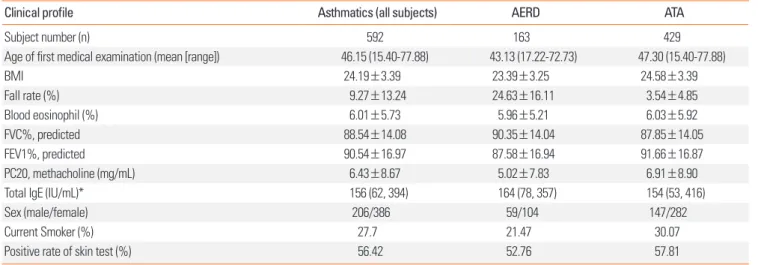
All patients had a history of dyspnea and wheezing in the past 12 months, plus one of the following: 1) >15% increase in FEV1 or >12% increase plus 200 mL following the inhalation of a short- acting bronchodilator, 2) <10 mg/mL PC20 methacholine, and 3) >20% increase in FEV1 following 2 weeks of treatment with inhaled steroids and long-acting bronchodilators. Twenty-four common inhalant allergens were used for a skin prick test.20 To- tal IgE was measured with the CAP system (Pharmacia Diag- nostics, Uppsala, Sweden), and atopy was defined as having a wheal reaction equal to or greater than histamine or 3 mm in diameter. All asthmatic patients had experienced no exacerba- tion of asthma and respiratory tract infection 6 weeks prior to the oral aspirin challenge (OAC). OAC was performed with in- creasing doses of aspirin using methods slightly modified from those previously described.20,21 Changes in FEV1 were followed for 5 hours after the last aspirin challenge dose. Aspirin-induced bronchospasms, as reflected by rate (%) of FEV1 decline, were calculated as the pre-challenge FEV1 minus the post-challenge FEV1 divided by the pre-challenge FEV1. OAC reactions were categorized into 2 groups of a 15% or greater decrease in FEV1 with naso-ocular or cutaneous reactions (AERD) and less than a 15% decrease in FEV1 without naso-ocular or cutaneous re- actions (aspirin tolerant asthma, ATA). The clinical profiles of the subjects are listed in Table 1.
SNP selection and genotyping
Thirty-four common (MAF>0.05) SNPs of FILIP1, with MAF>
0.05, were selected based on linkage disequilibrium (LD) status
Table 1. Clinical profiles of AERD patients and ATA cases
Clinical profile Asthmatics (all subjects) AERD ATA
Subject number (n) 592 163 429
Age of first medical examination (mean [range]) 46.15 (15.40-77.88) 43.13 (17.22-72.73) 47.30 (15.40-77.88)
BMI 24.19±3.39 23.39±3.25 24.58±3.39
Fall rate (%) 9.27±13.24 24.63±16.11 3.54±4.85
Blood eosinophil (%) 6.01±5.73 5.96±5.21 6.03±5.92
FVC%, predicted 88.54±14.08 90.35±14.04 87.85±14.05
FEV1%, predicted 90.54±16.97 87.58±16.94 91.66±16.87
PC20, methacholine (mg/mL) 6.43±8.67 5.02±7.83 6.91±8.90
Total IgE (IU/mL)* 156 (62, 394) 164 (78, 357) 154 (53, 416)
Sex (male/female) 206/386 59/104 147/282
Current Smoker (%) 27.7 21.47 30.07
Positive rate of skin test (%) 56.42 52.76 57.81
Fall rate refers to the decline of FEV1% by aspirin provocation.
*Total IgE value is shown as median (25% interquartile interval, 75% interquartile interval).
AERD, aspirin exacerbated respiratory disease; ATA, aspirin-tolerant asthma; FVC, forced vital capacity; FEV1, forced expiratory volume in 1 second.
from an Asian (Chinese and Japanese) population database of the International HapMap Project (http://hapmap.ncbi.nlm.
nih.gov/). Then, the selected SNPs were genotyped in 163 AERD and 429 ATA subjects. Genotyping was performed on a multi- plex level using the Illumina Golden Gate genotyping system (Illumina, San Diego, CA, USA) and data quality was assessed by duplicate DNAs (n=10). The SNPs were scanned using BeadXpress® (Illumina). SNPs that could not meet the follow- ing criteria were excluded: 1) a minimum call rate of 95%, 2) no duplicate error, and 3) a Hardy-Weinberg equilibrium of P>
0.05. As a result, 34 SNPs on FILIP1 were successfully genotyped.
Statistics
We examined Lewontin’s D’ (|D’|) and the linkage disequilib- rium (LD) coefficient r2 between all pairs of biallelic loci. LD was obtained using the algorithm developed by the Broad Institute (using the program Haploview).22 Haplotypes were first esti- mated using PHASE software,23 and then computed by logistic analyses using SAS. Subjects harboring missing genotypes were omitted in the analysis of individual single-nucleotide poly- morphisms and haplotypes. The genotype and haplotype asso- ciation with AERD were analyzed using logistic models with age (continuous value), gender (male=0, female=1), smoking status (non-smoker=0, ex-smoker=1, smoker=2), atopy (ab- sence=0, presence=1), and body mass index (BMI) as covari- ates compared to ATA patients as a control; significant associa- tions are shown in bold character (P<0.05). The association analysis of differences in the fall rates in FEV1, following the as- pirin challenge with the genotypes and haplotypes, were exam-
ined using SAS. To correct for the multiple testing error, we cal- culated the correction number of 27.21 using SNPSpD software (http://gump.qimr.edu.au/general/daleN/SNPSpD/).
RESULTS
Characteristics of study subjects
For our study, 592 subjects were recruited, with 163 AERD pa- tients as cases and 429 ATA patients as controls. The phenotype data of all subjects are summarized in Table 1. As expected, the fall rate of AERD subjects was significantly higher than that of the controls (24.63% for AERD subjects and 3.54% for ATA con- trols, P<0.0001). Other notable differences between cases and controls include age of first medical examination, BMI, FEV1, PC20 methacholine, and current smoking status (P<0.05).
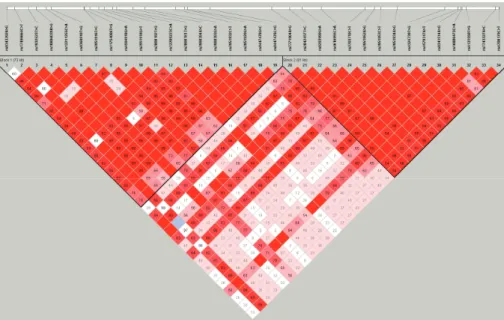
Genotyping, LD and haplotype of FILIP1 polymorphisms From the samples, we successfully genotyped a total of 34 common SNPs located in the intronic regions of FILIP1, span- ning over 186 kb region in chromosome 6q14.1 (Fig. 1A). Re- sults from the Hardy-Weinberg Equilibrium (HWE) test showed no significant difference between the distribution of the ob- served genotypes and the expected distributions (P>0.05; Ta- ble 2). Several SNPs were found to have absolute LD (|D’|=1 and r2=1, Fig. 1A) and indicated that these SNPs are always in- terlinked. Haplotypes were estimated (Fig. 1B), and only those with a frequency higher than 0.05 were analyzed for associations.
The SNPs comprised two tight haplotype blocks, with 19 SNPs in haplotype block 1 and 15 SNPs in haplotype block 2 (Figs. 1, 2).
G (0.121) >T (0.038) C (0.363) >G (0.352) >A (0.121) G (0.193) C (0.308) >G (0.162) A (0.354) T (0.365) G (0.497) >A (0.113) G (0.218) C (0.462) A (0.401) T (0.461) A (0.461) C (0.171) G (0.183) G (0.395) C (0.132) A (0.199) A (0.100) T (0.131) G (0.472) T (0.132) G (0.472) G (0.471) T (0.216) G (0.397) >A (0.143) G (0.397) C (0.360) T (0.360)
r2=1 r2=1 r2=1 r2=1
rs9343292 A>G rs17496664 C> rs1932523 T>C rs10806039 A> rs12211255 C> rs9360910 T>G rs2951916 T>C rs11754006 T> rs4594918 G>A rs2951918 G>T rs2808182 T>G rs12209223 C> rs2808181 T>G rs2998394 A>C rs2998393 G>A rs2951932 C>T rs2951929 G>A rs9447478 G>C rs9447476 C>G rs7771904 A>G rs2842457 T>C rs9293999 G>A rs4616955 C>A rs2703710 C>T rs2951952 A>G rs2951953 C>T rs2951934 A>G rs4324739 T>G rs4579317 A>T rs9341514 A>G rs16886475 C> rs4131550 T>G rs7743227 A>C rs4708179 C>T
Ex1 Ex2+1 Ex3 Ex4 Ex5, 6
A>G 4 C>T T>C 9 A>G 5 C>A T>G T>C 6 T>G G>A G>T T>G 3 C>A T>G A>C G>A C>T G>A G>C C>G
Block 1 Block 2
A>G 7 T>C 9 G>A C>A 0 C>T A>G C>T A>G 9 T>G 7 A>T A>G 75 C>A 0 T>G 7 A>C 9 C>T Hap. 92rs32934 rs17496664 2319325rs rs10806039 52511rs122 rs9360910 1916295rs rs11754006 rs4594918 18rs19295 rs8182280 22309122rs 2808181rs rs2998394 93rs29983 rs2951932 1929295rs rs9447478 rs9447476
Freq.
ht1 A C T A C T T T G G G C T C G T A G C 0.449 ht2 A C T A C T C T G G T C T A G C G G C 0.137 h 3 A C C G C G T T A T T C T A A C G C G 0 129
Hap. rs7771904 rs2842457 rs9293999 5569461rs rs2703710 rs2951952 rs2951953 3429519rs rs4324739 rs4579317 rs9341514 4716886rs rs4131550 rs7743227 rs4708179 Freq.
ht1 A T G C C G C G G A A C T A C 0.457 ht2 G T A C C A C A T T G C G C T 0.193 ht3 A C G C T A T A T A A C T A C 0 132 ht3 A C C G C G T T A T T C T A A C G C G 0.129
ht4 G C C G A T C G A T T A G A A C G G C 0.103 ht5 A C C G C G T T A T T C G A A C G G C 0.056 ht6 A T C G C T C G A T T C G A A C G G C 0.038 ht7 A C T A C T T T G G G C T A A C G C G 0.034 ht8 A C C A C T C T G T T C T A A C G G G 0.011
ht3 A C G C T A T A T A A C T A C 0.132 ht4 G T G A C A C A T A G A G C T 0.093 ht5 G T G C C A C A T A G C G C T 0.037 ht6 G T G C C A C A T A G A G A C 0.031 ht7 G T G C C A C A T T G C G C T 0.016 ht8 G T G C C A C A T A G A G C T 0.010 ht9 G C C G A T C G A T T C G A A C G G C 0.009
ht10 A C C G A T C G A T T A G A A C G G C 0.006 Others . . . 0.027
ht9 A T G C C G C G G A A C T C T 0.009 ht10 G T A C C A C A T T G C G A C 0.006 Others . . . . . . . . . . . . . . . 0.016
Fig. 1. Gene maps and haplotypes of the FILIP1. (A) A map of FILIP1 on chromosome 6q14.1, in which coding exons, UTR, and SNPs are shown. Coding exon (Ex) is marked by shaded blocks while UTRs are marked by white blocks. (B) Haplotypes of FILIP1 in the Korean population. SNPs are divided into 2 haplotype blocks. Only common haplotypes (frequency>0.05) were used for an association analysis.
A
B
Table 2. Associations of FILIP1 SNPs and haplotypes with AERD
SNP/Haplotype Position MAF
Heterozygosity HWE* OR (95% CI) P Pcorr†
AERD (n=163) ATA (n=429) Total (n=592)
rs9343292A>G Intron 0.126 0.118 0.121 0.213 0.932 1.04 (0.70-1.55) 0.84 -
rs17496664C>T Intron 0.028 0.040 0.038 0.072 0.896 0.60 (0.28-1.31) 0.20 -
rs1932523T>C Intron 0.402 0.347 0.363 0.463 0.525 1.30 (0.98-1.72) 0.07 -
rs10806039A>G Intron 0.393 0.334 0.352 0.456 0.521 1.33 (1.00-1.76) 0.05 -
rs12211255C>A Intron 0.126 0.117 0.121 0.213 0.404 1.06 (0.71-1.58) 0.79 -
rs9360910T>G Intron 0.239 0.178 0.193 0.312 0.722 1.59 (1.14-2.21) 0.006 0.16
rs2951916T>C Intron 0.322 0.294 0.308 0.426 0.549 1.10 (0.82-1.46) 0.53 -
rs11754006T>G Intron 0.153 0.160 0.162 0.271 0.696 0.90 (0.62-1.30) 0.57 -
rs4594918G>A Intron 0.393 0.337 0.354 0.457 0.444 1.31 (0.99-1.74) 0.06 -
rs2951918G>T Intron 0.402 0.350 0.365 0.464 0.447 1.28 (0.97-1.69) 0.08 -
rs2808182T>G Intron 0.439 0.524 0.497 0.500 0.471 0.69 (0.52-0.91) 0.008 0.22
rs12209223C>A Intron 0.120 0.107 0.113 0.201 0.676 1.05 (0.70-1.59) 0.82 -
rs2808181T>G Intron 0.242 0.203 0.218 0.341 0.321 1.19 (0.87-1.61) 0.28 -
rs2998394A>C Intron 0.405 0.490 0.462 0.497 0.477 0.70 (0.53-0.92) 0.01 0.27
rs2998393G>A Intron 0.436 0.386 0.401 0.480 0.348 1.25 (0.95-1.64) 0.12 -
rs2951932C>T Intron 0.405 0.488 0.461 0.497 0.448 0.70 (0.53-0.92) 0.01 0.27
rs2951929G>A Intron 0.404 0.488 0.461 0.497 0.472 0.70 (0.53-0.92) 0.01 0.27
rs9447478G>C Intron 0.184 0.169 0.171 0.283 0.716 1.20 (0.84-1.70) 0.31 -
rs9447476C>G Intron 0.193 0.183 0.183 0.299 0.801 1.15 (0.82-1.61) 0.43 -
FILIP1_BL1_ht1 0.402 0.474 0.450 0.495 0.742 0.74 (0.57-0.98) 0.03 0.82
FILIP1_BL1_ht2 0.156 0.122 0.135 0.234 0.244 1.32 (0.91-1.93) 0.15 -
FILIP1_BL1_ht3 0.153 0.125 0.131 0.228 0.928 1.40 (0.96-2.05) 0.08 -
FILIP1_BL1_ht4 0.117 0.094 0.102 0.184 0.268 1.22 (0.79-1.87) 0.37 -
FILIP1_BL1_ht5 0.083 0.044 0.055 0.104 0.399 1.95 (1.15-3.30) 0.01 0.27
rs7771904A>G Intron 0.414 0.392 0.395 0.478 0.633 1.08 (0.83-1.42) 0.56 -
rs2842457T>C Intron 0.153 0.122 0.132 0.229 0.316 1.32 (0.91-1.93) 0.15 -
rs9293999G>A Intron 0.190 0.203 0.199 0.319 0.574 0.87 (0.63-1.21) 0.42 -
rs4616955C>A Intron 0.110 0.098 0.101 0.181 0.771 1.28 (0.83-1.98) 0.27 -
rs2703710C>T Intron 0.150 0.122 0.131 0.228 0.336 1.29 (0.88-1.89) 0.19 -
rs2951952A>G Intron 0.433 0.485 0.472 0.498 0.811 0.82 (0.63-1.07) 0.14 -
rs2951953C>T Intron 0.150 0.124 0.132 0.229 0.316 1.28 (0.88-1.88) 0.20 -
rs2951934A>G Intron 0.433 0.485 0.472 0.498 0.811 0.82 (0.63-1.07) 0.14 -
rs4324739T>G Intron 0.433 0.484 0.471 0.498 0.746 0.82 (0.63-1.07) 0.14 -
rs4579317A>T Intron 0.227 0.216 0.216 0.339 0.694 1.00 (0.73-1.36) 0.99 -
rs9341514A>G Intron 0.417 0.393 0.397 0.479 0.659 1.09 (0.83-1.42) 0.54 -
rs16886475C>A Intron 0.147 0.142 0.143 0.245 0.795 1.13 (0.78-1.65) 0.52 -
rs4131550T>G Intron 0.417 0.393 0.397 0.479 0.659 1.09 (0.83-1.42) 0.54 -
rs7743227A>C Intron 0.387 0.353 0.360 0.461 0.575 1.15 (0.88-1.52) 0.31 -
rs4708179C>T Intron 0.387 0.353 0.360 0.461 0.575 1.15 (0.88-1.52) 0.31 -
FILIP1_BL2_ht1 0.420 0.474 0.461 0.497 0.634 0.80 (0.62-1.05) 0.11 -
FILIP1_BL2_ht2 0.187 0.193 0.192 0.310 0.607 0.91 (0.65-1.27) 0.57 -
FILIP1_BL2_ht3 0.147 0.121 0.129 0.225 0.217 1.28 (0.87-1.89) 0.21 -
FILIP1_BL2_ht4 0.104 0.090 0.093 0.169 0.469 1.31 (0.84-2.04) 0.24 -
Age, sex, smoking status, atopy, and body mass index are adjusted as co-variables for logistic analysis. OR (95% CI) and P values are analyzed from the co-dominant model as shown in the supporting information of our previous report.18 Bold values indicate the statistical significance of P<0.05.
*P value of the Hardy-Weinberg equilibrium (HWE). †Correction for multiple testing is calculated by SNPSpD program.
MAF, minor allele frequency; AERD, aspirin exacerbated respiratory disease; ATA, aspirin-tolerant asthma; OR, odds ratio; CI, confidence interval.
Logistic analysis of FILIP1 SNPs
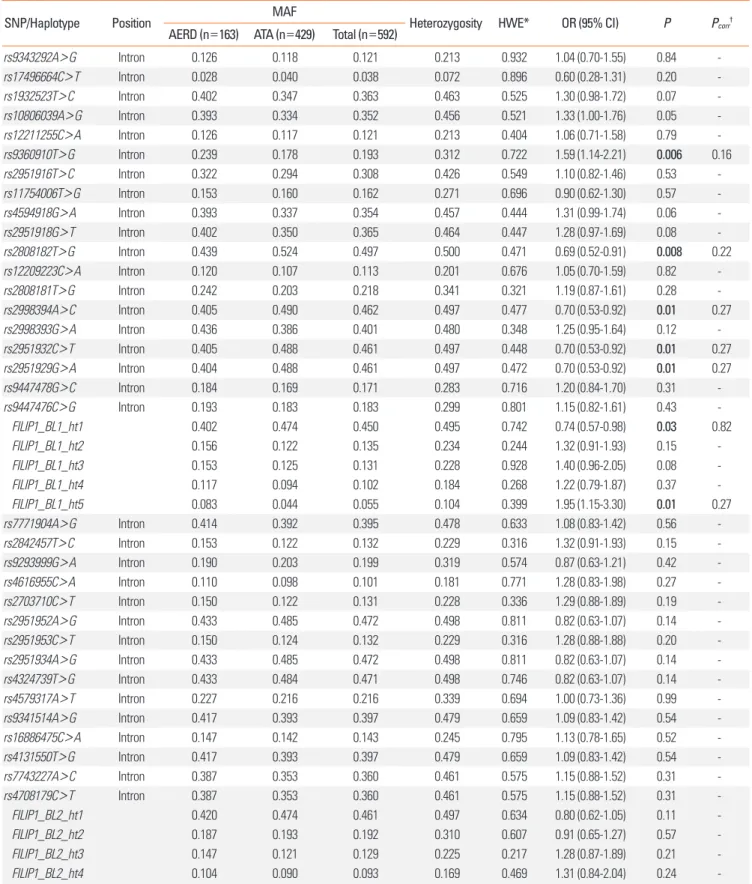
Logistic analyses on each SNP and haplotype showed that 5 SNPs (rs93690910, rs2808182, rs2998394, rs2951932, and rs2951929) in the haplotype block 1 were nominally associated with AERD (P=0.006-0.01, Table 2). Two haplotypes in the hap- lotype block 1, FILIP1_BL1_ht1 and FILIP1_BL1_ht5, also showed associations with AERD. However, all significant signals disap- peared after corrections for multiple testing (Pcorr>0.05, correc- tion number=27.21, Table 2). On the other hand, no genetic polymorphisms and haplotypes in the haplotype block 2 showed significant associations with AERD (P>0.05, Table 2).
Association analysis of FILIP1 polymorphisms with FEV1 decline by aspirin provocation
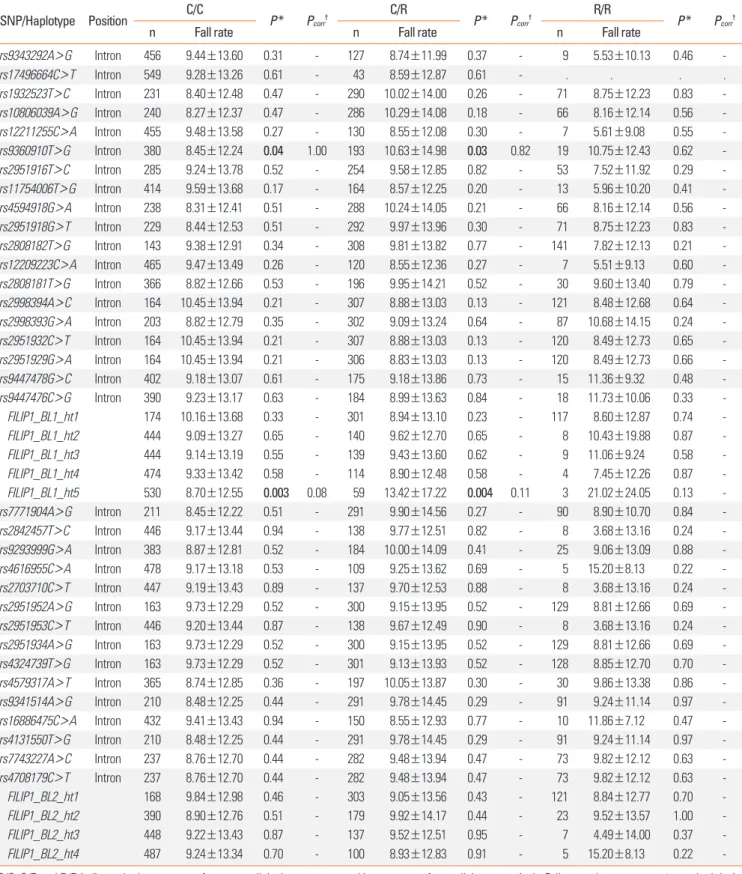
We additionally conducted association analysis between the genetic polymorphisms in FILIP1 and FEV1 by aspirin provo- cation (Table 3). Most of SNPs that showed nominal associa- tions with AERD revealed no significant relation with the fall rate of FEV1, except rs9360910 and FILIP1_BL1_ht5 in the hap- lotype block 1, which showed significant signals (Pa=0.04 and Pb=0.03 for rs9360910; Pa=0.003 and Pb=0.004 for FILIP1_
BL1_ht5, Table 3). However, similar to the AERD case/control association, the significant signals disappeared after corrections for multiple testing (Pcorr>0.05, Table 3). In addition, genetic variants in the haplotype block 2 again showed no association with the fall rate of FEV1 (P>0.05, Table 3).
DISCUSSION
During the inflammation process, the rolling and adhesion of activated leukocytes are mediated by endothelium, which is an important part of airway inflammation. In addition, adhesion
molecules are associated with airway remodeling, as evidenced in a recent study by a group in Canada.24 In their study, vascular cell adhesion molecule (VCAM-1) played a significant role in the airway remodeling via interaction with T cells. In addition, airway remodeling is closely related with aspirin hypersensitiv- ity.25 Intracellular signaling in endothelial cells is induced by in- tegrin-mediated adhesion to endothelial ligands of the immu- noglobulin family; in addition, intracellular adhesion mole- cule-1 (ICAM-1) has recently been revealed to interact with fila- min B.26 Since filamin A and B share similar roles and interact with each other,27 FILIP1 has been suggested as associated with the airway inflammation process via the interaction between filamins and adhesion molecules.
The possible relation between FILIP1 and AERD is also impli- cated in the role of LTB4. LTB4 is a family of proinflammatory lipid mediators and plays a critical role in allergic inflamma- tion.28 Furthermore, LTB4 is expressed in various inflammatory cells (including T cells), which are known to be modified by filamin A.11,12 A recent study has observed an increased LTB4 re- lease after an OAC,13 and suggests that LTB4 may play an impor- tant role for AERD in the involvement of T cells. Our present study revealed that genetic variations of FILIP1 might have no direct effect on the subsequent association with AERD devel- opment; however, other evidence also suggests a possible asso- ciation between the potential transcript derived from the alter- native splicing and LTB4 receptor. The potential splice variant of FILIP1 may also have a role in various allergic inflammations (such as aspirin hypersensitivity-related diseases) and requires further investigation since a recent study suggests that discrep- ant LTB4 receptor antagonists derived from alternative splicing of the receptor in airway smooth muscle may affect broncho- constriction.29
Fig. 2. LD coefficients graphical plot (|D’| and r2) among SNPs based on the genotypes of Korean study subjects (n=592).
Table 3. Association of FILIP1 SNPs and haplotypes with the fall of FEV1 by aspirin provocation
SNP/Haplotype Position C/C
P* Pcorr† C/R
P* Pcorr† R/R
P* Pcorr†
n Fall rate n Fall rate n Fall rate
rs9343292A>G Intron 456 9.44±13.60 0.31 - 127 8.74±11.99 0.37 - 9 5.53±10.13 0.46 -
rs17496664C>T Intron 549 9.28±13.26 0.61 - 43 8.59±12.87 0.61 - . . . .
rs1932523T>C Intron 231 8.40±12.48 0.47 - 290 10.02±14.00 0.26 - 71 8.75±12.23 0.83 -
rs10806039A>G Intron 240 8.27±12.37 0.47 - 286 10.29±14.08 0.18 - 66 8.16±12.14 0.56 -
rs12211255C>A Intron 455 9.48±13.58 0.27 - 130 8.55±12.08 0.30 - 7 5.61±9.08 0.55 -
rs9360910T>G Intron 380 8.45±12.24 0.04 1.00 193 10.63±14.98 0.03 0.82 19 10.75±12.43 0.62 -
rs2951916T>C Intron 285 9.24±13.78 0.52 - 254 9.58±12.85 0.82 - 53 7.52±11.92 0.29 -
rs11754006T>G Intron 414 9.59±13.68 0.17 - 164 8.57±12.25 0.20 - 13 5.96±10.20 0.41 -
rs4594918G>A Intron 238 8.31±12.41 0.51 - 288 10.24±14.05 0.21 - 66 8.16±12.14 0.56 -
rs2951918G>T Intron 229 8.44±12.53 0.51 - 292 9.97±13.96 0.30 - 71 8.75±12.23 0.83 -
rs2808182T>G Intron 143 9.38±12.91 0.34 - 308 9.81±13.82 0.77 - 141 7.82±12.13 0.21 -
rs12209223C>A Intron 465 9.47±13.49 0.26 - 120 8.55±12.36 0.27 - 7 5.51±9.13 0.60 -
rs2808181T>G Intron 366 8.82±12.66 0.53 - 196 9.95±14.21 0.52 - 30 9.60±13.40 0.79 -
rs2998394A>C Intron 164 10.45±13.94 0.21 - 307 8.88±13.03 0.13 - 121 8.48±12.68 0.64 -
rs2998393G>A Intron 203 8.82±12.79 0.35 - 302 9.09±13.24 0.64 - 87 10.68±14.15 0.24 -
rs2951932C>T Intron 164 10.45±13.94 0.21 - 307 8.88±13.03 0.13 - 120 8.49±12.73 0.65 -
rs2951929G>A Intron 164 10.45±13.94 0.21 - 306 8.83±13.03 0.13 - 120 8.49±12.73 0.66 -
rs9447478G>C Intron 402 9.18±13.07 0.61 - 175 9.18±13.86 0.73 - 15 11.36±9.32 0.48 -
rs9447476C>G Intron 390 9.23±13.17 0.63 - 184 8.99±13.63 0.84 - 18 11.73±10.06 0.33 -
FILIP1_BL1_ht1 174 10.16±13.68 0.33 - 301 8.94±13.10 0.23 - 117 8.60±12.87 0.74 -
FILIP1_BL1_ht2 444 9.09±13.27 0.65 - 140 9.62±12.70 0.65 - 8 10.43±19.88 0.87 -
FILIP1_BL1_ht3 444 9.14±13.19 0.55 - 139 9.43±13.60 0.62 - 9 11.06±9.24 0.58 -
FILIP1_BL1_ht4 474 9.33±13.42 0.58 - 114 8.90±12.48 0.58 - 4 7.45±12.26 0.87 -
FILIP1_BL1_ht5 530 8.70±12.55 0.003 0.08 59 13.42±17.22 0.004 0.11 3 21.02±24.05 0.13 -
rs7771904A>G Intron 211 8.45±12.22 0.51 - 291 9.90±14.56 0.27 - 90 8.90±10.70 0.84 -
rs2842457T>C Intron 446 9.17±13.44 0.94 - 138 9.77±12.51 0.82 - 8 3.68±13.16 0.24 -
rs9293999G>A Intron 383 8.87±12.81 0.52 - 184 10.00±14.09 0.41 - 25 9.06±13.09 0.88 -
rs4616955C>A Intron 478 9.17±13.18 0.53 - 109 9.25±13.62 0.69 - 5 15.20±8.13 0.22 -
rs2703710C>T Intron 447 9.19±13.43 0.89 - 137 9.70±12.53 0.88 - 8 3.68±13.16 0.24 -
rs2951952A>G Intron 163 9.73±12.29 0.52 - 300 9.15±13.95 0.52 - 129 8.81±12.66 0.69 -
rs2951953C>T Intron 446 9.20±13.44 0.87 - 138 9.67±12.49 0.90 - 8 3.68±13.16 0.24 -
rs2951934A>G Intron 163 9.73±12.29 0.52 - 300 9.15±13.95 0.52 - 129 8.81±12.66 0.69 -
rs4324739T>G Intron 163 9.73±12.29 0.52 - 301 9.13±13.93 0.52 - 128 8.85±12.70 0.70 -
rs4579317A>T Intron 365 8.74±12.85 0.36 - 197 10.05±13.87 0.30 - 30 9.86±13.38 0.86 -
rs9341514A>G Intron 210 8.48±12.25 0.44 - 291 9.78±14.45 0.29 - 91 9.24±11.14 0.97 -
rs16886475C>A Intron 432 9.41±13.43 0.94 - 150 8.55±12.93 0.77 - 10 11.86±7.12 0.47 -
rs4131550T>G Intron 210 8.48±12.25 0.44 - 291 9.78±14.45 0.29 - 91 9.24±11.14 0.97 -
rs7743227A>C Intron 237 8.76±12.70 0.44 - 282 9.48±13.94 0.47 - 73 9.82±12.12 0.63 -
rs4708179C>T Intron 237 8.76±12.70 0.44 - 282 9.48±13.94 0.47 - 73 9.82±12.12 0.63 -
FILIP1_BL2_ht1 168 9.84±12.98 0.46 - 303 9.05±13.56 0.43 - 121 8.84±12.77 0.70 -
FILIP1_BL2_ht2 390 8.90±12.76 0.51 - 179 9.92±14.17 0.44 - 23 9.52±13.57 1.00 -
FILIP1_BL2_ht3 448 9.22±13.43 0.87 - 137 9.52±12.51 0.95 - 7 4.49±14.00 0.37 -
FILIP1_BL2_ht4 487 9.24±13.34 0.70 - 100 8.93±12.83 0.91 - 5 15.20±8.13 0.22 -
C/C, C/R and R/R indicate the homozygote of common allele, heterozygote and homozygote of rare allele, respectively. Fall rate values are mean±standard devia- tion. Bold values indicate the statistical significance of P<0.05.
*P values of regression analysis are adjusted for sex, smoking status, atopy, and body mass index as covariates. †Correction for multiple testing is calculated by SNPSpD program (http://gump.qimr.edu.au/general/daleN/SNPSpD/).
This study conducted an association analysis of the genetic variants of FILIP1 with aspirin hypersensitivity (case-control study) and the fall rate of FEV1 (phenotypic regression analysis) in asthmatics. In order to achieve an optimal correction for the multiple testing of markers representing SNPs in LD and to ver- ify if the association signals on FILIP1 polymorphisms are false positive, this study applied multiple testing corrections using the effective number of independent marker loci that explains the eigenvalue spectral decomposition of all genotypes repre- sented in the correlation matrix.30 As a result, multiple testing corrections failed to show consistently significant associations with the FEV1 decline by aspirin provocation as well as AERD development. The results indicate that the previously observed association signals might be false positive and/or FILIP1 poly- morphisms might not affect AERD development and FEV1 de- cline by aspirin provocation; however, further replications in other larger cohorts and functional evaluations are required.
Although significant associations disappeared after correction for multiple testing, we investigated whether a FILIP1 variant with nominal associations could have potential functions using in silico prediction. In addition, genetic variations in intronic regions are shown to affect the splicing event that subsequently leads to different disease onset between populations. As a re- sult, EMBL-EBI splice site prediction (http://www.ebi.ac.uk/asd- srv/wb.cgi?method=2) found that the TTTAT sequence con- taining ‘A’ variant of rs2951929G>A could act as a potential branch point (BP) site for an alternative splicing, with BP score=
3.09 (Supplementary Fig. 1). Despite the need for further stud- ies, higher ‘A’ minor allele frequency of the SNP in ATA controls than in AERD patients suggest a possibility that this SNP could affect other aspirin hypersensitivity-related diseases.
Another interesting fact is that rs9360910 might have a sus- ceptible effect (odds ratio [OR]=1.59), while the latter 4 associ- ated SNPs could have protective effects (ORs of 0.69-0.70) in the FILIP1-related pathophysiology and functions in other diseas- es. Variant rs9360910 had the most significant P value and was the only SNP associated with the fall rate of FEV1; however, rs2808182 had the lowest P value among the 4 SNPs with pro- tective effects. We suspect that these 2 SNPs might be related with other aspirin hypersensitivity-related diseases; however, further functional studies are required. In addition, the findings suggest that genetic and/or phenotypic balances between SNPs with susceptible effects and those with protective effects may regulate the susceptibility of diseases.
This study has a few limitations such as a small sample size and ethnicity. Although replications are needed in large AERD cohorts, this study was conducted with relatively small num- bers of AERD patients due to the rareness of the disease. In ad- dition, the study subjects consisted only of Korean population.
Considering the ethnic diversity in antibiotic hypersensitivity including aspirin31 and the important role of filamin A on the immune cell activation and membrane rearrangement,11,12 fur-
ther studies in a broader population sample will be needed to confirm the genetic effect of FILIP1 on AERD. However, al- though we were not able to compare with the frequencies of Korean normal controls, minor allele frequencies of 34 FILIP1 SNPs among Korean asthmatics (AERD plus ATA in this study) and other Asian control populations (Chinese and Japanese) from the International HapMap Project database are shown in Supplementary Table 1.
This study first conducted an association analysis between ge- netic polymorphisms on the candidate gene of FILIP1 and AERD, and found that no SNPs or haplotypes were associated with AERD even though there were nominal evidences that showed possible links between FILIP1 and AERD. In addition, no significant relations between the SNPs and FEV1 decline by aspirin provocation were found. Although further replications are needed, our findings suggest that the genetic variants of FILIP1 have no affect on aspirin-exacerbated respiratory dis- eases in the Korean population.
ACKNOWLEDGMENTS
This work was supported by a grant from the Korea Health 21 R&D Project (A010249); a grant from Korea Science and Engi- neering Foundation (KOSEF) funded by the Korea government (MEST) (No. 2009-0080157); and a Priority Research Centers Program through the National Research Foundation of Korea (NRF) funded by the Ministry of Education, Science and Tech- nology (2012-0006690).
REFERENCES
1. Fanta CH. Asthma. N Engl J Med 2009;360:1002-14.
2. Babu KS, Salvi SS. Aspirin and asthma. Chest 2000;118:1470-6.
3. Widal F, Abrami P, Lermoyez J. Anaphylaxie et idiosyncrasie. 1992 [Anaphylaxis and idiosyncrasy. 1992]. Allergy Proc 1993;14:373-6;
discussion 371-2.
4. Kim SH, Hur GY, Choi JH, Park HS. Pharmacogenetics of aspirin- intolerant asthma. Pharmacogenomics 2008;9:85-91.
5. Kim SH, Kim YK, Park HW, Kim SH, Kim SH, Ye YM, Min KU, Park HS. Adenosine deaminase and adenosine receptor polymor- phisms in aspirin-intolerant asthma. Respir Med 2009;103:356-63.
6. Kim SH, Ye YM, Hur GY, Lee SK, Sampson AP, Lee HY, Park HS.
CysLTR1 promoter polymorphism and requirement for leukotri- ene receptor antagonist in aspirin-intolerant asthma patients.
Pharmacogenomics 2007;8:1143-50.
7. Baldassarre M, Razinia Z, Burande CF, Lamsoul I, Lutz PG, Calder- wood DA. Filamins regulate cell spreading and initiation of cell mi- gration. PLoS One 2009;4:e7830.
8. Nagano T, Yoneda T, Hatanaka Y, Kubota C, Murakami F, Sato M.
Filamin A-interacting protein (FILIP) regulates cortical cell migra- tion out of the ventricular zone. Nat Cell Biol 2002;4:495-501.
9. Nagano T, Morikubo S, Sato M. Filamin A and FILIP (Filamin A-In- teracting Protein) regulate cell polarity and motility in neocortical subventricular and intermediate zones during radial migration. J Neurosci 2004;24:9648-57.
10. Sato M, Nagano T. Involvement of filamin A and filamin A-interact- ing protein (FILIP) in controlling the start and cell shape of radially migrating cortical neurons. Anat Sci Int 2005;80:19-29.
11. Tavano R, Contento RL, Baranda SJ, Soligo M, Tuosto L, Manes S, Viola A. CD28 interaction with filamin-A controls lipid raft accu- mulation at the T-cell immunological synapse. Nat Cell Biol 2006;8:
1270-6.
12. Hayashi K, Altman A. Filamin A is required for T cell activation me- diated by protein kinase C-theta. J Immunol 2006;177:1721-8.
13. Ohnishi H, Miyahara N, Gelfand EW. The role of leukotriene B(4) in allergic diseases. Allergol Int 2008;57:291-8.
14. Pasaje CF, Kim JH, Park BL, Cheong HS, Chun JY, Park TJ, Lee JS, Kim Y, Bae JS, Park JS, Yoon SH, Uh ST, Choi JS, Kim YH, Kim MK, Choi IS, Cho SH, Choi BW, Park CS, Shin HD. Association of SL- C6A12 variants with aspirin-intolerant asthma in a Korean popula- tion. Ann Hum Genet 2010;74:326-34.
15. Park JS, Chang HS, Park CS, Lee JH, Lee YM, Choi JH, Park HS, Kim LH, Park BL, Choi YH, Shin HD. Association analysis of cysteinyl- leukotriene receptor 2 (CYSLTR2) polymorphisms with aspirin in- tolerance in asthmatics. Pharmacogenet Genomics 2005;15:483- 92.
16. Choi JH, Park HS, Oh HB, Lee JH, Suh YJ, Park CS, Shin HD. Leu- kotriene-related gene polymorphisms in ASA-intolerant asthma:
an association with a haplotype of 5-lipoxygenase. Hum Genet 2004;114:337-44.
17. Sanak M, Simon HU, Szczeklik A. Leukotriene C4 synthase pro- moter polymorphism and risk of aspirin-induced asthma. Lancet 1997;350:1599-600.
18. Kim JH, Park BL, Cheong HS, Bae JS, Park JS, Jang AS, Uh ST, Choi JS, Kim YH, Kim MK, Choi IS, Cho SH, Choi BW, Park CS, Shin HD.
Genome-wide and follow-up studies identify CEP68 gene variants associated with risk of aspirin-intolerant asthma. PLoS One 2010;
5:e13818.
19. Crapo RO, Casaburi R, Coates AL, Enright PL, Hankinson JL, Irvin CG, MacIntyre NR, McKay RT, Wanger JS, Anderson SD, Cockcroft DW, Fish JE, Sterk PJ. Guidelines for methacholine and exercise challenge testing-1999. This official statement of the American Thoracic Society was adopted by the ATS Board of Directors, July 1999. Am J Respir Crit Care Med 2000;161:309-29.
20. Kim TH, Chang HS, Park SM, Nam BY, Park JS, Rhim T, Park HS, Kim MK, Choi IS, Cho SH, Chung IY, Park BL, Park CS, Shin HD.
Association of angiotensin I-converting enzyme gene polymor- phisms with aspirin intolerance in asthmatics. Clin Exp Allergy 2008;38:1727-37.
21. Cormican LJ, Farooque S, Altmann DR, Lee TH. Improvements in an oral aspirin challenge protocol for the diagnosis of aspirin hy- persensitivity. Clin Exp Allergy 2005;35:717-22.
22. Barrett JC, Fry B, Maller J, Daly MJ. Haploview: analysis and visual- ization of LD and haplotype maps. Bioinformatics 2005;21:263-5.
23. Stephens M, Smith NJ, Donnelly P. A new statistical method for haplotype reconstruction from population data. Am J Hum Genet 2001;68:978-89.
24. Ramos-Barbón D, Fraga-Iriso R, Brienza NS, Montero-Martínez C, Verea-Hernando H, Olivenstein R, Lemiere C, Ernst P, Hamid QA, Martin JG. T Cells localize with proliferating smooth muscle alpha- actin+ cell compartments in asthma. Am J Respir Crit Care Med 2010;182:317-24.
25. Mascia K, Haselkorn T, Deniz YM, Miller DP, Bleecker ER, Borish L;
TENOR Study Group. Aspirin sensitivity and severity of asthma:
evidence for irreversible airway obstruction in patients with severe or difficult-to-treat asthma. J Allergy Clin Immunol 2005;116:970-5.
26. Kanters E, van Rijssel J, Hensbergen PJ, Hondius D, Mul FP, Deelder AM, Sonnenberg A, van Buul JD, Hordijk PL. Filamin B mediates ICAM-1-driven leukocyte transendothelial migration. J Biol Chem 2008;283:31830-9.
27. Del Valle-Pérez B, Martínez VG, Lacasa-Salavert C, Figueras A, Shapiro SS, Takafuta T, Casanovas O, Capellà G, Ventura F, Viñals F.
Filamin B plays a key role in vascular endothelial growth factor-in- duced endothelial cell motility through its interaction with Rac-1 and Vav-2. J Biol Chem 2010;285:10748-60.
28. Luster AD, Tager AM. T-cell trafficking in asthma: lipid mediators grease the way. Nat Rev Immunol 2004;4:711-24.
29. Einstein R, Jordan H, Zhou W, Brenner M, Moses EG, Liggett SB.
Alternative splicing of the G protein-coupled receptor superfamily in human airway smooth muscle diversifies the complement of re- ceptors. Proc Natl Acad Sci U S A 2008;105:5230-5.
30. Nyholt DR. A simple correction for multiple testing for single-nu- cleotide polymorphisms in linkage disequilibrium with each other.
Am J Hum Genet 2004;74:765-9.
31. Kim SH, Ye YM, Palikhe NS, Kim JE, Park HS. Genetic and ethnic risk factors associated with drug hypersensitivity. Curr Opin Aller- gy Clin Immunol 2010;10:280-90.