Chinese Society of Allergy Guidelines for Diagnosis and Treatment of Allergic Rhinitis
Lei Cheng,
1,2†Jianjun Chen,
3†Qingling Fu,
4†Shaoheng He,
5†Huabin Li,
6†Zheng Liu,
7†Guolin Tan,
8†Zezhang Tao,
9†Dehui Wang,
6†Weiping Wen,
4†Rui Xu,
4†Yu Xu,
9†Qintai Yang,
10†Chonghua Zhang,
6†Gehua Zhang,
10†Ruxin Zhang,
11†Yuan Zhang,
12-14†Bing Zhou,
14†Dongdong Zhu,
15†Luquan Chen,
16Xinyan Cui,
1Yuqin Deng,
9Zhiqiang Guo,
11Zhenxiao Huang,
14Zizhen Huang,
10Houyong Li,
6Jingyun Li,
12Wenting Li,
10Yanqing Li,
6Lin Xi,
12Hongfei Lou,
14Meiping Lu,
1Yuhui Ouyang,
12Wendan Shi,
9Xiaoyao Tao,
4Huiqin Tian,
1Chengshuo Wang,
14Min Wang,
12Nan Wang,
7Xiangdong Wang,
12-14Hui Xie,
17Shaoqing Yu,
18Renwu Zhao,
11Ming Zheng,
14Han Zhou,
1Luping Zhu,
19Luo Zhang
12-14*
1Department of Otorhinolaryngology, The First Affiliated Hospital, Nanjing Medical University, Nanjing, China
2International Centre for Allergy Research, Nanjing Medical University, Nanjing, China
3Department of Otorhinolaryngology, Union Hospital, Tongji Medical College, Huazhong University of Science and Technology, Wuhan, China
4Otorhinolaryngology Hospital, The First Affiliated Hospital, Sun Yat-sen University, Guangzhou, China
5Allergy and Clinical Immunology Research Centre, the First Affiliated Hospital of Jinzhou Medical University, Jinzhou, China
6Department of Otolaryngology Head Neck Surgery, Eye & ENT Hospital of Fudan University, Shanghai, China
7 Department of Otolaryngology-Head and Neck Surgery, Tongji Hospital, Tongji Medical College, Huazhong University of Science and Technology, Wuhan, China
8Department of Otolaryngology Head Neck Surgery, Third Xiangya Hospital, Central South University, Changsha, China
9Department of Otolaryngology-Head and Neck Surgery, Renmin Hospital, Wuhan University, Wuhan, China
10Department of Otolaryngology Head and Neck Surgery, The Third Affiliated Hospital, Sun Yat-sen University, Guangzhou, China
11Department of Otorhinolaryngology Head and Neck Surgery, Huadong Hospital, Fudan University, Shanghai, China
12Beijing Key Laboratory of Nasal Diseases, Beijing Institute of Otolaryngology, Beijing, China
13Department of Allergy, Beijing TongRen Hospital, Capital Medical University, Beijing, China
14Department of Otolaryngology Head and Neck Surgery, Beijing TongRen Hospital, Capital Medical University, Beijing, China
15Department of Otorhinolaryngology Head and Neck Surgery, China-Japan Union Hospital of Jilin University, Changchun, China
16Department of Traditional Chinese Medicine, Beijing TongRen Hospital, Capital Medical University, Beijing, China
17Department of Otorhinolaryngology, Affiliated Hospital, Chengdu University of Traditional Chinese Medicine, Chengdu, China
18Department of Otolaryngology Head and Neck Surgery, Tongji Hospital, Tongji University, Shanghai, China
19Department of Otorhinolaryngology, The Second Affiliated Hospital, Nanjing Medical University, Nanjing, China
This is an Open Access article distributed under the terms of the Creative Commons Attribution Non-Commercial License (http://creativecommons.org/licenses/by-nc/4.0/) which permits unrestricted non-commercial use, distribution, and reproduction in any medium, provided the original work is properly cited.
Correspondence to: Luo Zhang, MD, Beijing Institute of Otolaryngology, No. 17, HouGouHuTong, DongCheng District, Beijing 100005, China.
Tel: +8610-65141136; Fax: +8610-85115988; E-mail: [email protected] Received: June 15, 2017; Revised: September 17,2017; Accepted: October 05, 2017
†These authors contributed equally to the study.
• This work was supported by grants from National Key R & D Program of China (2016YFC20160905200), national natural science foundation of China (81630023, 81100704, 81441029, 81441031 and 8157089481630023, 81100704, 81441029, 81441031 and 8157089481630023, 81100704, 81441029, 81441031 and 81570894 and 81420108009), the program for Changjiang scholars and innovative research team (IRT13082), Beijing Municipal Administration of Hospitals Clinical Medicine Development of Special Funding Support (ZYLX201310), Beijing health bureau program for high level talents (2014-3-017) and Beijing Municipal Administration of Hospitals’ Mission Plan (SML20150203).
Allergic rhinitis (AR) is a global health problem that causes major illnesses and disabilities worldwide. Epidemiologic studies have demonstrated that the prevalence of AR has increased progressively over the last few decades in more developed countries and currently affects up to 40% of the population worldwide. Likewise, a rising trend of AR has also been observed over the last 2-3 decades in developing countries including China, with the prevalence of AR varying widely in these countries. A survey of self-reported AR over a 6-year period in the general Chinese adult population re- ported that the standardized prevalence of adult AR increased from 11.1% in 2005 to 17.6% in 2011. An increasing number of original articles and
Allergy Asthma Immunol Res. 2018 July;10(4):300-353.
https://doi.org/10.4168/aair.2018.10.4.300 pISSN 2092-7355 • eISSN 2092-7363
1. INTRODUCTION
1.1 Chinese Guideline for allergic rhinitis (AR) workshop To date, several international guidelines are available for the diagnosis and treatment of AR, in different parts of the world.1-9 Of these, 7 have been written by specialist groups from Europe, UK, USA, Canada, Japan and Australia for the management of AR patients from the respective countries, whereas 2 guidelines
─Allergic Rhinitis and its Impact on Asthma (ARIA) guidelines and the World Allergy Organization (WAO) White Book on Al- lergy: Update 2013 (www.worldallergy.org)─have been pre- pared as evidence-based documents in consultation with ex- perts from all over the world.
Compared to the published international AR guidelines, the criteria for the diagnosis and therapeutic evaluation of AR in China were established by specialist groups and organized by the Editorial Board of the Chinese Journal of Otorhinolaryngolo- gy early in 1990. In view of the rapid growth of the prevalence and misconceptions of AR during clinical practice, these guide- lines were subsequently updated by Chinese Guideline for AR workshops held in Haikou in 1997, in Lanzhou in 2004, in Wuy- ishan in 200910 and in Tianjin in 2015.11 Moreover, a clinical practice for children with AR was developed by a group of spe- cialists at a workshop held in Chongqing in 2012.12 However, these Chinese guidelines for AR have been published mostly in Mandarin Chinese in the Chinese Journal of Otorhinolaryngolo- gy Head Neck Surgery. In view of the large number of original articles as well as well-controlled clinical trials of Chinese AR patients that have been published in many peer-reviewed in- ternational journals by Chinese researchers and authors over the past 2 decades, our knowledge and understanding of the epidemiology, pathophysiologic mechanisms, diagnosis, man- agement and comorbidities of AR have been broadened sub- stantially. Consequently, the Chinese Society of Allergy orga- nized a workshop of the experts working in the different fields of AR management in China to develop the most updated Chi- nese Guidelines for the diagnosis and treatment of AR, using evidence-based models, as has been the case in the develop- ment of the ARIA international guidelines. Importantly, these
guidelines have also been developed in English in order that they can be readily accessed for reference by the non-Chinese speaking international fraternity.
1.2 Traditional Chinese Medicine
AR belongs to the category of ‘Bi Qiu’ in Traditional Chinese Medicine (TCM). ‘Bi Qiu’ refers to the disease which is charac- terised by sudden nasal itching, sneezing, rhinorrhea and nasal blockage. Thus, AR, vasomotor rhinitis and other similar dis- eases are all included in the ‘Bi Qiu’ category.
In ancient Chinese literature, the word ‘Bi Qiu’ was first found in the book of ‘Huangdi Neijing’ (Western Han Dynasty, 99 B.
C.-26 B.C.). ‘Bi Qiu’ had several alternative terms such as ‘Qiu,’
‘Ti,’ ‘Qiu Bi’ and ‘Runny nose’ and the record of the disease can be dated back to the book of ‘Rites’ (Western Han Dynasty, about 100 B.C.). The article of ‘Yue Ling’ in ‘Rites’ documented that
“In the last month of autumn, if the summer practices were ob- served, there would be great floods in the states. Then the winter stores would be affected and there would be many patients with sneezing and runny nose”; thus indicating that the ancient Chi- nese people recognized the existence of a close relationship be- tween AR and natural environment/climate events. Indeed, the ancient physicians believed that the main pathophysiology of AR was the dysfunction of ‘Zang-Fu,’ including the lungs, spleen and/or kidneys, in addition to external pathogenic factors like Wind-Evil, Cold-Evil, or other unusual pathogens. Although several ancient TCM literature has discussed AR from different aspects, ‘Su Wen’ in ‘Huangdi Neijing’ suggested that “(kidney) Deficiency would result in dysfunction of 9 orifices, and deficien- cy in the upper part and excess in the lower part of the body would manifest as runny nose and incessant lacrimation.” ‘Tai Ping Sheng Hui Fang’ (Song Dynasty, 992 A.D.) suggested that “the lung had its specific opening in the nose. When lung Cold affect- ed nose ascending meridian, the runny nose would happen. Thus, the cause of AR was Deficiency, Excess, Cold or Heat, involving the ‘Zang-Fu’, organs of the lungs, spleen and/or kidneys.”
While Western medicine was introduced into China about a century ago and has flourished since then, TCM has existed for almost all of China’s 5,000-year history and still plays an impor- clinical trials on the epidemiology, pathophysiologic mechanisms, diagnosis, management and comorbidities of AR in Chinese subjects have been published in international peer-reviewed journals over the past 2 decades, and substantially added to our understanding of this disease as a global problem. Although guidelines for the diagnosis and treatment of AR in Chinese subjects have also been published, they have not been translated into English and therefore not generally accessible for reference to non-Chinese speaking international medical communities. Moreover, methods for the diagnosis and treatment of AR in China have not been standardized entirely and some patients are still treated according to regional prefer- ences. Thus, the present guidelines have been developed by the Chinese Society of Allergy to be accessible to both national and international medi- cal communities involved in the management of AR patients. These guidelines have been prepared in line with existing international guidelines to provide evidence-based recommendations for the diagnosis and management of AR in China.
Key Words: Allergic rhinitis; China; diagnosis; treatment
tant role in the Chinese medical system. TCM employs several treatment approaches in the management of AR including Chi- nese herbs taken orally or applied externally, acupuncture and the ‘Daoyin (an ancient body-mind exercise aimed at health care as well as physical and spiritual purification)’. Each treat- ment can be used either alone or in combination, and general- ly complies with the theory of ‘where there is a syndrome, there is a treatment,’ suggesting that different therapies and measures should be used according to the disease characteristics of the pa- tient. Indeed, to date a large number of clinical studies have con- firmed the effectiveness and safety of TCM in the treatment of AR.
1.3 Need for Chinese Guidelines for AR and their update An ever increasing number of original articles and clinical tri- als have been published in peer-reviewed journals by Chinese researchers over the past 2 decades. This has substantially broad- ened our knowledge and database on the epidemiology, mech- anisms, diagnoses, managements and comorbidities of AR, es- pecially in Chinese subjects. Thus, in order to disseminate this knowledge and promote further research and clinical practice on the management of AR in China, the executive/organizing committee of the Chinese Society of Allergy decided that it was necessary to extensively review and summarize current litera- ture, using an evidence-based model. Furthermore, it was also necessary to review the characteristics and current practice of clinical diagnosis and treatment of AR in China. Although Chi- nese guidelines for AR have been in existence since 1991 and subsequently updated several times, none of them have been published in English in any international peer-reviewed jour- nal. Consensus among the Chinese professionals and practitio- ners indicated that the Chinese guidelines for AR had to be pub- lished in English from a Chinese viewpoint on the disease to be communicated to the international professionals and practitio- ners involved in the treatment of AR.
It is appreciated that since the recommendations in the Chi- nese guidelines were originally proposed by attendees at a work- shop, these guidelines need to be validated and revised by both Chinese and international experts from all over the world. It is anticipated that the Chinese guidelines for AR published in Eng- lish will serve as a reference for the treatment of AR by physi- cians, healthcare professionals and organizations involved in the treatment of AR in China and facilitate the development of relevant local standard of care documents for patients. Addi- tionally, the guidelines will be updated every 2 years, adding relevant data and information from newly published papers in peer-reviewed journals and thus developing the guideline into a state-of-the-art document for specialists as well as for the gen- eral practitioner and other healthcare professionals. Consequent- ly, it is expected that this document will encourage researchers and professionals to submit and publish their research in rele- vant peer-reviewed journals as well as update their knowledge of AR. Overall, the aim of this document is to provide an evi-
dence-based document on the diagnosis and management of AR across China, using a stepwise approach in line with other AR treatment guidelines.
2. EPIDEMIOLOGY 2.1 Global prevalence
Epidemiologic studies have revealed that the prevalence of AR has increased progressively in more-developed countries and currently affects up to 40% of the population worldwide.13,14 A high prevalence of AR has also been recorded in the devel- oped nations of the Northern Hemisphere, with 23%-30% of the population affected in Europe15,16 and 12%-30% in the US.17 The great diversity of AR prevalence is found in the non-Western populations of the Southern Hemisphere, with wide inter- and intraregional variations ranging from 2.9% to 54.1% between countries.18 The global rising trend of AR has been observed in the past few decades and the AR prevalence has varied widely particularly in developing nations.2 The increase in AR preva- lence has been linked with increased urbanization and improve- ments in living standards, which have contributed to increased exposure to a variety of indoor and outdoor pollutants and al- lergens, the potentiating effects of which cannot be ignored on respiratory disorders. Although the prevalence and possible factors responsible for the etiologies of AR have been well doc- umented in many developed countries, there is comparatively little information available for developing countries.19 Large- scale coordinated studies specifically designed to estimate the prevalence of AR in regions with different environmental fac- tors and climates are also required.
2.2 Previous AR prevalence in China
AR is one of the most common allergic disorders globally and affects 10% to 40% of the world’s population.7 While the majori- ty of epidemiologic data come from surveys of AR prevalence conducted mainly in Europe and North America, and to a less- er extent in the developed Asian countries, relatively little epi- demiologic data are available on AR prevalence in especially adults in China. One nationwide population-based study has assessed self-reported AR using validated questionnaire-based telephone interviews in over 38,000 adult in 11 major cities across China.20 The interviews were conducted from September 2004 to May 2005 and the authors demonstrated that the prevalence of AR was highly variable, ranging from 8.7% in Beijing in North China to 24.1% in Urumqi in Northwest China. Compared to adults, however, more data are available from studies investi- gating the prevalence of AR in children in China. The majority of such studies have investigated the prevalence of AR in com- bination with asthma and eczema using the standardized and appropriately translated versions of the International Study of Asthma and Allergies in Childhood (ISAAC) protocols,21-23 with only 1 nationwide study reporting the prevalence of specifically
AR in children in China.24 In this study, a total of 23,791 children aged 6-13 years in 8 metropolitan capital cities of provinces in 4 regions were surveyed between November and December of 2005, using a cluster-stratified sampling method. The study dem- onstrated that the mean prevalence of childhood AR was 9.8%
and ranged from 3.9% in Xi’an in Central China to 16.8% in Guang- zhou in South China. The published data on the prevalence of AR in children and adults in China suggest that industrializa- tion and the gross output of industries in most of the developed cities may reflect the prevalence of AR in certain cities in China.
Moreover, these studies are limited due to nonuniform stan- dardized study methods and diagnosis systems, which lead to biased comparisons among the studies.25
2.3 Current AR prevalence and trends
Compared to availability of progressive data for AR prevalence in many countries all over the world, there are insufficient com- parable epidemiologic data for AR in China. As one of the larg- est countries in the world with a population of around 1.3 bil- lion citizens, China has different topographic, climatic and eco- nomic conditions, which influence the lifestyle and exposure to allergens in different regions across the country. Thus, while the epidemiologic changes in AR prevalence is not unexpected due to the topographical and climatic conditions, the transition in socioeconomic status of many regions and individuals, par- ticularly as a consequence of rapid urbanization and changes to a Western lifestyle over the past few years, appears to have further influenced the prevalence of AR. The influence of rapid urbanization and changes to a Western lifestyle has often im- pacted AR prevalence adversely in China as in the developed Western countries. However, a more comprehensive study in- volving subjects from 18 major cities in China has recently re- ported that there was an overall increase in the prevalence of self-reported AR in the general Chinese adult population dur- ing a 6-year period spanning from 2005 to 2011.26 Compared to the national survey in 2005, the standardized prevalence of adult AR in the 18 major cities was 17.6% in 2011, with the high- est prevalence of 23% recorded in Shanghai and the lowest prev- alence of 9.8% recorded in Chengdu. These findings suggest that the prevalence of AR in China has not yet reached a pla- teau (Fig. 1). Other recent studies have focused on the preva- lence of AR in almost 800 million people living in the rural ar- eas of China. One study demonstrated that in North China while the prevalence of adult self-reported AR was significantly high- er in the rural area than in the urban area (19.1% vs 13.5%), the prevalence of confirmable AR in these areas were 6.2% and 7.2%, respectively.27 For preschool children, the prevalence of clinical AR in Beijing was found to be 19.5% in the urban areas and 10.8%
in the rural areas.28 However, these studies indicate that the lim- ited availability of local health services and the unmet need for the diagnosis and therapy of AR in rural areas of China should be given greater consideration in the future. A multicenter in-
vestigation has evaluated the clinical features of 11,004 AR pa- tients from 13 allergy centers in Central China.29 The study showed that 9.7% of all patients had intermittent mild AR, 3.1% persis- tent mild AR, 33.9% intermittent moderate-severe AR, and 53.3%
persistent moderate-severe AR. Furthermore, 61.6% and 42.2%
of the patients had concomitant ocular and lower respiratory symptoms, respectively.29 Collectively, these studies illustrate that AR is both a common and a growing national concern in China. They further indicate that future epidemiologic studies of AR in China performed at the national level should aim to as- sess the true prevalence of AR as demonstrate by a clinical di- agnosis of AR confirmed by allergen-related examinations and employing standardized methodology across all centers involved in the study.
2.4 Comorbidities and complications 2.4.1 Bronchial asthma
AR is an independent risk factor for the onset of asthma, and 40% of AR patients have or will have asthma.30 As the upper and lower airway inflammatory responses are similar and intercon- nected in these individuals, this could be described as “one air- way, one disease.” For AR patients, diagnosis for the coexisting asthma should be based on the patient’s medical history, symp- toms and lung function examination. Indeed, the 2004-2005 survey of AR patients in the 11 major cities in China showed that among all the subjects with self-reported AR, an average of 9.2% suffered from asthma31: Beijing (12.7%), Changchun (8.3%), Changsha (7.5%), Guangzhou (5.4%), Hangzhou (13.1%), Nan- jing (9.2%), Shanghai (9.3%), Shenyang (8.8%), Urumqi (6.3%), Wuhan (4.3%) and Xi’an (9.6%). Similarly, in 2011, a survey con- sisting of total 47, 216 telephone interviews showed that the prevalence of asthma in the AR subpopulation was 28% (23).
Fig. 1. Prevalence of adult AR in major cities in China in 2005 and 2011.
11 cities for adult AR survey in 2005 7 new cities for adult AR survey in 2011
2.4.2 Allergic conjunctivitis
Itchy/watery eyes, redness and other eye symptoms are the main symptom of AR patients with allergic conjunctivitis, espe- cially seasonal AR patients, whose incidence could be as high as 85%.32 The AR survey during the year 2005-2011 showed that the incidence of eye symptoms in AR patients was 32%-59%
based on medical history and clinical manifestation.26 It is not difficult to diagnose allergic conjunctivitis, but differential diag- nosis for other common conjunctival lesions should be noticed.
2.4.3 Chronic rhinosinusitis
Allergic inflammation is a major factor related to chronic rhi- nosinusitis (CRS).33 The cross-sectional survey of 7 cities in Chi- na recently showed the prevalence of CRS ranging from 4.8% to 9.7%.34 Moreover, the prevalence of CRS was found to be 30% in AR patients and 23% in asthmatic patients, compared to just 6%
and 7%, respectively, in subjects without AR or asthma. Similar- ly, larger surveys of subjects with self-reported AR from 11 and 18 major cities across China have demonstrated 13.3%31 and 10.1%, respectively, of the AR patients26 to have CRS. In another study, among all the 1,411 participants over 15 years old, 118 (8.4%) had self-reported CRS; patients with CRS had an incre- ased prevalence of AR and chronic obstructive pulmonary dis- ease compared to those without.35 Furthermore, the quality of life was significantly impaired in patients with CRS than in those without, with the quality of sleep being markedly impaired in CRS patients. Although this study did not assess the correlation between CRS severity and impairment of sleep, it is possible that the impairment in CRS patients with AR may indeed be corre- lated with the severity of CRS as shown in patients with AR.
2.4.4 Upper airway cough syndrome
AR and sinusitis are a common cause of chronic cough in chil- dren and adults.12,36 Nasal secretions reflux from the nose and the throat directly or indirectly stimulate cough. Cough result- ing from chronic sinusitis may thus be the main clinical mani- festation of upper airway cough syndrome (UACS). A pilot study of 393 children with cough as a chief complaint in Chengdu has recently shown that 45.8% of the children suffered from AR. Sim- ilarly, a multicenter survey investigating causes of chronic cough in China found that UACS was most frequently associated with AR (63.4%).37
2.4.5 Otitis media
Secretory otitis media (SOM) is a nonsuppurative inflamma- tory disease. Middle ear effusion─which includes serous fluid and pulp-like mucus─and hearing loss are the main features, and AR is regarded as one of the possible risk factors inducing SOM in children.12 Indeed, one study from the UK found that the prevalence of AR in patients with chronic or recurrent OME ranged from 24% to 89%.38 Similarly, a study from Qingdao city in China has indicated that children with SOM have increased
annual frequency of AR.
3. MAJOR ALLERGENS IN CHINA 3.1 China in general
Exposure to inhalant allergens is the primary inducer of AR symptoms; with particularly the aeroallergens, which include both outdoor and indoor allergens, being the most common al- lergens. Outdoor allergens, which mainly include pollen and fungi, are positively associated with the development of season- al/intermittent AR, whereas indoor allergens, which typically include mites, animal dander, cockroach and fungi, are the ma- jor cause of perennial/persistent AR. Although exposure to cer- tain occupational allergens may also lead to AR, exposure to food allergens rarely causes isolated nasal allergy symptoms.7,11 Due to the effect of geographic, climatic and humanistic fac- tors, the types of allergens inducing AR vary significantly among regions. Identifying major local allergens is thus the first step to AR management involving diagnosis, prevention and allergen- specific immunotherapy (AIT).
In 1964, Voorhorst39 discovered that the allergenic properties of house dust originated from the component of mites. The first mite allergen was isolated by Fain in 1966 from the genus Der- matophagoides pteronyssinus (Der p), and since then more spe- cies of mites have been discovered.40,41 In China, Chan and col- leagues42 have contributed greatly to the identification of diverse Dermatophagoides farina (Der f) allergens by proteomics. The novel allergens from Der f such as Der f 25 (triosephosphate isomerase), Der f 26 (myosin alkali light chain), Der f 27 (serpin), Der f 28 (heat shock protein), Der f 29 (cyclophilin), Der f 30 (fer- ritin), Der f 31 (cofilin), Der f 32 (pyrophosphate) and Der f 33 (alpha-tubulin) have greatly extended the spectrum of dust mite allergens,43 and the findings from Liu and colleagues61 could be of benefit for the guidance on more effective diagnosis and AIT of HDM respiratory allergy in China.
Pollen is a common aeroallergen worldwide. Ragweed aller- gen was described by Carl Linnaeus in the 18th century,44 but since then more highly allergenic pollen inducing seasonal al- lergic symptoms in respiratory tract have been discovered all over the world including China. In the 1950s, it was first report- ed that the genus Artemisia was the most important source of allergenic pollen in North China.45 Many new pollen allergens have subsequently been described in China. Indeed, during the mid-1980s to early 1990s, nearly 80 provincial- and municipal- level hospitals participated in a national epidemic survey on anemophilous allergenic pollen, resulting in the publication of a book entitled “A National Survey of Airborne and Allergenic Pollen in China” in 1991. This book summarizes the geographi- cal distribution and drift patterns of airborne allergenic pollen by regions in mainland China and is designed for reference by clinicians involved in the treatment of allergic disease. It is worth noting that increasing urbanization and alien plant invasion
have led to emergence of different trends in diffusion of pollen allergen.
3.2 Current data and trends
Zhang and colleagues25 reviewed the pattern of sensitization to inhalant allergens among AR patients in mainland China and found that the prevalence and type of aeroallergens were different among various cities and regions. A survey by Li and colleagues46 of 6,304 patients suffering from asthma and/or rhi- nitis in 17 cities from 4 regions of China showed that the overall prevalence of positive skin prick responses was highest for Der f (59.0%), Der p (57.6%), and Blomia tropicalis (40.7%), and low- est for mixed mould IV (4.4%), mixed grass pollen (3.5%), and mixed tree pollen (2.2%). The prevalence of sensitization to oth- er allergens ranged from 16.1% for American cockroach, 14.0%
for dog, 11.5% for Blatella germanica, 11.3% for Artemisia vul- garis, 10.3% for cat, 6.5% for Ambrosia artemisifolia, and 6.3%
for mixed mould I.46 Moreover, this study showed that the prev- alence of sensitization to allergens were different between adults and children, with Der p and Der f reported as the predominant aeroallergens in perennial/persistent AR individuals in China.
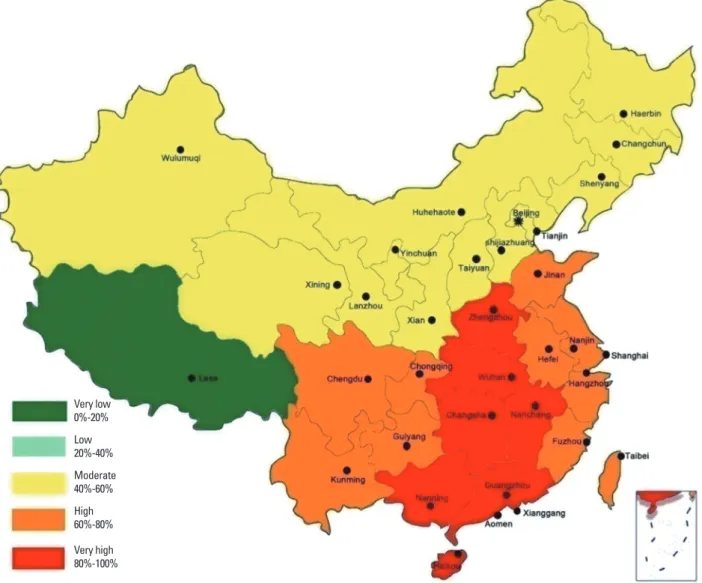
The prevalence of positive skin prick test results to Der p in Qin- gdao, Zhengzhou, Xiamen, and Guangzhou have been report- ed to be 69.6% (66.4%), 86.32% (87.54%), 76.56% (77.16%), and 72.84% (76.36%), respectively.47 We still reviewed 146 published reports documenting the prevalence of sensitization to Der p and Der f among 89,779 AR patients from 7 major regions across China, and drafted a nationwide epidemiologic map to better represent the patterns of sensitization to Der p and Der f in these regions (Fig. 2). This map indicated that overall sensitization to the 2 allergens is fairly similar, although the order of regional distribution for positive sensitization rates was South> Cen- tral> East> Southwest> Northwest> Northeast> North. These data suggested an obvious geographic difference of the preva-
Fig. 2. The prevalence of sensitization to dust mites in China.
Very low 0%-20%
Low20%-40%
Moderate 40%-60%
High 60%-80%
Very high 80%-100%
lence of sensitization to dust mites, demonstrating a trend of decrease from south and east to north and west in China. It is likely that the complicated geographic environment, climate, human activity, and air pollution contribute to these regional differences in the pattern of allergen sensitization. Neverthe- less, an overall upward trend in the prevalence of sensitization to dust mites in China has been observed in recent decades, and this may be related to the rapid change towards a “Western lifestyle.”
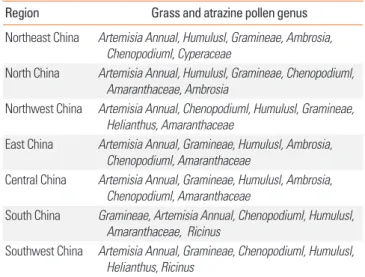
Airborne pollen is the most frequent and seasonal cause of AR in the western and northern regions of China. The existence of a considerable regional difference in the distribution of pollen species and counts is due to the geographic and vegetation dif- ferences in China; thus Artemisia pollen is the most common allergenic one in the northern part of the Yangtze River (Beijing, Xinjiang, Shanxi, Shandong, Shenyang, Lanzhou, and Ningxia) in China. Tables 1, 2 show the geographic distribution of tree, grass, and atrazine pollen in different regions in China.48,49 Thus, availability of this information and establishment of national real-time monitoring of atmospheric pollen may make the pre- vention and treatment of AR patients with pollen allergy and seasonal migration possible.
With improvements in living standards, pet ownership has become more prevalent in China. The number of domestic pets in China has increased 9-fold in 2013 compared to 2003. One survey showed that the positive serum sIgE rates of cat and dog allergens in AR child patients in Shanghai were 6.9% and 28.2%, respectively.50 Wang and colleagues51 conducted a 10-year ret- rospective study to investigate the trends in the prevalence of sensitization to common aeroallergens among AR patients in Guangzhou, the largest city in South China. The authors showed that the prevalence of sensitization to cat hair and dog dander had increased nearly 2-fold during the past decade, suggesting the importance of controlling the pet ownership and introduc- ing SIT for pet allergy.51
4. BURDEN OF AR IN CHINA 4.1 Health economics
The direct and indirect costs associated with the management of AR are a huge burden on the society.52 Data from the Nation- al Bureau of Statistics of China (http://www.stats.gov.cn/) indi- cate that there were 1.37 billion people in China at the end of 2014. A recent report showed that the standardized prevalence of self-reported AR is 17.6% in 18 major cities of China, and the prevalence of self-reported asthma 28% in the AR population.26 From these data, it is estimated that 0.24 billion people could be affected by AR and of these 67.51 million people could have AR combined with asthma (ARS).
Although there is no report of the direct cost of AR in China to date, a study by Chen and colleagues53 estimated that the direct cost of an ARS patient receiving subcutaneous immunotherapy (SCIT) or a specific medical treatment in Wuhan, China in 2013 was $982 and $259 per year, respectively. Since the income and economy of Wuhan represent the average levels of China, using the data of Chen and colleagues53 it is possible to estimate that the total societal cost in China could be $17.49 billion per year for all ARS patients if they received only medicinal therapy and no immunotherapy.
Furthermore, as the average disposable income of Wuhan was
$4,451 per person in 2013 (http://www.whtj.gov.cn/), it can be estimated that as the cost of SCIT is not included in most medi- cal insurance, the patients would have to spend 22% of their dis- posable income for their treatment involving SCIT.
In addition to the direct costs, there are considerable indirect costs such as decreased work productivity, workdays (adults) or school days (children) absent due to illness.54 Expenses manag- ing the comorbidities of AR such as sinusitis, bronchitis and oti- tis media should also be considered “hidden” costs of AR.55 Table 1. The main airborne tree pollens in different regions of China
Region Tree pollen genus
Northeast China Poplus, Ulmus, Pinus, Salix, Birch, Acer, Quercus North China Poplus, Platane, Pinus, Salix, Fraxinus, Birch, Ailantus Northwest China Poplus, Ulmus, Salix, Acer, Cupressaceae, Platane,
Corylus, Fraxinus
East China Platane, Pinus, Cupressaceae, Broussonetia, Pterocarya Kunth, Ulmus, Salix, Poplus
Central China Platane, Cupressaceae, Pinus, Broussonetia, Pterocarya Kunth, Quercus, Ligustrum, Morus
Southwest China Salix, Pinus, Alder, Cupressaceae, Broussonetia, Poplus, Firmiana Marsili, Cryptomeria
South China Pinus, Broussonetia, Eucalyptus, Cupressaceae, Casuarina, Morus, Juglans L, Palmae
Table 2. The main grass and atrazine pollens in different regions of China
Region Grass and atrazine pollen genus
Northeast China Artemisia Annual, Humulusl, Gramineae, Ambrosia, Chenopodiuml, Cyperaceae
North China Artemisia Annual, Humulusl, Gramineae, Chenopodiuml, Amaranthaceae, Ambrosia
Northwest China Artemisia Annual, Chenopodiuml, Humulusl, Gramineae, Helianthus, Amaranthaceae
East China Artemisia Annual, Gramineae, Humulusl, Ambrosia, Chenopodiuml, Amaranthaceae
Central China Artemisia Annual, Gramineae, Humulusl, Ambrosia, Chenopodiuml, Amaranthaceae
South China Gramineae, Artemisia Annual, Chenopodiuml, Humulusl, Amaranthaceae, Ricinus
Southwest China Artemisia Annual, Gramineae, Chenopodiuml, Humulusl, Helianthus, Ricinus
4.2 Effects of AR on life quality
AR is an important and serious public health problem not just because of its high prevalence but also because it adversely im- pacts patients’ quality of life (QOL) with respect to work pro- ductivity, school performance, social life, and mental and psy- chologic states. The disease burden comes from the morbidity of nasal symptoms, numerous comorbidities, and the impair- ment of multiple domains of QOL. Patients report that the dis- order has a marked detrimental effect on their sleep, social life, and attendance and functioning at school and work,56 and pa- tients also experience other psychologic symptoms that include fatigue, mood changes, anxiety, and depression.57,58 Yin and colleagues59 found that symptoms of AR could cause great dis- comfort in the patient’s daily functioning, including playing a satisfactory role in family, and professional and social life. Fur- thermore, nasal symptoms were significantly associated with anxiety, and emotion and behavior problems. A previous study on QOL of AR patients, using several instruments including the Medical Outcomes Study Short-Form 36-Item Health Survey (SF-36), Eysenck personality questionnaire (EPQ), self-rating anxiety scale (SAS) and self-rating depression scale (SDS), showed that the patients’ health status declined in all domains, especial- ly in general health perceptions, physical role functioning, and emotional role functioning.60 Furthermore, although the patients had no obvious differences in personality characteristics, the tendency to develop anxiety, but not depressive emotion, was observed. A study by Liu and colleagues61 using the Chinese version of SF-36 has also demonstrated pronounced decrements in general health, role-emotional, and role-physical dimensions in mild AR patients, whereas significant impairments were not- ed in all domains in patients with moderate to severe AR. In the latter group, the impairments were most prono unced in gener- al health, role-emotional and social function domains. Similar- ly, in a more recent prospective cohort study of patients with moderate/severe AR, using visual analogue scale (VAS) and AR Control Test (ARCT) demonstrated impairments in sleep in 86.9%, work life in 84.9%, social activities in 81%, and physical activities in 90.1% of the patients.62 Indeed, nasal symptoms including stuffy/blocked nose, runny nose, sneezing and post nasal drip, as well as the consequential practical problems, including in- convenience of having to carry tissues or handkerchief, need to rub nose/eyes, and need to blow the nose repeatedly, have been shown to be the most troublesome aspects of AR.63 Li and col- leagues64 employed the rhinoconjunctivitis quality of life ques- tionnaire (RQLQ) to assess the QOL in AR patients according to the sensitization profile for relevant aeroallergens in North Chi- na and showed that this was worse in patients sensitized to tree pollens or weed pollens than in those sensitized to HDMs. Al- though QOL of the patients was not significantly correlated with the level of specific IgE to the causative allergen, the QOL var- ied with the allergen responsible for symptoms.64 A study using Symptom Checklist-90 (SCL-90) has shown the SCL-90 scores
to be significantly higher for the obsessive-compulsive, hostili- ty, somatisation, and psychoticism dimensions in AR patients than in healthy controls.65 This study further indicated that the psychologic status of AR patients worsens with comorbid asth- ma. However, the effect of gender is somewhat unclear. A study by Xi and colleagues65 did not demonstrated effect of gender on SCL-90 scores of AR patients, whereas a study by Lv and col- leagues66 demonstrated poorer psychologic functioning in fe- male patients with moderate-to-severe persistent AR than in nonallergic women. VAS and RQLQ have also been employed to assess symptom severity and QOL, respectively, in Chinese children with AR.67 As for the adults, nasal symptoms were the most impairing aspect of QOL, with nasal itching and sneezing the main factors affecting the quality of sleep. While the quality of sleep may affect non-hay fever symptoms and emotions, rhi- norrhea appeared to be the main factor causing embarrass- ment to the child. VAS was significantly correlated with RQLQ, and skin prick tests (SPTs) results correlated with both VAS and RQLQ, suggesting a close relationship between the allergen lev- el and symptom severity/QOL.67 Song and colleagues58 investi- gated the effect of AR in 814 middle school students aged 10 to17 years enrolled from 4 schools in Changsha city, using VAS, to assess the effect of AR on sleep, emotion, and memory of these students. The rates of students reporting a moderate-to- severe impact of AR symptoms on sleep, emotion, and memory were 47.14%, 14.29%, and 27.14%, respectively, compared to 21.96%, 6.83%, and 11.28%, respectively, for children without AR. The authors suggested that AR significantly decreased the sleep quality and memory of these students, while emotional issues were increased with the onset of AR.58 AR has also been shown to impact on the sleep and attention in children and to decrease the QOL of children.68 Similar to these findings in Chi- nese AR patients, the symptoms of AR have also been shown to impair the QOL of patients from diverse regions of the world by adversely impacting on sleep, daily activities, physical and men- tal status, and social functioning.69 Poor sleep leads to fatigue and daytime somnolence, resulting in decreased performance, productivity, and social functioning as well as increased risk of associated diseases. A study from Europe has recently suggest- ed that the severity of AR adversely impacts on patients’ QOL to a greater degree than the duration of disease.70 Effects of gen- der, marital status, residential area, and duration of symptoms have also been shown to significantly impact on the patient’s well-being.71 QOL of children with AR has been shown to be se- verely compromised due to frequent night awakenings, easy fa- tigue, defects of language, and irritability, which all have a neg- ative influence on learning abilities. Indeed, AR may negatively impact on the QOL of the whole family because it could inter- fere with social life and financial costs.72
4.3 Psychologic impact
Although AR is not life-threatening, the serious negative influ-
ence of the disease on the patient’s quality of life and psycho- logic status has received more attention in recent years. Several studies have investigated the influence of psychosocial factors on atopic disorders and the effect of atopic disorders on mental health, demonstrating that there is a significant bidirectional relationship between psychosocial factors and future atopic disorders as well as between atopic disorders and future poor mental health.73 Cuffel and colleagues74 carried out a question- naire survey of 85,298 people and reported that the incidences of anxiety and depression in AR patients were 1.41 and 1.7 times, respectively, that of the general population. Several studies have shown an association between the risk of suicide during the hay fever season and seasonal pollen counts.75,76 Sansone and colleagues76 reviewed the studies investigating the relationships between allergies and anxiety/mood syndrome and found that the majority of studies (9 of 11 studies on anxiety syndromes, and 10 of 12 studies on depressive syndromes) indicated asso- ciations between allergies and anxiety/mood syndromes. One population-based study has suggested that AR may even be a risk factor for suicide.77 Similarly, some studies have investigat- ed the psychologic effects of AR in Chinese subjects. Xi and col- leagues65 used the SCL-90 to study psychologic characteristics between AR patients and nonallergic individuals and demon- strated that there were significant differences between the 2 groups; with the SCL-90 scores for somatization, compulsion, interpersonal sensitivity, hostility, and psychosis being higher in the AR patients. In another study, Lv and colleagues61 assessed the psychologic aspects of Chinese female outpatients with mod- erate-to-severe persistent AR and nonpsychometric adult fe- males, using the Minnesota Multiphasic Personality Inventory (MMPI). The authors concluded that women with AR have poor psychologic functioning as indicated by poorer MMPI scores for hypochondriasis, depression, hysteria, psych asthenia, schi- zophrenia and social introversion. Moreover, the women with AR felt depressed and unhappy, and were more likely to be pes- simistic about the future. Some exhibited apprehensive behav- ior, and even anger and resentment because they had likely ex- perienced many hours in hospital and felt misunderstood by physicians as well as by family members or others, and had a greater tendency to be alone. Another study by these authors has indicated that the psychologic status of seasonal AR patients was likely to be influenced markedly by the symptoms of AR, such as nasal obstruction and nasal itching.78 Collectively, these findings suggest that allergists should target both allergic dis- eases and subsequent psychologic disorders as a whole, rather than treat them as separate disease entities.
5. DEFINITION AND CLASSIFICATION 5.1 AR
AR is a symptomatic disorder of the nose, which is defined as an infectious inflammation associated with IgE-mediated in-
flammatory response to allergens. The symptoms of AR inclu- des paroxysmal sneezing, rhinorrhea, nasal congestion and itchin.4,7,8,11,79
The classification of AR in China has been adjusted continual- ly following a long period of research and discussion. Accord- ing to the original classification in 1997, AR was divided into 2 categories: perennial (the onset of symptoms is all year round and symptoms last for at least 6 months per year) and seasonal (the onset of symptom is seasonal). In order to adapt to the sit- uation in China, the classification was subsequently modified into 4 categories by combining the traditional classification with the classified standard recommended by ARIA in 2004: season- al intermittent, seasonal persistent, perennial intermittent, and perennial persistent.80 Furthermore, the severity of AR was clas- sified as mild (the symptoms are not interfering with sleep, dai- ly activities, physical exercise, entertainment, work and study) and moderate-severe (the symptoms are disturbing and severe- ly affected patients’ life mentioned above) in accordance with the ARIA classification. Thus, the classification was modified to being intermittent (<4 days/week or <4 weeks/year) or persis- tent (≥4 days/week and ≥4 weeks/year) by the frequency of symptoms and to being mild (the symptoms are not interfering with quality of the patient’s life) or moderate-severe (the symp- toms cause severe impairments in quality of life of patients) ac- cording to the severity of symptoms.10 More recently, the classi- fication of AR has been further modified by the addition of the type of allergen in 2016.11
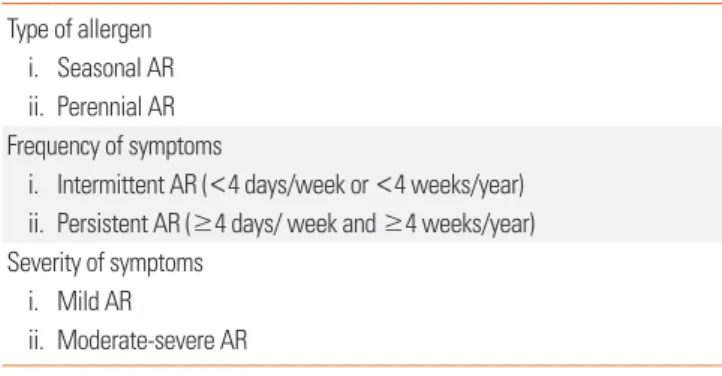
Taking the Chinese patients’ situation and international com- mon classification into consideration, AR can thus be classified in 3 ways as shown in Table 3.
1) The type of allergen
a) SAR: the onset of symptoms is seasonal. Aeroallergens (pollen and fungi) are the most common allergens.
b) Perennial AR: the onset of symptoms is year-round. The allergens include dust mites, animal dander, tree pollen, etc.
2) The frequency of symptoms4,10,11,80
a) Intermittent AR: <4 days/week or <4 weeks/year b) Persistent AR: ≥4 days/week and ≥4 weeks/year 3) The severity of symptoms4,10,11,80
Table 3. Classification of AR Type of allergen
i. Seasonal AR ii. Perennial AR Frequency of symptoms
i. Intermittent AR (<4 days/week or <4 weeks/year) ii. Persistent AR (≥4 days/ week and ≥4 weeks/year) Severity of symptoms
i. Mild AR
ii. Moderate-severe AR
a) Mild AR: the symptoms are not interfering with quality of the patient’s lifestyle including daily life, work, study, etc.
b) Moderate-severe AR: the symptoms cause severe trou- ble in quality of the patient’ life.
As the duration of aeroallergen pollen season depends on cli- matic conditions and geographic location, in some areas where the aeroallergen pollen season is year-round, this causes diffi- culty in classifying AR by the type of allergen. Thus, in such ar- eas AR is divided into the seasonal, perennial or the mixed (pe- rennial with seasonal exacerbations) types.79
The classification of AR by the frequency of symptoms also has some limitations.4 It is particularly difficult to sort out pa- tients with perennial symptoms, but for less than 4 days/week (more like “persistent”), into “intermittent” AR type.
The appropriate classification of AR should thus take into con- sideration different geographic conditions and patients’ situa- tions, and needs to be continuously improved accordingly.
5.2 Local AR
Local AR (LAR) is a newly described form of AR. LAR patients have typical clinical symptoms of AR, but without classic sys- temic atopy.81 In LAR patients, nasal symptoms, local sIgE pro- duction, and type 2 response-dominated inflammation in nasal mucosa can be induced during natural exposure to aeroaller- gens or by nasal provocation test (NPT).82
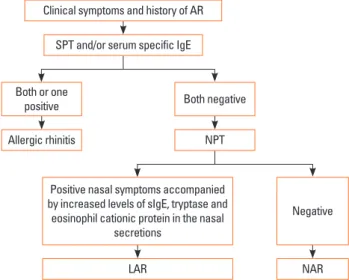
LAR affects about 47% of patients previously diagnosed as non- AR.81 Key features for the differential diagnosis of LAR and AR are shown in Table 4. LAR shares similar clinical symptoms, in- cluding rhinorrhea, nasal obstruction and itching, sneezing, and associated ocular symptoms, with AR; however, SPT and serum sIgE are negative for LAR patients. On the contrary, sim- ilar to AR patients, NPT is able to induce positive immediate, late, and dual nasal symptoms accompanied by increased lev- els of sIgE, tryptase, and eosinophil cationic protein (ECP) in the nasal secretions of LAR patients.83 NPT can be evaluated by assessing the change in nasal volume (NV) using acoustic rhi- nometry, and nasal symptoms can be score using a VAS system.
A 30% increase in the total VAS plus a 30% decrease in the vol-
ume of nasal cavity from 2 to 6 cm (NV 2-6 cm) is considered a positive response.84 The release of ECP and tryptase is signifi- cantly up-regulated in the nasal secretion as early as 15 minutes after challenge and can last for 24 hours with a gradual increase.
In some patients, sIgE can be detected in nasal secretion at base- line, and local sIgE levels can be further rapidly increased after NPT.85 Due to the lack of standardized provocation reagents in China and the potential side effects of NPT, NPT is only carried out in a laboratory, and seldom in the clinic. Thus, the preva- lence of LAR in China is not clear and this disease entity has not been widely recognized by Chinese physicians. Patients with LAR may present persistent or intermittent symptoms, with se- verity classified as mild, moderate or severe, similar to AR pa- tients.81 Indeed, a prospective follow-up study has recently shown that only a small number of individuals with LAR may evolve to typical AR with systemic atopy, suggesting that LAR is more like- ly a distinct entity.86
A diagnostic flowchart for LAR is summarized in Fig. 3.
6. MECHANISMS 6.1 Genetic factors 6.1.1 Genetics
AR, like other allergic diseases, is an inflammatory disease with a complex genetic component in the etiology of AR. Based on the European studies of twins, it was estimated that AR exhibit- ed a heritability ranging between 33% and 91%.87,88 In China, a genetic epidemiologic study involving 23,825 families from Ji- angsu province reported that the average AR heritability of the first, the second, and third generations was 81.86%.89 Earlier stud- ies using genome-wide linkage scans for AR in affected-sib-pair families from European and Japanese populations demonstrat-
Table 4. Diagnosis of AR and LAR
AR LAR
Symptoms Rhinorrhea, nasal obstruc- tion, nasal itching, sneez- ing with or without ocular symptoms
Rhinorrhea, nasal obstruc- tion, nasal itching, sneez- ing with or without ocular symptoms
Disease duration Persistent or intermittent Persistent or intermittent Laboratory test SPT and/or serum sIgE anti-
body positive SPT and serum sIgE anti- body negative Aeroallergen nasal
provocation test Positive Positive Fig. 3. Diagnostic flowchart for LAR. AR, allergic rhinitis; SPT, skin prick test;
IgE, immunoglobulin E; NPT, nasal provocation test; LAR, local allergic rhinitis;
NAR, non-allergic rhinitis; sIgE, serum-specific IgE.
Clinical symptoms and history of AR SPT and/or serum specific IgE
Both or one positive
Allergic rhinitis NPT
Both negative
Positive nasal symptoms accompanied by increased levels of sIgE, tryptase and eosinophil cationic protein in the nasal
secretions
LAR NAR
Negative
ed that the chromosomes 1p31, 2q32, 3p24-p14, 4q32.2, and 9q22-q34 were likely to contain the candidate gene loci associ- ated with the development of AR.90-92
With the rapid development of genotyping techniques, large population-based association strategies have been carried out more widely to investigate specific susceptibility genes for AR.
Because of the important role in antigen presentation, the hu- man leukocyte antigen (HLA) is known to be an important ge- netic susceptibility locus for a variety of allergic diseases. More- over, several HLA alleles have been shown to be associated with AR in different ethnic groups. In an earlier study, Lin and col- leagues93 first investigated the association between several HLA alleles (HLA-B27, RR of A31, A28, B12, and A33) and the genet- ic susceptibility of AR in a Chinese population. Subsequently, several studies have been performed in different ethnic groups from different parts of China (northeastern area,94 Beijing,95-97 Xinjiang98) and demonstrated a strong association between HLA
class II alleles (DR and DQ) and AR. However, these studies have been limited by the complicated nature of the genotyping pro- cedures employed and the small sample sizes (<100 AR pati- ents) investigated. More recently, Zhao and colleagues99 have employed polymerase chain reaction sequence-based typing (PCR-SBT), a form of higher resolution HLA typing, to assess the HLA-II gene alleles associated with AR in HDM-sensitive Han Chinese subjects and control subjects. The authors report- ed that HLA-DQB1*06:01:01 and HLA-DRB1*08:03:02 were sig- nificantly increased in HDM-sensitive AR patients compared to healthy controls, suggesting that these alleles may confer a risk of AR in Han Chinese subjects sensitized to HDM.
Candidate gene studies have also implicated a number of sev- eral other susceptibility genes related to AR in Chinese subpop- ulations (Fig. 4). These include cytokines (IL13,100,101 IL4,102 IL12B,103 IL17A,103,104 17F,102 IL6,105 IL27106) cytokine receptors (IL23R,107 IL12RB1,108 and EBI3109) immunity pathway molecules (JAK1,110
Fig. 4. Susceptibility loci of AR in Chinese population studies. Some loci were reported only in Chinese populations (loci shown in black) or in both Chinese popula- tions and other ethnic populations (loci shown in red).
FCRL3,111 TNFSF4,112 CTLA4,113 CD14,114 TNFA,115 PBX2,116 TAP1,117 TNFAIP3,118 FAM167A-BLK,112 GATA3,119 IRAK4,120 RORA,103 TGFB1,121 and FOXP3109), allergic airway inflammation and air- way remodelling molecular genes (BDNF,122 CYP2R1,123 VDR,123 ACE,124-126 MRPL4,115 ADAM33127,128), and others (rs 4982958 at 14q11.2).129 Fig. 4 shows that Chinese subpopulations and oth- er ethnic groups, including white European, Koreans and Japa- nese, share a large number of these genetic susceptibility loci.
Loci on the chromosome 5q31-33 have been shown to be hot- spots for AR susceptibility. These loci contain a cluster of cyto- kines and immune-related genes such as IL-13, IL-4, CD14, and IL-12B. Ying and colleagues101 conducted a meta-analysis in- volving Asian (China, Japan, and Korea) and Caucasian (Spain Germany and UK) subjects, and found that the functional sin- gle nucleotide polymorphism (SNP) rs20541 in the IL-13 gene was significantly associated with AR, particularly in Asians. How- ever, inconsistent data from other studies suggest that rs20541 may explain little of the heritability of AR.130 Recently, Li and col- leagues131 found that the DNA hypomethylation status of spe- cific CpG islands located ~2 kb upstream of the IL-13 gene may be an independent risk factor for HDM-sensitive AR. Likewise, IL-4, another important Th2 cytokine gene, has multiple poly- morphisms, including rs2243250, which regulates IL-4 gene ex- pression and has been reported to be associated with AR in many ethnic groups (Chinese, Caucasian, and others).130 The best gene-environment interaction presented in allergy to date should be SNPs in the CD14 gene, which plays a critical role in the innate immune response to microbial invasion. However, the association between CD14 genotypes and AR was found to be controversial in different studies in the Chinese population.114 Except for HLA loci, chromosome 6 has several susceptible loci (TNFA, PBX, TAP1, IL17A, IL17F, and TNFAIP3) for AR. The study of Zhang and colleagues115 demonstrated a genotype-depen- dant association pattern with regard to the SNP rs1799964 in the TNFA gene vs AR development in a Chinese population.
Some allergic airway inflammation and airway remodelling molecular genes have been shown to be as important as im- mune-related genes for AR susceptibility. Jin and colleagues,122 have identified an association of a common functional SNP rs6265 in the brain-derived neurotrophic factor (BDNF) gene with AR risk and disease severity in 2 independent populations of Chinese patients with moderate-to-severe AR. A series of studies have focused on the correlation of the polymorphism based on the presence (insertion/deletion) of a non-sense DNA fragment in the angiotensin-converting enzyme (ACE) gene, exerting an anti-inflammatory effect by inactivating different proinflammatory peptides with and AR risk in different popula- tions (also including Chinese populations).124-126 Similarly, the association of T1, T2, V4, and Q-1 polymorphisms in Disinteg- rin with the metalloproteinase 33 (ADAM33) gene encoded for a protein important for airway remodelling and AR have also been investigated in some Chinese studies.127,128
To date, 3 genome-wide association studies (GWAS) have been performed specifically for the AR phenotype. Andiappan and colleagues132 first employed GWAS strategy in a cohort of 4,461 ethnic Chinese individuals in Singapore and demonstrated that SNPs in mitochondrial ribosomal protein L4 (MRPL4) and B- cell adaptor for phosphatidylinositol 3-kinase (BCAP) were sug- gestively associated with AR. A recent study in a Han Chinese population demonstrated that SNPs in the MRPL4 was strongly associated with the risk of AR.115 However, other association sig- nals have not yet replicated in other populations.
Despite the overlapping genetic susceptibility to AR in the Chi- nese population and other ethnic populations, genetic hetero- geneity also plays an important role in explaining the apparent discrepancy in the genetic studies between races.
Although remarkable progress has been made in the genetics of AR and allergy, several limitations of these studies remain to be overcome; in particular, the confounding effects of endo- phenotyping, sample size, unmapping variants, epigenetic ef- fects, gene-gene/gene-environment interactions, and function- al validation. Furthermore, Zhang and colleagues103 recently provided evidence that there are wide interactions among the crucial genes involved in the effector T-cell pathways and that the T helper 17 (Th17) pathway is a key player in developing susceptibility to AR. Therefore, future research should system- atically integrate “overall data” from genomics, proteomics, epig- enomics, and metabolomics to provide new insights into preci- sion medical treatments for AR.
6.1.2 microRNA
Genetic regulation plays an undoubted role in the pathogene- sis of AR. Because they function as endogenous inhibitors of translational processes, microRNA (miRNA/miR) is a class of short, noncoding RNAs that have emerged as important regula- tors of gene expression in the immune system.133 Altered miR- NA expression profiles have been identified in AR. In this re- gard, 7 up-regulated and 10 down-regulated miRNAs were re- cently identified in activated bone marrow-derived mast cells following IgE-FcɛRI cross-linking with antigen, suggesting that these miRNAs may exert considerable influence on core signal- ling pathways and biologic behaviors.134 Among these altered miRNAs, miR-21a-3p and miR-3113-5p were the most remark- ably up-regulated and down-regulated miRNAs according to the bioinformatics algorithm.134 Some miRNAs can modify the messenger RNA (mRNA) and protein expression of the chemo- kines and transcription factors directly. The miRNA microarray chip analysis has shown that miR-224, miR-187, and miR-143 were down-regulated in AR patients,135 among which miR-143 has been shown to decrease the mRNA and protein expression levels of granulocyte–macrophage colony-stimulating factor (GM-CSF), eotaxin, and mucin 5AC (MUC5AC) in IL-13-stimu- lated nasal epithelial cells through direct suppression of IL-13 receptor α1 chain (IL13Rα1).136 This is particularly relevant as
IL-13 plays an important role in the pathogenesis of allergic in- flammation. In addition, miR-135a can down-regulate the mRNA and protein expression levels of GATA- binding protein-3 and IL-4, and up-regulate the expression levels of T-bet and IFN-γ, thus correcting the Th1/Th2 imbalance in AR mice.137 The po- tential effects of miR-143 and miR-135a on signalling pathways in AR development are briefly illustrated in Fig. 5.
Some miRNAs could predict the onset of AR. Suojalehto and colleagues138 have reported that miR-205, miR-155, and miR- 498 were up-regulated in the nasal mucosa of currently symp- tomatic AR, whereas let-7e was down-regulated in currently nonsymptomatic AR. Notably, Chen and colleagues139 found that miRNA-21 expression levels were significantly low in mono- nuclear leucocytes from cord blood samples with elevated cord blood IgE (CBIgE) and in monocytes from AR children, indicat- ing that miRNA-21 may be an early predictor of AR and a possi- ble therapeutic target for treating AR. However, further studies are needed reveal the full impact of miRNAs in the development of AR as well as to reveal their potential as therapeutic targets and noninvasive biomarkers in AR.
6.2 Immunopathogenesis 6.2.1 General concept
The symptoms of AR are a result of inhaled allergen-induced inflammation in the nasal mucosa, which is characterized by a Th2-dominated immune response associated with increased levels of serum IgE.140,141
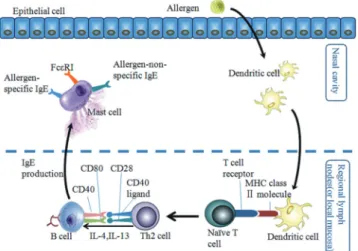
Similar to other allergic diseases, the immune response in AR begins with sensitization. When the nasal mucosa is exposed to allergens, the allergens are captured and processed by antigen- presenting cells (mainly dendritic cells) and presented to naïve T cells. Naïve T cells then differentiate into Th2 cells which pro-
duce IL-4, IL-5, and IL-13. The IL-4 and IL-13 cytokines, togeth- er with the ligation of matched co-stimulatory molecules in Th2 cells and B cells, promote B cell phenotype switching to produce allergen specific IgE. Thereafter, the allergen-specific IgE binds to its high-affinity receptors (FcεRI) on the surface of mast cells and basophils, causing sensitization of these 2 cell types (Fig. 6).142
Re-exposure of sensitized individuals to the sensitizing aller- gens leads to a cascade of pathologic events, and subsequently the symptoms of AR. Allergic responsiveness can generally be divided into 2 phases: the immediate or early-phase and the late-phase responses.140
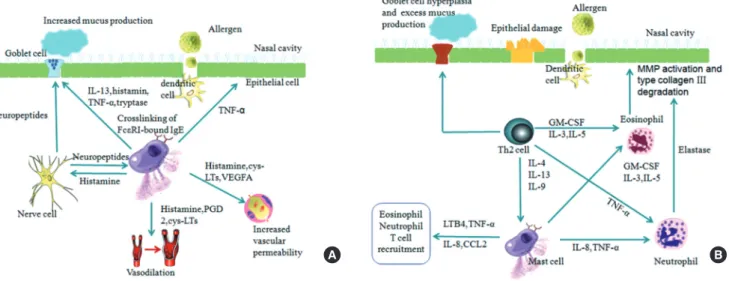
The early phase response occurs in sensitized individuals with- in minutes of allergen exposure, with mast cells and basophils being the best-known effector cells in this phase. Mast cells are abundant in the epithelial compartment of nasal mucosa in the sensitized individuals and can be easily activated upon re-ex- posure to the allergens. Cross-linking of the allergen-specific IgE-FcεRI complexes on the mast cell and basophil surfaces by specific allergen triggers secretion of 3 classes of biologic prod- ucts: those stored in cytoplasmic granules, lipid-derived medi- ators, and newly synthesized cytokines, chemokines, and growth factors as well as other products.140 These mediators collectively result in vasodilation, increased vascular permeability, and mu- cus production, as well as stimulation of sensory nerves, which
Fig. 5. The potential effects of miR-143 and miR-135a on signaling pathways.
While miR-143 can inhibit the expression of GM-CSF, eotaxin, and MUC5AC by suppressing the IL13Rα1 signalling pathway, miR-135a can down-regulate the mRNA and protein expression levels of GATA-3 and IL-4 and up-regulate the expression levels of T-bet and IFN-γ, thereby correcting the Th1/Th2 imbalance.
Fig. 6. The process of allergen sensitization in AR. Following exposure of nasal mucosa to allergens, allergens are captured, taken up, and processed by den- dritic cells (DCs). Subsequently, DCs are activate and, mature, and migrate to regional lymph nodes or to sites in the local mucosa, where they present aller- gen-derived peptides in the context of MHC class II molecules to naïve T cells.
Naïve T cells then differentiate into Th2 cells, which produce IL-4 and IL-13 in the presence of early IL-4. In the presence of these Th2-derived cytokines, to- gether with ligation of the suitable co-stimulatory molecules (CD40 ligand with CD40 and CD28 with CD80), B cells undergo immunoglobulin class-switch re- combination to produce IgE antibodies. The locally and/or systemically diffused IgE binds to the high-affinity receptors (FcεRI) on mast cells and basophils (not shown), and results in sensitization of these cells (adapted from Galli and col- leagues [142]).