Response-Guided Therapy for Hepatitis C Virus Recurrence Based on Early Protocol Biopsy after Liver Transplantation
Hepatitis C virus (HCV) recurrence after liver transplantation (LT) is universal and
progressive. Here, we report recent results of response-guided therapy for HCV recurrence based on early protocol biopsy after LT. We reviewed patients who underwent LT for HCV related liver disease between 2010 and 2012. Protocol biopsies were performed at 3, 6, and 12 months after LT in HCV recurrence (positive HCV-RNA). For any degree of fibrosis,
≥ moderate inflammation on histology or HCV hepatitis accompanying with abnormal liver function, we treated with pegylated interferon and ribavirin. We adjusted treatment period according to individual response to treatment. Among 41 HCV related recipients, 25 (61.0%) who underwent protocol biopsies more than once were enrolled in this study. The mean follow-up time was 43.1 (range, 23-55) months after LT. Genotype 1 and 2 showed in 56.0% and 36.0% patients, respectively. Of the 25 patients, 20 (80.0%) started HCV treatment after LT. Rapid or early virological response was observed in 20 (100%) patients.
Fifteen (75.0%) patients finished the treatment with end-of-treatment response.
Sustained virological response (SVR) was in 11 (55.0%) patients, including 5 (41.7%) of 12 genotype 1 and 6 (75.0%) of 8 non-genotype 1 (P = 0.197). Only rapid or complete early virological response was a significant predictor for HCV treatment response after LT (100%
in SVR group vs. 55.6% in non-SVR group, P = 0.026). Overall 3-yr survival rate was 100%. In conclusion, response-guided therapy for HCV recurrence based on early protocol biopsy after LT shows encouraging results.
Keywords: Hepatitis C; Recurrence; Liver Transplantation; Therapeutics; Biopsy Hyeyoung Kim, Kwang-Woong Lee,
Nam-Joon Yi, Hae Won Lee, YoungRok Choi, Suk-Won Suh, Jaehong Jeong, and Kyung-Suk Suh Department of Surgery, Seoul National University College of Medicine, Seoul, Korea
Received: 22 December 2014 Accepted: 29 July 2015 Address for Correspondence:
Kwang-Woong Lee, MD
Department of Surgery, Seoul National University College of Medicine, 101 Daehak-ro, Jongno-gu, Seoul 03080, Korea Tel: +82.2-2072-2511, Fax: +82.2-766-3975 E-mail: [email protected]
http://dx.doi.org/10.3346/jkms.2015.30.11.1577 • J Korean Med Sci 2015; 30: 1577-1583
INTRODUCTION
Compared to other etiologies, patient and graft survival rates are relatively poor for hepatitis C virus (HCV) related liver trans- plantation (LT) due to universal HCV recurrence after LT and progressive fibrosis (1-5). To date, the absence of preventive strat- egy for HCV reinfection after LT is a major challenge for HCV recipients undergoing LT (6). For best efficacy of anti-HCV treat- ment, pre-emptive or early post-transplant antiviral therapy should be initiated soon after LT, optimally within 1 month when the viral load is at its lowest level and fibrosis is absent (7,8). How- ever, in the early post-transplant period, antiviral therapy may be less effective due to high level of immunosuppression. In ad- dition, there is a high risk of poor hematological tolerance, re- jection, and sepsis in the early post-transplant period (7-12).
Although recent direct acting antivirals represent a new era in HCV associated liver disease, individual centers are now report- ing their experience with the new agents in the post-transplant period (5,13,14). Therefore, the current ‘standard of care’ for HCV recurrence in recipient is still pegylated interferon and ribavirin for 48 weeks irrespective of viral genotype (2,13).
We designed the present study with the following aims: 1) to evaluate the result of early protocol biopsies in HCV related re- cipient after LT; 2) to investigate the result of response-guided standard antiviral therapy for HCV recurrence based on early protocol biopsy after LT. In the present study, HCV related liver disease or HCV infection was confined as in case of positive se- rum HCV-RNA. HCV recurrence after LT was defined as recur- rence of serum HCV-RNA positivity after LT.
MATERIALS AND METHODS Immunosuppressive protocol after LT
All recipients had received induction with 20 mg of intravenous basiliximab (IL-2 receptor antagonist) within two hours before LT and on postoperative day 4. Basal immunosuppression was based on triple immunosuppressive regimen with calcineurin inhibitor (mostly, tacrolimus), mycophenolate mofetil and ste- roids. Tacrolimus or cyclosporine was started within 5 days af- ter LT. Tacrolimus and cyclosporine doses were adjusted accord- ing to individual clinical need with respective target whole blood trough levels around 8-12 ng/mL and 200-300 ng/mL for the
first month after LT, followed by 5-8 ng/mL and 100-200 ng/mL thereafter. Mycophenolate mofetil was started at 1.0 g daily with- in 5 days (500 mg twice a day) for most patients, and adjusted according to the occurrence of related side effects. Intravenous methylprednisolone 500 mg was given intra-operatively before portal perfusion. It was tapered from 200 mg to 20 mg within 6 days. Thereafter, oral prednisolone was continued at 20 mg dai- ly. It was tapered to 0-5 mg/day until 6 months post-LT.
Outpatient follow-up were usually conducted once a week for the first month after discharge, and was gradually length- ened to every 3 or 4 months, with additional visits as clinically necessary. A complete laboratory investigation, including liver function tests and blood calcineurin inhibitor trough level, was conducted at each follow-up.
Laboratory testing
HCV-RNA test and genotyping was performed using molecular methods. HCV-RNA was quantitatively measured using serum (gel EDTA bottle) by real-time reverse transcription polymerase chain reaction (detection range, 12-100,000,000 IU/mL). HCV genotyping was performed using serum (gel EDTA bottle) by polymerase chain reaction and hybridization (detectable pa- tients in case of ≥ 500 IU/mL HCV-RNA; detectable genotype:
1a, 1b, 2, 3, 4, 5, 6).
HCV-RNA measurement was performed before discharge and at almost every month after LT. In patients who underwent HCV treatment after LT, the assessments included HCV-RNA at baseline, week 4, 12, 24, the end of treatment, and 24 weeks af- ter the end of treatment irrespective of genotype. HCV genotype was usually performed once before LT.
Protocol liver biopsy after LT
Application of early protocol biopsy was confined to HCV re- currence after LT. Protocol biopsies were performed between postoperative day 7 and 14, and at 3 ± 1, 6 ± 1, and 12 ± 1 months after LT with annual biopsies thereafter in HCV related recipi- ents since January 2010. Sono-guided fine needle aspiration liver biopsies were performed by specialized radiologists. The biopsy specimens were stained with hematoxylin-eosin and Masson trichrome. Pathologic reviews were performed by two hepatopathologists at the institution. Hepatic fibrosis was as- sessed on a four-point scale using the METAVIR system (15). In all cases, an informed consent was obtained from each patient before biopsy.
Patient selection
We retrospectively analyzed the results of protocol biopsies in HCV related recipients who underwent LT at our institute from 2010 to 2012. A total of 510 patients underwent LT during the period, of which 41 were HCV related (8.0%). We excluded pa- tients who had the following: death before protocol biopsy, re-
fusal of biopsy or poor adherence, advanced hepatocellular car- cinoma with invasion of major vessels before LT, hepatocellular carcinoma recurrence after LT, re-LT, and no recurrence of HCV after LT. In the present study, we excluded the results of biop- sies which were performed during or after HCV treatment.
After LT, 97.6% of HCV related recipients experienced HCV recurrence (n = 40). Among the 40 recipients with HCV recur- rence, 28 (68.3%) underwent early protocol biopsies more than once within 1 yr after LT. After excluding hepatocellular carci- noma recurrence (n = 3), a total of 25 patients were included in the present study.
Response-guided antiviral therapy
The indication of HCV treatment was based on biopsy and lab- oratory test as shown in the following: 1) any degree of fibrosis related with HCV infection on histology, 2) inflammation de- gree with more than moderate or HCV hepatitis accompanying with abnormal liver function test. We started standard treatment with pegylated interferon and weight based ribavirin. We ad- justed treatment period according to individual response re- gardless of pre-LT HCV treatment. Definitions of virological re- sponse were based on the ‘2009 AASLD guidelines’ (16). In case of rapid virological response (RVR), we treated the patients for 24 weeks after the initial treatment regardless of the genotype.
For complete or partial early virological response (EVR), we treat- ed the patients for 48 weeks. In case of breakthrough after RVR or EVR, we treated patients for 72 weeks after the initial treat- ment. For patients who showed non-tolerance, non-adherence, or non-responder, we discontinued the treatment. The end-point of treatment was the sustained virological response (SVR). In case of relapse, we restarted HCV treatment for 48 weeks unless the patient had been non-tolerant or non-adherent. The end- point of retreatment was also the SVR.
End-points
The primary end-point of the present study was at 12 months after LT, that is, at the time of completion of early protocol biop- sies. The secondary end-point was at 24 weeks after completion of HCV treatment for evaluating SVR or relapse, or at the time of discontinuation of HCV treatment due to non-tolerance, non- adherence, or non-responder.
Statistical analysis
Continuous data were presented as mean ± standard deviation.
Categorical parameters were presented as number of cases with percentage in parenthesis. Continuous variables were compar- ed using Student’s t-test. Categorical variables were compared using Pearson’s chi-square test or Fisher’s exact test. Statistical analyses were performed using SPSS version 19.0 (SPSS Inc., Chicago, IL, USA). All P values were two-sided, and P < 0.05 was considered statistically significant.
Ethics statement
This study was approved by the institutional review board of Seoul National University Hospital (IRB No. 1112-110-391). In- formed consent was waived by the board.
RESULTS Demographics
The demographics of the 25 patients used in the present study are summarized in Table 1. Mean age was 56.64 ± 8.09 (range, 41-70) yr, including 15 (60.0%) living donor LT. The 25 patients included 14 (56.0%) patients with genotype 1 and 9 (36.0%) pa- tients with genotype 2. Tacrolimus was the main immunosup- pressant (88.0%). The mean follow-up was 43.1 (range, 23-55) months after LT.
Result of early protocol biopsies
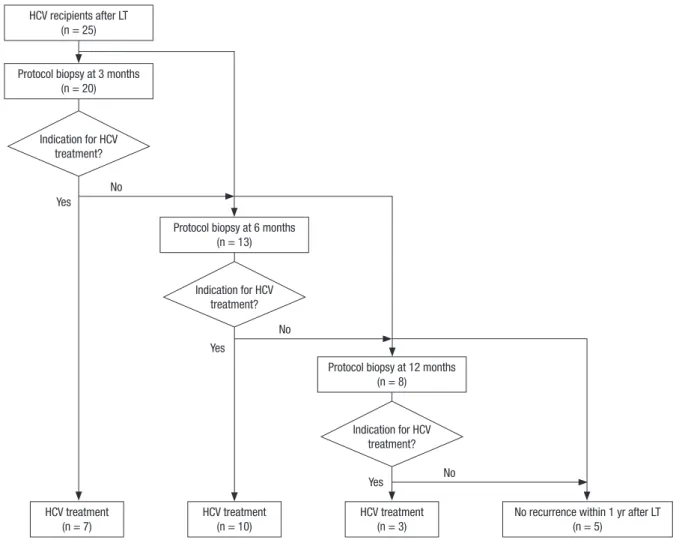
Result of early protocol biopsies in HCV related recipient after LT is shown in Fig. 1. Among 20 patients who underwent proto- col biopsy at 3, 6, and 12 months post-LT, 7 (35.0%), 10 (76.9% of untreated patients), and 3 (37.5% of untreated patients) came
in for HCV treatment, respectively. Based on early protocol biop- sies, 20 (80.0%) of 25 patients started treatment for HCV recur- rence within 1 yr after LT, including 17 (68.0%) patients within 6 months after LT and 7 (28.0%) patients within 3 months after LT.
Table 1. Demographics of participants
Parameters HCV recipients (n = 25)
Gender (men:women) 14:11 (56.0%:44.0%)
Age at LT (mean, yr) 56.6 (range, 41-70)
Living donor:deceased donor 15:10 (60.0%:40.0%) Combined liver disease
Hepatocellular carcinoma Hepatitis B related Alcoholic liver cirrhosis
11 (44.0%) 3 (12.0%) 1 (4.0%) Genotype
Type 1 Type 2 Type 3 Not checked
14 (56.0%) 9 (36.0%) 1 (4.0%) 1 (4.0%) Main immunosuppressant
Tacrolimus Cyclosporine Mycophenolate mofetil
22 (88.0%) 2 (8.0%) 1 (4.0%) HCV, hepatitis C virus; LT, liver transplantation.
Indication for HCV treatment?
Protocol biopsy at 6 months (n = 13)
Indication for HCV treatment?
Protocol biopsy at 12 months (n = 8)
HCV treatment (n = 7)
HCV treatment (n = 10)
HCV treatment (n = 3)
No recurrence within 1 yr after LT (n = 5)
Yes
Yes
Yes No
No
No HCV recipients after LT
(n = 25)
Protocol biopsy at 3 months (n = 20)
Indication for HCV treatment?
Fig. 1. Results of early protocol biopsies in hepatitis C virus related recipient after liver transplantation. HCV, hepatitis C virus; LT, liver transplantation.
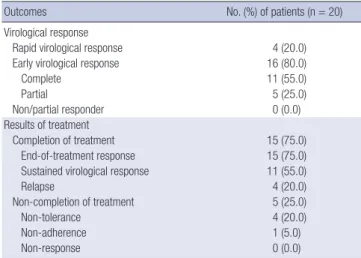
Outcome of response-guided therapy for HCV recurrence The outcome of response-guided therapy for HCV recurrence after LT is shown in Table 2 and Fig. 2. There was no non- or par- tial responder in our cohort. RVR was observed in 4 (20.0%) pa- tients. EVR was in 16 (80.0%) patients. RVR plus complete EVR was observed in 15 (75.0%) patients. Among the 20 patients who started HCV treatment, 15 (75.0%) who completed the treat- ment all showed end-of-treatment response (ETR). However, 5 (25.0%) patients had to discontinue the treatment due to non-
tolerance (n = 4) or non-adherence (n = 1). As the results, of the 20 patients who started HCV treatment, SVR was observed in 11 (55.0%) and relapsed in 4 (20.0%).
According to genotype, SVR was observed in 5 (41.7%) of 12 genotype 1 patients and 6 (75.0%) of 8 non-genotype 1 patients.
Regarding genotype 2, SVR was observed in 6 (85.7%) of 7 gen- otype 2 patients and 5 (38.5%) of 13 non-genotype 2 patients.
Even though SVR tended to be higher in non-genotype 1 (75.0%) or genotype 2 (85.7%), there were no significant statistical dif- ferences between the results according to genotypes (P = 0.197 for genotype 1, P = 0.070 for genotype 2). All 4 patients with RVR had genotype 2 infection.
Among 20 patients who underwent HCV treatment, 15 pa- tients (75.0%) maintained negative HCV-RNA until the last fol- low-up. Every patient is alive until the last follow-up. Overall 3-yr survival rate was 100.0% in 25 patients who underwent protocol biopsies.
Outcome of retreatment after relapse
As shown in Fig. 2, 4 patients who were relapsed started retreat- ment for HCV. As the results, all patients showed RVR (n = 1) or EVR (n = 3) and completed retreatment with positive ETR. Two patients achieved SVR (50.0%), and other two were relapsed again.
Table 2. Outcome of response-guided therapy for HCV recurrence after LT
Outcomes No. (%) of patients (n = 20)
Virological response
Rapid virological response 4 (20.0)
Early virological response 16 (80.0)
Complete 11 (55.0)
Partial 5 (25.0)
Non/partial responder 0 (0.0)
Results of treatment
Completion of treatment 15 (75.0)
End-of-treatment response 15 (75.0)
Sustained virological response 11 (55.0)
Relapse 4 (20.0)
Non-completion of treatment 5 (25.0)
Non-tolerance 4 (20.0)
Non-adherence 1 (5.0)
Non-response 0 (0.0)
HCV, hepatitis C virus; LT, liver transplantation.
Fig. 2. Outcome of response-guided therapy for hepatitis C virus. HCV, hepatitis C virus; Tx., treatment; RVR, rapid virological response; EVR, early virological response; ETR, end-of-treatment response; SVR, sustained virological response.
HCV Tx. (n = 20) RVR (n = 4)
SVR (n = 11) Relapse (n = 4)
SVR (n = 2) Re-relapse (n = 2)
HCV RNA negative at last follow-up (n = 15) HCV RNA positive at last follow-up (n = 5) Re-Tx. (n = 4)
EVR (n = 3) RVR (n = 1) EVR (n = 16)
Complete (n = 11) Partial (n = 5)
(n = 2) (n = 2)
(n = 2)
Non-tolerance (n = 4)
Completion of Tx. (n = 15; all ETR (+))
Completion of re-Tx. (n = 4; all ETR (+))
Non-completion of Tx. (n = 5) Non/partial responder (n = 0)
Non-adherence (n = 1)
Predictors for treatment response
Results of univariate analysis of predictors for treatment response are shown in Table 3. Patients who underwent HCV treatment were divided into SVR group (n = 11) or non-SVR group (n = 9).
Only RVR or complete EVR showed significant difference (100%
in SVR group vs. 55.6% in non-SVR group, P = 0.026). Except this, there was no significant difference or predictor between the two groups, including genotype.
DISCUSSION
Treatment for HCV recurrence after LT is challenging due to lower response compared to non-transplant setting (4). Unfor- tunately, only one-third of treated recipients achieve SVR when they are treated after LT (2-4,7,17-21). Furthermore, antiviral treatment is associated with poor tolerability which frequent needs dose adjustment due to adverse events in recipients (3, 22). In systematic reviews, dose reductions of ribavirin and/or pegylated interferon were necessary for around 70% of patients, and rate of treatment cessation was around 30% (7,17,20). In our study, similar results were obtained, with dose reductions in 80% and treatment cessation in 25%.
Optimal timing of treatment for HCV recurrence after LT to- gether with immunosuppression and new antiviral drugs are of interest (23). In HCV recurrence after LT, there is a trend toward greater recurrence rate of HCV, particularly during the first year
after LT (24). Gelley et al. reported that HCV recurrence was ob- served mainly within the first year after LT (83%), compared to 56% within 6 months and 20% within 3 months (25). However, due to the lack of clinical benefit and occurrence of side effects, there is currently no evidence to recommend prophylactic or pre-emptive HCV treatment to prevent HCV recurrence after LT (22,23,26-28). Directed HCV therapy after histological evi- dence of HCV recurrence is the mainstay of management for HCV after LT (23). Therefore, in the present study, we designed these directed and response-guided HCV treatment based on early protocol biopsies at 3, 6, and 12 months after LT in select- ed patients who showed positive pre- and post-LT HCV-RNA.
After early protocol biopsies, more than two-thirds of patients (68.0%) started HCV treatment within 6 months after LT and 85.0% of patients started HCV treatment within 1 yr after LT.
With our treatment strategy, the patients showed excellent early on-treatment response (75.0% of RVR or complete EVR) and relatively high SVR rate (55.0%). HCV genotype is one of the most important predictors of HCV treatment response. Among the genotypes, genotype 1 is the most prevalent worldwide and related to a lower response to treatment (13). In Korea, the most prevalent genotype is genotype 1 (41%-53%), followed by geno- type 2 (38%-45%) (29,30). In the present study, genotype 1 (56.0%) was the most prevalent, also. Even with a high rate of genotype 1 in our study, SVR rate was present in 55.0%, which was higher than that of other studies (2-4,7,17-21). These encouraging re- sults might be related to the prevalent favorable IL-28B polymor- phism in Korean. About 90% of Korean population had rs12979860 CC type (favorable IL-28B) (31-34). Although our study is lack of IL-28B genotype data, this may be the main reason behind the good result of our cohort.
In addition to IL-28B genotype of donor and recipient, known favorable predictors include younger donor age, lack of severe fibrosis, lack of insulin resistance, low pre- and early post-LT HCV-RNA levels, lack of HIV co-infection, early on-treatment response (RVR or EVR), adherence to drugs or therapy, reduced time since LT, and cyclosporine (1,5,10,35-37). Among those predictors, for immunosuppressant, some studies have report- ed higher rates of SVR in patients treated with cyclosporine. How- ever, that is still a matter of debate (4). In the present study, only early on-treatment response was a significant predictor of SVR (Table 3). Contrary to our expectations, genotype 1 or 2 was not significant predictors of SVR (P = 0.197 and 0.070). We cannot be sure why genotype was not significant predictor of treatment response. The small number of patients (n = 20) in the present study may be one of the possible reasons for that.
With regard to retreatment after relapse, little is known about the efficacy, tolerability, or SVR predictors. Recently, Berenguer et al. reported that SVR was achieved in approximately one-third of re-treated patients which could be predicted with the same variables used for naïve LT recipients (19). In the present study, Table 3. Predictors for treatment response
Variables SVR (n = 11) Non-SVR (n = 9) P value
Host factors at treatment
Gender (women) 6 (77.8) 2 (22.2) 0.197
Age at LT (yr) 56.18 ± 8.54 54.56 ± 8.516 0.676 Old age at LT ( > 60 yr) 3 (27.3) 3 (33.3) 1.000
Pre-LT HCV treatment 2 (18.2) 0 (0.0) 0.479
BMI (kg/m2) 23.94 ± 3.02 23.47 ± 3.30 0.744 Obesity (BMI ≥ 25 kg/m2) 3 (27.3) 4 (44.4) 0.642
Diabetes mellitus 5 (45.5) 5 (55.6) 1.000
Fatty liver* 1 (9.1) 1 (11.1) 1.000
Genotype 1 5 (45.5) 7 (77.8) 0.197
Genotype 2 6 (54.5) 1 (11.1) 0.070
High HCV-RNA† 10 (90.9) 9 (100.0) 1.000
Tacrolimus use 10 (90.9) 9 (100.0) 1.000
Donor factors
Donor age at LT (yr) 46.64 ± 12.58 38.33 ± 10.55 0.132 Ratio of donor to recipient age 0.85 ± 0.29 0.73 ± 0.24 0.316 Donor type (living donor) 7 (63.6) 3 (33.3) 0.370
Graft fatty change* 3 (27.3) 0 (0.0) 0.218
Treatment related factors
RVR or complete EVR 11 (100.0) 5 (55.6) 0.026
Antiviral dose reduction 9 (81.8) 8 (88.9) 1.000
Ribavirin 7 (63.6) 7 (77.8) 0.642
Pegylated interferon 8 (72.7) 7 (77.8) 1.000 Values are presented as the means ± SD or No. (%). *Fatty change ( ≥ 5%) on biop- sy; †HCV-RNA ≥ 40,000 IU/mL. SVR, sustained virological response; LT, liver trans- plantation; HCV, hepatitis C virus; BMI, body mass index; RVR, rapid virological response;
EVR, early virological response.
four patients who underwent retreatment after relapse showed RVR or EVR (100.0%), with two achieving SVR (50.0%) and the other two maintaining continuous negative HCV-RNA on third treatment after re-relapse (Fig. 2). Even though the number of patients was small, the result is encouraging. Therefore, we need to be more concerned about aggressive approach of retreatment for relapsed recipients.
The present study had some limitations, including the small number of patients included. We cannot be sure to extend or apply this result to other general cohorts, especially Caucasians or African Americans with respect to IL-28B genotype. More studies and long-term follow-up in this field are needed in the future.
With direct acting antivirals, strategies for HCV recurrence after LT has undergone a startling transformation. With these agents, there is renewed hope of better outcomes for HCV re- lated recipients (5,6,8,38-40). However, in the field of LT, there are some limitations of their use due to safety and tolerance is- sues. Studies in this field are at an early phase. In many coun- tries including Korea, direct acting antivirals are not approved or commercialized yet. More practically, their extremely high price may be an enormous obstacle. Therefore, even with sev- eral limitations, our strategy and the encouraging results can be useful when the newer antiviral agents are not available.
In conclusion, for recipients who show recurrence of HCV- RNA after LT, active therapeutic strategies based on early proto- col biopsies within the first year after LT and directed response- guided standard therapy can give rise to encouraging results.
DISCLOSURE
The authors have no potential conflicts of interest to disclose.
AUTHOR CONTRIBUTION
Designed the study, collected and analyzed data, and wrote the manuscript: Kim H. Designed the study, analyzed data, and wrote the manuscript: Lee KW. Designed the study and ana- lyzed data: Yi NJ. Analyzed data: Lee HW. Analyzed data: Choi YR. Collected data: Suh SW. Collected data: Jeong J. Designed the study and analyzed data: Suh KS. Final manuscript approv- al, all authors.
ORCID
Hyeyoung Kim http://orcid.org/0000-0002-3157-8214 Kwang-Woong Lee http://orcid.org/0000-0001-6412-1926 Nam-Joon Yi http://orcid.org/0000-0002-5467-425X Hae Won Lee http://orcid.org/0000-0002-3312-9295 YoungRok Choi http://orcid.org/0000-0003-2408-7086 Suk-Won Suh http://orcid.org/0000-0001-6111-9601
Jaehong Jeong http://orcid.org/0000-0002-7749-039X Kyung-Suk Suh http://orcid.org/0000-0002-9535-7349 REFERENCES
1. Gane EJ, Portmann BC, Naoumov NV, Smith HM, Underhill JA, Don- aldson PT, Maertens G, Williams R. Long-term outcome of hepatitis C infection after liver transplantation. N Engl J Med 1996; 334: 815-20.
2. Agarwal K, Barnabas A. Treatment of chronic hepatitis C virus infection after liver transplantation. Dig Liver Dis 2013; 45 S349-54.
3. Lange CM. The importance of IL28B genotype in hepatitis C virus-asso- ciated liver transplantation. Liver Int 2013; 33: 169-71.
4. Rubin A, Aguilera V, Berenguer M. Liver transplantation and hepatitis C.
Clin Res Hepatol Gastroenterol 2011; 35: 805-12.
5. Gane EJ, Agarwal K. Directly acting antivirals (DAAs) for the treatment of chronic hepatitis C virus infection in liver transplant patients: “a flood of opportunity”. Am J Transplant 2014; 14: 994-1002.
6. Hsu SH, Yeh ML, Wang SN. New insights in recurrent HCV infection af- ter liver transplantation. Clin Dev Immunol 2013; 2013: 890517.
7. Roche B, Samuel D. Hepatitis C virus treatment pre- and post-liver trans- plantation. Liver Int 2012; 32: 120-8.
8. Dhanasekaran R, Firpi RJ. Challenges of recurrent hepatitis C in the liver transplant patient. World J Gastroenterol 2014; 20: 3391-400.
9. Chalasani N, Manzarbeitia C, Ferenci P, Vogel W, Fontana RJ, Voigt M, Riely C, Martin P, Teperman L, Jiao J, et al.; Pegasys Transplant Study Group. Peginterferon alfa-2a for hepatitis C after liver transplantation:
two randomized, controlled trials. Hepatology 2005; 41: 289-98.
10. Bzowej N, Nelson DR, Terrault NA, Everson GT, Teng LL, Prabhakar A, Charlton MR; PHOENIX Study Group. PHOENIX: A randomized con- trolled trial of peginterferon alfa-2a plus ribavirin as a prophylactic treat- ment after liver transplantation for hepatitis C virus. Liver Transpl 2011;
17: 528-38.
11. Shergill AK, Khalili M, Straley S, Bollinger K, Roberts JP, Ascher NA, Ter- rault NA. Applicability, tolerability and efficacy of preemptive antiviral therapy in hepatitis C-infected patients undergoing liver transplantation.
Am J Transplant 2005; 5: 118-24.
12. Sugawara Y, Makuuchi M, Matsui Y, Kishi Y, Akamatsu N, Kaneko J, Ko- kudo N. Preemptive therapy for hepatitis C virus after living-donor liver transplantation. Transplantation 2004; 78: 1308-11.
13. European Association for Study of Liver. EASL Clinical Practice Guide- lines: management of hepatitis C virus infection. J Hepatol 2014; 60: 392- 420.
14. Coilly A, Roche B, Duclos-Vallée JC, Samuel D. Management of HCV transplant patients with triple therapy. Liver Int 2014; 34: 46-52.
15. Goodman ZD. Grading and staging systems for inflammation and fi- brosis in chronic liver diseases. J Hepatol 2007; 47: 598-607.
16. Ghany MG, Strader DB, Thomas DL, Seeff LB; American Association for the Study of Liver Diseases. Diagnosis, management, and treatment of hepatitis C: an update. Hepatology 2009; 49: 1335-74.
17. Xirouchakis E, Triantos C, Manousou P, Sigalas A, Calvaruso V, Corbani A, Leandro G, Patch D, Burroughs A. Pegylated-interferon and ribavirin in liver transplant candidates and recipients with HCV cirrhosis: system- atic review and meta-analysis of prospective controlled studies. J Viral Hepat 2008; 15: 699-709.
18. Veldt BJ, Poterucha JJ, Watt KD, Wiesner RH, Hay JE, Kremers WK, Rosen CB, Heimbach JK, Charlton MR. Impact of pegylated interferon and rib- avirin treatment on graft survival in liver transplant patients with recur- rent hepatitis C infection. Am J Transplant 2008; 8: 2426-33.
19. Berenguer M, Roche B, Aguilera V, Duclos-Vallée JC, Navarro L, Rubin A, Pons JA, de la Mata M, Prieto M, Samuel D. Efficacy of the retreatment of hepatitis C virus infections after liver transplantation: role of an ag- gressive approach. Liver Transpl 2013; 19: 69-77.
20. Wang CS, Ko HH, Yoshida EM, Marra CA, Richardson K. Interferon-bas- ed combination anti-viral therapy for hepatitis C virus after liver trans- plantation: a review and quantitative analysis. Am J Transplant 2006; 6:
1586-99.
21. Coto-Llerena M, Pérez-Del-Pulgar S, Crespo G, Carrión JA, Martinez SM, Sánchez-Tapias JM, Martorell J, Navasa M, Forns X. Donor and re- cipient IL28B polymorphisms in HCV-infected patients undergoing anti- viral therapy before and after liver transplantation. Am J Transplant 2011;
11: 1051-7.
22. Peveling-Oberhag J, Zeuzem S, Hofmann WP. Antiviral therapy of chron- ic hepatitis C in patients with advanced liver disease and after liver trans- plantation. Med Microbiol Immunol 2010; 199: 1-10.
23. Ciria R, Pleguezuelo M, Khorsandi SE, Davila D, Suddle A, Vilca-Me- lendez H, Rufian S, de la Mata M, Briceño J, Cillero PL, et al. Strategies to reduce hepatitis C virus recurrence after liver transplantation. World J Hepatol 2013; 5: 237-50.
24. Jiménez-Pérez M, Garcia DM, Grande RG, Daga JA, Pulido LB, Aguilar MD, Bravo MA, López JM, de la Mata Garcia MM. Analysis of the recur- rence of hepatitis C virus after liver transplantation: results of the Anda- lusian liver registry. Transplant Proc 2013; 45: 276-8.
25. Gelley F, Gámán G, Gerlei Z, Zádori G, Görög D, Kóbori L, Fehervari I, Schuller J, Szőnyi L, Nagy P, et al. Hepatitis C virus recurrence after liver transplantation in Hungary. Trends over the past 10 years. Orv Hetil 2013;
154: 1058-66.
26. Schiano TD, Charlton M, Younossi Z, Galun E, Pruett T, Tur-Kaspa R, Eren R, Dagan S, Graham N, Williams PV, et al. Monoclonal antibody HCV-AbXTL68 in patients undergoing liver transplantation for HCV: re- sults of a phase 2 randomized study. Liver Transpl 2006; 12: 1381-9.
27. Gurusamy KS, Tsochatzis E, Davidson BR, Burroughs AK. Antiviral pro- phylactic intervention for chronic hepatitis C virus in patients undergo- ing liver transplantation. Cochrane Database Syst Rev 2010: CD006573.
28. Davis GL, Nelson DR, Terrault N, Pruett TL, Schiano TD, Fletcher CV, Sapan CV, Riser LN, Li Y, Whitley RJ, et al.; Collaborative Antiviral Study Group. A randomized, open-label study to evaluate the safety and phar- macokinetics of human hepatitis C immune globulin (Civacir) in liver transplant recipients. Liver Transpl 2005; 11: 941-9.
29. Kim YS, Ahn YO, Lee HS. Risk factors for hepatitis C virus infection among
Koreans according to the hepatitis C virus genotype. J Korean Med Sci 2002; 17: 187-92.
30. Seong MH, Kil H, Kim YS, Bae SH, Lee YJ, Lee HC, Kang BH, Jeong SH.
Clinical and epidemiological features of hepatitis C virus infection in South Korea: a prospective, multicenter cohort study. J Med Virol 2013;
85: 1724-33.
31. Kil H, Jeong SH, Kim JW, Byoun YS, Min BY, Woo BH, Lee YJ, Kim YS.
Role of interleukin-28B genetic polymorphisms in Korean patients with hepatitis C virus infection. Gut Liver 2014; 8: 70-8.
32. Lyoo K, Song MJ, Hur W, Choi JE, Hong SW, Kim CW, Bae SH, Choi JY, Choi SW, Shin EC, et al. Polymorphism near the IL28B gene in Korean hepatitis C virus-infected patients treated with peg-interferon plus riba- virin. J Clin Virol 2011; 52: 363-6.
33. Sinn DH, Kim YJ, Lee ST, Gwak GY, Choi MS, Lee JH, Koh KC, Yoo BC, Paik SW. Association of a single nucleotide polymorphism near the inter- leukin-28B gene with response to hepatitis C therapy in Asian patients. J Gastroenterol Hepatol 2011; 26: 1374-9.
34. Thomas DL, Thio CL, Martin MP, Qi Y, Ge D, O’Huigin C, Kidd J, Kidd K, Khakoo SI, Alexander G, et al. Genetic variation in IL28B and spontane- ous clearance of hepatitis C virus. Nature 2009; 461: 798-801.
35. Firpi RJ, Zhu H, Morelli G, Abdelmalek MF, Soldevila-Pico C, Machicao VI, Cabrera R, Reed AI, Liu C, Nelson DR. Cyclosporine suppresses hep- atitis C virus in vitro and increases the chance of a sustained virological response after liver transplantation. Liver Transpl 2006; 12: 51-7.
36. Charlton MR, Thompson A, Veldt BJ, Watt K, Tillmann H, Poterucha JJ, Heimbach JK, Goldstein D, McHutchison J. Interleukin-28B polymor- phisms are associated with histological recurrence and treatment response following liver transplantation in patients with hepatitis C virus infec- tion. Hepatology 2011; 53: 317-24.
37. Rabie R, Mumtaz K, Renner EL. Efficacy of antiviral therapy for hepati- tis C after liver transplantation with cyclosporine and tacrolimus: a sys- tematic review and meta-analysis. Liver Transpl 2013; 19: 36-48.
38. Maticic M, Luznik Z, Stepec S, Popovic P, Snedec N, Poljak M, Stanisav- ljevic D. A modified ribavirin-free interferon therapy with boceprevir in post-liver transplant recurrent hepatitis C. J Clin Gastroenterol 2014; 48:
464-5.
39. Fontana RJ, Hughes EA, Bifano M, Appelman H, Dimitrova D, Hindes R, Symonds WT. Sofosbuvir and daclatasvir combination therapy in a liv- er transplant recipient with severe recurrent cholestatic hepatitis C. Am J Transplant 2013; 13: 1601-5.
40. Burton JR Jr, O’Leary JG, Verna EC, Saxena V, Dodge JL, Stravitz RT, Lev- itsky J, Trotter JF, Everson GT, Brown RS Jr, et al. A US multicenter study of hepatitis C treatment of liver transplant recipients with protease-in- hibitor triple therapy. J Hepatol 2014; 61: 508-14.