Effectiveness of Varicella Vaccination Program in Preventing Laboratory-Confirmed Cases in Children in Seoul, Korea
A universal one-dose varicella vaccination program was introduced in 2005 in Republic of Korea. However, the incidence of varicella in Korea has tripled over the last decade. We conducted a community based 1:1 matched case-control study to assess the effectiveness of one MAV strain-based vaccine and three Oka strain-based vaccines licensed for use in Korea. All cases were children in Seoul, Korea with varicella who were reported to the National Notifiable Disease Surveillance System in Seoul during 2013. The controls were age-matched children with mumps or scarlet fever but no history of varicella. We included 537 cases and 537 controls. The overall effectiveness of one dose of varicella vaccination was 13% (95% confidence interval [CI], -17.3-35.6). Of the four licensed varicella vaccines, only one was highly effective (88.9%; 95% CI, 52.1-97.4). The vaccine effectiveness for the other vaccines were 71.4% (95% CI, -37.5-94.1), -5% (95% CI, -61.9-31.9), and -100% (95% CI, -700-50.0). The overall effectiveness of vaccination was 75.8% (95% CI, 22.8-92.4) in the first year after vaccination and decreased thereafter;
the effectiveness became -7.2% (95% CI, -130.9-59.2) in the fourth year after
vaccination. Further studies are warranted to investigate reduced effectiveness of varicella vaccines in Korea.
Keywords: Varicella; Chickenpox; Vaccination; Case-Control Study; Matched Case- Control Study; Korea
Young Hwa Lee,1,2 Young June Choe,1,2 Sung-il Cho,1,2 Cho Ryok Kang,1,3 Ji Hwan Bang,1,4 Myoung-don Oh,1,5 and Jong-koo Lee1,6
1Seoul Center for Infectious Disease Control, Seoul, Korea; 2Department of Epidemiology, Graduate School of Public Health, Seoul National University, Seoul, Korea; 3Institute of Endemic Disease, Seoul National University College of Medicine, Seoul, Korea; 4Division of Infectious Diseases, Seoul National University Boramae Medical Center, Seoul, Korea; 5Department of Internal Medicine, Seoul National University College of Medicine, Seoul, Korea; 6Department of Family Medicine, Seoul National University College of Medicine, Seoul, Korea
Received: 18 May 2016 Accepted: 2 September 2016 Address for Correspondence:
Myoung-don Oh, MD
Department of Internal Medicine, Seoul National University College of Medicine, 103, Daehak-ro, Jongno-gu, Seoul 03080, Korea
E-mail: [email protected]
Funding: This study was supported by the Division of Life and Health of the Seoul Metropolitan Government, Korea.
https://doi.org/10.3346/jkms.2016.31.12.1897 • J Korean Med Sci 2016; 31: 1897-1901
INTRODUCTION
Varicella is an acute contagious disease caused by the varicella- zoster virus (VZV). A live attenuated varicella vaccine was first developed in 1974 and is now used widely in many countries including the United States, Germany, China, Taiwan, and Re- public of Korea (1-5). In a recent meta-analysis of global vari- cella vaccine effectiveness, varicella vaccine was reported to be effective in preventing varicella (6). In specific, the United States where a universal two-dose varicella vaccination program was adopted since 2006 experienced declines in the incidence of the disease, the hospitalization of infected patients, and disease outbreaks (7).
In Korea, the varicella vaccination has been recommended for children in high-risk groups since 1988. Following the intro- duction of universal varicella vaccination by the National Im- munization Program (NIP) in 2005, one-dose varicella vaccine has been recommended for all children aged 12-15 months.
Four live attenuated varicella vaccines are available; three are based on the Oka strain, and one is based on the MAV strain.
However, the incidence of varicella has yet to decline and, in fact, has been continuously rising, from 22.5 per 100,000 per- sons in 2006 to 73.2 in 2013 (8).
The objective of this study was to evaluate the effectiveness of one-dose varicella vaccination program in Korea by perform- ing a matched case-control on children in Seoul.
MATERIALS AND METHODS
We performed a matched case-control study on children who were younger than 12 years of age in Seoul, Korea. Relevant data were collected from the National Notifiable Disease Sur- veillance System (NNDSS). The NNDSS, which was established in 2001, consists of case-based national infectious disease data collected via a surveillance system; nationally notifiable diseas- es such as varicella must be reported by all local public health centers in the country. The varicella case data in the NNDSS in- clude demographic and clinical details such as patient name, date of birth, gender, address, date of disease onset, laboratory confirmation, and vaccination status.
All cases were children with varicella identified in Seoul be- tween January 2013 and December 2013. Cases were composed of confirmed and possible cases and we only use the former to avoid misclassification bias. We excluded cases born prior to universal varicella vaccination adopted in 2004 or after 2012, because varicella vaccination is recommended for children aged 12-15 months. In order to estimate the exact effectiveness of varicella vaccine, we also excluded subjects who developed varicella within 42 days after vaccination (the so-called “wild- type” varicella) and who were vaccinated twice.
We aimed at selecting controls to represent the source popu- lation from which varicella cases arose. From the same NNDSS data, mumps and scarlet fever were considered appropriate as controls for the following reasons; 1) mumps and scarlet fever are infectious diseases independent of varicella, 2) age distribu- tion in incidence of mumps or scarlet fever is similar to that of varicella.
In recruiting age-matched controls who had suffered from mumps or scarlet fever but had no history of varicella were iden- tified in Seoul between January 2013 and December 2013 in the same NNDSS population where cases were reported. We match- ed each control by date of birth to a 1-month interval centered on the birth date of each case; a single control was randomly chosen if more than one candidate seemed appropriate. Ulti- mately, we created a list of 1:1 individually matched controls.
The effectiveness of a vaccine was estimated as follows; we calculated vaccine effectiveness by substituting the matched overall risk (OR) for the relative risk (RR) (1-RR); this approxi- mates the RR in a case-control study (9).
Statistical analysis
The χ2 test was used to compare the groups in terms of categori- cal variables, and the paired t-test was used to compare them with regard to continuous variables. To estimate the effective-
ness of one-dose vaccination, we performed conditional logis- tic regression analysis on the 1:1 matched pairs after adjusting for the effects of possible confounders such as sex and age at vaccination; we then calculated matched odds ratios with 95%
confidence intervals (CIs). When calculating the effect of time since vaccination, we used conditional logistic models with dummy-coded variables (10). A two-sided P value < 0.05 was considered statistically significant. All data were analyzed with the aid of SAS software, version 9.3 (SAS Institute, Inc., Cary, NC, USA).
Ethics statement
The present study protocol was reviewed and approved by the institutional review board of Seoul National University (IRB No.
E1410-031-616). Informed consent was waived by the board.
RESULTS Subjects
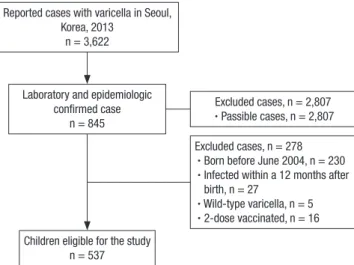
In 2013, a total of 3,622 cases were reported. Of the 3,622, we excluded 2,807 possible varicella cases. Of the remaining 815 cases, we also excluded 278 cases; 230 had been born before June 2004, 27 had been infected within 12 months of birth, 5 had wild-type varicella, 16 had received two doses of vaccine (Fig. 1). Finally, we included 537 varicella cases in the study.
Fig. 1. Subject recruitment procedures for 1:1 matched case-control study.
Reported cases with varicella in Seoul, Korea, 2013
n = 3,622
Laboratory and epidemiologic confirmed case
n = 845
Excluded cases, n = 2,807 ∙ Passible cases, n = 2,807
Children eligible for the study n = 537
Excluded cases, n = 278 ∙ Born before June 2004, n = 230 ∙ Infected within a 12 months after
birth, n = 27
∙ Wild-type varicella, n = 5 ∙ 2-dose vaccinated, n = 16
Table 1. Characteristics of children with varicella and matched controls
Characteristics Cases
(n = 537) Controls
(n = 537) P value Age, mon
Mean ± SD Median (range)
68.6 ± 22.7 70 (55-85)
68.5 ± 22.7 70 (54-85)
0.967
Gender, No. (%) Male
Female 289 (53.8)
248 (46.2) 306 (57.0) 231 (43.0)
0.297
MMR vaccine status, No. (%) Unvaccinated
Received MMR vaccine
No. of varicella vaccination within 28 days of MMR vaccine
97 (18.1) 440 (81.9) 1 (0.19)
13 (2.4) 524 (97.6)
3 (0.56)
< 0.001
Vaccination status, No. (%) 0.385
Unvaccinated 130 (24.2) 118 (22.0)
Vaccinated 407 (75.8) 419 (78.0)
Age at vaccination, mon 0.002
≤ 15 379 (93.1) 366 (87.4)
> 15 28 (6.9) 53 (12.6)
Type of vaccination 0.001
A 241 (59.2) 227 (54.2)
B 53 (13.0) 42 (10.0)
C 24 (5.9) 49 (11.7)
D 6 (1.5) 21 (5.0)
Unknown 83 (20.4) 80 (19.1)
Number of who received varicella vaccine at age younger than 12 months was 5 in controls.
MMR = measles-mumps-rubella.
Table 2. Overall effectiveness of varicella vaccine
Cases Matched control
VE (95% CI) P value Vaccinated Unvaccinated
Vaccinated 327 80 13.0 (-17.3-35.6) 0.361
Unvaccinated 92 38
When unadjusted for matched pairs, vaccine’s effectiveness ( = 1-OR) was 11.8%
(-17.1%-33.6%, P = 0.385).
VE = vaccine effectiveness ( = 1-matched OR), CI = confidence interval, OR = overall risk.
Table 3. Effectiveness of varicella vaccine by manufacturers Vaccines Vaccinated cases
with unvaccinated controls
Unvaccinated cases with vacci-
nated controls VE (95% CI) P value
A 42 40 -5 (-61.9-31.9) 0.825
B 6 3 -100 (-700-50.0) 0.327
C 2 18 88.9 (52.1-97.4) 0.003
D 2 7 71.4 (-37.5-94.1) 0.118
Unknown 28 24 -16.7 (-101-32.4) 0.580
VE = vaccine effectiveness, CI = confidence interval.
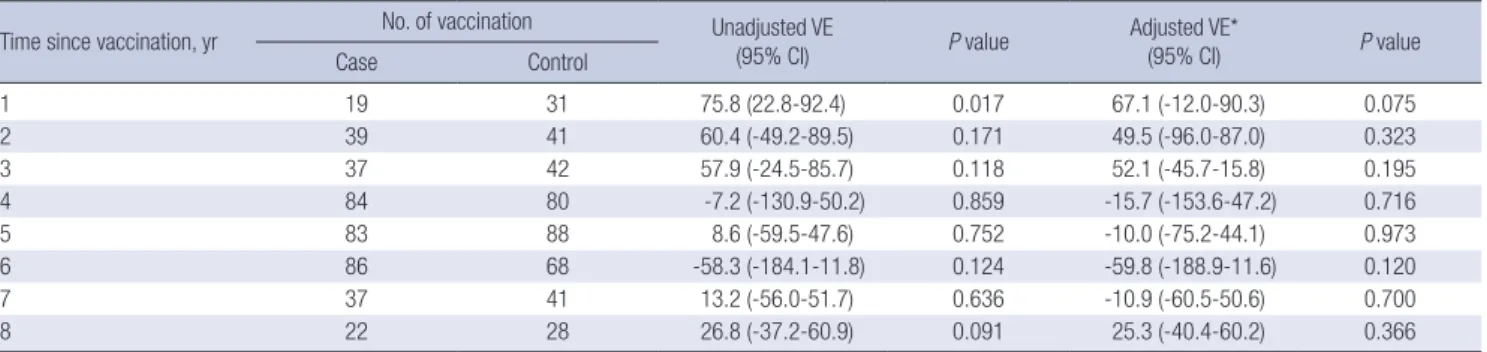
Table 4. Overall effectiveness of varicella vaccination by time since vaccination
Time since vaccination, yr No. of vaccination Unadjusted VE
(95% CI) P value Adjusted VE*
(95% CI) P value
Case Control
1 19 31 75.8 (22.8-92.4) 0.017 67.1 (-12.0-90.3) 0.075
2 39 41 60.4 (-49.2-89.5) 0.171 49.5 (-96.0-87.0) 0.323
3 37 42 57.9 (-24.5-85.7) 0.118 52.1 (-45.7-15.8) 0.195
4 84 80 -7.2 (-130.9-50.2) 0.859 -15.7 (-153.6-47.2) 0.716
5 83 88 8.6 (-59.5-47.6) 0.752 -10.0 (-75.2-44.1) 0.973
6 86 68 -58.3 (-184.1-11.8) 0.124 -59.8 (-188.9-11.6) 0.120
7 37 41 13.2 (-56.0-51.7) 0.636 -10.9 (-60.5-50.6) 0.700
8 22 28 26.8 (-37.2-60.9) 0.091 25.3 (-40.4-60.2) 0.366
VE = vaccine effectiveness, CI = confidence interval, MMR = measles-mumps-rubella.
*Results are adjusted for sex, MMR vaccination within 28 days, age at vaccination.
Characteristics of cases and controls
The 537 cases and their individually matched controls were sim- ilar in terms of both age and gender. The proportions of vacci- nated cases and controls were similar, at 407 (75.8%) and 419 (78.0%), respectively (Table 1).
Of those who were vaccinated, 379/407 (93.1%) cases and 366/419 (87.4%) controls were vaccinated before 15 months of age, as recommended by the national vaccination policy. The proportion of cases vaccinated was significantly higher than the proportion of controls vaccinated (P < 0.002).
More than half of all vaccinated cases (241/407; 59.2%) and 227/419 (54.2%) of the controls received vaccine A; the propor- tions of the other vaccines used were as follows: Unknown (20.4%
of cases and 19.1% of controls) > vaccine B (13.0% and 10.0%, respectively) > vaccine C (5.9% and 11.7%, respectively) > vac- cine D (1.5% and 5%, respectively). However, the proportions of the vaccines used were significantly different between the groups (P = 0.001). Thus, both age at vaccination and type of vaccina- tion were entered into the conditional logistic model.
Effectiveness of varicella vaccination
According to the conditional logistic regression analysis of the data for matched pairs, the overall effectiveness of one-dose varicella vaccination was 13% (95% CI, -17.3-35.6). The unad- justed estimate of vaccine effectiveness was 11.8% (95% CI, -17.1- 33.6, P = 0.385) (Table 2).
Conditional logistic regression analysis of vaccine effective- ness by each of the four vaccine manufacturers showed that the
effectiveness of different vaccines varied (Table 3). Only vaccine C exhibited statistically significant effectiveness (88.9%; 95% CI, 52.1-97.4). The vaccine effectiveness were -5% (95% CI, -61.9- 31.9) for vaccine A, -100% (95% CI, -700-50.1) for vaccine B, 71.4%
(95% CI, -37.5-94.1) for vaccine D, and -16.7% (95% CI, -101-32.4) for the vaccine of an unknown manufacturer.
Overall, the effectiveness of a one-dose varicella vaccination was 75.8% (95% CI, 22.8-92.4) in the first year after vaccination.
Thereafter, effectiveness decreased, falling to zero (or below) in the fourth and the sixth years. When adjusted for sex, age at vac- cination and measles-mumps-rubella (MMR) vaccination with- in 28 days of birth, the effectiveness of varicella vaccine was not significant even in the first year after vaccination (Table 4).
DISCUSSION
The results of this study show that the overall effectiveness of one-dose varicella vaccination in preventing confirmed cases of varicella was low and insignificant (13%; 95% CI, -17.3-35.6).
Specifically, the vaccine effectiveness of vaccine A, which was used in more than half of all vaccinations, was -5% (95% CI, -61.9- 31.9), whereas vaccine C was highly effective (88.9%; 95% CI, -52.1-97.4). Vaccination was effective for only 1 year (the esti- mate of 75.8% fell to 67.1% after adjustment for confounders).
These results are consistent with those of a recent clinical case- control study assessing the effectiveness of an MAV strain-based varicella vaccine in Korea (11). The estimated effectiveness was statistically insignificant (54%; 95% CI, -0.10-2.05) and the vac-
cine may not have alleviated clinical symptoms. In contrast, stud- ies in other countries have shown that single-dose varicella vac- cination was highly effective in terms of both reducing the prev- alence of varicella and alleviating the symptom severity (3,12- 16). Oka strain-based varicella vaccines have been 87% effec- tive in the United States (13,17), 86% effective in Germany (12), and 84% effective in China (3). In other studies, varicella vacci- nation remained quite effective over time, although some wan- ing was evident after the first year (13). However, vaccine effec- tiveness then rebounded and persistent immunity was evident in some studies.
In Korea, more than half of all vaccinees were immunized with vaccine A, derived from an MAV/06 strain of varicella isolated from a 33-month-old Korean boy in 1989 (18,19). An immuno- genicity study and a prelicensing safety study (19-21) showed that the strain was highly immunogenic and safe, with a post- vaccination geometric mean titer (GMT) of 173.7 and serocon- version rate of 100%. However, two clinical trials (22,23) and a recent clinical case-control study (11) showed that the vaccine did not ameliorate disease severity and was poorly immuno- genic. A recent immunogenicity study on MAV and Oka (Vari- L) vaccine showed that the MAV vaccine generated higher se- ropositivity rates and antibody titers than the Oka vaccine and provided immunity against VZV, despite waning of immunity observed (24). Not all Oka vaccine in this study, however, were effective against VZV, so it cannot directly be interpreted that MAV vaccine is effective.
The age at vaccination may also affect effectiveness, and our cases and controls differed significantly in this regard. In the United States, children vaccinated at younger than 15 months were at increased risk of breakthrough infection of varicella (13).
The proportion of children vaccinated at ages younger than 15 months was higher in the case group. Nevertheless, when we entered age at vaccination in our conditional model, using a du- mmy variable for time, age was not significant.
This study had several limitations. Selection bias may have been operating when we created our list of controls. The pro- portions of cases and controls who received MMR vaccinations differed, as it was lower in cases (81.9%) than in controls (97.6%).
However, as Korea operates a universal health insurance system and as MMR vaccination is included in that system, the differ- ence between cases and controls is unlikely to have introduced any substantial bias. Second, the severity of disease was not re- corded. To assess vaccine effectiveness, it is appropriate to ask if the vaccine alleviates severity of symptoms aspects of disease, such as fever, rash, and number of lesions. Again, we lacked such data. However, this is the first community-based matched case- control study on cases confirmed both epidemiologically and in the laboratory who underwent one-dose varicella vaccina- tion in Korea.
In conclusion, the one-dose varicella vaccination program
did not clearly protect against varicella. Therefore, it is neces- sary to further investigate why we had reduced effectiveness of varicella vaccine in Korea
ACKNOWLEDGMENT
We are grateful for their assistance with data acquisition to Di- vision of Life and Health of the Seoul Metropolitan Government.
DISCLOSURE
The authors have no potential conflicts of interest to disclose.
AUTHOR CONTRIBUTION
Study conception and design: Lee YH, Cho SI, Oh MD. Supervi- sion of whole aspects of this study: Oh MD. Data collection and analysis: Lee YH, Kang CR. Writing the manuscript: Lee YH. Crit- ical revision of the manuscript: Choe YJ, Cho SI, Bang JH, Lee JK. Review and approval of the final version of the manuscript:
all authors.
ORCID
Young Hwa Lee http://orcid.org/0000-0003-2073-993X Young June Choe http://orcid.org/0000-0003-2733-0715 Sung-il Cho http://orcid.org/0000-0003-4085-1494 Cho Ryok Kang http://orcid.org/0000-0002-9212-8292 Ji Hwan Bang http://orcid.org/0000-0002-7628-1182 Myoung-don Oh http://orcid.org/0000-0002-2344-7695 Jong-koo Lee http://orcid.org/0000-0003-4833-1178 REFERENCES
1. Kuter BJ, Weibel RE, Guess HA, Matthews H, Morton DH, Neff BJ, Provost PJ, Watson BA, Starr SE, Plotkin SA. Oka/Merck varicella vaccine in healthy children: final report of a 2-year efficacy study and 7-year follow-up stud- ies. Vaccine 1991; 9: 643-7.
2. Reuss AM, Feig M, Kappelmayer L, Siedler A, Eckmanns T, Poggensee G.
Varicella vaccination coverage of children under two years of age in Ger- many. BMC Public Health 2010; 10: 502.
3. Fu C, Wang M, Liang J, Xu J, Wang C, Bialek S. The effectiveness of varicel- la vaccine in China. Pediatr Infect Dis J 2010; 29: 690-3.
4. Tan HF, Chang CK, Tseng HF, Lin W. Evaluation of the national notifiable disease surveillance system in Taiwan: an example of varicella reporting.
Vaccine 2007; 25: 2630-3.
5. Park B, Lee YK, Cho LY, Go UY, Yang JJ, Ma SH, Choi BY, Lee MS, Lee JS, Choi EH, et al. Estimation of nationwide vaccination coverage and com- parison of interview and telephone survey methodology for estimating vaccination status. J Korean Med Sci 2011; 26: 711-9.
6. Marin M, Marti M, Kambhampati A, Jeram SM, Seward JF. Global varicel- la vaccine effectiveness: a meta-analysis. Pediatrics 2016; 137: e20153741.
7. Bialek SR, Perella D, Zhang J, Mascola L, Viner K, Jackson C, Lopez AS, Watson B, Civen R. Impact of a routine two-dose varicella vaccination program on varicella epidemiology. Pediatrics 2013; 132: e1134-40.
8. Korea Centers for Disease Control and Prevention. Disease web statistics system [Internet]. Available at http://is.cdc.go.kr/dstat/index.jsp [accessed on 14 May 2016].
9. Cornfield J. A method of estimating comparative rates from clinical data;
applications to cancer of the lung, breast, and cervix. J Natl Cancer Inst 1951; 11: 1269-75.
10. Niccolai LM, Ogden LG, Muehlenbein CE, Dziura JD, Vázquez M, Shap- iro ED. Methodological issues in design and analysis of a matched case- control study of a vaccine’s effectiveness. J Clin Epidemiol 2007; 60: 1127- 31.
11. Oh SH, Choi EH, Shin SH, Kim YK, Chang JK, Choi KM, Hur JK, Kim KH, Kim JY, Chung EH, et al. Varicella and varicella vaccination in South Ko- rea. Clin Vaccine Immunol 2014; 21: 762-8.
12. Liese JG, Cohen C, Rack A, Pirzer K, Eber S, Blum M, Greenberg M, Streng A. The effectiveness of varicella vaccination in children in Germany: a case-control study. Pediatr Infect Dis J 2013; 32: 998-1004.
13. Vázquez M, LaRussa PS, Gershon AA, Niccolai LM, Muehlenbein CE, Steinberg SP, Shapiro ED. Effectiveness over time of varicella vaccine.
JAMA 2004; 291: 851-5.
14. Marin M, Zhang JX, Seward JF. Near elimination of varicella deaths in the US after implementation of the vaccination program. Pediatrics 2011;
128: 214-20.
15. Guris D, Jumaan AO, Mascola L, Watson BM, Zhang JX, Chaves SS, Gargi- ullo P, Perella D, Civen R, Seward JF. Changing varicella epidemiology in active surveillance sites--United States, 1995-2005. J Infect Dis 2008; 197 Suppl 2: S71-5.
16. Sheffer R, Segal D, Rahamani S, Dalal I, Linhart Y, Stein M, Shohat T, Some- kh E. Effectiveness of the Oka/GSK attenuated varicella vaccine for the prevention of chickenpox in clinical practice in Israel. Pediatr Infect Dis J 2005; 24: 434-7.
17. Vázquez M, LaRussa PS, Gershon AA, Steinberg SP, Freudigman K, Shap- iro ED. The effectiveness of the varicella vaccine in clinical practice. N Engl J Med 2001; 344: 955-60.
18. Hwang KK, Park SY, Kim SJ, Ryu YW, Kim KH. Restriction fragment length polymorphism analysis of varicella-zoster virus isolated in Korea. J Kore- an Soc Virol 1991; 21: 201-10.
19. Hwang KK, Chun BH, Park HS, Park SY, Kim KH, Moon HM. Marker test for attenuation of varicella-zoster viruses isolated in Korea. J Korean Soc Virol 1992; 22: 105-9.
20. Sohn YM, Park CY, Hwang KK, Woo GJ, Park SY. Safety and immunoge- nicity of live attenuated varicella virus vaccine (MAV/06 strain). J Korean Pediatr Soc 1994; 37: 1405-13.
21. Sohn YM, Yu GJ, Kim PK, Kim KY, Park CY, Kim MR, Jeung WK, Hwang KK, Woo GJ, Park SY. Immunogenicity and safety of live attenuated vac- cine (MAV/06srtain) on healthy children and immunocompromised children. J Korean Pediatr Soc 1995; 38: 771-7.
22. Kim DJ, Park HS, Lee SY, Park KS, Kim TK, Song YH, Choi J, Han JW, Song YS, Park TJ, et al. Epidemiology of varicella in Korea based on pediatrician’s office practice. J Korean Pediatr Soc 1997; 40: 620-8.
23. Kim MR, Park JS, Kim DH, Lee HR, Park CY. A clinical and epidemiologic study on varicella in children. Korean J Pediatr Infect Dis 1998; 5: 88-95.
24. Choi UY, Huh DH, Kim JH, Kang JH. Seropositivity of varicella zoster virus in vaccinated Korean children and MAV vaccine group. Hum Vaccin Im- munother Forthcoming 2016.