I. 서 론
Full veneer crown의 유지력은 임상적 성패에 있어 매우 중요한 요소로 술자의 치아 삭제1,2)와 사용된 시 멘트2)에 의해 영향을 받는다. 과거 고정성 보철물의 실패에 관한 연구를 보면 실패의 원인은 치아 우식 증이 가장 많았고 그 다음으로 많은 것이 시멘트에 관련된 것으로 12�15%를 차지하였다. 또한 시멘트 와 관련된 실패는 사용기간도 짧아 평균 5.8�6.8년 정도를 보이고 있다3,4).
일반적으로 금관이나 연장가공의치 또는 가공의 치 유지장치의 탈락은 보철물의 변형과 관련되어 있 다고 생각된다. 저작시 보철물은 복잡한 힘을 받게 되고 탄성 범위 안에서 상당히 변형된다. 이러한 보 철물의 변형은 결과적으로 시멘트 피막에 과도한 응력을 야기하게 되고 이것이 시멘트의 파절을 일으 킬 수 있으며 이것은 보철물의 탈락을 야기할 수 있 다5,6).
과거 많은 연구들이 실험실 연구를 통해 고정성 보철물과 시멘트에 많은 응력이 발생하는 것을 보고
해 왔다5,7-14). 이러한 응력은 임상적으로 중요한 변연
부위에 집중되기 때문에 실질적인 응력은 저작압을 삭제된 지대치의 표면적으로 단순히 나누어서 추정 하는 것보다는 상당히 클 수 있다. 이러한 국소적인 응력 집중 부위가 시멘트 실패의 시발 부위가 될 것 이다. 몇몇의 피로 실험들은 시멘트의 미세 파절이 실패의 초기 현상이고 후에 고정성 보철물의 완전 한 탈락이 뒤따른다고 하였다14,15).
인산아연시멘트는 1877년 Ames에 의해 치과 영 역에 소개된 이래로 현재까지도 널리 사용되고 있는 시멘트 중 하나이다16). 이 시멘트는 치질에 화학적으 로 결합하는 성질이 없음에도 불구하고 임상에서 성 공적으로 사용되어지고 있다. 인산아연시멘트는 기 본적으로 90% ZnO와 10%의 MgO로 구성된 분말과 67%의 인산으로 구성된 액을 혼합하면서 시작되는 산-염기 반응에 의해 경화한다. 시멘트의 강도는 분 말과 액의 혼합비에 의해 영향을 받으며 분말이 많 이 들어갈수록 강도가 증가한다. 경화된 시멘트는 매우 단단하여 13 GPa이라는 높은 탄성을 보이는데 이는 long span bridge에서와 같이 높은 응력이 생기 는 경우에 탄성 변형에 저항하는 것을 가능하게 해 준다17).
레진시멘트는 치질과 화학적으로 결합하는 성질 때문에 점점 그 사용이 증가하는 추세이다. 고정성 보철물의 합착에 사용되어왔던 전통적인 레진시멘 트들은 두꺼운 피막두께, 짧은 작업 시간, 치수 자 극, 잉여 시멘트의 제거 곤란 등 많은 문제점들을 노 출시켜 왔다18). 그러나 Panavia 21(이하 Panavia)은 phosphate ester를 단량체에 첨가하여 전통적으로 사 용되어오던 다른 레진시멘트와는 다른 물성을 보여 주고 있다. 이 phosphate 단량체는 치질 뿐만 아니라 금속과의 결합력을 개선시키는데도 상당한 도움을 주었다19). 또한 무기충전재의 함량을 높여(77 wt%) 기계적 성질과 수분에 대한 저항력을 증가시켰으며
20) 압축강도와 인장강도 모두 인산아연시멘트보다 우수하게 되었다6,20-22). Panavia의 중합은 산소에 의 대한치과보철학회지:Vol. 38, No. 5, 2000
반복 하중이 Full veneer crown의 유지력에 미치는 영향에 관한 연구
서울대학교 치과대학 치과보철학교실 김기연∙이선형∙정헌영∙양재호∙허성주
해 지연되기 때문에 변연에서는 장시간 중합되지 않 아 잉여 시멘트의 제거 또한 쉬운 장점을 가진다18,23). 이상적인 시멘트가 갖추어야할 조건으로 치질과 보철물과의 결합(adhesion), 교합압을 견딜 수 있는 적당한 강도, 낮은 용해성, 신체 친화성, 항우식성, 조작의 편이성 등을 들고 있다24). 그러나 현재까지는 이러한 조건을 모두 만족시키는 시멘트는 없으므로 물성 개선을 위해 여러 연구들이 이루어져 왔다
1,20,22,23,25)
. 또한 임상가에게 현재 상황에 맞는 시멘트 의 선택을 가능하게 하기 위해 많은 실험들을 통해 정보를 제공해 왔다. 그 중 하나가 full veneer crown 의 유지력에 관한 실험들이었지만 최근의 실험들조 차 하중이라는 요소가 개재되지 않은 것이 대부분이 어서 구강내 상황을 정확히 재현하는 것은 아니었다
26-32)
. 그래서 실제로 반복 하중을 가한 후에는 얼마나 유지력이 영향을 받는지를 시멘트의 종류와 삭제된 지대치 축벽의 경사도에 따라 알아보는 것이 본 연 구의 목적이다.
Ⅱ 연구재료 및 방법
1. 다이와 금관 제작
8�와 16�의 경사도를 갖는 강철 다이를 표준화를 위하여 CNC milling machine을 이용해서 각각 32개
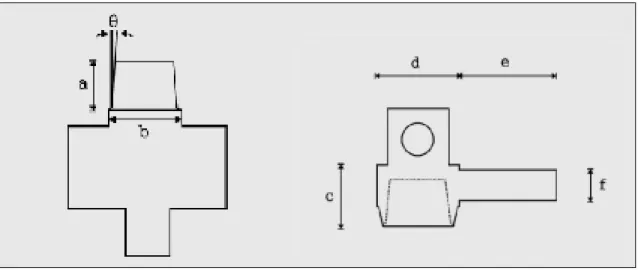
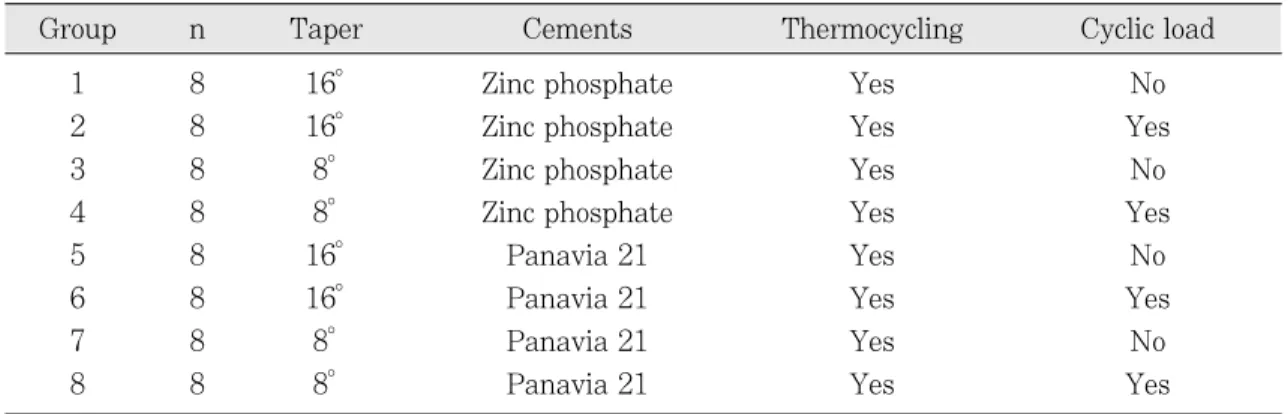
씩 제작하고 이에 장착될 상부 금관도 밀링을 통하 여 강철로 제작하였다(Fig. 1). 이 64개의 시편을 Table 1과 같이 8개 군으로 나누었다.
2. 접착
제작된 다이와 금관을 Fit-checker Ⅱ(GC Co, Japan)로 내면 적합도를 검사한 뒤 다이와 금관 내 면 모두에 50 ㎛의 산화알루미늄 결정을 10초간 분 사한 후 초음파 세척기를 이용하여 세척하였다. 이 번 실험에 사용된 시멘트는 2 종류로 인산아연시멘 트(Confident Co., U.S.A.)와 Panavia 21(Kuraray Co. Ltd., Japan)을 이용하였다. 1, 2, 3 ,4 군은 인 산아연시멘트로 5, 6, 7, 8 군은 Panavia 21로 접착 하였다. 제조자의 지시대로 시멘트를 혼합하여 금관 을 접착한 후 수제작한 하중 전달 장치를 이용하여 5 ㎏의 정적 하중을 10분간 가하였다.
3. 반복 하중 과 유지력 측정
접착 24시간 후 1, 3, 5, 7 군은 열순환만 시행하였 고 2, 4, 6, 8 군은 열순환을 시행한 다음 수제작한 반복 하중 장치를 이용하여 중심에서 10mm 떨어진 지점에 65 N의 힘으로 cantilever loading을 가하였 다. 열순환은 ISO 권장 기준대로 5�55℃의 온도 범
Fig. 1. Schematic drawing of crown and die.
Dimensions (mm): a=4; b=8; c=5; d=10; e=10; f=3; 2θ(Convergence angle in degrees)=8 or 16
Fig. 2. Strain sensor.
Table 1. Experimental groups
1 8 16� Zinc phosphate Yes No
2 8 16� Zinc phosphate Yes Yes
3 8 8� Zinc phosphate Yes No
4 8 8� Zinc phosphate Yes Yes
5 8 16� Panavia 21 Yes No
6 8 16� Panavia 21 Yes Yes
7 8 8� Panavia 21 Yes No
8 8 8� Panavia 21 Yes Yes
Fig. 3. Cyclic loading machine.
Fig. 4. Schematic drawing of cyclic loading ma-
chine. Fig. 5. Retention test using Instron testing ma- chine.
Group n Taper Cements Thermocycling Cyclic load
위와 30초의 계류시간으로 500회 시행하였다33). 하 중 장치는 한 개의 air cylinder와 4개의 시편을 고정 할 수 있는 고정대가 사용되었다(Fig. 3, 4). 따라서 반복 하중이 가해지는 동안 피스톤에 의한 집중 하 중이 동일한 4개의 분포 하중으로 분산되도록 하였 다. 균등한 하중으로 분산시키기 위해서 각각의 시 편이 x,y,z 방향으로 독립적으로 움직일 수 있는 기 계적 메카니즘을 갖도록 고정대를 설계하였다. 본격 적인 하중 실험이 행해지기 전에 먼저 load cell(SB- 500L, CAS Co., Korea)을 이용하여 air cylinder에 서는 총 260 N의 하중이 나오도록 조절한 다음 응 력 감지기(Strain sensor)로 각각의 시편에 하중이 고 르게 분포되는지를 측정하였다. 응력 감지기는 사각 의 아크릴 막대의 각 면에 스트레인 게이지(EA-06- 240LZ-120, Measurements Group INC., U.S.A.) 를 부착시킨 것으로 순수한 수직 하중에 의한 변형 률만을 측정할 수 있도록 고안되었다(Fig. 2). 하중 이 아크릴 막대에 가해지면 아크릴 막대에 변형이 발생되고 그 결과 아크릴에 부착된 스트레인 게이지 에 저항이 발생되며 이를 휘스톤 브리지에 연결시키 면 스트레인 게이지 저항의 변화로 인해 전압의 차 가 발생하고 여기서 발생된 신호는 AD board를 통하 여 PC에 출력된다. 이로써 피스톤에 의한 집중 하중 이 4개로 동일하게 분산되는지를 검사하였다. cycle 은 1.2초당 1회로 하였고 총 100,000번의 하중을 가 하였다. 유지력 측정은 cross head speed를 0.5mm/min으로 설정한 Instron(Model 4466)을 이 용하였다(Fig. 5).
4. 통계분석
각 군의 측정치에 대해 평균과 표준편차를 구하고 각 측정치간의 차이를 시멘트의 종류와 경사도에 따 라 각각 이원변량분산분석(two-way ANOVA)으로 분석하였다.
Ⅲ. 연구 결과
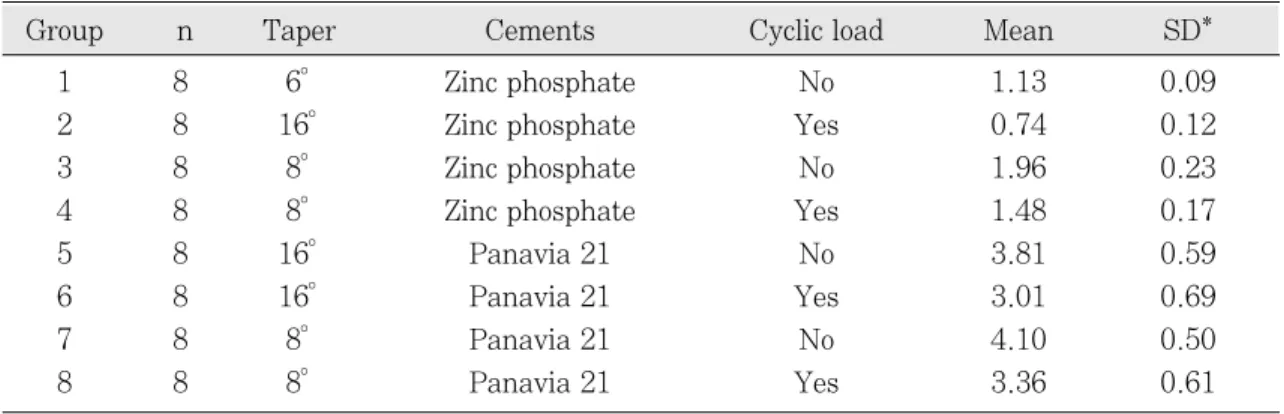
각 군의 결과치는 Instron을 이용해 측정한 유지력 을 다이의 단위면적으로 나누어 유지강도로 나타내 었고 이에 대한 평균과 표준 편차는 Table 2와 같다 (Fig. 6).
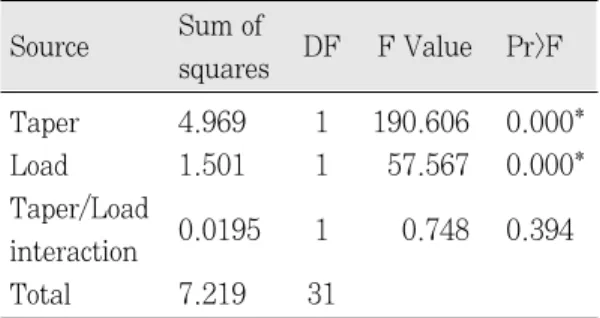
시멘트 종류에 따라 분석한 결과를 보면 인산아연 시멘트의 경우 경사도와 반복 하중 여부가 모두 유
Table 2. The mean and standard deviation of the retentive strength(MPa)
1 8 6� Zinc phosphate No 1.13 0.09
2 8 16� Zinc phosphate Yes 0.74 0.12
3 8 8� Zinc phosphate No 1.96 0.23
4 8 8� Zinc phosphate Yes 1.48 0.17
5 8 16� Panavia 21 No 3.81 0.59
6 8 16� Panavia 21 Yes 3.01 0.69
7 8 8� Panavia 21 No 4.10 0.50
8 8 8� Panavia 21 Yes 3.36 0.61
*Standard Deviation
Fig. 6. Histogram showing the mean retentive strength.
Group n Taper Cements Cyclic load Mean SD*
의성 있는 차이를 보였다(P<0.05)(Table 3). 즉 8�경 사에서 16�경사보다 유의성있게 높은 유지력을 보였 고 반복하중 후 유지력이 유의성있게 감소하였다.
Panavia 의 경우 반복 하중 여부는 유의성 있는 차이를 보였지만(P<0.05) 경사도에 대해서는 유의성 있는 차이가 없었다(P>0.05)(Table 4). 즉 반복 하중 후 유지력은 유의성있게 감소하였지만 8�경사와 16�
경사 사이에서는 유지력이 유의성 있는 차이를 보이 지 않았다.
경사도 종류에 따라 분석한 결과를 보면 8�, 16�경 사 모두에서 Panavia가 인산아연 시멘트에 비해 유 의성있게 높은 유지력을 보였고 하중을 가한 후 유 지력이 유의성있게 감소하였다(P<0.05)(Table 5, 6).
Ⅳ. 총괄 및 고안
금관의 유지력에 미치는 요소에 관해 그 동안 많 은 연구가 있었는데 Witwer 등34)은 지대치의 경사도, 유지면적의 크기, 축벽의 길이와 주조관의 물성 등 이 영향을 준다고 하였고 Gardner35)는 삭제된 형 태, 주조 정확도, 시멘트의 물리적 성질 등이 유지력 에 영향을 준다고 하였다. 본 실험에서는 유지력에 영향을 미칠 수 있는 요소 중 다이와 관련된 요소(지 대치 높이, 합착 면적, 표면 거칠기 등)와 치관과 관 련된 요소(하중을 가하는 위치, 금관의 두께 등)에 의한 실험 오차는 줄이고 순수히 경사도, 하중 여부, 시멘트의 종류에 의한 결과를 비교하기 위해 다이와 치관은 밀링을 통하여 제작하였다.
Table 3. Two-way ANOVA summary in Zinc phosphate cement, comparing taper and load to retentive strength
Taper 4.969 1 190.606 0.000*
Load 1.501 1 57.567 0.000*
Taper/Load
interaction 0.0195 1 0.748 0.394 Total 7.219 31
* Significant at P<0.05
Table 5. Two-way ANOVA summary in 16�ta- per die, comparing cement and load to retentive strength
Source Sum of DF F Value Pr>F squares
Cement 48.931 1 230.884 0.000*
Load 2.803 1 13.224 0.001*
Cement/Load
interaction 0.347 1 1.635 0.211 Total 58.014 31
* Significant at P<0.05
Table 6. Two-way ANOVA summary in 8�ta- per die, comparing cement and load to retentive strength
Source Sum of DF F Value Pr>F squares
Cement 32.261 1 183.053 0.000*
Load 2.983 1 16.926 0.000*
Cement/Load
interaction 0.131 1 0.745 0.395 Total 40.309 31
* Significant at P<0.05
Table 4. Two-way ANOVA summary in Panavia 21, comparing taper and load to re- tentive strength
Source Sum of DF F Value Pr>F squares
Taper 0.835 1 2.307 0.140 Load 4.736 1 13.078 0.001*
Taper/Load
interaction 0.007503 1 0.021 0.887 Total 15.717 31
* Significant at P<0.05 Source Sum of
DF F Value Pr>F squares
Source Sum of
DF F Value Pr>F squares
Source Sum of
DF F Value Pr>F squares
Source Sum of
DF F Value Pr>F squares
과거 여러 연구를 살펴보면 고정성 보철물의 실패 원인 중 시멘트와 관련된 것이 상당한 것으로 보고 되고 있다. 일반적으로 이러한 실패는 저작시 보철 물의 변형과 관련되어 있다고 생각되어진다. 저작시 보철물은 복잡한 힘을 받게 되고 탄성 범위 안에서 상당히 변형된다. 이러한 보철물의 변형은 결과적으 로 시멘트 피막에 과도한 응력을 야기하게 되고 이 것이 시멘트의 파절을 일으킬 수도 있다. 이러한 시 멘트 파절은 보철물의 탈락을 야기할 수 있다4,5). Kamposiora 등14)은 저작을 통해 생길 수 있는 가장 큰 응력(2.35 MPa)도 가장 약한 시멘트인 인산아연 시멘트의 인장응력(8 MPa)의 30%도 안되기 때문에 한 번의 저작으로는 시멘트의 파절이 생길 수 없다 고 하였다. 그러나 하중이 반복적으로 가해지면 시 멘트의 파절이 일어날 수 있다36). O/lio 등37)은 8mm의 폭경에 5mm의 높이와 10�의 경사도를 갖는 지대치 에 수직 하중이 가해지고 축벽을 통하여 골고루 응 력이 분포된다고 가정하면 축벽의 시멘트 피막에 발 생하는 응력이 2.5�5 MPa 정도가 되지만 실제 상 황에서는 응력이 균일하게 분포되기보다는 여러 요 인들에 의해 국소화되는 경향이 있으므로 실제로 5
�10 MPa 정도의 응력이 발생할 수 있다고 하였다.
DeBoever 등38)은 고정성 보철물의 가공치에 force transducer를 식립하고 단일 구치의 저작압을 측정 하였는데 3명의 피실험자에서 각각 평균 2.44, 2.03, 4.26 lb를 기록했다고 보고하였고 최대 저작압이 15 lb를 넘지 않았다고 하였다. Anderson 등39)은 정상 치열의 경우 8�14 kg의 범위를 보였다고 하였고 Graf 등40)은 최대 수직 하중 값이 4 kg이라고 보고하 였다. 이와 같은 연구들을 바탕으로 본 실험에서는 시편에 가하는 반복 하중의 크기를 65 N으로 하였 다. 또한 구강내에서의 저작 속도와 유사하도록 여 러 연구들의 결과를 기초로 1분당 50회의 속도로 하 중을 가하였다41). Wiskott 등42)은 접착된 금관에 반복 하중을 가해 지대치 경사도와 유지력간의 관계를 비 교하는 실험에서 실험에 필요한 시간을 줄이기 위해 1분 당 1000회의 속도로 하중을 가했는데 저자 자신 도 이러한 속도에서의 시멘트의 파절 진행은 정상적 인 저작 속도에서의 파절의 진행과 다를 수 있음을 지적하였다.
Cantilever loading을 가한 것은 대부분의 치과용 시멘트들이 압축강도보다는 인장강도가 훨씬 낮다
는 사실에 근거해6,20,21)금관에 cantilever loading을 가 함으로써 금관에 되도록 인장응력이 많이 발생케 해 시멘트에 좀 더 가혹한 조건을 부여하기 위해서였 다. 실제 Yamashita 등13)이 고정성 가공 의치에 스트 레인 게이지를 장착하고 구강내에서 직접 응력을 측 정한 결과 변연 부위에 응력이 집중되면서 압축응력 과 인장응력이 복잡하게 나타나는 것을 보고하였다.
본 실험에서는 총 하중횟수를 100,000 번으로 하였 는데 이는 하루에 저작과 연하시 500번의 치아 접촉 이 있다고 가정하면 대략 200일의 효과에 해당하는 것이다43). 하중횟수는 예비실험을 통하여 유의성있 게 차이가 나는 횟수를 선정하였다.
그 동안 치과용 시멘트 종류에 따른 금관의 유지 력에 관해 많은 연구가 있었다. 대부분의 실험들32,44-
47)에서 Panavia가 인산아연시멘트보다 월등히 높은 유지력을 보였고 이는 본 연구의 결과와 일치한다.
반복 하중 후 인산아연시멘트에서는 16�경사의 경우 35%, 8�경사의 경우 25% 감소하였고 Panavia에서 는 16�경사의 경우 21%, 8�경사의 경우 18% 감소 해 유지력의 감소는 Panavia가 인산아연시멘트 보다 적었다. 이는 아마도 Panavia의 기계적 물성이 인산 아연시멘트보다 더 우수하기 때문이라 사료된다.
Panavia는 다른 레진시멘트들보다 무기 충전재의 함량이 높아(77 wt%) 향상된 기계적 물성을 보인다
20). White 등21)이 보고한 바에 따르면 인산아연시멘 트의 경우 압축강도가 62.1 MPa, 인장강도가 9.3 MPa인 반면 Panavia는 압축강도가 178.5 MPa, 인 장강도가 45.1 MPa이라고 하였고 Li 등6)도 비슷한 결과를 보고하였는데 인산아연시멘트의 경우 압축 강도가 48 MPa, 인장강도가 10 MPa이고 Panavia 는 압축강도가 137 MPa, 인장강도가 44 MPa이라고 하여 두 결과 모두에서 Panavia가 더 우수한 기계적 물성을 보였다. 또한 경사도가 작은 경우가 반복하 중 후 유지력의 감소가 적었는데 이는 경사도가 작 을수록 응력분산에 유리하기 때문이라 사료된다7,57). 인산아연시멘트로 접착한 금관에서 최대유지력을 얻으려면 평행한 치아의 삭제가 필수적이다48-50). Jo¨ rgensen49)은 지대치의 경사도가 5�일 때 유지력이 가 장 높다고 하였고 Tylman 등51)은 2�5�경사도가 가 장 이상적이라고 하였고 Johnston 등52)은 5�7�의 경사도를 추천하였으나 실제 임상에서는 이러한 경 사도로 치아삭제를 하는 것은 쉽지 않다. 치과 대학
학생들을 대상으로 한 연구에서는 평균 경사도가 21�라고 하였고53)다른 연구에서는 일반의와 전문의 의 평균 경사도가 20�라고 보고하였다54). 그래서 본 실험에서는 이상적 경사도에 가까운 8�경사와 임상 적 상황에 좀 더 가까운 16�경사의 다이를 이용하여 시멘트 종류에 따른 차이를 조사하였다. Panavia는 인산아연시멘트와는 달리 경사도에 의한 영향을 거 의 받지 않았는데 이는 기계적 유지에 의해서만 유 지력을 얻는 인산아연시멘트의 경우와는 달리 Panavia의 경우 금속과 화학적 결합이 가능하다는 것이 원인인 것 같다. Panavia는 단량체에 phos- phate ester를 첨가해 치질과 금속과의 결합을 상당 히 개선시켰다19). 본 실험에서는 비록 금속 다이를 이용하였지만 Panavia가 치질과 금속 모두에 화학적 으로 결합하는 성질이 있으므로 이러한 결과는 실제 구강내에서도 어느 정도 반영될 수 있다고 사료된 다. El-Mowafy 등26)도 비슷한 결과를 보고하였는데 24�경사도의 지대치에 인산아연시멘트로 접착한 금 관보다 70�경사도의 지대치에 레진시멘트로 접착한 금관이 더 유지력이 컸다고 하면서 임상에서 치아 삭제시 많이 경사진 지대치는 레진시멘트로 접착할 것을 권장하였다.
Rosenstiel55)은 경사도에 대한 Jo¨rgensen hyper- bola를 다음과 같이 수학적으로 공식화하였다.
Retention[g/mm2] = 380/Taper[degrees] + 5.5 이 공식에 8�와 16�를 대입해보면 경사도가 8�에 서 16�로 커지면 유지력이 45% 감소한다는 계산이 나온다. 실제 본 실험 결과치를 분석해보면 인산아 연시멘트에서 43%가 감소해 거의 유사함을 보였다.
경사도와 하중과의 관계에 대해서 Wiskott 등42)은 경사도와 하중에 대한 저항이 반비례한다고 보고하 였는데 이 번 실험에서도 인산아연시멘트의 경우 8�
경사는 반복 하중 후 35%, 16�경사는 25% 유지력이 감소해 8�경사가 하중 후 유지력 감소율이 적었다.
Gundler 등56)은 인산아연시멘트로 접착한 금관에 대해 지대치의 경사도를 달리해 1,000,000번의 반복 하중을 가하여 피로 실험을 한 결과 20�경사에서는 실패가 없었지만 40�에서는 70%, 60�에서는 100%
의 실패를 보고하였다. 레진시멘트에서는 경사도에 대한 하중의 영향이 적었다. Kamposiora 등14)은 유한 요소분석법을 이용하여 시멘트의 미세파절을 관찰 한 결과 인산아연시멘트가 레진시멘트보다 더 큰 평
균 응력을 보였다고 보고하였으며 Owen57)은 지대치 의 경사도가 클수록 그 정도가 더 심화된다고 보고 하였다. 이는 본 실험 결과와 무관하지 않은데 실제 본 실험에서도 인산아연시멘트가 Pananvia 보다 하 중의 영향을 더 크게 받은 것으로 나타났고 경사도 면에서도 Panavia 보다 인산아연시멘트가 더 크게 영향을 받은 것으로 나타났다.
Ⅴ. 결 론
반복 하중이 full veneer crown의 유지력에 미치는 영향을 구명하기 위하여 8�및 16�의 축벽경사를 갖 는 표준화한 금속 다이를 제작하고 또한 여기에 맞 는 금관을 제작한 다음 이들을 각각 인산아연시멘트 와 Panavia 21로 접착하고 하중을 가하지 않은 군과 하중을 가한 군을 시멘트의 종류와 다이의 경사도에 따라 비교하여 다음과 같은 결론을 얻었다.
1. 모든 군에서 Panavia 21이 인산아연시멘트에 비 해 유의성있게 높은 유지력을 보였다(p<0.05).
2. 인산아연시멘트의 경우 8�경사의 경우가 16�경 사보다 유의성있게 높은 유지력을 보였지만 (p<0.05) Panavia 21의 경우에는 8�와 16�경사 사 이에 유지력의 유의성있는 차이는 없었다 (P>0.05).
3. 모든 군에서 반복 하중이 금관의 유지력을 유의 성있게 감소시켰다(p<0.05).
4. 16�경사의 다이에 인산아연시멘트로 접착한 경 우 반복 하중 후 유지력이 35% 감소하였고 8�경 사의 다이에 인산아연시멘트로 접착한 경우에는 25% 감소하였다. Panavia 21에서는 16�경사의 다이의 경우 21%, 8�의 경우 18% 감소하였다.
참 고 문 헌
1. O/lio G. Luting cements: a review and comparison. Int Dent J 1991;41:81-88.
2. Kanoy BE, Felton DA, White JT, Bayne SC: Effect of the porcelain firing sequence on the bond strengths of cements. J Oral Rehabil 1989;16:335-343.
3. Schwartz NL, Whitsett LD, Berry TG, Stewart JL. Unserviceable crowns and
fixed partial dentures: life-span and caus- es for loss of serviceability. J Am Dent Assoc 1970; 81:1395-1401.
4. Walton JN, Gardner M, Agar JR. A sur- vey of crown and fixed partial denture fail- ures: Length of service and reasons for re- placement. J Prosthet Dent 1986;56:416- 421.
5. Yamashita J, Shiozawa I, Takakuda K, Miyairi H. Deformation of restoration and fracture of luting cement film. J Dentistry 1998;26:459-466.
6. Li ZC, White SN. Mechanical properties of dental luting cements. J Prosthet Dent 1999;81:597-609.
7. Nicholls JI. Crown retention. Ⅱ. The ef- fect of convergence angle variation on the computed stresses in the luting agent.
J Prosthet Dent 1974;31:651-657.
8. Nicholls JI. Crown retention. Ⅰ. Stress analysis of symmetric restorations. J Prosthet Dent 1974;31:179-184.
9. Yettram AL, Wright KW, Pickard HM.
Finite element stress analysis of the crowns of normal and restored teeth. J Dent Res 1976;55:1004-1011.
10. Farah JW, Craig RG. Stress analysis of three marginal configurations of full pos- terior crowns by three-dimensional pho- toelasticity. J Dent Res 1974;53:1219-1225.
11. Goldstein GR, Wesson A, Schweitzer K, Cutler B. Flexion characteristics of four- unit fixed partial denture frameworks using holographic interferometry. J Prosthet Dent 1992;67:609-613.
12. Libman WJ, Nicholls JI. Load fatigue of teeth restored with cast posts and cores and complete crowns. Int J Prosthodont 1995;8:155-161.
13. Yamashita J, Shiozawa I, Takakuda K. A comparison of in vivo and in vitro strain with posterior fixed partial dentures. J
Prosthet Dent 1997;77:250-255.
14. Kamposiora P, Papavasilious G, Bayne SC.
Felton DA. Finite element analysis esti- mates of cement microfracture under com- plete veneer crowns. J Prosthet Dent 1994;71:435-441.
15. Fan P, Nicholls JI, Kois JC. Load fa- tigue of five restoration modalities in structurally compromised premolars. Int J Prosthodont 1995;8:213-220.
16. Ames WB. A new oxyphosphate for crown setting. Dent Cosmos 1892;34:392-393.
17. Anusavice KJ. Phillip’s science of dental materials. 10th ed. Philadelphia: WB Saunders; 1996. P.555-581.
18. Phillip’s RW. Skinner’s science of dental materials. 8th ed. Philadelphia: WB Saunders, 1982;478.
19. Tjan AHL, Li T. Seating and retention of complete crowns with a new adhesive resin cement. J Prosthet Dent 1992;67:478- 483.
20. White SN, Yu Z. Physical properties of fixed prosthodontic, Resin composite luting agents. Int J Prosthodont 1993;6:384-389.
21. White SN, BDentSc, Yu Z. Compressive and diametral tensile strengths of current ad- hesive luting agents. J Prosthetic Dent 1993;69:568-572.
22. Rosenstiel S, Land M, Crispin BJ. Dental luting agents: A review of the current literature 1998;80:280-301.
23. McComb D. Adhesive luting cements - Classes, criteria, and usage. Compendium 1996;17:759-773.
24. Donovan T, Cho GC. Contemporary eval- uation of dental cements. Compendium 1999;20:197-219.
25. White SN, Sorensen JA, Kang SK, Caputo AA, Microleakage of new crown and fixed partial denture luting agents. J Prosthet Dent 1992;67:156-161.
26. EL-Mowafy OM, Fenton AH, Forrester N, Milenkovic M. Retention of metal crowns cemented with resin cements: Efffects of preparation taper and height. J Prosthet Dent 1996;76:524-529.
27. Mausner IK, Goldstein GR, Georgescu M. Effect of two dentinal desensitizing agents on retention of complete cast cop- ing using four cements. J Prosthet Dent 1996;75:129-134.
28. Swift EJ, Lloyd AH, Felton DA. The effect of resin desensitizing agents on crown retention. J Am Dent Assoc 1997;128:195- 200.
29. Lyons KM, Rodda JC, Hood JAA. The ef- fect of environmental pressure changes dur- ing diving on the retentive strength of dif- ferent luting agents for full cast crowns. J Prosthet Dent 1997;78:522-527.
30. Ernst CP, Wenzl N, Stender E, Willershausen B. Retentive strengths of cast gold crowns using glass ionomer, com- pomer, or resin cement. J Prosthet Dent 1998;79:472-476.
31. Hansen PA, Woolsey G, Killoy WJ, Hanson C. Effect of brushing with sonic and coun- terrotational toothbrushes on the bond strength of full veneer crowns. J Prosthet Dent 1998;80:429-433.
32. Ayad MF, Rosenstiel SF, Salama M.
Influence of tooth surface roughness and type of cement on retention of complete cast crowns. J Prosthet Dent 1997;77:116-121.
33. ISO/TC106/Subcommittee 1. CD TR 11405-Guidance on testing of adhesion to tooth structure. International Organization for Standardization, Geneva, Switzerland.
34. Witwer DJ, Storey RJ, von Fraunhofer JA.
The effects of surface texture and groov- ing on the retention of cast crowns. J Prosthet Dent 1986;56:421.
35. Gardner FM. Margins of complete crowns-
Literature review. J Prosthet Dent 1982
;48:396.
36. Wiskott HWA, Nicholls JI, Belser UC.
Stress fatigue: Basic principels and prostho- dontic implications. Int J Prosthodont 1995;8:105-116.
37. O/lio G, Espevik S. Stess/strain behavior of some dental luting cements. Acta Odontol Scand 1978;36:45-49.
38. DeBoever JA, McCall WD, Holden S.
Functional occlusal forces. An investiga- tion by telemetry. J Prosthet Dent 1978;40:326-333.
39. Anderson DJ, Picton DCA. Masticatory stresses in normal and modified occlusion.
J Dent Res 1958;37:312-317.
40. Graf H, Grassl H, Aeberhard HJ. A method of measurement of occlusal forces in three dimensions. Helv Odont Acta.
1974;18:7-11.
41. Bates JF, Stafford GD, Harrison A.
Masticatory function- A review of the lit- erature. Ⅱ. Speed of movement of the mandible, rate of chewing and forces de- veloped in chewing. J Oral Rehabil 1975;2:349-361.
42. Wiskott HWA, Nicholls JI, Belser UC.
The relationship between abutment taper and resistance of cemented crowns to dy- namic loading. Int J Prosthodont 1996;9:117-130.
43. Ramp MH, Suzuki S, Cox CF, Lacefield WR, Koth DL. Evaluation of wear: Enamel opposing three ceramic materials and a gold alloy. J Prosthet Dent 1997;77:523-530.
44. Tjan AHL, Li T. Seating and retention of complete crowns with a new adhesive resin cement. J Prosthet Dent 1992;67:478- 483.
45. Wiskott HWA, Nicholls JI, Belser U. The relationship between abutment taper and resistance of cemented crowns to dynam-
ic loading. Int J Prosthod 1996;9(2):117- 130.
46. Jung YW, Cho HW, Jin TH. The film thickness and retention of cast crown uning adhesive resin cements. J Korean Acad Prosthodont 1992;30:437-442.
47. Lee CH, Jo KH. Comparison for the re- tention of casting crown and cement thick- ness following various cements. J Korean Acad Prosthodont 1994;32:37-45.
48. Gundler A, Lockowandt P, Erhardson S.
Crown retention and cyclic loading(in vit- ro). Scand J Dent Res 1993;101:252- 256.
49. Jo¨rgensen KD. The relationship between retention and convergence angle in cemented veneer crowns. Acta Odontol Scand 1955;13:35-40.
50. Kaufman EG, Coelho DH, Colin L. Factors influencing the retention of cemented gold castings. J Prosthet Dent 1961;11:487-502 51. Tylman SD, Malone WFP. Tylman’s the- ory and practice of fixed prosthodontics, ed
7. St Louis: Mosby, 1978:108.
52. Johnston JF, Phillips RW, Dykema RW.
Modern practice in crown and bridge prosthodontics, ed 3. Philadelphia:
Saunders, 1971:68.
53. Ohm E, Silness J. The convergence angle in teeth prepared for artificial crowns. J Oral Rehabil 1978;5:371-375.
54. Nordlander J, Weir D, Stoffer W, Ochi S.
The taper of clinical preparations for fixed prosthodontics. J Prosthet Dent 1988;60:148-152.
55. Rosenstiel E. The retention of inlays and crowns as a function of geometric form. Br Dent J 1957;103:388-394.
56. Gunder A, Lockowandt P, Erhardson S.
Crown retention and cyclic loading(in vit- ro). Scand J Dent Res 1993;101:252- 256.
57. Owen CP. Retention and resistance in preparations for extracoronal restora- tions. Part Ⅰ:theoretical studies. J Prosthet Dent 1986;56:13-16.
Reprint request to:
Sun-Hyung Lee, D.D.S., M.S.D., Ph.D.
Department of prosthodontics, College of Dentistry, Seoul National University 28-1, Yeongun-Dong, Chongno-Gu, Seoul, 110-749, Korea
[email protected]
Dislodgement of a crown or extension bridge and the loosening of a retainer of a bridge is a se- rious clinical problem in fixed restoration. Generally these problems are considered to be associated with deformation of the restoration. During biting, the restoration is subjected to complex forces and deforms considerably within the limit of its elasticity. Deformation of the restoration under the occlusal force induces excessive stress in the cement film, which then leads to the cement frac- ture. Such a fracture may eventually cause loss of the restoration. Because most of the past re- tention tests for full veneer crown were done without fatigue loading, they were not exactly sim- ulating intraoral environment. And the purpose of this study was to evaluate the effect of cyclic cantilever loading on the retentive strength of full veneer crowns depending on different type of cements and taper of prepared abutment.
Steel dies with 8�or 16�convergence angle were fabricated through milling and crowns with the same method. These dies and crowns were divided into 8 groups.
Group 1: 16�taper die, cementation with zinc phosphate cement, without loading Group 2: 16�taper die, cementation with zinc phosphate cement, with loading Group 3: 8�taper die, cementation with zinc phosphate cement, without loading Group 4: 8�taper die, cementation with zinc phosphate cement, with loading Group 5: 16�taper die, cementation with Panavia 21, without loading
Group 6: 16�taper die, cementation with Panavia 21, with loading Group 7: 8�taper die, cementation with Panavia 21, without loading Group 8: 8�taper die, cementation with Panavia 21, with loading
After checking the fit of die and crown, the luting surface of dies and inner surface of crowns were air-abraded for 10 seconds. The crowns were cemented to the dies, with cements mixed ac- cording to the manufacturer’s recommendations. A static load of 5 kg was then applied for 10 min- utes with static loading device.
THE EFFECT OF CYCLIC LOADING ON THE RETENTIVE STRENGTH OF FULL VENEER CROWNS
Ki-Youn Kim, D.D.S., Sun-Hyung Lee, D.D.S.,M.S.D.,Ph.D.
Hun-Young Chung, D.D.S.,M.S.D.,Ph.D., Jae-Ho Yang, D.D.S.,M.S.D.,Ph.D., Seong-Joo Heo, D.D.S.,M.S.D.,Ph.D.
Department of Prosthodontics, Graduate School, Seoul National University
ABSTRACTTwenty-four hours later, group 1,3,5,7 were only thermocycled, group 2,4,6,8 were subjected to cyclic loading after thermocycling. Retentive tests were performed on the Instron machine. From the finding of this study, the following conclusions were obtained.
1. Panavia 21 showed significantly higher retentive strength than zinc phosphate cement for all groups(p<0.05).
2. There was a significant difference in the retentive strength between 8�and 16�taper for zinc phosphate cement(p<0.05), but no significant difference for Panavia 21(p>0.05).
3. Cyclic loading significantly decreased the retentive strength for all groups(p<0.05).
4. For zinc phosphate cement, there was 35% reduction of the retentive strength after loading in the 16�taper die, 25% in the 8�taper die, and for Panavia 21, 21% in the 16�taper die, 18%
in the 8�taper die.