www.e-enm.org
Endocrinol Metab 2018;33:466-472 https://doi.org/10.3803/EnM.2018.33.4.466 pISSN 2093-596X · eISSN 2093-5978
Original Article
Thyroid-Stimulating Hormone Reference Ranges in the First Trimester of Pregnancy in an Iodine-Sufficient
Country
Carmen Castillo1, Nicole Lustig2, Paula Margozzini3, Andrea Gomez4, María Paulina Rojas5, Santiago Muzzo6, Lorena Mosso2
1Department of Medicine, San Juan de Dios Hospital and University of Talca, Curico; Departments of 2Endocrinology, 3Public Health, Faculty of Medicine, Pontifical Catholic University of Chile; 4School of Public Health, Faculty of Medicine, University of Chile; 5Department of Family Medicine, Faculty of Medicine, Pontifical Catholic University of Chile; 6Department of Pediatrics, Faculty of Medicine, Diego Portales University, Santiago, Chile
Background: Thyroid dysfunction is associated with negative neonatal and obstetric outcomes. Large differences in thyroid func- tion reference intervals exist across different populations. These differences can be explained by population-specific factors, such as iodine status. Many countries in Latin America report iodine sufficiency, but relatively few countries have published up-to-date data on iodine levels and thyroid function in the overall population, and especially in pregnant women. We evaluated the iodine status of pregnant women in Chile and determined thyroid hormone reference ranges in this population.
Methods: This was a prospective observational study of healthy Chilean women at their first prenatal visit before week 14. Thyroid- stimulating hormone (TSH), total thyroxine (T4), free T4, antithyroid peroxidase antibody (TPOAb), and iodine levels from spot urine samples were measured. Iodine status and the reference ranges for TSH were calculated.
Results: A total of 1,022 pregnant women in the first trimester were selected. Urinary iodine levels were measured in 302 randomly- selected women. The median urinary iodine concentration was 173.45 μg/L (interquartile range, 108.11 to 249.35).The reference ranges of TSH were calculated in 670 patients selected according to the National Academy of Clinical Biochemistry guidelines. The median TSH level was 1.88 μIU/mL (2.5th percentile: 0.13 to 97.5th percentile: 5.37). Using the reference range in the 1,022 wom- en, the prevalence of clinical hypothyroidism was 1.76%, and that of subclinical hypothyroidism was 3.92%. TPOAb positivity was more common in women with TSH levels above 3.5 μIU/mL.
Conclusion: We found adequate iodine intake and a right-shifted distribution of serum TSH levels in pregnant women in Chile. The prevalence of hypothyroidism in our sample of pregnant women was higher than has been described in the literature.
Keywords: Pregnancy; Hypothyroidism; Thyroid; Iodine
INTRODUCTION
Currently, universal agreement exists about the relevance of
maternal thyroid status; however, difficulties remain in estab- lishing reference ranges for maternal thyroid parameters [1-3].
The currently available thyroid-stimulating hormone (TSH)
Received: 28 June 2018, Revised: 23 September 2018, Accepted: 28 September 2018
Corresponding author: Lorena Mosso
Department of Endocrinology, Faculty of Medicine, Pontifical Catholic University of Chile, 4th Floor, Diagonal Paraguay 362, Santiago, Chile Tel: +56-2-354-3095, Fax: +56-2-2638-5675, E-mail: [email protected]
Copyright © 2018 Korean Endocrine Society
This is an Open Access article distributed under the terms of the Creative Com- mons Attribution Non-Commercial License (http://creativecommons.org/
licenses/by-nc/4.0/) which permits unrestricted non-commercial use, distribu- tion, and reproduction in any medium, provided the original work is properly cited.
pISSN 2093-596X · eISSN 2093-5978
reference intervals for pregnant women show substantial differ- ences among countries [4-8]. According to the National Acade- my of Clinical Biochemistry (NACB) guidelines, the definition of the reference population includes subjects with no prior histo- ry of thyroid disease, no history of taking medication that could influence thyroid function, no family history of thyroid disease, negative antithyroid peroxidase antibody (TPOAb) results, and serum free thyroxine (fT4) levels in the reference range [9]. Cur- rent American Thyroid Association (ATA) guidelines also sug- gest that intervals maybe calculated locally, and that normal ranges might be obtained in a population with normal iodine levels [10-12]. However, iodine status is not considered when defining the reference population. The use of iodized salt is not widespread, and it has been established that TSH levels are di- rectly related to the degree of iodine nutrition of the population [13]; therefore, when establishing TSH reference levels, it is necessary to know the iodine status of the population.
The World Health Organization (WHO) has requested that countries perform iodine monitoring, but few studies have been conducted among pregnant women [10-12]. A Chinese study recently reported that women with excessive iodine intake had higher mean TSH and lower fT4 concentrations [14,15]. In Ko- rea, a recent nationwide survey demonstrated more than ade- quate iodine intake and a right-shifted distribution of serum TSH levels, also supporting the argument that nutritional iodine status is important for determining serum TSH levels and is as- sociated with a high prevalence of hypothyroidism [16].
Iodination in Chile started in 1979 with a policy of iodination of culinary salt to control iodine deficiency in the population.
The Chilean Universal Salt Iodination Program required each kilogram of salt to be fortified with 100 µg of iodine (100 ppm).
In the year 2000, measurements showed a very high level of io- dine in school-aged children, which motivated a reduction of io- dination to 40 ppm [15,17], so it is possible that Chileans were exposed to a period of excessive iodine intake. Iodine nutrition status has not subsequently been assessed in Chile.
We conducted the present study to assess iodine status in pregnant Chilean woman and to estimate the local thyroid hor- mone reference ranges.
METHODS
Subjects
A total of 1,038 pregnant women with singleton pregnancies at- tending their first prenatal care visit at three primary health care centers in central Chile were invited to participate in this study
between March 2014 and December 2016. The patients were recruited at a primary care clinic in Curicó (including rural and urban low-socioeconomic-status populations), Red de Salud UC-Christus in Santiago (urban middle-socioeconomic-status women), and a primary care clinic in the southeast sector of Santiago (urban low-socioeconomic-status women). We ex- cluded women with multiple gestations; women who presented to their first prenatal visit after week 14; women with a prior history of thyroid dysfunction, diabetes, or the use of medica- tions that can affect thyroid function, such as antidepressants, anticonvulsants, and antipsychotic drugs; and women with a history of thyroid surgery or radioactive iodine treatment.
Protocol
This study was approved (01-179) by the Research Ethics Com- mittee of the School of Medicine of Pontificia Universidad Católica de Chile and by the South Metropolitan Health Servic- es Ethics Committee. All participants provided written informed consent.
Gestational age was determined by the last menstrual period and confirmed by ultrasound examination. When a major dis- crepancy between these 2 dates was found, the date of gestation was ultimately defined by the ultrasound examination. Each participant completed a standardized clinical questionnaire on demographic and obstetric characteristics, with a special em- phasis on the thyroid disease risk factors described by the Endo- crine Society and the ATA guidelines [3,4].
In all included patients, a morning fasting venous blood sam- ple of 20 mL and a 50-mL isolated spot urine sample to assess urinary iodine (UI) levels were obtained and kept at 4°C. In all included patients, serum concentrations of TSH, total T4, fT4, and TPOAb were centrally analyzed at the Clinical Laboratory Services of Red de Salud UC in Santiago, which has interna- tional accreditation (ISO 15189). UI was determined in a sub- group of 302 patients who were representative of the broader sample.
Laboratory measurements
Ultrasensitive TSH, total T4, and fT4 measurements were made by competitive electrochemiluminescent immunoassay (Modu- lar Analytics E 170, Roche, Indianapolis, IN, USA). For TSH, the threshold of detection was 0.005 μIU/mL, and the intra- and inter-assay coefficients of variation were <3.3% in the range of 0.035 to 3.66 mIU/L. For total T4, the analytical sensitivity was 5.4 nmol/L with intra and inter-assay coefficients of variation
<4.2% in the range of 65.64 to 231.66 nmol/L. For fT4, the ana-
www.e-enm.org
lytical sensitivity was 0.296 pmol/L with intra- and inter-assay coefficients of variation <3.6% in the range of 14.93 to 25.74 pmol/L. The quantitative determination of TPOAb was per- formed by a microparticle enzyme immunoassay (AXSYM- ABBOT, Abbott Laboratories, Lake Bluff, IL, USA) with an analytical sensitivity of 1 kIU/L. During the study period, the manufacturer’s reference values for non-pregnant women were as follows: TSH 0.3 to 4.2 mIU/L; T4 59.2 to 154.44 nmol/L;
fT4 0.8 to 2.0 ng/dL in those <20 years old and 0.93 to 1.7 ng/dL in those >20 years old; and TPOAb <12 kIU/L.
UI was determined by the method of oxide reduction with ammonium persulfate and colorimetric determination at 420 nm at the Clinical Laboratory Services of Red de Salud UC in San- tiago, which maintains international cross-lab analyses and transformation factors with central labs in Helsinki [18].
In pregnant women, we considered iodine intake to be insuf- ficient if UI was <150 μg/L, adequate if UI was between 150 and 249 μg/L, more than adequate if UI was between 250 and 499 μg/L and excess if UI was >500 μg/L [19].
Definition of the reference population
The reference population was defined according the NACB guidelines as subjects with no prior history of thyroid disease, no history of taking medication that could influence thyroid
function, no family history of thyroid disease, negative TPOAb results, and serum fT4 levels in the reference range. The TSH reference range was estimated from the reference population [9].
Statistical analyses
Normality tests were applied (Kolmogorov-Smirnov test) to quantitative data. Reference ranges for TSH were estimated ex- cluding women that did not meet NACB criteria. We also ex- clude atypical values of TSH (i.e., observations that fell outside of the quartile 1 to 3 interquartile range). For a better under- standing of the results, tables and graphs are presented. We cal- culated the median TSH level and the 2.5th and 97.5th percen- tiles. Logistic regression was performed to identify associations between TPOAb positivity and TSH levels.
RESULTS
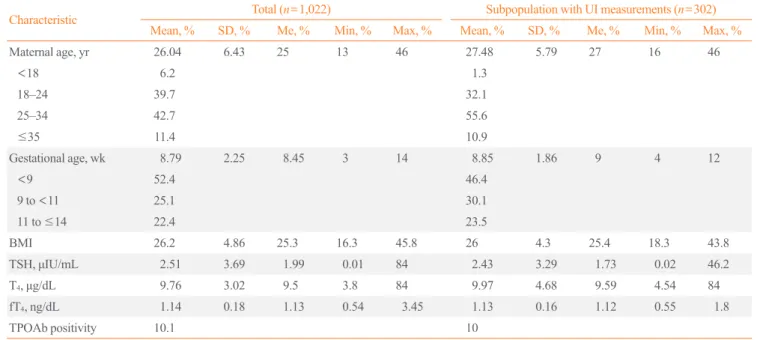
A total of 1,022 first-trimester pregnant women were ultimately selected to participate in the study (Table 1). Sixteen women opted not to participate, and after the selection process, 670 pa- tients formed the reference population (Fig. 1). It was not possi- ble to analyze UI levels in all patients due to financial con- straints, so UI levels were measured in a random sample of 302 pregnant women in the first trimester of pregnancy.
Table 1. Characteristics of the Study Population
Characteristic Total (n=1,022) Subpopulation with UI measurements (n=302)
Mean, % SD, % Me, % Min, % Max, % Mean, % SD, % Me, % Min, % Max, %
Maternal age, yr 26.04 6.43 25 13 46 27.48 5.79 27 16 46
<18 6.2 1.3
18–24 39.7 32.1
25–34 42.7 55.6
≤35 11.4 10.9
Gestational age, wk 8.79 2.25 8.45 3 14 8.85 1.86 9 4 12
<9 52.4 46.4
9 to <11 25.1 30.1
11 to ≤14 22.4 23.5
BMI 26.2 4.86 25.3 16.3 45.8 26 4.3 25.4 18.3 43.8
TSH, μIU/mL 2.51 3.69 1.99 0.01 84 2.43 3.29 1.73 0.02 46.2
T4, μg/dL 9.76 3.02 9.5 3.8 84 9.97 4.68 9.59 4.54 84
fT4, ng/dL 1.14 0.18 1.13 0.54 3.45 1.13 0.16 1.12 0.55 1.8
TPOAb positivity 10.1 10
UI, urinary iodine; SD, standard deviation; Me, median; BMI, body mass index; TSH, thyroid-stimulating hormone; T4, thyroxine; fT4, free T4; TPOAb, antithyroid peroxidase antibody.
The participants in whom UI levels were and were not mea- sured were compared by age, body mass index, TSH, and gesta- tional age, and no statistically significant differences were found, except in age, for which median values of 25 years and 27 years were found in the respective populations.
Iodine status
In the patients selected for UI measurements, the median UI concentration was 173.45 μg/L (interquartile range, 108.11 to 249.35). The distribution of UI levels is shown in Fig. 2.
Concentrations of TSH and prevalence of subclinical and clinical hypothyroidism
In the reference population, the mean TSH level was 1.88 μIU/mL, and the 2.5th and 97.5th percentiles were 0.13 and 5.37 μIU/mL, respectively.
Using our reference ranges, we calculated the prevalence of subclinical and clinical hypothyroidism in the total group of 1,022 pregnant women. The prevalence of subclinical hypothy-
roidism was 3.92%, and that of clinical hypothyroidism was 1.76%. Fig. 3 presents the prevalence of clinical and subclinical hypothyroidism using other TSH cut-off points.
TPOAb status
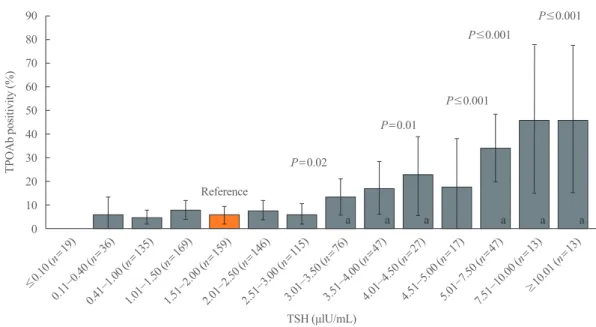
TPOAb was present in 10% of our pregnant population, similar to the findings that have been previously reported in the litera- ture. We evaluated the prevalence of positive TPOAb according to TSH levels in all pregnant women. TPOAb positivity was significantly more common in women with TSH levels higher than 3.5 mIU/L, especially in those with TSH levels above 5.0 mIU/L (Fig. 4).
16 Pregnant women chose not to participate
3 Without information on TPOAb results
6 With a prior history of thyroid disease
4 With a history of taking medica- tion that could influence thyroid
function
99 With positive TPOAb results
183 With a family history of thy- roid disease
43 With serum fT4 levels outside the reference range (39 low and 4
high)
14 TSH values with outliers
Fig. 1. Flow diagram of patients. TPOAb, antithyroid peroxidase antibody; fT4, free thyroxine.
40 30 20 10 0
100 80 60 40 20 0
FrequencyFrequency
Urinary iodine (μg/L)
TSH (μlU/mL) Median: 173.45 μg/L
Median: 1.99 μlU/mL
0 100 200 300 400 500 600 700 800 900 1,000
0 1 2 3 4 5 6 7 8 9 10 Fig. 2. Urinary iodine levels during the first trimester of pregnancy.
Median urinary iodine level: 173.45 μg/L.
Fig. 3. Distribution of thyroid-stimulating hormone (TSH) levels (μIU/mL) in the first trimester of pregnancy in 1,022 women and differences in the prevalence of hypothyroidism using different cut- off points (2.5, 4.2, and 5.36 μIU/mL).
34.8%
10.4%
5.7%
4.7%
24.4%
1,038 Pregnant women were invit- ed to participate in the study
1,022 Pregnant women were final- ly selected
1,013 Pregnant women
1,009 Pregnant women
910 Pregnant women
727 Pregnant women
670 Pregnant women as the refer- ence population
www.e-enm.org
DISCUSSION
Hypothyroidism was found to be common in first-trimester pregnant women living in Chile, affecting 5.68% of the preg- nant women in our sample. The Chilean iodine fortification pro- gram has achieved the adequate recommended iodine intake for pregnant women [11,12].
Most Chileans consume sufficient iodine, but iodine sufficien- cy and excess iodine intake may coexist in our population [20], similar to other countries in Latin America, as described by Mio- to et al. [21] in Brazil. In any case, since the population of Chile is classified as iodine-sufficient, spot urine samples should not be used for the purposes of individual diagnosis and treatment.
One of the strengths of this study is the determination of ref- erence thyroid parameters, which have not been previously de- scribed for this population in our country.
We applied the reference range calculated for TSH in our population and compared it with other cut-off points described in the literature. Our upper cut-off TSH level (97.5th percentile) was 5.37 μIU/mL, which is higher than the normal ranges re- ported in the literature for other populations [6,22-24]. With this level, the calculated prevalence of hypothyroidism in pregnancy was 5.68%, which is higher than has been reported in the litera- ture [25], but significantly lower than the prevalence that would
be obtained if we applied the internationally proposed parame- ters (Fig. 3). In fact, we established a pregnancy-specific refer- ence range for our population in this study with the specific goal of avoiding applying the international reference ranges of TSH, as the ATA and other experts have recommended [10,26]. It has been established that using the reference ranges suggested in the 2011 ATA guidelines leads to an elevated prevalence of high TSH (8% to 28%), because in most studies the upper TSH refer- ence range used was higher than 2.5 or 3.0 mIU/L, whereas studies conducted to establish local reference ranges in iodine- replete areas found upper TSH reference values for first- and second-trimester women ranging from 4.04 to 4.34 mIU/L [26].
Those reference ranges are much closer to the values calculated in our population.
It is possible that some determinants such as ethnic factors, en- vironmental factors, or obesity as a comorbidity in our patients could have influenced the upper TSH reference value that we obtained [8,27].
The possibility of thyroid autoimmune phenomena would not account for the findings in our population, since we did not find a higher prevalence of TPOAb than has been described globally [11,12].
It has been proposed that the most appropriate “normal” TSH level might be found in the population with the lowest preva-
90 80 70 60 50 40 30 20 10 0
TPOAb positivity (%)
TSH (μlU/mL) P=0.02
P=0.01
P≤0.001
Reference
≤0.10 ( n=19)
0.11−0.40 (n=36) 0.41−1.00
(n=135) 1.01−1.50
(n=169) 1.51−2.00
(n=159) 2.01−2.50
(n=146) 2.51−3.00
(n=115) 3.01−3.50
(n=76) 3.51−4.00
(n=47) 4.01−4.50
(n=27) 4.51−5.00
(n=17) 5.01−7.50
(n=47) 7.51−10.00
(n=13)
≥10.01 ( n=13)
Fig. 4. Prevalence of positive antithyroid peroxidase antibody (TPOAb) according to thyroid-stimulating hormone (TSH) levels in pregnant women during the first trimester. aSignificant differences of anti-TPOAb prevalence with respect to the lowest prevalence within the normal range (5.66%; 95% confidence interval [CI], 2.03 to 9.29) in 1.51 to 2.0 TSH category. Prevalence in 3.01 to 3.50, 3.51 to 4.0, 4.01 to 4.50, 5.01 to 7.50, 7.51 to 10.00, and 10.01+; TSH groups are 13.16% (95% CI, 5.38 to 20.93), 17.02% (95% CI, 5.87 to 28.18), 22.22% (95% CI, 5.46 to 38.98), 34.04% (95% CI, 19.98 to 48.11), 46.15% (95% CI, 14.8 to 77.51), and 46.15% (95% CI, 14.8 to 77.51), respectively.
P≤0.001
P≤0.001
a a a a a a
lence of TPOAb [28]. In our analysis of TPOAb-positive pa- tients, we found that TPOAb positivity was significantly more common in patients with TSH levels above 3.5 μIU/mL and fur- ther increased with even higher TSH levels; this fact supports the use of a cut-off level over 3.5 μIU/mL as a reference.
A limitation of our study is that the participants in whom UI was measured showed a statistically significant difference in age from those in whom UI was not measured, despite the fact that they were randomly selected; however, since the difference was very small, we do not believe that this age difference was relevant to our findings for the other variables or that it inter- fered with our global analysis. Furthermore, we did not measure 24-hour UI levels, but the spot urine technique has been sup- ported by the WHO [19]. As a third limitation, it should be not- ed that measuring thyroid hormones only in the first trimester does not allow us to infer that our calculated ranges are applica- ble throughout pregnancy.
Population-wide mandatory iodination must be supported.
Precautions must be taken to include the lowest amount of io- dine necessary to minimize iodine-deficiency disorders, while simultaneously preventing overexposure. Iodine deficiency and overexposure will always coexist; Gauss curves assure this. To avoid overexposure, the fortification of salt should be decreased, but at the same time, strategies targeting subgroups at the high- est risk of deficiency must be introduced.
Nutritional iodine status should considered when establishing TSH reference intervals of populations in iodine-replete areas, in which insufficiency and excessive iodine intake coexist in pregnant women.
CONFLICTS OF INTEREST
No potential conflict of interest relevant to this article was re- ported.
AUTHOR CONTRIBUTIONS
Conception or design: C.C., N.L., P.M., L.M. Acquisition, anal- ysis, or interpretation of data: C.C., N.L., P.M., A.G., M.P.R., S.M., L.M. Drafting the work or revising: C.C., N.L., P.M., A.
G., M.P.R., S.M., L.M. Final approval of the manuscript: C.C., N.L., P.M., A.G., M.P.R., S.M., L.M.
ORCID
Lorena Mosso https://orcid.org/0000-0001-5420-7099
REFERENCES
1. Abalovich M, Amino N, Barbour LA, Cobin RH, De Groot LJ, Glinoer D, et al. Management of thyroid dysfunction during pregnancy and postpartum: an Endocrine Society Clinical Practice Guideline. J Clin Endocrinol Metab 2007;
92(8 Suppl):S1-47.
2. Stagnaro-Green A, Abalovich M, Alexander E, Azizi F, Mestman J, Negro R, et al. Guidelines of the American Thy- roid Association for the diagnosis and management of thy- roid disease during pregnancy and postpartum. Thyroid 2011;21:1081-125.
3. Qaseem A, Snow V, Owens DK, Shekelle P; Clinical Guide- lines Committee of the American College of Physicians.
The development of clinical practice guidelines and guid- ance statements of the American College of Physicians:
summary of methods. Ann Intern Med 2010;153:194-9.
4. Orito Y, Oku H, Kubota S, Amino N, Shimogaki K, Hata M, et al. Thyroid function in early pregnancy in Japanese healthy women: relation to urinary iodine excretion, emesis, and fetal and child development. J Clin Endocrinol Metab 2009;94:1683-8.
5. Yan YQ, Dong ZL, Dong L, Wang FR, Yang XM, Jin XY, et al. Trimester- and method-specific reference intervals for thyroid tests in pregnant Chinese women: methodology, eu- thyroid definition and iodine status can influence the setting of reference intervals. Clin Endocrinol (Oxf) 2011;74:262-9.
6. Marwaha RK, Chopra S, Gopalakrishnan S, Sharma B, Kanwar RS, Sastry A, et al. Establishment of reference range for thyroid hormones in normal pregnant Indian wom- en. BJOG 2008;115:602-6.
7. Moon HW, Chung HJ, Park CM, Hur M, Yun YM. Estab- lishment of trimester-specific reference intervals for thyroid hormones in Korean pregnant women. Ann Lab Med 2015;
35:198-204.
8. Mosso L, Martinez A, Rojas MP, Margozzini P, Solari S, Lyng T, et al. Frequency of subclinical thyroid problems among women during the first trimester of pregnancy. Rev Med Chil 2012;140:1401-8.
9. Baloch Z, Carayon P, Conte-Devolx B, Demers LM, Feldt- Rasmussen U, Henry JF, et al. Laboratory medicine practice guidelines. Laboratory support for the diagnosis and moni- toring of thyroid disease. Thyroid 2003;13:3-126.
10. De Groot L, Abalovich M, Alexander EK, Amino N, Barbo- ur L, Cobin RH, et al. Management of thyroid dysfunction during pregnancy and postpartum: an Endocrine Society
www.e-enm.org
clinical practice guideline. J Clin Endocrinol Metab 2012;
97:2543-65.
11. Lazarus J, Brown RS, Daumerie C, Hubalewska-Dydejczyk A, Negro R, Vaidya B. 2014 European Thyroid Association guidelines for the management of subclinical hypothyroid- ism in pregnancy and in children. Eur Thyroid J 2014;3:76- 94.
12. Alexander EK, Pearce EN, Brent GA, Brown RS, Chen H, Dosiou C, et al. 2017 Guidelines of the American Thyroid Association for the diagnosis and management of thyroid disease during pregnancy and the postpartum. Thyroid 2017;27:315-89.
13. Li C, Shan Z, Mao J, Wang W, Xie X, Zhou W, et al. Assess- ment of thyroid function during first-trimester pregnancy:
what is the rational upper limit of serum TSH during the first trimester in Chinese pregnant women? J Clin Endocri- nol Metab 2014;99:73-9.
14. Shi X, Han C, Li C, Mao J, Wang W, Xie X, et al. Optimal and safe upper limits of iodine intake for early pregnancy in iodine-sufficient regions: a cross-sectional study of 7190 pregnant women in China. J Clin Endocrinol Metab 2015;
100:1630-8.
15. Council on Environmental Health, Rogan WJ, Paulson JA, Baum C, Brock-Utne AC, Brumberg HL, et al. Iodine defi- ciency, pollutant chemicals, and the thyroid: new informa- tion on an old problem. Pediatrics 2014;133:1163-6.
16. Kim WG, Kim WB, Woo G, Kim H, Cho Y, Kim TY, et al.
Thyroid stimulating hormone reference range and preva- lence of thyroid dysfunction in the Korean population: Ko- rea National Health and Nutrition Examination Survey 2013 to 2015. Endocrinol Metab (Seoul) 2017;32:106-14.
17. Muzzo S, Burgueno M, Carvajal F, Biolley E, Avendano M, Vargas S, et al. Iodine nutrition in school children of four census areas of Chile. Rev Med Chil 1997;125:1299-304.
18. EUthyroid. Laboratory method and statistical analysis for cross-lab comparison [Internet]. Vienna: Biolution GmbH;
c2015 [cited 2018 Nov 5]. Available from: http://euthyroid.
eu/download/EUthyroid_iodinemap_textEN.pdf.
19. World Health Organization. Assessment of iodine deficiency disorders and monitoring their elimination. 3rd ed. Geneva:
World Health Organization; 2007.
20. Muzzo S, Leiva L, Ramirez I, Carvajal F, Biolley E. Iodine nutrition status in school age children of an area of high io- dine intake (Calama) compared with an area of normal in- take (Punta Arenas). Rev Chil Nutr 2005;32:28-35.
21 Mioto VCB, Monteiro ACCNG, de Camargo RYA, Borel AR, Catarino RM, Kobayashi S, et al. High prevalence of iodine deficiency in pregnant women living in adequate io- dine area. Endocr Connect 2018;7:762-7.
22. Medici M, Korevaar TI, Visser WE, Visser TJ, Peeters RP.
Thyroid function in pregnancy: what is normal? Clin Chem 2015;61:704-13.
23. Soldin OP, Tractenberg RE, Hollowell JG, Jonklaas J, Janicic N, Soldin SJ. Trimester-specific changes in maternal thyroid hormone, thyrotropin, and thyroglobulin concentra- tions during gestation: trends and associations across trimes- ters in iodine sufficiency. Thyroid 2004;14:1084-90.
24. Quinn FA, Gridasov GN, Vdovenko SA, Krasnova NA,
Vodopianova NV, Epiphanova MA, et al. Prevalence of ab- normal thyroid stimulating hormone and thyroid peroxidase antibody-positive results in a population of pregnant women in the Samara region of the Russian Federation. Clin Chem Lab Med 2005;43:1223-6.
25. Stricker R, Echenard M, Eberhart R, Chevailler MC, Perez V, Quinn FA, et al. Evaluation of maternal thyroid function during pregnancy: the importance of using gestational age- specific reference intervals. Eur J Endocrinol 2007;157:509- 14.
26. Korevaar TIM. The upper limit for TSH during pregnancy:
why we should stop using fixed limits of 2.5 or 3.0 mU/l.
Thyroid Res 2018;11:5.
27. Mosso L, Martinez A, Rojas MP, Latorre G, Margozzini P, Lyng T, et al. Early pregnancy thyroid hormone reference ranges in Chilean women: the influence of body mass index.
Clin Endocrinol (Oxf) 2016;85:942-8.
28. Spencer CA, Hollowell JG, Kazarosyan M, Braverman LE.
National Health and Nutrition Examination Survey III thy- roid-stimulating hormone (TSH)-thyroperoxidase antibody relationships demonstrate that TSH upper reference limits may be skewed by occult thyroid dysfunction. J Clin Endo- crinol Metab 2007;92:4236-40.