Microtensile bond strength of repaired indirect resin composite
Porntida Visuttiwattanakorn*, Kallaya Suputtamongkol, Duangjai Angkoonsit, Sunattha Kaewthong, Piyanan Charoonanan
Prosthodontics Department, Faculty of Dentistry, Mahidol University, Bangkok, Thailand
PURPOSE. The objective of this study was to investigate the effect of surface treatments on microtensile bond strengths (MTBSs) of two types of indirect resin composites bonded to a conventional direct resin composite.
MATERIALS AND METHODS. Indirect resin composite blocks of Ceramage and SR Nexco were prepared in a plastic mold having a dimension of 10 × 10 × 4 mm. These composite blocks were divided into three groups according to their surface treatments: Group1: Sandblast (SB); Group2: Sandblast and ultrasonically clean (SB+
UL); Group3: Sandblast plus silane (SB+SI). After bonding with direct resin composite, indirect-direct resin composite blocks were kept in distilled water for 24 hours at 37oC and cut into microbars with the dimension of 1
× 1 × 8 mm. Microbar specimens (n = 40 per group) were loaded using a universal testing machine. Failure modes and compositions were evaluated by SEM. The statistical analyses of MTBS were performed by two-way ANOVA and Dunnett’s test at α = .05. RESULTS. Surface treatments and brands had effects on the MTBS without an interaction between these two factors. For SR Nexco, the MTBSs of SB and SB+SI group were significantly higher than that of SB+UL. For Ceramage, the MTBSs of SB and SB+SI were significantly higher than that of SB+UL. The mean MTBS of the Ceramage specimens was significantly higher than that of SR Nexco for all surface treatments.
CONCLUSION. Sandblasting with or without silane application could improve the bond strengths of repaired indirect resin composites to a conventional direct resin composite. [J Adv Prosthodont 2017;9:38-44]
KEYWORDS: Surface treatment; Indirect resin composite; Microtensile bond strength; Sandblast; Silane; Ultrasonic
INTRODUCTION
Indirect resin composites (IRCs) are used to fabricate many kinds of both intracoronal and extracoronal dental restorations including inlays, onlays, overlays, veneering material for fixed restorations, and removable dentures. During 1960s and 1990s, the first and the second generations of indirect resin compos- ites were developed to improve both their physical and mechan- ical properties. For the second generation of indirect resin
composites, an increase in micro-hybrid fillers and a decrease in organic matrix were aimed to improve the mechanical strength and to decrease polymerization shrinkage of these materials.1,2
Dental restorations made from indirect resin composite offer some benefits as compared to direct resin composite res- torations, such as better mechanical performance and a signifi- cant reduction in polymerization shrinkage. Therefore, they could provide longer service time and better color stability and would reduce postoperative sensitivity.3-5 It is also easier to achieve ideal proximal contacts and anatomic morphology, pre- cise marginal integrity, and optimal esthetics.6
Compared to ceramic materials, indirect resin composites exhibit better stress distribution, better reparability, lower cost, and ease of handling.7,8 Due to their low elastic moduli, resin composite materials have shown a greater capacity to absorb compressive loading forces and reduce the impact forces than porcelain has. Due to similar composition of the luting cement and composites, the marginal adaptation of composites is bet- ter than that of ceramics and resin composites have a lower tendency for marginal chipping than ceramics.4,6 On the other
Corresponding author:
Porntida Visuttiwattanakorn
Prosthodontics Department, Faculty of Dentistry, Mahidol University, 6 Yothi Street, Ratchathewi, Bangkok 10400, Thailand
Tel. +6622007817-9: e-mail, [email protected]
Received May 16, 2016 / Last Revision October 21, 2016 / Accepted November 17, 2016
© 2017 The Korean Academy of Prosthodontics
This is an Open Access article distributed under the terms of the Creative Commons Attribution Non-Commercial License (http://creativecommons.
org/licenses/by-nc/3.0) which permits unrestricted non-commercial use, distribution, and reproduction in any medium, provided the original work is properly cited.
hand, resin composites show inferior long term surface charac- teristics, such as surface roughness and esthetics, and they are more prone to color changes.1,9
In recent years, indirect resin composites have gained more popularity because of their improved wear resistance similar to natural tooth and also because they can overcome the problem of veneering porcelain, including tendency to wear opposing teeth significantly and difficulty of repair.10 Despite the consid- erable improvement of indirect resin composites, clinical fail- ures may still occur, including bulk fractures, chipping, margin- al gaps, wear, and color alteration.In such situations, it may be necessary to replace or repair the existing restorations in order to restore function and esthetics. Successful resin composite repairing procedure requires an adequate interfacial bond between existing and new resin composite materials. Various methods have been reported to improve the reactivity of high- ly converted composites. These methods include acid etching, air abrasion, and the use of solvents and silanes.10-13 There is no consensus on the results obtained from these procedures.
Hydrofluoric acid has capacity of increasing surface rough- ness in the aged resin composite surface by the dissolution of the filler particles. Many studies have shown that sandblasting and silanization can promote durable bond strength of repaired composite without HF etching, and thus using hazardous and highly corrosive HF can be avoided.11-13 Hummel et al.,14 in 1997, reported that surface treatment by hydrofluoric acid or phosphoric acid etching alone was not sufficient to create an effective bond for repaired indirect composite. In addition, Cesar et al.,11 in 2001, studied the tensile bond strength of composite repairs applied to Artglass, and they reported that using silane after sandblasting resulted in statistically higher bond strength compared to using sand paper, diamond bur, and acid etching surface treatment.
Although some studies mentioned that none of the surface treatment could be recommended as a universal protocol for repairing resin composites, knowing compositions of repaired composites would be helpful for repairing procedure.15 The studies suggested that when the composition of a repaired composite was unknown, etching with phosphoric acid or sandblasting was recommended.15 In addition, silica coating, or aluminum oxide blasting and silanization provided significantly better results in repaired indirect resin composite.10-11,13,16-17
SR Nexco and Ceramage are the new materials in the fami- ly of the second generation indirect resin composites. The
higher amount of ceramic fillers and the use of UDMA resin monomers are the main improvement of these indirect resin composites. Because of their improved mechanical properties, it is claimed that they can be used to fabricate various kinds of dental restorations. However, there is limited information regarding their clinical performance. The objectives of this study were to compare the microtensile bond strengths of two new indirect resin composite (Ceramage and SR Nexco) repaired with direct resin composite (Filtek Z350). Their failure characteristics were also determined.
MATERIALS AND METHODS
Indirect resin composite blocks of Ceramage (Lot No. 081/23, Shofu Inc., Kyoto, Japan) and SR Nexco (Lot No. R31493, Ivoclar Vivadent, Schaan, Liechtenstein) were prepared in a plastic mold (10 mm × 10 mm × 4 mm). The compositions of Ceramage and SR Nexco are shown in Table 1. Incremental layers (2 mm) of indirect resin composite were condensed into a mold using a load transfer device at the force of 1 kg. Then, each layer was initially polymerized using a hand-held light cur- ing device for 40 s (Optilux 501, Kerr, Danbury, CT, USA).
The last increment was covered with a glass slab in order to obtain a flat surface after light curing. The intensity of the light was verified to be no less than 500 mW/cm2 by using a built-in radiometer before starting the polymerization procedure. After a specimen was removed from the mold, Ceramage oxy-barrier (Lot No. R60504, IvoclarVivadent AG, Schaan, Liechtenstein) or SR gel (Lot No. R60504, Ivoclar Vivadent AG, Schaan, Liechtenstein) was applied to prevent oxygen inhibited layer and the specimen was further polymerized in a special polym- erization device (Solidilite V, Shofu Inc., Kyoto, Japan) follow- ing the manufacturer’s recommendations. After complete polymerization, the outer surfaces were polished with silicone carbide papers 600 grit under running water. Then all specimen blocks were stored in distilled water for 24 hours at 37oC in an incubator.
These blocks were categorized into three groups according to their surface treatments (2 blocks per group).
Group 1: Sandblast (SB):
Specimens were sandblasted with aluminum oxide particles (Al2O3) (Tecline, Bandhagen, Sweden) of 50 µm, 60 psi at a distance 1 cm perpendicular to surface for 5 seconds by a sandblasting machine (Base M.B.L, Dentalfarm, Torino, Italy)
Table 1. Compositions of indirect resin composite use in this study
Material Manufacturer Polymer matrix Filler Particle
SR Nexco Paste dentine
IvoclarVivadent, Schaan, Leichtenstein
UDMA, Aliphatic Dimethacrylate
(16.9%wt)
silicon dioxide (19.8%wt) prepolymer and co-polymer which consists of pre-polymerised ground up UDMA
matrix and inorganic microfiller particles (62.9%wt.)
10 - 50 nm
Ceramage SHOFU Inc.,
Kyoto, Japan UDMA zirconium silicate (73%wt) NP
NP = not provided by the manufacturers
Group 2: Sandblast and ultrasonic clean (SB+ UL):
After sandblasted, composite specimens were cleaned ultra- sonically in distilled water for 10 minutes using an ultrasonic cleaner (Vibraclean 300, MDT Co., Harvey, CA, USA) and steam-cleaned for 5 seconds.
Group 3: Sandblast plus silane (SB+SI):
After sandblasted, composite specimens were applied with silane (Monobond-S, Ivoclar Vivadent, Germany) using a microbrush, left for 60 seconds, and dispersed with a strong air stream.
After surface treatments, indirect resin composite blocks were positioned in another plastic mold (10 mm × 10 mm × 9 mm). The direct resin composite (Filtek Z350, Lot No.
441110, 3M ESPE, St. Paul, MN, USA) was condensed on the treated surface of indirect resin composite by incremental technique without bonding agents. Each layer was light-polym- erized for 40 seconds (Optilux 501, Kerr, Danbury, CT, USA) until completion. The last increment was covered with a glass slab in order to obtain a flat surface. After the specimens were removed from the mold, they were further polymerized for 40 seconds in the areas that previously contacted with the plastic mold.
The specimens were stored in distilled water for 24 hour at 37oC in incubator and cut into microbars of 8 mm length and 1 mm2 in cross-section with the Micro Cutting Instrument (Struers, Copenhagen, Denmark). Sizes of all microbars were measured with a digital caliper and were recorded. Only micro- bars with cross-sectional area between 1.0 ± 0.1 mm2 were selected for MTBS test. All microbars were examined for defects with an optical light microscope at 10× magnification.
The microbars with any defects were discarded from the study.
The number of microbars tested in each group was forty.
The microtensile bond strength (MTBS) test was per- formed using a universal testing machine (Model 5566, Instron Ltd., Buckinghamshire, England) in tension at a crosshead speed of 1 mm/min. The maximum load at failure was record- ed and the tensile bond strength was calculated using the for- mula:
R = F/A
Where “R” is the MTBS (in MPa), “F” is the load at fracture (in N) and “A” is the interfacial area of the specimen (in mm2)
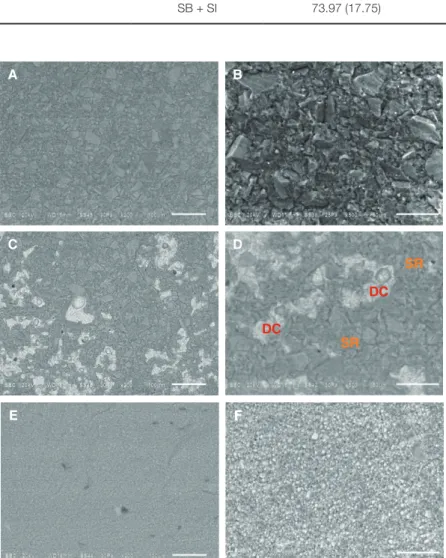
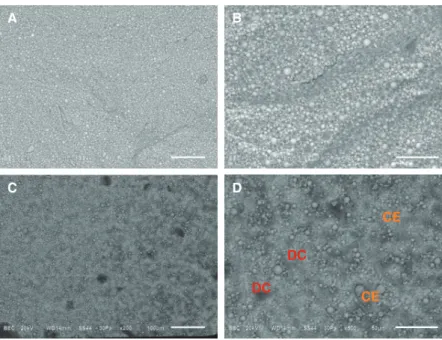
The scanning electron microscope (SEM) was used to eval- uate compositions of indirect resin composites. Modes of fail- ure were identified using SEM. The failure modes were classi- fied into three modes:
Cohesive failure of indirect resin composite: where fracture occurred in indirect resin composite
Cohesive failure of direct resin composite: where fracture occurred in direct resin composite
Interfacial failure: where fracture occurred at the interface between indirect and direct resin composite
The mean MTBSs and standard deviations were calculated and recorded. Shapiro-Wilk test was used to test the normality of the data and Levene’s test was used for testing the equality of variances. The MTBS values of all groups were analyzed by two-way ANOVA and Dunnett’s T3 multiple comparison test at α = .05
RESULTS
The mean MTBSs of all groups are shown in Table 2. The results from two-way ANOVA showed that different brands of indirect resin composite (SR Nexco and Ceramage) and surface treatments (SB, SB+UL and SB+SI) had effects on the MTBS without an interaction between these two factors. The MTBS of Ceramage was higher than SR Nexco (P < .001) for all sur- face treatments. Dunnett’s T3 multiple comparison test was used to identify the difference between MTBSs of different surface treatment groups and the results showed that the mean MTBSs of SB and SB+SI groups were significantly higher than that of SB+UL group (P < .001) for both SR Nexco and Ceramage. The failure modes of fracture specimens are pre- sented in Table 3 and Table 4. The number and percentage of specimens according to their failure mode are shown in Table 3. Cohesive failures of direct resin composite and interfacial failures were mostly observed for Ceramage material. For SR Nexco, cohesive failure of indirect resin composite and interfa- cial failure were frequently observed. The mean MTBS values of specimens in all groups according to their failure mode were calculated as shown in Table 4. Slight variation in the mean MTBS values for each material was observed depending on the failure mode. The microstructures of indirect and direct resin composites are shown in Fig. 1, Fig. 2, Fig. 3, Fig. 4. The irregular shape SiO2 particles with varied particle sizes, ranging from submicron size to nearly 50 µm were observed in SR Nexco (Fig. 1, Fig. 3). In Ceramage, the round-shape zirconium silicate particles less than 10 µm in size are observed. (Fig. 2, Fig. 4) The SEM micrographs of direct resin composite (Filtex Z350) showed irregular shape of zirconium silicate particles, mostly less than 10 µm in size (Fig. 1).
Table 2. Mean microtensile bond strengths (in MPa) (standard deviations in parentheses) of six experiment groups
Indirect resin composite Surface treatments
SB SB + UL SB + SI
SR Nexco 53.04 (10.52)a 43.81 (10.83)b 53.23 (10.45)a
Ceramage 72.08 (14.52)c 63.88 (12.90)d 72.49 (15.70)c
Groups with different superscript letters indicate significant differences (P < .05).
SB = Sandblast only, SB + UL = Sandblast and ultrasonic clean application, SB + SI = Sandblast plus silane application
Table 3. The number and percentage of failure mode of six experiment groups Indirect resin
composite
Surface treatments
Failure mode Interfacial Cohesive of direct resin
composite
Cohesive of indirect resin composite
SR Nexco SB 11 (23.40 %) 8 (17.02 %) 28 (59.57 %)
SB + UL 26 (54.16 %) 9 (18.75 %) 13 (27.08 %)
SB + SI 11 (25 %) 8 (18.18 %) 25 (56.82 %)
Ceramage SB 25 (52.08 %) 14 (29.17 %) 9 (18.75 %)
SB + UL 15 (33.33 %) 24 (53.33 %) 6 (13.33 %)
SB + SI 9 (21.43 %) 23 (54.76 %) 10 (23.81 %)
Table 4. The mean (standard deviation in parentheses) of MTBS according to the failure mode Indirect resin
composite
Surface treatments
Failure mode Interfacial
(Mixed)
Cohesive of direct resin composite
Cohesive of indirect resin composite
SR Nexco SB 53.92 (10.91) 54.21 (9.63) 52.36 (10.91)
SB + UL 44.10 (13.63) 41.17 (7.72) 45.14 (6.07)
SB + SI 56.06 (9.94) 50.89 (11.50) 52.74 (10.50)
Ceramage SB 74.65 (16.64) 70.58 (10.12) 67.27 (13.83)
SB + UL 68.94 (14.78) 60.88 (9.28) 63.23 (18.35)
SB + SI 73.97 (17.75) 70.88 (13.92) 74.85 (18.80)
Fig. 1. The representative SEM photographs of SR Nexco groups. (A), (B) the cohesive failure in SR Nexco (SR). (C), (D) the interfacial failure. (E), (F) the cohesive failure in the direct resin composite (DC).
A B
C D
E F
SR
DC SR
DC
Fig. 2. The representative SEM micrographs of Ceramage groups. A, B: the cohesive failure in Ceramage (CE). C, D: the interfacial failure.
A B
C D
CE
DC
DC CE
Fig. 3. The representative SEM micrographs show microstructures of SR Nexco in backscattered electron composition (BEC) and secondary electron imaging (SEI) mode.
A B
Fig. 4. The representative SEM micrographs show microstructures of Ceramage in backscattered electron composition (BEC) and secondary electron imaging (SEI) mode.
A B
DISCUSSION
Several techniques are purposed to improve the repair bond strength of indirect resin composites including mechanical interlocking and chemical bonding of resin composite materi- als.10 However, the success of composite-composite adhesion depends on the surface treatment of an aged resin composite.18 The bonding between aged and new resin composite could be accomplished by three mechanisms, which are a chemical bonding with the organic matrix, a chemical bonding with the exposed filler particles, and the micromechanical retention to the treated surface.19 A chemical bonding with the organic matrix relies on the unconverted C=C double bonds remaining in the surface of the aged composite.18 The higher conversion rate of an indirect resin composite may compromise its repair- ing procedure.10
For a chemical bonding with the exposed filler particles, silane is effective in improving adhesion to silica-based materi- als. Having the structure Y-Si(OR),3 where Y is a functional group (usually be methylmethacrylate), silane will chemically react with the adhesive resin (dimethacrylate). OR is an alkoxyl group, which is hydrolyzed to a silanol (SiOH) and forms silox- ane bonds with silanols on the filler particles surface. Therefore, it is possible to create chemical bond with the filler particles of the aged composite using a silane coupling agent, and silane also improves the wettability of the substrate surfaces.12
For micromechanical retention to the treated surface, sur- face conditioning, such as the use of diamond burs, sandblast- ing, and acid etching, can create micromechanical retention and increase the bond strength of repaired composite. Few studies have shown that the surface grinding of the indirect resin com- posite with diamond bur would yield less bond strength than the others.11
In this study, pre-testing failures were found in the untreat- ed indirect-direct resin composite specimens, as well as in the resin treated with silane only. Bonding failures in the untreated indirect-direct resin composite specimens were found during the polishing procedure with a silicon carbide paper. The speci- mens treated with silane only had bonding failures during the cutting process. Therefore, no treatment or surface treatment by silane alone could not be included in this study because all the specimens were debonded during specimen preparation steps. Along with previous studies, using silica coating or alu- minum oxide blasting increased microtensile bond strength val- ues of repaired direct resin composite, irrespective of primer used.6,11,20-21 Alumina particles have been used to increase sur- face roughness of the substrates and some alumina particles might have been embedded into the surfaces during grit blast- ing and formed =Al-O-Si bonds after silanization.10,12 Thus, sandblasting was a necessary process for bonding of indirect- direct resin composite.13
According to the manufacturers’ information, flexural strength of Ceramage (146 MPa) is higher than that of SR Nexco (90 MPa). The main reason for the differences in strength should be the differences in compositions of these materials; SR Nexco Paste has highly dispersed silicon dioxide as microfiller in the 10 to 50 nm range. The main filler compo-
nent (62.9%) is a prepolymer/copolymer, which consists of pre-polymerized ground up UDMA matrix and inorganic microfiller particles. On the other hand, Ceramage is com- posed of zirconium silicate particles supported by an inorganic polymer matrix (UDMA). The microstructures of indirect and direct resin composites are shown in Fig.1, Fig. 2, Fig. 3, Fig. 4.
SiO2 particles of SR Nexco are varied in size and non-homo- geneous because the prepolymer and copolymer are present in the composition of the resin. For Ceramage material, zirconi- um silicate particles with sizes ranging between submicron to approximately 10 μm were observed.
The significantly higher bond strengths of repaired indirect resin composite were observed when SR Nexco and Ceramage were treated with sandblast only or sandblast plus silane appli- cation. This result was in accordance with previous studies that showed the higher bond strength when using sandblasting and silane as opposed to hydrofluoric acid, diamond bur, or other procedures to create micromechanical retention.11,13,21 However, this result showed that silane would not be necessary for repairing resin composite as also reported in previous stud- ies.16,22 Surface treatment by alumina sandblasting alone is suffi- cient to produce effective bond strength for repairing indirect resin composite with direct composite.
From this study, sandblasting and ultrasonic clean had the lowest microtensile bond strength in both Ceramage and SR Nexco. Moisture at the interface from ultrasonic cleaning of repaired indirect resin composite might be the reason for reduced bond strength. Water absorption affects the bond strength by hydrolytic degradation of the resin-filler interface and causes swelling of the resin matrix that could lower the bonding ability and mechanical properties of resin composite materials.23-25 However, actual ultrasonic cleaning cannot be used in the patients with the direct repairing technique but can be used only in a laboratory.
The failure modes of Ceramage were mostly cohesive fail- ure of direct resin composite or interfacial failure. On the other hand, failure modes of SR Nexco were mostly cohesive failure of indirect resin composite or interfacial failure. Considering the tensile strength values of all materials used in this study, direct resin composite and Ceremage were the strongest with tensile strength approximately 62 - 80 MPa, according to the manufacturers’ information. SR Nexco was the weakest materi- al. The factor that convincingly determined the bond strength of indirect-direct resin composite bonding would be the strength of these resin composite materials. When SR Nexco was bonded to direct resin composite, failure usually occurred in SR Nexco, which was the weaker material. When Ceramage was bonded to direct resin composite, failure could occur in both materials because they had comparable strength.
Therefore, mechanical properties of resin composite materials would be an important factor that control the successive bond- ing of these materials.
CONCLUSION
Surface treatment methods and compositions of indirect resin composite had effects on the MTBS of bonded indirect-direct
resin composite bilayers.
Sandblasting with or without silane application could improve the bond strengths of repaired indirect–direct resin composites in both SR Nexco and Ceramage.
ORCID
Porntida Visuttiwatanakorn http://orcid.org/0000-0002-8711-6350 REFERENCES
1. Nandini S. Indirect resin composites. J Conserv Dent 2010;
13:184-94.
2. Miara P. Aesthetic guidelines for second-generation indirect inlay and onlay composite restorations. Pract Periodontics Aesthet Dent 1998;10:423-31.
3. Dietschi D, Scampa U, Campanile G, Holz J. Marginal adapta- tion and seal of direct and indirect Class II composite resin restorations: an in vitro evaluation. Quintessence Int 1995;26:
127-38.
4. Touati B. The evolution of aesthetic restorative materials for inlays and onlays: a review. Pract Periodontics Aesthet Dent 1996;8:657-66.
5. Hickel R, Manhart J. Longevity of restorations in posterior teeth and reasons for failure. J Adhes Dent 2001;3:45-64.
6. Touati B, Aidan N. Second generation laboratory composite resins for indirect restorations. J Esthet Dent 1997;9:108-18.
7. Soares CJ, Martins LR, Pfeifer JM, Giannini M. Fracture resis- tance of teeth restored with indirect-composite and ceramic inlay systems. Quintessence Int 2004;35:281-6.
8. Soares CJ, Santana FR, Fonseca RB, Martins LR, Neto FH. In vitro analysis of the radiodensity of indirect composites and ceramic inlay systems and its influence on the detection of cement overhangs. Clin Oral Investig 2007;11:331-6.
9. Hirata M, Koizumi H, Tanoue N, Ogino T, Murakami M, Matsumura H. Influence of laboratory light sources on the wear characteristics of indirect composites. Dent Mater J 2011;30:127-35.
10. Dall’oca S, Papacchini F, Radovic I, Polimeni A, Ferrari M.
Repair potential of a laboratory-processed nano-hybrid resin composite. J Oral Sci 2008;50:403-12.
11. Cesar PF, Meyer Faara PM, Miwa Caldart R, Gastaldoni Jaeger R, da Cunha Ribeiro F. Tensile bond strength of com- posite repairs on Artglass using different surface treatments.
Am J Dent 2001;14:373-7.
12. Lung CY, Matinlinna JP. Aspects of silane coupling agents and surface conditioning in dentistry: an overview. Dent Mater 2012;28:467-77.
13. Passos SP, Ozcan M, Vanderlei AD, Leite FP, Kimpara ET, Bottino MA. Bond strength durability of direct and indirect composite systems following surface conditioning for repair. J Adhes Dent 2007;9:443-7.
14. Hummel SK, Marker V, Pace L, Goldfogle M. Surface treat- ment of indirect resin composite surfaces before cementa- tion. J Prosthet Dent 1997;77:568-72.
15. Loomans BA, Cardoso MV, Roeters FJ, Opdam NJ, De Munck J, Huysmans MC, Van Meerbeek B. Is there one opti-
mal repair technique for all composites? Dent Mater 2011;27:
701-9.
16. Lucena-Martín C, González-López S, Navajas-Rodríguez de Mondelo JM. The effect of various surface treatments and bonding agents on the repaired strength of heat-treated com- posites. J Prosthet Dent 2001;86:481-8.
17. Trajtenberg CP, Powers JM. Bond strengths of repaired labo- ratory composites using three surface treatments and three primers. Am J Dent 2004;17:123-6.
18. Rodrigues SA Jr, Ferracane JL, Della Bona A. Influence of surface treatments on the bond strength of repaired resin composite restorative materials. Dent Mater 2009;25:442-51.
19. Brosh T, Pilo R, Bichacho N, Blutstein R. Effect of combina- tions of surface treatments and bonding agents on the bond strength of repaired composites. J Prosthet Dent 1997;77:
122-6.
20. Soares CJ, Giannini M, Oliveira MT, Paulillo LA, Martins LR.
Effect of surface treatments of laboratory-fabricated com- posites on the microtensile bond strength to a luting resin ce- ment. J Appl Oral Sci 2004;12:45-50.
21. Souza EM, Francischone CE, Powers JM, Rached RN, Vieira S. Effect of different surface treatments on the repair bond strength of indirect composites. Am J Dent 2008;21:93-6.
22. Swift EJ Jr, Cloe BC, Boyer DB. Effect of a silane coupling agent on composite repair strengths. Am J Dent 1994;7:200- 2.
23. Martos J, Osinaga PWR, de Oliveira E, de Castro LAS.
Hydrolytic degradation of composite resins: effects on the microhardness. Mater Res 2003;6:599-604.
24. Furuse AY, da Cunha LF, Benetti AR, Mondelli J. Bond strength of resin-resin interfaces contaminated with saliva and submitted to different surface treatments. J Appl Oral Sci 2007;15:501-5.
25. Berger SB, Palialol AR, Cavalli V, Giannini M. Characterization of water sorption, solubility and filler particles of light-cured composite resins. Braz Dent J 2009;20:314-8.