24(3) : 194-198 (2018)
https://doi.org/10.20307/nps.2018.24.3.194
194
Chemicals from Cimicifuga dahurica and Their Inhibitory Effects on Pro-inflammatory Cytokine Production by LPS-stimulated
Bone Marrow-derived Dendritic Cells
Nguyen Phuong Thao
1,†, Young Suk Lee
2,†, Bui Thi Thuy Luyen
3, Ha Van Oanh
3, Irshad Ali
4, Madeeha Arooj
4, Young Sang Koh
4,*, Seo Young Yang
2,*, and Young Ho Kim
2,*
1
Institute of Marine Biochemistry (IMBC), Vietnam Academy of Science and Technology (VAST), 18-Hoang Quoc Viet, Hanoi, Vietnam
2
College of Pharmacy, Chungnam National University, Daejeon 34134, Republic of Korea
3
Hanoi University of Pharmacy, 13-15 Le Thanh Tong, Hanoi, Vietnam
4
School of Medicine and Jeju Research Center for Natural Medicine, Jeju National University, Jeju 63243, Republic of Korea
Abstract – Inflammation is a biological response caused by overactivation of the immune system and is controlled by immune cells via a variety of cytokines. The overproduction of pro-inflammatory cytokines enhances abnormal host immunity, resulting in diseases such as rheumatoid arthritis, cardiovascular disease, Alzheimer’s disease, and cancer. Inhibiting the production of pro-inflammatory cytokines such as interleukin (IL)-12p40, IL-6, and tumor necrosis factor (TNF)-α might be one way to treat these conditions. Here, we investigated the anti-inflammatory activity of compounds isolated from Cimicifuga dahurica (Turcz.) Maxim., which is traditionally used as an antipyretic and analgesic in Korea. In primary cell culture assays, 12 compounds were found to inhibit the production of pro-inflammatory cytokines (IL-12p40, IL-6, and TNF-α) in vitro in bone marrow-derived dendritic cells stimulated with LPS.
Keywords – Cimicifuga dahurica, Ranunculaceae, Anti-inflammatory, IL-12 p40, IL-6,TNF-α
Introduction
Inflammation is the sum of the complex biological responses caused by an overactivated immune system.
Inflammation is closely associated with the pathology of many diseases, such as autoimmune diseases like multiple sclerosis and rheumatoid arthritis as well as degenerative diseases like Alzheimer’s disease, cardiovascular disease, and cancer.
1Consequently, it will be important to develop treatments that can alleviate or cure these diseases.
Dendritic cells (DCs) perform essential roles in innate
and adaptive immunity, such as processing and presenting xenobiotics intruded into the host and acting as a central regulator of the immune responses.
2These functions of DCs are controlled by various pro-inflammatory cytokines, such as interleukin (IL)-12p40, IL-6, and tumor necrosis factor (TNF)- α.
3IL-12 has two subtypes, p35 and p40, which have disulfide bonds in different locations. It is produced by antigen-presenting cells, like DCs, monocytes, and macrophages, and induces an inflammatory response to xenobiotics and immune signals.
4It might also be a trigger that initiates cellular immunity. IL-6 was originally known as a B-cell differentiation factor and is involved in various biological actions, such as the acute immune response and hematopoiesis.
5TNF- α is mainly released by monocytes and macrophages and is a pro-inflam- matory cytokine involved in host defenses against xeno- biotics and cancer.
6TNF- α might also be involved in the pathogenic mechanisms of acute and chronic inflammatory disease.
7Pro-inflammatory cytokines play important roles in host immunity, but their overexpression can make a
*Author for correspondence
Young Ho Kim. Ph.D., College of Pharmacy, Chungnam National University, Daejeon 34134, Republic of Korea.
Tel: +82-42-821-5933; E-mail: [email protected]
Seo Young Yang Ph.D., College of Pharmacy, Chungnam National University, Daejeon 34134, Republic of Korea.
Tel: +82-42-821-7321; E-mail: [email protected]
Young Sang Koh Ph.D., School of Medicine and Jeju Research Cen- ter for Natural Medicine, Jeju National University, Jeju 63243, Republic of Korea.
Tel: +82-64-754-3851; E-mail: [email protected]
†
These authors contributed equally to this work.
disease worse, triggering fever and tissue damage and even leading to death. Suppressing the overproduction of these cytokines could be a way to treat diseases related to inflammation.
Cimicifuga dahurica (Turcz.) Maxim. belongs to the Ranunculaceae and grows widely in Korea, China, and Japan where it is traditionally used as an antipyretic and analgesic.
8This medicinal plant produces cycloartane- type triterpenoids, indolinone alkaloids, phenolics, and their glycosides. Plant preparations are believed to have anti-cancer, anti-inflammatory, and antioxidative effects.
9-12Previously, we reported that components from C.
dahurica inhibit soluble epoxide hydrolase, which is one of the causes of cardiovascular and renal disease.
13–15As part of our ongoing investigations of the anti-inflammatory activity of Korean medicinal plants, we found that the methanol extract of C. dahurica and dichloromethane and water fractions showed significant in vitro anti-inflammatory activity. Here, we studied its immunoregulatory effect by measuring excreted pro-inflammatory cytokines in the culture supernatant of bone marrow-derived dendritic cells (BMDCs) stimulated by lipopolysaccharide (LPS).
Experimental
Extraction and isolation – The fresh roots of C.
dahurica (2.5 kg) were cut into pieces and extracted with 95% aqueous EtOH (3 × 5.0 L) under ultrasonic agitation at 90 Hz and 40°C. The ethanol solution was concentrated under vacuum and filtered through a Buchner funnel to give a brown extract (65.3 g), which was suspended in distilled H
2O and successively partitioned with n-hexane and CH
2Cl
2to afford n-hexane (9.6 g, A), CH
2Cl
2(15.2 g, B) fractions, and a H
2O layer (W).
The CH
2Cl
2fraction was partitioned by column chromatography over silica gel and eluted with n-hexane- EtOAc (95:5, 80:20, 40:60, v/v) to produce seven fractions (Fractions, B-1 to B-7). Fraction B-3 (0.8 g) was chromatographed by Sephadex LH-20 CC eluted with MeOH-H
2O (95:5, 70:30, 50:50, v/v) to give three sub- fractions (Fractions, B-3.1 to B-3.3) and further purified by YMC RP-C
18CC using acetone-H
2O (3:2) as the eluent to afford 24-epi-acerinol (1, 6.8 mg), 23-O-methyl- cimiacerogenin B (2, 3.5 mg), and 25-triepoxy-12 β- acetoxy-3 β,26-dihydroxy-9,19-cyclolanost-7-ene (3, 10.2 mg). Next, fraction B-4 (1.1 g) was chromatographed over a silica gel CC eluted with n-hexane-EtOAc (2:1) to obtain 7,8-didehydrocimigenol (4, 13.5 mg), 24-epi-24-O- acetyl-7,8-didehydroshengmanol (5, 4.0 mg), and 25- anhydrocimigenol (6, 3.1 mg). Similarly, fraction B-5 (1.3
g) was separated by YMC RP-C
18CC using acetone-H
2O (2.5:1) and Sephadex LH-20 using CH
2Cl
2-MeOH (20:80) as eluent to give 25-O-acetyl-7,8-didehydroci- migenol (7, 5.6 mg). Next, fraction B-7 (1.1 g) was chromatographed on a column of Sephadex LH-20 and eluted with H
2O in MeOH, successively, to give three sub-fractions (Fractions, B-7.1 to B-7.3). Subfraction B- 7.2 (0.5 g) was separated by CC over silica gel using a mixture solvent of CH
2Cl
2-MeOH-H
2O (8:1:0.08) as eluents and further purified by YMC RP-C
18CC, eluted with MeOH-H
2O (4:1), to give ferulic acid methyl ester (832.6 mg).
The H
2O fraction was separated using a Diaion HP-20 column and was eluted with a gradient solvent mixture of MeOH-H
2O (25:75, 50:50, 65:35, 75:25, to pure MeOH, stepwise) to yield four fractions (W-1 to W-4), based on TLC analysis. When the same steps were repeated as above, 7,8-didehydro-25-anhydrocimigenol-3-O- β-D-xylo- pyranoside (9, 18.2 mg) was also obtained by purifying subfraction W-2 on YMC RP-C
18silica gel and followed by passage over a Sephadex LH-20 column using mixtures of MeOH-acetone-H
2O (8:1:1). Next, fraction W-3 (1.7 g) was subjected to YMC RP-C
18silica gel CC and was eluted with a solvent mixture of H
2O-MeOH (5:1, 3:1, 1:1, and 100% MeOH) to afford four smaller subfractions (W-3.1 to W-3.4). Further purification of subfraction W- 3.1 (0.42 g) via silica gel column eluted with CH
2Cl
2- MeOH (7:1), yielded a compound mixture (18.2 mg) that was further purified by preparative TLC (acetone-H
2O, 1:2) to yield 24-epi-25-O-acetyl-7,8-didehydrocimigenol 3-O- β-D-xylopyranoside (10, 9.5 mg). In a similar process to that described above, subfraction W-3.3 (0.07 g) was subjected to YMC RP-C
18silica gel CC (MeOH-H
2O, 1:1) and then was further purified by silica gel CC using to yield cimiricaside C (11, 10.2 mg). Finally, the fractio- nation of subfraction W-4 (1.3 g) was separated via silica gel CC and eluted repeatedly with CHCl
3-EtOAc (8:1, 4:1, and 2:1) to yield five smaller subfractions (W-4.1 to W-4.5), which were separated by passage over a Sephadex LH-20 column and then applied to repeated silica gel CC (LiChroprep RP-C
18column) and a silica gel CC eluted successively with CH
2Cl
2-EtOAc-H
2O (5:1:0.1) and CHCl
3- acetone (1:1) to yield (26R)-cimicifugoside (12, 9.8 mg to yield).
Cell cultures − Bone marrow-derived dendritic cells
were grown from wild-type C57BL/6 mice (Orient Bio
Inc., Seoul, Korea). All animal procedures were approved
by and performed according to the guidelines of the
Institutional Animal Care and Use Committee of Jeju
National University (#2010-0028). Briefly, the mouse
tibia and femur were obtained by flushing with Dulbecco’s modified Eagle medium to yield bone marrow cells. The cells were cultured in Rosell Park Memorial Institute (RPMI) 1640 medium containing 10% heat- inactivated fetal bovine serum (FBS; Gibco, Grand Island, NY, USA), 50 μM β-mercaptoethanol, and 2 mM glutamine supplemented with 3% J558L hybridoma cell culture supernatant containing granulocyte-macrophage colony- stimulating factor (GM-CSF). The culture medium was replaced with fresh medium every other day. At day six of culture, non-adherent cells and loosely adherent dendritic cell (DC) aggregates were harvested, washed, and resuspended in RPMI 1640 supplemented with 5% FBS.
Cytokine production measurements – The BMDCs were incubated in 48-well plates in 0.5 mL containing 1 × 10
5cells per well, and then treated with the extract, fractions and isolated compounds (1 - 12) at various concentrations for 1 h before stimulation with 10 ng/mL LPS from Salmonella minnesota (Alexis, Famingdale, NY, USA). Supernatants were harvested 18 h after stimulation.
Concentrations of murine IL-12 p40, IL-6, and TNF- α, in the culture supernatant were determined by ELISA (BD PharMingen, San Diego, CA, USA) according to the manufacturer’s instructions. The data are presented as means ± S.D. of at least three independent experiments performed in triplicate. The inhibitory effects are repre- sented as giving 50% inhibition (IC
50) relative to the vehicle (DMSO) control. SB203580, an inhibitor of p38 MAP kinase, was used as a positive control.
Result and discussion
The methanol extract and dichloromethane and water fractions were subjected to cell treatment to evaluate the level of cytokines in LPS-stimulated BMDCs. The methanol extract of C. dahurica inhibited IL-12p40, IL-6, and TNF- α production (IC
50= 2.45, 1.21, and 22.0 μg/
mL, respectively; Table 1). Since the methanol extract
significantly reduced inflammation, it was partitioned to obtain a dichloromethane-soluble portion and an aqueous phase. As shown in Table 1, the dichloromethane-soluble fraction strongly inhibited LPS-stimulated IL-12p40, IL- 6, and TNF- α production (IC
50= 6.82, 0.07, and 11.62 μg/mL, respectively), while the aqueous layer strongly suppressed the production of IL-12p40 (IC
50= 2.43 μg/
mL) and TNF- α (IC
50= 2.98 μg/mL) (Table 1).
All of the compounds (1 - 12, Fig. 1) isolated from the dichloromethane fraction and water layer of the C.
dahurica extract were tested for inhibitory effects on the production of the pro-inflammatory cytokines IL-12p40, IL-6, and TNF- α. The results of 3-(4,5-dimethyl-2,5- thiazolyl)-2,5-diphenyl-2H-tetrazolium bromide (MTT) assays showed that compounds 1 - 12 did not exhibit significant cytotoxicity at the concentrations tested (data not shown). The positive control, SB203580, an inhibitor of p38 MAP kinase, inhibited IL-12, IL-6, and TNF- α production with IC
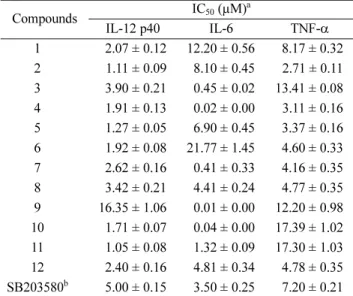
50values of 5.00 ± 0.15, 3.50 ± 0.25, and 7.20 ± 0.21 μM, respectively (Table 2).Of the tested compounds, 1 - 8 and 10 - 12 inhibited IL-12p40 produc- tion more strongly than SB203580, with IC
50values of 3.0 µM or less (Table 2). The variability in inhibition of the inflammatory response by 1 - 8 and 10 - 12 may be explained by the different levels of secreted inammatory factors following LPS stimulation. Compound 6 (a cycloartane-type triterpenoid) strongly inhibited LPS- stimulated IL-12p40 production (IC
50= 1.92 μM), at a level comparable to that of SB203580 (IC
50= 5.00 μM), while the inhibitory effect of compound 9 on IL-12p40 production was moderate (IC
50= 16.35 μM). When the sugar unit at C-3 of the aglycone in compound 9 was linked to a xylose chain, the effect was weaker than that of compound 6, suggesting that a hydroxyl group at position C-3 of aglycone is an important functional element.
Regarding IL-6, the methanol extract, dichloromethane- soluble fraction, and water layer strongly inhibited LPS- stimulated IL-6 production (IC
50s= 1.21, 0.07, and 24.00
Table 1. Anti-inflammatory effects of extract and fractions on LPS-stimulated bone marrow-derived dendritic cells
Extract and fractions IC
50( μg/mL)
aIL-12 p40 IL-6 TNF- α
Extract Methanol 2.45 ± 0.12 1.21 ± 0.03 22.00 ± 1.21
Fractions Dichloromethane 6.82 ± 0.31 0.07 ± 0.00 11.62 ± 0.32
Water 2.43 ± 0.34 24.00 ± 1.02 2.98 ± 0.15
SB203580
b5.00 ± 0.15 3.50 ± 0.25 7.20 ± 0.21
a
The inhibitory effects are represented as giving 50% inhibition (IC
50) relative to the vehicle control. These data represent the average val- ues of three repeated experiments (mean ± SD). IC
50values for selected extracts are given in column IL-12 p40, IL-6 and TNF-α. Values
< 25 μM are considered to be active.
b
SB203580 was used as a positive control.
μg/mL, respectively). Of the tested compounds, 3, 4, 7, and 9 - 11 exerted greater inhibitory effects than SB203580 on IL-6 production with IC
50values of 0.45, 0.023, 0.41, 0.01, 0.04, and 1.32 μM, respectively (Table 2). This variability in the inhibition of the inflammatory response by 3, 4, 7, and 9 - 11 may be explained by the secretion of different levels of inflammatory factors upon LPS stimu- lation.
Overexpression of the pro-inflammatory cytokines TNF- α and IL-6 is associated with the development of autoimmune, inflammatory, and immunopathological di- seases. Therefore, blocking TNF- α, IL-6, and their respective signaling pathways might be effective in the treatment of inflammatory diseases. Our results indicated that the water layer inhibited LPS-stimulated TNF- α production (IC
50= 2.98 μg/mL). Notably, compounds 2, 4 - 8, and 12 strongly inhibited TNF- α production (IC
50s= 2.71, 3.11, 3.37, 4.60, 4.16, 4.77, and 4.78 μM, respectively;
Table 2). Nevertheless, the water layer was more active than these compounds (2, 4 - 8, and 12), suggesting the presence of other active derivatives that acted individually or synergistically with the isolated cycloartane-type deri- Fig. 1. Structures of compounds 1 - 12 isolated from C. dahurica.
Table 2. Anti-inflammatory effects of compounds on LPS- stimulated bone marrow-derived dendritic cells
Compounds IC
50(µM)
aIL-12 p40 IL-6 TNF- α
1 2.07 ± 0.12 12.20 ± 0.56 8.17 ± 0.32 2 1.11 ± 0.09 8.10 ± 0.45 2.71 ± 0.11 3 3.90 ± 0.21 0.45 ± 0.02 13.41 ± 0.08 4 1.91 ± 0.13 0.02 ± 0.00 3.11 ± 0.16 5 1.27 ± 0.05 6.90 ± 0.45 3.37 ± 0.16 6 1.92 ± 0.08 21.77 ± 1.45 4.60 ± 0.33 7 2.62 ± 0.16 0.41 ± 0.33 4.16 ± 0.35 8 3.42 ± 0.21 4.41 ± 0.24 4.77 ± 0.35 9 16.35 ± 1.06 0.01 ± 0.00 12.20 ± 0.98 10 1.71 ± 0.07 0.04 ± 0.00 17.39 ± 1.02 11 1.05 ± 0.08 1.32 ± 0.09 17.30 ± 1.03 12 2.40 ± 0.16 4.81 ± 0.34 4.78 ± 0.35 SB203580
b5.00 ± 0.15 3.50 ± 0.25 7.20 ± 0.21
a
The inhibitory effects are represented as giving 50% inhibition (IC
50) relative to the vehicle control. These data represent the average values of three repeated experiments (mean ± SD). IC
50values for selected extracts are given in column IL-12 p40, IL-6 and TNF- α. Values < 25 μM are considered to be active.
b