Photobacterium damselae subsp. damselae (Pdd) is an important pathogen in various marine organisms and is a strong histamine producer that causes histamine fish poisoning in humans. We sequenced the genome of Pdd strain KC-Na-NB1, isolated from a narrow-ridged finless porpoise (Neophocaena asiaeorientalis).
The genome of the KC-Na-NB1 strain was 4,522,546-bp long (G + C content = 40.1%), comprising two chromosomes and five plasmids. Within this genome, we found virulence-associated genes and gene clusters associated with histamine production (i.e., histidine/histamine antiporter, pyridoxal phosphate-dependent histidine decarboxylase, and histidyl-tRNA synthetase), suggesting a strong potential to cause zoonotic infections and histamine fish poisoning. This work furthers our understanding of risk factors for histamine fish poisoning caused by Pdd and provides insights into microbial diversity in cetaceans.
Keywords: Photobacterium damselae, cetaceans, histamine poisoning, histidine decarboxylase
Histamine fish poisoning (or scombroid poisoning) is a foodborne disease that results from the consumption of histamine- contaminated fish (Hungerford, 2010). The number of cases is underreported, presumably because its allergy-like symptoms can be misdiagnosed as IgE-mediated fish allergy (Taylor et al., 1989). The pathological mechanism for histamine fish poisoning is complex and not entirely known; however, the causal factor is an elevated histamine level from histamine- forming bacteria in fish with high free histidine content (Kanki et al., 2007). Recently, various bacterial species possessing histidine decarboxylase, which has the potential to convert free histidine to histamine, have been reported to be associated with
Korean Journal of Microbiology (2020) Vol. 56, No. 4, pp. 397-400 pISSN 0440-2413
DOI https://doi.org/10.7845/kjm.2020.0091 eISSN 2383-9902
Copyright ⓒ 2020, The Microbiological Society of Korea
Complete genome sequence of Photobacterium damselae subsp.
damselae KC-Na-NB1, a potential histamine producer isolated from finless porpoise (Neophocaena asiaeorientalis)
Subin Yoon
1,2†, Yuna Cho
3†, Kyunglee Lee
3, Se Ra Lim
1, Seon Young Park
1, Hyemin Kwon
1, Ye Seul Lee
1, Jee Eun Han
4, and Ji Hyung Kim
1*
1
Infectious Disease Research Center, Korea Research Institute of Bioscience and Biotechnology, Daejeon 34141, Republic of Korea
2
College of Pharmacy, Seoul National University, Seoul 08826, Republic of Korea
3
Cetacean Research Institute, National Institute of Fisheries Science, Ulsan 44780, Republic of Korea
4
Laboratory of Aquatic Biomedicine, College of Veterinary Medicine, Kyungpook National University, Daegu 41566, Republic of Korea
상괭이(Neophocaena asiaeorientalis) 유래 잠재적 히스타민 생성능을 지닌 Photobacterium damselae subsp. damselae KC-Na-NB1 균주의 전장 유전체 분석
윤수빈
1,2†・ 조유나
3†・ 이경리
3・ 임세라
1・ 박선영
1・ 권혜민
1・ 이예슬
1・ 한지은
4・ 김지형
1*
1
한국생명공학연구원,
2서울대학교 약학대학,
3국립수산과학원 고래연구센터,
4경북대학교 수의학과
(Received September 16, 2020; Revised October 21, 2020; Accepted October 21, 2020)
†
These authors contributed equally to this work.
*For correspondence. E-mail: [email protected];
Tel.: +82-42-879-8272; Fax: +82-42-879-8498
398 ∙ Yoon et al.
미생물학회지 제56권 제4호
histamine fish poisoning (Björnsdóttir-Butler et al., 2009, 2010).
Among these, Photobacterium damselae subsp. damselae (Pdd) and P. phosphoreum are considered to be strong histamine producers in seafood (Tsai et al., 2004; Trevisani et al., 2017).
Originally, Pdd was considered a primary pathogen in various marine ectotherms, such as fish, sea turtles, mollusks, and crustaceans (Moi et al., 2017). However, the species is now generally recognized as a causative agent of emerging infectious diseases in marine mammals, including cetaceans, and is one of the most important marine zoonotic pathogen responsible for clinical infections (Rivas et al., 2013b).
Since 2016, we have investigated the emergence of Pdd that can colonize and establish infections in marine mammal species present in the coastal waters of South Korea, and we first reported its complete genome in 2018 (Lee et al., 2018). Herein, we present the complete genome of a novel Pdd strain (KC-Na- NB1) that originated from a wild cetacean and has histamine- producing potential.
The strain KC-Na-NB1 was isolated from the blowhole swab of a fresh carcass of an adult male narrow-ridged finless porpoise (Neophocaena asiaeorientalis, voucher no. CRI007124) found bycaught from net fisheries in 2017 along the East Sea (Republic of Korea). The isolate was then cultured on 5% sheep blood agar (BA, Hanil Komed) at 37°C. The non-luminescent and β-hemolytic isolate showed > 99% 16S rRNA identity with P. damselae strains available in the GenBank database, including ATCC 33589
T(NR_040831.1). Moreover, due to its cultivability at 37°C and hemolysis on BA (Rivas et al., 2013a, 2013b), the isolate was further classified as subspecies damselae. Genomic DNA was extracted as previously described (Lee et al., 2018) and sequenced using a hybrid approach with the PacBio RS II system (Pacific Biosciences), by constructing a 20 kb SMRTbell
TMtemplate library with paired-end Illumina short-read data, using a HiSeq 2000 instrument (Illumina). Genome assembly of the filtered PacBio reads (1,093,126,818 bp; 116,664 reads) was performed using the HGAP (v3.0) pipeline, and the Illumina paired-end 150 bp reads (1,006,923,359 bp, 9,975,286 reads) were mapped using BWA-MEM (v0.7.15). Errors were corrected using Pilon (v1.21) with default parameters. Annotation was performed using the NCBI Prokaryotic Genome Annotation Pipeline (http://www.ncbi.nlm.nih.gov/books/NBK174280/).
The KC-Na-NB1 genome comprised 4,522,546 bp, including
two chromosomes (chromosome I: 3,125,062 bp with 41.6% G + C content, 171 × coverage; chromosome II: 1,098,614 bp with 39.3% G + C content, 170 × coverage) and five plasmids (pFPPDNB1-1: 75,779 bp with 39.4% G + C content, 943 × coverage; pFPPDNB1-2: 73,113 bp with 38.8% G + C content, 368 × coverage; pFPPDNB1-3: 72,374 bp with 40.4% G + C content, 234 × coverage; pFPPDNB1-4: 65,678 bp with 39.2%
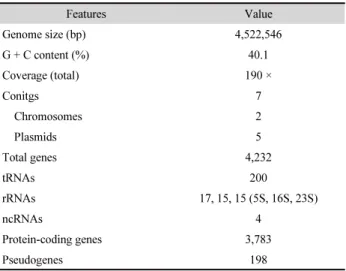
G + C content, 335 × coverage; pFPPDNB1-5: 11,926 bp with 37.1% G + C content, 378 × coverage), encoding 3,783 CDS, 47 rRNAs, 200 tRNAs, and 4 non-coding RNAs (Table 1).
Genomic similarity between KC-Na-NB1 and other Pdd strains was assessed using the average nucleotide identity (ANI) calculator (Yoon et al., 2017), and the genome showed a relatively high ANI value (97.8%) to the type strain of Pdd, ATCC 33589
T(PYOG00000000.1). Among previously reported major virulence factors in Pdd (Osorio et al., 2018), strain KC-Na-NB1 encoded phospholipase (plpV) (locus_tag: ETN89_
14005) in chromosome I. Moreover, this strain possessed the largest number (n = 5) of plasmids among the sequenced Pdd genomes in the GenBank database. Among these plasmids, one gene homologous to Vibrio thermostable direct hemolysin (>
80% amino acid identity), which is one of the major virulence factors associated with hemolysis and cytotoxicity in human pathogenic Vibrio spp. (Letchumanan et al., 2014), was found to be encoded on plasmid pFPPDNB1-3.
The chromosome I-encoded gene cluster composed of three continuous open reading frames identified as histidine/histamine
Table 1. Genomic features of Photobacterium damselae subsp. damselae strain KC-Na-NB1
Features Value
Genome size (bp) 4,522,546
G + C content (%) 40.1
Coverage (total) 190 ×
Conitgs 7
Chromosomes 2
Plasmids 5
Total genes 4,232
tRNAs 200
rRNAs 17, 15, 15 (5S, 16S, 23S)
ncRNAs 4
Protein-coding genes 3,783
Pseudogenes 198
Genome of Photobacterium damselae subsp. damselae ∙ 399
Korean Journal of Microbiology, Vol. 56, No. 4 antiporter (locus_tag: ETN89_02770), pyridoxal phosphate-
dependent histidine decarboxylase (locus_tag: ETN89_02775), and histidyl-tRNA synthetase (locus_tag: ETN89_02780), and its deduced amino acids were almost identical (> 99%) to those functionally confirmed genes in Pdd ATCC 51805 (Kimura et al., 2009). Although whaling and trading of cetaceans is currently banned by the Korean government, N. asiaeorientalis has been consumed as whale meat, and some illegal and unregulated processing of porpoise meat is suspected (Baker et al., 2006;
Lee et al., 2019). Based on the findings of this study, the meat of N. asiaeorientalis might be contaminated by Pdd, which possesses histidine decarboxylase, with the potential to cause histamine fish poisoning in consumers. The genome of Pdd KC-Na-NB1 will provide important insights into the microbial diversity in cetaceans and valuable information for improving control strategies against histamine fish poisoning, and the zoonotic marine pathogen itself.
Nucleotide sequence accession numbers
The Pdd strain KC-Na-NB1 was deposited at the Korean Culture Center of Microorganisms under KCCM 90345. The complete genome sequences of PDD strain KC-Na-NB1 have been deposited in GenBank under accession numbers CP035457.1 (chromosome I), CP035458.1 (chromosome II), CP035459.1 (pFPPDNB1-1), CP035460.1 (pFPPDNB1-2), CP035461.1 (pFPPDNB1-3), CP035462.1 (pFPPDNB1-4), and CP035463.1 (pFPPDNB1-5).
적 요
Photobacterium damselae subsp. damselae (Pdd)는 수상생 물에서 과도한 히스타민을 생성하여 해당 균에 오염된 수산물 을 섭취한 사람에게 히스타민 식중독(스콤브로이드 중독)을 일 으킬 수 있다. 본 연구에서는 국내에서 포획된 야생 상괭이에서 분리된 잠재적 히스타민 중독 유발 Pdd KC-Na-NB1 균주의 전 장 유전체를 분석하였다. 2개의 염색체와 5개의 플라스미드로 구성된 KC-Na-NB1 균주의 유전체 크기는 총 4,522,546 bp이 며, G + C 함량은 40.1%이다. 본 유전체 분석으로 병독성 관련 유전자와 histidine/histamine antiporter, pyridoxal phosphate- dependent histidine decarboxylase, histidyl‐tRNA synthetase 로 구성된 유전자군이 확인되었으며, 이는 해당 균주가 히스
타민 식중독과 같은 인수공통 감염증을 유발할 가능성이 큼을 시사한다. 본 연구 결과는 사람에게 히스타민 식중독을 유발 할 수 있는 잠재적 위험 인자와 상괭이 내 미생물 다양성을 이 해하는 데에 기여할 것이다.
Acknowledgments
This research was funded by the KRIBB Initiative programs, the National Research Foundation (NRF) of Korea (NRF- 2020R1I1A2068827), and the National Institute of Fisheries Science (R2020024) of the Ministry of Oceans and Fisheries in Republic of Korea.
References