학교생활 안전사고 예방을 위한 시설 개선 방향에 관한 연구
- 경기도 초‧중‧고등학교를 중심으로 -
A Study on Improving Facility Standards for School Safety Accident Prevention
- Focus on Schools in Gyeonggi-do -
양 형 모* 이 재 림**
Yang, Hyeong-Mo Lee, Jae-Rim
Abstract
The majority of school accidents occur due to negligence caused by the student. And there are many accidents caused by inadequate facilities and poor. In order to improve the facilities, a lot of improvement in student life facilities will be preceded conscious about the sense of safety, than the budget. If schools member have a risk recognition through safety training and ongoing attention of all experience-oriented, the occurrence of accidents is significantly reduced. it is needed continuous attentions and careful efforts to improve school facilities. The results were as follows.
First, check for accident prevention and the improvement of the school facilities should be made immediately.
Second, we need to redefine the standards facilities for school safety accident prevention.
Third, the management program is needed to prevented school accident.
Fourth, the Hazard identification and risk assessment training is needed.
키워드:학교안전, 학교생활환경, 위험성평가, 안전교육
Keywords:School safety, School Environment, Risk assessment, Safety education
1. 서론
1)1.1 연구목적
세월호 참사이후 교육당국의 안전종합 대책의 강화에도 불구하고 2014년 전국 유치원‧초·중·고등학교 등에서 발생 한 안전사고는 2013년보다 11% 증가한 것으로 나타났다.
1)* Ph.D. Candidate Dept of educational policy, KNUE., Korea
** Professor, Ph.D., Dept. of educational policy, KNUE., Korea Corresponding Author,
Tel: 82-43-230-3445, E-mail: [email protected] 1) 국회 교육문화체육관광위원회 소속 새누리당 강은희 의원(비
례)은 교육부에서 받은 ‘2013~2014 학교안전사고 발생 현황’을 분석한 결과 2014년 유치원, 초·중·고등학교, 특수학교 등에서 발생한 안전사고가 11만6527건으로 집계됐다고 2015년 4월5일 밝혔다. 이는 2013년(10만5088건)보다 1만1439건(10.9%) 증가 한 수치다.
학교에서 발생하는 사고의 유형은 다양하지만 미끄러짐, 충돌 등과 같은 개인의 부주위로 인한 사고가 많기 때문 에 학교에서의 지속적인 안전교육과 안전프로그램을 통한 사고예방 교육은 매우 중요하다. 학생들의 주의력과 위험 인지 능력을 배양하는 교육을 통해서 직접적이고 체득적 인 체험형 안전교육은 학교에서 일어나는 사고를 상당수 줄일 수 있을 것이다. 또한 학교시설 설계‧시공의 낙후성 으로 인하여 발생하는 안전사고도 많기 때문에 학교 시설 부분에 대한 보수와 개선은 지속적으로 이루어져야 한다.
학교 건물의 구조적 점검은 정기적으로 이루어지지만 학
생들이 생활하는 생활시설에 대해서는 무관심한 경우가
많다. 학교에서 주로 발생하는 학생 안전 사고와 손상은
건축물의 구조체적 요인보다는 생활시설면에서 많이 발생
하기 때문에 학생들의 생활 공간에 대한 세심한 점검과
Objective of Research
Improving school facilities proposed for accident prevention
▲ Analysis of results
∙Schools of analysis result
∙Items of analysis result
▲ Survey
∙Research : 19 schools in Gyeonggi-do
∙Survey areas : Seongnam (5 schools), Gwangju (two schools), Pyeongtaek (2 schools), Osan (1 schools), hwaseong (2 schools), Gunpo (Opening 1), Suwon (2 schools), Ansan (two schools), Anyang (2 schools)
∙Survey information : Checking facilities for school safety accident prevention
▲
School Accidents Analysis & Create a Checklist
∙Current status of school safety accidents Cause/location/type of accident
∙Create a Checklist for school safety accident prevention : 8 fields 75 items school zone, Classroom (floor, walls, windows and doors), special classes (science room), corridor, stairs, toilets, outside the building, playground and sport outfits
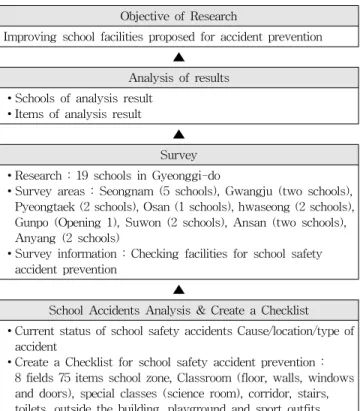
Figure 1. Research Systems(연구 체계도)
위험을 줄이기 위한 개선 노력이 필요하다.
이러한 맥락에서 본 연구는 학교생활 중 미흡한 시설에 서 발생할 수 있는 학생들의 손상과 사고를 예방하기 위 해 학교생활 안전사고 예방을 위한 시설 개선 방안을 제 시하고자 한다.
1.2 연구범위 및 방법
본 연구의 범위는 경기도의 19개 초‧중‧고등학교를 대 상으로 하였다.
본 연구의 연구 방법은 다음과 같다.
첫째, 선행연구자료를 통해 학교에서 발생한 안전사고를 분석하여 사고발생원인과 사고발생장소, 사고 발생 형태를 확인한다. 이를 통해 기존의 학교시설안전관리기준에 학교 생활 중 안전 사고가 발생할 수 있는 시설을 추가하여 학 교생활 안전사고 예방을 위한 안전관리기준안을 작성한다.
둘째, 조사 대상 학교를 현장 방문 조사하여 작성한 안 전관리기준안에 의해 학교 생활 안전 사고 발생 가능성이 높은 시설을 조사하고 점검한다.
셋째, 학교생활 안전사고 예방을 위한 안전관리기준안을 적용한 점검결과를 학교별 위험성평가와 항목별 위험성평 가로 분류하여 학교생활시설에서의 안전사고를 예방하고 줄일 수 있는 학교생활 안전사고 예방을 위한 시설 개선 방향을 제시한다.
이상과 같은 연구과정을 도식화 하면 그림. 1의 연구체 계도와 같다.
1.3 용어설명
∙학교생활시설 : 학교에서 학생들이 실생활을 하면서 사용하는 공간과 시설물을 말한다. 본 연구에서는 교 실, 복도, 계단, 화장실, 특별교실, 학교건물주위, 운동 장과 체육놀이시설 등 학생들이 학교에서 일상적으로 생활하는 공간과 시설물을 지칭한다.
∙위험성평가 : 위험을 찾아 내고(위험발굴, Hazard identification) 사전에 그것이 어느 정도 위험한 것인 지를 평가하고 그 평가의 크기에 따라 확실하게 대책 을 수립하는 것으로 본 연구에서는 위험발굴을 통한 위험지수의 크기를 척도화한 개념으로 접근한다.
2. 학교생활 안전사고 현황‧유형‧내용
성장기에 있는 청소년들은 신체적 발달의 특성으로 매 우 활동적이다. 청소년들이 많은 시간을 보내며 생활하는 학교는 그러한 측면에서 봤을 때 사고의 위험이 가장 높 은 장소이기도 하다. 학생들의 이러한 불안전한 행동에 의 한 사고를 예방하기 위해서는 미흡한 시설적 보완과 개선 도 함께 이루어져야 한다. 학생들이 주로 생활하며 머무는 학교생활시설의 위험요소에 대해 선행연구 자료를 통해 안전사고 유형과 내용, 대책방향을 고찰하였다.
2.1 학교 안전사고 현황
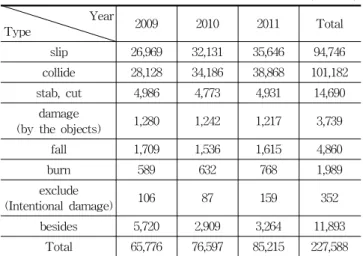
학교는 제한된 공간에서 여러 구성원이 함께 모여 생활 하며 다양한 활동이 이루어지는 공동체 공간이다. 항상 크 고 작은 사고의 위험이 존재하며, 실제로 많은 안전사고가 발생하고 있다. 학교에서 발생하는 사고의 유형은 다양하 지만 학생 개인의 미끄러짐, 충돌 등과 같은 부주위로 인 한 학생의 불안전한 행동에 의한 사고가 가장 많다(Table 1). 학교 안전공제회 자료에 의하면 70%이상의 사고가 학 생의 부주의로 인해 발생한다.
2)사고가 가장 많이 발생하 는 시간은 Table 2. 에서 보는 바와 같이 휴식시간>체육 수업>과외수업 순이다.
또한 학교안전사고 발생현황을 장소별로 구분하여 살펴 보면 가장 많은 사고가 발생하는 장소는 운동장으로 41.55%,
2) 학교안전공제회자료(2006~2008)에 의하면 학생부주의 사고 비율은 2006년 29,124건 76.6%, 2007년 32,472건 78.9%, 2008 년 43,066건 88.7%.으로 나타났다.
Table 1. Status of Accident cause type3)
(unit: ea) Year
Type 2009 2010 2011 Total
slip 26,969 32,131 35,646 94,746
collide 28,128 34,186 38,868 101,182
stab, cut 4,986 4,773 4,931 14,690
damage
(by the objects) 1,280 1,242 1,217 3,739
fall 1,709 1,536 1,615 4,860
burn 589 632 768 1,989
exclude
(Intentional damage) 106 87 159 352
besides 5,720 2,909 3,264 11,893
Total 65,776 76,597 85,215 227,588
Table 3. Status of Place of accident5)
(unit: ea)
Place Count Rate(%)
classroom 17,598 16.70
corridor/stairs 17,664 16.77
accessory structures 20,114 19.09
playg round 43,775 41.55
outside 5,919 5.62
etc facility 283 0.27
Total 105,353 100
부속시설(화장실, 급식실, 강당, 기숙사, 주차장 , 도서실 등) 19.09%, 통로(복도, 계단, 출입문, 현관 등) 16.77%, 교실 16.70%로 나타났다(Table 3).
Table 2. Status of Hourly accidents(Seoul)4)
(unit: ea) Year
Content 2010 2011 2012 2013 Total
Class time
Curriculum
Classes 862 1026 1130 1040 4,058
Physical
education 2,376 2415 3447 3608 11,846
afterschool
classes 1,408 1451 2036 2255 7,150
rest time 2,628 2984 3625 3713 12,950
besides 726 840 791 811 23,054
Total 9,284 9,887 12,250 12,629 36,004
*과외수업 : 특별활동, 방과후수업, 현장학습, 소풍, 수학여행, 수련활동 등 기타 : 청소시간, 등하교시간, 교육활동 전후 통상적인 학교체류시간 등
3) 질병관리본부, 국가손상종합통계, 2009-2011
4) 송효근, 통계로 본 학교안전사고 현황, 서울학교안전공제회, 교 육정책포럼 통권254 p41, 2014.
5) 덕성여자대학교 스포츠과학연구원, 학교안전사고 통계분석 및 예방정책 수립 방안 연구, 2014.
2.2 학교 시설 유형분류에 따른 안전사고 내용‧원인‧대책 방향
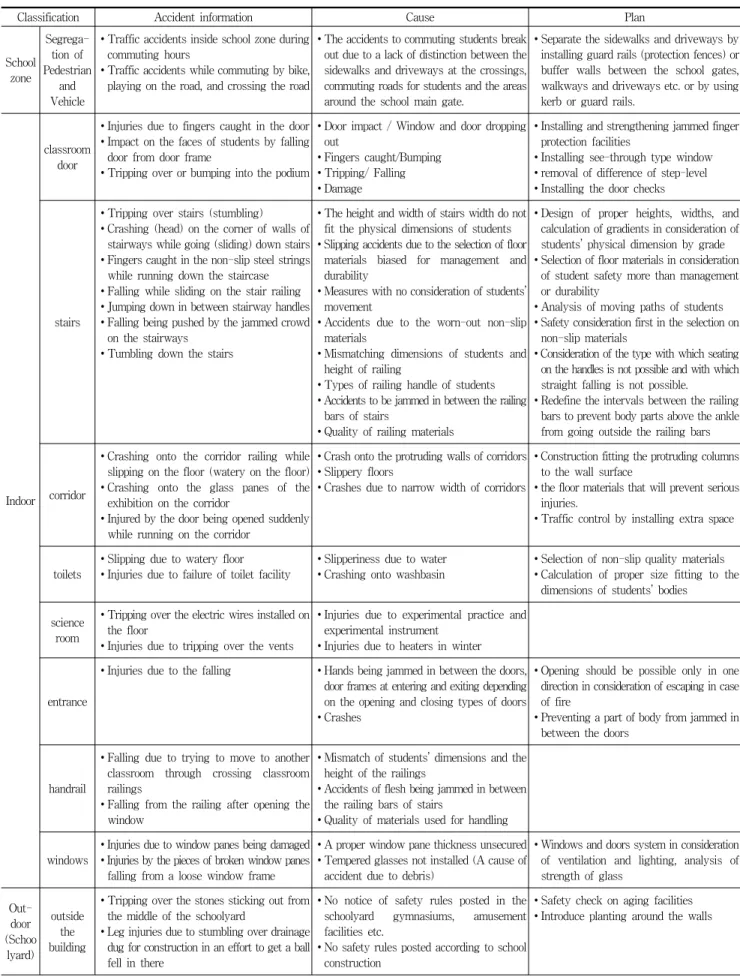
학교 시설 설계 안전 매뉴얼 개발 연구(교육인적자원부, 2003)와 안전한 학교모형에 관한 연구(유재두, 2012)를 통 해 살펴본 학교안전사고에 대한 주요 내용과 원인, 대책방 향은 Table 4와 같다.
학교시설 안전 사고 발생장소는 크게 통학로와 교내, 교 외로 구분할 수 있다. 더불어 발생손상의 내용은 등하교시 스쿨존(School Zone) 내 교통사고, 자전거 등하교, 교통사 고 등과 같은 통학로에서 발생하는 손상과 교실, 운동장, 복도, 계단, 출입문‧현관, 화장실 등에서 발생하는 교내 손 상, 학교주변과 운동장에서 발생하는 교외 손상 등으로 분 류할 수 있다. Table 4에서 보는 바와 같이 대부분의 학 교 안전 사고는 교실에서의 손끼임, 부딪힘, 넘어짐, 난간 에서의 추락(난간), 유리창의 파손, 복도에서의 부딪힘과 걸려 넘어짐, 계단에서의 미끄러져 넘어짐, 떨어짐, 현관출 입부분에서 동시에 많은 학생의 이동에 의한 넘어짐, 화장 실바닥의 미끄러움과 시설불량, 운동장에서의 (걸려)넘어 짐, 외부시설 불량 등에 의한 것으로 나타났다. 지속적이 고 반복적인 체험위주의 안전교육은 매우 중요하며 위험 상황이나 위험요소에 대해 학생들이 위험성을 인식하면서 사고를 피할 수 있도록 하는 능력도 매우 필요하다. 더불 어 시설환경적 측면에서 보다 세심한 점검과 개선을 통해 위해(危害)요인을 사전에 제거하는 것이 매우 중요하다.
3. 학교생활 안전사고 예방을 위한 안전관리기준
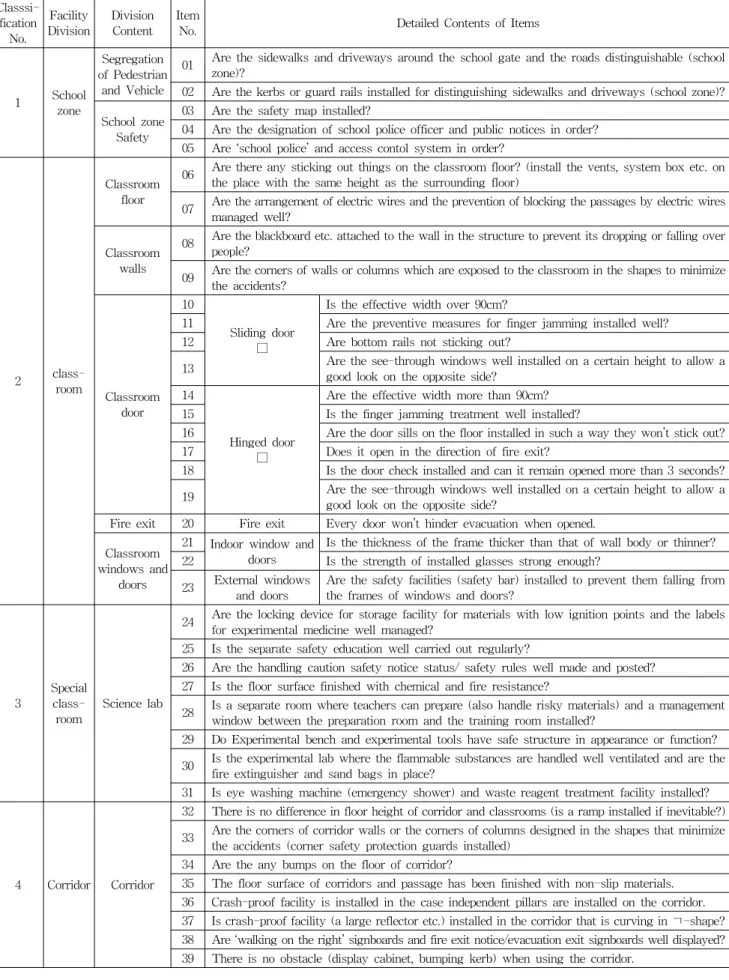
3.1 안전관리기준안 내용 구성
학교생활시설에서의 안전사고를 예방하고 학교생활시설 개선 방향을 추출할 수 있는 항목으로 Table 5와 같이 구 성하였다. 점검항목 구성은 학교시설안전관리기준(학교안 전사고예방및보상에관한법률 제10조제1항관련)의 건축물 부분 기준과 실내건축 구조‧시공방법에 관한 기준 (국토 교통부공고 제2015-110호)을 참고로 하여 재구성하였다.
학교에서 발생하는 학생 사고 유형 및 사고 발생 장소 분 석을 통해 사고 발생 위험성이 많은 요인들을 포함하여 수정․보완하였다.
항목별, 학교별 분석은 평가기준과 평가점수에 따라 객
관적인 계량화를 시도하였으며 평가 요소별 평가점수를
비교‧분석하여 학교생활 안전사고예방을 위한 시설 개선
방향을 제시하고자 하였다.
Table 4. Accident information‧Causes‧Plan by School Facility Category
Classification Accident information Cause Plan
School zone
Segrega- tion of Pedestrian
and Vehicle
∙Traffic accidents inside school zone during commuting hours
∙Traffic accidents while commuting by bike, playing on the road, and crossing the road
∙The accidents to commuting students break out due to a lack of distinction between the sidewalks and driveways at the crossings, commuting roads for students and the areas around the school main gate.
∙Separate the sidewalks and driveways by installing guard rails (protection fences) or buffer walls between the school gates, walkways and driveways etc. or by using kerb or guard rails.
Indoor
classroom door
∙Injuries due to fingers caught in the door
∙Impact on the faces of students by falling door from door frame
∙Tripping over or bumping into the podium
∙Door impact / Window and door dropping out
∙Fingers caught/Bumping
∙Tripping/ Falling
∙Damage
∙Installing and strengthening jammed finger protection facilities
∙Installing see-through type window
∙removal of difference of step-level
∙Installing the door checks
stairs
∙Tripping over stairs (stumbling)
∙Crashing (head) on the corner of walls of stairways while going (sliding) down stairs
∙Fingers caught in the non-slip steel strings while running down the staircase
∙Falling while sliding on the stair railing
∙Jumping down in between stairway handles
∙Falling being pushed by the jammed crowd on the stairways
∙Tumbling down the stairs
∙The height and width of stairs width do not fit the physical dimensions of students
∙Slipping accidents due to the selection of floor materials biased for management and durability
∙Measures with no consideration of students’
movement
∙Accidents due to the worn-out non-slip materials
∙Mismatching dimensions of students and height of railing
∙Types of railing handle of students
∙Accidents to be jammed in between the railing bars of stairs
∙Quality of railing materials
∙Design of proper heights, widths, and calculation of gradients in consideration of students’ physical dimension by grade
∙Selection of floor materials in consideration of student safety more than management or durability
∙Analysis of moving paths of students
∙Safety consideration first in the selection on non-slip materials
∙Consideration of the type with which seating on the handles is not possible and with which straight falling is not possible.
∙Redefine the intervals between the railing bars to prevent body parts above the ankle from going outside the railing bars
corridor
∙Crashing onto the corridor railing while slipping on the floor (watery on the floor)
∙Crashing onto the glass panes of the exhibition on the corridor
∙Injured by the door being opened suddenly while running on the corridor
∙Crash onto the protruding walls of corridors
∙Slippery floors
∙Crashes due to narrow width of corridors
∙Construction fitting the protruding columns to the wall surface
∙the floor materials that will prevent serious injuries.
∙Traffic control by installing extra space
toilets
∙Slipping due to watery floor
∙Injuries due to failure of toilet facility
∙Slipperiness due to water
∙Crashing onto washbasin
∙Selection of non-slip quality materials
∙Calculation of proper size fitting to the dimensions of students’ bodies
science room
∙Tripping over the electric wires installed on the floor
∙Injuries due to tripping over the vents
∙Injuries due to experimental practice and experimental instrument
∙Injuries due to heaters in winter
entrance
∙Injuries due to the falling ∙Hands being jammed in between the doors, door frames at entering and exiting depending on the opening and closing types of doors
∙Crashes
∙Opening should be possible only in one direction in consideration of escaping in case of fire
∙Preventing a part of body from jammed in between the doors
handrail
∙Falling due to trying to move to another classroom through crossing classroom railings
∙Falling from the railing after opening the window
∙Mismatch of students’ dimensions and the height of the railings
∙Accidents of flesh being jammed in between the railing bars of stairs
∙Quality of materials used for handling
windows
∙Injuries due to window panes being damaged
∙Injuries by the pieces of broken window panes falling from a loose window frame
∙A proper window pane thickness unsecured
∙Tempered glasses not installed (A cause of accident due to debris)
∙Windows and doors system in consideration of ventilation and lighting, analysis of strength of glass
Out- door (Schoo
lyard) outside
the building
∙Tripping over the stones sticking out from the middle of the schoolyard
∙Leg injuries due to stumbling over drainage dug for construction in an effort to get a ball fell in there
∙No notice of safety rules posted in the schoolyard gymnasiums, amusement facilities etc.
∙No safety rules posted according to school construction
∙Safety check on aging facilities
∙Introduce planting around the walls
Classsi- fication No.
Facility Division
Division Content
Item
No. Detailed Contents of Items
1 School
zone
Segregation of Pedestrian
and Vehicle
01 Are the sidewalks and driveways around the school gate and the roads distinguishable (school zone)?
02 Are the kerbs or guard rails installed for distinguishing sidewalks and driveways (school zone)?
School zone Safety
03 Are the safety map installed?
04 Are the designation of school police officer and public notices in order?
05 Are ‘school police’ and access contol system in order?
2 class-
room
Classroom floor
06 Are there any sticking out things on the classroom floor? (install the vents, system box etc. on the place with the same height as the surrounding floor)
07 Are the arrangement of electric wires and the prevention of blocking the passages by electric wires managed well?
Classroom walls
08 Are the blackboard etc. attached to the wall in the structure to prevent its dropping or falling over people?
09 Are the corners of walls or columns which are exposed to the classroom in the shapes to minimize the accidents?
Classroom door
10
Sliding door
□
Is the effective width over 90cm?
11 Are the preventive measures for finger jamming installed well?
12 Are bottom rails not sticking out?
13 Are the see-through windows well installed on a certain height to allow a good look on the opposite side?
14
Hinged door
□
Are the effective width more than 90cm?
15 Is the finger jamming treatment well installed?
16 Are the door sills on the floor installed in such a way they won’t stick out?
17 Does it open in the direction of fire exit?
18 Is the door check installed and can it remain opened more than 3 seconds?
19 Are the see-through windows well installed on a certain height to allow a good look on the opposite side?
Fire exit 20 Fire exit Every door won’t hinder evacuation when opened.
Classroom windows and
doors
21 Indoor window and doors
Is the thickness of the frame thicker than that of wall body or thinner?
22 Is the strength of installed glasses strong enough?
23 External windows and doors
Are the safety facilities (safety bar) installed to prevent them falling from the frames of windows and doors?
3
Special class-
room
Science lab
24 Are the locking device for storage facility for materials with low ignition points and the labels for experimental medicine well managed?
25 Is the separate safety education well carried out regularly?
26 Are the handling caution safety notice status/ safety rules well made and posted?
27 Is the floor surface finished with chemical and fire resistance?
28 Is a separate room where teachers can prepare (also handle risky materials) and a management window between the preparation room and the training room installed?
29 Do Experimental bench and experimental tools have safe structure in appearance or function?
30 Is the experimental lab where the flammable substances are handled well ventilated and are the fire extinguisher and sand bags in place?
31 Is eye washing machine (emergency shower) and waste reagent treatment facility installed?
4 Corridor Corridor
32 There is no difference in floor height of corridor and classrooms (is a ramp installed if inevitable?) 33 Are the corners of corridor walls or the corners of columns designed in the shapes that minimize
the accidents (corner safety protection guards installed) 34 Are the any bumps on the floor of corridor?
35 The floor surface of corridors and passage has been finished with non-slip materials.
36 Crash-proof facility is installed in the case independent pillars are installed on the corridor.
37 Is crash-proof facility (a large reflector etc.) installed in the corridor that is curving in ㄱ-shape?
38 Are ‘walking on the right’ signboards and fire exit notice/evacuation exit signboards well displayed?
39 There is no obstacle (display cabinet, bumping kerb) when using the corridor.
Table 5. CHECK LIST(Evaluation Standards)
Classsi- fication No.
Facility Division
Division Content
Item
No. Detailed Contents of Items
5 Stair-
case
Stair installment
40 Is the staircase in the shape of left rotating stair way in order to prevent bumping within the stairway?
41 Has the surface of the ramp been finished with materials not too rough or slippery?
Stair size 42 Is the height of each step even and proper?
43 Is the width of step board sufficiently broad?
Stair Landing 44 Is the width of stair landing at least 150cm?
Stair handrail
45 Are handrails installed on both sides of stairs and stair landing which are over 1m in height?
46 Are more than two handrails installed on each step board in the case the handrail is a vertical member? (horizontal member 15cm and below)l
47 Is the handle of the horizontal member installed as sticking outwardly at the end of the stairway?
48 Is the height of the stair handrail 85cm and above from the stairs?
49 Is the handle installed 5cm separated from the wall?
Safety handrail
50 Have the falling-proof etc. the structures over which it is hard for children to climb (longitudinal direction)?
51 Is the interval between the handrails 10cm and below, and the height 120cm and above (rooftop top floor)?
52 Has the auxiliary handle been installed in addition in consideration of body dimensions of users?
Non-slip/
non-sliding
53 Are non-slip pad and non-slip prevention installed?
54 Are non-slip pads in eye-catching bright or florescent color?
55 Is the non-sliding measure for stair handrail sliding installed?
6 toilets
Entrance.
Floor.
Comfort
56 Is the safety of toilets entrance secured?(see-through window secured etc.)
57 Are the toilets floor material (non-slip) and drainage structure (state of dryness) well installed?
58 Is the environment of the toilets comfortable and clean?
7
Outside of Building
Entrance
59 Are the finger jamming-proof measures well installed?
60 Is the front entrance ramp well installed?
61 Are umbrella holders installed in case of rain?
Passage 62 Are the risk factors removed?
Rooftop 63 Can the rooftop be used as a shelter?
64 Is there any obstacle on the access road to the rooftop?
Walkway 65 Are the walkways even and free of pondings?
Remote areas 66 Are the safety concern facilities in the remote areas (cctv, street light etc.) installed?
67 Are falling-proof facilities installed in the falling risk area?
Gutter/drain 68 Isn’t the safety cover for drainage sticking out? Is it clearly visible?
69 Are gutters and drainage well connected?
Risk awareness
70 Braille block installation (entrance, stairs, elevator) 71 Braille/Voice guide installation
8 Schoo-
lyard
Sports play facilities
72 Is the schoolyard even and void of pebbles?
73 Can the washbasin be approached safely?
74 Is the gymnastic facility safety guard installed?
75 Is the safety rule board installed?
4. 실태 조사
4.1 조사 개요
본 연구는 경기도의 9개 시
6)(市) 19개 초‧중‧고등학교
7)를 대상으로 진행되었으며 조사기간은 2015년 7월 20일부
6) 성남(5개교), 광주(2개교), 평택(2개교), 화성(2개교), 군포(1개 교), 수원(2개교), 안산(2개교), 안양(2개교), 김포(1개교) 7) 초등학교 10개교, 중학교 4개교, 고등학교 5개교
터 2015년 9월 15일까지 이루어졌다. 학생들이 많은 시간
을 보내며 생활하는 학교생활시설과 공간에 대해 현장 방
문하여 실태 점검을 하였다(조사 학교 22개교 중 특수학
교는 제외하였으며 단일공간의 사립 중․고등학교 2개교
는 중학교 통계에 포함시켰다). 점검 결과를 모든 학교의
실태로 보기에는 한계가 있으나 학교생활 안전사고 예방
을 위해 시설의 문제점과 개선 방향을 파악하기 위한 기
초 자료를 제공하는데 그 의미가 있다.
Classsi- fication
No.
Facility Division
Division Content
Item number
Risk- score
Risk- rate
Risk class
1 School
Zone
segregation of pedestrian
and vehicle
01 16 42.11 Ⅱ
02 22 57.89 Ⅱ
school zone safety
03 34 89.47 Ⅳ
04 24 63.16 Ⅲ
05 17 44.74 Ⅱ
2 Class-
room
classroom floor
06 0 0.00 Ⅰ
07 4 10.53 Ⅰ
classroom walls
08 0 0.00 Ⅰ
09 26 68.42 Ⅲ
classroom door
10 0 0.00 Ⅰ
11 6 23.08 Ⅰ
12 3 11.54 Ⅰ
13 9 34.62 Ⅰ
14 0 0.00 Ⅰ
15 16 66.67 Ⅲ
16 2 8.33 Ⅰ
17 18 75.00 Ⅲ
18 20 83.33 Ⅳ
19 14 58.33 Ⅱ
fire exit 20 0 0.00 Ⅰ
classroom windows and doors
21 0 0.00 Ⅰ
22 0 0.00 Ⅰ
23 4 10.53 Ⅰ
Table 9. Analysis table of Risk results
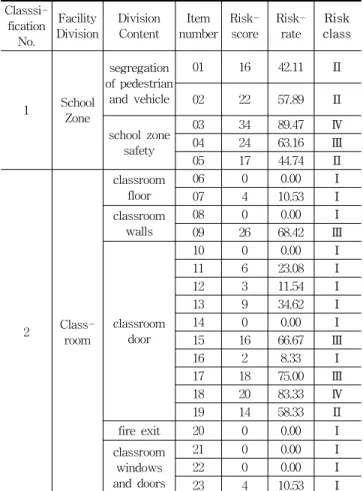
조사항목은 통학로, 교실(바닥, 벽, 문, 창호), 특별교실 (과학실), 복도, 계단, 화장실, 건물외부, 운동장 및 체육놀 이시설 등 8개 분야 75항목을 점수화하여 사고발생가능성 높음 2점, 사고발생가능성 있음 1점, 사고발생가능성 거의 없음 0점으로 척도화(Table 6)하여 학교별 획득점수와 항 목별 획득점수를 각각 백분율(만점대비)로 환원하여 위험 도 크기를 알아보았다. 항목별 위험도와 학교별 위험도는 점검항목의 안전여부에 대한 점검 결과로 점검내용의 이 행 정도를 의미한다.
Table 6. Check score of each item
Risk very-high medium very-low
Score 2 1 0
Table 7. Risk score of each item
Risk class Ⅳ Ⅲ Ⅱ Ⅰ
Risk above 80% under80%
~60%
under60%
~40%
under 40%
accident
occurrence very-high high low very-low
* 항목별위험도는 개별 항목에 대한 조사대상 학교의 위험도 점수 합 계 비율임(예, 01항목에 대해 조사대상 19개학교의 점수 합계가 16 점일 경우, [16/(19*2)]*100=42.11%
Table 8. Risk score of schools
Risk class 4 3 2 1
Risk above40% unde40%
~30%
unde30%
~20%
under 20%
Accident
occurrence very-high high low very-low
* 학교별위험도는 개별 학교의 점검 해당 항목수에 대한 위험도 점수 합계 비율(예, P1학교의 항목별 취득 점수가 55점, 점검항목수 75개 일 경우 [55/(75*2점)]*100=36.67%
4.2 학교생활시설 위험도평가 조사 분석 결과 1) 항목별 위험도 평가 결과
8개 영역 75개 항목에 대한 항목별 위험도 조사 결과는 Table 9, Table 10과 같다. 80%이상의 학교에서 이행하지 않고 있는 항목으로 위험도 크기가 Ⅳ단계인 항목은 9개로 나타났으며, 그 내용은 안전지도판 설치 여부(03), 여닫이문 의 도어체크 설치 및 3초 이상 열림 유지 여부(18), 복도 기 둥의 충돌방지 시설 설치(36), ㄱ자로 꺽이는 복도에 충돌방 지(대형 반사경 설치 등) 시설 설치여부(37), 사용자 신체치 수 고려한 보조 손잡이 설치 여부(52), 논슬립 패드의 시인 성(54), 계단 난간 미끄럼타기 방지 설치 여부(55), 운동장 체육놀이시설 안전수칙 게시판 설치여부(75)로 나타났다.
위험도크기 Ⅲ단계에 해당하는 항목은 8개이며 그 내용 은 전담경찰관 지정 및 공지 사항(04), 교실벽의 모서리나 기둥 모서리 등 안전사고 최소화형태 여부(09), 여닫이문
의 손끼임방지처리(15), 여닫이문의 피난방향으로의 개폐 여부(17), 특별교실의 눈세척기(비상샤워기) 설치와 폐시약 처리시설 설치여부(31), 계단난간의 손잡이 벽에서 5cm이 격 설치(49), 점자 및 음성안내도 설치여부(71), 운동장 체 육놀이시설 안전보호대 설치여부(74)로 나타났다.
위험도크기 Ⅱ단계에 해당하는 항목은 12개이며 그 내
용은 차량이 통행하는 교문 및 도로에 보행로와 차도의
구분(01), 보차구분을 위한 경계턱이나 가드레일 설치여부
(02), 배움터 지킴이 및 출입통제 여부(05), 여닫이문의 투
시창 설치여부(19), 복도벽 모서리나 기둥모서리 안전사고
최소화 형태여부(33), 우측보행표시 및 대피로 공지, 탈출
구 표시 이행여부(38), 계단 난간의 수직재인 경우 디딤판
한 단에 2개 이상 설치(수평재 15cm이하)여부(46), 난간간
격 10cm이하 높이 120cm이상(계단 최상층부)(51), 논슬립
패드 및 미끄럼방지 설치여부(53), 현관출입구 경사로 설
치여부(60), 출입구계단엘리베이터 점자블록 설치(70), 운
동장의 세면대 접근 안전여부(73) 등으로 나타났다. 위험
도크기 Ⅳ단계, Ⅲ단계, Ⅱ단계에 해당하는 29개 항목은
잠재적 위험성이 있기 때문에 세심하고 적극적인 시설 개
선 대책과 조치가 필요하다.
Classsi- fication No.
Facility Division
Division Content
Item number
Risk- score
Risk- rate
Risk class
3
Special class- room
science lab
24 1 5.00 Ⅰ
25 1 6.25 Ⅰ
26 1 5.56 Ⅰ
27 0 0.00 Ⅰ
28 1 5.56 Ⅰ
29 0 0.00 Ⅰ
30 5 25.00 Ⅰ
31 11 61.11 Ⅲ
4 Corridor corridor
32 0 0.00 Ⅰ
33 19 50.00 Ⅱ
34 1 2.63 Ⅰ
35 2 5.26 Ⅰ
36 12 85.71 Ⅳ
37 34 89.47 Ⅳ
38 19 50.00 Ⅱ
39 12 31.58 Ⅰ
5 Stair-
case
stair installment
40 5 13.16 Ⅰ
41 0 0.00 Ⅰ
stair size 42 1 2.63 Ⅰ
43 1 2.63 Ⅰ
stair landing 44 0 0.00 Ⅰ
stair handrail
45 10 26.32 Ⅰ
46 22 57.89 Ⅱ
47 2 5.26 Ⅰ
48 0 0.00 Ⅰ
49 24 63.16 Ⅲ
safety handrail
50 11 28.95 Ⅰ
51 21 55.26 Ⅱ
52 36 94.74 Ⅳ
non-slip/
non-sliding
53 20 55.56 Ⅱ
54 30 83.33 Ⅳ
55 32 84.21 Ⅳ
6 Toilets
entrance.
floor.
comfort
56 7 18.42 Ⅰ
57 0 0.00 Ⅰ
58 4 10.53 Ⅰ
7
Outside of Building
entrance
59 4 10.53 Ⅰ
60 16 42.11 Ⅱ
61 32 84.21 Ⅳ
passage 62 2 5.26 Ⅰ
rooftop 63 8 21.05 Ⅰ
64 2 5.26 Ⅰ
walkway 65 3 7.89 Ⅰ
remote areas 66 6 16.67 Ⅰ
67 7 23.33 Ⅰ
gutter/drain 68 7 18.42 Ⅰ
69 12 33.33 Ⅰ
risk awareness
70 19 50.00 Ⅱ
71 26 68.42 Ⅲ
8 School
yard
sports play facilities
72 4 10.53 Ⅰ
73 17 44.74 Ⅱ
74 29 76.32 Ⅲ
75 32 84.21 Ⅳ
Table 10. Risk results of each item
Risk class Ⅳ Ⅲ Ⅱ Ⅰ
Risk above 80% under80%
~60%
under60%
~40%
under 40%
Accident
occurrence very-high high low very-low
Count 9 8 12 46
그 외의 46항목에 대해서는 안전사고 발생율이 매우 낮 게 평가되어 대체적으로 안전사고 예방을 위한 시설 기준 에 부합되었다.
2) 학교별 위험도 조사 결과
학교생활 안전사고 예방을 위한 안전관리기준안의 8개 영역 75개 항목에 대한 학교별 위험도 조사 결과는 Table 11과 Table 12와 같다. 개별학교에 대해 75항목 조사 결 과에 의한 학교별 위험도 결과 사고발생 가능성이 매우 높음(위험도4)에 해당하는 학교는 6개교(P1, P4, M2, M4, H1, H3), 31.58%로 나타났다. 사고발생가능성이 높음(위험 도3)에 해당하는 학교는 4개교(P3, P7, H2, H4)로 26.32%
가 해당되었다. 사고발생가능성이 있음(위험도2)에 해당하 는 학교는 7개교(P2, P5, P6, P8, P9, M1, M3), 31.58%에 해당하였다. 거의 없음(위험도1)에 해당하는 학교는 2개 학교(P10, H5), 10.52%로 나타났다.
Table 11. Risk results of schools Division School Founded Region Risk-
score Risk-
rate Risk class
Primary School
P1 1960 Haseong 55 42.31 4
P2 1984 Anyang 35 25.74 2
P3 1988 Seongnam 52 38.24 3
P4 1992 Seongnam 50 41.67 4
P5 1993 Gunpo 36 27.69 2
P6 1993 Seongnam 41 29.71 2
P7 1996 Ansan 44 30.14 3
P8 1996 Pyeongtaek 29 21.32 2
P9 1999 Suwon 26 22.03 2
P10 2014 Kimpo 26 17.57 1
Middle School
M1 1951 Anyang 36 24.66 2
M2 1970 Pyeongtaek 57 48.31 4
M3 1995 Seongnam 50 38.46 2
M4 1999 Suwon 49 41.53 4
High School
H1 1970 Gwangju 50 43.1 4
H2 1974 Seongnam 52 37.68 3
H3 2000 Ansan 52 42.62 4
H4 2007 Haseong 40 32.79 3
H5 2014 Gwangju 26 18.84 1
Table 13. Best practices to improve school facilities
School Zone
segregation of pedestrian and vehicle safety map school police officer
Indoor
•classroom
•corridor
•stair
•toilets
•special classes (science room)
safety cushion round column vision glass/door check
finger guard device
for door safety bar toilet vision glass no-wall projecting a slope way safety management
stairway hand rail non-slip non-slip anti-stair Railing
Riding barrier-free railing structure for fall prevention
wall-design corner safety(chafering) emergency shower laboratory waste
Outdoor barrier-free facilities
reflector prevention of collision safety cushion safety cushion
Table 12. Risk results analysis of school
Risk class 4 3 2 1
Risk above40% unde40%
~30%
unde30%
~20%
under 20%
Accident occurrence
very
high high low very
low
Count 2/2/2 2/1/2 5/1/0 1/0/1
Rate(%) 31.58 26.32 31.58 10.52
3) 학교생활 안전사고 시설 개선 사례
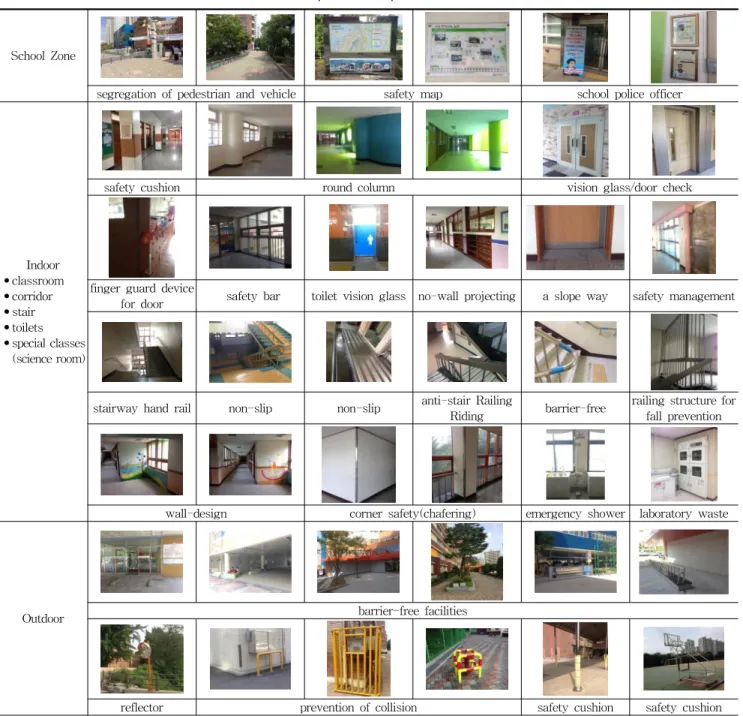
Table 13은 19개 학교의 안전사고 예방을 위한 학교생 활시설 개선 사례이다. 통학로에서의 개선사례는 교내 보 차 분리 이행, 보행안전지도판 설치, 전담경찰관공지 등
이며 실내에서는 독립기둥의 충돌보호대 설치, 사각 기둥
이 아닌 둥근 형태로의 시공, 여닫이문의 투시창과 도어체
크 설치, 손끼임 방지 설치, 교실과 복도 등 창문에 안전
바(bar) 설치, 복도와 교실의 바닥에 단 차가 있을 경우
경사로 설치, 복도와 난간의 위험요소 제거, 복도벽과 계단
의 단을 활용한 안전교육홍보 및 우측보행 교육, 복도벽의
사각모서리 부분의 모접기를 통한 안전성 구축 등의 시설
개선사례가 이루어졌다. 실외부분에서는 현관경사로 설치,
교내 산책로 정리, 단차가 없는 운동장 세면대 설치, 체육
시설 및 놀이시설에 충돌보호대 설치 등으로 나타났다.
4) 시사점
지역적인 특이점은 찾아볼 수 없으나, 설립연도로 보면 2014년 이후에 설립된 학교가 이전의 학교보다는 학교시 설에 대한 안전의식이 반영되고 있는 것으로 보인다. 급간 별로는 초등학교에서 대체적으로 안전한 학교생활시설을 구축하기 위한 다양한 노력을 통해 시설 개선이 이루어지 고 있는 것으로 나타났다. 대체적으로 거의 모든 학교에서 잠재된 위험성이 있음을 보여주고 있으며 사고발생가능성 이 매우 높은 학교(위험도4) 6개교와 높은 학교(위험도3) 4개교에 대해서는 학생생활시설 점검과 개선이 즉각적으 로 이루어져야 할 것이다.
위험도 2에 해당하는 학교 7개교와 위험도 1에 해당하 는 2개교에 대해서도 지속적인 안전보완대책과 함께 시설 개선 노력이 병행되어야 할 것이다. 또한 우수사례에서 살 펴보았듯이 적은 예산으로 학교안전사고를 예방할 수 있 는 아이디어와 대책이 필요하다. 그러기 위해서는 학교생 활공간에 대한 위험성 예지교육과 안전의식 함양을 통해 학교안전사고를 경감시키는 노력이 병행되어야 할 것이다.
4. 결론
학교생활 안전사고 예방을 위한 시설 개선방향에 대한 본 연구의 결론은 다음과 같다.
첫째, 학생들의 안전한 등하교를 위한 안전지도판 설치 가 적극적으로 필요하다. 안전지도를 숙지하고 일상생활에 서 활용한다면 안전한 등하교길 환경 구축과 위험상황발 생시 대피가 용이하여 안전사고를 예방하고 경감시킬 수 있을 것이다.
둘째, 교실은 대체적으로 안전한 환경으로 구축되어있지 만 노출되는 벽의 모서리나 기둥 모서리 등에 안전사고를 최소화할 수 있는 형태가 적극적으로 이루어져야 하며, 출 입문의 손끼임 방지 설치 및 문턱의 돌출부제거, 도어체크 설치, 투시창 설치 등으로 학생 부주의에 의해 발생할 수 있는 사고를 미연에 방지하는 노력이 필요하다.
셋째, 복도벽의 모서리나 복도 기둥 모서리는 안전사고 를 최소화 할 수 있는 형태로 시공하고 미흡한 학교에서 는 안전보호대를 설치하는 조치가 필요하다. 더불어 ㄱ 자 로 꺽이는 복도는 충돌방지시설(대형 반사경)을 설치함으 로써 학생들의 충돌사고 방지 및 위험 예지 노력이 필요 하다.
넷째, 계단부에서는 학생의 신체치수를 고려한 보조 손 잡이 설치, 논슬립 설치시 가인성 확보, 난간 미끄럼타기
방지 설치가 필요하며, 출입구에 우산거치대 설치, 점자블 록 설치 등을 통한 사고 유의 표시 등이 필요하다.
다섯째, 학교에서 사고와 손상이 가장 많은 발생하는 운 동장은 다양한 체육시설에 안전보호대 설치를 의무화 하 고 안전수칙 및 사고예방 ‧ 위험알림 게시판 등의 설치가 필요하다.
본 연구는 학교생활 안전사고 예방을 위한 시설 개선방 향을 제시하는데 그 목적이 있다. 그러나 구체적인 개선방 안과 안전관리기준안을 제시하는 데에는 다소 미흡하며 경기도의 일부학교를 대상으로 한 본 연구의 결과를 일반 화하기에는 한계가 있다. 학교생활 안전사고 예방을 위한 안전관리 기준에 대한 추가적인 연구가 필요하다.
References
1. Kim, Tae-Hwan, A study on the Actuality of School Safety and the Development of Safety Manual, 2005.
2. Yoon, Yong-Gi, A Study on the Problems of elementary School Safety and its Improvement in Korea, 2014.
3. Park, Im-ho and Jung, Jin-Ju, Study on Improvement of Fascility Cciteria of Architectural Planning by analysing the State of Safety Accident in Schools, 2012.
4. A Study on the effect of school safety Management system on Accidents in school : Based on Study of high Schools in seoul, 2002.
5. You, Jae-Doo and Chang, Suk-Heon, Research for a safety school model configuration. Korean association of public safety and criminal justice. No49. pp.141~163, 2012.
6. Ministry of Education & Human Resources Development, School Facilities Design Safety Manual Development, 2003.
접수 2015. 11. 20 1차 심사완료 2016. 1. 11 게재확정 2016. 1. 25