INTRODUCTION
Steroid withdrawal after ABO-compatible (ABO-c) kidney transplantation (KT) has been attempted to minimize long-term negative effects of steroid treatment. Recently, ABO-incompatible (ABO-i) KT has started to be applied across worldwide. However, limited data existing regard- ing steroid withdrawal after ABO-i KT show a higher re- jection rate, from 7% to 55% [1-4]. These differences may
have been affected by the differences in immunosup- pressive regimen and/or time of steroid withdrawal, and presence or absence of protocol biopsy. Here, we report the case of a patient who stopped steroids treatment 26 months after KT and has maintained stable renal function for 48 months. To the best of our knowledge, this is the first case reported in Korea featuring late steroid with- drawal with no issue of acute or chronic rejection.
A case of successful late steroid withdrawal after ABO-incompatible kidney transplantation
Jeong Min Cho
1, Heungman Jun
2, Hyung Ah Jo
1, Kum Hyun Han
1, Han-Seong Kim
3, Sang Youb Han
11Department of Internal Medicine, Inje University College of Medicine, Ilsan Paik Hospital, Goyang, Korea
2Department of Surgery, Inje University College of Medicine, Ilsan Paik Hospital, Goyang, Korea
3Department of Pathology, Inje University College of Medicine, Ilsan Paik Hospital, Goyang, Korea
Few data exist regarding steroid withdrawal in ABO-incompatible (ABO-i) kidney transplantation (KT). Here, we report a case of steroid withdrawal after ABO-i KT. A 46-year-old man diagnosed with Henoch-Schonlein purpura received ABO-i KT from his 42-year-old sister. The recipient and donor blood types were O and AB, respectively.
His preoperative ABO antibody titers were anti-A of 1:16 and anti-B of 1:8 in isoaggluti- nin test. HLA mismatch was 0 and he received a single 325 mg/m
2dose of intravenous (IV) rituximab 4 weeks before KT. Three sessions of plasma exchange were undertaken before KT and low-dose IV immunoglobulin of 0.1 g/kg was administered after plasma exchange. On the day of the operation, ABO antibody titer decreased to anti-A of 1:4 and anti-B of 1:2. Renal function remained stable after KT. The patient wished to stop ste- roid treatment despite the risk of rejection after withdrawal. Steroid tapering was initi- ated at 20 months and accomplished at 26 months after KT. At that time, serum creati- nine level was 1.13 mg/dL, and anti-A and anti-B titers were 1:8 and 1:2, respectively. No issues were observed after steroid withdrawal. At 48 months after KT, serum creatinine level was 1.21 mg/dL, and anti-A and anti-B antibody titers were 1:32 and 1:2, respec- tively. Steroid withdrawal in ABO-i KT might be considered in immunologically low-risk patients.
Keywords: Kidney transplantation; ABO blood-group system; Blood group incompatibility;
Steroid; Withholding treatment
Received May 4, 2020 Revised June 4, 2020 Accepted June 10, 2020
Corresponding author: Sang Youb Han Department of Internal Medicine, Inje University Ilsan Paik Hospital, 170 Juhwa-ro, Ilsanseo-gu, Goyang 10380, Korea
Tel: +82-31-910-7201 Fax: +82-31-910-7219 E-mail: [email protected]
© The Korean Society for Transplantation This is an Open Access article distributed under the terms of the Creative Commons Attribution Non-Commercial License (http://creativecommons.org/licenses/
by-nc/4.0/) which permits unrestricted non-commercial use, distribution, and reproduction in any medium, provided the original work is properly cited.
pISSN 2671-8790
eISSN 2671-8804
CASE REPORT
A 46-year-old man had received an ABO-i KT from his 42-year- old sister. He had been diagnosed with Henoch-Schonlein purpura 16 years previously. He had undergone hemodialysis for 5 months. His blood type was O, and his sister’s type was AB. His preoperative ABO antibody titer was anti-A of 1:16 and anti-B of 1:8 in isoagglutinin test. HLA mismatch was 0.
Complement-dependent cytotoxic crossmatch tests of T and B cells and flow-cytometric crossmatch test of T cell were negative. Panel-reactive antibody (PRA) was negative for classes I and II.
He received a single 325 mg/m
2dose of intravenous (IV) rituximab 4 weeks before KT. Three sessions of plas- ma exchange were undertaken before KT, and low-dose 0.1 g/kg IV immunoglobulin was administered after plas- ma exchange. On the day of the operation, ABO antibody titer decreased to anti-A of 1:4 and anti-B of 1:2 in isoag- glutinin test. Oral prednisolone 20 mg once per day was initiated 3 days before KT. On the day of the operation, IV methylprednisolone 500 mg was administered, with daily reductions thereafter. Tacrolimus 1.5 mg and mycophe- nolate mofetil (MMF) 750 mg (both twice per day) were initiated 3 days before KT and continued thereafter. As induction therapy, IV basiliximab 20 mg was administered on the day of KT and after 4 days.
Following KT, serum creatinine level gradually de- creased. By postoperative day 5, serum creatinine and blood urea nitrogen levels had decreased to 1.06 and 15.5 mg/dL, respectively. Kidney Doppler the day after KT showed normal perfusion of the transplanted kidney and normal resistant index (0.61–0.68), with no evidence of vascular or urinary tract abnormality. Protocol biopsy was not performed. Graft function was stable with a tacrolim- us trough level of approximately 10 ng/mL.
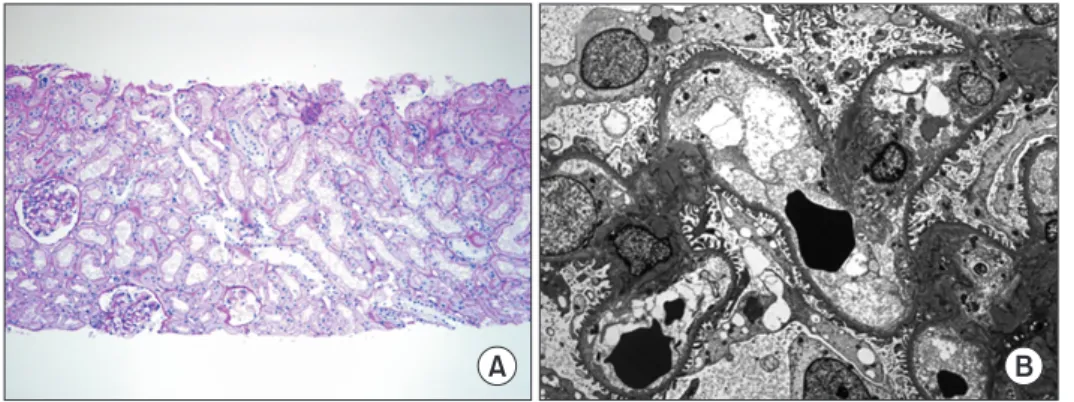
At 3 months after KT, serum creatinine had increased to 1.56 mg/dL, and blood tacrolimus trough level was 10.2 ng/mL. Following a reduction of tacrolimus dose, serum creatinine decreased to 1.40 mg/dL. At 4.2 months, serum creatinine level had again increased to 1.60 mg/dL with a tacrolimus trough level of 4.8 ng/mL. C-reactive protein level and urinalysis were both within normal range, how- ever, protein/creatinine ratio was 0.25 g/gCr. ABO titer values were anti A of 1:16 and anti-B of 1:1. To detect acute rejection, kidney biopsy was performed at this time, showing no evidence of acute rejection (Fig. 1). Serum creatinine decreased to 1.29 mg/dL without any further specific management.
However, at 18 months after KT, the patient wanted to stop steroid treatment owing to fear of its long-term com- plications. Steroid tapering was initiated at 20 months after KT and accomplished at 26 months. The patient had maintained methylprednisolone at 4 mg/day at the time of initiation of steroid tapering, followed by lowering of the dosage to 4 mg q 48 hours for 6 months, after which ste- roid administration was terminated. At that point, serum creatinine level had decreased to 1.13 mg/dL, and anti-A and anti-B isoagglutinin titers were 1:8 and 1:2, respec- tively.
No issues were observed after steroid withdrawal.
Serum creatinine levels were 1.19 and 1.21 mg/dL at 36 and 48 months after KT, respectively (Table 1). Anti-A HIGHLIGHTS
• Few data exist regarding early steroid withdrawal in ABO-incompatible (ABO-i) kidney transplantation (KT) cases.
• Steroid withdrawal in ABO-i KT might be considered in immunologically low-risk patients.
A B
Fig. 1. Transplanted kidney biopsy. (A) Pe-