• 검색 결과가 없습니다.

A Retrograde Approach to Coronary Ostial Stenosis after a Bentall Procedure in a Patient with Behçet’s Disease

N/A
N/A
Protected

Academic year: 2022

Share "A Retrograde Approach to Coronary Ostial Stenosis after a Bentall Procedure in a Patient with Behçet’s Disease"

Copied!
4
0
0

로드 중.... (전체 텍스트 보기)

전체 글

(1)

277 Copyright © 2013 The Korean Society of Cardiology

Korean Circulation Journal

Introduction

In Behçet’s disease, coronary ostial stenosis following a Bentall procedure is rarely reported but can be fatal.

1)

Among chronic total occlusion (CTO) lesions, the ostial location is especially difficult to treat with percutaneous coronary intervention (PCI) due to the in- ability to engage the guiding catheter into the coronary artery. How- ever a retrograde approach, has been recently introduced, which may increase the rate of success of PCI.

2)

Here we report a case of retrograde recanalization of a chronically occluded right coronary artery (RCA) ostium after a repeated Bentall procedure in a patient with Behçet’s disease.

Case Report

http://dx.doi.org/10.4070/kcj.2013.43.4.277 Print ISSN 1738-5520 • On-line ISSN 1738-5555
A Retrograde Approach to Coronary Ostial Stenosis after a Bentall Procedure in a Patient with Behçet’s Disease

Taek Kyu Park, MD, Jeong Hoon Yang, MD, Hongseok Yoo, MD, Joonseong Ahn, MD, Jaryong Jeon, MD, Young Bin Song, MD, and Hyeon-Cheol Gwon, MD

Division of Cardiology, Department of Medicine, Cardiac and Vascular Center, Samsung Medical Center, Sungkyunkwan University School of Medicine, Seoul, Korea

We describe a case of chronic total occlusion of the right coronary artery ostium 5 months after a repeated Bentall procedure in a patient with Behçet’s disease. In this patient, an antegrade approach to delivering the guidewire during percutaneous coronary intervention was not successful. Coronary angiography revealed the existence of collateral blood supply from the left coronary artery. Using a retrograde approach, a guidewire was successfully advanced from the distal left circumflex artery through the collateral vessel and into the postero- lateral branch of the right coronary artery. After the guidewire crossed over the occluded right coronary artery ostium and was snared into the ascending aorta, antegrade access for balloon and stent delivery succeeded. (Korean Circ J 2013;43:277-280)

KEY WORDS: Behçet disease; Percutaneous coronary intervention; Coronary occlusion.

Received: July 17, 2012

Revision Received: August 13, 2012 Accepted: August 17, 2012

Correspondence: Hyeon-Cheol Gwon, MD, Division of Cardiology, De- partment of Medicine, Cardiac and Vascular Center, Samsung Medical Center, Sungkyunkwan University School of Medicine, 50 Irwon-dong, Gangnam-gu, Seoul 135-710, Korea

Tel: 82-2-3410-1631, Fax: 82-2-3410-3849 E-mail: [email protected]

• The authors have no financial conflicts of interest.

This is an Open Access article distributed under the terms of the Creative Commons Attribution Non-Commercial License (http://creativecommons.

org/licenses/by-nc/3.0) which permits unrestricted non-commercial use, distribution, and reproduction in any medium, provided the original work is properly cited.

Case

A 41-year-old man with Behçet’s disease was referred to our out- patient clinic for treatment of CTO of the RCA ostium. He did not have any risk factors such as hypertension, diabetes, hyperlipide- mia, and smoking. He had undergone a Bentall procedure for severe aortic regurgitation 10 years ago, and required reoperation on the aortic root replacement with Prima Plus 23 mm (Edwards Lifesci- ences, Irvine, CA, USA) and an ascending aortic graft insertion with Intergard 24 mm (Maquet, Wayne, NJ, USA) due to infective endo- carditis 7 months prior. Two months earlier, he experienced rapidly worsening exertional angina and was evaluated at another hospital.

Emergent coronary angiography showed a significant tubular lesion

of the left main coronary artery (LMCA) ostium (Fig. 1A) and total

occlusion of the RCA ostium (Fig. 1B). Stent implantation in the

LMCA was successfully performed, but catheter engagement into

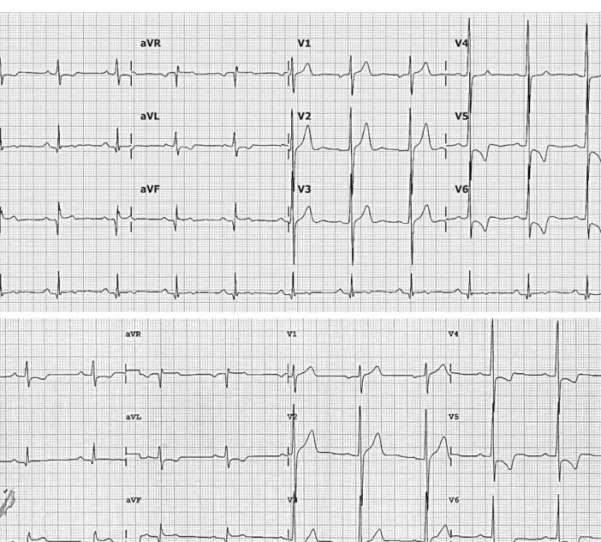
the RCA failed due to CTO of the RCA ostium. On admission, electro-

cardiography revealed abnormal Q waves over the inferior leads

(Fig. 2A), but cardiac magnetic resonance imaging showed no evid-

ence of delayed enhancement. Echocardiography showed normal

left ventricle systolic function and aortic valve function. Coronary

angiography showed a patent LMCA stent and no disease in the

left sided vasculature; however, the RCA ostium was totally occlud-

ed and collateral flow (grade 3) was supplied by the left coronary ar-

tery (Fig. 3A). We first attempted to use a 6 Fr JR 4 guiding catheter

(Cordis, Miami, FL, USA) for an antegrade approach, but were unable

(2)

278 Behçet’s Disease and Coronary Ostial Stenosis

http://dx.doi.org/10.4070/kcj.2013.43.4.277 www.e-kcj.org

to penetrate into the RCA ostium. Subsequently, a 5 Fr XB 3.5 guid- ing catheter (Cordis, Miami, FL, USA) was used in a retrograde appro- ach via the right radial artery. We chose the left circumflex artery (LCX) for the retrograde approach. A superselective tip injection of

contrast using a Finecross

TM

microcatheter (Terumo, Tokyo, Japan) was performed, and a channel from the LCX to the posterolateral branch of the RCA was confirmed. A Runthrough

TM

NS (Terumo, To- kyo, Japan) with a microcatheter was retrogradely advanced into

A   B   C  

Fig. 1. Initial coronary angiography from the previous hospital. A: significant tubular stenosis at the left main coronary artery (white arrow). B: ostial oc- clusion with thrombolysis in myocardial infarction 1 flow at the right coronary artery (white arrow). C: final angiography after stent implantation of left main coronary artery at the previous hospital. Collateral flow supplied to proximal right coronary artery.

A  

B  

Fig. 2. Electrocardiography before (A) and after (B) revascularization.

(3)

279 Taek Kyu Park, et al.

http://dx.doi.org/10.4070/kcj.2013.43.4.277 www.e-kcj.org

the distal RCA, and further advanced into the distal end of the oc- clusion (Fig. 3B) before penetrating the CTO lesion (Fig. 3C). We then exchanged the Runthrough

TM

NS guidewire for a Fielder-FC

TM

300 cm guidewire (Asahi Intecc, Aichi, Japan), which was subse- quently snared into the ascending aorta (Fig. 3D) and pulled out of the sheath placed in the right femoral artery using a Multi-Snare®

(PFM medical, CA, USA) (Fig. 3E). The lesion was pre-dilated using a 2.0×20 mm Lacrosse balloon (Goodman, Nagoya, Japan) at 18 atmo- spheres. A 3.0×28 mm Nobori® stent (Terumo, Tokyo, Japan) was then placed successfully in the CTO lesion at 16 atmospheres. Final angiographic findings showed no residual stenosis or complica- tions (Fig. 3F). The medications of the previous hospital were main- tained including colchicine 0.6 mg qd, azathioprine 50 mg qd, aspi- rin 100 mg qd, clopidogrel 75 mg qd, ramipril 5 mg qd, bisoprolol 5 mg qd, and atorvastatin 80 mg qd. He was referred back to the

previous hospital.

Discussion

Aneurysmal dilatations of the sinus of Valsalva and ascending aorta are more frequent in patients with Behçet’s disease than in he- althy subjects.

3)

The Bentall procedure for aortic root and valve re- placement with coronary reimplantation is considered the gold st- andard for treatment of combined valve and ascending aortic pa- thology,

4)

with coronary ostial stenosis following this procedure occurring in less than 2% of patients.

5)

This complication may be re- lated to an imperfect suture technique, or to the direct instrumen- tation of the coronary ostium itself. In these cases, signs of ischemia typically present early on during hospitalization.

6)

In recent reports, delayed ostial coronary stenosis occurring within months of the A  

D  

B  

E  

C  

F  

Fig. 3. Revascularization for chronic total occlusion (CTO) in right coronary artery. A: patent stent at the left main coronary artery. Collateral flow supplied

from the left coronary artery to the right coronary artery (white arrows). B: a Finecross

TM

microcatheter (Terumo, Tokyo, Japan) was further advanced into

the CTO lesion (white arrow). C: a Runthrough

TM

NS (Terumo, Tokyo, Japan) was crossed over the CTO lesion. D: snaring of the retrograde guidewire into the

ascending aorta (white arrow). E: a retrograde guidewire was pulled out of the sheath placed in the right femoral artery (white arrow). F: final angiogram

with no residual stenosis.

(4)

280 Behçet’s Disease and Coronary Ostial Stenosis

http://dx.doi.org/10.4070/kcj.2013.43.4.277 www.e-kcj.org

operation might be due to inflammatory and/or proliferative re- sponses of the coronary wall to tissue adhesives used during the operation.

7)8)

Coronary artery stenosis in aortitis syndrome with the stenosis occurred two years after the operation has been reported.

9)

In our case, signs and symptoms of stenosis were observed 5 months after surgery. Thus, the time lapse between the procedure and the presentation of ostial occlusion implies a mechanism that is related to the tissue adhesion rather than the suture technique or Behçet’s disease itself.

Our patient presented with acute myocardial infarction and un- derwent successful PCI of the LMCA ostium. It was not possible to perform this procedure using an antegrade approach to the CTO in the RCA ostium. It has been reported that successful revasculariza- tion of CTO leads to significantly reduced mortality rates and long term risk of adverse cardiac events.

10)11)

Retrograde CTO recanaliza- tion has recently become an essential alternative to the classical antegrade approach. When performed by an experienced clinician, the retrograde technique has a high success rate with a low com- plication profile, despite frequent utilization in the most anatomi- cally and clinically complex patients.

2)

In retrograde CTO recanaliz- ation, analysis of all potential collateral channels is critical. The epi- cardial collaterals are preferred less than septal collaterals, because rupture could lead to tamponade and procedural ischemia or infarc- tion may occur.

2)

However, we used the epicardial collateral because no septal collaterals are suitable. In addition, because the occlusion was located at the ostium of the coronary artery, there was no space to engage the antegrade guiding catheter. In such situation, a pure retrograde wire crossing is the only way to transverse the occlusion.

The retrograde wire was able to advance to the false lumen and ad- vancing more caused the dissection. If available for antegrade ap- proach, the use of intravascular ultrasound through the antegrade system may prevent the engagement to the false lumen.

12)

However, if not available for antegrade wiring, we have no choice but to ad- vance the retrograde wire carefully by an experienced operator. After crossing CTO lesion, either pushing the retrograde guidewire into the guiding catheter or trapping it at the contralateral sheet may be used for wire externalization.

13)

Through this retrograde approach, we were able to snare the 300 cm guidewire into the ascending aorta, and then ultimately pull it out of the proximal end of the fem- oral sheath.

In summary, we propose that a retrograde approach for PCI can be useful in the treatment of CTO of the coronary ostium as a consequ-

ence of the Bentall procedure in patients with Behçet’s disease.

References

1. Nonoyama M, Tsuchida K. [A case report of sudden death after Ben- tall’s operation (Piehler’s modification) due to left coronary occlusion].

Kyobu Geka 1997;50:569-72.

2. Joyal D, Thompson CA, Grantham JA, Buller CE, Rinfret S. The retro- grade technique for recanalization of chronic total occlusions: a step- by-step approach. JACC Cardiovasc Interv 2012;5:1-11.

3. Gürgün C, Ercan E, Ceyhan C, et al. Cardiovascular involvement in Be- hçet’s disease. Jpn Heart J 2002;43:389-98.

4. Huang XM, Huang CJ, Sha Y, Wang Q, Zeng XJ. [Cardiac valve involve- ment in Behcet’s disease: a clinical study of 10 patients]. Zhonghua Yi Xue Za Zhi 2010;90:2357-9.

5. Worthley MI, Burgess J, Traboulsi M. Bilateral coronary ostial stenoses post-Bentall procedure: management options in the DES era. J Invasive Cardiol 2005;17:680-2.

6. Balbi M, Olivotti L, Scarano F, et al. Percutaneous treatment of left main coronary stenosis as a late complication of bentall operation for acute aortic dissection. Catheter Cardiovasc Interv 2004;62:343-5.

7. Marino M, Cellini C, Tsiopoulos V, et al. A case of myocardial infarction effectively treated by emergency coronary stenting soon after a Ben- tall-De Bono aortic surgery. Cardiovasc Revasc Med 2010;11:263.

8. Tsukui H, Aomi S, Nishida H, Endo M, Koyanagi H. Ostial stenosis of coronary arteries after complete replacement of aortic root using gela- tin-resorcinol-formaldehyde glue. Ann Thorac Surg 2001;72: 1733-5.

9. Terasawa A, Kondo K, Ishikawa S, Morimoto R, Tajika T, Hayashi Y. Siro- limus-eluting stent implantation for ostial stenosis of left main coro- nary artery after Bentall operation in aortitis syndrome. J Cardiol 2010;

55:147-50.

10. Joyal D, Afilalo J, Rinfret S. Effectiveness of recanalization of chronic total occlusions: a systematic review and meta-analysis. Am Heart J 2010;160:179-87.

11. Rathore S, Katoh O, Matsuo H, et al. Retrograde percutaneous recanali- zation of chronic total occlusion of the coronary arteries: procedural outcomes and predictors of success in contemporary practice. Circ Cardiovasc Interv 2009;2:124-32.

12. Rathore S, Katoh O, Tuschikane E, Oida A, Suzuki T, Takase S. A novel modification of the retrograde approach for the recanalization of ch- ronic total occlusion of the coronary arteries intravascular ultraso- und-guided reverse controlled antegrade and retrograde tracking. JACC Cardiovasc Interv 2010;3:155-64.

13. Galassi AR, Tomasello SD, Costanzo L, Tamburino C. Retrograde recana- lization of an in-stent ostial chronically occluded right coronary artery.

Int J Cardiol 2010;142:304-6.

수치

Fig. 2. Electrocardiography before (A) and after (B) revascularization.
Fig. 3. Revascularization for chronic total occlusion (CTO) in right coronary artery. A: patent stent at the left main coronary artery

참조

관련 문서