1. 서 론
전 세계적으로 일어나고 있는 지구온난화(Global warming)의 가장 큰 원인은 인위적으로 발생하는 CO2농 도의 증가에 있다(Kobayashi, 2006). 지구온난화로 인해 지구의 온도가 올라가면 인류의 생활을 비롯한 생물의 생태계는 큰 영향을 받을 것이다(Jang et al., 1998).
IPCC의 2001년 보고서에는 100년에 0.6℃의 속도로 온 난화가 일어난다고 보고하였다. 하지만 2007년의 보고
서에는 100년에 0.74℃의 속도로 온난화가 일어나고 있 으며 20세기 이후 온난화 속도가 가속되고 있다고 발표 하였다(IPCC, 2007). 최근 가장 일반적인 지구온난화 시 나리오(IPCC, 2007)인 B1 시나리오와 우리나라의 경우 지난 97년간(1912∼2009) 주요 6개 도시의 평균기온이 약 1.7℃ 상승하여 전 지구의 평균기온상승(0.74℃)의 2 배 이상으로 전 지구적인 추세를 상회하고 있다(IPCC, 2007; Korea Meteorological Administration, 2009).
지구온난화의 영향은 한반도에도 많은 영향을 끼쳤다.
CO
2농도와 온도증가에 따른
멸종위기수생식물 선제비꽃의 생태학적 반응
장래하 · 이승혁 · 한영섭 · 조규태 · 유영한
+공주대학교 생물학과
Ecologcal Response of the endangered aquatic plant, Viola raddeana Regal, to Effect of Increased CO2 Concentration and Air Temperature
Rae Ha Jang ․ Seung Hyuk Lee ․ Young Sub Han ․ Kyu Tae Cho ․ Young Han You+
Department of Biology, University of Kongju
요 약
멸종위기수생식물 선제비꽃이 증가된 CO2농도와 온도에 생태적으로 어떻게 반응하는지 알아보기 위하여 연구를 실시하 였다. 실험은 2007년부터 2012년까지 야외조건인 대조구와 CO2농도 + 온도를 증가시킨 처리구에서 개체생태학적으로 생 육반응을 모니터링하였다. 그 결과 지상부 길이, 개체 당 가지 수, 개체 당 열매 수, 열매 당 종자 수, 가지 당 열매 수와 종자무게는 처리구에서 대조구보다 낮았으나, 가지 당 잎 수는 많았고, 꽃대길이, 가지 길이와 개체 당 잎 수는 차이가 없었다. 이러한 결과 CO2농도와 온도가 증가하면 선제비꽃의 가지 수는 줄어들지만 가지에 붙은 잎 수를 늘리는 반응을 하며, 종자생산이 감소하여 번식에 부정적임을 의미한다. 그래서 지구온난화현상은 멸종위기의 주요한 원인 중 하나가 될 것으로 판단된다.
핵심용어 : 지구온난화, 다년생초본, 습지, 개체생태학
Abstract
The increased CO2 concentration and temperature affect ecological responses of plants. In order to know the effects of global warming on the Viola raddeana Regal, endangered aquatic plant designated by the Ministry of Environment Korea, this study was investigated at control and treatment(increased CO2 concentration + increased temperature) in glasshouse. Then, autecological responses of V. raddeana were monitored and measured. As a result, shoot length, number of fruits per plant, number of branch per plant, number of seeds per fruit, number of fruits per branch, and weight of 10 seeds were higher in control than in treatment. number of leaves per branch was higher in treatment than in control. Length of axis, length of branch and number of leaves per plant were not different between in the control and in the treatment. These results demonstrated that the reproductive response of V. raddeana might be negatively influenced by increased CO2 concentration and temperature. The global warming will be one of the main causes of extinction for V. raddeana Regal.
Keywords : autecology, global warming, perennial herb, wetland
+ To whom correspondence should be addressed [email protected]
한반도의 2005년 CO2 평균농도(389 ppm)는 세계 평균 (379 ppm)보다도 10 ppm 더 높았으며, 기온은 지난 100 년간 1.5℃ 올랐다. 이러한 상승률은 지구평균의 2배에 이른다(Ministry of Environment, 2009).
제비꽃과는 18속 800여종으로 구성되며 이 중 절반가 량인 400여종이 제비꽃 속(Viola)에 속하고 우리나라에는 1속 약 46분류군이 분포한다(Lee, 2006). 제비꽃 속은 대 부분 다년생 초본이며 드물게 관목이고, 잎은 호생하며 드물게 대생하기도 하며, 아프리카에 가장 적은 수의 종 들이 분포하며 아시아 온대지역 특히 중국, 일본 그리고 한국 등에 특산종들이 많다(Hashimoto, 1967). 제비꽃 종 류들은 복잡한 교배 방식(breeding system), 형태적 다양 성과 서식지의 다양성 등이 비교생태연구에 매우 적합 하고(Solbrig, 1981), 개방화(chasmogamous flower)와 폐쇄 화(cleistogamous flower)를 만들어 자손의 생산을 극대화 하기 위해 능동적으로 대처한다(Lord, 1981; Venable, 1985).
본 연구에 사용한 선제비꽃(Viola raddeana Regal)은 제비꽃과에 속하는 다년초로 수원 이북의 산이나 들의 습한 곳과 물이 범람하는 습지에서 자라며(Lee, 2006), 환경부 지정 멸종위기 Ⅱ급으로 지정되어있다(Ministry of Environment, 2012). 일본에서도 멸종위기 Ⅱ급으로 지 정되어 있으며, 일본에서 멸종위기로 지정된 이유는 생 육지의 관리부족과 방치라고만 하였고(Sawada, 2011) 지 구온난화에 대한 반응에 대한 연구는 없다.
한편으로 CO2농도와 온도의 증가는 식물의 생장과 생 리적 특성에 변화를 일으켜 육상 생태계의 구조와 기능 에 직접적인 영향을 미친다(Florides and Christodoulides, 2009; He et al., 2005; Idso et al., 1987). 지구온난화가 진 행되어 온도가 1.5∼2.5℃이상 상승할 경우, 전체 생물종 의 20∼30%는 멸종 위기의 가능성이 높아지고, 4℃이상 상승할 경우 전체 생물종의 최대 40%가 멸종의 위기를 맞는 심각한 결과를 가져올 것으로 전망된다(IPCC, 2007). 실제 지구상에서 100여종의 동·식물이 멸종위기를 맞고 있으며 이미 50여종은 가까운 시기 안에 멸종 될 것으로 보고 있다(IPCC 2007). 그리고 1,103종의 3분의 1 이 넘는 종들이 지금부터 2050년까지 사라지거나 사라 질 위기에 처해있다(Thomas et al., 2004).
본 연구에서는 지구온난화가 선제비꽃의 생태적 반응 에 미치는 영향을 알아보기 위해 지구온난화의 핵심요 인인 CO2농도와 온도를 상승시킨 처리구와 일반대기조 건인 대조구에서 개체생태학적으로 모니터링하였다.
2. 연구방법
2,1 실험재료
2007년 국립환경과학원에서 분양받은 선제비꽃을 화
분(60 x 43 x 21cm)에 심어서 사용하였다.
2.2 지구온난화 처리
유리 온실 안에서 일반대기조건인 대조구와 온실가스 인 CO2농도와 온도를 상승시킨 처리구로 나누었다. 대조 구의 CO2농도는 360ppm~370ppm이고 처리구의 CO2농도 는 750ppm~800ppm 온도는 대조구보다 약 2℃높게 처 리하였는데 그 IPCC의 B1시나리오에 근거하였다.
CO2농도는 처리구 내에 CO2가스통 2개를 설치한 뒤, 이와 연결된 Gas regulator를 지름 0.2mm인 호스와 연결 하여 분사하였다. 컴퓨터에서 원격제어되는 자동화센서 (LCSEMS-002, Parus CO. Korea)를 식물체 높이에 설치하 였다. 이 센서로 유지하고자 하는 CO2농도 범위(750pp m~800ppm)를 설정하여 CO2농도를 일정하게 유지시켰 다.. CO2농도와 온도는 10분 간격으로 모니터링하였다.
광은 자연광, 토양은 마사토 100%를 동일하게 처리하 였고 수분은 2∼3일 간격으로 같은 양을 공급하였다.
2.3 수확 및 측정
대조구와 처리구에서 5년간 자란 선제비꽃 5개체씩을 6월에 다른 색의 끈으로 표시하고 가지 당 열매수를 측 정하였고, 10월에 가지 수, 잎 수를 세었고, 가지와 지상 부 길이를 측정하였다. 그리고 라벨링을 하지 않은 열매 를 꽃대까지 수확하여 꽃대의 길이를 재고 폐쇄화의 열 매 수와 열매 당 종자 수를 측정하였다.
2.4 통계분석
대조구와 처리구간 생태적 차이를 알아보기 위하여 Fisher 최소유의차 법으로 5% 유의수준으로 Statistica (Statsoft Co. 2006)를 이용해 분산분석을 실시하였다(No and Jung, 2002).
3. 결과 및 고찰
지상부 길이는 처리구에서 대조구보다 13.8cm 짧았지 만(Fig. 1-a), 꽃대길이와 가지 길이는 차이가 없었다(Fig.
1-b, c). 이와 유사하게 섬자리공(Phytolacca insularis)의 지상부길이는 CO2농도와 온도가 증가하면 처리구에서 짧았으며, 꽃대길이에도 차이가 없었다(Kim and You, 2010). 또한 토마토(Lycopersicon esculentum)의 지상부 길 이는 온도가 25℃보다 증가하면 증가할수록 계속 감소 하였다(Chi, 2000). 하지만 본 연구결과와 다른 반응을 보이는 식물도 있다. CO2농도와 온도가 증가한 조건에서 단양쑥부쟁이(Aster altacicus var. uchiyamae),벼, 섬시호 (Bupleurum latissimum Nakai)와 명아주(Chenopodium album)는 지상부길이에 차이가 없고 꽃대와 줄기의 길이
가 길었다(Almaz et al., 2009; Han et al., 2012 ; Jung, 2012 ; Kim and You, 2010). 일반적으로 지상부 길이가 짧으면 다른 지상부 길이가 긴 식물보다 광 확보에 불 리하다. 대조구의 선제비꽃은 직립하지만 처리구의 선제 비꽃은 줄기와 가지가 웃자라 점차 옆으로 바닥을 기는 형태로 바뀌었다. 높이는 대조구에서 21cm 처리구에서 8cm로 처리구에서 키가 작다. 이 같은 결과로 볼 때 대 조구보다 처리구에서 광 확보에 불리할 것이다.
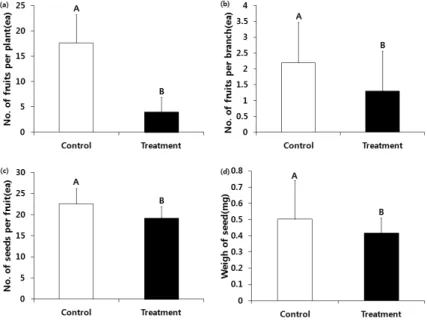
개체 당 열매 수는 처리구에서 대조구보다 13.6개 적 었고(Fig. 2-a), 가지 당 열매 수는 0.9개(Fig. 2-b), 열매 당 종자수는 3.4개(Fig. 2-c) 그리고 종자무게는 00.8mg 적었다(Fig. 2-d). 본 연구결과와 같이 단양쑥부쟁이(Aster altaicus var. uchiyamae), 섬시호, 섬자리공, 창질경이 (Plantago lanceolata L.)와 벼과인 Bromus madritensis ssp.
rubens은 CO2농도와 온도가 증가하면 종자무게가 줄어들 고 열매와 종자 생산량이 감소하였다(Han et al., 2012;
Huxman et al., 1999; Kim and You, 2012; Renata and Helen, 1985; Sin et al., 2012). 그리고 CO2농도가 증가된 조건에서 야생식물 55종의 종자 무게가 감소했고(Leanne et al., 2002) 어저귀(Abutilon theophrasti)의 열매 수와 종 자수도 감소하여 번식생태적으로 불리하였다(Garbutt and Bazzaz, 1984).
하지만 본 연구결과와는 다르게 CO2농도나 온도가 증 가하면 열매 수나 종자에 긍정적인 반응을 보이는 연구 결과들도 있다(Hong, 2012; Kim and You, 2010). CO2 농 도가 증가하였을 때 애기장대(Mouseear cress)의 식물당 종자수도 증가하였으며(Ward and Strain, 1997), 십자화과 의 Raphanus raphanistrum은 식물 당 꽃 수와 종자수가 증가하였다(Peter et al., 1994).
이처럼 CO2농도와 온도는 식물의 열매와 종자 생산에 많은 영향을 끼친다. 유럽에서 폭서사건(평년보다 6℃
이상으로 수일 지속)은 단기간의 온도증가가 식물의 종 자 생산에 얼마나 큰 영향을 끼치는지 보여주는 좋은 사례다. 폭서사건을 겪었던 2003년에는 옥수수 수확량이 이탈리아에서 약 36%, 프랑스에서 약 30% 줄었으며 (Giais P. et al., 2005), 열대지역의 벼, 밀 및 옥수수는 기온이 1∼2℃ 상승하면 급격히 감소한다(IPCC, 2007).
이는 개화기의 기온이 너무 낮거나 높으면 쭉정이가 많 이 생겨서 불임률이 증가하기 때문이다(Kim, 2012). 식물 은 환경적 조건이 열악한 경우 일반적으로 생식부에 대 한 투자가 감소한다(Way et al., 2009). 본 연구에서 처리 구는 대조구보다 선제비꽃에게 열악한 환경조건일 것이 다. 그래서 생식부의 수와 무게에 부정적인 영향을 끼쳤 다고 판단된다.
개체 당 가지 수는 처리구에서 대조구보다 4개 적었
다(Fig. 3-a). 개체 당 잎 수는 차이가 없었으며(Fig. 3-b), 가지 당 잎 수는 3.42개 더 많았다(Fig. 3-c). 일반적으로 초본식물에서 CO2농도나 온도가 증가하면 잎에 대한 반 응이 감소하였다. 섬시호는 CO2농도와 온도가 증가하면 잎 수가 적었고(Jung, 2012). 제비꽃과의 파놀라 노랑 점 박이꽃(Viola x wittrockiana)도 온도가 증가할수록 잎의 길이, 면적, 잎자루뿐만 아니라 꽃의 크기와 식물의 생 물량 또한 감소하여 부정적인 영향을 받았다(Genhua et al., 2000). 또한 멸종위기로 지정된 왕제비꽃은 최저온도 보다는 최고온도에 큰 영향을 받으며, 온도가 25℃ 이상 이면 지상부 길이와 잎의 생태적 반응에 불리하였고 (Song, 2012), 14종의 제비꽃을 대상으로 실험한 결과 각 종마다 생육에 적합한 온도가 다르며 25℃ 이상에는 모 든 종이 부정적인 영향을 받았다(Lee et al., 1996). 이로 보아 각 식물종에게 최적온도가 있으며 이 최적온도를 넘으면 식물의 생태적 반응에 부정적인 영향을 끼친다.
본 연구에서 가지 당 잎 수는 처리구에서 많았지만, 가지 수는 대조구에서 더 많았고 잎 수에서는 차이가 없었다. 높은 CO2농도는 일반적으로 줄기당 잎수를 증가 시키지만(Poorter et al., 1988), 잎 수에는 변화가 없다 (Paez et al., 1983). 잎 수는 식물의 광합성에 큰 영향을 주고 생장과 직결된다(Lawlor and Mitchell, 1991). 하지만 부정근을 내리는 선제비꽃의 가지 수가 적으면 부정근 을 내릴 확률이 낮아서 번식에 불리하며 더 넓은 면적 을 차지하는 대조구의 선제비꽃보다 광합성에 필요한 광의 확보에 불리할 것으로 판단된다.
CO2농도가 증가하면 초본식물종의 열매 수, 종자 생 산량과 잎 수도 증가하는 것이 일반적이다(Ward and Strain, 1999). 이와 같이 CO2농도와 온도증가가 식물의 생장과 발달을 증진시키기도 하지만(Carson and Bazzaz, 1982; Krizek et al., 1969), 변화가 없거나 본 연구결과와 같이 감소하기도 한다(Idso and Kimball, 1997). 연구 결 과가 종마다 상이하게 나온 이유는 각 식물들은 종 특 이성을 가지며 CO2농도와 온도에 따른 식물의 생장은 다른 조건과 복합적으로 이루어지기 때문이다(Kim and You, 2010).
본 연구에서 선제비꽃은 지구온난화가 가속화 되면 가지 당 잎 수는 증가하지만 개체 당 잎 수에는 차이가 없고, 지상부 길이와 가지 수가 감소할뿐더러 번식에 결 정적인 요인인 열매 생산성과, 종자무게가 감소하여 부 정적인 영향을 받는다.
이 같은 결과로 볼 때 지금까지 선제비꽃이 멸종위 기에 처한 원인은 자생지파괴였지만(Sawada, 2011), 지구 온난화현상은 또 다른 멸종위기의 주요한 원인 중 하나 가 될 것으로 판단되어 이에 대한 대책이 필요하다.
Fig. 1. Shoot length(a), length of floral axis(b) and length of branch(c) in the control(ambient CO2-ambient air temperature) and treatment(increased CO2 concentration - increased air temperature). Alphabets on the bars mean
significantly different between control and treatments(Fisher`s least significant difference, p<0.05).
Fig. 2. Number of fruits per plant(a), fruits per branch(b), seeds per fruit(c) and weigh of seed(d) in the control(ambient CO2-ambient air temperature) and treatment(increased CO2 concentration - increased air temperature). Alphabets on the bars mean significantly different between control and treatments(Fisher`s least
significant difference, p<0.05).
Fig. 3. Number of branch per plant(a), leaves per plant(b) and leaves per branch(c) in the control(ambient CO2-ambient air temperature) and treatment(increased CO2 concentration - increased air temperature). Alphabets on
the bars mean significantly different between control and treatments(Fisher`s least significant difference, p<0.05).
감사의 글
본 논문은 교육과학기술부의 재원으로 지원을 받아 수행된 산학협력 선도대학(LINK) 육성사업의 연구결과 입니다.
References
Carson, RW and Bazzaz, EA (1982). Photosynthetic and growth response to fumigation with SO2 at elevated CO2 for C3 and C4 plants. Oceologia, 59, pp. 50-54.
Chi, SH (2000). Effect of 5 different solution temperature on growth and dry matter partitioning rate of tomato seedlings. J. of The Institute Technology Honam University, 8, pp. 279-283
Ciais, P, Reichstein, M, Viovy, N, Granier, A, Ogee, J, Allard, V., Aubinet, M, Buchmann, N, Bernhofer, C, Carrara, A, Chevallier, F, Noblet, ND, Friend, AD, Friedlingstein, P, Grunwald, T, Heinesch, B, Keronen, P, Knohl, A, Krinner, G, Loustau, D, Manca, G, Matteucci, G, Miglietta, F, Ourcival, JM, Papale, D, Pilegaard, K, Rambal, S, Seufert, G, Soussana, JF, Sanz, MJ, Schulze, ED, Vesala, T and Valentini, R (2003). Europe-wide reduction in primary productivity caused by the heat and drought in 2003. Nature 437, pp. 529-533.
Florides, GA and Christodoulides, P (2009). Global warming and carbon dioxide through sciences. Environment International, 35, pp. 390-401.
Garbutt, K and Bazzaz, FA (1984). The effect of elevated CO2 on plants Ⅲ. flower, fruit and seed production and abortion. New Phytol, 98, pp. 433-446.
Han, YS, Kim, HR and You, YH (2012). Effect of elevated CO2 concentration and temperature on the ecological responses of Aster altaicus var. uchiyamae, endangered hydrophyte. J. of Wetlands Research, 14(2), pp. 169-180.
Hashimoto, T (1967). Violets of Japan. Sungmoondang, Tokyo. Japan.
He, JS, Kelly, Wolfe-Bellin S and Bazzaz (2005).
Leaf-level physiology, biomass and reproduction of Phytolacca americana under conditions of elevated CO2 and altered temperature regimes. International J.
of Plant Sciences, 166(4), pp. 615-622.
Huxman, TE, Hamerlynck, EP and Smith, SD (1999).
Reproductive allocation and seed production in Bromus madritensis ssp. rubens at elevated atmospheric CO2. Functional Ecology, 13, pp. 769-777.
Hong, YS (2012). Effects of elevated CO2 concentration and temperature on the phenology, growth response and reproductive ecology of Cicuta virosa, endangered plant in Kore,. Master`s Thesis, University of Kongju, Kongju, Korea.
IPCC. 2007. Climate change 2007: Mitigation of Climate Change. Contribution Working Group Ⅲ Contribution to the Fourth Assessment Report of the Intergovernmental Panel on Climate Change. Cambridge university press, Cambridge, New york, USA.
Idso, SB and Kimball, BA (1997). Effects of long-term atmospheric CO2 enrichment on the growth and fruit preoduction of sour orange trees. Global Change Biology, 3, pp. 89-96.
Idso, SB, Kimball, BA, Anderson, MG and Mauneyv. JR (1987). Effect of amospheric CO2 enrichment on plant growth: the interaction role of air temperature.
Agriculture, Ecosystems and Environment, 20, pp.
1-10.
Jang, SK, Jung, HS and Yun, HI (1998). Global warming and recent retreat of an ice cliff on King george island, South shetland islands, West Antarctica. J. of the Korean Earth Science Society, 19(1), pp. 101-106.
Jung, JK (2012). Ecological response of Bupleurum latissimum(Apiaceae, endangered species) to the environmental gradient treatments. Ph. MD. Dissertation, University of Kongju, Kongju, Korea.
Kim, HR and You, YH (2010). Effects of elevated CO2
concentration and temperature on the response of seed germination, phenology and leaf morphology of Phytolacca insularis(endemic species) and Phytolacca americana(alien species). Korean Society of Environment
& Ecology, 24(1), pp. 62-68.
Kim, HR and You, YH (2010). The effects of the elevated CO2 concentration and increased temperature on growth, yield and physiological responses of rice (Oryza sativa L. cv. Junam). Society of Education (India), 1(2), pp. 1-5.
Kim, JH (2012). The Global Warming as seen by Biologist. Seoul National University Perss.
Kim, KS (2004). Studies of comparative morphology on the korean Viola species. Ph. D. Dissertation, University of Sungkyunkwan, Seoul. Korea.
Kobayashi, N (2006). Global Warming and Forest Business.
Bomundang, Korea.
Krizek, DT, Zimmermann RH, Kueter HH and Bailey WA (1969). Accelerated growth of birch and crabapple seedlings under CO2 enriched atmospheres. Plant
Physiology Supplement, 44, pp. 15.
Lawlor, DW and Mitchell, RAC (1991). The effects of increasing CO2 in crop photosynthesis and productivity : a review of field studies. Plant, Cell & Encironment.
14(8), pp. 807-818.
Leanne, MJ, Xianzhong, W and Peter SC (2002). Plant reproduction under elevated CO2 conditions : a meta-analysis of reports on 79 crop and wild species.
New Phytologist, 156, pp. 9-26.
Lee, CH, Han, NY and Jin, YH (1996). Effect of temperature on seed germination in viola species.
Korean Society for Horticultural Science, 14(2), pp.
430-431.
Lee, YN (2012). New flora of Korea. Kyohak Publishing, Seoul, Korea.
Lord, EM (1981). Cleistogamy: A Tool for the Study of Floral Morphogenesis, Function, and Evolution. The Botanical Review, 47(4), pp. 421-449.
Ministry of Environment (2012). White paper. Ministry of Environment.
No, HJ and Jung HY (2002). Well-defined Statistical Analysis according to Statistica. Hyeong-seok Publisher.
Paez, A, Hellmers, H and Strain, BR (1983). CO2
enrichment, drought stress and growth of Alaska pea plants(Pisum sativum). Physiologia Plantarum, 58, pp.
161-165.
Peter, SC, Allison, AS and Amy, SM (1994). Genotype- specific effects of elevated CO2 on fecundity in wild radish(Raphanus raphanistrum). Oecologia, 97, pp.
100-105.
Poorter, H, Pot, S and Lambers, H (1988). The effect of an elevated atmospheric CO2 concentration on growth, photosynthesis and respiration of Plantago major.
Physiologia Plantarum, 73, pp. 553-559.
Renata, DW and Helen, MA (1985). Intraspecific variation in the response to CO2 enrichment in seeds and seedlings of Plantago lanceolata L.. Oecologia, 66, pp. 458-460.
Sawada, M, Obata, K, Kamijo, T and Nakamura, T (2011). Habitat characteristics and vegetation management of the threatened wetland plant species Viola raddeana
in the tone river system, Japan. J. of the Japanese Society of Revegetation Technology, 37(1), pp. 44-49.
Sin, DH, Kim, HR. and You, YH (2012). Effects of elevated CO2 concentration and increased temperzature on the change of the phenological and reproductive characteristics of Phytolocca insularis, a Korea endemic plant. J. of Wetlands Research, 14(1), pp.
1-9.
Song, JM (2012). A study on physiology, ecology and propagation of Viola websteri. Ph. MD. Dissertation, University of Kangwon, Kangwon, Korea.
Thomas, CD, Cameron, A, Green, RE, Bakkenes, M, Beaumont, LJ, Collingham, YC, Erasmus, BFN, Siqueira, MF, Grainger, A, Hannah, L, Hyghes, L, Huntley, B, Jaarsveld, AS, Midhley, GF, Miles, L, Ortega-Huerta, MA, Petercon, AT, Phillips, OL and Willians, SE (2004). Extinction risk from climate change. Nature, 427, pp. 145-148.
Venable, DL (1985). The evolutionary ecology of seed heteromorphism. American Naturalist, 126 pp. 577-595.
Ward, JK and Strain, BR (1997). Effects of low and elevated CO2 partial pressure on growth and reproduction of Arabidopsis thaliana from different elevations.
Plant, Cell and Environment, 20, pp. 254-260.
Ward, JK and Strain, BR (1999). Elevated CO2 studies : past, present and future. Tree Physiology, 19, pp.
211-220.
Way, DA, Ladeau, SL, Mccarthy, HR, Clark, JS, Oren, R, Finzi, AC and Jackson, RB (2009). Greater seed production in elevated CO2 is not accompanied by reduced seed quality in Pinus taeda L. Global Change Biology. pp. 1-10.
Wulff, RD and Alexander, HM (1985). Intraspecific variation in the response to CO2 enrichment in seeds and seedlings of Plantago lanceolata L.. Oecologia, 66, pp. 458-460.
○ 논문접수일 : 2013년 05월 06일
○ 심사의뢰일 : 2013년 05월 23일
○ 심사완료일 : 2013년 06월 18일