*1 Received on February 27, 2012; accepted on March 21, 2013
*2 Department of Forest Sciences, College of Agriculture & Life Sciences, Seoul National University, Seoul 151-742, Korea
*3 Department of Forest Sciences, Research Institute for Agriculture and Life Sciences, College of Agriculture & Life Sciences, Seoul National University, Seoul 151-742, Korea
*4 Department of Wood Science and Engineering, Chonnam National University, Gwangju 500-757, Korea
*5 Department of Forest Sciences, Research Institute for Agriculture and Life Sciences, College of Agriculture & Life Sciences, Seoul National University, Seoul 151-742, Korea
*6 Department of Forest Sciences, Research Institute for Agriculture and Life Sciences, College of Agriculture & Life Sciences, Seoul National University, Seoul 151-742, Korea
†
Corresponding author : Jun-Jae Lee (e mail: [email protected])
Shear Performance of PUR Adhesive in Cross Laminating of Red Pine* 1
Hyung-Kun Kim *
2, Jung-Kwon Oh *
3, Gi-Young Jeong *
4, Hwan-Myeong Yeo *
5, and Jun-Jae Lee *
6†ABSTRACT
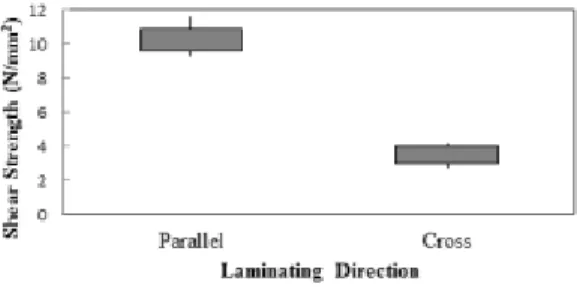
Cross laminated timber (CLT) has been an rising issue as a promising building material replacing steel-concrete in mid story rise construction. But, there was no specific standard for CLT because it had been developed in industrial section. Recently, new draft for requirements of CLT was proposed by EN which suggested to evaluate the performance of adhesive in CLT by the same method as glulam. But, it has been reported that shear performance of cross laminated timber is governed by rolling shear. There- fore, block shear tests were carried out to compare parallel to grain laminating and cross laminating using commercial one component PUR (Poly urethane resin). The result showed that the current glulam standard for evaluating bonding performance is not appropriate for CLT. Beacause shear strength of cross lami- nating decreased to 1/3 of parallel to grain laminating and this strength was representing shear performance of wood itself not the bond. However, cross laminating showed no significant effect on wood failure.
Thus, wood failure can be used as a requirement of CLT bonding. Based on the results, cross laminating effect should be included when evaluating adhesive performance of CLT correctly and should be con- sidered as an important factor.
Keywords : cross laminated timber, shear strength, wood failure, adhesive, PUR
1. INTRODUCTION
Demand on wood construction has been in- creasing by the governmental policy called
“green growth” followed by increasing interest in wood construction. This situation has been accel- erated by worldwide regulation such as Green House Gas Mitigation and Low Carbon Footprint.
Recently, some construction companies are throw- ing effort to develop timber housing complex in suburban area for meeting increasing demands.
However, high cost and poor knowledge about wood can be obstacles for customers to hesitate making their choices.
Cross laminated timber (CLT) was first de- veloped in 1970s in Europe, but it took 30 years to commercialize and start mass production along with increasing concern on environmental issues.
As proved in Europe, CLT can be an out- standing solution for stationary timber construc- tion market in Korea. It can be applied to single housings, multi-story housings and also indust- rial buildings which require long span. More- over, CLT was proven to be more economical than concrete building when it comes to mid- rise building. It is easy to construct and fast in construction than concrete building. Less waste and embodied energy make CLT more environ- ment-friendly material.
However, there is no specific standard for CLT because it had been developed in industrial section. So many researchers in Europe and North America has been working on developing standard for making CLT and it is still under development or draft is completed. Two impor- tant things affecting performance of CLT are timber and adhesive. Timber should be selected by their structural requirement and adhesive should be selected by their end-use environ- ment. Regardless of their environment in use, adhesive should not fail and has to satisfy speci- fic requirement. So far, industrial section is using the adhesive such as PUR (Poly urethane resin) and PRF (Phenol resorcinol formaldehyde) commonly used in glulam and the proposed drafts also suggests to evaluate the performance
of adhesive in CLT by the same method as glulam. But Blass H. J. (2011) reported that struc- tural behavior of CLT is governed by rolling shear and failure by the rolling shear occurs only in cross laminating. Therefore, this study is focusing on difference in evaluation of adhesive performance between glulam and CLT. More- over, it is aimed to investigate whether Korean standard for glulam is appropriate for CLT.
2. Materials and Methods
2.1. Materials
Japanese Red pine (Pinus densiflora) was se- lected as species for making samples and the moisture content and oven-dried density were 12.16 ± 0.73% and 460 ± 20 kg/m
3, respect- ively. One-component Polyurethane (PUR) was selected as adhesive because it is commonly used for CLT in Europe and convenient as it does not require hardener. P84 (OTTO CHEMIE, Germany) has very high bond strength and has been used to manufacture laminated wood pro- ducts and it has already passed weathering resist- ant test (DIN EN 204-D4). Technical Data Sheet (TDS) which includes detailed bonding condition has to be presented by each manufacturer of ad- hesives and TDS of P84 is shown in Table 1.
Therefore, specimens were made following the TDS and KS F 3021 (Structural Glued Lami- nated Timber) because there is no certified ad- hesive standard for cross laminated timber until now.
2.2. Block Shear Test
Block shear test was conducted following KS
F 3021 to evaluate bonding performance of glue
line. The performance is evaluated by shear
strength of glue line and percentage of wood
failure. Test specimen were manufactured in two
Table 1. Technical Data Sheet of P84 P84
Open time (min) 20
Processing temperature (°C) not below +5 Viscosity at 23°C (mPas) 2,000
Density at 23°C (g/cm
3) 1.23 Pressing time at 23 °C (min) 30
Pressure (kg/cm
2) 10 Amount of adhesive (g/m
2) 175 Recommended wood humidity (%) 12 (8 - 16)
Shelf life at 23°C/50% RAH in original, unopened packagings
(months)
12
Fig. 1. TSchematics of Specimen (Parallel laminat- ing - left, Cross laminating - right).
Table 2. Standard for Glu-lam about Shear Stress and Wood Failure in Block Shear Test (KS F 3021)
SpeciesGroup Shear Stress (N/mm
2)
Wood Failure (%)
A, B 7.1 65
C 5.9 65
D 5.3 70
A: Larch, B: Pine, C: Nut Pine, D: Cedar
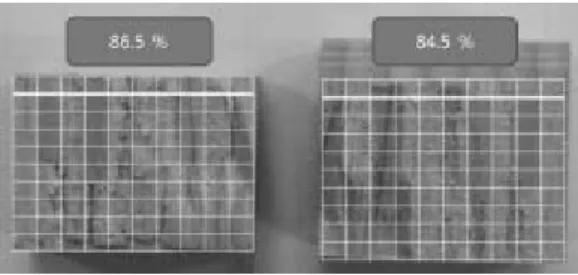
Fig. 2. Measuring of Wood Failure (Parallel lami- nating, Specimen No. 12).
different ways to evaluate cross laminating effect on bonding performance as shown in Fig. 1.
Universal testing machine (Zwick, max 980N, Germanu) was used to apply load to a specimen and the loading rate was 2 mm/min.
Adhesive performance can be evaluated by measuring shear strength and wood failure. Di- fferent requirements are specified for each group of species in KS F 3021 related to glulam. The species of this study (Pinus densiflora) is cate- gorized in group B, therefore shear strength should be higher than 7.1 N/mm
2and wood failure should be larger than 65% to satisfy Korean Standard.
The first standard which was implemented in the world, EN (Euro code) 16351 draft, also re- quires to satisfy the requirement of glulam. The requirement is presented in Table 3.
2.2.1. Shear Strength and Wood Failure Shear strength was calculated using eqation (1).
(1)
where,
f
v: shear strength (N/mm
2) P
max: Maximum load (N) A
v: Shear area (mm
2)
Wood failure was measured in 0.5% level by making grid and applying it on both bonding sur- face. Then the average value of both sides were taken as wood failure according to ASTM D 5226-99. Wood failure can be calculated using eqn. 2.
× (2)
Table 3. Minimum wood failure percentages relating to the shear strength f
vaAverage Individual values
Shear strengh f
v(N/mm
2) 6 8 f
v≥11 4 ≤ f
v≤ 6 6 f
v≥10
Minimum wood failure percentage (%)
b90 72 45 100 74 20
a
For values in between linear interpolation shall be used
b