한국컴퓨터정보학회 하계학술대회 논문집 제19권 제2호 (2011. 6)
45
파노라믹 영상 구축을 위한 동적 객체 추출과 궤도 표현
신성윤*, 장대현*, 신광성○, 이현창**, 이양원*
*○군산대학교 컴퓨터정보공학과
**원광대학교 정보전자상거래학부
e-mail: {s3397220, ywrhee}@kunsan.ac.kr, [email protected]
The Dynamic Object Detection and Trajectory Representation for Construction of Panoramic Image
Seong-Yoon Shin*, Dai-Hyun Jang*, Kwang-Seong Shin○, Hyun-Chang Lee**, Yang-Won Rhee*
*○Dept. of Computer Information Science, Kunsan National University
**Division of Information and Electric Commerce, Wonkwang University
● 요 약 ●
파노라믹 영상에슨 정적 파노라믹 영상과 동적 파노라믹 영상이 있다. 동적 파노라믹 영상을 생성하기 위해서는 먼저 카메라의 움직임을 계산한 후에 객체의 움직임을 식별해야 한다. 본 논문에서는 동적 객체를 추출하기 위하여 우선 어파인 파라미터로 카 메라의 움직임을 추출 하고, 지역적 탐색으로 객체의 움직임을 탐지한다. 영상에 동적 객체가 있는 경우 동적 객체 판별을 위하 여 영역 분할 방법을 이용하여 계산한다. 이러한 동적 객체의 궤도를 나타내기 위하여 먼저 동적 객체를 추출하는데, 4분할 탐 색 기법을 이용하여 추출하게 된다. 최종적으로 구축되어진 배경 파노라믹 영상위에 동적 객체의 궤도를 표현한다.
키워드: 동적 모자이크, 어파인 파라미터, 지역적 탐색, 4분할 탐색
I. Introduction
The easiest method in that create mosaic image is that consisted transfer only between images. Images moved so only can be implemented easily on minimum restriction, and mosaic of high resolution that quality is high of mosaic image can be created, and advantage is as well as computing time is fast [1-4].
Camera motion must be measured necessarily to construct mosaic. One of the camera motion estimation is a method that performs through parameter calculation of camera that uses optical flow [5, 6]. Also, motion models that used to extract camera parameter have used as two-dimensions parameter motion model and complicated three-dimension motion model [5]. Affine model that can measure rotation at the same time including movement and scaling among 2 dimensions motion model is utilized most in camera parameter measuring [7].
II. Dnamic Panoramic Image
2.1 Affine Model
Camera parameter including rotation, scaling and movement
of image is measured by using affine model based on the most similar pixel value that is detected by using Equation (1).
⎟⎠
⎜ ⎞
⎝ + ⎛
⎟⎠
⎜ ⎞
⎝
⎟⎛
⎠
⎜ ⎞
⎝
= ⎛
⎟⎟⎠
⎜⎜ ⎞
⎝
⎛
f e y
x d c
b a y
x
' '
(1)
2.2 Detect Dynamic Object
Simple method that can think most usually is that object is occupying middle of screen mainly when camera takes an important object. So, similarity is measured by based on macro block of outer region except middle of base image in this method.
Fig. 1. Macro Block of Base Image
Fig. 1 shows macro block of base image for comparison.
Each macro block selects macro block by non-linear as central
한국컴퓨터정보학회 하계학술대회 논문집 제19권 제2호 (2011. 6)
46
outer region of cross shape. Preferential assumption is that the size of object does not occupy half of image. This is algorithm that detect dynamic object by setting macro block.
(1) Input two image (frame);
(2) Similarity measure of macro block 1, 2, 3 and 4;
If (value of least sum of square difference< threshold) Then {measure of motion vector; goto (3);}
Else goto (1);
(3) If (motion vector is similar to all four macro block) Then {camera parameter = motion vector; goto (4);}
Else {measure of motion vector by extending to macro block 5, 6, 7 and 8; goto (4);}
(4) Measure of camera parameter through affine transformation;
(5) Local difference operation between two images
2.3 Least Sum of Square Difference
First, must extract correct camera parameter to look for similarity between two images, this paper proposes least sum of square difference about fixed window block as Equation (2).
∑∈
+ +
− +
=
W b
k j
i X b I X b d
I C
E( ) [ ( ) ( )]2 (2)
2.4 Local Difference Operation
By next time, must detect movement of object, local detection must perform for this. Method to present in this paper performs by comparison through difference operation using motion vector and macro block between two images with camera motion that is calculated, as Equation (3).
∑∈
+ +
−
− +
=
W b
k j
i X b I X u k b d
I O
E( ) [ ( ) ( ( ) )]2 (3)
2.5 Region Splitting
In Fig. 2, if suppose that b and c region of two images show similar region between two images, following assumption is followed for detecting dynamic object. First, if some part of a region and some part of region c or d is corresponded, this region becomes object. Second, it some part of region b and d is corresponded, this region becomes dynamic object. Finally, conflicting region between region b and c that corresponding between two images becomes object.
a b
c d
Fig. 2. Region Splitting for Dynamic Object Detection
2.6 4-Split Detection
Dynamic object extraction is that extract only dynamic object by detection of similar region that existing dynamic object in two images. If value of difference image between two similar region is large, there is assumption that dynamic object is existed within two images. As shown in Fig. 3, region of 1 quadrant is calculated and compared. If value of difference image is small, computation proceeds to 2 quadrants and so on continuously. Size of dynamic object ignores object fewer than smallest 7×7 pixel size, and when multiple dynamic objects are detected, the largest dynamic object between them is extracted. Detection process is performed up to last 8×8 block and dynamic object region is created by sum of blocks.
Fig. 3. 4-Split Detection Method
2.7 Dynamic Trajectory Description and Blurring Background image composition compose only remainder background image after dynamic object extraction. At this time, background part of other remainder image is inserted on part of extracted dynamic object. After create background mosaic image, the description of dynamic object express object that distance is more than 1.5 times of maximum width and height size of the extracted object. Evaluation function that present in this paper is as shown in Ex. 4.
if (A>1.5B)then describe dynamic object where A=Ii(x2, y2)-Ii-1(x1,y1)
B=Length(OMAX[(x1,x2),(y1,y2)])
(4)
In Ex. 4, after calculating maximum size (OMAX) of dynamic object, when dynamic object moved to right, it is described if distance difference ((Ii(x2, y2) - Ii-1(x1, y1))) between left region of present image and right region of
한국컴퓨터정보학회 하계학술대회 논문집 제19권 제2호 (2011. 6)
47 preceding image is more than 1.5 times of maximum object
size.
Blurring creates visually smoothing mosaic image using the most general method that sum of whole mask set to 1 using 3 x 3 mask on the border part where each image may integrated.
Ⅲ. Experimental Result
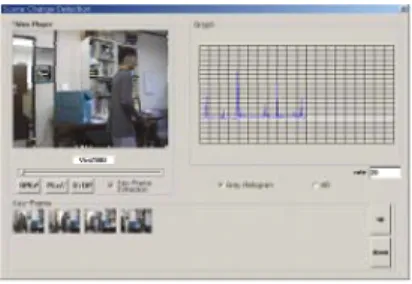
Experiment that construct dynamic mosaic image in video that dynamic object exists is as following. First, Figure 4 is window that extract key frame by proposed scene change detection method for a video 30 seconds long that dynamic object exists in it.
Fig. 4. Scene Change Detection
Figure 5 is dynamic mosaic image that describing dynamic object. When dynamic object is moved more than 80 pixels by an experiment, dynamic object is appeared in mosaic image.
Fig. 5. Dynamic Mosaic Image
Ⅳ. Conclusion
Camera parameter measured by utilizing least sum of square difference and affine model, and difference image is used for similarity measure of two input images. Dynamic objects are detected by through macro block setting and extracted by using region splitting and 4-split detection methods. And soft mosaic image is constructed through blurring after used dynamic trajectory evaluation function for expression of dynamic object.
This tree-based mosaic system presented foundation that can reduce time and storage space to construct video database.
Reference
[1] Tekalp A., Ozkan M., Sezan M.: High-Resolution Image Reconstruction from Lower-Resolution Image Sequences and Space-Varying Image Restoration, Proc. of IEEE International Conference on Acoustics, Speech, and Signal Processing, March 23-26, pp. III-169-172, 1992.
[2] Teodosio L., Bender W.: Salient Video Stills : Content and Context Preserved, Proc. ACM Multimedia Conf., 1993.
[3] Gulrukh Ahanger, Thomas D.C.Little: A Survey of Technologies for Parsing and Indexing Digital Video, Journal of Visual Communication and Image Representation, Vol. 7, No.1, March, pp. 28-43, 1996.
[4] Heeger D. J.: Optical Flow Using spatiotemporal Filters, International Journal of Computer Vision, pp. 279-302, 1998.
[5] Heung-Yeung Shum, Richard Szeliski: Panoramic Image Mosaic, MSR-TR-97-23, 1997.
[6] Richard Szelisk, Shum H.: Creating Full View Panoramic Image Mosaics and Environment Maps, In Proc. of SIGGRAPH, pp. 251-258, 1997.
[7] Teodosio L., Bender W.: Salient Video Stills : Content and Context Preserved, Proc. ACM Multimedia Conf., 1993.