Evaluation of Antioxidant and Anticancer Activity of Steam Extract from The Bamboo Species
1Ji-Su Kim2⋅Hyung Chul Lee2⋅Jong-Soo Jo3⋅Ji Young Jung2⋅Yeong Lea Ha4⋅and Jae-Kyung Yang2,†
ABSTRACT
Natural plant extract has been the subject of intense research aiming in elucidating the underlying mechanisms of their chemopreventive effects upon various forms of human cancers. The objective of our study was to evaluate the natural antioxidants and anticancer agent potential of Phyllostachys. The chemical composition of steam extract from Phyllostachys was carried out using GC-MS. The steam extract of Phyllostachys was dominated by monoterpenes (62.96% - 71.36%) and sesquiterpenes (23.58% - 33.13%) as the main compounds. The antioxidant activities of the steam extract was determined using a DPPH scavenging and hydrogen peroxide scavenging activity test systems.
Furthermore, the amounts of total phenolics in steam extract were determined spectrometrically The steam extract of P. pubescens and P. bambusoides were presented the high activity (69.4% and 64.0%, respectively.). The steam extract from Pyllostachys species showed a hydrogen peroxide scavenging activity of approximately 50.4% - 54.6% when compared to that of the standard gallic acid. The anticancer activities of steam extract were determined using a MTT assay. Assessment of the cytotoxic effect of the steam extract on PC-3 cells showed that the P. bambusoides (20.85%) and P. pubescens (20.41%) were superior in induced cytotoxicity compared with the steam extract of P. nigra var. he- nonis (1.15%). Findings from this study indicated that steam extract of P. bambusoides and P. pubescens possessed potential as medicinal drug especially in prostate cancer treatment.
Keywords : Phyllostachys, antioxidant, anticancer, polyphenol, volatile compounds
1 Date Received February 21, 2014, Date Accepted March 18, 2014
2 Division of Environmental Materials Secience, Gyeongsang National University, Institute of Agriculture & Life Science, Jinju, Korea.
3 Department of Interior Materials Engineering, Gyeongnam National University of Science and Technology, Jinju, 660-758, Korea
4 Division of Applied Life Science (BK21 Program), Graduate School, and Institute of Agriculture & Life Science, Gyeongsang National University, Jinju, Korea
† Corresponding author : Jea-Kyung Yang (e-mail: [email protected])
1. INTRODUCTION
In recent years, the morbidity and mortality of cancer still reach a high plateau and is a major pub- lic health problem worldwide. One among the many
reasons for the conversion of normal cells to cancer- ous cells are the free radicals that are generated (Halliwell et al. 1992) in the human body as a con- sequences of a number of endogeneous metabolic processes involving redox enzymes and bioenergetic
electron transfer and exposure to a plethora of exo- geneous chemicals. In vivo, some of these reactive oxygen species (ROS) play positive roles in cell physiology. Under normal circumstances, the ROS generated are detoxified by the innate defense anti- oxidant enzymes present in the body. However, ow- ing to ROS overproduction and inadequate anti- oxidant defense, they may cause great damage to cell membranes by lipid peroxidation and induce mutations in DNA leading to cancer and other dis- eases (Aqil et al. 2006). Antioxidants may mediate their effect by directly reacting with ROS (Shukla et al. 1997).
Antioxidants reduce the oxidative stress in cells and are therefore useful in the treatment of many human diseases like cancer, cardiovascular and in- flammatory diseases. Traditionally lipid oxidation controlled by the addition of powerful synthetic anti- oxidants such as butylated hydroxy anisole (BHA) and butylated hydroxy toluene (BHT) (Monahan and Troy, 1997). However, new toxicological data on some synthetic antioxidants has led to caution re- garding their use, as evidence has shown that they possess toxic, pathogenic and carcinogenic effects (Amarowicz et al. 2000). Hence, many recent inves- tigations have been targeted at the identification of alternative novel antioxidants from natural sources which have similar properties (Hossain et al. 2008).
Some components in natural products such as car- otenoids, flavonoides, anthocyanins and phenolic compounds are known to function as scavengers in both primary and secondary oxidation process. In particular, it has been reported that potential anti- oxidants exist in a number of natural plant extract including grapes, green teas, berries, tomatoes and rosemary (Gahler et al. 2003; Nielsen et al. 2003).
Plants are also reported to possess metabolites ca- pable of inducing apoptosis considered to be vital for targeted drug therapies (Amirghofran et al.
2007). Natural products are a rich resource of cancer chemotherapy drugs, and primarily target rapidly cy- cling tumor cells, experimental studies demonstrated that many naturally occurring agents and plant ex- tract have anticancer potential in a variety of bio- assay systems and animal models, having relevance to human diseases (Aziz et al. 2003), thus the long- standing interest in the identification of medicinal plants and derived natural products for developing cancer therapeutics increased steadily (Dai et al.
2011).
Plant extraction compounds have played an im- portant role in the development of several clinically useful anti-cancer agents. The discovery of paclitaxel from the bark of the Pacific yew, Taxus brevifolia Nutt. (Taxaceae) is another evidence of the success in natural product drug discovery (Luduena, 1998).
Paclitaxel is significantly active against ovarian can- cer, advanced breast cancer, small and non-small cell lung cancer (Mehndiratta et al. 2011).
Taken together natural plant extract have been the subject of intense research aiming in elucidating the underlying mechanisms of their chemopreventive ef- fects upon various forms of human cancers (Ziech et al. 2011).
Bamboo is a perennial plant of the Gramineae family, and is a giant, woody grass that grows in Korea, China, Japan, and Southeast Asia, and repre- sents an important commodity (Choi et al. 2008).
There are approximately 75 species and 200 varieties of Phyllostachys.
Some biologically active components in bamboo extract and their potential health benefits have re- cently been studied. The ethanol or water extract of bamboo leaves mainly contains flavone glycosides, phenolic acids, coumarone lactones, anthraquinones, and amino acids, and has also been utilized clin- ically in the treatment of hypertension, arterio- sclerosis, cardiovascular disease, and certain forms of
cancer (Shibata et al. 1975). Wang and Ng (2003) reported on the antifungal protein isolated from bam- boo shoots. Bamboo shoots are also regarded as a dietary source of natural phenolic antioxidants, par- ticularly exhibiting dose-dependent inhibitory activity on angiotensin-converting enzymes (Park and Jhon 2010). In particular, the bamboo leaves have also been used as a clinical traditional medicine, mainly to lessen or cure stomach ache, diarrhea, and vomit- ing, chest diaphragm inflammation, restlessness, and excessive thirst (Lu et al. 2005). Many papers have indicated that a bamboo extract has multiple bio- logical effects, such as anti-free radical, anti-oxida- tion, anti-aging, anti-bacteria, anti-cancer and cos- metic ingredient (Tang and Ding 2000). Although many researchers have attempted to study the bio- logical activities of bamboo extract, only a few stud- ies have reported on the evaluation of an extract from bamboo species.
In the present study, we investigated the uti- lization of Phyllostachys spp. such as Phyllostachys bambusoides, Phyllostachys pubescens and Phyllostachys nigra var. henonis as sources of natural antioxidants and anticancer agents. Therefore, the chemical com- position, antioxidant activity (DPPH radical scaveng- ing activity, hydrogen peroxide scavenging activity and total phenolic content) and anticancer activity of steam extracts from isolated Phyllostachys species were examined.
2. MATERIALS and METHODS
2.1. Plant MaterialHealthy, mature bamboo of P. bambusoides, P.
pubescens and P. nigra var. henonis were collected from natural populations in Gyeongsang National University Campus, in Korea. The collection of bam- boo was done during July to August in 2012. The
bamboo leaves were cut into 1 cm × 3 cm pieces with a scissors and preserved in refrigerator to be used within 12 hours.
2.2. Preparation of Extract
The extract was prepared using steam distillation (Yang et al. 2009). The fresh bamboo leaves (based on dry weight, 100 g of each) were added with 3 L of distilled water. And extraction was carried out with Gas-Assisted Process (GAP, K22D-10L, Japan) apparatus using liquefied petroleum gas as a heating source for 100 min. The steam extract was obtained by GAP was stored at refrigerator (4, ℃ below) be- fore subsequent experiments. The yield of steam ex- tract of P. bambusoides, P. pubescens and P. nigra var. henonis were 9.4%, 11.0% and 3.5%, respectively.
2.3. GC-MS Analysis
The steam extract (2 mℓ) was placed in a 22 mℓ round-bottomed vial; then the vials were sealed with aluminium-rubber septa (Agilent Technologies Inc., USA). GC-MS consisted of an Perkin Elmer Clarus 600 gas chromatograph (Perkin Elmer, USA) equip- ped with DB-5MS column (30 m × 0.25 mm i.d., 0.25 µm film thickness; Agilent Technologies Inc., USA), and interfaced with Perkin Elmer Turbomass mass spectrometer (software version 4.1, Perkin Elmer, USA). Head space were as follows: oven temperature, 120℃ at 20 min; transfer line temper- ature 105℃. Temperatures were as follows: injection port, 250℃; oven, programmed at 40℃ for 3 min, then raised at 3℃/min to 220℃, and held for 4 min.
MS conditions were as follows: capillary direct inter- face temperature, 250℃; ionization energy, 70 eV;
mass range, 50 - 300 amu; scan rate, 2 scans/s.
Helium was used as carrier gas at a constant flow rate of 0.96 mℓ/min. Component identifications were
made by comparing mass spectra from the total ion-chromatogram and retention indices using NIST and Wiley GC-MS libraries.
2.4. Determination of Antioxidant Activity
2.4.1. DPPH Radical Scavenging Activity The steam extract was tested for their ability to scavenge DPPH radicals by DPPH radical scaveng- ing assay as described by Burits and Bucar (2000).
The steam extract from bamboo (0.5 mℓ) were mixed with 3 mℓ of 0.1 mM DPPH in ethanol was added to each tube and incubated in dark at room temperature for 30 min. Absorbance was read at 517 nm using a U-3000 UV-Spectrophotometer (Hitachi Inc., Japan). The radical scavenging activity was cal- culated as a percentage of DPPH discoloration using the following equation:
Radical scavenging activity (%) = (Ac - A)
× 100 (1) Ac
where Ac is the absorbance of the control and A is the absorbance of the steam extract. BHT and quer- cetin were used as standard compound. All measure- ments were performed in triplicate.
2.4.2. Hydrogen Peroxide Scavenging Activity A modified method based on that of Ruch et al.
(1989) was used to determine the ability of the steam extract to scavenge hydrogen peroxide.
Hydrogen peroxide (43 mM) was prepared in phos- phate-saline buffer (pH 7.4). Standards (gallic acid) and steam extract solutions were prepared at concen- trations of 0.1 to 1.0 mM. Aliquots of standard or steam extract solutions (3.4 mℓ) were added to 0.6 mℓ of hydrogen peroxide solution. The reaction mixture was incubated at room temperature for 10 min, and the absorbance was determined at 230 nm.
Blank solution contained the phosphate buffer with- out H2O2. The percentage of H2O2 scavenging was calculated as:
% H2O2 scavenging effect (%) = (Ac - A) × 100 (2) Ac
where Ac is the absorbance of the control and A is the absorbance in presence of standard or steam extracts. All measurements were performed in triplicate.
2.4.3. Determination of Total Polyphenol Content
Total polyphenol content was determined by the method described by Lister and Wilson (2001). The steam extract (0.5 mℓ) were mixed with 2.5 mℓ of Folin-Ciocalteau reagent and 2 mℓ of sodium carbo- nate (7.5% w/v) were added and the tubes incubated at 45℃ for 15 min. Absorbance were read at 765 nm using a U-3000 UV-spectrophotometer (Hitachi, Inc., Japan). All measurements were performed in triplicate. Results were expressed in terms of gallic acid equivalence in µg/mℓ.
2.5. Determination of Anticancer Activity
2.5.1. Cell Cultures
Human prostate adenocarcinoma PC-3 cells (PC-3 cell) were cultured in RPMI-1640 medium supple- mented with 10% FBS (v/v) and penicillin (100 U/mℓ)/
streptomycin (100 mg/mℓ). Cultures were maintained in a humidified incubator at 37℃ in 5% CO2/95% air.
2.5.2. MTT Assay Method
The in vitro cytotoxicity of steam extract from bamboo on PC-3 cells was measured with an MTT assay (Prencipe et al. 2009), as described. Briefly, cultured PC-3 cells were harvested, counted and plat-
ed (1 × 10⁴ cells/well) in a 24-well plate and make up to 500 µℓ with media.
After 24 hours of incubation to allow for attach- ment, different concentrations 0 and 40 µℓ of steam extract samples were added to each well in duplicate.
After the indicated incubation times, the medium was removed and 100 µℓ of MTT solution (0.5 µg/mℓ in phosphate-saline buffer) was added to each well for 3 hours. Subsequently, MTT solution add 200 µℓ of dimethyl sulfoxide (DMSO) transfer to 100 µℓ/well of 96 well were measured by absorb- ance at 570 nm with ELISA reader (Spectra Max 250, USA).
2.6. Statistical Analysis
The means and standard deviations of the data were calculated. Evaluations of each group’s sig- nificance were performed using SAS ver. 9.1 (SAS Institute, Cary, NC, USA) at the 5% significance level with Duncan’s multiple range test.
3. RESULTS and DISCUSSION
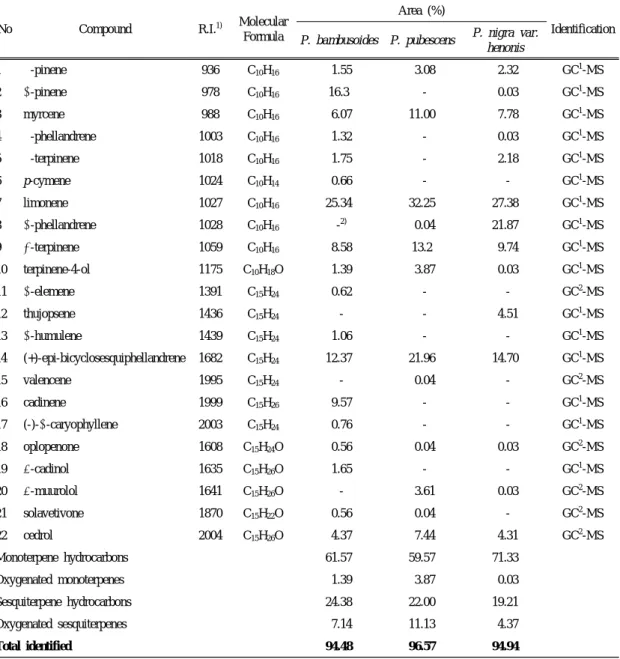
3.1. Chemical CompositionsThe steam extract was analyzed by GC-MS and the components were identified on the basis of their RI values and by comparison of their mass spectra with those reported in the literatures. The GC-MS analysis of the steam extract led to the identification of 22 different components, representing 94.46% - 96.57% of total volatile constituents.
Eighteen compounds were identified in steam ex- tract of P. bambusoides, which accounted for 94.48%
of the total amount; the major constituent was limo- nene (25.34%), followed by β-pinene (16.30%), (+)-epi-bicyclosesquiphellandrene (12.37%), cadinene (9.57%), γ-terpinene (8.58%) and myrcene (6.07%).
The GC-MS analysis of steam extract from P. pu- bescens showed 12 compounds representing 96.57%
of the total amount; limonene was the main con- stituent (32.25%) followed by (+)-epi-bicyclosesqui- phellandrene, γ-terpinene, myrcene and cedrol (21.96%, 13.20%, 11.00% and 7.44%, respectively). In the steam extract of P. nigra var. henonis, 14 constituents represented 94.94% of the total amount; the major constituent was limonene (27.38%), followed by β-phellandrene (21.87%), (+)-epi-bicyclosesqui- phellandrene (14.70%), γ-terpinene (9.74%) and myrcene (7.78%).
The major class of substances in the steam extract of P. bambusoides, P. pubescens and P. nigra var.
henonis were the monoterpene compound (62.96%, 63.44% and 71.36%, respectively), followed by ses- quiterpene compounds (31.52%, 33.13% and 23.58%, respectively). Limonene and (+)-epi-bicyclosesqui- phellandrene were the main constituents in the all species. Lu et al. (2003) reported that limonene showed antiangiogenic and proapoptotic effects on human gastric cancer implanted in nude mice, thus inhibiting tumor growth and metastasis. Misra et al.
(2013) reported that (+)-epi-bicyclosesquiphellan- drene showed antimicrobial and anticancer activities.
Kim et al. (2004) reported that the tea tree (Melaleuca alternifolia) oil has been suggested as a natural antioxidant alternative for BHT with the inherent antioxidant activity attributed mainly to the monoterpenes content such as α-terpinene and γ-terpinene. Tan et al. (2000) reported that sig- nificant effect on the treatment of glioma was re- ported using the sesquiterpenes which is found in small amounts in many essential oils: it prolonged quality survival time of patients with glioma. In ad- dition, in vitro anticancer activity of oxygenated ter- pinene have been reported (Kim et al. 2004; Wu et al. 2012).
There was a variability in the chemical composi-
No Compound R.I.1) Molecular Formula
Area (%)
Identification P. bambusoides P. pubescens P. nigra var.
henonis
1 α-pinene 936 C10H16 1.55 3.08 2.32 GC1-MS
2 β-pinene 978 C10H16 16.3 - 0.03 GC1-MS
3 myrcene 988 C10H16 6.07 11.00 7.78 GC1-MS
4 α-phellandrene 1003 C10H16 1.32 - 0.03 GC1-MS
5 α-terpinene 1018 C10H16 1.75 - 2.18 GC1-MS
6 p-cymene 1024 C10H14 0.66 - - GC1-MS
7 limonene 1027 C10H16 25.34 32.25 27.38 GC1-MS
8 β-phellandrene 1028 C10H16 -2) 0.04 21.87 GC1-MS
9 γ-terpinene 1059 C10H16 8.58 13.2 9.74 GC1-MS
10 terpinene-4-ol 1175 C10H18O 1.39 3.87 0.03 GC1-MS
11 β-elemene 1391 C15H24 0.62 - - GC2-MS
12 thujopsene 1436 C15H24 - - 4.51 GC1-MS
13 β-humulene 1439 C15H24 1.06 - - GC1-MS
14 (+)-epi-bicyclosesquiphellandrene 1682 C15H24 12.37 21.96 14.70 GC1-MS
15 valencene 1995 C15H24 - 0.04 - GC2-MS
16 cadinene 1999 C15H26 9.57 - - GC1-MS
17 (-)-β-caryophyllene 2003 C15H24 0.76 - - GC1-MS
18 oplopenone 1608 C15H24O 0.56 0.04 0.03 GC2-MS
19 τ-cadinol 1635 C15H26O 1.65 - - GC1-MS
20 τ-muurolol 1641 C15H26O - 3.61 0.03 GC2-MS
21 solavetivone 1870 C15H22O 0.56 0.04 - GC2-MS
22 cedrol 2004 C15H26O 4.37 7.44 4.31 GC2-MS
Monoterpene hydrocarbons 61.57 59.57 71.33
Oxygenated monoterpenes 1.39 3.87 0.03
Sesquiterpene hydrocarbons 24.38 22.00 19.21
Oxygenated sesquiterpenes 7.14 11.13 4.37
Total identified 94.48 96.57 94.94
1) Retention indices relative to C9-C24 n-alkanes on the DB-5MS column; GC1: Identification based on retention times of authentic compounds on DB-5MS column; GC2: Retention index according to literature; RI: Kovats retention index according to n-alkanes (C9-C24) on the DB-5MS column
2) Not detected.
Table 1. Chemical composition of steam extract from Phyllostachys species
tion of steam extract obtained from Phyllostachys species. These more qualitative, less quantitative dif- ferences in the volatile composition are primarily de-
termined by genetic and environmental factors and influenced by the analytical procedures applied (Walden et al. 2004).
Fig. 1. The DPPH radical-scavenging activity of steam extract from Phyllostachys species. Results are expressed as percentage decrease in absorbance at a wavelength of 517 nm with respect to the control.
BHT and quercetin were used as a standard. Each value represents mean ± SD of three experiments, per- formed in triplicate. Different labels (a - d) indicate a significant difference at p < 0.05 (Control: BHT, quercetin).
Fig. 2. The hydrogen peroxide scavenging activity of steam extract from Phyllostachys species. Results are expressed as percentage decrease in absorbance at a wavelength of 230 nm with respect to the control. Each value represents mean ± SD of three experiments, performed in triplicate (Control: gallic acid).
3.2. Antioxidant Activity
Antioxidants are believed to have an important role in the maintenance of human health by render- ing protection against the constant and unavoidable challenge of reactive oxygen species (Fridovich, 1998). And at least two testing systems have been recommended to deduce the antioxidant activities of crude plant extract owing to the complex nature of phytochemicals present (Schlesier et al. 2002).
Accordingly, the present study employed two differ- ent antioxidant testing systems (DPPH and hydrogen peroxide scavenging) to confirm the antioxidant po- tentials of the steam extract from Phyllostachys species.
The steam extract of Phyllostachys species was tested to determine their ability as DPPH scavenging activity was depicted in Fig. 1. All the tested steam extracts more than 57.7% of DPPH scavenging activities. For each Pyllostachys species, the DPPH scavenging activity showed the following order: P.
pubescens > P. bambusoides > P. nigra var. henonis.
The steam extract of P. pubescens and P. bambu- soides were presented as the high activity (69.4%, 64.0%) and their DPPH scavenging activities were significantly different from each other (p < 0.05).
Our results showed that the steam extraction worked better than the hot water extracting phytochemical from the Phyllostachys species leaves (below 4.4%) used in the work of Kim et al. (2001) on DPPH scavengingt activities. Choi et al. (2008) reported on the antioxidant effects of bamboo trees oil from P.
nigra var. henonis, P. pubescens and P. bambusoides were investigated, and the results show that the DPPH scavenging rate follows the order of P. bam- busoides (100%) > P. nigra var. henonis (94.7%) >
P. pubescens (92.8%). The reason where the result is different becomes supposed to influence of different extraction method.
The hydrogen peroxide activities of the steam ex- tract from Phyllostachys species compared with gal- lic acid have been exhibited in Fig. 2. The steam ex-
Species Total polyphenol content (μg/mℓ) P. bambusoides 69.2 ± 3.5a1)
P. pubescens 63.3 ± 2.0ab
P. nigra var. henonis 59.8 ± 1.2c
1) Values with different alphabets in the same column are sig- nificantly different at p < 0.05.
Table 2. Total polyphenol content of steam extracts from Phyllostachys species
Fig. 3. Cytotoxic activity of steam extracts from Phyllostachys species using MTT assay (Control: not treated).
tract from Pyllostachys species showed a hydrogen peroxide scavenging activity of approximately 50.4%
- 54.6% when compared to that of the standard gal- lic acid. The steam extract of P. bambusoides has given the higher scavenging activity for hydrogen peroxide. And, the steam extract of P. pubescens and P. nigra var. henonis have not presented any sig- nificant differences between them (p < 0.05).
The total polyphenol content present in steam ex- tract was measured using gallic acid as standard samples (Table. 2). According to the results, the total polyphenol contents of steam extract of P. bambu- soides and P. pubescens were 69.2 µg/mℓ and 63.3 µg/mℓ, respectively. While total polyphenol content of P. nigra var. henonis extract was 59.8 µg/mℓ showing lower levels than P. bambusoides and P.
pubescens steam extract.
Plant phenolic compounds have been found to possess potent antioxidant (Park and Jhon, 2010), an- timicrobial (Zaouali et al. 2010) and anticancer ac- tivities (Mehndiratta et al. 2011). Many studies have conclusively shown close relationship between total phenolic contents and antioxidative activity of natu- ral plants (Velioglu et al. 1998). DPPH scavenging activities found in the steam extract of P. bambu- soides and P. pubescens (64.0 - 69.4%) imply the role of phenolic compounds in contributing these activities. The determination of total phenolic content is an important parameter to estimate the amount of antioxidants. However, in this study, the total phe-
nolic contents was not in agreement with the hydro- gen peroxide scavenging activity. This may be ex- plained by the fact that different types of phenolic compounds posses different antioxidant capacities which is related to their chemical structure. For ex- ample, the previous researches showed that phenolic compounds with ortho- and para- dihydroxylation or a hydroxy and a methoxy group or both have stron- ger antioxidant activity than simple phenolics (Hossain et al. 2011). Also, The antioxidant effi- ciency of volatile compounds was reported in many previous works (Bourgou et al. 2008; Zaouali et al.
2010) and seems to be related to the activity of some kinds of compounds enclosed in such as oxy- genated monoterpenes, especially alcohols and phe- nols than polyphenol content.
3.3. Anticancer Activity (PC-3 cells)
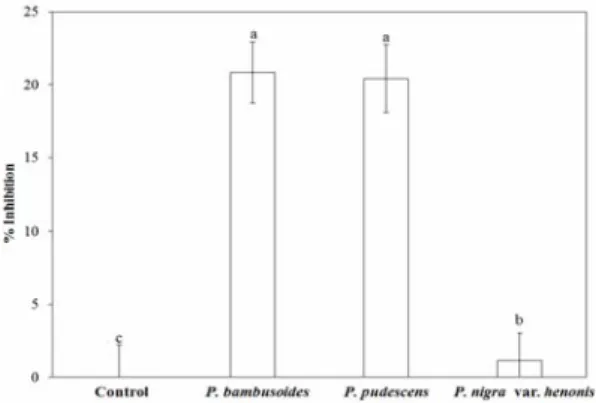
The effect of steam extract from Phyllostachys species on the growth of PC-3 cells as determined by the MTT assay was given in Fig. 3. Assessment of the cytotoxic effect of the steam extract on PC-3 cells showed that the P. bambusoides (20.85%) and P. pubescens (20.41%) were superior in induced cy-
totoxicity compared with the steam extract of P. ni- gra var. henonis (1.15%).
Interestingly, in the present study, the steam ex- tract of P. bambusoides and P. pubescens were showed the higher DPPH scavenging activity, hydrogen peroxide scavenging activity and cytotoxic activity.
However, the steam extract of P. nigra var. henonis was showed the higher DPPH scavenging activity and hydrogen peroxide scavenging activity, whereas cytotoxic activity was showed the least value.
This may be explained by the fact that many pre- vious works showed biological (Dorman and Deans, 2000), antioxidant activities (Jirovetz et al. 2005) and especially anticancer activities of sesquiterpenes (Banjerdpongchai and Khaw-on, 2013). Sesquiterpenes content of steam extract from P. nigra var. henonis was 23.58% showed lower levels than steam extract of P. bambusoides (31.52%) and P. pubescens (33.13%), are shown in Table 1. Moreover, sesqui- terpenes has shown anti-inflammatory effect, anti- bacterial, antifungal and an anticancer activity (Zhang et al. 2005) in human melanoma cell lines (M14) (Calcabrini et al. 2004) and lung cancer cells have also been showed in recent studies (Wu et al.
2012).
Thus, from this study it is likely that steam ex- tract has a high cytotoxic effect in PC-3 cells, sug- gesting a potential role of P. bambusoides and P.
pubescens as a powerful chemotherapeutic agent.
However, further experiments are required to assess the apoptogenic effect of steam extract of Phyllostachys species in PC-3 cells and to define the mechanism at the molecular level. This study should help to an- swer more conclusively, whether Pyllostachys species containing sesquiterpenes would be effective in the treatment of advanced prostate cancer.
4. CONCLUSION
Antioxidant activity and anticancer activity were evaluated using steam extract of Phyllostachys species.
In conclusion, steam extract of Phyllostachys species has the highest antioxidant activities as demonstrated by DPPH scavenging and hydrogen peroxide scav- enging activities. The steam extract of P. nigra var.
henonis has low anticancer activity in PC-3 cells;
however, the strong anticancer activity was observed with steam extract of P. bambusoides and P.
pubescens. The steam extract containing sesqui- terpenes of Phyllostachys species has a therapeutic agent potential due to their antioxidant and anti- cancer activities.
ACKNOWLEDGEMENT
This study was carried out with the support of
‘Forest Science & Technology Projects (Grant No.
S211313L010140)’ provided by Korea Forest Service and partially supported by Gyeongnam National University of Science and Technology Grant in 2013.
REFERENCES
Amarowicz, R., Naczk, M., Shahidi, F. 2000.
Antioxidant activity of various fractions of non-tannin phenolics of canola hulls. Journal of Agriculture and Food Chemistry. 48: 2755∼2759.
Amirghofran, Z., Bahmani, M., Azadmehr, A., Javidnia, K. 2007. Javidnia Immunomodulatory and apoptotic effects of Stachys obtusicrena on proliferative lymphocytes. Medical Science Monitor.
13(6): 145∼150.
Aqil, F., Ahmad, I., Mehmood, Z. 2006. Antioxidant and free radical scavenging properties of twelve traditionally used Indian medicinal plants. Turkish
Journal of Biology. 30: 177∼183.
Aziz, M.H., Kumar, R., Ahmad, N. 2003. Cancer chemoprevention by resveratrol: in vitro and in vivo studies and the underlying mechanisms (review). International Journal of Oncology. 23:
17∼28.
Banjerdpongchai, R., Khaw-on, P. 2013. Terpinen-4-ol Induces Autophagic and Apoptotic Cell Death in Human Leukemic HL-60 Cells. Asian Pacific Journal of Cancer Prevention. 14(12): 7537∼
7542.
Bourgou, S., Ksouri, R., Bellila, A., Skandrani, I., Falleh, H., Marzouk, B. 2008. Phenolic composi- tion and biological activities of Tunisian Nigella sativa L. shoots and roots. Comptes Rendus Biologies. 331: 48∼55.
Burits, M., Bucar, F. 2000. Antioxidant activity of Nigella sativa essential oil. Phytotherapy Research.
14: 323∼328.
Calcabrini, A., Stringaro, A., Toccacieli, L., Meschini, S., Marra, M., Colone, M., Salvatore, G., Mondello, F., Arancia, G., Molinari, A. 2004. Journal of Investigative Dermatology. 122: 349∼360.
Choi, D.B., Cho, K.A., Na, M.S., Choi, H.S., Kim, Y.O., Lim, D.H., Cho, S.J., Cho, H. 2008. Effect of bamboo oil on antioxidative activity and ni- trite scavenging activity. Journal of Industrial and Engineering Chemistry. 14(6): 765∼770.
Dai, Z.J., Gao, J., Li, Z.F., Ji, Z.Z., Kang, H.F., Guan, H.T., Diao, Y., Wang, B.F., Wang, X.J.
2011. In vitro and in vivo antitumor activity of scutellaria barbate extract on murine liver cancer. Molecules. 16(6): 4389∼4400.
Dorman, H.J.D., Deans, S.G. 2000. Antimicrobial agent from plants; antibacterial activity of plant volatile oils. Journal of Applied Microbiology.
88: 308∼316.
Fridovich, I. 1998. Oxygen toxicity: a radical explanation. The Journal of Experimental Biology.
201: 1203∼1209.
Gahler, S., Otto, K., Bohm, V. 2003. Alterations of vitamin C, total phenolics, and antioxidant ca- pacity as affected by processing tomatoes to dif- ferent products. Journal of Agricultural and Food Chemistry. 51(27): 7962∼7968.
Halliwell, B., Gutteridge, J.M.C., Cross, C.E. 1992.
Free radicals, antioxidants and human disease:
where are we now?. Journal of Laboratory and Clinical Medicine. 119(6): 598∼620.
Hossain, M., Brunton, N., Barry-Ryan, C., Martin- Diana, A.B., Wilkinson, M. 2008. Antioxidant activity of spice extracts and phenolics in com- parison to synthetic antioxidants. Rasayan Journal of Chemistry. 1(4): 751∼756.
Hossain, M.A., Shah, M.D., Gnanaraj, C., Iqbal, M.
2011. In vitro total phenolics, flavonoids con- tents and antioxidant activity of essential oil, various organic extracts from the leaves of trop- ical medicinal plant Tetrastigma from Sabah.
Asian Pacific Journal of Tropical Medicine. 4(9):
717∼721.
Jirovetz, L., Buchbauer, G., Denkova, Z., Stoyanova, A., Murgov, I., Schmidt, E., Geissler, M. 2005.
Antimicrobial testings and gas chromatographic analysis of pure oxygenated monoterpenes 1,8-cineole, α-terpineol, terpene-4-ol and cam- phor as well as target compounds in essential oils of pine (Pinus pinaster), rosemary (Rosmarinus officinalis) and tee tree (Melaleuca alternifolia).
Scientia Pharmaceutica. 73(1): 27∼39.
Kim, H.J., Chen, F., Wu, C., Wang, X., Chung, H.Y., Jin, Z. 2004. Evaluation of antioxidant ac- tivity of Australian tea tree (Melaleuca alternifolia) oil and its components. Journal of Agricultural and Food Chemistry. 52(10): 2849∼2854.
Kim, N.K., Cho, S.H., Lee, S.D., Ryu, J.S., Shim, K.H. 2001. Functional properties and antimicrobial activity of bamboo (Phyllostachys spp.) extracts.
Korean Journal of Postharvest Science Technology.
8(4): 475∼480.
Lister, E., Wilson, P. 2001. Measurement of total phenolics and ABTS assay for antioxidant activ- ity (personal communication). Crop Research Institute, Lincoln, New Zealand.
Lu, B., Wu, X., Tie, X., Zhang, Y., Zhang, Y. 2005.
Toxicology and safety of anti-oxidant of bamboo leaves. Part 1: Acute and subchronic toxicity studies on anti-oxidant of bamboo leaves. Food and Chemical Toxicology. 43(5): 783∼792.
Lu, X.G., Feng, B.A., Zhan, L.B., Yu, Z.H. 2003.
D-limonene induces apoptosis of gastric cancer cells. Chinese Journal of Oncology. 25(4): 325∼
327.
Luduena, R.F. 1998. Multiple form of tubulin: differ- ent gene products and covalent modification.
International Review of Cytology. 178(13): 207.
Mehndiratta, S., Kumar, S., Kumar Meena, A. 2011.
A review on lants a useful source of anti-cancer drugs. Journal of Pharmacy Research. 4(1): 264
∼271.
Misra, L.N., Wouatsa, N.A.V., Kumar, S., Kumar, R.V. 2013. Antibacterial, cytotoxic activities and chemical composition of fruits of two Cameroonian Zanthoxylum species. Journal of Ethnopharmacology.
148: 74∼80.
Monahan, F.J., Troy, D.J. 1997. Overcoming sensory problems in low fat and low salt products. In A.
M. Pearson & T. R. Dutson (Eds.), Advances in meat research. Production and processing of healthy meat, poultry and fish products London:
Blackie Academic and Professional. 11: 257∼281.
Nielsen, I.L.F., Haren, G.R., Magnussen, E.L., Dragsted, L.O., Rasmussen, S.E. 2003. Quantification of anthocyanins in commercial black currant juices by simple high-performance liquid chromatography.
Investigation of their pH stability and anti- oxidative potency. Journal of Agricultural and
Food Chemistry. 51: 5861∼5866.
Park, E.J., Jhon, D.Y. 2010. The antioxidant, angio- tensin converting enzyme inhibition activity and phenolic compounds of bamboo shoot extracts.
LWT- Food Science and Technology. 43(4):
655∼659.
Prencipe, M., Fitzpatrick, P., Gorman, S., Mosetto, M., Klinger, R., Furlong, F., Harrison, M., O’Connor, D., Roninson, I.B., O’Sullivan, J., McCann, A. 2009. Cellular senescence induced by aberrant MAD2 levels impacts on paclitaxel responsiveness in vitro. British Journal of Cancer. 101: 1900∼1908.
Ruch, R.J., Cheng, S.J., Klaunig, J.E. 1989.
Prevention of cytotoxicity and inhibition of in- tracellular communication by antioxidant catechins isolated from Chinese green tea. Carcinogenesis.
10(6): 1003∼1008.
Schlesier, K., Harwat, M., Bohm, V., Bitsch, R.
2002. Assessment of antioxidant activity by us- ing different in vitro methods. Free Radical Research. 36(2): 177∼187.
Shibata, M., Yamatake, Y., Sakamoto, M., Kanamori, M., Takagi, M., Okabe, S. 1975. Pharmacological studies on bamboo grass (1): Acute toxicities, anti-inflammatory and antiulcerogenic activities of water-soluble fraction (Folin) extracted from Sasa albomarginata Makino et Shibata. Folia Pharmacologica Japonica. 71: 481∼490.
Shukla, A, Rasik, A.M., Patnaik, G.K. 1997. Depletion of reduced glutathione, ascorbic acid, vitamin E and antioxidant defence enzymes in healing cu- taneous wound. Free Radical Research. 26(2): 93
∼101.
Tan, P., Zhong, W., Cai, W. 2000. Clinical study on treatment of 40 cases of malignant brain tumor by elemene emulsion injection. Zhongguo Zhong Xi Yi Jie He Za Zhi, Chinese Journal of Integrated Traditional and Western Medicine. 20(9):
645∼648.
Tang, L.L., Ding, X.L. 2000. Extraction of bamboo amylase and its biological functions. Development and Research of Food. 21: 8∼10.
Velioglu, Y.S., Mazza, G., Gao, L., Oomah, B.D.
1998. Antioxidant activity and total phenolics in selected fruits, vegetables, and grain products.
Journal of Agricultural and Food Chemistry.
46(10): 4113∼4117.
Walden, B., McGue, M., William G, L., Alexandra, B.S., Irene, E. 2004. Identifying shared environ- mental contributions to early substance use: The respective roles of peers and parents. Journal of Abnormal Psychology. 113(3): 440∼450.
Wang, H.X., Ng, T.B. 2003. Dendrocin, a distinctive antifungal protein frombamboo shoots. Biochemical and Biophysical Research Communications. 307(3):
750∼755.
Wu, C.S., Chen, Y.J., Chen, J.J.W., Shieh, J.J., Huang, C.H., Lin, P.S., Chang, G.C., Chang, J.H.T., Lin, C.C. 2012. Terpinen-4-ol induces apoptosis in human nonsmall cell lung cancer in vitro and in vivo. Journal of Evidence-Based
Complementary and Alternative Medicine. 2012:
1∼13
Yang, Z., Luo, S., Peng, Q., Zhao, C., Yu, Z. 2009.
GC-MS analysis of the essential oil of coral gin- ger (Zingiber corallinum Hance) rrhizome ob- tained by supercritical fluid extraction and steam distillation extraction. Journal of Chromatographia.
69(7∼8): 785∼790.
Zaouali, Y., Bouzaine, T., Boussaid, M. 2010. Essential oils composition in two Rosmarinus officinalis L. varieties and incidence for antimicrobial and antioxidant activities. Food and Chemical Toxicology. 48(11): 3144∼3152.
Zhang, S., Won, Y.K., Ong, C.N., Shen, H.M. 2005.
Anti-cancer potential of sesquiterpene lactones:
Bioactivity and molecular mechanisms. Current Medicinal Chemistry - Anti-Cancer Agents. 5:
239∼249.
Ziech, D., Franco, R., Pappa, A., Panayiotidis, M.I.
2011. Reactive oxygen species (ROS)-induced genetic and epigenetic alterations in human carcinogenesis. Mutation Research. 711(1∼2):
167∼173.