745
Copyright © 2015 The Korean Society of Fisheries and Aquatic Science pISSN:0374-8111, eISSN:2287-8815
서 론
뜸부기
[Silvetia siliquosa (C.K. Tseng & C.F. Chang) E.A.
Serrão, T.O. Cho, S.M. Boo & S.H. Brawley]
는갈조류모자 반목뜸부기과에속하는다년생해조류로우리나라와일본및 중국에분포한다(Boo et al., 2010).
우리나라에서는남해안전 역과서해안의조간대암반에광범위하게군락을형성하여생 육하고있어,
손쉽게채취할수있었으나,
현재는육지와인접 한연안에서는거의보기어려울만큼군락이감소하였으며,
외 양에위치한흑산도,
추자도,
진도,
완도,
거문도등일부도서에서소규모의군락으로생육하고있는것으로알려졌다
(Gong et
al., 1999).
따라서정부에서는최근에뜸부기를보호대상해조류로지정하여일정기간
(8
월1
일-9
월30
일)
채취를금지하고있 다(NFRDI, 2009).
뜸부기는 서남해안에서는전통적으로제사상의나물재료로 이용되는등식용으로널리이용되어왔는데
,
시중에서판매되 고있는뜸부기의가격은현재건중량1 kg
당10-12
만원으로 거래되고있다.
최근에는
S. babingtonii
의경우푸코이단,
지질과알긴산등 경제적가치가높은화합물들(Khotimchenko and Titlyanova, 1996; Terasake et al., 2009; Skriptsova et al., 2012)
이함유 되어있음이밝혀졌다.
또한S. babingtonii
의추출물에는고지 혈증(Ohta et al., 2002)
과α-glucosidase
를효과적으로억제 하는조절물질도함유하고있는것으로알려졌다
(Wang et al., 2014).
또한S. babingtonii
는병원균(Trypanosoma cruzi)
의활 력을억제하는dihyroorotate dehydrogenase (DHOD)
와원생동물
(protozoan)
감염및포유류의세포증식을억제하는물질(Nara et al., 2005; Spavieri et al., 2010)
도함유하고있어,
의약학적용도로서매우전망이밝다고할수있다
(Wang et al.,
2014).
이렇듯뜸부기의이용요구량은증가되고있는반면,
뜸부기의자원량은지속적으로감소되고있는실정이다
.
또한모자반과에속하는뜸부기는배우체세대가없는복상의 생활사형태만을가지고있어서,
수정이몸의외부에서일어나 므로유배의방출(Peason et al., 2004)
과배형성(Bogaert et al., 2013),
극성(Kropf et al., 1999; Peters and Kropf, 2010)
과비 대칭세포분열(Peters et al., 2008; Hable and Hart, 2010)
등의한국 진도의 자연군락 뜸부기(Silvetia siliquosa)의 생장과 성숙 주기
황은경·유호창·하동수·박찬선
1*
국립수산과학원 해조류연구센터, 1국립목포대학교 해양수산자원학과
Growth and Maturation Period of Silvetia siliquosa in the Natural Population in Jindo, South Korea
Eun Kyoung Hwang, Ho Chang Yoo, Dong Soo Haand Chan Sun Park
1
*Seaweed Research Center, National Institute of Fisheries Science, Mokpo 58746, Korea
1
Department of Marine and Fisheries Resources, Mokpo National University, Muan 58554, Korea
The ecological characteristics of Silvetia siliquosa , an endangered brown alga, were investigated from January to December 2013 in Jindo, South Korea. The S. siliquosa population formed widespread patches on natural rock. Re- ceptacles were observed from March to August when seawater temperatures ranged from 8-26℃. A maturation peak was detected in June, when seawater temperatures were 23.4℃. After embryo release, the alga bleached and only the discoidal holdfast remained after August. Developmental initiation of the thallus occurred at temperatures above 8℃, and receptacle formation required approximately 196 degree-days. This is the first study to examine a S. siliquosa population throughout the entire year in a natural habitat.
Key words: Silvetia siliquosa , Growth, Maturation, Natural population
This is an Open Access article distributed under the terms of the Creative Commons Attribution Non-Commercial Licens (http://creativecommons.org/licenses/by-nc/3.0/) which permits unrestricted non-commercial use, distribution, and reproduction in any medium, provided the original work is properly cited.
http://dx.doi.org/10.5657/KFAS.2015.0745 Korean J Fish Aquat Sci 48(5) 745-751, October 2015
Received 5 September 2015; Revised 13 October 2015; Accepted 16 October 2015
*Corresponding author: Tel: +82. 61. 450. 2396 Fax: +82. 61. 452. 8875
E-mail address: [email protected]
1996),
배의형태형성(Yoon et al., 1994),
발생형태학적연구(Yoon and Sho, 1998)
및양식학적연구(Gong et al., 1999)
등 이이루어졌으나,
뜸부기자연군락개체군의생장과성숙주기 를상세히밝히기위한연구는거의없는실정이다.
따라서이연구에서는육지와인접한진도연안에서식하는 뜸부기자연개체군의생태학적시계열성연구를통한뜸부기 의생장과성숙주기를정확히밝힘으로써
,
보호대상종인뜸부 기의인위적인증식및자연개체군의효율적인보호와보전관 리의과학적근거를마련하고자하였다.
재료 및 방법
분포 및 환경조사
뜸부기의분포는뜸부기가주로서식하는진도군진도읍금갑 해변의조간대암반지역을대상으로정성및정량조사에의해 실시하였다
(Fig. 1).
서식지의환경은수온,
염분,
전기전도도 및용존산소를YSI-85 (YSI Inc., USA)
로매월정성조사시현 장에서측정하였다.
개체군 생태조사
뜸부기의생장및성숙주기는
2013
년1
월부터12
월까지매월간조시
25×25 cm
방형구법을통한정량조사법으로실시하였으며
,
시료는최소한3
개이상의방형구내에분포하는뜸부기의엽체의생식기가지형성유무확인과생식기가지형성개체의 출현비율을월별로측정하여분석하였다
.
성숙유효적산온도 추정
뜸부기의성숙유효적산온도추정은생장자료를근거로하 여뜸부기의생물학적영점온도를
8
oC
로설정하였고(Fig. 5),
조사지점의표층수온측정치와진도지역의연안수온관측치(2012
년부터2014
년까지3
개년동안뜸부기의주생장기인3
월 부터5
월까지의누적치를평균한값, Table 1)
을근거로하여1
일평균생육수온에서성숙유효하한수온(8℃)
을뺀값을누적 시켜구하였다(Hwang et al., 2010).
통계처리
뜸부기생장자료의통계분석은분산분석법
(one-way ANO- VA)
을이용하여실시하였으며,
통계프로그램은SPSS ver 8.0
과SYSTAT ver 9.0
을이용하여유의수준0.05
수준에서이루 어졌다.
결과 및 고찰
생태 및 환경적 특성
뜸부기는진도군진도읍금갑해변의조간대암반지역에주로 분포하고있었다
.
조사지역에서뜸부기개체군이분포하는면Fig. 1. A map showing the sampling site at Geumgap, Jindo-gun, Korea. Closed circle represent the population distribution of Sil- vetia siliquosa.
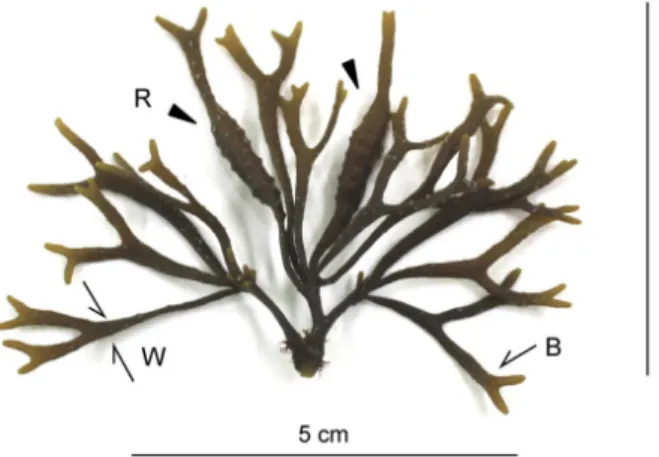
Fig. 2. Morphological character of Silvetia siliquosa. L: Length.
W: Width. B: Number of bifurcation. R: Receptacle. Arrowheads represent receptacle.
적은약
10 ha
로추정되는지역에서엽체들이분산된작은패 치(patch)
를형성하여서식하고있었다(Fig. 1).
현재까지알려 진뜸부기의분포지역은우리나라의경우흑산도,
추자도와진 도등일부도서지역(Gong et al., 1999)
에서군집이발견되었 으나,
육지에인접한지역에서뜸부기가군집을형성하는곳은 매우드물다.
뜸부기가분포하는지역은암반지역으로투명도 가높으며,
외양역에면해조류소통이원활한지역인것으로 분석되었다.
뜸부기서식지의환경조사결과수온은
6.3-25.9℃
였으며, 2
월에가장낮고
8
월에가장높았다.
염분농도는31.7-34.3 psu
범위였으며,
용존산소농도는6.1-10.7 mg L
-1,
그리고전기전 도도는34.7-50.8 ms
범위였다.
진도금갑해변의서식지저질은폭넓게발달된암반지역이 며
,
돌김류,
파래류,
풀가사리류,
톳,
지충이와패등다양한해 조류군락이발달된지역이다(Fig. 3).
조간대에서해조류의서식위치는종종적정서식대에분포하 는종들의상호경쟁에서생장
,
생존및생식에영향을미치게되 는데(Wright et al., 2004),
이러한미세한환경구배는특히조간대에서식하는해조류에서나타나는현저한서식지역별형태 변이의원인이되기도한다
(Fowler-Walker et al., 2006, Hays, 2007). Kang (1968)
과Song et al. (1996)
이보고한바와같이 뜸부기는조간대의암상에군락을이루는해조류로체형의변 화가커서다양한생육형이존재한다고하였다.
뜸부기의서식 환경에따른체형변화에관해서도보다심도있는연구가필요 할것으로판단된다.
Fig. 3. The natural habitat of Silvetia siliquosa at Geumgap, Jindo- gun, Korea. A: June 2013. B: September 2013. Dotted circle em- phasized stipe and holdfast part after decayed thallus. Scale bars 10 cm.
Fig. 4. Monthly morphological features of Silvetia siliquosa at Geumgap, Jindo-gun, Korea from January to December 2013. . Arrowheads represent receptacle.
Fig. 5. Relation between seawater temperature and length of Sil- vetia siliquosa at the natural population in Geumgap, Jindo-gun, Korea. Vertical bar represents standard deviation. Shaded area in- dicates maturation period in the habitat. Note the developmental thresholds.
생장특성
뜸부기의엽장
(Table 1)
은수온이8℃
이상으로증가하기시작하는
2013
년3
월부터빠른신장이이루어져,
수온23℃
인6
월에7.0±1.4 cm (mean±SD)
로최대생장을나타내었고,
이 후점차감소하기시작하여9
월이후에는대부분의엽체가소 실되고주지의일부와가근부분만남아겨울을보내는것으로 관찰되었다(Fig. 3B).
엽폭(Table 1)
은주생장시기인3
월부터8
월까지0.05±0.02~0.2±0.1 cm
로유의한차이를보이지않 았다.
분기수(Table 1)
역시1.0±0.5~3.1±1.8
회로생장초기인
1-2
월과엽체소실기인9-12
월을제외하면유의한차이를보이지않았다
.
뜸부기의 단위면적당현존량
(Table 1)
은 수온10℃
이상으로 상승하기 시작하는4
월부터 점차 증가하기 시작하여6
월에53.4±14.9 g-fresh wt m
-2로최대치를보였고,
이후점차감소 하여9
월이후에는엽체의형태를인지할수없을정도로소실 되었다.
단위면적당개체수(Table 1)
도6
월에60.1±22.8
개체m
-2로가장많았으며,
이후점차감소하였다.
Song et al. (1996)
은충남태안에분포하는뜸부기엽체의형 태분석을통해,
뜸부기는연중서식하며,
길이생장과현존량 은8
월(
수온26℃)
에최대를보인다고하였다.
또한Gong et al.
(1999)
은전남해남군송지면갈산리지역의자연개체군에서7
월
(
수온23.0℃)
에뜸부기의엽장이최대에도달하였다고보고하였다
.
그러나본연구결과에서는수온23℃
인6
월에엽장과 현존량이모두최대치에도달하여,
서식지의환경조건에따라 최대생장에도달하는시기에는차이가있는것으로나타났다.
이와같은결과는뜸부기가서식환경에따라엽체의생장특성 을달리한다는것으로,
뜸부기자연군락의보호,
육성,
이용,
관 리등의양상과시기가서식지환경에따라세심하게관리되어 야한다는것을의미한다.
미역이나 다시마류의분포및생물량은 일반적으로수온에 따라매우다른양상을보인다
(Kirihara et al., 2006).
즉, 22℃
또는그이상의수온조건에서성숙또는생물량이 증가하는 해조류종류로는미역
,
넓미역,
곰피등이있으나대부분의다 시마류는20℃
이하의수온조건하에서성숙된다(Kirihara et al., 2006)
는것이다.
뜸부기의성숙시기에관하여Song et al.
(1996)
은연중생식기가지의형성을보인다고하였으나,
본연구결과에서는생식기가지의형성이
3
월부터8
월까지나타났 으며,
그외의시기에는엽체의일부만이남아있는상태였다(Fig. 4).
즉
,
뜸부기가생식기가지를형성하고생식기집을성숙시켜유 배를방출시키는데요구되는수온은25℃
이상으로미역이나 다시마류의성숙과유주자대량방출을위한수온조건20-22℃
보다상대적으로높았다
.
이는뜸부기가자연군락에서자연적 으로성숙을위한누적적산수온의측면에서도많은시간을요 할뿐만아니라유배의방출도주로대조기로제한되어단속적 으로이루어지므로대량번식에불리한측면이있는것으로추 론할수있다.
본연구에서생식기가지를형성한뜸부기성숙엽체의출현 비율은
3
월(
수온8.3℃)
이후8
월(
수온25.9℃)
까지지속적으 로증가하는경향을나타내었다.
생식기가지의형성비율은8
월 에83.3±14.5%
로최대값을보였으며(Fig. 4, Table 1),
이후에 는점차유배의방출및수온상승에따른엽체의소실때문에 감소하여9
월에엽체의대부분이거의소실되는경향을보였다.
적산온도
(accumulated temperature)
의개념은Boussingault
(1837)
에의하여처음제시되었는데,
곡물의생장시개화부터성숙시기까지소요되는총온도
(
기온)
의합을측정하는것이다.
후에이개념은Candolle (1855)
에의해식물지리학에도입되 었으며, 1978
년영국의농업기상학에도적용(Gregory, 1954)
M 5.3±2.1 0.2±0.1 2.5±1.5 17.5±3.1 21.2±12.4 36.7±13.4
J 7.0±1.4 0.2±0.1 3.6±1.5 53.4±14.9 60.1±22.8 51.4±15.6
J 5.5±2.8 0.2±0.1 3.3±1.7 17.0±1.8 17.3±9.7 68.9±25.1
A 4.8±0.8 0.2±0.1 3.1±1.8 10.3±8.3 13.3±8.3 83.3±14.5
S 0.8±0.3 0.05±0.02 2.5±1.5 - - -
O 0.2±0.2 0.05±0.02 2.1±1.7 - - -
N 0.1±0.1 0.02±0.02 1.0±0.5 - - -
D 0.1±0.1 0.02±0.02 1.0±0.5 - - -
되기시작하였다
.
해양은육상에비교하여온도의변화가매우 안정적이라할수있으므로,
생물의발달과성숙에미치는온도 의영향은육상의그것보다매우중요한요인이된다.
따라서전 복과어패류등의성성숙시적산수온이매우중요하게작용하 며,
적산수온을계산할때생물학적영점온도(biological mini- mum temperature)
의적용이필요하다.
생물학적영점온도는 발생이정지하는기초수온을나타낸다(Chang et al., 2000).
Chen et al. (1970)
은Porphyra miniata
의경우각포자낭의형 성은13-15℃,
각포자방출은3-7℃
조건에서개시된다고하였는데
, Dring (1974)
은적산온도와생물학적영점온도의개념을해조류에접목시켜해조류의생식
,
생활사및생장에정성및정 량적영향을설명하였다. Rietema (1982)
는Dumontia contorta
엽상체의생장이수온16℃
이하에서개시된다는것을말하면 서해조류의특정생활사단계에서생물학적영점온도가관여 한다고하였다.
이와같은맥락에서Hwang et al. (2003, 2010)
은옥덩굴(Caulerpa okamurae)
과넓미역(Undariopsis peterse-
niana)
개체군의성숙유효적산수온을구한바있으나,
아직보다많은해조류종들에대한연구가필요한상태이다
.
해조류의경우종별생장과성숙등각발달단계에요구되 는누적온도의총합은항상일정하며
,
그총합은온도와시간의 조합으로나타낼수있다(Baskerville and Emin, 1969; Allen,
1976).
뜸부기의경우야외개체군조사에서생물학적영점온도는
8
oC
로추정되었으며(Fig. 5, Table 2),
성숙유효적산온도 약196 degree-days
가경과되면자연상태에서뜸부기엽체가 생식기가지를형성하는것으로추정되었다.
이는Hwang et al.
(2003)
이옥덩굴개체군의성숙유효적산온도를270 degree- days
로보고한것과, Hwang et al. (2010)
이넓미역개체군의 성숙유효적산온도를236 degree-days
로보고한것보다는비 교적짧은것으로나타났다.
이러한차이는해조류의종별생리 생태학적특성차이에서기인된것으로보인다.
이논문에서는전남진도금갑해변에서식하는보호대상해 조류인뜸부기의생장과성숙주기를밝힘으로써뜸부기자연
자원의보호와효율적인이용을위한필수적인자료를제공하 고자하였다
.
또한유용수산자원인뜸부기의생태학적특성을 이용하여,
양식을통한자연군락보존과이용에효과적으로활 용될수있을것이다.
사 사
본논문은
2015
년도국립수산과학원의연구비지원(R2015
013)
과2009
년도정부(
교육과학기술부)
의한국연구재단의대 학중점연구소 지원 사업(2009-0093828)
으로 수행된연구이 며,
연구비지원에감사드립니다.
References
Allen JC. 1976. A modified sine wave method for calculating degree-days. Environ Entomol 5, 388-396. http://dx.doi.
org/10.1093/ee/5.3.388.
Baskerville GL and Emin P. 1969. Rapid estimation of heat ac- cumulation from maximum and minimum temperatures.
Ecology 50, 514-517
Bogaert KA, Arun A, Coelho SM and Clerck OD. 2013. Brown algae as a model for plant organogenesis. Plant organogene- sis: methods and protocols. Methods in Molecular Biol 959, 97-125. http://dx.doi.org/10.1007/978-1-62703-221-6_6.
Boo SM, Lee WJ, Hwang IK, Keum YS, Oak JH and Cho GY.
2010. Algal Flora of Korea. Marine brown algae II. Natl Inst Biol Res, Ministry of Environment, 203.
Boussingault JB. 1837. Examen comparative des circonstances météorologiques sous lesquelles végètent les cereals, lemais et les pommes de terre a l’équateur et sous la zone tempérée.
Comptes rendus á l’ Academie des Sciences 4, 178.
Chang YJ, Choi YH, Chang YJ and Choi SW. 2000. Effect of water temperature on the egg development of Pearl Oyster,
Pinctada fucata martensii and Pacific Oyster, Crassostrea gigas. J Korean Fish Soc 33, 559-564.
Chen LCM, Edelstein T, Ogata E and McLachlan J. 1970. The life history of Porphyra miniata. Can J Bot 48, 385-389.
Dring MJ. 1974. Reproduction. In WDP Stewart (ed.), Algal physiology and Biochemistry, pp. 814-837. Blackwell Sci- entific Publications, Oxford.
De Candolle A. 1855. Géographie botanique raisonné. V. Mas- son 2,51-68.
Fowler-Walker MJ, Wernberg T and Connel SD. 2006. Dif- ferences in kelp morphology between wave sheltered and exposed localities; morphology plastic or fixed traits? Mar Biol 148, 755-767. http://dx.doi.org/10.1007/s00227-005- 0125-z.
Gregory S. 1954. Accumulated temperature maps of the British lsles. Transactions and Papers 20, 59-73.
Gong YG, Kim GJ, Kim JG and Yoon JT. 1999. Cultivation of
Pelvetia siliquosa. Report of South Sea Fish Inst, NFRDI,
Table 2. Calculation of degree-days for maturation of Silvetiasiliquosa at the natural population in Geumgap, Jindo-gun, Korea from December 2012 to May 2014
Periods
(water temperature) Degree days
(℃day) Remark
15 Mar 2012 (8.2℃)~
11 May 2012 (15.2℃) 169.6
Developmental thresholds: 8℃
13 Mar 2013 (8.1℃)~
22 May 2013 (15.1℃) 197.9 1 Mar 2014 (8.5℃)~
10 May 2014 (15.1℃) 220.1
Mean±SD 195.9±25.3
9658(2007)88[149:APDATI]2.0.CO;2.
Hwang EK, Gong YG and Park CS. 2010. Ecological charac- teristics of the endangered brown alga, Undariopsis peterse-
niana (Kjellman) Miyabe et Okamura, at Jeju Island, Korea:
growth and maturation. Korean J Fish Aquat Sci 43, 63-68.
http://dx.doi.org/10.5657/kfas.2010.43.1.063.
Hwang EK, Park CS, Han JW, Shin WJ, Choi CG and Sohn CH.
2003. Growth and maturation of a green alga, Caulerpa oka-
murae Weber van Bosse. Algae 18, 217-223. http://dx.doi.
org/10.4490/ALGAE.2003.18.3.217.
Kang JW. 1968. Illustrated encyclopedia of fauna & flora of Ko- rea. Vol 8 Marine algae. Samwha Publ, 153.
Kirihara S, Nakamura T, Kon N, Fujita D and Notoya M. 2006.
Recent fluctuations in distribution and biomass of cold and warm temperature species of Laminariales algae at Cape Ohma, northern Honshu, Japan. J Appl Phycol 18, 521-527.
http://dx.doi.org/10.1007/s10811-006-9057-3.
Khotimchenko SV and Titlyanova TV.1996. Distribution of an amino acid-containing phospholipid in brown algae. Phyto- chemistry 41, 1535-1537. http://dx.doi.org/10.1016/0031- 9422(95)00740-7.
Kropf DL, Bisgrove SR and Hable WE. 1999. Establishing a growth axis in fucoid algae. Trend in Plant Sci 4, 490-494.
http://dx.doi.org/10.1016/S1360-1385(99)01509-5.
Lee IK and Kang JW. 1986. A check list of marine algae in Ko- rea. Korean J Phycol 1, 311-325.
Nagasato C, Inoue A, Mizuno M, Kanazawa K, Ojima T, Okuda K and Motomura T. 2010. Membrane fusion process and as- sembly of cell wall during cytokinesis in the brown alga,
Silvetia babingtonii (Fucales, Phaeophyceae). Planta 232,
287-298. http://dx.doi.org/10.1007/s00425-010-1188-8.Nara T, Kamei Y, Tsubouchi A, Annoura T, Hirota K, Lizumi K, Dohmoto Y, Ono T and Aoki T. 2005. Inhibitory action of marine algae extracts on the Trypanosoma cruzi dihydrooro- tate dehydrogenase activity and on the protozoan growth in mammalian cells. Parasitology Int 54, 59-64. http://dx.doi.
org/10.1016/j.parint.2004.11.001.
NFRDI (National Fisheries Research & Development Institute).
2009. Report on capture prohibition period of the fisheries animals and plants, 1-313.
Ohta T, Sasaki S, Oohori T, Yoshikawa S and Kurihara H. 2002.
α-glucosidase inhibitory activity of a 70% methanol extract from ezoishige (Pelvetia babingtonii de Toni) and its effect on the elevation of blood glucose level in rats. Bioscience
generation specific developmental processes are modified in the immediate upright mutant of the brown alga Ectocar-
pus siliculosus. Development 135, 1503-1512. http://dx.doi.
org/10.1242/dev.016303.
Peters NT and Kropf DL. 2010. Asymmetric microtubule arrays organize the endoplasmic reticulum during polarity estab- lishment in the brown alga Silvetia compressa. Cytoskeleton 67, 102-111. http://dx.doi.org/10.1002/cm.20427.
Rietema H. 1982. Effects of photoperiod and temperature on macrothallus initiation in Dumontia contorta (Rhodophyta).
Mar Ecol Progr Ser 8, 187-196.
Spavieri J, Allmendinger A, Kaiser M, Casey R, Hingley-Wilson S, Lalvani A, Guiry MD, Blunden G and Tasdemir. 2010.
Antimycobacterial, antiprotozoal and cytotoxic potential of twenty-one brown algae (Phaeophyceae) from British and Irish waters. Phytotherapy Res 24, 1724-1729. http://dx.doi.
org/10.1002/ptr.3208.
Skriptsova AV, Shevchenko NM, Tarbeeva DV and Zvyagint- seva TM. 2012. Comparative study of polysaccharides from reproductive and sterile tissues of five brown seaweeds. Mar Biotech 14, 304-311. http://dx.doi.org/10.1007/s10126-011- 9413-4.
Song HS, Seo KS and Boo SM. 1996. Field studies of the brown alga Pelvetia siliquosa with implications for taxonomy and distribution. Algae 11, 65-71.
Terasaki M, Hirose A, Narayan B, Baba Y, Kawagoe C, Yasui H, Saga N, Hosokawa M and Miyashita K. 2009. Evaluation of recoverable functional lipid components of several brown seaweeds (Phaeophyta) from Japan with special reference to fucoxanthin and fucosterol contents. J Phycol 45, 974-980.
http://dx.doi.org/10.1111/j.1529-8817.2009.00706.x.
Wang G, Wei X, Shuai L, Lu B, Wang S and Kang D. 2014.
Early development of Silvetia babingtonii (Fucales, Phaeo- phyceae). Oceanic and Coastal Sea Research 13, 677-682.
http://dx.doi.org/10.1007/s11802-014-2220-6.
Wright JT, Williams SL, Dethier MN. 2004. No zone is always greener: variation in the performance of Fucus gardneri em- bryos, juveniles and adults across tidal zone and season. Mar Biol 145, 1061-1073. http://dx.doi.org/10.1007/s00227- 004-1399-2.
Yoon JT and Soh WY. 1998. Developmental morphology on the regeneration of Pelvetia siliquosa Tseng et Chang (Pha- eophyta) in Korea. Algae 13, 261-270.
Yoon JT, Soh WY and Kim JR. 1994. A morphogenesis from
culture of wounded embryo of Pelvetia siliquosa Tseng et Chang. Korean J Phycol 9, 95-105.