Kor J Fish Aquat Sci 46(6),702-707,2013 한수지 46(6), 702-707, 2013
Original Article
702
서 론사람은일생중 1/3을잠을자는데사용한다. 인간의삶에있 어수면은매우중요하며, 수면동안뇌는일과중얻은심신피 로의해소및정보를처리하여기억등인지기능을강화시킨다. 하지만 Ohayon (2002)과 Kupfer (1997) 등의연구에의하면
전체인구의 30-35%에서일시적수면장애가있으며, 특히여
성이나노인에서는그비율이더높다는보고를하였다. 이처 럼현대인들의다수는수면장애를앓고있으며, 수면장애로인 해많은어려움을겪고있는실정이다. 이러한수면장애의원인 으로는스트레스, 긴장, 공포, 불안등다양하며, 이중에서현 대인들은스트레스로인한수면장애를겪는빈도가높은편이 다. 이는미국의정신질환분류편람인 Diagnostic and Statistical Manual of Mental Disorders, 4th edition (DSM-IV) 에서 “대부 분의불면증은심리, 사회및의학적스트레스를받을때급성으 로생긴다”라고설명하고있으며, 실제불면증환자들중 78%
가스트레스가불면증을유발하였다고보고하고있다(Bastien
et al., 2004). 이와같은이유로주요선진국에서는아데노신
(Adenosine), 아세틸콜린(acetyl choline), 세로토닌(serotonin, 5-Hydroxytryptamine), 멜라토닌(melatonin, N-acetyl-5-me- thoxy-tryptamine), gamma amino butyric acid (GABA) 등과 같은수면촉진물질을대상으로수면유도보조제를개발하고 자하는연구를진행중이다. 또한수면장애치료를위하여현재 사용되고 있는 약물로는 벤조디아핀제(benzodiazepine)계열 의 약물, 비벤조디아핀제(non-benzodiazepine)계열의약물과 항우울약등이사용되고있다. 수면장애치료에사용되고있는 약물의약리학적기전을살펴보면다음과같다. 벤조디아핀제 의경우염소이온의세포막투과성을증가시켜신경흥분시에 gamma-amino butyric acid (GABA)의억제효과를촉진시키 는것으로, GABA 수용체에작용하며 GABA에의한 Cl-이온 통로개방횟수증가시킨다. 낮은용량에서진정효과를보이며,
높은 용량에서수면효과 발현을유도한다(Claude, 2002). 비
벤조디아핀제계수면제중최근에개발된 zolpidem, zaleplon,
eszopiclone은 GABA를통하여억제효과가나타나고수면효
Article history;
Received 26 September 2013; Revised 7 November 2013; Accepted 15 November 2013
*Corresponding author: Tel: +82. 51. 722. 5453 Fax: +82. 51. 722. 0020 E-mail address: [email protected]
Kor J Fish Aquat Sci 46(6) 702-707, December 2013 http://dx.doi.org/10.5657/KFAS.2013.0702 pISSN:0374-8111, eISSN:2287-8815
ⓒ The Korean Society of Fishereis and Aquatic Science. All rights reserved
굴( Crassostrea gigas)·다시마(Saccharina japonica) 발효 분말의 스트레스 완화 및 수면 유도 효과
우남식ㆍ서용배*
(주) 마린바이오프로세스
Stress Relaxation and Sleep Induction Effect of Fermented Sea Tangle Saccharina japonica and Oyster Crassostrea gigas Powder
Nam-Sik Woo and Yong Bae Seo*
Marine Bioprocess Co. LTD., Busan 619-912, Korea
Sleep is an essential biological process of which the underlying regulatory mechanisms involve numerous anatomical structures and biochemical substances that can be compromised by stress and the immune system. Gamma aminobutyric acid (GABA) is the main inhibitory neurotransmitter of the central nervous system (CNS). It is well established that activation of GABAA
receptors promotes sleep. L. brevis BJ20 fermentation of sea tangle and oysters resulted in stress reduction and sleep inducing effects. This is the first study to report that GABA has the ability to induce sleep related hormones in mice; therefore, it has potential use as a natural sleep aid. These results suggested that sea tangle and oysters fermented by L. brevis BJ20 can be used as potential agents for stress reduction and sleep promotion.
Key words: Sea tangle, Oyster, Gamma-amino butyric acid (GABA), Stress, Sleep
굴∙다시마 발효 분말의 스트레스 해소 및 수면 유도 효과
703
과가나타난다(Roehrs et al., 1994; Sherin et al., 1998). 하지만 이와같은약물의경우이들을장기간사용하였을때내성및의 존성등의많은부작용을나타낸다. 따라서부작용이적으면서 불면을치료할수있는대체식∙의약품을개발하는것이절실히 요구되고있다(Krueger et al., 1999).
이처럼수면장애에대한치료제는대부분 GABA가그중심
적역할을수행하고있다. 이러한 GABA의최근연구를살펴
보면 GABA-receptors가 뇌조직에 주로 존재하여 리간드인
GABA가작용결합하여중추신경계에서억제성신경전달물
질로서작용하며, GABA의양이증가함에따라정서적안정,
항정신불안증, 항경련효과를나타낸다(Concas et al., 1994).
또한, GABA를식이한실험쥐를대상으로한연구에서혈압상
승억제효과가있는것으로밝혀졌으며(Arnaud et al., 2001), 그외에도스트레스해소, 기억력증진효과가있음이밝혀졌다 (Declerck et. al., 1992).
다시마와굴은 GABA의전구물질인글루탐산(glutamic acid) 을함유(다시마의경우 5%/dry base 기준, 굴의경우 4.8%/dry base; w/w) 하고있는것으로알려져있고, 이는발효공법에의
하여 GABA를생산할수있는우수한천연소재중의하나이다
(Lee et al., 2010). 따라서, 이러한해양생물을원료로하여제조 된굴∙다시마발효분말 (fermented sea tangle and oyster; FSO) 에는다량의 GABA가함유되어있다. 따라서, GABA가신경 전달계통의물질이며다수의연구에서정신건강에도움줄수 있는것에착안하여많은사람들이겪고있는각종스트레스와 수면장애증세로인해불면증에시달리고있고, 이로인해일상 생활에서의만성피로를호소하며, 작업효율이떨어지는등다 양한문제를일으키고있는것에대해천연수면유도제로서굴∙ 다시마발효분말의적용가능성에대해연구할필요성이있다. 본연구에서는 GABA을다량함유하고있는굴∙다시마발효 분말의항스트레스및수면유도기능성식품소재로서활용하 기위한기초자료를확보하고자굴∙다시마발효분말의항스트 레스및수면유도효과에대하여탐색하였다.
재료 및 방법
재료
다시마는 2012년 10월에 부산광역시소재 서진기장영어조
합법인에서구입하여사용하였고, 굴은 2012년 11월에경상남 도통영에서양식한양식산굴을구입하여사용하였다. Lac- tobacillus brevis BJ20은 Marinebioprocess Co., Ltd (Busan, Korea)에서분리동정한것을사용하였다.
실험에사용된 동물은체중 220-250 g의 Sprague Dawley 계암컷흰쥐(샘타코, 경기도, 한국)로일주일간사육실환경에 적응시킨후사용하였다. 사육실온도는 22±2℃, 습도는 55- 60%로유지하였고, 사육실내환풍기와공기정화기를항시가 동시켰다. Light-dark cycle이 12시간단위로조절되게한후,
흰쥐용고형사료와물을제한없이공급하였다. 실험에사용된 실험동물은 Naive Normal (n=5), Control (Saline, n=5), 5-200 [(5; FSO 200 mg/kg, n=5), 5-400 (후박; FSO 400 mg/kg, n=5) 의 4군으로나누어사용하였다.
굴 및 다시마 추출액의 제조
다시마추출물은수세, 탈염, 분쇄공정을거쳐적당한크기로 분쇄한다음여기에 16배의물(w/v)을첨가하고, 80℃에서 30 분간열수추출한후 20 mesh 망으로걸러제조하였다. 굴추출 물은상업용가수분해효소 (Alcalase)로 40℃, 1시간동안효소
분해한이후 90℃, 1시간동안효소를실활시킨이후필터프레
스(250 mesh, 여과포)를이용하여정밀여과하여제조하였다.
굴·다시마 발효분말의 제조
굴∙다시마발효분말(fermented sea tangle and oyster pow- der, FSO)은다시마추출액 45% (w/v), 굴추출액 45% (w/v), yeast extracts 4% (w/v), glucose 4% (w/v)를각각혼합하고, 멸균(121℃, 30 min) 및균주(2% L. brevis BJ20) 접종을실시 한다음발효(37℃, 24 hrs) 및재멸균(121℃, 30 min)하고건조 하여제조하였다. 제조시굴과다시마의비율을각각 1:9에서 8:2 비율로각각의샘플을제조하여실험을진행하였다
GABA
Areceptor affinity assay
GABAA receptor affinity assay은 Risa et al. (2004)의방법 을 참고하여 시행하였다. 적출한 SD-rat 의 대뇌 피질을 30 mM Tris-HCl buffer (pH 7.4, keep at 4℃) 20 mL에넣어균 질화시킨후 10초정도초음파처리하고, 4℃에서원심분리 (27,000×g, 15 min)하여상층액을버리고다시 30 mM Tris- HCl buffer 20 mL을취하여원심분리(27,000×g, 15 min)하였 다. 위과정을 3번반복하였다. 조직에서의 endogenous GABA 를제거하기위하여 37℃ water bath (SWB-03 shaking water bath, JEIO TECH, Korea)에서 30분간 incubation 시키고다시 원심분리(27,000×g, 15 min)한후 pellet을 binding assay에사 용하기까지 -70℃에서보관하였다. 동결된 membrane을해동 시킨후원심분리(4℃, 27,000×g, 10분간)하여상층액을버리 고 50 mM Tris-citrate buffer (binding buffer, pH 7.1, keep at 4℃) 20 mL을넣고원심분리(4℃, 27,000×g, 10분간) 하였다. 이과정을 3번반복한후뇌조직을 binding buffer에현탁시켜 (500 mL buffer/original tissue g) binding assay를위한조직액 을제조하였다. Tube에 membrane suspension 500 μL, extract 25 μL 및 [3H] flumazenil (1 nM, finalconcentration)을넣고 혼합한후 ice 에서 40분간 incubation 하였다. 이후 binding buffer 5 mL을넣고 glass fiber filter (GF/C, Whatman)을이용 하여 harvest 하였다(Brandel Inc., Gaithersburg, MD, USA).
샘플의 radioactivity (액체섬광계수, liquid scintillation count-
우남식·서용배
704
ing)는 Tri-Carb Liquid Scintillation Analyzers (Perkin-Elmer, Shelton, CT, USA)를통해측정하였다. 비특이적결합(non- specific binding)은 clonazepam (1 μM, final concentration)을 이용하여그값을결정하였다. Binding값 (%)은아래와같은식 을통해계산하였다.
Binding (%) = (Extract DPM - NSB DPM)
× 100 (TB DPM - NSB DPM)
DPM : disintegrations per minute, NSB : nonspecific binding, TB : total binding
5-HT
2Creceptor affinity assay
동결된 membrane (Perkin-Elmer, USA)을해동시킨후 bind- ing buffer에현탁시켜 [500:1] binding assay를위한조직액을 제조하였다. Tube에 membrane suspension 500 μL, extract 25 μL 및 [3H] Mesulergine (1.3nM, final concentration)을넣고 혼합한후 37℃에서 30분간 incubation 하였다. 이후 binding buffer 5 mL을넣고 glass fiber filter (GF/C, Whatman)을이용 하여 harvest 하였다(Brandel Inc., Gaithersburg, MD, USA).
샘플의 radioactivity (액체섬광계수, liquid scintillation count- ing)는 Tri-Carb Liquid Scintillation Analyzers (Perkin-Elmer, Shelton, CT, USA)를 통해측정하였다. 비특이적 결합(non- specific binding)은 Miaserine (25 μM, final concentration) 을이용하여그값을결정하였다. Binding값 (%)은위 GABAA receptor affinity assay와동일하게계산하였다.
Forced swimming test (FST; 강제 수영 시험)
절망행동검사(behavioral despair test)라고도하는강제수영 시험은약물개발시의항우울효과를검색하는기본적인실험 으로알려져있다. 본테스트의 24시간전에, 높이 50 cm, 지름30 cm의투명한아크릴원통형수조에 22℃의물에쥐의꼬리
가바닥에닿지않을정도의물높이에강제로빠뜨린다음 15 분간있게하였다. 처음수분간은이를벗어나기위해쥐가심 한저항을보이나, 시간이흐를수록점점부동자세를보이는시 간이늘어난다. 15분간의강제수영이끝나면첫번째약투여 를하고, 테스트 5시간, 1시간전에약물을투여한다. 24시간후 에는 5분간같은환경에서강제수영을시키고, 여기서 climb- ing, swimming, immobility 세가지행동을측정한다. 전형적 인 immobility란쥐가얼굴을포함한상체의일부분만수면위 로드러낸채몸의균형을유지하면서사지의움직임이 전혀 없는상태이다. 한편, swimming은쥐가수면위를돌면서움
직이고, 간혹물밑으로잠수하기도하는상태이다. Climbing은 가장격렬한운동상태인데, 앞발을적극적으로사용하여아크 릴원통위로올라가려고사지를다쓰는상태이다. 실수와사 람에의한오차를줄이기위해비디오카메라로측정하여자료 를확보하였다.
Tail suspension test (TST; 꼬리 현수법)
절망행동검사(behavioral despair test)라고도하는꼬리현수 법은약물개발시의항우울효과를검색하는기본적인실험으 로알려져있다. 테이프를이용해꼬리의절반쯤되는곳으로부 터테이프를감아꼬리끝부분을 30 cm의 box (H: 54 cm, W:
30 cm, D: 47 cm)에고정시켜거꾸로매달아놓는다. 총 6분간 매달아놓으며, 2분간은측정을하지않고, 4분동안은부동행 동을측정해서우울행동을평가하게된다.
ELISA 분석
행동실험이끝난쥐를 sodium pentobarbital (80 mg/kg, i.p.) 로마취시킨후, 심장에서혈액을채취해원심분리(1000 × g, 10 min) 하여 -70℃에보관한다. 우울행동과관련이있는항 산화효소인 superoxide dismutase (SOD), glutathione peroxi- dase (GPX)의발현을 commercial ELISA kit (USCN life sci- ence, Huston, U.S.A)를이용하여분석하였다.
통계 처리
모든 측정값은 평균값±표준오차(mean±S.E)로 표시하였
고, 각실험군간의통계학적분석 window용 SPSS를이용하 였다. 조직분석법의측정값은 one-way ANOVA test를시행하 였으며, 사후검증은 Tukey test를이용하였다. 통계적유의성은 신뢰구간 P<0.05에서의미를부여하였다.
결과 및 고찰
굴·다시마 발효분말의 GABAA receptor 및 5-HT2C receptor affinity assay
수면촉진물질로는 GABA, 아데노신, 아세틸콜린, 세로토 닌그리고몇가지수면유발펩타이드가알려져있으며아세 틸콜린과 세로토닌은 수면및각성에모두참여한다. VLPO (Ventrolateral preoptic nucleus: VLPO)에서의 GABA성 세 포의 활성화는 비렘 수면을유도하는데 반해 VLPO 주변지
역에 있는 GABA성세포들은 뇌간의렘중지신경핵인노르
아드레날린및세로토닌성신경원을억제하여렘수면을촉진 한다(Finnimore et al., 1995). 세로토닌은각성의활동성을감 소시켜수면을준비시키는물질로서 5-HT1A수용체자극시에 는전뇌기저부의콜린성신경원들을억제하여서파수면을유 도하고 5-HT2C, 5-HT3수용체활성화는 GABA 분비중간신
굴∙다시마 발효 분말의 스트레스 해소 및 수면 유도 효과
705
경원을자극하여청색반점(locus coeruleus) 및배쪽피개구역 (ventral tegmental area: VTA)과같은각성계를억제한다(Yun and Kwon, 1993). 이러한연구배경을중심으로본연구에서는 GABA와세라토닌 receptor를중심으로 FSO의수면증진에관 한영향을살펴보았다.
굴과다시마의비율을각각 1:9에서 8:2 비율로제조한 FSO를 재료및방법에서설명한샘플과의결합력분석결과다시마와 굴의비율이 5:5로첨가되어제조된 FSO에서 GABAA receptor
결합력이가장높은것으로밝혀졌다. 또한세라토닌 receptor
인 5-HT2C receptor와의결합력역시 5:5 비율에서제조된 FSO 가가장활성이높았다. FSO의 GABAA receptor와 5-HT2C re- ceptor에대한결합력결과는 Fig. 1에정리하여나타내었다.
수면증진효능
FSO의수면증진효능을알아보기위해서수면박탈동물모
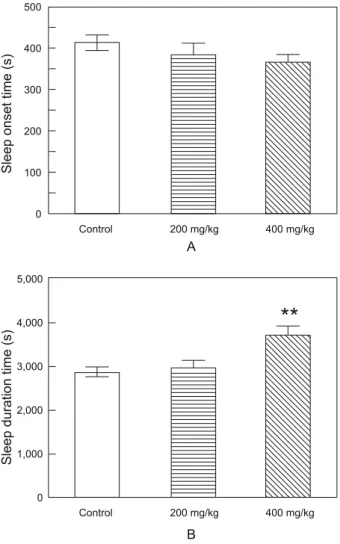
델을이용하여실험을진행하였다. 제조된 FSO는굴과다시마 비율이 1:1인조건을이용하여제조하였으며, 이를각각 200 mg/kg과 400 mg/kg을섭취시켰으며, 그결과수면박탈모 델에 FSO를투여시입면시간은감소하는경향을보였지만그 결과는미미하였다. 다만수면유지시간은유의적으로증가함 Fig. 1. Mental related receptor binding affinity effect. FSO
displaced over 50% of [3H] flumazenil binding at a concentration of 20mg/mL and showed an effective binding affinity to the GABAA-BZD receptor and 5-HT2C receptor. (A); Percent binding of [3H] flumazenil to the GABAA-BZD receptor in in fermentated marine organisms. (B); Percent binding of [3H]-mesulergine to the 5-HT 2C receptor in fermentated marine organisms.
Fig. 2. Effect of the FSO on SLEEP ENEHNCEMENT in rats.
Effects of FSO on sleep latency (A) and sleep duration (B) in mice induced by hypnotic dose (45 mg/kg, i.p.) of pentobarbital.
Mice received pentobarbital 45min after oral administration (p.o.) of CON (0.5% CMC-saline 10 mL/kg) and FSO (200, 400 mg/
kg). Each column represents mean ± SEM (n=10). * P<0.05, significant as compared to the control group (Dunnett's test).
Climbing Swimming
140
120 100
80
0.01 0.1 1 2.5 5 10
60 40
Binding (%)
Concentration of extract (mg/mL) A
220
160
100 60
0.01
Control 200 mg/kg 400 mg/kg
0.1
OYSTER : SEA TANGLE = 1:9 OYSTER : SEA TANGLE = 2:8 OYSTER : SEA TANGLE = 3:7 OYSTER : SEA TANGLE = 4:6 OYSTER : SEA TANGLE = 5:5 OYSTER : SEA TANGLE = 6:4 OYSTER : SEA TANGLE = 7:3 OYSTER : SEA TANGLE = 8:2 FERMENTED SEA OYSTER FERMENTED SEA TANGLE
1 2.5 5 10
20
500 400 300 200 100 0 180
120 200
140
80 40 0
Binding (%)Sleep onset time (s)
A
B
Concentration of extract (mg/mL) B
Control 200 mg/kg 400 mg/kg
5,000 4,000 3,000 2,000 1,000 0
Sleep duration time (s)
A
Control 200 mg/kg 400 mg/kg
30
20
10
0
Mean counts (sec)
Control 200 mg/kg 400 mg/kg
150
100
50
0
Mean counts (sec)
Control 200 mg/kg 400 mg/kg Control 200 mg/kg 400 mg/kg 250
200 150 100 50 0
Mean counts (sec)
A B C D
8,000
6,000
4,000
2,000
0
Conc. (U/mL)
GPX
40
30
20
10
0
Conc. (pg/mL)
SOD
B
A C D
Climbing Swimming
140 120
100 80
0.01 0.1 1 2.5 5 10
60 40
Binding (%)
Concentration of extract (mg/mL) A
220
160
100 60
0.01
Control 200 mg/kg 400 mg/kg
0.1
OYSTER : SEA TANGLE = 1:9 OYSTER : SEA TANGLE = 2:8 OYSTER : SEA TANGLE = 3:7 OYSTER : SEA TANGLE = 4:6 OYSTER : SEA TANGLE = 5:5 OYSTER : SEA TANGLE = 6:4 OYSTER : SEA TANGLE = 7:3 OYSTER : SEA TANGLE = 8:2 FERMENTED SEA OYSTER FERMENTED SEA TANGLE
1 2.5 5 10
20
500 400 300 200 100 0 180
120 200
140
80 40 0
Binding (%)Sleep onset time (s)
A
B
Concentration of extract (mg/mL) B
Control 200 mg/kg 400 mg/kg
5,000 4,000 3,000 2,000 1,000 0
Sleep duration time (s)
A
Control 200 mg/kg 400 mg/kg
30
20
10
0
Mean counts (sec)
Control 200 mg/kg 400 mg/kg
150
100
50
0
Mean counts (sec)
Control 200 mg/kg 400 mg/kg Control 200 mg/kg 400 mg/kg 250
200 150 100 50 0
Mean counts (sec)
A B C D
8,000
6,000
4,000
2,000
0
Conc. (U/mL)
GPX
40
30
20
10
0
Conc. (pg/mL)
SOD
B
A C D
Climbing Swimming
140
120 100 80
0.01 0.1 1 2.5 5 10
60 40
Binding (%)
Concentration of extract (mg/mL) A
220
160
100 60
0.01
Control 200 mg/kg 400 mg/kg
0.1
OYSTER : SEA TANGLE = 1:9 OYSTER : SEA TANGLE = 2:8 OYSTER : SEA TANGLE = 3:7 OYSTER : SEA TANGLE = 4:6 OYSTER : SEA TANGLE = 5:5 OYSTER : SEA TANGLE = 6:4 OYSTER : SEA TANGLE = 7:3 OYSTER : SEA TANGLE = 8:2 FERMENTED SEA OYSTER FERMENTED SEA TANGLE
1 2.5 5 10
20
500 400 300 200 100 0 180
120 200
140
80 40 0
Binding (%)Sleep onset time (s)
A
B
Concentration of extract (mg/mL) B
Control 200 mg/kg 400 mg/kg
5,000 4,000 3,000 2,000 1,000 0
Sleep duration time (s)
A
Control 200 mg/kg 400 mg/kg
30
20
10
0
Mean counts (sec)
Control 200 mg/kg 400 mg/kg
150
100
50
0
Mean counts (sec)
Control 200 mg/kg 400 mg/kg Control 200 mg/kg 400 mg/kg 250
200 150 100 50 0
Mean counts (sec)
A B C D
8,000
6,000
4,000
2,000
0
Conc. (U/mL)
GPX
40
30
20
10
0
Conc. (pg/mL)
SOD
B
A C D
우남식·서용배
706
을확인하였다. 이는 FSO가입면후수면을유지하는것에도
움을줄수있음을시사하는것으로이에대한결과를 Fig. 2에
정리하였다.
Forced swimming test (FST; 강제 수영 시험)
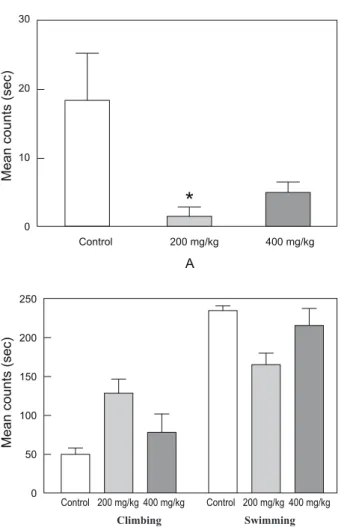
강제수영시험에대한결과는 Fig. 3에정리하였다(IMO: F2, 171.64, P=0.23, CLIM: F2, 17 = 5.27, P<0.05, SWIM: F2, 17 = 5.12, P<0.05). Saline을투여한 control군에비해 5-200 (200 mg/kg 섭취) 군에서부동행동시간이약 70%이상감소 하는것을알수있었다. 또한, active behavior인 climbing과 swimming 행동이증가하는경향이나타났다. 이는 5-400 (후 박; 200 mg/kg 섭취후 200 mg/kg 재섭취)을투여한군에서 “ Fig. 3. Anti-stress effect by forced swimming test. FSO significantly decreased the immobility time at FSO 200 mg/kg (A) and enhanced behavioral mobility, shown as the swimming times, and climbing times, after FSO administration (B). Each value represents the mean±S.E.M. The result of FSO was analyzed by performing separate one-way ANOVA among the groups. Each value represents the mean ± S.E.M. *P<0.05 compared to the control group.Fig. 4. Anti-stress effect by tail suspension test. FSO decreased the immobility time in dose-dependence manner. Each value represents the mean±S.E.M.
Fig. 5. Serum GPx and SOD level. Serum GPx, SOD were significantly increased in the TMT-treatment group than those in FSO treated group. Each value represents the mean ± S.E.M. The GPX and SOD level in the serum of normal group (A, saline), control (B, TMT 10 mg/kg, i.p.), FSO 200 mg/kg (C) and FSO 400 mg/kg (D).
Climbing Swimming
140 120
100 80
0.01 0.1 1 2.5 5 10
60
40
Binding (%)
Concentration of extract (mg/mL) A
220
160
100 60
0.01
Control 200 mg/kg 400 mg/kg
0.1
OYSTER : SEA TANGLE = 1:9 OYSTER : SEA TANGLE = 2:8 OYSTER : SEA TANGLE = 3:7 OYSTER : SEA TANGLE = 4:6 OYSTER : SEA TANGLE = 5:5 OYSTER : SEA TANGLE = 6:4 OYSTER : SEA TANGLE = 7:3 OYSTER : SEA TANGLE = 8:2 FERMENTED SEA OYSTER FERMENTED SEA TANGLE
1 2.5 5 10
20
500 400 300 200 100 0 180
120 200
140
80 40 0
Binding (%)Sleep onset time (s)
A
B
Concentration of extract (mg/mL) B
Control 200 mg/kg 400 mg/kg
5,000 4,000 3,000 2,000 1,000 0
Sleep duration time (s)
A
Control 200 mg/kg 400 mg/kg
30
20
10
0
Mean counts (sec)
Control 200 mg/kg 400 mg/kg
150
100
50
0
Mean counts (sec)
Control 200 mg/kg 400 mg/kg Control 200 mg/kg 400 mg/kg 250
200 150 100 50 0
Mean counts (sec)
A B C D
8,000
6,000
4,000
2,000
0
Conc. (U/mL)
GPX
40
30
20
10
0
Conc. (pg/mL)
SOD
B
A C D
Climbing Swimming
140
120 100
80
0.01 0.1 1 2.5 5 10
60 40
Binding (%)
Concentration of extract (mg/mL) A
220
160
100 60
0.01
Control 200 mg/kg 400 mg/kg
0.1
OYSTER : SEA TANGLE = 1:9 OYSTER : SEA TANGLE = 2:8 OYSTER : SEA TANGLE = 3:7 OYSTER : SEA TANGLE = 4:6 OYSTER : SEA TANGLE = 5:5 OYSTER : SEA TANGLE = 6:4 OYSTER : SEA TANGLE = 7:3 OYSTER : SEA TANGLE = 8:2 FERMENTED SEA OYSTER FERMENTED SEA TANGLE
1 2.5 5 10
20
500 400 300 200 100 0 180
120 200
140
80 40 0
Binding (%)Sleep onset time (s)
A
B
Concentration of extract (mg/mL) B
Control 200 mg/kg 400 mg/kg
5,000 4,000 3,000 2,000 1,000 0
Sleep duration time (s)
A
Control 200 mg/kg 400 mg/kg
30
20
10
0
Mean counts (sec)
Control 200 mg/kg 400 mg/kg
150
100
50
0
Mean counts (sec)
Control 200 mg/kg 400 mg/kg Control 200 mg/kg 400 mg/kg 250
200 150 100 50 0
Mean counts (sec)
A B C D
8,000
6,000
4,000
2,000
0
Conc. (U/mL)
GPX
40
30
20
10
0
Conc. (pg/mL)
SOD
B
A C D
Climbing Swimming
140 120
100 80
0.01 0.1 1 2.5 5 10
60 40
Binding (%)
Concentration of extract (mg/mL) A
220
160
100 60
0.01
Control 200 mg/kg 400 mg/kg
0.1
OYSTER : SEA TANGLE = 1:9 OYSTER : SEA TANGLE = 2:8 OYSTER : SEA TANGLE = 3:7 OYSTER : SEA TANGLE = 4:6 OYSTER : SEA TANGLE = 5:5 OYSTER : SEA TANGLE = 6:4 OYSTER : SEA TANGLE = 7:3 OYSTER : SEA TANGLE = 8:2 FERMENTED SEA OYSTER FERMENTED SEA TANGLE
1 2.5 5 10
20
500 400 300 200 100 0 180
120 200
140
80 40 0
Binding (%)Sleep onset time (s)
A
B
Concentration of extract (mg/mL) B
Control 200 mg/kg 400 mg/kg
5,000 4,000 3,000 2,000 1,000 0
Sleep duration time (s)
A
Control 200 mg/kg 400 mg/kg
30
20
10
0
Mean counts (sec)
Control 200 mg/kg 400 mg/kg
150
100
50
0
Mean counts (sec)
Control 200 mg/kg 400 mg/kg Control 200 mg/kg 400 mg/kg 250
200 150 100 50 0
Mean counts (sec)
A B C D
8,000
6,000
4,000
2,000
0
Conc. (U/mL)
GPX
40
30
20
10
0
Conc. (pg/mL)
SOD
B
A C D
Climbing Swimming
140 120
100 80
0.01 0.1 1 2.5 5 10
60 40
Binding (%)
Concentration of extract (mg/mL) A
220
160
100 60
0.01
Control 200 mg/kg 400 mg/kg
0.1
OYSTER : SEA TANGLE = 1:9 OYSTER : SEA TANGLE = 2:8 OYSTER : SEA TANGLE = 3:7 OYSTER : SEA TANGLE = 4:6 OYSTER : SEA TANGLE = 5:5 OYSTER : SEA TANGLE = 6:4 OYSTER : SEA TANGLE = 7:3 OYSTER : SEA TANGLE = 8:2 FERMENTED SEA OYSTER FERMENTED SEA TANGLE
1 2.5 5 10
20
500 400 300 200 100 0 180
120 200
140
80 40 0
Binding (%)Sleep onset time (s)
A
B
Concentration of extract (mg/mL) B
Control 200 mg/kg 400 mg/kg
5,000 4,000 3,000 2,000 1,000 0
Sleep duration time (s)
A
Control 200 mg/kg 400 mg/kg
30
20
10
0
Mean counts (sec)
Control 200 mg/kg 400 mg/kg
150
100
50
0
Mean counts (sec)
Control 200 mg/kg 400 mg/kg Control 200 mg/kg 400 mg/kg 250
200 150 100 50 0
Mean counts (sec)
A B C D
8,000
6,000
4,000
2,000
0
Conc. (U/mL)
GPX
40
30
20
10
0
Conc. (pg/mL)
SOD
B
A C D
굴∙다시마 발효 분말의 스트레스 해소 및 수면 유도 효과
707
절망행동”이감소하는것을나타내는것으로 FSO 섭취시스트
레스완화에도움을줄수있음을시사하는것이다.
Tail suspension test (TST; 꼬리 현수법)
꼬리 현수법에 대한 결과는 다음과 같다. Saline을 투여한
control군에비해 5-400 군에서부동행동시간이약 20%이상 감소하는것을알수있었다(F2, 17=1.83, P=0.20). 이는고농 도의 FSO를투여한군에서 “절망행동”이감소하는것을나타 내는것으로강제수영시험과같은결과를얻은것이다. 이에대 한결과는 Fig. 4에정리하였다.
SOD, GPX의 ELISA 분석
동물모델의행동실험이모두끝난후 serum내에서 SOD와 GPX의발현을알아본결과는 Fig. 5와같다(SOD: F3,14=2.7, P=0.1; GPX: F3,14=4.6, P=0.5, CORT: F3, 14=28.2, P<0.001). 대조군에서는정상군에비해혈액내에 SOD, GPX 의발현이약 50% 정도감소하였다. 하지만, 5-400군에서는대 조군에비해항산화효소인 SOD와 GPX가증가하는경향을 나타내었다.
이상의결과를종합하면 FSO는스트레스완화와수면증진 (또는유지)에도움을줄수있는천연물소재로현대인들이다 양한스트레스로인한수면장애에대한치료보조제로사용가 능한해양생물유래천연물소재라사료된다. 향후본연구결과 를바탕으로한임상실험을통해 FSO의안정성에대한연구가 진행된다면부작용이없는불면증치료보조제로의건강기능식 품을개발가능할것이다.
사 사
본연구과제는중소기업청에서시행한 2011년도중소기업기 술혁신개발사업연구비지원에의해수행된결과의일부이며, 이에감사드립니다(과제번호 : SA114084).
References
Arnaud C, Gauthier P and Gottesmann C. 2001. Study of a GA- BAC receptor antagonist on sleep-waking behavior in rats.
Psychopharmacology 154, 415-419.
Bastien CH, Vallieres A and Morin CM. 2004. Precipitating fac- tors of insomnia. Behav Sleep Med 2, 50-62.
Claude G. 2002. GABA Mechanisms and sleep. Neuroscience 111, 231-239.
Concas A, Serra M, Santoro G. Maciocco E, Cuccheddu T and Biggio G. 1994. The effect of cyclopyrrolones on GABAA receptor function is different from that of benzodiazepines.
Naunyn Schmiedeberg's Arch Pharmacol 350, 294-300.
Declerck AC, Ruwe F, O'Hanlon JF and Wauquier A. 1992. Ef- fects of Zolpidem and funitrazepam on nocturnal sleep of
women subjectively complaining of insomnia. Psychophar- macology 106, 497-501.
Finnimore AJ, Roebuck M, Sajkow D and Mcevoy RD. 1995.
The effect of the GABA agonist, baclofen, on sleep and breathing. Eur Resp 8, 230-234.
Krueger JM, Obal F Jr and Fang J. 1999. Humoral regulation of physiological sleep: Cytokines and GHRH. J Sleep Res 1, 53-59.
Lee B-J, Kim J-S, Kang YM, Lim J-H, Kim Y-M, Lee M-S, Jeong M-H, Ahn C-B and Je J-Y. 2010. Antioxidant activ- ity and γ-aminobutyric acid (GABA) content in sea tangle fermented by Lactobacillus brevis BJ20 isolated from tran- ditional fermented foods. Food Chemistry. 122, 271-276.
http://dx.doi.org/10.1016/j.foodchem.2010.02.071.
Monk TH, Petrie SR, Hayes AJ and Kupfer DJ. 1994. Regular- ity of daily life in relation to personality, age, gender, sleep quality and circadian rhythms. J Sleep Res 3, 196-205.
Ohayon MM and Partinen M. 2002. Insomnia and global sleep dissatisfaction in Finland. J Sleep Res 11, 339–346
Risa J, Risa A, Adsersen A, Gauguin B, Stafford GI, vanStaden J and Jäer AK. 2004. Screening of plants used in southern Africa for epilepsy and convulsions in the GABAA-benzodi- azepine receptor assay. Journal of Ethno pharmacology 93, 177-182.
Roehrs T, Beare D, Zorick F and Roth T. 1994. Sleepiness and ethanol effects on simulated driving. Alcohol Clin Exp Res 18, 154-158.
Sherin JE, Elmquist JK, Torrealba F and Saper CB. 1998. In- nervation of histaminergic tuberomammillary neurons by GABAergic and galaninergic neurons in the ventrolateral preoptic nucleus of the rat. Journal of Neuroscience 18, 4705-721.
Yun JO and Kwon KI. 1993. Pharmacokinehcs of caffeine sensi- tive and non-senstive volunteers and in the obese rat and the lean rat. Korean Pharm Sci 37, 341-348.