Vol. 26, No. 5 (2016)
287
Effect of Solution Treatment and Short Time Aging on Mechanical Properties of Cast Ti-6Al-4V Alloy
Seong-Tak Oh 1 , Kee-Do Woo 1† , Seung-Mi Kwak 1 and Jae-Hwang Kim 2
1Division of Advanced Material Engineering & RCAMD, Chonbuk National University, Jeonju 54896, Republic of Korea
2Korea Institute of Industrial Technology, Gimje 54325, Republic of Korea
(Received March 14, 2016 : Revised April 11, 2016 : Accepted April 14, 2016)
Abstract
The effect of heat treatment on the microstructure and mechanical properties of cast Ti-6%Al-4%V alloy was investigated. Heat treatment of cast Ti-6Al-4V alloy was conducted by solution treatment at 950oC for 30 min; this was followed by water quenching and then aging at 550oC for 1 to 1440 min. The highest hardness of the heat-treated specimens was obtained by solution treatment and subsequent aging for 5 min due to precipitates of fine α that formed from retained β phase. The tensile strength of this alloy increased without dramatic decrease of the ductility due to microstructural refinement resulting from the decomposition of α' martensite into fine α and β phases, and also due to the fine α phase formed from the retained β phase by aging treatment for 5 min. In addition, this strengthening might be caused by the transformation induced plasticity (TRIP) effect, which is a strain-induced martensite transformation from the retained β phase during deformation, and which occurs even after aging treatment at 550oC for 5 min.Key words
cast Ti-6Al-4V alloy, heat treatments, microstructure, hardness, tensile properties.1. Introduction
Ti-6Al-4V based alloys have been widely used in various applications for lightweight parts due to their excellent specific strength, and good combination of strength and ductility with high corrosion resistance.
1)In addition, Ti-6Al-4V alloy has a possibility for further strengthening through microstructural control. Due to this attractive potential, many researchers have investigated heat treatments to obtain various microstructures and good mechanical properties of this alloy through micro- structure control.
2-3)Water quenching after a solution treatment and followed by aging treatment of Ti-6Al-4V alloy are one of the common heat treatment. In this heat treatment, the tensile strength of Ti-6Al-4V alloy increased by the formation of α' martensite transformed from β phase by the solution treatment and the decomposed α' martensite to fine α and β phases by aging treatment.
3-6)Moreover, nano- sized α
2(Ti
3Al) phase can lead to the additional impro vement of their mechanical properties such as strength
and toughness by over-aging treatments at 500~600
oC for long aging time.
5,7)However, the heat treatment for α
2precipitation has a problem because it takes relatively a long aging time. On the other hand, several studies have reported that the tensile strength is improved by short-time aging consisting of solution treatment at 970
o
C for 1 min and followed by aging at 500
oC for 0.7 min. This result of the mechanical properties is closely related to TRIP effect in titanium alloys, which is strain- induced martensite transformation from retained β phase under applied stress. However, the elongation of short time aging treated Ti-6Al-4V alloy decreased a little than as-cast.
2,8)This result indicates that tensile strength of Ti- 6Al-4V alloy can be improved by the aging treatment for short time. However, above original studies for the short aging treatment of Ti-6Al-4V alloy has been studied by using the equiaxed microstructure of wrought alloys as a starting microstructure. In general, wrought Ti-6Al-4V alloys lead to three kinds of microstructures, i.e., Widmanstätten, equiaxed and bimodal microstructures de- pended on heat treatments. But in cast Ti-6Al-4V alloy,
†
Corresponding author
E-Mail : [email protected] (K. D. Woo, Chonbuk Nat'l Univ.)
© Materials Research Society of Korea, All rights reserved.
This is an Open-Access article distributed under the terms of the Creative Commons Attribution Non-Commercial License (http://creative-
commons.org/licenses/by-nc/3.0) which permits unrestricted non-commercial use, distribution, and reproduction in any medium, provided the
original work is properly cited.
equiaxed or bimodal structures by heat treatments.
9-10)Therefore, it is necessary to study the effect of short aging time on mechanical properties in cast Ti-6Al-4V alloy.
The purpose of this study is to improve the mechanical properties of cast Ti-6Al-4V alloy through the solution and aging treatment with various aging time from 1 to 1440 min, as well as to study the effect of aging for relatively short time on microstructure and mechanical properties of cast Ti-6Al-4V alloy.
2. Experimental Procedure
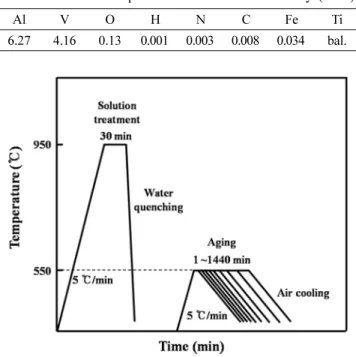
The cast Ti-6Al-4V alloy was fabricated by vacuum arc remelting(VAR) skull method. The chemical com- positions of the specimen are shown in Table 1.
Solution treatment of the specimens was conducted at 950
oC for 30 min and followed by water quenching(STQ
To observe microstructures, all specimens were polished and etched by using a Kroll reagent of 1 % HF, 3 % HNO
3, and 96 % distilled H
2O. Microstructure of the specimens was observed by scanning electron micro- scopy(SEM), electron backscattered diffraction(EBSD), and transmission electron microscopy(TEM). The thin foil for TEM observation was prepared by twin jet-electro polishing using a chemical solution of 60 % methanol, 35 % butanol, and 5 % perchloric acid at −30
oC. The each phase was analyzed by X-ray diffraction using the angle of 2 θ from 33
oto 46
oby scan speed of 0.25
omin
−1. Hardness was also measured using a Vickers hardness tester with a load of 9.8 N for 15 sec. The tensile test was conducted using ASTM E8 specimens at room tem- perature. Cross head speed for tensile test was 10
−3sec
−1. 3. Results and Discussion
Fig. 2 shows the SEM microstructures of as-cast, solution-treated and aged specimen. The microstructure of as-cast consists of a typical Widmanstätten structure.
The α phase having a width of 1~4 μm is shown by dark region, while the β phase between the α plates is indicated by the bright region. The α phase was formed along the β grain boundaries by decreasing temperature from β single region at above 990
oC to room temperature.
4,11)Microstructure of the solution-treated alloy at 950
oC is shown in Fig. 2(b). The primary α phase was trans- formed from the β phase by the solution treatment at 950
oC for 30 min. Thus its microstructure consists of the primary α phase and α' martensite. Microstructure of aged specimen at 550
oC for 1440 min is similar to the solution-treated specimen as shown in Fig. 2(c).
In order to observe the fine α and β phases of STA specimen, TEM observation was conducted using the specimen solution treated at 950
oC for 30 min and followed by aging treated at 550
oC for 1440 min as shown in Fig. 3. The decomposed fine α and β phases after aging treatment were observed.
Fig. 4 shows the hardness change with the STQ and Table 1. Chemical compositions of cast Ti-6Al-4V alloy (wt.%).
Al V O H N C Fe Ti
6.27 4.16 0.13 0.001 0.003 0.008 0.034 bal.
Fig. 1. Schematic illustration of heat treatment of cast Ti-6Al-4V alloy.
Fig. 2. Microstructures of as-cast and solution-treated Ti-6Al-4V alloys. (a) As-cast, (b) STQ
950oC, and (c) ST
950oCA
550oC,1440min.
followed by aging at 550
oC for 1440 min. Hardness of as-cast increased due to formation of α' martensite from β phase by the solution treatment and followed by water quenching. The subsequent aging at 550
oC for 1 min leads to increase of hardness more than that of the STQ specimen. The peak hardness was shown in aged specimen for 5 min. This is because fine α phase was precipitated from retained β phase. This result shows that the aging at 550
oC can improve the strength of the cast Ti-6Al-4V alloy in a short aging time. It is reported that pre- cipitation of fine α phase from retained β phase is the secondary strengthening.
2)After aging for 60 min, hard-
ness was decreased with increasing aging time due to decrease volume fraction of α' martensite by transfor- mation of fine α and β phases during aging. Thus, the specimens aged for long time showed the plateau of hardness to 1440 min. This is because α' martensite should completely be transformed to the α and β phases.
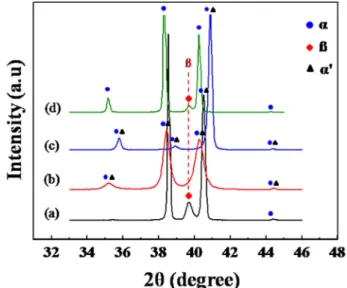
Fig. 5 shows the X-ray diffraction patterns of the as- cast, solution-treated(STQ), and then aged(STA) spe- cimens. The as-cast specimen is shown in Fig. 5(a). The α phase (hcp) and β phase (bcc) were shown on the diffraction pattern. After the solution treatment, peaks of α' martensite (hcp) appeared at the same 2θ of the α phase due to same crystal structure with similar lattice parameter of a-aixs as shown in Fig. 5(b). In general, the stable β phase was disappeared after the solution treat- ment at 950
oC followed by water quenching because stable β phase was transformed to α' martensite in solution- treated specimen. In addition, retained β peaks are not detectable in the X-ray diffraction patterns because the interplanar spacing of the two structures between the α' (hcp) and retained β (bcc) phase are nearly same.
2,8-9)Thus, the β peak was not detected in solution-treated specimen and aged at 550
oC for 5 min. Even though the specimen aged for 5 min at 550
oC after the solution treatment, the β peak was not shown in Fig. 5(c). To contrast, the specimen aged at 680
oC for 5 min shows the clear β peak by increasing volume fraction of stable β phase at higher aging temperature of 680
oC than 550
o
C as shown in Fig. 5(d). Therefore, X-ray diffraction data proves only the absence of a stable β phase in the solution-treated and aged specimens at 550
oC.
IQ map(left) and phase map(right) of EBSD were shown in Fig. 6. In solution-treated specimen as shown in Fig. 6(a), the α' martensite was observed having Fig. 3. TEM micrograph (bright field image) of aged specimen at
550
oC for 1440 min after solution treatment at 950
oC for 30 min.
Fig. 4. Hardness with aging time at 550
oC of solution-treated Ti- 6Al-4V alloy at 950
oC for 30 min followed by water quenching.
Fig. 5. X-ray diffraction profile. (a) As-cast (b) STQ
950oC, (c) ST
950oC-
A
550oC,5min, and (d) ST
950oCA
680oC,5min.
acicular shape. In addition, it is noticed that the β phases were shown as the green color, although β peak was not detected by the X-ray diffraction. According to these results, the retained β phase was still remained after the solution treatment. Followed by aging at 550
oC for 5 min as shown in Fig. 6(b), the β phase was shown. It is thought that the α' martensite was decomposed to the β phase during aging for 5 min at 550
oC and fine α phase was precipitated from β phase at the same time.
However, although the retained β phase was transformed to α phase during the aging treatment, the retained β phase still exists since stable β phase peak was not found by XRD result. In order to compare between retained β phase and stable β phase, the aged specimen at 680
oC for 5 min was also shown in Fig. 6(c). In the specimen aged at 680
oC for 5 min, the larger amount of α' martensite was transformed to α and β phases and larger
amount of retained β phase was also transformed to α phase through the aging at higher temperature(680
oC).
Thus, the β phase shown in EBSD map seems to stable β because the β peak was shown in the X-ray diffraction of the specimen aged at 680
oC for 5 min.
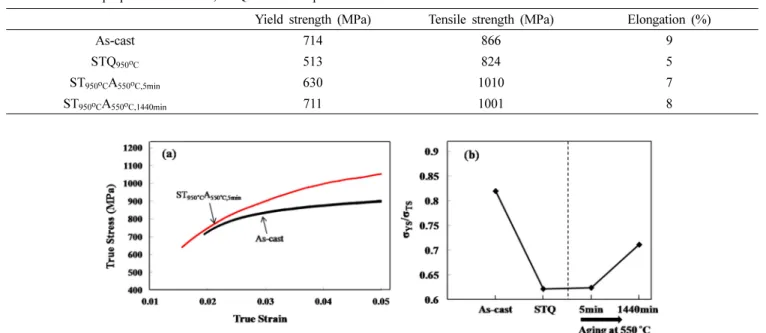
Table 2 shows the tensile properties of as-cast and heat- treated specimens. The as-cast specimen had the higher elongation and lower tensile strength than that of STA specimens. In the tensile result of this study, the strength and ductility of STQ specimen shows the lowest. This result might be significantly brittle with larger α' marten- site and higher dislocation density. However, the yield and tensile strength were improved by subsequent the aging treatment, as well as the elongation was also improved having similar level of non-treated as-cast.
Although the STA specimen aged for 5 min, the com- bination of strength and ductility shows the improvement Fig. 6. Microstructures obtained by EBSD. (a) STQ
950oC, (b) ST
950oCA
550oC,5min, and (c) ST
950oCA
680oC,5min.
Table 2. Tensile properties of as-cast, STQ and STA specimens.
Yield strength (MPa) Tensile strength (MPa) Elongation (%)
As-cast 714 866 9
STQ
950oC513 824 5
ST
950oCA
550oC,5min630 1010 7
ST
950oCA
550oC,1440min711 1001 8
Fig. 7. (a) True stress-strain curve and (b) change of the ratio between the yield strength and tensile strength.
without dramatically decreased elongation.
The increased strength without decreased ductility is caused by microstructure refinement resulting from de- composition of α' martensite to fine α and β phases during aging. Except for that, TRIP effect of retained β phase is thought during tensile deformation.
2,8,12)In Fig. 7(a), the slope(strain hardening rate) of as-cast curve is lower than STA specimen aged for 5 min. This result indicates that strain hardening occurred during de- formation. Results of the σ
YS/ σ
TSare shown in Fig. 7(b).
Its ratio of STQ specimen was shown with the lowest value. However, the σ
YS/ σ
TSratio increased with increasing aging time. According to these results, the TRIP effect is reasonable to explain through strain-induced martensite transformation from retained β phase under applied tensile stress. Although volume fraction of retained β and decomposed β phase cannot be obtained after aging in this study, the result of Fig. 7 indicates that the retained β phase caused TRIP effect even by aging for 5 min.
After the aging for 5 min at 550
oC, the retained β phase decreased with increasing aging time.
4. Conclusions
(1) The hardness of as-cast increased after STQ due to α' martensite formation and STA treatment due to fine α and β phases decomposed after the aging from α' martensite formed by the solution treatment.
(2) The tensile strength and hardness of solution- treated at 950
oC for 30 min and followed by water quenching and subsequent aged specimen at 550
oC for 5 min were improved due to decomposed fine α and β phases from α' martensite, as well as precipitated fine α phase from retained β phase. Especially, improvement of the tensile strength without dramatically decreased ductility is resulted by TRIP effect. The retained β phase is still
remained after aging at 550
oC for 5 min, leading to strain-induced martensite transformation of retained β during deformation.
Acknowledgement
This research was conducted using the cast Ti-6Al-4V alloy provided from NIB Materials Co., Ltd., Jeonju 54854, Korea.
References
1. G. Lutjering and J. C. Williams, 1sted., p.7, Springer- Verlag, Berlin (2003).
2. T. Morita, K. Hatsuoka, T. Iizuka and K. Kawasaki, Mater. Trans., 46, 1681 (2005).
3. R. G. Sherman and H. D. Kessler, Trans. ASM, 48, 657 (1956).
4. F. J. Gil, M. P. Ginebra, J. M. Manero and J. A. Planell, J. Alloys Compd., 329, 142 (2001).
5. G. Welsch, G. Lütjering, K. Gazioglu and W. Bunk, Metall. Mater. Trans. A, 8A, 169 (1977).
6. H. Geng, S. He and T. Lei, Metall. Mater. Trans. A, 28A, 1809 (1997).
7. D. G. Lee and S. H. Lee, J. Mater. Sci., 40, 4077 (2005).
8. M. A. Imam and C. M. Gilmore, Metall. Mater. Trans.
A, 14A, 233 (1983).
9. M. T. Jovanovi , S. Tadi , S. Zec, Z. Miškovi and I.
Bobi , Mater. Des., 27, 192 (2006).
10. D. G. Lee, S. H. Lee and Y. T. Lee, Mater. Sci. Eng. A, 486, 19 (2008).
11. C. G. Rhodes and N. E. Paton, Metall. Mater. Trans. A, 10A, 1753 (1979).
12. M. Marteleur, F. Sun, T. Gloriant, P. Vermaut, P. J.
Jacques and F. Prima, Scr. Mater. 66, 749 (2012).
c′ c′ c′
c′