Print ISSN: 1738-3110 / Online ISSN 2093-7717 http://dx.doi.org/10.15722/jds.18.6.202006.5
A Study on the Effect of Service Quality, Consumer Empathy and Shopping Value on Curation Commerce Satisfaction
*Min-Jung KANG1
Received: May 15, 2020. Revised: May 26, 2020. Accepted: May 27, 2020.
Abstract
Purpose: This study was based on curation commerce that has been rapidly developing. It looked into the effect of curation commerce’s quality of service factors (information quality, information interest quality, interaction quality, and personalization quality) on satisfaction and the mediating effect of consumer empathy and shopping value between service qualities and consumers’ satisfaction with curation commerce. Research design, data, and methodology: The survey was conducted on 273 consumers who used Chinese curation commerce services. The research data was analyzed using the Smart PLS 3.0 program. The empirical analysis was conducted with reliability and validity analyses of the questionnaire and hypothesis test. Results: As a result, only the quality of information had a direct impact on satisfaction. The remaining service quaility factors (information interest quality, interaction quality, and personalization quality) were found to affect satisfaction through utilitarian value or consumer empathy. Conclusions: This study is meaningful in that it selected the service quality factors experienced by consumers about curation commerce services in line with the bright market prospects of curation services. In addition, the significance of this study was to reveal the psychological mechanism of the process in which the quality of service reaches consumer satisfaction.
.
Keywords : Curation Commerce, Service Quality, Shoppig Value, Consumer Empathy JEL Classification Code: M10, M15, M20, M19, M00
1. Introduction
12
Data on the Internet continues to grow at a tremendous rate. This increase in the amount of data will persist and accelerate further (Ramïrez, 2011). Consumers are unable to focus on content or messages due to the large amount of information they are exposed to online. Consumers should put in a lot of efforts to purchase the best products,
* This Research was supported by Research Funds of Mokpo National University in 2017.
1 First Author. Associate Professor, Department of Business and Management, Mokpo National University, South Korea.
Email: [email protected]
© Copyright: The Author(s)
This is an Open Access article distributed under the terms of the Creative Commons Attribution Non-Commercial License (https://creativecommons.org/licenses/by-nc/4.0/) which permits unrestricted non-commercial use, distribution, and reproduction in any medium, provided the original work is properly cited.
including price comparison, product experience reviews and performance verification. However, in an information- rich environment, consumers face difficulties in making choices, and the desire to get recommendations for products from trusted experts gradually grows.
Curation services can meet these consumer needs. A curation service that provides high-quality and excellent products customized to consumers based on individual expertise. It has become necessary to provide more accurate information than search tooling. The curation service verifies the quality of the product or service and can provide reliable information optimized for a specific requirement (Tan, 2007).
The curation commerce is a type of e-commerce wherein by selling competitive high-quality products to consumers at reasonable prices, consumers reduce fatigue from saturated information and companies easily promote products. Curation commerce seeks high satisfaction for
both consumers and businesses. Many companies have wanted to develop curation commerce services and use them for e-commerce. However, numerous curation commerce websites still have a hard time generating revenue or achieving sustainability (Park, Jun, & Park, 2017).
Curation commerce is already used by the distribution industry that provides an algorithm service that analyzes customers’ data and recommends products. Existing studies have covered the use of curation and curation of marketing aspects. Research trends in curation services include investigations on consumer behavior as a distribution channel strategy and studies linking social media with content curation and data curation systems. However, research on the quality of services on curation commerce is lacking (May et al., 2014). Meanwhile, consumer behavior continues to expand online. Therefore, it is necessary to understand the role of online services and study how they affect consumer behavior from a business perspective (Rust
& Lemon, 2001). As the market growth of curation commerce is high, it is worth the research. However, prior research on curation services is insufficient. Therefore, this study intended to analyze the factors that affect the satisfaction of social curation commerce.
This study aims to identify the effect of curation commerce's service quality characteristics on consumers’
satisfaction. Specifically, the service quality characteristics of curation commerce are divided into information quality, information entertainment, personalization quality, interaction and diffusion. In addition, the study also looks at whether shopping value and consumer empathy play a mediating role in the relationship between service quality and consumer satisfaction.
2. Literature Review 2.1. Curation Commerce
The term curation service is derived from curators who plan and explain works displayed in art galleries and museums. Curation services, similar to curators, collect and evaluate content from the Internet to help consumers make satisfactory purchases (Abdullah, Xu & Geva, 2013).
Rosenbaum (2011) defined curation services as activities that increase value by adding human qualitative judgments to the objects that humans collect and organize. Influential consumer curators collect directly, send reassembled information, and share and exchange information with others through social media and online shopping sites (Rosenbaum, 2011).
With the advent of the big data era, the amount of information available online is rapidly increasing. Digital
data is doubling in volume every three years, twice as fast as global economic growth (Bhaskar, 2016).
Consumers find it difficult to select accurate and reliable information due to the vast amount of information present.
The process of curation collects valuable details and provides consumers with reliable information from a huge amount of relevant data to provide product or service information optimized for consumer needs (Tan, 2007).
Curation serves are an essential interface for the consumer economy. In addition, while the production and consumption of information were valued in the past, the weight and importance given to information intermediaries are now growing (Bhaskar, 2016).
2.2. Service Qualityof Curation Commerce
Companies want to secure competitiveness through improved service quality that more effectively satisfies consumers’ needs (Akroush & Khatib, 2009). High perceived quality of services results in consumers having positive feelings for a particular product or service;
otherwise, they have unpleasant feelings. As a result, consumer sentiment is affected by the quality of service that affects purchasing intent (Graefe & Hong, 2004).
The quality of service is the degree of inconsistency and direction between consumer expectations and perception, and the overall judgment or attitude regarding the performance of service excellence (Parasuraman, Zeithaml,
& Berry, 1988). If a company has higher levels of service quality and market value, it leads to better customer satisfaction (Rust, Danaher, & Varki, 2000).
2.2.1. Information Quality
Information quality determines the profitability of the business and user satisfaction, which is the usefulness of information (Parasuraman et al., 1988).
Information is the form of conveying specific content or meaning to an acceptor and giving practical value to current or future actions and decisions (Davis & Olson, 1985).
Companies can make consumers build trust in them by providing information that can provide them with the value they want online (Lewis, 1999).
Information quality is defined as a concept that includes the accuracy, timeliness, presence, presentation, and reliability of the information received on SNS(Social Network Service) (Delone & McLean, 1992).In the information system, the quality of product information to show to consumers is very important. Since it is a non-face- to-face transaction in online environments such as O2O(Online to Offline)-based fresh food e-commerce applications, it is essential to provide accurate information to consumers (Gu, Bao, & Lee, 2019).
2.2.2. Information Interest Quality
Information interest refers to a distinct interest or pleasure arising from information obtained from online communication platforms such as SNS (Maignan & Lukas, 1997). In an online environment, the free or new experiences that users obtain when they can access new information from surrounding obstacles are critical (Vallerand et al., 1986). Interest- and pleasure-oriented products or services on online platforms such as SNS promote users’ consumption (Mainignan & Lukas, 1997).
The satisfaction of shopping comes from the external rewards from purchasing a product or service, as well as the emotional rewards from the fun and enjoyment of the purchasing process (Jarvenpaa & Todd, 1997).
2.2.3. Interaction Quality
The nature of online services allows information providers and receptors to interactively exchange information within an expanded network, during which new information is reproduced. Interaction quality refers to the degree of interaction with information providers that positively affects consumers’ emotional immersion in SNS (Mael & Ashforth, 1992).
Interaction quality refers to the assessment of the customers’ experiences in receiving the service from the service provider (Cho, 2012).
Mael and Ashforth (1992) said that interaction with users has a positive effect on the emotional immersion they feel online.Online interactions affect customers’ decision- making and preferences for brands, companies, and products (Arielli, 2000). Holland and Baker (2001) asserted interactive activity is the key to increasing the participation of online communities.
2.2.4. Personalization Quality
Personalization is a concept that is widely used in the marketing field. Beyond the characteristics and levels of interest of users, it has developed to expose personalized advertisements based on factors such as personal search history, click history, pages visited, and content in which consumers showed interest (De Keyzer, Dens, & De Pelsmacker, 2015). Personalization services can actively customize users’ needs based on personal information (Karwatzki, 2017).
Personalization services identify user preferences and analyze data to provide optimized services or content to users (Liang, Lai, & Ku, 2007). Curated personalization services provide products, services and information that meet the individual needs of the customers in a timely fashion (Tam & Ho, 2006).
2.3. Shopping Value
Shopping value is the strongest factor to understand consumer behavior and can affect the buying behavior of goods or services depending on what consumption value they meet (Babin, Darden, & Griffin, 1994). Babin, Darden and Griffin (1994) argued that shopping value should be considered simultaneously with the practical aspects. They conceptualized conceptualizing shopping value by dividing it shopping value into two value aspects and developing measurement tools.
Sheth, Newman, and Gross (1991) defined consumption value as an abstract concept in which consumers are the basis or objectives of decision making in the process of determining market choices.
Pui-Lai, Liao, and Lin (2007) categorized online shopping values into utilitarian and hedonic dimensions.
Practical values are associated with cost-saving, convenience, selection and information availability, and their features create practical motivations for consumers' online shopping and affect their intent to buy. Lower costs mean that the same product can be purchased online at a lower price due to reduced commodity and browsing prices.
Convenience refers to the value of providing non-stop services without being purchased in time and place.
Selection indicates to the value of providing a wider range of products and choices than in the case of limited product selection in offline stores. It refers to the fact that consumers find it convenient because they can easily locate and purchase the style of products they want, saving their efforts in shopping.
Information availability refers to the value of efficiently identifying various information such as specifications, stores, and promotions for products through various channels. Pleasant value, including adventure, authority, and status, causes empirical pleasure motivation and affects purchasing intent. Hedonic value, through factors such as adventure, authority, and status, causes empirical pleasure motivation and affects purchasing intent. Adventure is the value of providing a pleasant experience by discovering new and interesting things in the shopping process.
Authority and status refer to the shopping experience that allows customers to view products online, place orders, and decide and control when to receive them (Pui-Lai, Liao, &
Lin, 2007).
Utilitarian value can be obtained when customers achieve what they want in shopping and find the item they were looking for (Babin, Darden & Griffin, 1994).Measures of the hedonistic value of online shopping include pleasure, interest, pursuit of fun and participation in virtual communities (Babin, Darden, & Griffin, 1994).
Sheth, Newman, and Gross (1991) stated that functional value is the utility that consumers perceive for physical or practical functions such as the function, quality, service and
price of a product. They said that emotional value indicates the utility of the product chosen by the consumer to create a special emotional state or a sense of comparison to other products.
2.4. Consumer Empathy
Escalas and Stern (2003) argued consumer empathy is the perception of someone else’s feelings. Empathy can be defined as an emotional response that unconsciously loses the difference between the self and others, immersion of oneself in other people’s feelings, and undergoing the same experience. Empathy experiences affect advertising attitudes, brand attitudes, and attitudes toward products (Escalas & Stern, 2003).
An empathic response from other people’s emotional states or conditions caused by reaction is an emotional response that matches other people’s emotional states (Eisenberg, 1991). Empathy is the ability to accurately recognize and understand other people’s emotions and respond appropriately to them (Leiberg & Anders, 2006).
2.5. Curation Commerce Satisfaction
Oliver (1980) defined consumer satisfaction as the experience of inconsistencies relative to expected levels. It refers to the psychological state in which consumers have pre-existing feelings and consumption experiences.
Satisfaction is a positive response to a product or service and affects the relationship between the seller and user, as well as the company’s profits (Anderson et al., 1994).
Customer satisfaction is an essential factor for the growth and maintenance of the status quo of the enterprise. This is because customer satisfaction leads to repurchase and new customers can be secured (Chun & Park, 2018).
3. Research Hypothesis and Methods 3.1. Research Model and Hypothesis
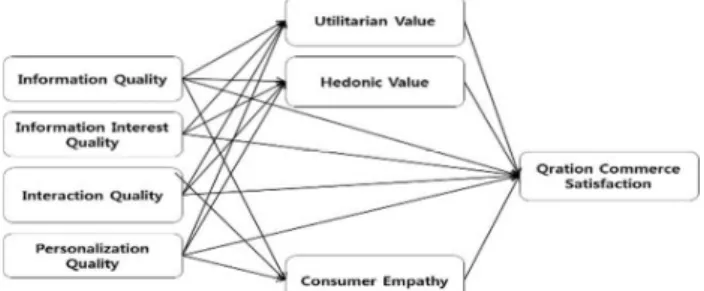
The following hypotheses were established, as shown in the research model in Figure 1.
Figure 1:Research Model
H1: Curation service qualities will have a significant positive impact on consumers’ satisfaction with curation commerce.
H1-1: The information quality will have a significant positive impact on consumers’ satisfaction with curation commerce.
H1-2: The information interest quality will have a significant positive impact on consumers’ satisfaction with curation commerce.
H1-3: The interaction quality will have a significant positive impact on consumers’ satisfaction with curation commerce.
H1-4: The personalization quality will have a significant positive impact on consumers’ satisfaction with curation commerce.
H2: Utilitarian value will significantly mediate the relationship between curation service qualities and consumers’ satisfaction with curation commerce.
H2-1: Utilitarian value will significantly mediate the relationship between the information quality and consumers’ satisfaction with curation commerce.
H2-2: Utilitarian value will significantly mediate the relationship between the information interest quality and consumers’ satisfaction with curation commerce.
H2-3: Utilitarian value will significantly mediate the relationship between the interaction quality and consumers’ satisfaction with curation commerce.
H2-4: Utilitarian value will significantly mediate the relationship between the personalization quality and consumers’ satisfaction with curation commerce.
H3: Hedonic value will significantly mediate the relationship between curation service qualities and consumers’ satisfaction with curation commerce.
H3-1: Hedonic value will significantly mediate the relationship between the information quality and consumers’ satisfaction with curation commerce.
H3-2: Hedonic value will significantly mediate the relationship between the information interest quality and consumers’ satisfaction with curation commerce.
H3-3: Hedonic value will significantly mediate the relationship between the interaction quality and consumers’ satisfaction with curation commerce.
H3-4: Hedonic value will significantly mediate the relationship between the personalization quality and consumers’ satisfaction with curation commerce.
H4: Consumer empathy value will significantly mediate the relationship between curation service qualities and consumers’ satisfaction with curation commerce.
H4-1: Consumer empathy will significantly mediate the relationship between the information quality and consumers’ satisfaction with curation commerce.
H4-2: Consumer empathy will significantly mediate the relationship between the information interest quality and consumers’ satisfaction with curation commerce.
H4-3: Consumer empathy will significantly mediate the relationship between the interaction quality and consumers’ satisfaction with curation commerce.
H4-4: Consumer empathy value will significantly mediate
the relationship between the personalization quality and consumers’ satisfaction with curation commerce.
3.2. Configuration of Questionnaires
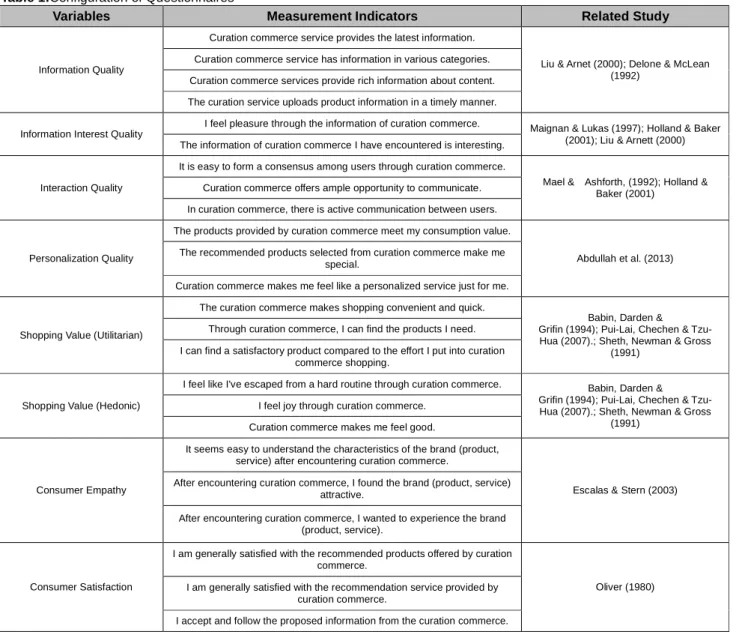
The manipulation and the measurement items of questions about variables are shown in Table 1.
Table 1:Configuration of Questionnaires
Variables Measurement Indicators Related Study
Information Quality
Curation commerce service provides the latest information.
Liu & Arnet (2000); Delone & McLean (1992)
Curation commerce service has information in various categories.
Curation commerce services provide rich information about content.
The curation service uploads product information in a timely manner.
Information Interest Quality
I feel pleasure through the information of curation commerce. Maignan & Lukas (1997); Holland & Baker (2001); Liu & Arnett (2000) The information of curation commerce I have encountered is interesting.
Interaction Quality
It is easy to form a consensus among users through curation commerce.
Mael & Ashforth, (1992); Holland &
Baker (2001) Curation commerce offers ample opportunity to communicate.
In curation commerce, there is active communication between users.
Personalization Quality
The products provided by curation commerce meet my consumption value.
Abdullah et al. (2013) The recommended products selected from curation commerce make me
special.
Curation commerce makes me feel like a personalized service just for me.
Shopping Value (Utilitarian)
The curation commerce makes shopping convenient and quick.
Babin, Darden &
Grifin (1994); Pui-Lai, Chechen & Tzu- Hua (2007).; Sheth, Newman & Gross
(1991) Through curation commerce, I can find the products I need.
I can find a satisfactory product compared to the effort I put into curation commerce shopping.
Shopping Value (Hedonic)
I feel like I've escaped from a hard routine through curation commerce. Babin, Darden &
Grifin (1994); Pui-Lai, Chechen & Tzu- Hua (2007).; Sheth, Newman & Gross
(1991) I feel joy through curation commerce.
Curation commerce makes me feel good.
Consumer Empathy
It seems easy to understand the characteristics of the brand (product, service) after encountering curation commerce.
Escalas & Stern (2003) After encountering curation commerce, I found the brand (product, service)
attractive.
After encountering curation commerce, I wanted to experience the brand (product, service).
Consumer Satisfaction
I am generally satisfied with the recommended products offered by curation commerce.
Oliver (1980) I am generally satisfied with the recommendation service provided by
curation commerce.
I accept and follow the proposed information from the curation commerce.
3.3. Analysis and Methods
This study was conducted on the Chinese population using curation commerce in China, and the questionnaire in the survey was translated directly into Chinese. A total of
273 copies were used for the survey. This study used SPSS 22.0 as the basic statistic, and Smart PLS 3.0 (Partial Least Squared) was used to perform the analysis based on the structural equation.
4. Empirical Analysis Results 4.1. Reliability Analysis Results
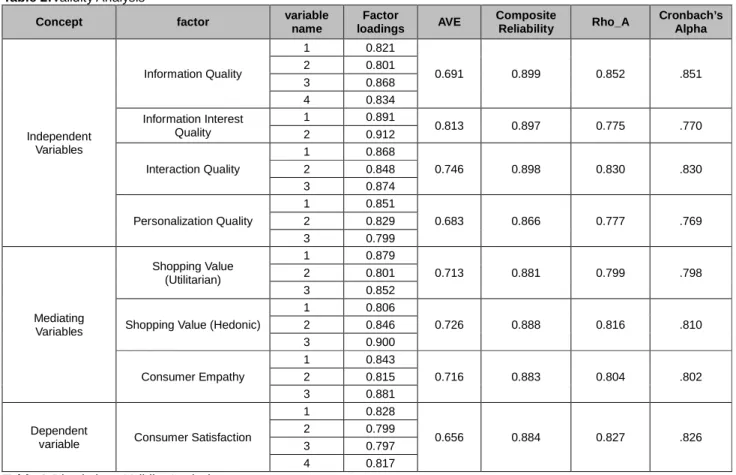
Reliability is a concept that determines how consistent the response results are when the respondents under study are repeatedly measured. Among the methods for measuring reliability, the internal inertia test by the Cronbach’s α coefficient was generally the most used. If the Cronbach’s α coefficient was 0.7 or higher, it was acceptable (Hair et al., 1998). The Cronbach’s α coefficients for each variable are shown in Table 2.
4.2. Validity Analysis Results
As a result of the factor analysis for the validity test of measurement tools, the construct of validity was tested by combining the different concepts into a single dimension.
For the purpose of validity analysis, this study analyzed the composite reliability value and average variance extracted (AVE) value obtained using the standardized factor loadings and error variance that are the effects of latent variables on
the observation variables. To verify the validity of each component concept or factor, the estimated factor loadings in the factor analysis were reviewed. The factor loadings in Table 2 were all 0.7 or higher, showing that each measurement variable item loaded with each factor (component concept) significantly reflected the concept of its composition. Convergent validity for each construct concept met a threshold value of 0.7 or higher for composite reliability, as recommended by Fornell and Larker (1981). Further, the AVE also met conditions above the threshold of 0.5 or higher.
On the other hand, the discriminant validity was measured by entering the square root of the AVE diagonally along with the corresponding correlations between the different constructions into the non-diagonal position. To achieve the discriminant validity of the concept of composition, the value of all diagonal positions must be greater than that of the non-diagonal position (Ling et al., 2017). As shown in Table 3, the value of the AVE square diagonally was higher than the relative value of each factor.
Therefore, the discriminant validity of the measurement model in this study has been verified.
Table 2:Validity Analysis
Concept factor variable
name
Factor
loadings AVE Composite
Reliability Rho_A Cronbach’s Alpha
Independent Variables
Information Quality
1 0.821
0.691 0.899 0.852 .851
2 0.801
3 0.868
4 0.834
Information Interest Quality
1 0.891
0.813 0.897 0.775 .770
2 0.912
Interaction Quality
1 0.868
0.746 0.898 0.830 .830
2 0.848
3 0.874
Personalization Quality
1 0.851
0.683 0.866 0.777 .769
2 0.829
3 0.799
Mediating Variables
Shopping Value (Utilitarian)
1 0.879
0.713 0.881 0.799 .798
2 0.801
3 0.852
Shopping Value (Hedonic)
1 0.806
0.726 0.888 0.816 .810
2 0.846
3 0.900
Consumer Empathy
1 0.843
0.716 0.883 0.804 .802
2 0.815
3 0.881
Dependent
variable Consumer Satisfaction
1 0.828
0.656 0.884 0.827 .826
2 0.799
3 0.797
4 0.817
Table 3:DiscriminantValidity Analysis
II Q I Q IT Q CE SVH PQ CS SVU
II Q 0.901
I Q 0.627 0.831
IT Q 0.745 0.698 0.864
CE 0.702 0.683 0.764 0.846
SVH 0.750 0.602 0.723 0.755 0.852
PQ 0.659 0.694 0.722 0.701 0.708 0.827
CS 0.536 0.667 0.602 0.752 0.569 0.588 0.810
SVU 0.658 0.760 0.689 0.796 0.661 0.715 0.741 0.844
4.3. Verification of Hypothesis Related with Direct Effects
The hypothesis test in this study was performed by using the path factor of the PLS structural model. The hypothesis was verified by testing the path-reliability between the variables using a measurement model that tested the reliability and validity of the measured items. PLS has no constraints on the normal number of variables and
residuals in the sample compared to structured statistical packages such as LISREL and AMOS (Chin, 1998).The t- value used for the hypothesis test was calculated by generating 500 repeated samplings through bootstrap, a method of estimating measurements with the same distribution by restoring from the sample (Hall, 2008). PLS is a representative analysis tool that uses the minimum self- defense method. The results of verifying the significance of the path factor using Smart PLS 3.0 are shown in Table 4.
Table 4:PLS Analysis Results and Hypothesis Test
Hypotheses Direct Effect Pathcoefficient t value Results
H 1-1 Information Quality→Satisfaction 0.207 2.695*** supported
H 1-2 Information Interest
Quality→Satisfaction -0.081 1.045 unsupported
H 1-3 Interaction Quality→Satisfaction -0.049 0.686 unsupported
H1-4 Personalization quality→Satisfaction -0.060 0.784 unsupported
***p < 0.01, **p < 0.05. *p < 0.1
It has been shown that the quality of information in hypothesis 1-1 has a direct and significant effect on curation commerce satisfaction.
4.4. Verification of Hypothesis Related with Mediation Effects
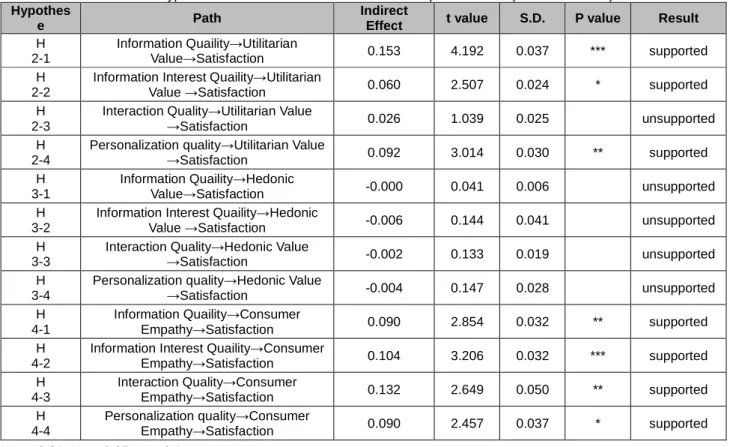
This study has verified the significance of the total and indirect effects to test the mediated effects. The results are shown in Table 5 and Table 6.
The quality of information directly affects satisfaction, leading to satisfaction through utilitarian value (0.153, p<.05) and consumer empathy (0.090, p<.01). Therefore, the hypotheses H1-1, H2-1, and H4-1 were all supported.
The quality of information interest did not directly affect satisfaction. However, utilitarian value (0.060, p<.05) and consumer empathy (0.104, p<.001) were proved to completely mediate the relationship between the quality of information interest and satisfaction. Therefore, H2-2 and H4-2 were supported.
Table 5:Total Effect of Structural Equation Model
Path Total Effect S.D. t value Results
Information Quality→Satisfaction 0.244 0.050 4.828 ***
Information Interest Quality→Satisfaction 0.158 0.058 2.718 ***
Interaction Quality→Satisfaction 0.155 0.053 2.958 ***
Personalization quality→Satisfaction 0.178 3.149 0.056 ***
***p < 0.01, **p < 0.05. *p < 0.1
Table 6:Indirect Effect and Hypothesis Verification Results of Structural Equation Model (Mediation Effect) Hypothes
e Path Indirect
Effect t value S.D. P value Result H
2-1
Information Quaility→Utilitarian
Value→Satisfaction 0.153 4.192 0.037 *** supported
H 2-2
Information Interest Quaility→Utilitarian
Value →Satisfaction 0.060 2.507 0.024 * supported
H 2-3
Interaction Quality→Utilitarian Value
→Satisfaction 0.026 1.039 0.025 unsupported
H 2-4
Personalization quality→Utilitarian Value
→Satisfaction 0.092 3.014 0.030 ** supported
H 3-1
Information Quaility→Hedonic
Value→Satisfaction -0.000 0.041 0.006 unsupported
H 3-2
Information Interest Quaility→Hedonic
Value →Satisfaction -0.006 0.144 0.041 unsupported
H 3-3
Interaction Quality→Hedonic Value
→Satisfaction -0.002 0.133 0.019 unsupported H
3-4
Personalization quality→Hedonic Value
→Satisfaction -0.004 0.147 0.028 unsupported
H 4-1
Information Quaility→Consumer
Empathy→Satisfaction 0.090 2.854 0.032 ** supported
H 4-2
Information Interest Quaility→Consumer
Empathy→Satisfaction 0.104 3.206 0.032 *** supported
H 4-3
Interaction Quality→Consumer
Empathy→Satisfaction 0.132 2.649 0.050 ** supported
H 4-4
Personalization quality→Consumer
Empathy→Satisfaction 0.090 2.457 0.037 * supported
***p < 0.01, **p < 0.05. *p < 0.1
The personalization quality did not directly affect satisfaction. However, the quality of personalization was shown to reach satisfaction through utilitarian value (0.092, p<.001) and consumer empathy (0.090, p<.05). Therefore, H2-4 and H4-4 were supported.
5. Conclusion
This study focused on determining which quality of service increases consumer satisfaction in the growing curation market and should be provided for better service.
In addition, the study sought to identify psychological mechanisms in the process of service quality that affect satisfaction. Specifically, it aimed to identify whether shopping value and consumer empathy serve as the mediating variables between service quality and satisfaction.
Recently, companies have been struggling with the practical use of curation commerce. Therefore, this analyzed the characteristics of this new commerce and looked into the effect of the characteristics on consumers’
curation satisfaction.
The e-commerce industry is evolving into a “curation commerce” that attracts consumers’ attention while strengthening content to enhance their shopping convenience to differentiate itself from other offline stores.
At a time when consumers are feeling fatigued from an information overload, curation services provide quality content and recommend customized products, relieving consumers of the worries and difficulties of making decisions.
However, there are a few previous studies on curation commerce. This study identified the effect of curation commerce characteristics on consumer satisfaction to help develop efficient curation services.
Existing studies in online commerce have presented a variety of success factors, including online customer relationship management, service quality characteristics, and website quality control (Santouridis, Trivelas &
Reclitis, 2009). In line with these research trends, this study also confirmed that the quality of service for curation commerce affects consumer satisfaction. This research is significant in that it has provided marketing grounds for the effect of the quality of the curation service attributes that marketers will consider to establish their curation service strategies on service satisfaction. In particular, while
previous studies have covered a lot of ground on the impact of curation service quality on satisfaction, there have not been many studies on what variables link the relationship between them in the course of service quality on satisfaction.
This study is meaningful because it has identified consumer responses to social curation commerce’s service quality, shopping value, consumer empathy and satisfaction in a short period of time since the curation service was launched.
Implications related to the results of this study are as follows.
First, this study sought to identify which service quality of curation commerce directly affects satisfaction. In the results, only the quality of information was found to have a direct impact on satisfaction. When implementing a marketing strategy for curation commerce, it should be prioritized to provide sufficient, accurate and new information to consumers.
Secondly, the utilitarian value was shown to act as an important mediating variable in the relationship between curation commerce service qualities (i.e., information quality, information interest quality, and personalization quality) and satisfaction.
Third, the hedonistic value was not shown to rmediate the relationship between curation commerce service qualities and satisfaction. It was confirmed that utilitarian value must be involved to bring even the quality of information interest to satisfaction. The services provided on curation commerce should provide values such as practicality and performance, rather than pleasure.
Finally, consumer empathy was to mediate the relationship between all service qualities and satisfaction of curation commerce. In other words, in the process of curation commerce delivering services to customers, a process is needed to persuade consumers to project themselves into the brand and enable the formation of a relationship between the customer and the brand.
There are several limitations of this study are. Based on prior research on e-service quality, this study consisted of various sub-factors. However, the actual curation commerce service quality is expected to be more diverse.
In the future, it will be more helpful if studies were conducted on the impact of various service quality factors on satisfaction.
References
Abdullah, N., Xu, Y., & Geva, S. (2013). Integrating collaborative filtering and matching-based search for product recommendations. Journal of Theoretical and Applied Electronic Commerce Research, 8(2), 34-48.
Anderson, E. W., Fornell, C., & Lehmann, D. R. (1994).
Customer satisfaction, market share, and profitability:
Findings from Sweden. The Journal of Marketing, 58, 53-66.
Akroush, M. N. & Fahed S. K. (2009). The impact of service quality dimensions on performance: An empirical investigation of Jordan’s commercial banks. Journal of Accounting-usiness and Management, 16(1), 22-44.
Babin, B. J., Darden, W. R., & Griffin, M. (1994). Work and/or fun: Measuring hedonic and utilitarian shopping value.
Journal of Consumer Research, 20(4), 644-656.
Bhaskar, M. (2016). Curation: The Power of Selection in a World of Excess. Little, Brown Book Group.
Chin, W. & Marcoulides, G. (1998). The partial least squares approach to structural equation modeling. Advances in Hospitality and Leisure, 8(2), 295-336.
Cho, H. J. (2012). The effects of service quality on shopping value and repatronage intention: The case of specialty coffee shops. Journal of Distribution Science, 10(4), 21-28.
http://dx.doi.org/10.15722/jds.10.4.201204.21
Chun, J. L. & Park, S. B. (2018). A study on the customers’
service expectation level: The effects of distribution service excellence awards for an Airport. Journal of Distribution
Science, 16(11), 47-56.
http://dx.doi.org/10.15722/jds.16.11.201811.47
Cronin, J. J. & Taylor, S. A. (1992). Measuring service quality: A reexamination and extension. Journal of Marketing, 56(July), 55-68.
Davis, G. B., & Olson, M. H. (1985). Management Information Systems: Conceptual Foundations, Structure, and Development. New York: McGraw-Hill.
Dale, S. (2014). Content curation: The future of relevance.
Business Information Review. 31(4), 199-205.
De Keyzer, F., Dens, N., & De Pelsmacker, P. (2015). Is this for me? How consumers respond to personalized advertising on social network sites. Journal of interactive advertising, 15(2), 124-134.
DeLone, H. W., & Ephraim, R. M. (1992). Information systems success: The quest for the dependent variable. Information Systems Research, 3(1), 60-95.
Eisenberg, N. (1991). Values, sympathy, and individual differences: Toward a pluralism of factors influencing altruism and empathy. Psychological Inquiry, 2(2), 128-131.
Escalas, J. E., & Stern, B. (2003). Sympathy and empathy:
Emotional responses to advertising dramas. Journal of Consumer Research, 29(4), 566-78.
Fornell, C., & Larcker, D. F. (1981). Evaluating structural equation models with unobservable variables and measurement error. Journal of Marketing Research, 18(1), 39-50.
Graefe, A., & Hon, K. W. (2004). Predicting event satisfaction by using SERVPERF and the circumplex model of affect.
Journal of Tourism and LeisureResearch, 16(4), 7-25.
Gu, W., Bao, P., & Lee, J. H. (2019). A study on the continuance intention of O2O fresh agricultural products E-Commerce.
International Journal of Industrial Distribution & Business,
10(10), 35-44.
http://dx.doi.org/10.13106/ijidb.2019.vol10.no10.35
Hair, J. F. (1998). Multivariate Data Analysis. Upper Saddle River, NJ.
Hall, M. (2008). The effect of comprehensive performance
measurement systems on role clarity, psychological empowermentand managerial performance. Accounting Organizations and Society, 316(6), 529-558.
Holland J., & Baker S. M. (2001). Customer participation in creating site brand loyalty. Journal of Interactive Marketing, 15(4), 34-45.
Jarvenpaa, S. L., & Todd, P. A. (1997). Consumer reaction to electronic shopping on the world wide web.
InternationalJournal of Electronic Commerce, 1(2), 59-88.
Karwatzki, S. (2017). Beyond the personalization-privacy paradox: Privacy valuation, transparency features, and service personalization. Journal of Management Information Systems, 32(2). 369-400.
Leiberg, S., & Anders, S. (2006). The multiple facets of empathy:
A survey of theory and evidence. Progress in Brain Research, 156, 419-440.
Liang, T. P., Lai, H. J., & Ku, Y. C. (2007). Personalized content recommendation and user satisfaction: Theoretical synthesis and empirical findings. Journal of Management Information Systems, 23(3), 45-70
Ling, N. P., Bandar, N. F. A., Halim, F. A., & Muda, A. L. (2017).
Proactive behaviour as a mediator in the relationship between quality of work life and career success. International Journal of Business and Society, 18(S4), 701-709.
Lewis, L.(1999). Branding the brand. Progressive Grocer, 78(7), 90-99.
Liu, C., & Arnett, K. (2000). Exploring the factors associated with web site success in the context of electronic commerce.
Information & Management, 38(1), 23-33.
Mael, F. A., & Ashforth, B. E. (1992). Alumni and their alma mater: A partial test of the reformulated model of organizational identification. Journal of Organizational Behavior, 13(2), 103-123.
Maignan, I., & Bryan A. L. (1997). The nature and social uses of the internet: A qualitative investigation. Journal of Consumer Affairs, 31(2), 346-371.
May, A., Chaintreau, A., Korula, N., & Lattanzi, S. (2014). Filter
& follow: How social media foster content curation.
Mearsurement and Modeling of Computer Systems, 1(3), 43- 55.
Oliver, R. L. (1980). A cognitive model of the antecedents and consequences of satisfaction decisions. Journal of Marketing Research, 17, 460-469.
Parasuraman, A., Zeithaml, V. A., & Berry, L. L. (1988).
SERVQUAL: A multiple-item scale for measuring consumer perceptions of service quality. Journal of Retailing, 64(1), 12–40.
Park, S. H., Jun, J. H., & Park, H. J. (2017). What factors affect to curation commerce website loyalty intetntion: The mediating effects of perceived deception. Quality Innovation Prosperity, 21(3), 95-113.
Pui-Lai, L., Chechen, L., & Tzu-Hua L. (2007). Shopping motivations on internet: A study based on utilitarian and hedonic value. Technovation, 27(12), 774-787.
Ramïrez, M.L. (2011). Opinion: Whose role is it anyway?: A library practitioner's appraisal of the digital data deluge.
Bulletin of the American Society for Information Science and Technology, 37(5), 21-23.
Rosenbaum, S. (2011). Curation Nation: How to Wn in A World Where Consumers Are Creators.NY: McGraw-Hill.
Rust, R. T., Danaher, P. J., & Varki, S. (2000). Using service quality data for competitive marketing decisions.
International Journal of Service Industry Management, 11(5), 438-469.
Santouridis, I., Trivellas, P., & Reklitis, P. (2009). Internet service qualityand customer satisfaction: Examining internet banking in Greece. Total Quality Management, 20(2), 223-239.
Sheth, J. N., Newman, B. I., & Gross, B. L. (1991). Consumption Values and Marketchoice: Theory and Application. Cincinnati:
South-Western Publishing Co.
Tan, W.C. (2007). Provenance in databases: Past, current, and future. IEEE Data Eng. Bull., 30(4), 3-12.
Tam, K.Y., & Ho, S.Y. (2006). Understanding the impact of web personalization on user information processing and decision outcomes. Management Information Quarterly, 30(4), 865- 890.
Vallerand, R. J., Gauvin, L. I., & Hallivell, W. R. (1986).
Negative effects of competition on children’s intrinsic motivation and perceived competence. The Journal of Social Psychology, 126, 659–657.