Print ISSN: 2288-4637 / Online ISSN 2288-4645 doi:10.13106/jafeb.2021.vol8.no6.0287
Customer Perception of E-Service Quality:
An Empirical Study in Indonesia
Muhammad Asril ARILAHA1,Johan FAHRI2,Irfandi BUAMONABOT3
Received: February 20, 2021 Revised: April 20, 2021 Accepted: May 02, 2021
Abstract
E-service quality has received attention from customer perception, especially online shopping customers. In the context of online shopping, e-service quality is believed to make an enormous contribution to customer perception. This study examines the effect of e-service quality (web design, responsiveness, reliability, trust, and personalization) on customer perception. A total of 278 respondents from South Sulawesi, North Sulawesi, Maluku, North Maluku, and Papua were involved and selected by purposive sampling method. The validity was tested using factor analysis with a loading factor value of ≥0, the reliability was tested by a Cronbach’s Alpha value ≥0.6, and hypotheses were tested by regression analysis. The results show that e-service quality (web design, responsiveness, reliability, trust, and personalization) has a positive effect on customer perception. This study summarizes new findings regarding the positive effect of e-service quality (website design, responsiveness, reliability, trust, personalization) on customer perception as well as providing recommendations for future research. This research underlines that women dominate shopping more than men and that Generation Z dominates online shopping. In addition, the research provides new evidence that earnings do not determine how much online purchases will made by consumers as the majority of our respondents are students who are active purchasers.
Keywords: Customer Perception, E-Service Quality, Online Shopping, Responsiveness, Reliability JEL Classification Code: M31, M37, L81
an organization’s products and services (Law & Leung, 2000; Muafi et al., 2021; Wattimena & Sin, 2020; Warrier et al., 2021). One of the businesses for which the potential is limitless using the Internet is online shopping (e-commerce) (Guo & Barnes, 2009; Ha et al., 2021). This potential incorporates good service quality since it is one of the main aspects of business success (Tshin et al., 2014). Service quality is defined as a comparison between expectations and reality (Parasuraman et al., 1988). It results in a good consumer experience and leads to greater customer loyalty with higher returns (Tan & Goh, 2017; Dam & Dam, 2021; Putra et al., 2021).
Hapsawati, (2019) argued that service quality carries new customers and maintains their loyalty. In an online shopping environment, e-service quality is understood as customer perceptions and judgments regarding the excellence and quality of delivery (Lee & Lin, 2005). Customer perceptions of the service they received are influenced by several components and determined based on their experience (Rakhmawati et al., 2013). However, the challenge to determine the effect of e-service quality on customer perception in the context of online shopping is the novelty of this study. Most studies discuss consumer perceptions based on the e-service quality
1 First Author. Faculty of Economics and Business, Universitas Khairun, Indonesia.
2 Faculty of Economics and Business, Universitas Khairun, Indonesia. 3 Corresponding Author. Faculty of Economics and Business,
Universitas Khairun, Indonesia [Postal Address: 97719, Ternate, Province North Maluku, Indonesia] Email: [email protected]
© Copyright: The Author(s)
This is an Open Access article distributed under the terms of the Creative Commons Attribution Non-Commercial License (https://creativecommons.org/licenses/by-nc/4.0/) which permits unrestricted non-commercial use, distribution, and reproduction in any medium, provided the original work is properly cited.
1. Introduction
The Internet has become part of the lifestyle of most people in the world (Harcar & Yucelt, 2012). This can be seen from the level of Internet usage, which has rapidly increased in the last two decades (Trivedi & Trivedi, 2018). Indonesia becomes the second-highest Internet user country in the Asia Pacific region for online shopping (Statista, 2018a; Statista, 2018b; Statista, 2018c; Kalia, 2016; Kalia et al., 2016; Kalia et al., 2017).
The Internet has changed the way of doing business as today’s consumers have more ways to access information about
variable, rather than each variable of customer perception and e-service quality separately (e.g., Kim & Kim, 2020; Setiawan et al., 2020; Suhartanto et al., 2019).
This research was conducted with online shoppers of Shopee and Tokopedia in Indonesia spread over the areas of South Sulawesi, North Sulawesi, Maluku, North Maluku, and Papua. This research breaks new academic grounds in this field.
2. Literature Review
2.1. Web DesignA website is a design process with a more effective approach used in a limited manner and developed based on customer perceptions (Katz et al., 1991; Weinberg, 2000). The successful rise of the Internet has made web-based systems an important medium in connecting service providers or products with their customers (Taherdoost, 2019). Customers’ perceptions of the websites change when the information they are looking for is not available and they will move to other websites providing the information they need (Gao, 2005). This means that online shopping must be able to present their website visually attractive, have an easy-to-understand interface for consumers, and a fast and easy completion process (Parasuraman et al., 1988; Kim & Lee, 2002). When this has been fulfilled by online shopping, it will attract the attention of consumers by itself (Ganguly et al., 2010). 2.2. Responsiveness
Responsiveness refers to the speed and accuracy of responding to consumer requests and transactions (Zeithaml et al., 2002; Hu et al., 2012; Ayo et al., 2016). It concurrently fulfills the commitment of the online shopping party, both listening and providing clear information to consumers (Zemblytė, 2015). Besides, post-purchase inconveniences still occur frequently. Online shopping responds to this by providing support and after-sales service to respond to customer problems, which are part of the quality of the process that can only be felt (Bauer et al., 2006). Consumers expect online shopping parties to respond to their complaints promptly as quick responses help consumers solve their problems and make decisions in a timely manner (Wolfinbarger & Gilly, 2003; Liao & Cheung, 2002). A quick response to consumer demand is likely to increase perceived comfort and reduce uncertainty (Gummerus et al., 2004). Thus, high responsiveness can form positive consumer perceptions. 2.3. Reliability
Reliability deals with the ability to perform the promised services accurately, reliably, and punctually (Parasuraman
et al., 1988). It covers the ability to solve problems, blemished transactions with adequate security (Lee & Lin, 2005; Chang et al., 2016). Reliability is a major factor that motivates consumers to purchase. The reliability of products available online encourages consumers to make online purchases (Rishi, 2010). For this reason, every online shopping must be able to run its business at certain times, have a sincere intention to provide solutions to the problems faced by consumers, and avoid mistakes, whether intentional or unintentional (Parasuraman et al., 1988; Kim & Lee, 2002). This certainly has an impact on consumer perceptions of being comfortable when shopping. Therefore, one aspect of the Internet as a shopping platform is the reliability system that guarantees further examination of its convenience (Jun et al., 2004; Kim & Park, 2012; Udo et al., 2010; Yang & Fang, 2004). 2.4. Trust
Trust is the level of risk when involved in a relationship to get the expected results (Tandiono et al., 2020). Casaló et al., (2010) defined trust as an attitude to use social media toward the privacy and security issues. Trust in online shopping must be able to maintain the confidentiality of consumer data, not occur fraud related to financial transactions, must be able to protect online financial transactions, have a relatively low risk, be able to carry out obligations as an online shopping party, be highly competent in the field of e-commerce and have a good reputation (Parasuraman et al., 1988; Yang & Jun, 2002; Fang et al., 2011; Djojo et al., 2015). It has a direct influence on attitudes since perceptions are developed in the online shopping experience (Pavlou & Fygenson, 2006). It also has an impact on the decision to return to shopping in the future (Wu et al., 2008; Zheng et al., 2019). Trust also influences online shopping behavior (Hong & Cho, 2011). Teoh et al., (2013) contended that trust has an effect on customer perception in the context of online payment systems. 2.5. Personalization
According to Vesanen, (2007), there is no universally-accepted definition of personalization. It reflects the extent to which information is tailored to meet the needs of individual users and becomes an important determinant of positive experiences (Bilgihan et al., 2016). As positive experiences form a better consumer perception, online shopping (e-commerce) attempts to provide relevance by offering interesting content or products as a solution to consumer needs (Riegger et al., 2021). This includes targeted e-mails for new consumers, providing alternative recommendations for products and services based on consumer preferences, and providing a home or free space for consumers (Parasuraman et al., 1988; Yang & Jun, 2002; Fang et al., 2011; Djojo et al., 2015). Implicit relevance incorporates context specificity, which is important for personalization to
deliver the right content to the right people and at the right time (Tam & Ho, 2006). Personalization generates greater attention to offerings by creating self-associations, providing a good match with customer preferences, and encouraging increased elaboration of relevant information. These efforts are more likely to succeed in positively influencing purchasing decisions, by creating joy, gratitude, or customer satisfaction (Bock et al., 2016). Anderson and Liem (2020) stated that there are varies factors that influence customers to buy products and service and experience when buy products and service is one of significant factor.
2.6. Customer Perception
In the context of online shopping, consumer perceptions come from previous experiences (Tandiono et al., 2020). As perception is the source of subjective norms (Pudaruth & Nursing, 2017), consumers’ perceptions determine the success of e-service quality (Cristobal et al., 2007). The success of electronic services is largely determined by consumer perceptions of the online shopping system compared to offline methods, including the effectiveness and efficiency of services and the time required by consumers when shopping online compared to offline and consumer perceptions regarding the appearance of a friendly design and being able to attract the desire to shop online compared offline (Teoh et al., 2013; Fang et al., 2011). It is largely determined by the application of e-service quality such as web design, responsiveness, reliability, and trust (Lee & Lin, 2005) as well as personalization (Bues et al., 2017).
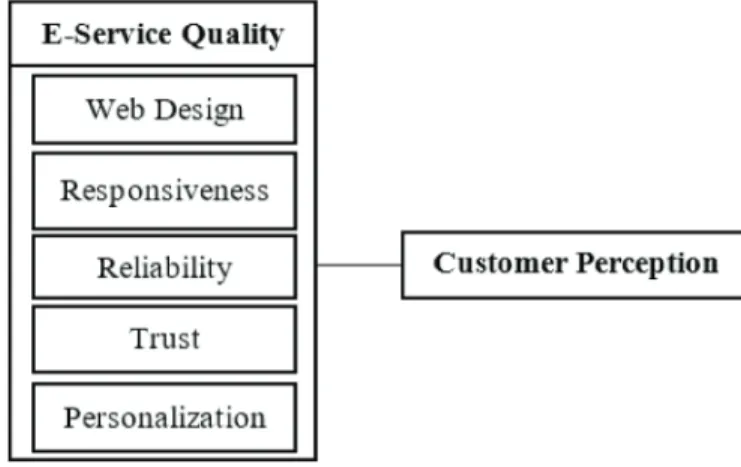
Based on the description above, this study illustrates the research model as in Figure 1 and proposes the following hypotheses:
H1: Web design has a positive effect on customer perception.
H2: Responsiveness has a positive effect on customer perception.
H3: Reliability has a positive effect on customer perception.
H4: Trust has a positive effect on customer perception. H5: Personalization has a positive effect on customer perception.
3. Methodology
The population of this study is online shoppers of Shopee and Tokopedia. The sample was taken by purposive probability sampling method fulfilling the criterion of having made an online purchase from Shopee and or Tokopedia. The questionnaires were distributed in May-June 2019 with a total sample of 278 respondents. The validity was tested using factor analysis with a loading factor value of ≥0.5 (Hair et al., 2010), and the reliability was tested by a Cronbach’s Alpha value ≥0.6 (Hair et al., 2009). The hypotheses were tested by simple regression analysis (Hair, Jr, 2015). The e-service quality measurement was adopted from Lee and Lin (2005) suggesting that e-service quality is divided into five variables, including website design, reliability, and responsiveness measured by a questionnaire developed by Parasuraman et al. (1988) and Kim and Lee, (2002). Furthermore, trust and personalization variables were measured by a questionnaire developed by Djojo et al. (2015), Fang et al. (2011), Parasuraman et al. (1988) and Yang and Jun, (2002). The customer perception variables were measured with a questionnaire developed by Teoh et al. (2013) and Fang et al. (2011).
4. Results and Discussion
The questionnaires were directly distributed to respondents in North Maluku, and for those in North Sulawesi, South Sulawesi, Maluku, and Papua, they were
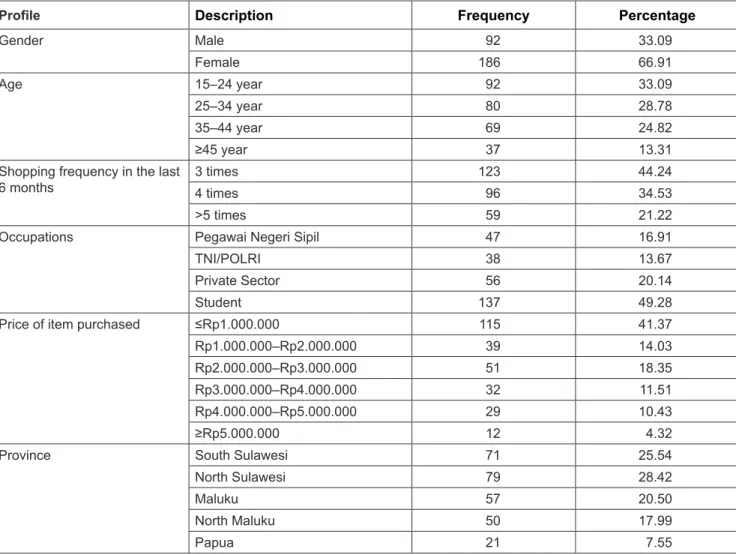
given the questionnaire through Google Form link via WhatsApp group. Among the 350 questionnaires distributed, 298 (85%) were returned and 278 (79%) were eligible for further testing. Table 1 presents the respondent profile.
Table 1 shows the profile of the respondents by their gender, age, shopping frequency, occupation, purchased item price, and provinces. In general, the majority of the respondents were women, aged 15–24 years old with a shopping frequency of three times. Most of them are students purchasing products less than IDR1,000,000 worth. They come from five provinces, namely, South Sulawesi, North Sulawesi, Maluku, North Maluku, and Papua.
Table 1 implies that women enjoy shopping more, have more brand and price awareness, have higher self-confidence, and are hedonistic, while men prioritize functional and time-saving aspects when shopping (Seock & Bailey, 2008). By age and occupation, respondents are
generally Generation Z, followed by Millennial Generation, Generation X, and the Baby Boomers Generation. This underlines that Generation Z is more proficient in using the Internet than other generations so that the average goods purchased are under IDR1,000,000 (Ayuni, 2019; Dharmesti et al., 2019; Koksal, 2019; Ladhari et al., 2019).
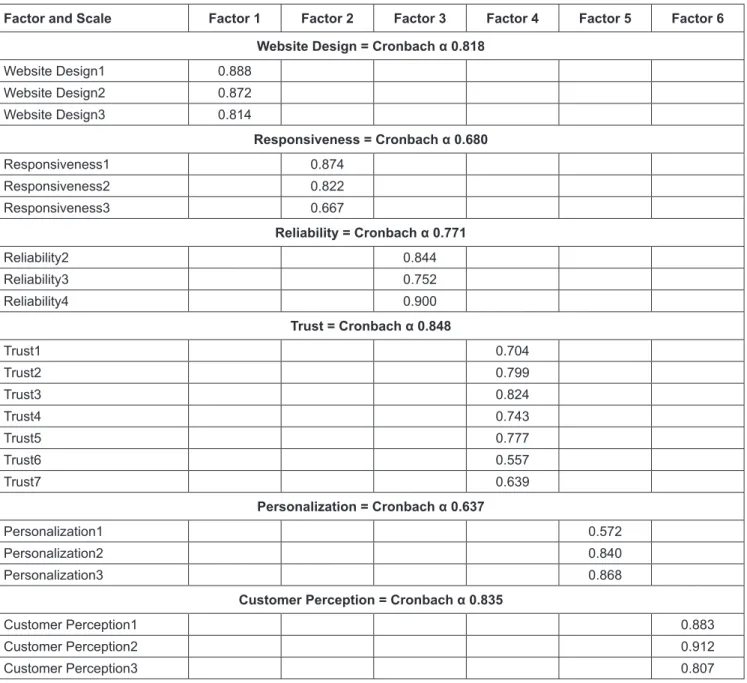
Table 2 indicates the results of testing the validity and reliability among the variables studied. Website design, responsiveness, trust, personalization, and customer perception, all showed a loading factor value of ≥0.5. Only the variable reliability has to be tested for validity twice because one question item does not meet the loading factor value. Furthermore, all variables were declared valid (Hair et al., 2010). Furthermore, for the results of reliability testing for the variables studied, all of them had a Cronbach’s Alpha value ≥0.6, so that all variables (website design, reliability, responsiveness, trust, personalization, and customer Table 1: Profile of Respondents
Profile Description Frequency Percentage
Gender Male 92 33.09 Female 186 66.91 Age 15–24 year 92 33.09 25–34 year 80 28.78 35–44 year 69 24.82 ≥45 year 37 13.31
Shopping frequency in the last
6 months 3 times4 times 12396 44.2434.53
>5 times 59 21.22
Occupations Pegawai Negeri Sipil 47 16.91
TNI/POLRI 38 13.67
Private Sector 56 20.14
Student 137 49.28
Price of item purchased ≤Rp1.000.000 115 41.37
Rp1.000.000–Rp2.000.000 39 14.03
Rp2.000.000–Rp3.000.000 51 18.35
Rp3.000.000–Rp4.000.000 32 11.51
Rp4.000.000–Rp5.000.000 29 10.43
≥Rp5.000.000 12 4.32
Province South Sulawesi 71 25.54
North Sulawesi 79 28.42
Maluku 57 20.50
North Maluku 50 17.99
perception), were declared reliable (Hair, Jr, 2015). This shows that valid questions must be reliable and the analysis can be continued to the following stages (Sekaran & Bougie, 2016).
Also, the results of validity and reliability testing in Table 2 shows that among the variables studied, the website design variables, responsiveness, trust, personalization, and customer perception, all showed a loading factor value ≥0.5. Only the reliability variable, which is one question item, must be discarded because it does not meet the loading factor value. Furthermore, all variables are declared valid. Furthermore, for
the results of reliability testing for the variables studied, all of them had a Cronbach’s Alpha value ≥0.6, so that all variables were declared reliable. This shows that valid questions must be reliable and can be continued at the following stages.
Table 3 indicates that the majority of respondents agreed that website design must be visually attractive with a well-organized appearance and quick and easy transaction completion. As for the responsiveness, the respondents agreed about the importance of providing fast service, customer assistance, and proper responses to customer requests. They Table 2: Validity and Reliability Testing Results
Factor and Scale Factor 1 Factor 2 Factor 3 Factor 4 Factor 5 Factor 6 Website Design = Cronbach α 0.818
Website Design1 0.888 Website Design2 0.872 Website Design3 0.814 Responsiveness = Cronbach α 0.680 Responsiveness1 0.874 Responsiveness2 0.822 Responsiveness3 0.667 Reliability = Cronbach α 0.771 Reliability2 0.844 Reliability3 0.752 Reliability4 0.900 Trust = Cronbach α 0.848 Trust1 0.704 Trust2 0.799 Trust3 0.824 Trust4 0.743 Trust5 0.777 Trust6 0.557 Trust7 0.639 Personalization = Cronbach α 0.637 Personalization1 0.572 Personalization2 0.840 Personalization3 0.868
Customer Perception = Cronbach α 0.835
Customer Perception1 0.883
Customer Perception2 0.912
Table 3: Respondents Perception Variables Strongly (%)
Disagree
(%)
Disagree Neutral(%) Agree(%)
(%) Strongly
Agree Modus
Website Design – 2.2% 6.5% 54.3% 37.1% Agree
Responsiveness – 2.2% 14.4% 65.8% 17.6% Agree
Reliability 2.2% 6.1% 34.9% 47.1% 9.7% Agree
Trust – 2.2% 16.5% 65.1% 16.2% Agree
Personalization – – 22.3% 62.2% 15.5% Agree
Customer Perception 2.2% 4% 27% 43.2% 23.7% Agree
Table 4: Hypotheses Testing Independent Variable Customer Perception β T Sig Website Design 0.409 5.121 0.000 Responsiveness 0.761 9.194 0.000 Reliability 0.433 6.881 0.000 Trust 0.800 10.878 0.000 Personalization 0.228 2.511 0.013
Note: Beta (β), t count (t), significant (Sig).
also agreed that reliability shows a sincere desire to solve customer problems flawlessly and with adequate security.
Furthermore, regarding the trust variable, the respondents agreed that the value of privacy protection, trustworthiness, transaction protection, low risk, proper obligation fulfillment, and e-commerce competency and good reputation. Also, as for personalization, the respondents agreed that targeted emails, product recommendations, and free personal homepages for customers will be beneficial. Table 3 also highlights that the respondents perceived online purchasing method is better and more efficient than the traditional method, and the user-friendly interfaces on e-commerce websites influence their purchasing decisions.
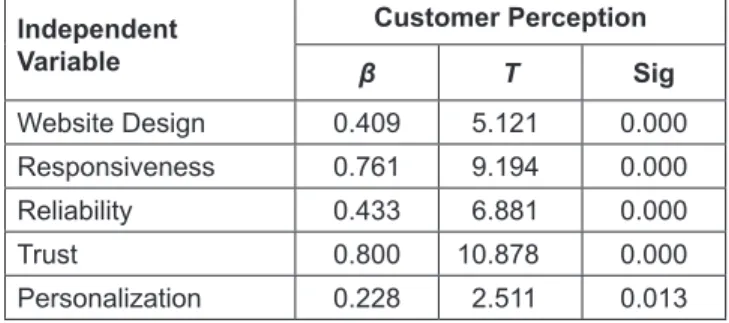
The results of hypothesis testing (see Table 4) show that website design has a positive effect on customer perception (β = 0.409, t = 5.121, P < 0.05), responsiveness has a positive effect on customer perception (β = 0.761, t = 9.194,
P < 0.05), reliability has a positive effect on customer
perception (β = 0.433, t = 6.881, P < 0.05), trust has a positive effect on customer perception (β = 0.800,
t = 10,878, P < 0.05), and personalization has a positive effect
on customer perception (β = 0.228, t = 2.511, P < 0.05). This concludes that all five hypotheses are supported. The results of hypothesis testing are shown in Table 4.
The hypothesis testing reveals that website design has a positive effect on customer perception. This implies that website design is the main medium that connects online shopping with consumers (Taherdoost, 2019). Thus, a good website must meet the elements of being visually attractive, having a well-organized appearance, and providing speed transactions (Kim & Lee, 2002; Parasuraman et al., 1988). Both Shopee and Tokopedia have fulfilled this.
The hypothesis testing also proves that responsiveness has a positive effect on customer perception. This shows that Shopee and Tokopedia have been able to handle complaints and respond quickly. E-commerce must constantly carry out its commitment to listen to the customers or provide clear information (Zemblytė, 2015), give fast service, help
customers, and respond to their requests quickly (Kim & Lee, 2002; Parasuraman et al., 1988).
The hypothesis testing also suggests that reliability has a positive effect on customer perception. It is the main factor that motivates consumers to shop (Rishi, 2010). Good reliability performs the promised service accurately, reliably, and promptly (Parasuraman et al., 1988).
Also, the hypothesis testing signifies that trust has a positive effect on customer perception. Shopee and Tokopedia have been able to maintain consumer privacy and security which shape their consumer perceptions. This impacts their repurchasing decision (Wu et al., 2008; Zheng et al., 2019). This finding is in line with Teoh et al., (2013).
Subsequently, personalization has a positive effect on customer perception. This implies that positive shopping experiences in Shopee and Tokopedia form better consumer perceptions. This in turn creates a sense of joy, gratitude, and customer satisfaction (Bock et al., 2016).
5. Conclusion
This study summarizes new findings regarding the positive effect of e-service quality (website design, responsiveness, reliability, trust, personalization) on customer perception as
well as providing recommendations for future research. It also provides descriptive aspects such as gender, age, and occupation. This research underlines that women dominate shopping more than men and that online shopping is dominated by Generation Z. In addition, the research provides new evidence that earnings do not determine how much online purchases consumers will make as our respondents are students who are active purchasers. The challenge for future research will be to add other variables, both antecedents (customer knowledge, experiences, and perceived usefulness) and consequences (e-consumer satisfaction and purchase intention).
References
Ayo, C. K., Oni, A. A., Adewoye, O. J., & Eweoya, I. O. (2016). E-banking users’ behaviour: e-service quality, attitude, and customer satisfaction. International Journal of Bank Marketing,
34(3), 347–367. https://doi.org/10.1108/02652323199400002
Ayuni, R. F. (2019). the Online Shopping Habits and E-Loyalty of Gen Z As Natives in the Digital Era. Journal of Indonesian
Economy and Business, 34(2), 168. https://doi.org/10.22146/
jieb.39848
Bauer, H. H., Falk, T., & Hammerschmidt, M. (2006). eTransQual: A transaction process-based approach for capturing service quality in online shopping. Journal of Business Research,
59(7), 866–875. https://doi.org/10.1016/j.jbusres.2006.01.021
Bilgihan, A., Kandampully, J., & Zhang, T. (Christina). (2016). Towards a unified customer experience in online shopping environments: Antecedents and outcomes. International
Journal of Quality and Service Sciences, 8(1), 102–119. https://
doi.org/https://doi.org/10.1108/IJQSS-07-2015-0054
Bock, D. E., Mangus, S. M., & Folse, J. A. G. (2016). The road to customer loyalty paved with service customization.
Journal of Business Research, 69(10), 3923–3932. https://doi.
org/10.1016/j.jbusres.2016.06.002
Bues, M., Steiner, M., Stafflage, M., & Krafft, M. (2017). How Mobile In-Store Advertising Influences Purchase Intention: Value Drivers and Mediating Effects from a Consumer Perspective. Psychology and Marketing, 34(2), 157–174. https://doi.org/10.1002/mar.20981
Casaló, L. V., Flavián, C., & Guinalíu, M. (2010). Antecedents and consequences of consumer participation in on-line communities: The case of the travel sector. International
Journal of Electronic Commerce, 15(2), 137–167. https://doi.
org/10.2753/JEC1086-4415150205
Chang, S. H., Chih, W. H., Liou, D. K., & Yang, Y.-T. (2016). The mediation of cognitive attitude for online shopping. Information
Technology & People, 29(3), 618–646. https://doi.org/https://
doi.org/10.1108/ITP-08-2014-0172
Cristobal, E., Flavián, C., & Guinalíu, M. (2007). Perceived e-service quality (PeSQ): Measurement validation and effects on consumer satisfaction and web site loyalty.
Managing Service Quality, 17(3), 317–340. https://doi.
org/10.1108/09604520710744326
Dam, S. M., & Dam, T. C. (2021). Relationships between Service Quality, Brand Image, Customer Satisfaction, and Customer Loyalty. Journal of Asian Finance, Economics and Business, 8(3), 585–593. https://doi.org/10.13106/jafeb.2021.vol8.no3.0585 Dharmesti, M., Dharmesti, T. R. S., Kuhne, S., & Thaichon, P.
(2019). Understanding online shopping behaviours and purchase intentions amongst millennials. Young Consumers,
June. https://doi.org/10.1108/YC-12-2018-0922
Djojo, B. W., Arief, M., & Heriyati, P. (2015). Exploring the relationship of distribution channel role to trust and purchase intention of microinsurance. Advanced Science Letters, 21(5), 1108–1112. https://doi.org/10.1166/asl.2015.6010
Fang, Y., Chiu, C., & Wang, E. T. G. (2011). Understanding customers’ satisfaction and repurchase intentions. Internet
Research. https://doi.org/10.1108/10662241111158335
Fang, Y. H., Chiu, C. M., & Wang, E. T. G. (2011). Understanding customers’ satisfaction and repurchase intentions: An integration of IS success model, trust, and justice. Internet Research, 21(4), 479–503. https://doi.org/10.1108/10662241111158335 Ganguly, B., Dash, S. B., Cyr, D., & Head, M. (2010). The effects
of website design on purchase intention in online shopping : the mediating role of trust and the moderating role of culture. Int. J.
Electronic Business, 8(4–5), 302–330. https://doi.org/10.1504/
IJEB.2010.035289
Gao, Y. (2005). Web systems design and online consumer behavior. Idea Group Publishing Global.
Gummerus, J., Liljander, V., Pura, M., & Van Riel, A. (2004). Customer loyalty to content-based Web sites: The case of an online health-care service. Journal of Services Marketing,
18(3), 175–186. https://doi.org/10.1108/08876040410536486
Guo, Y., & Barnes, S. (2009). Virtual item purchase behavior in virtual worlds: An exploratory investigation. Electronic
Commerce Research, 9(1–2), 77–96. https://doi.org/10.1007/
s10660-009-9032-6
Ha, N. T., Nguyen, T. L. H., Pham, T. Van, & Nguyen, T. H. T. (2021). Factors Influencing Online Shopping Intention: An Empirical Study in Vietnam. Journal of Asian Finance,
Economics and Business, 8(3), 1257–1266. https://doi.
org/10.13106/jafeb.2021.vol8.no3.1257
Hair, Jr, J. F. (2015). Essentials of Business Research Methods. In
Essentials of Business Research Methods. Routledge. https://
doi.org/10.4324/9781315704562
Hair, J., Black, W., Babin, B., & Anderson, R. (2010). Multivariate Data Analysis: A Global Perspective. In: Hall, P. P. (Ed.),
Multivariate Data Analysis: A Global Perspective (7th Ed.,
Vol. 7). Pearson.
Hair, J. F., Black, W., Babin, B., & Anderson, R. E. (2009).
Multivariate Data Analysis. Upper Saddle River, NJ: Prentice
Hall.
Hapsawati, T. (2019). Service Quality and Consumer’s Trust Using PT. JNE Gorontalo Branch. International Journal of Applied
Business & International Management, 4(1), 103–111. https://
Harcar, T., & Yucelt, U. (2012). American Consumer’s Attitudes towards Different Airline Companies Channels: A Comparison of transaction Methods. PASOS. Revista de Turismo y
Patrimonio Cultural, 10(2), 59–68. https://doi.org/10.25145/
j.pasos.2012.10.027
Hong, I. B., & Cho, H. (2011). The impact of consumer trust on attitudinal loyalty and purchase intentions in B2C e-marketplaces: Intermediary trust vs. seller trust. International
Journal of Information Management, 31(5), 469–479. https://
doi.org/10.1016/j.ijinfomgt.2011.02.001
Hu, Y. C., Wang, J. H., & Hung, L. P. (2012). Evaluating Microblogging e-Service Quality using ET AL. Journal of
Multi-Criteria Decision Analysis, 19(1–2), 89–111. https://doi.
org/10.1002/mcda.491
Jun, M., Yang, Z., & Kim, D. S. (2004). Customers’ perceptions of online retailing service quality and their satisfaction. International Journal of Quality and
Reliability Management, 21(8), 817–840. https://doi.org/
10.1108/02656710410551728
Kalia, P. (2016). Tsunamic E-Commerce in India: The Third Wave.
The Global Analyst, 5(7), 47–49.
Kalia, P., Arora, R., & Kumalo, S. (2016). E-service quality, consumer satisfaction and future purchase intentions in e-retail. E-Service Journal, 10(1), 24. https://doi.org/10.2979/ eservicej.10.1.02
Kalia, P., Kaur, N., & Singh, T. (2017). E-commerce in India: Evolution and revolution of online retail. Mobile Commerce:
Concepts, Methodologies, Tools, and Applications, 2, 736–758.
https://doi.org/10.4018/978-1-5225-2599-8.ch036
Katz, K. L., Larson, B. M., & Larson, R. C. (1991). Prescription for waiting–in line blues: Entertain, enlighten and engage. (winter), 32(2). Sloan Management Review (Winter), 32(2), 44–55.
Kim, B. C., & Park, Y. W. (2012). Security versus convenience? An experimental study of user misperceptions of wireless internet service quality. Decision Support Systems, 53(1), 1–11. https:// doi.org/10.1016/j.dss.2011.08.006
Kim, J. H., & Kim, M. (2020). Conceptualization and assessment of E-service quality for luxury brands. Service Industries
Journal, 40(5), 436–470. https://doi.org/10.1080/02642069.2
018.1517755
Kim, J., & Lee, J. (2002). Critical design factors for successful e-commerce systems. Behaviour and Information Technology,
21(3), 185–199. https://doi.org/10.1080/0144929021000009054
Koksal, M. H. (2019). Differences among baby boomers, Generation X, millennials, and Generation Z wine consumers in Lebanon: Some perspectives. International Journal of Wine
Business Research, 31(3), 456–472. https://doi.org/10.1108/
IJWBR-09-2018-0047
Ladhari, R., Gonthier, J., & Lajante, M. (2019). Generation Y and online fashion shopping: Orientations and profiles. Journal
of Retailing and Consumer Services, 48(February), 113–121.
https://doi.org/10.1016/j.jretconser.2019.02.003
Law, R., & Leung, R. (2000). A study of airlines’ online reservation services on the internet. Journal of Travel Research, 39(2), 202–211. https://doi.org/10.1177/004728750003900210 Lee, G. G., & Lin, H. F. (2005). Customer perceptions of e-service
quality in online shopping. International Journal of Retail
and Distribution Management, 33(2), 161–176. https://doi.
org/10.1108/09590550510581485
Liao, Z., & Cheung, M. T. (2002). Internet-based e-banking and consumer attitudes: an emprirical study. Information and
Management Journal, 39(4), 283–295. https://doi.org/10.1016/
S0378-7206(01)00097-0
Muafi, M., Syafri, W., Prabowo, H., & Nur, S. A. (2021). Digital Entrepreneurship in Indonesia: A Human Capital Perspective.
Journal of Asian Finance, Economics and Business, 8(3),
351–359. https://doi.org/10.13106/jafeb.2021.vol8.no3.0351 Parasuraman, A., Zeithaml, V. A., & Berry, L. L. (1988).
SERVQUAL: A multiple-item scale for measuring consumer perceptions of service quality. Journal of Retailing, 64(1), 12–40.
Pavlou, P. A., & Fygenson, M. (2006). Understanding and Predicting Electronic Commerce Adoption: An Extension of the Theory of Planned Behavior. MIS Quarterly, 30(1), 115–143. https://doi. org/10.1109/GLOCOMW.2012.6477580
Pudaruth, S., & Nursing, R. K. (2017). Exploring the Determining Factors Influencing Online Purchase Behaviour among Consumers in Emerging Economies: A Case of Mauritius.
International Journal of Arts & Sciences, 10(1), 1–22.
Putra, P., Jayadi, R., & Steven, I. (2021). The Impact of Quality and Price on the Loyalty of Electronic Money Users: Empirical Evidence from Indonesia. Journal of Asian Finance, Economics
and Business, 8(3), 1349–1359. https://doi.org/10.13106/
jafeb.2021.vol8.no3.1349
Rakhmawati, T., Sumaedi, S., Bakti, I. G. M. Y., Astrini, N. J., Yarmen, M., Widianti, T., Sekar, D. C., & Vebriyanti, D. I. (2013). Developing a Service Quality Measurement Model of Public Health Center in Indonesia. Management Science
and Engineering, 7(2), 1–15. https://doi.org/10.3968/j.mse.
1913035X20130702.1718
Riegger, A. S., Klein, J. F., Merfeld, K., & Henkel, S. (2021). Technology-enabled personalization in retail stores: Understanding drivers and barriers. Journal of Business
Research, 123, 140–155. https://doi.org/10.1016/j.jbusres.
2020.09.039
Rishi, B. (2010). Motivators and decisional influencers of online shopping. International Journal of Business Innovation and
Research, 4(3), 195–209. https://doi.org/10.1504/IJBIR.
2010.032383
Sekaran, U., & Bougie, R. (2016). Research Methods For Business:
A Skill Building Approach (7th ed.). Hoboken, NJ:
Wiley-Blackwell.
Seock, Y. K., & Bailey, L. R. (2008). The influence of college students’ shopping orientations and gender differences on online information searches and purchase behaviours.
International Journal of Consumer Studies, 32(2), 113–121.
https://doi.org/10.1111/j.1470-6431.2007.00647.x
Setiawan, E. B., Wati, S., Wardana, A., & Ikhsan, R. B. (2020). Building trust through customer satisfaction in the airline industry in Indonesia: Service quality and price fairness contribution. Management Science Letters, 10(5), 1095–1102. https://doi.org/10.5267/j.msl.2019.10.033
Statista. (2018a). Number of Digital Buyers in indonesia from
2016-2022 (In Millions). 2018.
Statista. (2018b). Number of Internet Users in indonesia from 2015
to 2022. Statista.
Statista. (2018c). The statistics portal. Statista. https://www.statista. com/sta-tistics/272314/advertising-spending-in-the-us
Suhartanto, D., Helmi Ali, M., Tan, K. H., Sjahroeddin, F., & Kusdibyo, L. (2019). Loyalty toward online food delivery service: the role of e-service quality and food quality. Journal
of Foodservice Business Research, 22(1), 81–97. https://doi.or
g/10.1080/15378020.2018.1546076
Taherdoost, H. (2019). Electronic service quality measurement: development of a survey instrument to measure the quality of e-service. International Journal of Intelligent
Engineering Informatics, 7(6), 491–526. https://doi.
org/10.1504/ijiei.2019.104559
Tam, K. Y., & Ho, S. Y. (2006). Understanding the Impact of Web Personalization on User Information Processing and Decision Outcomes. MIS Quarterly, 30(4), 865–890. https://doi.org/ https://doi.org/10.2307/25148757
Tan, C. M., & Goh, T. N. (2017). Theory and practice of quality and reliability engineering in Asia industry. Theory and Practice of
Quality and Reliability Engineering in Asia Industry, 1–300.
https://doi.org/10.1007/978-981-10-3290-5
Tandiono, J., Djojo, B. W., Candra, S., & Heriyati, P. (2020).
Finding Customer Perception of Peer-to-Peer ( P2P ) Lending Financial Technology in Pohon Dana, 11(March), 51–58.
https://doi.org/10.21512/bbr.v11i1.6014
Teoh, W. M.-Y., Chong, S. C., Lin, B., & Chua, J. W. (2013). Factors affecting consumers’ perception of electronic payment: an empirical analysis. Internet Research, 23(4), 465–485. https:// doi.org/https://doi.org/10.1108/IntR-09-2012-0199
Teoh, W. M. Y., Chong, S. C., Lin, B., & Chua, J. W. (2013). Factors affecting consumers’ perception of electronic payment: An empirical analysis. Internet Research, 23(4), 465–485. https:// doi.org/10.1108/IntR-09-2012-0199
Trivedi, V., & Trivedi, A. (2018). Interpretive structural modelling of website quality factors for repurchase intention in online context. International Journal of Electronic Business, 14(4), 309–325. https://doi.org/10.1504/ijeb.2018.098127
Tshin, E. Y. H., Tanakinjal, G. H., & Stephen Jr, L. S. (2014). The key dimensions of online service quality: a study of consumer perceptions. The IUP Journal Of Marketing Management,
13(2), 7–18.
Udo, G. J., Bagchi, K. K., & Kirs, P. J. (2010). An assessment of customers’ e-service quality perception, satisfaction and intention. International Journal of Information
Management, 30(6), 481–492. https://doi.org/10.1016/j.
ijinfomgt.2010.03.005
Vesanen, J. (2007). What is personalization? A conceptual framework. European Journal of Marketing, 41(5–6), 409–418. https://doi.org/10.1108/03090560710737534 Warrier, U., Singh, P., Jien, C. W., Mui, D., Kee, H., Zi, G.,
Liang, T. Y., SB, G., Nair, S., Nair, R. K., Lokhande, S. D., & Ganatra, V. (2021). Factors that Lead Amazon . com to A Successful Online Shopping Platform. International Journal
of Tourism and Hospitality in Asia Pacific (IJTHAP), 4(1), 7–17. https://doi.org/https://doi.org/10.32535/ijthap.
v2i2.523
Wattimena, R. E., & Sin, L. G. (2020). Building Trust and Quality of Customer Service Through Customer Satisfaction (Study of Gojek’s Customers in Malang City). Journal of The Community
Development in Asia, 3(3), 79–87. https://doi.org/10.32535/
jcda.v3i3.892
Weinberg, B. D. (2000). Don’t keep your internet customers waiting too long at the (virtual) front door. Journal of Interactive
Marketing, 14(1), 30–39.
https://doi.org/10.1002/(SICI)1520-6653(200024)14:1<30::AID-DIR3>3.0.CO;2-M
Wolfinbarger, M., & Gilly, M. C. (2003). eTailQ: Dimensionalizing, measuring and predicting etail quality. Journal of
Retailing, 79(3), 183–198.
https://doi.org/10.1016/S0022-4359(03)00034-4
Wu, Y. H., Chu, S. Y., & Fang, W. C. (2008). An empirical study of trust and TAM: An example of online shopping. Journal of
Information Management, 15(1), 123–152.
Yang, Z., & Fang, X. (2004). Online service quality dimensions and their relationships with satisfaction: A content analysis of customer reviews of securities brokerage services. International
Journal of Service Industry Management, 15(3), 302–326.
https://doi.org/10.1108/09564230410540953
Yang, Z., & Jun, M. (2002). Consumer perception of e-service quality: From Internet purchaser and non-purchaser perspectives. Journal of Business Strategies, 19(1), 19–41. Zeithaml, V. A., Parasuraman, A., & Malhotra, A. (2002). Service
quality delivery through web sites: A critical review of extant knowledge. Journal of the Academy of Marketing Science,
30(4), 362–375. https://doi.org/10.1177/009207002236911
Zemblytė, J. (2015). The Instrument for Evaluating E-Service Quality. Procedia - Social and Behavioral Sciences, 213, 801–806. https://doi.org/10.1016/j.sbspro.2015.11.478 Zheng, X., Men, J., Yang, F., & Gong, X. (2019). Understanding
impulse buying in mobile commerce: An investigation into hedonic and utilitarian browsing. International Journal of
Information Management, 48(February), 151–160. https://doi.