Introduction
Insofar as characteristics of river segments reflect interactions among local geomorphology, climatic gradients and spatial and temporal scales of natural disturbances (Naiman et al., 1991), they can induce changes in plankton biomass and community structure (Ha et al., 1999; Kim et al., 2002; Kim et al., 2004). Zooplankton may form an important component of the biological communities in large rivers due to their high abundances and their ability to cycle nutrients through the aquatic environment (Kobayashi et
al., 1998). Furthermore, hydrodynamics probably play a key role in determining zooplankton dynam- ics in a body of flowing water (Kim and Joo, 2000).
The mean water residence time and dilution eff- ects resulting from lateral inflows from tribu- taries, determine the opportunities for organisms to multiply in the water column (Kim et al., 2002). Although zooplankton may be important in the food web of river, most studies of zoo- plankton have been carried out in the river- reservoir hybrid systems and restricted to sec- tions of the river such as the lower reaches (Benfield, 1990).
Numerous factors influence the zooplankton
─
─ 412 ──
Characteristics and Inter- - annual Variability of Zooplankton Dynamics in the Middle Part of the River (Nakdong River)
Kim, Hyun- -Woo*, Kwang- - Hyeon Chang
1and Gea- -Jae Joo
2 Department of Environmental Education, Sunchon National University,Suncheon, Jeonnam 540-742, Korea
1Center for Marine Environmental Studies, Ehime University, Matsuyama 790-8566, Japan
2Department of Biology, Pusan National University, Busan 609-735, Korea
낙동강 중류지점에서의 동물플랑크톤 동태의 연간 변이 및 특성 (낙동강). 김현우*
∙
장광현1∙
주기재2(순천대학교 환경교육학과, 1에히메대학교 해양환경연구센터, 2부산대학교 생물학과)낙동강 중류 지점에서(왜관, 낙동강 하구언으로부터 175 km 상류 지점) 1998년 1월부터 2002년 12월까지 동물플랑크톤 군집 동태 및 환경요인 들과의 상관관계에 대해서 조사하였다. 조사지점에 서의 동물플랑크톤의 계절별 변화와 연간 변화는 매우 뚜렷하였으며(ANOVA, p⁄0.01), 1998년과 2002년을 제외하고는 1999년부터 2001년까지3년 동안 유사한 동물플랑크톤 양상을 나타내었다. 조사기간 동안 연 평균 윤충류의 개체수는43±76 ind. L-1(평균±s.d., n = 118)이며, 요각류(1.6±
4.8 ind. L-1)와 지각류(0.4±1.2 ind. L-1) 순으로 나타났다. 윤충류 군집내에서는 Brachionus spp., Polyarthra spp., Colurella spp., Keratella spp.와Trichocerca spp. 등이 우점하였다. 이러한 종들은 전체 총 윤충류의 개체수에 대한 상대 풍부도의80% 이상을 차지하였다. 조사지점 내 총 동물플랑 크톤 개체수는 봄과 가을에 급격히 증가 하였으며, 겨울 동안에는 낮은 개체수를 유지하였다. 여름 기간 동안, 동물플랑크톤 동태는 수문학적 요인에 의해 크게 영향을 받는 것으로 파악된다. 조사 구획 내 동물플랑크톤의 동태는 내적요인(동물플랑크톤의 먹이상태, 예: 식물플랑크톤 생체량) 보다 는 외적 요인(강의 수문학적 요인)들에 의해서 보다 더 큰 영향을 받는 것으로 사료된다.
Key words : inter--annual variation, zooplankton, rotifer, hydrology, Nakdong river
* Corresponding Author: Tel: +82-61-750-3384, Fax: +82-61-750-3380, E-mail address: [email protected]
community in river ecosystems. The interactions between them are so complicated, and the rela- tive importance of the factors varies. Further- more, the transport of zooplankton biomass from middle stretches to downstream in the river could be more important factor in the zooplank- ton dynamics of discontinuous running-water environments such as regulated river. However, the potential variability in zooplankton commu- nity structure of middle stretches in river chan- nels was little understood. In contrast to zoo- plankton dynamics associated with lakes and reservoirs in main river channels (Shiel and Walker, 1984; Walz and Welker, 1998; Kim et al., 2003), the condition for zooplankton development in the middle part of the river stretches could be different.
We investigated the zooplankton dynamics in the middle stretch in the regulated river ecosys- tem, considering following hypothesis: zooplank- ton development and community structure is mainly dependent on the interaction between external conditions (e.g., hydrological factors) and internal conditions (e.g., phytoplankton bio- mass).
Materials and Methods
1. Description of the study site
The river shows typical characteristics of large Korean rivers, being hydrologically regulated by a series of multipurpose dams in the headwater tributaries and middle part of the river, and by barrages in the estuary (length: 528 km, total drainage area: 23,818 km
2) (Fig. 1). The consis- tently high nutrient levels, along with high phyto- plankton biomass, would classify the lower Nak- dong River as hyper-eutrophic level (Kim et al., 1999; Kim et al., 2000; Kim et al., 2002). The sam- pling station (RK 175; river kilometer; above 175 km from the estuary dam) is situated in mean- dering stretches where weir has been built across the river to maintain a minimum depth in the channel and facilitate water supplies since 2000 (Fig. 1). At low discharge, many of these sand and gravel banks emerge and form strips near the shore or at the head of islands. The average partial retention time of the river water in the middle stretches between RK 145 and RK 180 is about 1.0 day (Kim et al., 2002), but retention
time varies seasonally with regulated discharges.
Average phytoplankton biomass (Chl. a) were 12.8±12.4 µ g L
-1from 1994 to 1998. The average concentration of TN and TP were 3.9±1.5 mg L
-1and 141±75 µ g L
-1, respectively from 1994 to 1999.
2. Sampling procedures, water quality analysis and climate data
Sampling was carried out in the middle Nak- dong River on biweekly intervals from 1998 to 2002. Water samples were obtained from 0.5 m depth with a Van Dorn sampler, placed into 20 L sterile polyethylene bottles, and kept in the shade at ambient temperatures until return to the lab- oratory. Water temperature and dissolved oxy- gen were measured with a YSI Model 58 meter.
Fig. 1. Map showing the basin of the Nakdong River, major tributaries, and the study site (●: Waekwan, river kilometer 175 RK from the mouth of the river).
Study site (RK 175)
Estuary dam (RKO) KOREA
0 100 km JAPAN CHINA
45�
40�
35�
N 120� 125� 130� 135�
Busan
Turbidity was measured with Shaban model 200052. Conductivity was measured using a Fisher model 152 and alkalinity was measured by titration with 0.02 N H
2SO
4to an end point of pH 4.5. The pH was measured using an Orion Model 407A meter. Phytoplankton biomass (Chl.
a) was determined with a spectrophotometer using the monochromatic method described in Wetzel and Likens (2000). Local climate data (daily precipitation for the middle Nakdong river basin; Gumi) were obtained from the water man- agement resources information system (Ministry of Construction and Transportation and Korea Water Resources Corporation).
3. Zooplankton sample collection and enumeration
For the determination of zooplankton density, 8 L samples of water were collected from 0.5 m depth. The collected water was filtered through a
35 µ m mesh net, and preserved with 10% (final concentration) formalin. Zooplankton samples were gently mixed and aliquots of known volume were removed and enumerated until at least 300 animals were counted. Macrozooplankton (clado- cerans and copepods) were counted at 50×mag- nification, and microzooplankton (rotifers) were counted at 100× magnification using an inverted microscope. Zooplankton were identified to genus or species level (with the exception of juvenile copepods and protozoa) according to Koste (1978), Smirnov and Timms (1983), Koste and Shiel (1987) and Bayly (1992).
4. Statistical analysis
Most of the data collected in this study were not normally distributed and it was not possible to correct this problem using transformations.
Therefore, we used nonparametric statistics to analyze the data. A two-way nonparametric
J FMAMJ J ASOND J FMAMJ J ASOND J FMAMJ J ASOND J FMAMJ J ASOND J FMAMJ J ASOND J
J FMAMJ J ASOND J FMAMJ J ASOND J FMAMJ J ASOND J FMAMJ J ASOND J FMAMJ J ASOND J
J FMAMJ J ASOND J FMAMJ J ASOND J FMAMJ J ASOND J FMAMJ J ASOND J FMAMJ J ASOND J
Water temp. (�C)
0 10 20 30 40
Conductivity (µS cm-1) 0 100 200 300 400 500 600 700
Turbidity (NTU)
0 20 40 60 80 100
126 240
1998 1999 2000 2001 2002
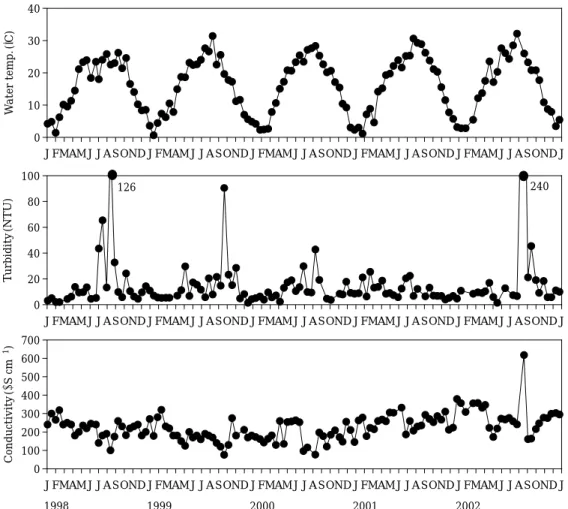
Fig. 2. Change in the basic limnological parameters (water temperature, turbidity, and conductivity) in the study site during the study period (Jan. 1998~Dec. 2002).
ANOVA was used to test for significant effects of season on the abundance of total zooplankton and major zooplankton communities. Significant differences were identified at 95% level.
Results
1. Characteristic of limnological properties and the hydrological regime
Water temperatures varied from 0.6 to 32.1� C (Table 1, Fig. 2). During spring (April~May) and winter (December~January), water temperatures were highly variable. Average pH and dissolved oxygen concentration was 7.6±0.7 (5.9~10.1) and 10.8±2.7 mg L
-1(6.1~19.7) during the study period (Table 1). Highest turbidities were obser- ved in the summer except 2001, coincident with greater amounts of surface runoff (Fig. 3). Season- al changes in conductivity were pronounced, with reductions occurring during summer flooding events except 2002 (Fig. 3).
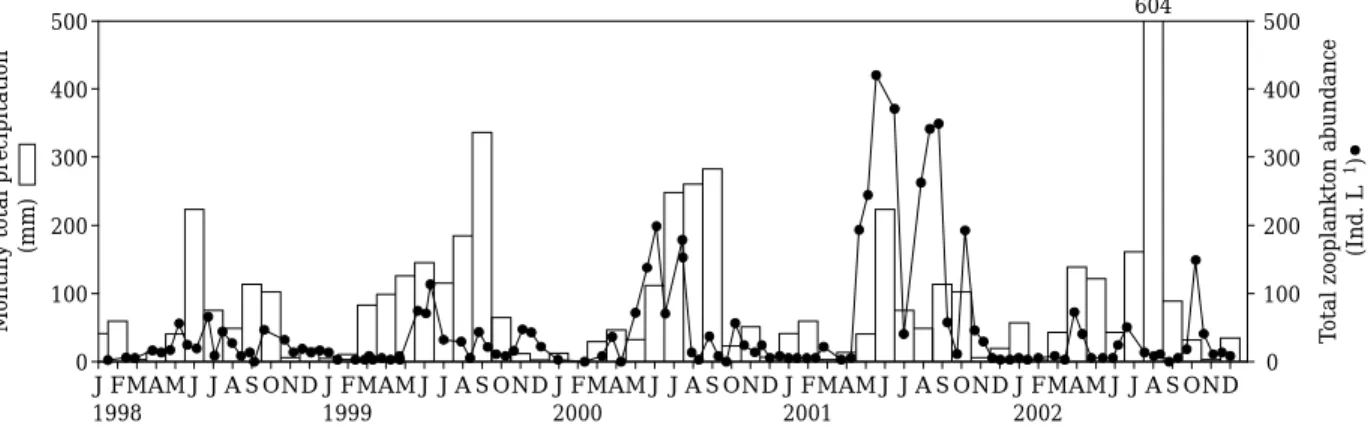
In the middle part of Nakdong River basin, over 61% of the precipitation was concentrated in
the summer (June~September) while low precip- itation occurred from late fall to early spring (Fig. 3). Total rainfall amounts in 1998, 1999, 2000, 2001, and 2002 at the central part of the river basin were 744 mm, 1,180 mm, 1,103 mm, 744 mm and 1,327 mm, respectively (5 years average±s.d. = 1,019±283 mm). Total rainfall in 2002 was unusually high. Peak discharge occurred at the end of the wet season (June~
September), while low discharges occurred in other periods of the year. There were distinct non- flooding phases. In the wet season flooding phase, water velocities sometimes were in excess of l m s
-1. Typically, there was a brief period of rising water in the summer, after which high discharge was maintained for several weeks.
2. The inter- -annual variations of zooplankton community dynamics
The annual variation in total zooplankton abun- dance was significant (ANOVA, p⁄0.01), dis- playing similar patterns in three years from 1999 to 2001 except 1998 and 2002. The timing and magnitude of zooplankton community occur- rences appeared to be consistent across seasonal cycles. Zooplankton community in summer of 2001 and 2002 showed a contrast in abundance and development in the study site. During heavy rainfall events and f loods in summer of 2002, total abundance decreased sharply (Fig. 3). Gen- erally, after the f looding ended, total zooplank- ton abundance increased rapidly and recovered to pre-f lood levels within 1⁄month.
While macrozooplankton was restricted to young cyclops copepoids or small cladocerans (e.g., Bosmina and Alona), rotifers accounted for
J FMAM J J A S OND J FMAM J J A S OND J FMAM J J A S OND J FMAM J J A S OND J FMAM J J A S OND 0
100 200 300 400 500
0 100 200 300 400 604 500
Monthly total precipitation (mm) Total zooplankton abundance (Ind. L-1)
1998 1999 2000 2001 2002
Fig. 3. Seasonal changes in total zooplankton abundances and changes of monthly total precipitation in middle basin of the river (Gumi: ~RK 195).
Table 1. Means, standard deviations, and ranges of lim- nological parameters of the study site (Jan. 1998
~Dec. 2002).
Unit Study site (RK 175) Temperature �C 16.0±8.6 (0.6~32.1)
pH 7.6±0.7 (5.9~10.1)
Conductivity µS cm-1 225±72 (76~618)
Alkalinity mg L-1 42±14 (14~104)
Dissolved Oxygen mg L-1 10.8±2.7 (6.1~19.7) Dissolved Oxygen % 108±22 (58~180)
Turbidity NTU 15±25 (1.5~240)
a large fraction of the total zooplankton abun- dances (Fig. 4). The annual average of micro- zooplankton abundance during the study period was 43±76 ind. L
-1(n = 118), followed by cope-
podids (1.6±4.8 ind. L
-1), small cladocerans (0.4
±1.2 ind. L
-1). Cladocerans and copepods dis- played similar seasonal trends as rotifers, but formed a minor part of the total zooplankton
J FMAMJ J A S OND J FMAMJ J A S OND J FMAMJ J A S OND J FMAMJ J A S OND J FMAMJ J A S OND
Zooplankton community abundance (lnd. L-1) 0 100 200 300 400
J FMAMJ J A S OND J FMAMJ J A S OND J FMAMJ J A S OND J FMAMJ J A S OND J FMAMJ J A S OND 0
10 20 30 40 50
Rotifers
Cladocerans Copepodids
1998 1999 2000 2001 2002
Fig. 4. Seasonal changes in rotifers and macrozooplankton community abundances in the study site (Jan. 1998~Dec.
2002).
Table 2. Dominant rotifers taxa over 1% of total zooplankton abundance in the study site (1998~2002).
Community Taxa 1998 1999 2000 2001 2002
(n = 24) (n = 24) (n = 22) (n = 23) (n = 25)
Brachionus angularis * * 2.4 5.6 *
Brachionus budapestinensis * * 2.6 * *
Brachionus calyciflorus 7.1 6.0 18.9 16.2 2.6
Brachionus forficula 1.3 * * * *
Brachionus rubens * 7.6 * 2.0 1.3
Brachionus urceolaris 1.3 * 3.9 2.2 2.1
Brachionus quadridentatus 1.2 3.0 1.1 * *
Colurella sp. 11.6 5.1 6.6 14.1 43.3
Conochilus unicornis * * * 1.1 *
Filinia longiseta 3.8 2.5 6.2 * *
Hexarthra mira * * 3.0 * *
Rotifers Keratella cochlearis 12.5 15.1 14.8 10.5 2.1
Keratella quadrata * 1.5 * * *
Keratella valga 5.8 1.5 * * *
Lecane sp. 3.8 1.0 1.1 1.1 *
Lepadella oblonga * 2.5 * 1.3 1.7
Monostyla lunaris 3.2 2.5 * * *
Notholca labis 2.4 1.0 * * *
Philodina roseola 3.0 1.0 1.0 * *
Polyarthra sp. 20.9 19.7 16.5 28.8 17.5
Pomphlx complanata * 1.0 * * *
Testudinella sp. * 2.0 * * *
Trichocerca sp. 10.6 15.2 12.8 8.4 13.7
Trichotria tetractis 3.2 2.5 2.4 2.5 6.9
Total No. of species 26 33 32 42 24
*indicate less than 1% of the total zooplankton abundance.
community (Fig. 4). Zooplankton occurrence with regard to abundance development was observed in the order of rotifer → macrozooplankton (clado- cerans±copepodids) across the seasonal cycles.
3. The rotifer dynamics
Rotifers highly dominated the zooplankton community in the study site. In this part of the river, 42 species of rotifers were identified during 5 years (Table 2). The annual variations in roti- fer abundance were significant (ANOVA, p⁄
0.01). The number of rotifer species in 2001 was much higher than that of other years (Table 2).
Seasonal variations of total rotifer abundance were also significant. In spring and fall, high peaks of rotifer biomass were observed (Fig. 4).
Among the rotifers, Brachionus spp., Polyarthra spp., Colurella spp., Keratella spp., and Tricho- cerca spp. were the most common taxa. These species occupied more than 80% of the total rotifer abundance throughout the study period (Table 2). The most abundant were Brachionidae with 7 species of the genus Brachionus (B. calyci- florus and B. rubens were largely dominated).
The genus Polyarthra represented up to 23% of the rotifer communities. The genus Colurella, Keratella, and Trichocerca contributed ~15%,
~12%, and ~10% of the total rotifer abundance, respectively.
Discussion
In comparison with zooplankton dynamics in the lower reaches of the river (Kim, 1999) and the three tributaries of the Nakdong River (Kim et al., 2004), there were notable differences in abundance and zooplankton community struc- ture in study site. The annual average of total zooplankton abundance in the study site was much lower (43±76 ind. L
-1, n = 118) than sites (e.g., Mulgum) in the lower reaches (Kim et al., 2003). De Ruyter Van Steveninck et al. (1992) explained that zooplankton could not maintain significant densities in the middle stretch of Rhine River, because reproductive rates cannot keep up with losses due to high flushing rates.
Previous studies on zooplankton dynamics in the Nakdong River (Kim et al., 2004) reported that the river-reservoir hybrid system provided a stable environment for zooplankton reproduction and development and the high phytoplankton
densities provide an adequate food sources to support the increasing zooplankton community (Kim and Joo, 2000). High phytoplankton bio- mass was considered to be one of the factors, which would lead to the high abundance of zoo- plankton in the river ecosystem (Kim et al., 2000).
However, only a weak relationship existed bet- ween phytoplankton biomass and zooplankton abundances in 1998 observed in the study site.
On the other hand, climate and hydrological conditions, as a regulator of water flow, exerts an important control over fluvial communities (Admiraal et al., 1994). Previous study on zoo- plankton dynamics in the Nakdong River (Kim, 1999) also reported that local conditions (e.g., dilution rate and advective effects form major tributaries) might induce seasonal and longi- tudinal changes of zooplankton abundance.
However, hydrologic parameters more clearly explained the seasonal and inter-annual varia- tions of zooplankton dynamics in this study (Fig.
3).
Community structure of the middle stretch was also different from that of the lower part. In con- trast to the lower part (Kim et al., 2004), large zooplankton like Daphnia was not observed in all samples, and small cladocerans (e.g., Bosmina and Alona) and rotifers were numerically domi- nant. Among the numerous rotifer taxa, Brach- ionus spp., Polyathra spp., Colurella spp., Kerat- ella spp., and Trichocerca spp. were the most common in the study site. Different from clado- cerans which require more time to reproduce, rotifers have very short generation time (Walz, 1995). The several species of dominant rotifers in the river channel are among the fastest growing taxa recorded in the literature (Bennet and Bor- aas, 1989). Rotifers are considered to be oppor- tunistic r-strategists with a great reproductive potential (Allan, 1976). Such rapid growth is necessary to maintain positive net growth when flushing rate is relatively high in the middle stretch of the river.
Among the numerous rotifer taxa, Brachionus
spp., Polyathra spp., Colurella spp., Keratella
spp., and Trichocerca spp. were the most com-
mon in the study site. An increase in total rotifers
density may indicate advancing eutrophication
(Gannon and Stemberger, 1978). The high rotifer
densities may indicate a high rate of energy
transfer between the producers and herbivores
in the lower Nakdong River (Kim et al., 1999).
Kim et al. (2002) also reported that microzoop- lankton was able to decrease phytoplankton concentration down to 50% in 1.2 days and bac- teria in 1.5 days. Generally, B. angularis, B.
calyciflorus, K. cochlearis and A. fissa (which are dominant in the lower Nakdong River) are indi- cators of eutrophy (Peiler and Berzins, 1989).
However, the difference in total rotifer abundance (N
mean: less than 50 ind. L
-1) and dominant species, especially Colurella spp. and Trichocerca spp. between the study site and downstream (Kim, 1999) indicates that grazing by rotifers could not seriously impact phytoplankton biomass and bacteria in the study site. Considering these results on zooplankton dynamics in a river sys- tem, we suggest that branched rivers with man- made structures such as dams induce complexity in natural landscape and studies of this nature provide some insight into their ecological comple- xity.
Acknowledgements
We are grateful to anonymous reviewers for improving our manuscript. This paper was sup- ported in part by NON DIRECTED RESEARCH FUND (2001), Sunchon National University.
This paper is contribution for the National Long- term Ecological Research Program (Freshwater : Nakdong River LTER 2005) of the Minstry of Environment.
Abstract
The dynamics of zooplankton community and its relationship with environments were studied at the middle stretch (Waekwan, RK; river kilo- meter; above 175 km from the estuary dam) of large regulated river, Nakdong River from 1998 to 2002. There were distinct inter-annual varia- tions and seasonal changes in total zooplankton abundance in the study site (ANOVA, p⁄0.01), displaying similar pattern in three years from 1999 to 2001 except 1998 and 2002. The annual average rotifers abundance during the study period was 43±76 ind. L
-1(mean±s.d., n = 118), followed by adult copepodids (1.6±4.8 ind. L
-1), and small cladocerans (0.4±1.2 ind. L
-1). Among the rotifers, Brachionus spp., Polyarthra spp., Colurella spp., Keratella spp., and Trichocerca
spp. were the most common taxa. These species occupied more than 80% of the total rotifer abun- dance throughout the study period. Total zoo- plankton abundance rapidly increased in spring and fall and remained low throughout the winter.
During summer, zooplankton dynamics seemed to be largely affected by hydrological parameters.
Overall, rather the external factors (hydrological factors of the river) than internal factors (food condition for zooplankton such as phytoplankton biomass) appear to be responsible for changes in zooplankton dynamics in the middle stretch of the river.
References
Admiraal, W., L. Breebaart, G.M.J. Tubbing, B. van Zanten, E.D. de Ruijter van Steveninck and R.
Bijkerk. 1994. Seasonal variation in composition and production of planktonic communities in the lower River Rhine. Freshwat. Biol. 32: 519-531.
Allan, J.D. 1976. Life history patterns in zooplank- ton. Am. Nat. 110: 165-180.
Bayly, I.A.E. 1992. ‘The Non-marine Centropagidae (Copepoda: Calanoida) of the World.’ Guides to the Identification of the Microinvertebrates of the Continental Waters of the World. No. 2. (SPB Academic Publishing: The Hague)
Benfield, L.A. 1990. The composition and distribution of zooplankton in the lower Waikato River, New Zealand. M.S. thesis. University of Waikato, Hamilton, New Zealand. 120pp.
Bennett, W.N. and M.E. Boraas. 1989. A demograph- ic profile of the fastest growing metazoan: a strain of Brachionus calyciflorus (Rotifera). Oikos 55:
365-369.
De Ruyter Van Steveninck, E.D., W. Admiraal, L.
Breebaart, G.M.J. Tubbing and B. van Zanten.
1992. Plankton in the River Rhine: structural and functional changes observed during downstream transport. J. Plankton Res. 14: 1351-1368.
Gannon, J.E. and R.S. Stemberger. 1978. Zooplank- ton (especially crustaceans and rotifers) as indica- tors of water quality. Trans. Am. Micros. Soc. 97:
16-35.
Ha, K., E.A. Cho, H.W. Kim and G.J. Joo. 1999.
Microcystis bloom formation in the lower Nakdong River, South Korea: importance of hydrodynamics and nutrient loading. Mar. Freshwater Res. 50:
89-94.
Kim, H.W. 1999. Water quality, plankton community dynamics, and trophic regulation in the microbial food web by zooplankton in a hypertrophic river (Nakdong River, Korea). -Ph. D. dissertation, Pusan National University, Pusan, 230pp.
Kim, H.W. and G.J. Joo. 2000. The longitudinal dist- ribution and community dynamics of zooplankton in a regulated large river: a case study of the Nakdong River (Korea). Hydrobiologia. 438: 171- 184.
Kim, H.W., K.H. Chang, K.S. Jeong and G.J. Joo.
2003. The spring metazooplankton dynamics in the river-reservoir hybrid system (Nakdong River, Korea): Its role in controlling the phytoplankton biomass. Korean J. Limnol. 36: 420-426.
Kim, H.W., K.H. Chang, W.-K. Shin, G.-H. La, K.- S. Jeong and G.J. Joo. 2004. Population dynamics of predator (Asplanchna spp.) and its impact on herbivorous rotifers community in three tribu- taries of the Nakdong River (S. Korea). Korean J.
Limnol. 37: 385-393.
Kim, H.W., S.-J. Hwang and G.J. Joo. 1999. Grazing rates of rotifers and their contribution to commu- nity grazing in the Nakdong River. Korean J.
Ecol. 22: 337-342.
Kim, H.W., S.-J. Hwang and G.J. Joo. 2000. Zoo- plankton grazing on bacteria and phytoplankton in a regulated large river (Nakdong River, Korea).
J. Plankton Res. 22: 1559-1577.
Kim, H.W., S.-J. Hwang, K.H. Chang, M.H. Jang, G.J. Joo and N. Walz. 2002. Longitudinal differ- ence in zooplankton grazing on phyto- and bacte- rioplankton in the Nakdong River (Korea). Inter- nat. Rev. Hydrobiol. 87: 281-293.
Kobayashi, T., R.J. Shiel, P. Gibbs and P.I. Dixon.
1998. Freshwater zooplankton in the Hawkesbury -Nepean River: comparison of community struc- ture with other rivers. Hydrobiologia 377: 133- 145.
Koste, W. 1978. Rotatoria. Die Radertiere Mitteleuro- pas. Ein Bestimmungswerk begrundet von Max
Voigt, 2nd edn. (Borntrager: Stuttgart, Vol. 1, Textband 673p., Vol. 2. Textband 234p.)
Koste, W. and R.J. Shiel. 1987. Rotifera from Austra- lian inland waters II. Epiphanidae and Brachioni- dae (Rotifera: Monogononta). Invertebrate Taxo- nomy 1, 949-1021.
Naiman, R.J., J.A. Stanford and H. Decamps, 1991.
The application of ecological knowledge to river management. In What large rivers for the future?
Meeting of the ‘Ministere de l’Environement’, Orlecans, France, 55pp.
Peiler, B. and B. Berzins. 1989. On choice of substrate and habitat in brachionid rotifers. Hydrobiologia 186/187: 137-144.
Shiel, R.J. and K.F. Walker. 1984. Zooplankton of regulated and unregulated rivers: The Murray- Darling river system, Australia, in: Regulated rivers- In: A. Lillehammer and S.J. Saltveit (eds.), Univ. Oslo., pp. 263-270.
Smirnov, N.N. and B.V. Timms. 1983. A revision of the Australian Cladocera (Crustacea). Records of the Australian Museum Supplement 1: 1-132.
Walz, N. 1995. Rotifer populations in plankton com- munities: Energetics and life history strategies.
Experientia 51: 437-453.
Walz, N. and M. Welker. 1998. Plankton develop- ment in a rapidly flushed lake in the River Spree system (Neuendorfer See, Northeast Germany). J.
Plankton. Res. 20: 2071-2087.
Wetzel, R.G. and G.E. Likens. 2000. Limnological Analyses, 3rd edn. Springer-Verlag. New York.
429p.
(Manuscript received 10 August 2005, Revision accepted 10 September 2005)