ORIGINAL ARTICLE
낙동강 수계에서의 고지혈증 치료제 검출 특성
손희종*․서창동․염훈식․송미정․김경아 부산광역시 상수도사업본부 수질연구소
Detection Characteristics of Blood Lipid Lower Agents (BLLAs) in Nakdong River Basin
Hee-Jong Son*, Chang-Dong Seo, Hoon-Sik Yeom, Mi-Jung Song, Kyung-A Kim Water Quality Institute, Busan Water Authority, Gimhae 621-813, Korea
Abstract
The aims of this study were to investigate and confirm the occurrence and distribution patterns of blood lipid lower agents (BLLAs) in Nakdong river basin (mainstream and its tributaries). 4 (atorvastatin, lovastatin, mevastatin and simvastatin) out of 5 statins and 2 (clofibric acid and zemfibrozil) out of 3 fibrates were detected in 29 sampling sites and simvastatin (>50%) was predominant compound followed by atorvastatin, lovastatin and clofibric acid. The total concentration levels of BLLAs on April, August and November 2009 in surface water samples ranged from ND∼25.7 ng/L, ND∼18.8 and ND to 38.8 ng/L, respectively. The highest concentration level of BLLAs in the mainstream and tributaries in Nakdong river were Goryeong and Jincheon-cheon, respectively. The sewage treatment plants (STPs) along the river affect the BLLAs levels in river and the BLLAs levels decreased with downstream because of dilution effects.
Key words :Blood lipid lower agents, Statin class, Fibrate class, Main stream, Tributary, Nakdong river basin
1. 서 론1)
최근에는 환경중의 잔류 의약물질들로 인한 환경 오염과 환경 독성에 대한 많은 연구가 진행되고 있다. 잔류 의약물질들은 의약물질 생산 공정 및 저장 과정 에서의 유출, 가정과 병원을 비롯한 도사하수, 축산폐 수 등의 다양한 경로를 통하여 우리들의 상수원인 강 이나 호소로 유입되어 수중에 잔류하며(Bendz 등, 2005; Halling-Sorensen 등, 1998; Moldovan, 2006), 장시간 동안 생물학적 활성을 가지면서 수중에 잔존 하기 때문에 수중 생태계에 지속적으로 위해를 가하 는 것으로 알려져 있다(Fent 등, 2006). 이들 잔류 의
약물질들은 기존의 살충제, 소독제 등과 같은 오염물 질들과는 달리 수환경 중에서 수 ng/L∼수 μg/L 정도 의 매우 낮은 농도로 존재하기 때문에 높은 저항력을 유발하지 않으면서 지속적으로 수생태계에 독성 효과 를 나타낸다(Dorne 등, 2007; Yamamoto 등, 2007). 최 근에는 분석기술의 발달로 인해 수환경에서 검출되는 잔류 의약물질들의 종류와 검출빈도가 높아지고 있으 며, 전 세계적으로 수환경 중에서의 잔류 의약물질들 의 검출, 거동, 영향 및 수처리 공정에서의 제거에 대 한 연구결과들이 발표되고 있다(Mompelat 등, 2009;
Pal 등, 2009; Son 등, 2012; Westerhoff 등, 2005).
최근에는 여러 잔류의약물질 그룹들 중 고지혈증
Received 18 April, 2013; Revised 12 June, 2013;
Accepted 16 July, 2013
*Corresponding author : Hee-Jong Son, Water Quality Institute, Busan Water Authority, Gimhae 621-813, Korea
Phone: +82-051-669-4797 E-mail: [email protected]
ⓒ The Korean Environmental Sciences Society. All rights reserved.
This is an Open-Access article distributed under the terms of the Creative Commons Attribution Non-Commercial License (http://
creativecommons.org/licenses/by-nc/3.0) which permits unrestricted non-commercial use, distribution, and reproduction in any medium, provided the original work is properly cited.
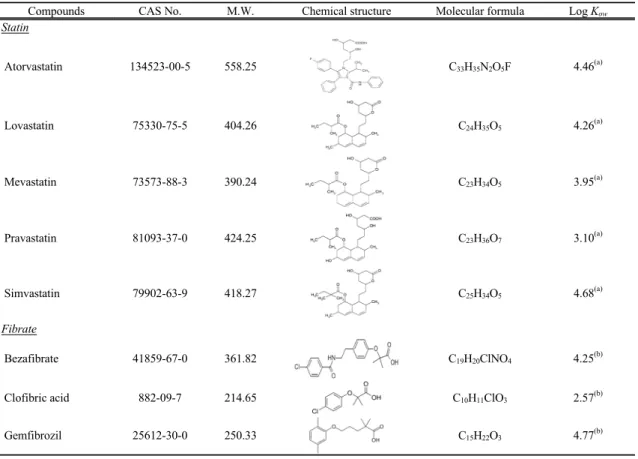
Compounds CAS No. M.W. Chemical structure Molecular formula Log Kow
Statin
Atorvastatin 134523-00-5 558.25 C33H35N2O5F 4.46(a)
Lovastatin 75330-75-5 404.26 C24H35O5 4.26(a)
Mevastatin 73573-88-3 390.24 C23H34O5 3.95(a)
Pravastatin 81093-37-0 424.25 C23H36O7 3.10(a)
Simvastatin 79902-63-9 418.27 C25H34O5 4.68(a)
Fibrate
Bezafibrate 41859-67-0 361.82 C19H20ClNO4 4.25(b)
Clofibric acid 882-09-7 214.65 C10H11ClO3 2.57(b)
Gemfibrozil 25612-30-0 250.33 C15H22O3 4.77(b)
(a)Martín 등, 2011; (b)Hernando 등, 2007.
Table 1. Physico-chemical chemical properties of the BLLAs 치료제들(blood lipid lower agents, BLLAs)에 대한 수환경 중에서의 검출현황에 대한 연구결과들이 많이 보고되고 있다(Hernando 등, 2007). 이들 BLLAs는 크게 fibrate계와 statin계로 분류되며, 콜레스테롤 저 하나 고지혈증 치료 목적으로 많이 사용되고, 기존 하 수처리장의 생물학적 처리 공정에 대해 강한 내성으 로 인해 하수처리장에서의 제거율이 50% 이하로 매 우 낮아서 강이나 호소수에서 수 ng/L∼수 μg/L 정도 로 검출되며, 수돗물에서도 검출된 것으로 보고되었 다(Farré 등, 2001; Hernando 등, 2007; Stumpf 등, 1999; Ternes, 1998). 또한, BLLAs는 잔류 의약물질들 중 비교적 높은 Log Kow로 인해 생체농축율이 높고, 발 암 및 돌연변이원성 등과 같은 생체독성도 높은 것으로 알려져 있다(Hernando 등, 2007; Mimeault 등, 2005).
낙동강은 부산과 인근 경남지역의 식수원으로 활 용되는 중요한 수자원이나 구미와 대구 등과 같은 대
도시가 강의 상류에 위치하고 있어 각종 하수와 오수 가 낙동강 본류로 유입되기 때문에 다양한 오염물질 들에 대해 노출되어 있다(Seo 등, 2010; Son 등, 2012;
Son 등, 2013a). 따라서 본 연구에서는 낙동강 수계를 중심으로 본류 및 본류로 유입되는 지천 등을 중심으 로 BLLAs에 대한 수환경에서의 잔류량 평가 및 물질 별 검출 특성을 외국의 경우와 비교·분석함으로써 향 후 BLLAs의 관리 방안 마련을 위한 기초자료를 제공 하고자 하였다.
2. 실험재료 및 방법
2.1. 실험 재료
2.1.1. BLLAs 표준물질 및 시약
본 실험에 사용된 BLLAs 8종들은 순도 99% 이상 의 atorvastatin, lovastatin, mevastatin, pravastatin,
S1
S2 S3 S4 S5 S6
S8 S7
S9 S10
S11
S13 S14 S16 S15 S18 S17
S19 S20 S21
S22 S23
S24
S25 S26 S27
S29 S28 Down
stream Up stream
S12 Main stream
Tributary
S1
S2 S3 S4 S5 S6
S8 S7
S9 S10
S11
S13 S14 S16 S15 S18 S17
S19 S20 S21
S22 S23
S24
S25 S26 S27
S29 S28 Down
stream Up stream
S12 Main stream
Tributary
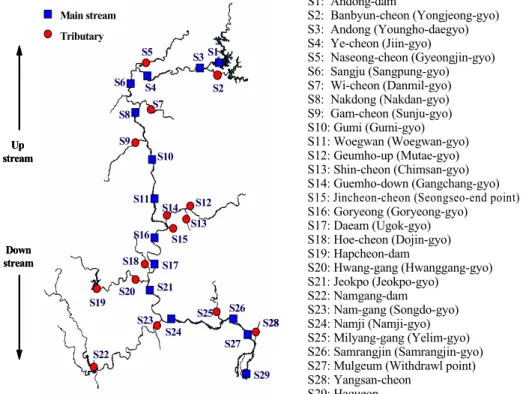
S1: Andong-dam
S2: Banbyun-cheon (Yongjeong-gyo) S3: Andong (Youngho-daegyo) S4: Ye-cheon (Jiin-gyo)
S5: Naseong-cheon (Gyeongjin-gyo) S6: Sangju (Sangpung-gyo) S7: Wi-cheon (Danmil-gyo) S8: Nakdong (Nakdan-gyo) S9: Gam-cheon (Sunju-gyo) S10: Gumi (Gumi-gyo) S11: Woegwan (Woegwan-gyo) S12: Geumho-up (Mutae-gyo) S13: Shin-cheon (Chimsan-gyo) S14: Guemho-down (Gangchang-gyo) S15: Jincheon-cheon (Seongseo-end point) S16: Goryeong (Goryeong-gyo)
S17: Daeam (Ugok-gyo) S18: Hoe-cheon (Dojin-gyo) S19: Hapcheon-dam
S20: Hwang-gang (Hwanggang-gyo) S21: Jeokpo (Jeokpo-gyo)
S22: Namgang-dam S23: Nam-gang (Songdo-gyo) S24: Namji (Namji-gyo) S25: Milyang-gang (Yelim-gyo) S26: Samrangjin (Samrangjin-gyo) S27: Mulgeum (Withdrawl point) S28: Yangsan-cheon
S29: Hagueon
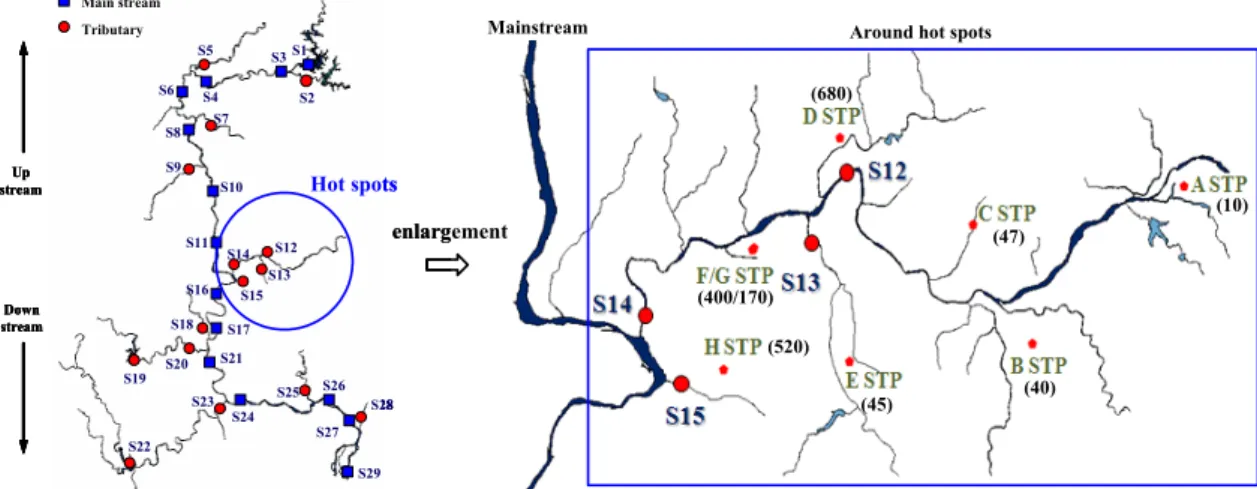
Fig. 1. Description of the sampling sites in Nakdong river basin.
simvastatin과 같은 5종의 statin계 BLLAs와 bezafibrate, clofibric acid, gemfibrozil과 같은 3종의 fibrate계 BLLAs를 Sigma-aldrich사에서 구매하여 사용하였다.
분석대상 물질인 BLLAs 8종에 대한 물성치는 Table 1과 같다.
2.1.2. 낙동강 수계 시료채수 지점
시료는 2009년 4월, 8월 및 11월에 채수하였으며, 깨 끗이 세척한 1 L 용량의 갈색 유리병에 채수한 후 시료의 변질을 막기 위해 분석 전까지 4℃로 냉장 보관하였다.
시료채수 지점은 낙동강 본류 14개 지점과 지류 15개 지 점을 선택하여 채수하였으며, Fig. 1에 채수지점인 29개 지점을 간략히 나타내었고, 본류 채수지점은 ■, 지류 채 수지점은 ●로 나타내었다.
2.2. 실험 방법 2.2.1. 시료 전처리
모든 샘플은 고체상 추출(solid phase extraction, SPE) 장치로 농축하기 전에 0.45 μm 멤브레인 필터
(Millipore, USA)로 여과하여 입자성 불순물을 제거 하였으며, 염산 (1+7) 용액을 사용하여 시료수의 pH 를 3 이하로 조절하였다.
2.2.2. BLLAs 추출 및 농축
8종의 BLLAs의 분석에 있어 대상 시료의 농축 및 추출을 위한 전처리 장치로 Spark Holland사의 on-line SPE equipment (Symbiosis, Spark Holland, Netherlands) 를 사용하였으며, 농축 및 추출에는 hysphere-C18 extraction cartridge (2 mm x 10 mm, 8 μm, Spark- Holland, Netherlands)를 사용하였다. SPE cartridge 는 먼저 1 mL 100% MeOH, 1 mL DI water를 순서대 로 사용하여 conditioning하였다. 시료수 100 mL를 5 mL/min의 유속으로 cartridge에 흡착시킨 후 DI water 1 mL로 세척하고, 고순도 질소가스를 이용하여 2분 간 건조시켰다. On-line SPE 추출시에는 LC/MS-MS 의 이동상 용매 A와 B가 on-line SPE cartridge를 통 과하여 LC 컬럼으로 주입되도록 설정하여 두 가지 이
동상 용매를 이용하여 BLLAs를 용출시켰다(Son 등, 2013b). 이 때의 이동상 분율은 LC의 이동상 농도구 배 조건과 동일하다.
2.2.3. BLLAs 분석
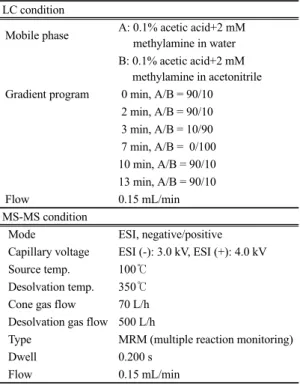
본 연구에서는 8종의 BLLAs 분석을 위해 UPLC (Water, Acquity, USA)/MS-MS (Waters, Quattro micro API, USA)를 사용하였으며, BLLAs 8종의 분 리를 위해 Waters사의 Xbridge column (2.1 mm x 20 mm, 1.7 μm)을 사용하였다. 분석에 사용된 이동상 용 매는 DI water 및 acetonitrile에 acetic acid 및 methylamine을 각각 0.1% 및 2 mM의 농도로 조제한 것을 사용하였으며, 분석물질들의 효율적인 분리를 위해 시간에 따른 두 가지 용매의 분율을 달리하였으 며, LC와 MS-MS의 자세한 분석조건을 Table 2에 나 타내었다. 또한, Table 3에는 MS-MS 분석에 사용된 각각의 BLLAs의 parents ion 및 daughter ion의 분자 량과 cone voltage 및 collision 값을 나타내었다. 시료 수에서 BLLAs의 정량한계(limit of quantification, LOQ)는 0.5∼1.0 ng/L (n=7, 10×S.D.)로 나타났다.
Table 2. Analytical conditions of LC/MS-MS LC condition
Mobile phase A: 0.1% acetic acid+2 mM methylamine in water B: 0.1% acetic acid+2 mM
methylamine in acetonitrile Gradient program 0 min, A/B = 90/10
2 min, A/B = 90/10 3 min, A/B = 10/90 7 min, A/B = 0/100 10 min, A/B = 90/10 13 min, A/B = 90/10
Flow 0.15 mL/min
MS-MS condition
Mode ESI, negative/positive Capillary voltage ESI (-): 3.0 kV, ESI (+): 4.0 kV Source temp. 100℃
Desolvation temp. 350℃ Cone gas flow 70 L/h Desolvation gas flow 500 L/h
Type MRM (multiple reaction monitoring)
Dwell 0.200 s
Flow 0.15 mL/min
Table 3. Product ions (m/z) of BLLAs Compounds
Parents ion
Daughter ion
Cone
voltage Collision (m/z) (m/z) (V) (V)
ES+
Mevastatin 422 185 22 15
Lovastatin 436 285 25 15
Simvastatin 450 199 25 18
Pravastatin 456 269 16 10
Atorvastatin 559 440 35 21
ES-
Clofibric acid 213 127 20 10
Gemfibrozil 249 121 17 20
Bezafibrate 360 274 30 15
Relative intensity (%)
(a) Pravastatin, 456 > 269
(b) Atorvastatin, 559 > 440
(c) Mevavastatin, 422 > 185
(e) Simvastatin, 450 > 199
(f) Clofibric acid, 213 > 127
(g) Bezafibrate, 360 > 274
(h) Gemfobrozil, 249 > 121
Time (min) (d) Lovastatin, 436 > 285
Fig. 2. Time-scheduled SRM chromatograms of a standard solution of statins and fibrates.
3. 결과 및 고찰
3.1. 낙동강 수계에서의 BLLAs 검출 현황
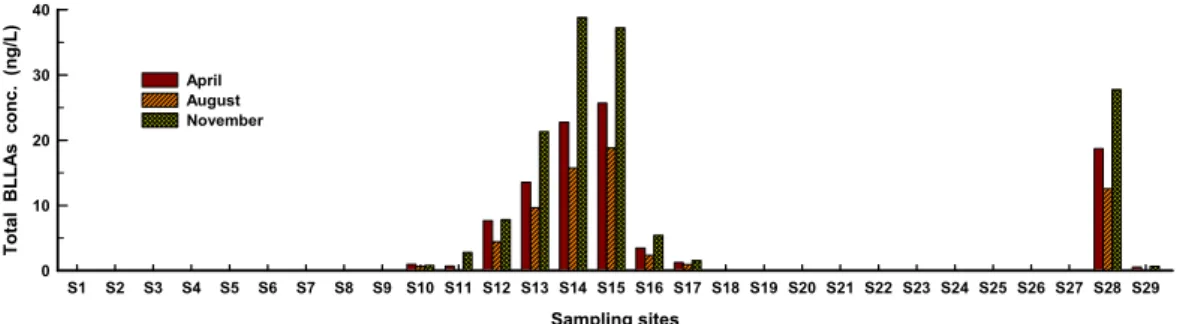
낙동강 본류와 지류를 포함한 전 수계에서의 BLLAs 검출현황을 Fig. 3에 나타내었다. 안동댐(S1)부터 감 천(S9)까지의 상류지역에서는 BLLAs가 검출되지 않 았으며, 구미(S10)에서 대암(S17)에 이르는 낙동강 중 류의 경우 검출농도가 상류나 회천(S18) 이남인 하류 보다 월등히 높게 나타나고 있다. 지류인 금호강 하류 (S14)의 경우 4월, 8월 및 11월에 각각 20.1 ng/L, 14.8 ng/L 및 37.5 ng/L로 나타났으며, 진천천(S15)의 경우 는 4월, 8월 및 11월에 각각 23.6 ng/L, 18.3 ng/L 및
Sampling sites
S1 S2 S3 S4 S5 S6 S7 S8 S9 S10 S11 S12 S13 S14 S15 S16 S17 S18 S19 S20 S21 S22 S23 S24 S25 S26 S27 S28 S29
Total BLLAs conc. (ng/L)
0 10 20 30 40
April August November
Fig. 3. Variation of total BLLAs concentrations in the Nakdong River basin.
Sampling sites
S1 S3 S4 S6 S8 S10 S11 S16 S17 S21 S24 S26 S27 S29
Total BLLAs conc. (ng/L)
0 1 2 3 4 5 6
2 STPs S5 (STP)
S7 (STP)
S9 (STP)
STPs S14 (STPs) S15 (STP)
S18 & S20
S23 S25
S28 (STP) Apr.
Aug.
Nov.
Fig. 4. Variation of total BLLAs concentrations in main streams of Nakdong River basin.
35.9 ng/L로 나타나 두 지점에서의 총 BLLAs 검출농 도는 매우 유사하게 나타났다. 또한, 낙동강 하류에 위 치한 지전인 양산천(S28)의 경우는 4월, 8월 및 11월 에 각각 17.9 ng/L, 15.2 ng/L 및 38.6 ng/L의 검출농 도를 나타내었다. 이와 같은 현상을 자세하게 살펴보 기 위해 지류를 제외한 낙동강 본류에서의 BLLAs 검 출농도를 Fig. 4에 나타내었다.
Fig. 4에는 지류의 하수처리장(STP)의 존재 유·무 에 따른 낙동강 본류에서의 BLLAs 검출농도를 조사 하여 나타내었다. 지류에 하수처리장이 존재하더라도 방류량 적거나 지류 상류에 위치하여 본류에 영향을 미치지 않는 경우는 제외하였다. 본류의 경우 구미 (S10)부터 검출되었으며, 구미 (S10)의 경우는 구미 채수지점 상류에 위치한 원평 하수처리장(60,000 m3/day)과 구미 4단지 하수처리장(50,000 m3/day) 방 류수의 영향을 받아 BLLAs가 검출된 것으로 보이며, 왜관(S11)의 경우는 유입되는 본류 주변에 위치한 구 미 하수종말처리장(330,000 m3/day)과 중소 규모의
하수처리장에서 방류한 방류수가 BLLAs의 농도 증 가에 기여한 것으로 판단된다. 또한, 고령(S16)의 경 우는 본류의 채수지점 중에서 가장 높은 검출농도인 1.5 ng/L(4월), 5.0 ng/L(9월) 및 4.3 ng/L(11월)를 나 타내었으며, 대암(S17)의 경우도 4월∼11월에 0.5∼
3.0 ng/L의 농도를 나타내어 금호강(S12∼S14)과 진 천천(S15)에 위치한 하수처리장의 방류수에 많은 영 향을 받는 것으로 나타났다. 대암(S17) 하류로는 지류 인 회천(S18), 황강(S20), 남강(S23) 및 밀양강(S25) 과 같은 지류의 유입에 의한 희석효과로 인해 BLLAs 가 검출되지 않은 것으로 판단된다.
낙동강 본류의 BLLAs 농도 증가에 미치는 지류들 의 영향을 파악하기 위하여 Fig. 5에는 각각의 지류들 에서의 BLLAs 검출농도를 살펴보았다. BLLAs가 검 출된 지류들로는 금호강(S12∼S14), 진천천(S15) 및 낙동강 하류에 위치한 양산천(S28)으로 나타났으며, 본류에서 최고의 BLLAs 검출농도를 나타낸 고령 (S16)의 경우 금호강(S12∼S14)과 진천천(S15)에서
Sampling sites
S2 S5 S7 S9 S12 S13 S14 S15 S18 S19 S20 S22 S23 S25 S28
Total BLLAs conc. (ng/L)
0 10 20 30 40
Apr.
Aug.
Nov.
(Apr.) (Aug.) (Nov.) Max. concentration
in the main stream
Fig. 5. Variation of total BLLAs concentrations in tributaries of Nakdong River basin.
S1
S2 S3
S4 S5
S6 S8 S7
S9 S10
S11 S13 S14
S16 S15 S18 S17
S19 S20 S21
S22
S23 S24 S25 S26
S27
S29 S28 Down
stream Up stream
S12 Main stream
Tributary
(10) (47)
(45) (40) (680)
(520) (400/170)
Mainstream Around hot spots
enlargement Hot spots
S1
S2 S3
S4 S5
S6 S8 S7
S9 S10
S11 S13 S14
S16 S15 S18 S17
S19 S20 S21
S22
S23 S24 S25 S26
S27
S29 S28 Down
stream Up stream
S12 Main stream
Tributary
S1
S2 S3
S4 S5
S6 S8 S7
S9 S10
S11 S13 S14
S16 S15 S18 S17
S19 S20 S21
S22
S23 S24 S25 S26
S27
S29 S28 Down
stream Up stream
S12 Main stream
Tributary
(10) (47)
(45) (40) (680)
(520) (400/170)
Mainstream Around hot spots
enlargement Hot spots
Fig. 6. Description of STP locations and their capacities (unit: × 103 m3/day) around hot spots.
유입되는 하수처리장들의 방류수가 BLLAs 농도 상 승에 직접적인 영향을 미치는 것으로 나타났다. 또한, 금호강(S12∼S14), 진천천(S15) 및 양산천(S28)의 경 우는 모두 본류에서의 최고 검출농도 보다 높은 검출 농도를 나타내었다. 양산천의 경우는 양산 하수처리 장(146,000 m3/day)이 위치하고 있어 양산 하수처리 장 방류수의 영향으로 비교적 높은 검출농도를 나타 낸 것으로 판단된다. 낙동강 하류지역의 수질에 직접 적인 영향으로 미치는 금호강(S12∼S14)과 진천천 (S15)을 부근을 hot spot으로 선정하여 주변에 대한 하수처리장 위치 및 방류량에 대해 조사한 것을 Fig. 6 에 나타내었다.
Hot spot 부근을 조사한 결과, 10,000 m3/day 처리 용량의 A 하수처리장과 40,000 m3/day 처리용량의 B
하수처리장 및 47,000 m3/day 처리용량의 C 하수처리 장이 금호강 상류지점(S12)의 상류에 위치하고 있어 금호강 상류지점(S12)은 이 3개의 하수처리장에 영향 을 받고 있으며, 신천 지점(S13)은 관거를 통해 하천 의 유지용수로 공급되는 100,000 m3/day의 D 하수처 리장 방류수와 45,000 m3/day 처리용량의 E 하수처리 장 방류수의 영향을 많이 받는다. 금호강 하류지점 (S14)의 경우는 금호강 유역에 있는 8개 하수처리장 (A∼G STP)의 영향을 받고 있으나 금호강 상류와 신 천의 합류 및 주변 지천들의 유입에 따른 희석효과로 신천 지점(S13) 보다는 다소 낮은 검출농도를 나타내 었다. 진천천 지점(S15)의 경우 하천유량의 대부분이 H 하수처리장 방류수로 유지되고 있어 조사된 지류들 중에서 11월을 제외하고 가장 높은 검출농도를 나타
S1 S3 S4 S6 S8 S10 S11 S16 S17 S21 S24 S26 S27 S29
Proportion (%)
0 20 40 60 80 100
S1 S3 S4 S6 S8 S10 S11 S16 S17 S21 S24 S26 S27 S29
Proportion (%)
0 20 40 60 80 100
Sampling sites
S1 S3 S4 S6 S8 S10 S11 S16 S17 S21 S24 S26 S27 S29
Proportion (%)
0 20 40 60 80 100
Atorvastatin Lovastatin Mevastatin Pravastatin Simvastatin Bezafibrate Clofibric acid Zemfibrozil (a) April
(b) August
(c) November
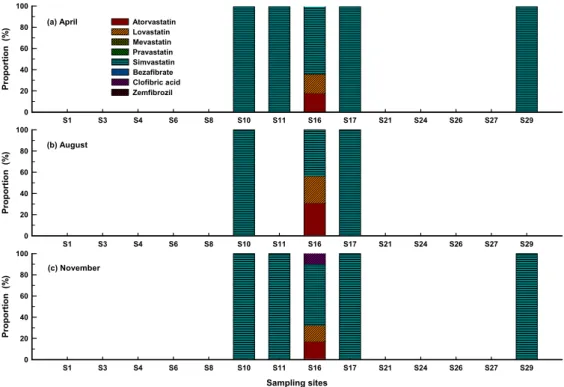
Fig. 7. The proportion of BLLAs species in the mainstream of Nakdong River basin.
내었다. 따라서 hot spot 부근의 채수지점들은 하수처 리장 방류수의 영향이 지배적인 것으로 나타나 본류 인 고령 지점(S16)이 Fig. 4에서 보는 바와 같이 본류 에서 BLLAs의 검출농도가 가장 높은 것으로 나타나 고 있다.
3.2. 낙동강 본류 및 지천에서 검출된 BLLAs 구성비율 낙동강 본류와 지류에서 검출된 BLLAs의 구성비 율을 Fig. 7과 Fig. 8에 나타내었다. 본류(14개 지점) 에서 검출된 BLLAs에 대한 구성비율을 나타낸 Fig. 7 을 보면 4월에는 5개 지점, 8월에는 3개 지점 및 11월 에는 5개 지점에서 검출되었으며, 검출된 물질들은 고 령(S16)을 제외한 구미(S10), 왜관(S11), 대암(S17) 및 하구언(S29)에서는 simvastatin만 검출되었고, 고 령의 경우는 4월∼11월에 simvastatin이 44%∼64%를 차지하였고, atorvastatin이 17%∼31% 및 lovastatin이 16%∼26%의 비율로 검출되었으며, clofibric acid는 4월과 8월에는 검출되지 않았으나 11월에는 전체 비 율의 10% 정도로 검출되었다.
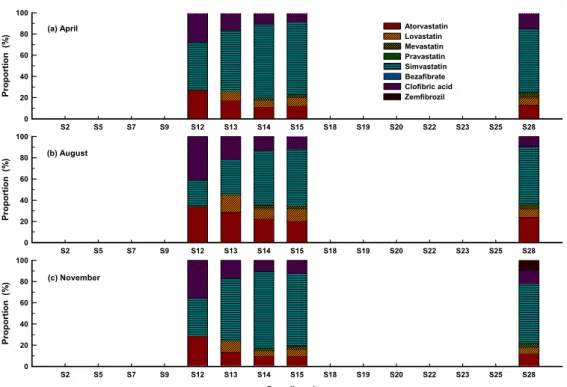
또한, 지류(15개 지점)에서 검출된 BLLAs에 대한 구성비율을 나타낸 Fig. 8을 보면 4월∼11월에 금호강 상류(S12), 신천(S13), 금호강 하류(S14), 진천천(S15) 및 양산천(S28)에서만 BLLAs가 검출되었으며, 금호강 상류(S12)에서는 atorvastatin, simvastatin 및 clofibric acid가 검출되었으며, 신천(S13)에서는 atorvastatin, lovastatin, simvastatin 및 clofibric acid가 검출되었 다. 또한, 금호강 하류(S14)와 진천천(S15)의 경우는 atorvastatin, lovastatin, mevastatin, simvastatin 및 clofibric acid가 검출되었으며, 양산천(S28)의 경우는 4월과 8월에는 atorvastatin, lovastatin, mevastatin, simvastatin 및 clofibric acid가 검출되었으나 11월에 는 zemfibrozil 1종이 더 추가적으로 검출되어 총 6종이 검출되었다. 금호강 상류(S12)의 경우는 atorvastatin이 27%, clofibric acid가 27% 및 simvastatin이 46%로 나타났으나 하류에 위치한 지천으로 갈수록 atorvastatin 과 clofibric acid의 비율이 감소하면서 simvastatin의 구성비율이 점점 증가하는 경향을 나타내었다. 따라 서 낙동강의 본류와 지천에서 검출된 BLLAs의 대부
S2 S5 S7 S9 S12 S13 S14 S15 S18 S19 S20 S22 S23 S25 S28
Proportion (%)
0 20 40 60 80 100
S2 S5 S7 S9 S12 S13 S14 S15 S18 S19 S20 S22 S23 S25 S28
Proportion (%)
0 20 40 60 80 100
Sampling sites
S2 S5 S7 S9 S12 S13 S14 S15 S18 S19 S20 S22 S23 S25 S28
Proportion (%)
0 20 40 60 80 100
Atorvastatin Lovastatin Mevastatin Pravastatin Simvastatin Bezafibrate Clofibric acid Zemfibrozil (a) April
(b) August
(c) November
Fig. 8. The proportion of BLLAs species in tributaries of Nakdong River basin.
Atorvastatin Lovastatin Mevastatin Simvastatin Statins Clofibric acid Gemfibrozil Fibrates Total Apr. Aug.Nov. Apr. Aug.Nov. Apr. Aug.Nov. Apr. Aug. Nov. Apr. Aug.Nov. Apr. Aug.Nov. Apr. Aug.Nov. Apr. Aug.Nov. Apr. Aug. Nov.
Avg.a 2.18 2.57 2.79 1.34 1.37 1.83 0.71 0.56 1.05 6.14 4.00 9.37 8.33 6.98 12.27 2.38 1.85 3.14 - - 2.58 2.38 1.85 3.57 9.52 8.14 14.42 SDb 0.85 1.20 1.07 0.55 0.63 0.68 0.24 0.05 0.19 6.52 3.80 10.55 8.75 6.28 13.43 0.28 0.42 1.40 - - - 0.28 0.42 1.86 9.87 7.06 15.42 Min.c 0.61 0.72 0.91 0.62 0.60 0.84 0.53 0.51 0.88 0.52 0.65 0.68 0.52 0.65 0.68 2.10 1.14 2.80 - - 2.58 2.10 1.14 0.54 0.52 0.65 0.68 Max.d 3.12 3.81 3.81 2.13 2.23 2.62 0.98 0.61 1.25 17.50 10.08 28.3123.3716.6334.91 2.80 2.20 4.60 - - 2.58 2.80 2.20 6.09 25.67 18.83 38.81
DFe 6/29 6/29 6/29 5/29 5/29 5/29 3/29 3/29 3/29 10/29 8/29 10/2910/29 8/29 10/29 5/29 5/29 6/29 0/29 0/29 1/29 5/29 5/29 6/29 10/29 8/29 10/29
LOQf 0.5 0.5 0.5 0.5 1.0 1.0
aAvg.: average concentration, bSD: standard deviation, cMin.: minimum concentration, dMax.: maximum concentration, eDF: detection frequency, f LOQ: limit of quantification
Table 3. Concentration levels of BLLAs (ng/L) in the Nakdong River basin at detected sites (ng/L) 분은 statin계 BLLAs가 많은 부분을 차지하였으며,
대부분이 simvastatin이었다.
3.3. 낙동강 수계에서의 BLLAs 검출 특성
낙동강 본류와 지류에서의 BLLAs 검출특성을 조 사한 것을 Table 3에 나타내었다. 본류 및 지류를 합쳐 서 검출빈도 및 검출지점들에서의 평균 검출농도가 가장 높은 물질은 simvastatin으로 4월∼11월에 8∼
10개 지점에서 평균 4.00∼9.37 ng/L로 검출되었으 며, 다음으로 atorvastatin, clofibric acid, lovastatin, mevastatin 및 gemfibrozil 순으로 나타났다. 또한, statin계와 fibrate계로 나누어 비교해보면 검출지점들 에서의 statin계와 fibrate계의 검출빈도와 평균농도는 4월∼11월에 각각 8∼10개 지점들에서 6.98∼12.27 ng/L 및 5∼6개 지점들에서 1.85∼3.57 ng/L로 나타 나 fibrate계 보다 statin계의 검출빈도 및 평균 검출농
도가 3.4∼3.8배 정도 높은 것으로 나타났다. 검출지 점들에서 검출된 6종의 총합(total)에 대한 평균농도 는 4월∼11월에 8.14∼14.42 ng/L로 조사되었고, 가 장 낮게 검출된 지점에서는 0.52∼0.68 ng/L, 가장 높 은 지점에서는 18.83∼38.81 ng/L의 범위였다.
4. 결 론
낙동강 수계의 본류 14개 지점과 지류 15개 지점에 대 해 BLLAs에 대한 물질별 검출 특성을 조사한 결과 다음 과 같은 결론을 얻을 수 있었다.
1. 낙동강 수계에서 검출된 BLLAs는 statin계인 atorvastatin, lovastatin, mevastatin, simvastatin 4종 과 fibrate계인 clofibric acid와 zemfibrozil 2종이 검 출되었으며, 본류에서는 atorvastatin, lovastatin, simvastatin 및 clofibric acid 4종만이 검출되었다.
2. 낙동강 본류에서 가장 높은 검출농도를 나타낸 지점은 고령지점(고령교)으로 4월, 8월 및 11월에 각 각 1.5 ng/L, 5.0 ng/L 및 4.3 ng/L가 검출되었고, 지류에 서는 진천천 지점으로 4월, 8월 및 11월에 각각 25.7 ng/L, 18.8 ng/L 및 37.2 ng/L의 검출농도를 나타내었다.
3. 낙동강 수계에서 검출된 BLLAs의 구성비율을 조사한 결과, simvastatin이 50% 이상을 차지하여 가 장 높게 나타났고, 다음으로 atorvastatin, lovastatin과 clofibric acid가 높은 비율을 나타내었다.
4. 낙동강 수계에서의 BLLAs는 상류에서는 거의 검출되지 않았으나 구미 지점부터 하수처리장 방류수 의 영향을 받아서 검출되었고, hot spot의 영향을 많이 받는 고령지점에서 최대농도를 나타낸 후 하류로 갈 수록 희석효과에 의해 농도가 점점 감소하였다.
참 고 문 헌
Bendz, D., Paxéus, N. A., Ginn, T. R., Loge, F. J., 2005, Occurrence and fate of pharmaceutically active compounds in the environment, a case study: Höje River in Sweden, J. Hazard. Mater., 122, 195-204.
Dorne, J. L. C., Ragas, A. M., Frampton, G. K., Spurgeon, D. S., Lewis, D. F., 2007, Trends in human risk assessment of pharmaceuticals, Anal. Bioanal. Chem., 387, 1167-1172.
Farré, M., Ferrer, I., Ginebreda, A., Figueras, M., Olivella, L., Tirapu, L., Vilanova, M., Barceló, D., 2001, Determination of drugs in surface water and wastewater samples by liquid chromatography-mass spectrometry: methods and preliminary results including toxicity studies with Vibrio fischeri, J.
Chromatogr. A, 938, 187-197.
Fent, K., Weston, A. A., Caminada, D., 2006, Ecotoxi- cology of human pharmaceuticals, Aquat. Toxicol., 76, 122-159.
Halling-Sorensen, B., Nielson, S. N., Lanzky, P. E., Ingerslev, L. F., 1998, Occurrence, fate and effects of pharmaceutical substances in the environment―a review, Chemosphere, 36(2), 357-393.
Hernando, M. D., Agüera, A., Fernández-Alba, A. R., 2007, LC-MS analysis and environmental risk of lipid regulators, Anal. Bioanal. Chem., 387(4), 1269-1285.
Martín, J., Buchberger, W., Alonso, E., Himmelsbach, M., Aparicio, I., 2011, Comparison of different extraction methods for the determination of statin drugs in wastewater and river water by HPLC/Q- TOF-MS, Talanta, 85, 607-615.
Mimeault, C., Woodhouse, A. J., Miao, X. S., Metcalfe, C. D., Moon, T. W., Trudeau, V. L., 2005, The human lipid regulator, gemfibrozil bioconcentrates and reduces testosterone in the goldfish, Carassius auratus, Aquat. Toxicol., 73, 44-54.
Moldovan, Z., 2006, Occurrences of pharmaceutical and personal care products as micropollutants in rivers from Romania, Chemosphere, 64, 1808-1817.
Mompelat, S., Le Bot, B., Thomas, O., 2009, Occurrence and fate of pharmaceutical products and by-products, from resource to drinking water, Environ. Int., 35, 803-814.
Pal, A., Gin, K. Y. H., Lin, A. Y. C., Reinhard, M., 2010, Impacts of emerging organic contaminants on freshwater resources: review of recent occurrences, sources, fate and effects, Sci. Total Environ., 408, 6062-6069.
Seo, C. D., Son, H. J., Lee, I. S., Oh, J. E., 2010,
Detection of synthetic musk compounds (SMCs) in Nakdong River basin, J. Kor. Soc. Environ. Eng., 32(6), 615-624.
Son, H. J., Yeom, H. S., Jung, J. M., Jang, S. H., Kim, H. S., 2012, Caffeine and carbamazepine: detection in Nakdong River basin and behavior under drinking water treatment processes, J. Environ. Sci. Intl., 21(7), 837-843.
Son, H. J., Hwang, Y. D., Yoom, H. S., Choi, J. T., Kwon, K. W., 2013a, Detection of perfluorinated compounds (PFCs) in Nakdong River basin, J. Kor.
Soc. Environ. Eng., 35(2), 84-93.
Son, H. J., Yoom, H. S., Jung, J. M., Jang, S. H., 2013b, Application of on-line SPE-LC/MSD to measure perfluorinated compounds (PFCs) in water, J. Kor.
Soc. Environ. Eng., 35(2), 75-83.
Stumpf, M., Ternes, T. A., Wilken, R. D., Rodrigues, S.
V., Baumann, W., 1999, Polar drug residues in sewage and natural waters in the state of Rio de Janeiro, Brazil, Sci. Total Environ., 225, 135-141.
Ternes, T, A., 1998, Occurrence of drug in German sewage treatment plants and rivers, Water Res., 32(11), 3245-3260.
Westerhoff, P., Yoon, Y., Snyder, S., Wert, E., 2005, Fate of endocrine-disruptor, pharmaceutical, and personal care product chemicals during simulated drinking water treatment processes, Environ. Sci.
Technol., 39, 6649-6663.
Yamamoto, H., Nakamura, Y., Nakamura, Y., Kitani, C., Imari, T., Sekizawa, J., 2007, Initial ecological risk assessment of eight selected human pharmaceuticals in Japan, Environ. Sci., 14, 177-193.