INTRODUCTION
The predation by zooplanktivore has been re- cognized as a major factor determining zooplank- ton community structure in lakes. Fish predation results in a decrease in the mean body size of
zooplankton and induces a replacement of larger prey species by smaller ones (Lynch, 1979; Vanni, 1986; Luecke et al., 1990; Lazzaro et al., 1992;
Rudstam et al., 1993). Recently, the effect of age-0 juvenile fish predation on zooplankton has been also studied frequently (DeVries and Stein, 1992; Qin and Culver, 1995; Boersma et al.,
* Corresponding Author: Tel: 051) 510-2258, Fax: 051) 583-0172, E-mail: [email protected]
─
─ 310 ──
Effect of Juvenile Fish Predation on the Zooplankton Community in the Large Regulated Nakdong River,
South Korea
Chang, Kwang-
-Hyeon
1, 4, Soon--Jin Hwang
2, Min--
Ho Jang1, Hyun--Woo Kim
3, Kwang--
Seuk Jeong1and Gea--Jae Joo
1*
1 Department of Biology, Pusan National University, Busan, Korea,
2 Department of Biological Systems Engineering, Konkuk University, Seoul, Korea,
3 Department of Environmental Education, Sunchon National University, Sunchon, Korea,
4 Present address: Research and Education Center for Inlandwater Environment, Shinshu University, 5-2-4 Kogandori, Suwa 392-0027, Japan
In the large regulated Nakdong River, the predation effect of juvenile fish on the zooplankton community was evaluated by gut and stomach analyses of fish in 1999.
Juvenile fish of five species showed high density from May to early June when river discharge was low and water body became stagnant. During this period, large rotifers, Asplanchna spp. and Brachionus spp. declined and the decrease of cladoceran (Moina micrura and Bosminopsis deitersi) density was also obeserved. At this time, small rotifers including Polyarthra spp. reached maximum density. Gut analysis of fish demonstrated that small--sized juvenile fish (⁄15 mm in total length) preferred large rotifers as well as cladocerans, while large sized fish (¤15 mm) selected only cladocerans. On the other hand, juvenile Micropterus salmoides of which size was larger than other juvenile fish consumed not only zooplankton but also other small juvenile fish. Based on these results, the decline of large rotifers and cladocerans during early summer in the river seems to be result of predation by juvenile fish. However, the period when juvenile f ish maintained their high density was as short as one month and the decreased density of cladocera rapidly recovered as soon as juvenile fish became scarce. Such a short period of juvenile f ish devel- opment in the river can be attributed to the consumption of juvenile fish by the young--of--the--year cohorts as well as adults of M. salmoides. The high trophic state of the river might permit the rapid recovery of the cladoceran community. The predation impact of juvenile fish in the Nakdong River seems to be affected by the existence of piscivore as well as high trophic status.
Key words : Predation, Juvenile fish, Cladocera, Zooplankton, Nakdong River
1996; Mehner et al., 1998a, b). Especially mid- summer declines of large cladocerans and con- sequent change in the cladoceran community have been attributed to the predation by newly hatched fish in June and July (Cryer et al., 1986;
Whiteside, 1988; Romare and Bergman, 1999).
The predation impact of juvenile f ish has been considered to be very important in regulating the zooplankton community since they are plankti- vorous regardless of species and may remain abundant and increase the biomass until pisci- vores cause their decline (Gliwicz and Pijanowska, 1989). The impact of juvenile fish is different from that of adult zooplanktivore. Unlike adult zooplanktivore, larval planktivores change their main prey items from small plankters to larger prey as they grow because they are gape-limited predators (Mehner et al., 1998a). In addition, ontogenetic shifts in the foraging behavior of planktivorous fish and strong relationships with piscivores may result in a high temporal variabi- lity in the predation impact on the zooplankton community (DeVries and Stein, 1992; Post et al., 1997).
The Nakdong River is a large regulated river in Korea and is a river-reservoir hybrid type of which flow regime is controlled by an estuary dam and multi-purpose dams (Ha et al., 1998;
Kim et al., 1998). The hybrid characteristic of this river induces a lake-like pattern in the su- ccession of zooplankton from winter to early spring when the water body becomes stagnant and river-like succession during summer and fall when high discharge is maintained (Lim et al., 1997; Kim et al., 2000).
To evaluate the predation impact of age-0 fish on the zooplankton community in the Nakdong River, prey selectivity and predation effects of age-0 fish were estimated by gut and stomach analyses with the seasonal changes of zooplank- ton and juvenile fish development.
MATERIALS AND METHODS
Zooplankton and juvenile fish were sampled in the lower part of the Nakdong River (35�44′ N and 128�59′E), Mulgum (27 km upstream of the mouth of river) from March to September 1999.
The river is the second largest in Korea (length, 528 km and catchment area, 23,817 km
2) and highly eutrophic (Ha et al., 1999).
Juvenile fish were sampled from May to June 1999 with a towing net (mesh size 100
µm, net diameter 60 cm, and net length 1.5 m, 4 m of towing distance, 5~6 seconds per each towing, 15 times of towing a sampling) in the surface wa- ter. Body lengths of collected juvenile fish were measured. Among the collected fish, 50~100 individuals were used for gut and stomach an- alyses. Zooplankton in the gut and stomach was identified at the species level.
Food preferences of juvenile fish were esta- blished by the selectivity index (
α) of Chesson (Chesson, 1978) which is widely used to estimate the selective feeding of fish (Parrish and Mar- graf, 1991; Boersma et al., 1996). Chesson’s α uses i as the prey class considered and j for all other classes. The proportion of the prey item in the gut is r
ior r
jand the proportion in the envi- ronment is p
ior p
j.
αranges from 0 (negative selection) to 1 (positive selection) and non-selec- tivity is 0.5.
α
= (r
i/ p
i) / (r
i/ p
i± r
j/ p
j)
Zooplankton was sampled using a vertical net towing with a 32
µm mesh net (diameter 60 cm) and the body length and the number of eggs of collected cladoceran species were measured. An egg-ratio analysis (Paloheimo, 1974) was com- pleted for Moina micrura and Bosminopsis dei- tersi. The egg-ratio analysis allows calculation of instantaneous birth rate (b), given the informa- tion on the number of eggs in the population (E) and the duration of the egg stage (D):
b = ln [(E±1) / D]
D is calculated from the empirical equations fit to egg development rates (Hanazato and Yasuno, 1985):
ln D = 4.522±[-0.399 (ln T)
2] for M. micrura ln D = 3.102±[-0.261 (ln T)
2] for B. deitersi where T is water temperature. In the case of B.
deitersi, coefficients of Bosmina longirostris whose size is similar was used in the calculation of the duration of the egg stage.
Phytoplankton biomass (Chlorophyll a) was determined spectrophotometrically using a mo- nochromatic method (Wetzel and Likens, 1991).
Daily precipitation data (Miryang) and monthly
discharge data (Samryangjin) were obtained
from the Korea Meteorological Administration
and Flood Control Center in Pusan, respectively.
RESULTS
Juvenile fish composition and size distribution A total of five juvenile fish species Hemiram- phus sajori (half beak), Rhinogobius brunneus (common freshwater goby), Acanthorodeus mac- ropterus (deep body bitterling), Opsariichtys bidens (Korean piscivorous chub), and Microp- terus salmoides (largemouth bass) were collected by the net from May to June. H. sajori comprised most of the juvenile fish community in the early period of fish development and dominated until June 1 except the period of May 29. R. brunneus, A. macropterus, and O. bidens were collected in June. M. salmoides were collected only in the late period of the juvenile fish flourishing season (June 10) and their size exceeded 3 cm when they were caught first in the net. After June 10, the abundance of juvenile fish became scarce and were not collected in the net. The density of col- lected juvenile fish peaked at May 17 and fluc- tuated greatly thereafter (Fig. 1a). The average size of juvenile fish was 7.4 mm in May and 18.2 mm in June (Fig. 1b). Juvenile fish less than 10
mm accounted for 92% of the total juvenile fish in the early period of their development, and were gradually replaced by larger sizes of fish ranging from 15~20 mm (Fig. 1c). Among the juvenile fish species, H. sajori was smallest with average size of 9.1 mm, whereas the average size of M.
salmoides exceeded 30 mm and was largest.
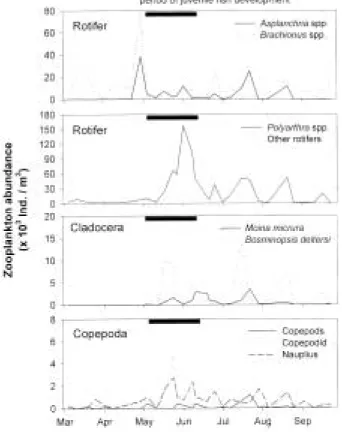
Zooplankton composition and abundance In the Nakdong River, rotifers dominated the zooplankton communities during the study peri- od and comprised 91% of the total zooplankton density (Fig. 2). The average density of rotifer was 30,600 (41,600 (n = 52) ind./m
3. The rotifer density increased from March and reached its first peak (141,000 ind./m
3) with abundant den- sities of larger species, Asplanchna spp. and Bra- chionus spp. in late April. The high density of rotifers then rapidly decreased in early May, when juvenile fish began to increase. The second peak of rotifer density, mainly consisted of small Polyarthra spp., was observed in early June and
Fig. 1. Changes of juvenile fish (a) abundance and species composition, (b) mean body size, and (c) proportion of size class in the lower Nakdong River.
Fig. 2. Seasonal changes of rotifer, cladoceran, and cope- pods densities in the lower Nakdong River. Thick bars indicate the period of juvenile fish develop- ment.
reached its maximum density of 188,000 ind./m
3. Cladoceran species built up their density from May. From late May to early June, cladoceran density decreased from 10,000 ind./m
3to 1,000 ind./m
3and then recovered thereafter. Dominant species were Bosminopsis deitersi and Moina micrura which occupied about 80% of total cla- docera. The density of copepoda and nauplius was low (average density copepoda, 400±700 ind./m
3; nauplius, 600±900 ind./m
3) and con- sisted of only 1% and 2% of the total zooplankton density, respectively. The adult cyclopoid cope- poda was rare throughout the study period ex- cept for mid July.
During the rainy season from July to early September, the density of total zooplankton was
strongly affected by high discharge mainly caus- ed by high precipitation. Sixty percents of the total precipitation was concentrated during this season and monthly discharges during this time were about two to five times higher than those in spring. Flooding events often occurred and rise and fall of zooplankton density was repeated (Fig. 3).
Effects of juvenile fish predation
The data of gut and stomach analysis indicated that juvenile fish species mainly consumed large rotifers including Asplanchna spp. and Brachio- nus spp. during the early period of their develop- ment, and cladocera (M. micrura) during the later period (Table 1). They rarely consumed small rotifers and nauplius (less than 2% of total prey consumed). The species composition of zooplank- ton in the gut and stomach contents was similar for same size of H. sajori, R. brunneus, and O.
bidens. During the beginning of the developmen- tal period when the juvenile fish size is smaller than 10 mm, fish selected large rotifers and copepodid as their prey. As their size increased, their prey item changed to cladoceran species and M. micrura occupied 85% of total contents of gut and stomach of fish near the end period of juvenile fish development. Individual preference values (Chesson’s
αindex) also indicated a si- milar pattern (Table 2). However, preference va- lues suggested that large rotifers were still posi- tively selected by juvenile f ish even in the later period. Different from other species, A. macrop-
Table 1. Relative abundance (%) of zooplankton species in the gut and stomach of juvenile f ish in the lower Nakdong River, Mulgum.
Relative abundance (%) Total
13 May 17 May 24 May 27 May 1 Jun. 8 Jun. 10 Jun. %
Rotifer
Asplanchna spp. 13.3 5.8 11.0 3.0
B. calyciflorus 22.7 12.1 26.7 29.2 3.7 9.9 9.8
Brachionus spp. 45.5 45.5 8.8 5.5 8
K. cochlearis 3.7 1
Polyarthra spp. 4.1 3.5 2
Cladocera
M. micrura 5.5 40.0 38.6 33.0 62.5 85.3 52
B. longirostris 12.1 13.3 5.8 14.7 9.9 2.3 8
B. deitersi 18.2 22.0 14.9 10
Daphina sp. 2.7 1.5 3.5 2
Copepoda
Cyclops spp. 18.2 8.0 11.4 1.2 5.6 4
Nauplius 15.2 6.1 1
Fig. 3. Seasonal changes of total zooplankton, precipita- tion, and monthly discharge in the lower Nakdong River (1999).
terus and M. salmoides of which sizes were lar- ger than other juvenile f ish, selected only large cladocerans. In particular, 30% of collected M.
salmoides contained other juvenile fish in their gut and stomach. Not only food preference but also the consumption amount of fish changed according to their body size. The consumption amount of juvenile f ish increased according to body size (Fig. 4).
DISCUSSION
The dynamics of river zooplankton have been often considered to be controlled by transport of populations and hydrology of rivers (Hynes, 1970;
Pace et al., 1992; Thorp et al., 1994). However, in the Nakdong River, control of the water flow by four dams on tributaries and an estuary dam led to the river having river-reservoir hybrid hydro- logy (Kim et al., 1998; Kim et al., 2000). Thus the reservoir-like environment of the river during
Table 2. Means of individual prey selectivity (Chesson’s αindex) of five juvenile fish in the lower Nakdong River, Mulgum.
13 May 17 May 24 May 27 May 1 Jun 8 Jun 10 Jun
H. sajori (7.4) (7) (9.3) (9.7) (11.6)
Asplanchna spp. 0.85 0.57 0.54
B. calycif lorus 0.61 0.77 0.80 0.76 0.88
Brachionus spp. 0.96 0.90 0.81 0.79
M. micrura 0.97 0.99 0.99 0.99
B. longirostris 0.95 0.92 0.81 0.88
B. deitersi 0.40 0.88
Nauplius 0.95 0.85
R. brunneus (11.7) (15.9) (15.8)
Asplanchna spp. 0.97
B. calycif lorus 0.61
M. micrura 0.99 0.98 0.99
B. longirostris 0.97 0.86 0.84
B. deitersi 0.94
Daphnia sp. 0.86
Copepoda 0.86
O. bidens (12) (11.7) (15.5) (26)
Asplanchna spp. 0.66 0.96
B. calyciflorus 0.74 0.99 0.70
Brachionus spp. 0.98 0.95
M. micrua 0.96 0.98
B. longirostirs 0.94 0.99 0.91
B. deitersi 0.56 0.86 0.92
Daphnia sp. 0.96
A. macropterus (21) (27)
M. micrura 1.00 1.00
M. salmoides (35)
M. micrura 0.99
Daphnia sp. 0.84
Copepoda 0.91
Juvenile f ish 0.3*
( ): average body size (mm) of juvenile fish
*: average individual numbers of juvenile fish in the stomach of juvenile largemouth bass
Fig. 4. Gut and stomach contents of each size class of juvenile fish (individual numbers of zooplankton/
single fish gut and stomach, mean±SD) collected from the lower Nakdong River (1999).
spring and early summer induced a high abun- dance of cladoceran species as well as juvenile fish. Thus, the possibility of juvenile fish to con- trol zooplankton in this circumstance is opened.
Our results of the gut analysis indicate that the main prey items of juvenile fish in the Nak- dong River are large rotifers and cladocerans.
The food selection by juvenile fish seems to be determined by body size of fish since the gape size of fish larvae restricts their feeding range (Hart- mann, 1983; Mehner et al., 1998a). In the Nak- dong River, regardless of species, food items of the juvenile fish shifted from large rotifer to clado- cera with the increase of body size of the fish.
High density of smaller size of juvenile fish and their high selectivity on large rotifer may explain the decrease of Brachionus and Asplanchna dur- ing the same period. In early June, as juvenile fish grew, selective feeding on cladoceran species may induce the decrease of M. micrura and B.
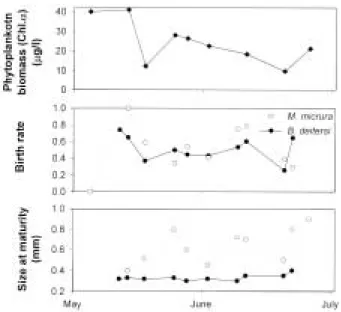
deitersi. High phytoplankton biomass (average chl. a : 26.7
µg/l, mainly consisting of Chloro- phyta and Crysophyta from May to June) and decrease of maturity size (Fig. 5) of these species support that juvenile fish predation would be a main reason for the decrease of their densities rather than food limitation, which often induces a mid-summer decline of cladoceran species combined with size-selective predation by age-0 juvenile fish (Lin and Culver, 1991; Hülsmann and Mehner, 1997). On the contrary, the decline of birth rate seems to be the result of intense juvenile fish predation on the large individuals bearing more eggs than smaller individuals (Gliwicz and Pijanowska, 1989; Gliwicz et al., 2000).
Changes in the juvenile fish community seems to be one of the factors which contributed to minimizing the predation impact in the Nakdong River. On June 10, juvenile largemouth bass, M.
salmoides, were collected in the net and all individuals exceeded 3 cm in body size. Different from other juvenile fish, the gut and stomach contents of bass contained other juvenile fish as well as zooplankton. Olson (1996) reported that the prey item of the largemouth bass changed from crustaceans to fish in the size c.a. 2 cm and a distinct diet shift from crustaceans to fish occurred when their size reached near 4 cm of length. The juvenile largemouth bass feeds first on zooplankton, and then its foraging behavior shifts to piscivorous. As it becomes progressively
more piscivorous, its impact on food web struc- ture reverses and induces the dominance of lar- ger bodied zooplankton such as cladocera since it removes other planktivorous juvenile fish (Post et al., 1997). In the lower part of Nakdong River, adult largemouth bass occupied 12% of total fish abundance (The Ministry of Environment, 2000).
Predation by adult largemouth bass may control the food web structure through intense predation on other fishes as well as juveniles (Carpenter and Kitchell, 1993; Mittelbach et al., 1996). Thus, the presence of the piscivorous largemouth bass might induce the decline of other juvenile fish in the Nakdong River.
In the Nakdong River, the decrease of clado- ceran density rapidly recovered after their den- sity declined. The high trophic status of the river may be one of the reasons for the rapid recovery of cladoceran density. Vijverberg et al. (1990) and Mehner et al. (1998b) also reported a rapid reco- very of cladoceran species during the develop- ment of juvenile fish in shallow eutrophic lakes.
Their results suggest that the high trophic state of the environment makes food limitation less obvious, and that the predation impact of age-0 planktivores is more important and consequently had a low influence of age-0 fish predation on
Fig. 5. Changes of phytoplankton biomass (chl. a), instan- taneous birth rates, and maturity sizes (smallest size of individual containing eggs in the brood chamber) of two major cladoceran species (Moina micrura and Bosminopsis deitersi) in the Nakdong River (1999).
decline of large cladoceran.
In conclusion, the low discharge and water body stagnancy in the regulated river induced a lake- like succession of zooplankton community during a dry season. In this circumstance, juvenile fish predation seems to be one of the important fac- tors controlling the zooplankton community, by suppressing large rotifers and cladocerans. How- ever, the impact of juvenile fish predation seems to be modified by the high trophic state of the river and/or changes in the predator community such as predation of piscivorous bass on other juvenile fish by leading to the recovery of the cla- doceran species.
ACKNOWLEDGMENT
This study was supported by Korea Research Foundation, 1998 (Project No. 1998-001-D00898).
REFERENCES
Boersma, M., O.F.R. van Tongeren and W.M. Mooij.
1996. Seasonal patterns in the mortality of Daph- nia species in a shallow lake. Can. J. Fish. Aquat.
Sci. 53: 18-28.
Carpenter, S.R. and T.M. Kitchell. 1993. The Trophic Cascade in Lakes. Cambridge University Press.
New York.
Chesson, J. 1978. Measuring preference in selective predation. Ecology 9: 923-947.
Cryer, M., G. Peirson and C.R. Townsend. 1986. Reci- procal interactions between roach, Rutilus rutilus, and zooplankton in a small lake: Prey dynamics and fish growth and recruitment. Limnol. Ocea- nogr. 31: 1022-1038.
DeVries, D.R. and R.A. Stein. 1992. Complex interac- tions between fish and zooplankton: Quantifying the role of an open-water planktivore. Can. J.
Fish. Aquat. Sci. 49: 1216-1227.
Gliwicz Z.M. and J. Pijanowska. 1989. The role of predation in zooplankton succession. In: Plankton Ecology (U. Sommer, ed.). Springer-Verlag, New York, pp. 253-296.
Gliwicz, Z.M., A.E. Rutkowska and J. Wojciechowska.
2000. Daphnia populations in three interconnected lakes with roach as the principal planktivore. J.
Plankton Res. 22: 1539-1557.
Ha, K., H.W. Kim and G.J. Joo. 1998. The phytop- lankton succession in the lower part of hypertro- phic Nakdong River (Mulgum), South Korea.
Hydrobiologia 369/370: 217-227.
Ha, K., E.A. Cho, H.W. Kim and G.J. Joo. 1999.
Microcystis bloom formation in the lower Nak-
dong River, South Korea: importance of hydrody- namics and nutrient loading. Mar. Freshwater Res. 50: 89-94.
Hanazato T. and M. Yasuno. 1985. Effect of tempe- rature in the laboratory studies on growth, egg development and first parturition of five species of cladocera. Jpn. J. Limnol. 46: 185-191.
Hartmann, J. 1983. Two feeding strategies of young fishes. Arch. Hydrobiol. 96: 496-509.
Hulsmann, S. and T. Mehner. 1997. Predation by un- deryearling perch (Perca f luviatilis) on a Daphnia galeata population in a short-term enclosure ex- periment. Freshwater Biol. 37: 209-219.
Hynes, H.B.N., 1970. The ecology of running waters.
University of Toronto Press, Toronto.
Kim, H.W., K. Ha and G.J. Joo. 1998. Eutrophication of the lower Nakdong River after the construction of an estuary dam in 1987. Internat. Rev. Hydro- biol. 83: 65-72.
Kim, H.W., S.J. Hwang and G.J. Joo. 2000. Zooplank- ton grazing on bacteria and phytoplankton in the regulated Nakdong River (Korea). J. Plankton Res. 22: 1559-1577.
Lazzaro, X., R.W. Drenner, R.A. Stein and J.D. Smith.
1992. Planktivores and plankton dynamics: Eff- ects of f ish biomass and planktivore type. Can. J.
Fish. Aquat. Sci. 49: 1466-1473.
Lim, B.J., B.C. Kim, K.I. Yoo and J.K. Ryu. 1997.
Changes in zooplankton community during the Blue-green algal bloom in the Nakdong River.
Kor. J. Lim. 30: 337-346.
Lin, W. and D.A. Culver. 1991. Age-0 yellow perch (Perca flavescens) dietary ontogeny in the western basin of Lake Erie: Effect of midsummer decline in zooplankton populations. Verh. Internat. Ver- ein. Limnol. 24: 2366-2370.
Luecke, C., M.J. Vanni, J.J. Magnuson, J.F. Kitchell and P.T. Jacobson. 1990. Seasonal regulation of Daphnia populations by planktivorous fish: Impli- cations for the spring clear-water phase. Limnol.
Oceanogr. 35: 1718-1733.
Lynch, M. 1979. Predation, competition and zoo- plankton community structure: an experimental study. Limnol. Oceanogr. 24: 253-272.
Mehner, T., M. Plewa, S. Hulsmann and S. Worischka.
1998a. Gape-size dependent feeding of age-0 perch (Perca fluviatilis) and age-0 zander (Stizo- stedion lucioperca) on Daphnia galeata. Arch.
Hydrobiologia 142: 191-207.
Mehner, T., S. Hülsmann, S. Worischka, M. Plewa and J. Benndorf. 1998b. Is the midsummer de- cline of Daphnia really induced by age-0 fish pre- dation? Comparison of fish consumption and Daphnia mortality and life history parameters in a biomanipulated reservoir. J. Plankton Res. 20:
1797-1811.
Ministry of Environment, Korea. 2000. The Research for Ecological Effect of Endocrine (in Korean). 303
pp.
Mittelbach, G.G., A.M. Turner, D.J. Hall, R.E. Rettig and C.W. Osenberg. 1996. Perturbation and resili- ence in an aquatic community: A long-term study of the extinction and reintroduction of a top pre- dator. Ecology 76: 2347-2360.
Olson, M.H. 1996. Ontogenetic niche shift in large- mouth bass: Variability and consequences for first-year growth. Ecology 77: 179-190.
Pace, M.L., S.E.G. Findlay and D. Lints. 1992. Zoo- plankton in advective environments: The Hudson River community and a comparative analysis.
Can. J. Fish. Aquat. Sci. 49: 1060-1069.
Paloheimo, J.E. 1974. Calculation of instantaneous birth rate. Limnol. Oceanogr. 19: 692-694.
Parrish, D.L. and F.J. Margraf. 1991. Selectivity by age 0 white perch (Morone americana) and yellow perch (Perca flavescens) in laboratory experi- ments. Can. J. Fish. Aquat. Sci. 48: 607-610.
Post, D.M., S.R. Carpenter, D.L. Christensen, K.L.
Cottingham, J.F. Kitchell, D.E. Schindler and J.R.
Hodgson. 1997. Seasonal effects of variable recr- uitment of a dominant piscivore on pelagic food web structure. Limnol. Oceanogr. 42: 722-729.
Qin, J. and D.A. Culver. 1995. Effect of young-of- the-year walleye (Percidae: Stizostedion vitreum) on plankton dynamics and water quality in ponds.
Hydrobiologia 297: 217-227.
Romare, P. and E. Bergman. 1999. Juvenile fish ex- pansion following biomanipulaiton and its effect on zooplankton. Hydrobiologia 404: 89-97.
Rudstam L.G., R.C. Lathrop and S.R. Carpenter.
1993. The rise and fall of a dominant planktivore:
Direct and indirect effects on zooplankton.
Ecology 74: 303-319.
Thorp, J.H., A.R. Black, K.H. Haag and J.D. Wehr.
1994. Zooplankton assemblages in the Ohio River:
Seasonal, tributary and navigation dam effects.
Can. J. Fish. Aquat. Sci. 51: 1634-1643.
Vanni, M.J. 1986. Fish predation and zooplankton demography: Indirect effects. Ecology 67: 337- 354.
Vijverberg, J., M. Boersma, W.L.T. van Densen, W.
Hoogenboezem, E.H.R.R. Lammens and W.M.
Mooij. 1990. Seasonal variation in the interactions between piscivorous fish, planktivorous fish and zooplankton in a shallow eutrophic lake. Hydro- biologia 207: 279-286.
Wetzel, R.G. and G.E. Likens. 1991. Limnological Analyses, 2nded. Springer-Verlag, New York.
Whiteside, M.C. 1988. 0± fish as major factors affec- ting abundance patterns of littoral zooplankton.
Verh. Internat. Verein. Limnol. 23: 1710-1714.
(Received 20 Oct. 2001, Manuscript accepted 8 Dec. 2001)
⁄ ¤
저수지화 성향을 띤 낙동강에서 치어 섭식이 동물플랑크톤 군집에 미치는 영향
장광현1, 4∙황순진2∙장민호1∙김현우3∙정광석1∙주기재1* (1부산대학교 생물학과, 2건국대학교 지역생태시스템공학과,
3순천대학교 환경교육과, 4 境敎 究센타)
낙동강에서 치어섭식이 동물플랑크톤에 미치는 영향을 채집된 치어의 소화관조사를 통해 고찰하 였다. 조사지역인 낙동강 하류 물금에서는 유량이 감소하고 수체가 정체되는5월에서6월사이5종 류의 치어가 높은 밀도를 나타내었다. 같은 시기, 동물플랑크톤 군집내에서는 대형윤충류인 Asplanchna spp.와 Brachionus spp., 지각류인 Moina micrura 및 Bosminopsis deitersi의 밀도가 큰 폭으로 감소하였다. 반면, Polyarthra속의 소형윤충류는 최대 밀도를 나타내었다. 채집된 치어의 소화관 조사 결과, 15 mm 이하의 치어는 대형윤충류 및 지각류를, 15mm 이상의 치어인 경우 지각 류를 선택적으로 섭식하는 것으로 나타났다. 큰입배스의 치어의 경우, 같은 시기 채집된 치어에 비 해 대형이었으며 동물플랑크톤 뿐 아니라 다른 치어를 포식하는 것으로 조사되었다. 조사 결과, 이 시기의 낙동강 동물플랑크톤 군집내의 대형 윤충류와 지각류의 급격한 밀도 감소는 치어의 섭식으 로 인한 것으로 사료된다. 반면, 이러한 밀도감소는 치어의 수가 감소함에 따라 회복되는 경향을 보였다. 부영양화된 낙동강의 경우 배스치어의 섭식으로 인한 치어밀도의 급속한 감소, 풍부한 먹 이농도 등이 감소한 지각류의 밀도회복을 유도하는 것으로 사료된다.