www.kwss.or.kr
- 44 -
1경상북도농업기술원, 702-708, 대구광역시 북구 동호동 189(Gyeongsangbuk-do Provincial Agricultural Research & Extension Services, Daegu 702-708, Korea)
2경상북도농업기술원 영양고추시험장, 764-803, 경상북도 영양군 영양읍 대천리 579-3(Youngyang Pepper Experiment Station, Gyeongsangbuk-do Provincial Agricultural Research & Extension Services, Youngyang 764-803, Korea)
3계명대학교 지구환경학과, 704-701, 대구광역시 달서구 달서구대로 1095(Department of Global Environment, Keimyung University, Daegu 704-701, Korea)
* 연락저자(Corresponding author):Phone) +82-53-580-5918, Fax) +82-53-580-0294, E-mail) [email protected]
(Received December 26, 2011; Examined March 7, 2012; Accepted March 20, 2012)
Ⓒ 2012 Korean Society of Weed Science
벼 담수직파에서 피와 너도방동사니의 발생밀도에 따른 쌀 수량, 미질 및 경제적 허용 한계밀도 설정
김상국1*, 김수용1, 원종건2, 신종희1, 김학윤3
Effect of Densities of Echinochloa crus-galli and Cyperus serotinus in Direct-seeding Flooded Rice on Rice Yield and
Quality, and Economic Threshold Level of the Weeds
Sang-Kuk Kim1*, Su-Yong Kim1, Jong-Gun Won2, Jong-Hee Shin1 and Hak Yoon Kim3*
ABSTRACT This study was conducted to predict the rice yield loss and to determine the economic threshold levels for direct-seeding flooded rice cultivation from competition to the most serious perennial weeds, Cyperus serotinus Rottb. and Echinochloa crus-galli L. The rice yield loss model of C. serotinus and E. crus-galli were predicted as Y = 560 kg/(1+0.001883x), r2=0.933, and Y = 507 kg/(1+0.001734x), r2=0.867, respectively. In comparison of the competitiveness represented by parameter β, it was 0.001883 in C. serotinus and 0.001734 in E. crus-galli, respectively. Economic thresholds calculated using Cousens' equation were negatively related with the competitiveness of weed. The economic thresholds of C. serotinus and E. crus-galli were 15.5 and 2.3 plants per m2, respectively.
Key words: Cyperus serotinus; direct-seeding flooded rice; Echinochloa crus-galli; economic threshold; rice loss yield.
서 언
최근 친환경 벼 재배는 환경보전과 생산비 절감에 대한 중요성이 부각되면서 벼농사의 잡초 관리가 제초
제를 이용한 완전방제 개념에서 쌀 생산 경제 비용을 고려한 친환경 잡초관리 기술로 대체되고 있는 실정이 다(Kwon 등 2009).
우리나라의 논에서 발생하는 잡초는 약 22과 76종
으로 이중 사초과잡초는 17종으로 전체 22.4%를 차지 한다. 사초과잡초 17종 중 논에서 문제가 되는 초종은 알방동사니, 올챙이고랭이, 올방개, 너도방동사니 등 이다(Park 등 2001). 이중 벼 재배양식별 알방동사니의 잡초밀도에 따른 쌀 수량, 미질 및 경제적 방제 허용밀 도에 대한 연구는 수행된 바 있다(Kwon 등 2007;
Kwon 등 2009).
논 잡초는 벼와 양분 및 광, 수분 등 다양한 요소의 경합을 통하여 수량감소를 초래하므로 잡초종류별 발 생밀도에 따라 정확한 수량 감수 예측모델을 설정하여 방제 여부를 판단할 근거 자료가 필요하다고 할 수 있 다. 우리나라에서는 농촌진흥청 국립농업과학원을 중 심으로 2006년부터 잡초에 대한 정밀관리기술 개발의 일환으로 주요 문제 논 잡초 10여 종을 선정하여 이들 잡초들에 대한 경합밀도에 따른 피해 해석과 경제적 방제수준 밀도 설정연구를 도 농업기술원과 공동으로 수행하였다(Kwon 등 2008; Kwon 등 2009).
작물이 재배되고 있는 포장에서의 잡초 발생은 한 정된 면적 내에 식물체의 밀도가 증가되는 것을 의미 하는 것으로 가장 높은 수량을 내기 위한 작물재배의 환경에 있어 잡초는 기본적으로 작물의 평균 수량을 감소시키는 역할을 한다. 이러한 잡초 발생으로 인한 작물 수량 감소 정도는 수학적인 모델식을 이용하여 예측하려는 다양한 노력이 시도되었다(Cousens 1985;
Kropff와 Spitters 1991; Kropff 등 1995; Berti와 Sattin 1996). 이러한 모델들 가운데 Cousens에 의해 시도되 었던 잡초의 밀도와 작물의 수량감소를 연계한 Rec- tangular hyperbola 모델이 가장 많이 사용되고 있으며 (Cousens 1985), 실제로 이와 같이 잡초밀도를 이용하 여 다양한 작물에 대한 수량감소를 예측한 연구들이 보고되고 있다(Kim 등 2002; Cowan 등 1998; Lind- quist 등 1996).
이와 관련하여 국내에서 지금까지 연구된 일년생 잡초는 물피를 비롯한 강피, 물달개비, 알방동사니, 여 뀌바늘, 사마귀풀, 자귀풀, 미국가막사리 등 8종과 다 년생 잡초종인 올방개를 비롯한 벗풀, 올챙이고랭이, 새섬매자기 등 4종에 대하여 수행되었다. 이러한 잡초 종의 발생밀도를 보면 이앙 후 60일경에 벼의 분얼수 가 10.2~27.5%정도 감소되며, 쌀 수량은 약 18~51%
까지 감소되었다. 이러한 쌀 수량 감소는 수량 구성요 소 중 이삭수의 감소에 기인한 것으로 알려져 있다.
또한 이들 잡초종의 발생밀도 증가에 따른 쌀 품위 중 완전미 비율이 낮아지며 미숙립은 증가하지만 밥맛 의 지표가 되는 취반미 윤기치 및 단백질 함량 차이는 거의 없다고 하였다. 뿐만 아니라, 벼 생육에 영향을 미치는 잡초의 경합력은 벼 품종 및 재배지역, 재배양 식, 재배시기, 시비조건, 잡초발생 양상 등 여러 가지 요인들에 의해 좌우된다고 하였다(Cho와 Lee 2004;
Kwon 등 2002; Lee 등 2005, 2006; Song 등 2006, 2008).
따라서 본 시험은 2010년 경상북도농업기술원 벼 재배포장에서 잡초발생 예찰 시스템 구축의 일환으로 벼 담수직파재배에서 피와 너도방동사니 발생밀도에 따른 쌀 수량 감수정도와 예측모델을 구하고 이들 쌀 수량 감수 예측모델을 활용하여 잡초로 인한 경제적 피해한계 밀도를 설정하여 잡초방제 여부 판단자료로 활용하고자 수행되었다.
재료 및 방법
포장시험
본 시험은 2010년에 경상북도농업기술원 담수직파 포장에서 수행되었다. 벼 종자 (호품벼)는 충분히 최아 시킨 다음 ha당 40kg을 6월 4일에 산파하였으며 파종 후 20일과 30일에 m2당 입모수를 100~120개로 조정 하여 재배하였다. 대상 잡초는 너도방동사니와 피로서 너도방동사니는 괴경, 피는 종자를 사용하였다.
너도방동사니와 피의 파종은 동일한 밀도로 m2당 0, 1, 8, 24, 48 및 96본이 되도록 하였다. 파종 후 20일과 30일의 2회에 걸쳐 본수를 보정하였으며, 대상 잡초 외에 발생된 잡초는 파종 후 20, 40 및 60일에 각각 손제초하였다.
시비량은 질소-인산-칼리를 90-45-57 kg ha-1 시용하 였다. 질소는 기비-분얼비-수비를 40-30-30%, 칼리는 기비-수비를 70-30%, 인산은 전량기비로 시용하였다.
시험구 배치는 난괴법 3반복으로 하였으며, 벼의 초장 과 분얼수 및 엽록소 함량(Model Minolta SPAD-502, Japan)은 파종 후 30일, 60일 및 출수기에 조사하였다.
벼 수량과 수량구성요소는 농촌진흥청 조사기준에 준하였으며 쌀 품위는 백미의 완전립 비율, 청미, 동할 미 및 사미를 분석하였다. 단백질과 아밀로스 함량은
Weed density (Plant m-2)
30 DAS1) 60 DAS Heading stage
Plant height (cm)
Tiller (No. hill-1)
SPAD value
Plant height (cm)
Tiller (No. hill-1)
SPAD value
Plant height (cm)
Tiller (No. hill-1)
SPAD value
Echinochloa crus-galli 0
1 8 24 48 96
39a2) 39a 39a 38a 37a 37a
23.6a 23.4a 22.1a 21.3a 19.2b 19.0b
39.5a 39.4a 39.4a 37.6b 37.1b 36.7c
91a 91a 89a 86b 85b 85b
21.4a 20.2a 18.1ab
17.3b 16.7b 15.3c
39.2a 38.0a 37.4b 36.0c 34.3d 34.4d
99a 97a 95b 93b 91c 91c
19.4a 18.2a 17.5a 16.4b 15.2b 14.5b
33.8a 32.2a 31.5a 30.6b 29.4b 27.6c Cyperus serotinus
0 1 8 24 48 96
39a 39a 39a 38a 38a 38a
23.6a 22.7a 22.4a 21.5b 21.2b 21.0b
39.5a 39.3a 39.3a 38.9a 37.8b 37.5b
91a 89a 89a 86b 82c 81c
21.4a 21.0a 18.5ab 17.7ab 15.8b 15.0b
39.2a 39.3a 37.7a 37.1b 36.3c 36.4d
99a 95b 95b 93b 89c 89c
19.4a 19.2a 18.3a 16.2b 15.3b 15.2b
33.8a 33.6a 32.4b 31.6b 30.0c 30.3c
1)DAS:Days after seeding.
2)DMRT:In each column, means with the same letters are not significantly different at the 5% level by Duncan's multiple range test.
Table 1. Changes of plant height, number of tiller and SPAD value of rice plant as affected by different weed densities of two weed species in direct-seeding flooded rice cultivation.
FOSS Tecator(Model FOSS infratec 1241, Sweden)를 이용하여 분광학적 방법으로 측정하였다. 취반미의 식미 값은 Toyo meter(Model MA-90B, Japan)로 측정하였다.
통계분석 및 예측모델 작성
모든 통계분석은 Genstat 프로그램을 이용하여 분석 하였으며, 잡초 밀도에 따른 벼 수량 감소를 예측하기 위한 추정식을 작성하기 위하여 Cousens(1985)이 제 시한 아래의 Rectangular hyperbola 식을 이용하여 계 산하였다.
Y= Y0
1+βX (1)
여기서 Y0는 잡초가 완전 방제시의 쌀 수량, β는 잡 초의 벼에 대한 경합력, X는 잡초의 밀도를 나타낸다.
경제적 잡초 한계 허용 밀도(tE)는 잡초방제에 필요한 비용, 제초제 비용, 쌀값을 고려하여 Cousens(1987)에 의해 개발된 아래의 식에 의해 계산하였다.
tE= Ch+Ca
Y0PLH (2)
여기서 Ch는 제초제 가격, Ca는 제초작업 비용, Y0
는 잡초 완전 방제시 쌀 수량, P는 쌀 가격, L은 잡초 1본에 의해 감소되는 쌀 수량, H는 제초제 처리시 방 제가를 나타낸다.
결과 및 고찰
잡초 밀도별 벼 생육 차이
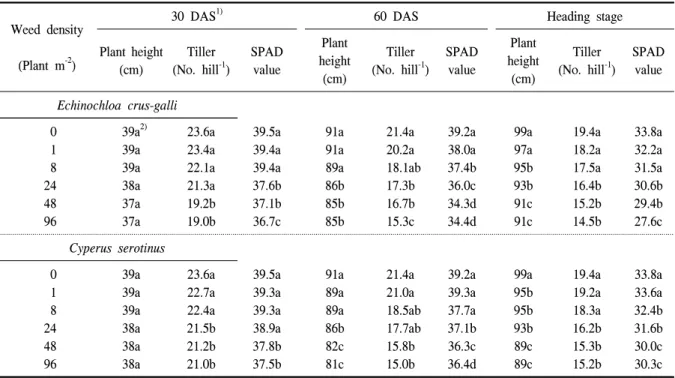
표 1은 피와 너도방동사니 잡초종의 밀도에 따른 벼 의 초장, 분얼수 및 엽록소 함량에 대한 차이를 생육시 기에 따라 조사한 결과이다. 피의 경우 파종 후 30일에 서 분얼수는 잡초밀도가 48본 m-2 이상에서 감소하였 으며 SPAD 값은 24본 m-2이상에서 감소하였다. 파종 후 60일 조사에서 초장과 분얼수는 24본 m-2이상에서, SPAD값은 8본 m-2부터 감소되었으며 밀도가 증가할
Weed density (Plant m-2)
Culm length (cm)
Panicle length (cm)
Panicles (No. hill-1)
Spikelets (No. panicle-1)
Ripened grain ratio (%)
1,000-seed weight (g)
Rice yield (ton ha-1) Echinochloa crus-galli
0 1 8 24 48 96
83a 71b 71b 71b 70b 67c
19.3a 18.4a 18.3a 18.3a 18.1a 17.8a
17.2a 16.7a 15.8a 14.9a 13.6b 12.5b
101.2a 82.9b 75.8c 74.3c 66.5d 64.7d
88.8a 88.6a 86.3a 83.1b 79.5c 73.2d
22.8a 21.1a 20.8a 20.8a 20.6ab 20.5ab
5.63a 4.99b 4.36c 4.21c 3.02d 2.27e Cyperus cerotinus
0 1 8 24 48 96
83a 82a 82a 81a 80a 76b
19.3a 19.4a 19.4a 19.5a 19.1a 19.2a
17.2a 16.3a 16.4a 15.3a 14.4b 14.1b
101.2a 98.9b 97.5b 89.2c 90.6c 86.3c
88.8a 89.4a 87.6ab
86.4b 83.8c 79.6d
22.8a 22.6a 21.5a 21.7a 21.6a 21.5a
5.63a 5.58a 5.48ab
5.32b 5.27bc
4.69c
1)DMRT:In each column, means with the same letters are not significantly different at the 5% level by Duncan's multiple range test.
Table 2. Changes of yield and yield components as affected by different weed densities of two weed species in direct-seeding flooded rice cultivation.
수록 급격히 감소되는 경향을 보였다. 출수기의 피 밀 도증가에 따른 초장, 분얼수 및 엽록소 함량은 파종 후 60일과 유사한 결과를 보였다. 너도방동사니 잡초밀도 증가에 따른 파종 후 30일의 초장과 분얼수는 통계적 인 유의성은 없었으나 다소 감소하였고 엽록소 함량은 m2당 48본에서 유의적으로 감소하였다. 파종 후 60일 에서는 초장의 경우 잡초밀도 m2당 24~96본에서 유 의적인 감소를 보였으며 분얼수는 m2당 8본에서 유의 적으로 감소하였다. 출수기에서의 초장과 분얼수 및 엽록소 함량은 파종 후 30일과 60일의 경향과 유사하 였다.
잡초 밀도별 벼 수량 및 수량구성요소
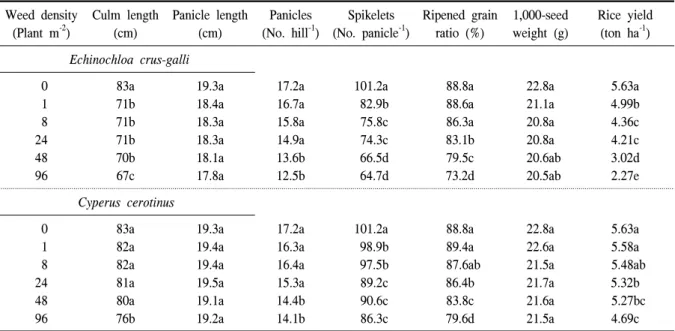
피와 너도방동사니의 잡초밀도에 따른 쌀 수량 및 수량구성요소 변화는 표 2와 같다. 피의 경우 잡초밀 도 m2당 1~48본에서는 간장이 71cm이었으나, m2당 96본에서는 67cm로 매우 작았고, 이삭길이는 영향을 받지 않았다. 이삭수는 피의 잡초밀도가 증가할수록 감소하였으며, 특히 m2당 48본에서 현저한 감소를 보 였다. 등숙비율은 m2당 1본부터 8본까지 무경합구와 큰 차이를 보이지 않았으나 m2당 24본부터 낮아지기
시작하여 96본 m-2의 경우 무경합구 대비 15.6%까지 감소하였다. 또한 수량구성요소별 무경합구 대비 감소 정도를 보면, m2당 수수 2.9~27.3%, 수당립수 18.1~
36.1%, 등숙비율 0.2~17.6%, 현미 천립중 7.5~10.1%
로 감소되어 쌀 수량에 미치는 요인은 수당립수> m2 당 수수> 등숙비율> 현미 천립중 순이었다. 따라서 ha당 쌀 수량성은 완전 제초구의 5.63t에 비하여 m2당 1본부터 감소되었으며, 특히 m2당 8본에서 22.6%, 96 본에서 59.7%까지 감소되었다.
한편 너도방동사니의 경우 수량구성요소별 무경합 구 대비 감소 정도는 m2당 수수 5.2~18.0%, 수당립수 2.3~14.7%, 등숙비율 0.7~10.4%, 현미 천립중 0.9~
5.7%로 감소되어 쌀 수량에 미치는 요인은 수당립 수> m2당 수수> 등숙비율> 현미 천립중 순이었으 며 ha당 쌀 수량은 완전 제초구의 5.63t에 비하여 m2당 8본부터 감소하였으며 8본부터 96본까지 2.7~16.7%
까지 감소되었다.
이상의 결과로 볼 때, 벼와 같이 화본과 일년생 잡초 인 피는 사초과인 너도방동사니보다 광, 양분 및 공간 적 경합 등에서 훨씬 큰 것으로 나타났다. Lee 등 (2005)은 m2당 50본의 다년생 잡초가 발생할 경우, 너
Density (Plant m-2)
Quality of milled rice(%)
Quality2) value
Protein3) (%)
Amylose3) Head rice Immatured (%)
rice
Damaged kernel
Cracked
rice Others 0
1 8 24 48 96
93.8a1) 93.3a 92.2a 87.6b 84.5c 80.7d
2.3d 2.6d 3.6d 7.1c 9.5b 13.2a
0.3a 0.3a 0.3a 0.4a 0.6a 0.5a
3.4a 3.5a 3.6a 4.3a 4.9a 5.2a
0.2 0.3 0.3 0.6 0.5 0.4
82.7a 81.4a 81.0a 75.7b 74.3c 73.1c
6.6c 6.6c 7.0b 7.4a 7.5a 7.4a
18.6a 18.6a 18.4a 18.3a 18.2a 18.2a
1)DMRT:In each column, means with the same letters are not significantly different at the 5% level by Duncan's multiple range test.
2)Quality value was measured by Toyo Meter(MA-90B, Japan).
3)Protein and amylose content were measured by Foss Tecator(Infratec 1241, Sweden).
Table 4. Quality value of milled rice as affected by different densities of Cyperus cerotinus in direct-seeding flooded rice cultivation.
Density (Plant m-2)
Quality of milled rice(%)
Quality2) value
Protein3) (%)
Amylose3) Head rice Immatured (%)
rice
Damaged rice
Cracked
rice Others 0
1 8 24 48 96
93.8a1) 93.4a 90.9a 88.2b 86.4b 84.0c
2.3d 2.4d 4.5c 6.7b 8.5a 9.8a
0.3 0.3 0.4 0.5 0.8 0.7
3.4 3.6 3.9 4.1 3.9 5.1
0.2 0.3 0.3 0.5 0.4 0.4
82.7a 82.5a 82.6a 81.9b 81.7b 81.6b
6.6 6.6 6.5 6.3 6.4 6.5
18.6 18.7 18.6 18.5 18.4 18.6
1)DMRT:In each column, means with the same letters are not significantly different at the 5% level by Duncan's multiple range test.
2)Quality value was measured by Toyo meter(MA-90B, Japan).
3)Protein and amylose content were measured by Foss Tecator(Infratec 1241, Sweden).
Table 3. Quality value of milled rice as affected by different densities of Echinochloa crus-galli in direct-seeding flooded rice cultivation.
도방동사니 64%, 올방개 17%, 가래 13%, 벗풀 11%의 수량감소를 보인다고 하여 잡초종류 뿐만 아니라 밀도 에 따라서도 큰 차이가 있음을 보고하였다. 본 시험에 서는 48본에서 6.3% 감소하여 이 등의 결과와는 큰 차 이가 있었는데 이는 이앙재배와 담수직파재배와 같은 재배양식, 이앙시기, 파종시기 등 재배방식과 생육기 간 중 온도, 양분경합 등 다양한 요인에 의한 것으로 사료되었다.
잡초 밀도별 미질 특성
피와 너도방동사니의 잡초밀도에 따른 쌀(백미)의
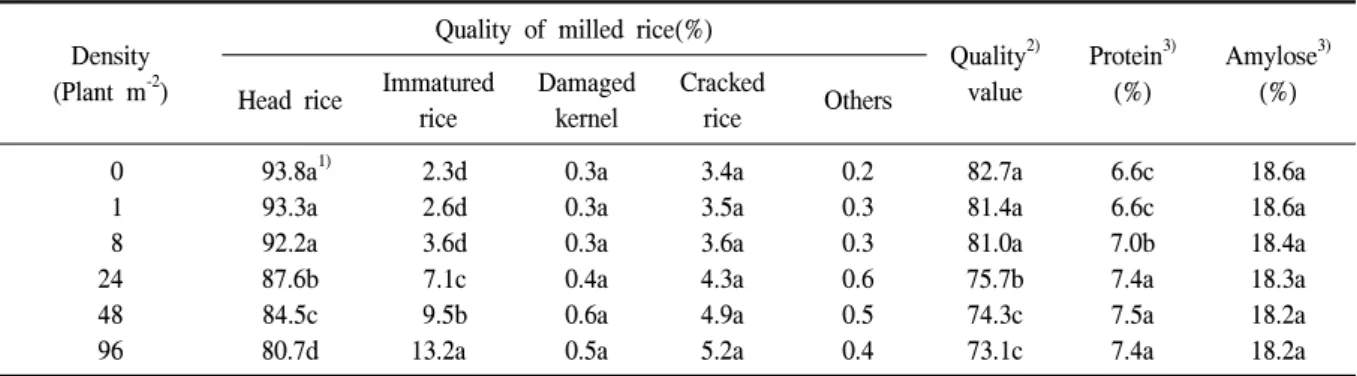
품위를 보면(표 3, 4), 피의 경우 m2당 24본 이상에서 완전미 비율은 유의적으로 감소하였고, 미숙립 비율은 잡초밀도가 증가할수록 유의적으로 증가하였다. 즉, 피의 경합밀도별(m2당 1~96본) 백미의 품위 변이 정 도는 완전미 비율의 경우 무경합구 대비 0.1~14.0%
정도 감소하였으며, 미숙립은 11.5~82.6% 정도 증가 하였다. 또한 밥맛을 나타내는 취반미의 윤기치는 m2 당 24본 이상에서 유의적으로 감소하였으며 단백질 함량은 m2당 8본 이상에서 유의적으로 증가하는 결과 를 보였다. 아밀로스 함량은 m2당 잡초밀도가 증가할 수록 다소 감소하였으나 통계적인 유의성은 없었다.
Weed species Parameter estimates
R2 Yo (ton ha-1) β
Echinochloa crus-galli Cyperus cerotinus
5.07 5.60
0.001734 0.001883
0.867 0.933
Fig. 1. Observed and predicted rice grain yield as a function of and in direct-seeding flooded rice cultivation. The predicted rice grain yield (continuous line) was calculated using equation 1 and parameter estimates in Table 5.
The dots represent in real rice grain yield harvested in the fields.
Table 5. Weed free rice yield(Yo) and the competitiveness represented by parameter β, whose reciprocal 1/β is a weed density reducing rice yield by 50% in direct-seeding flooded rice cultivation.
한편 너도방동사니의 경우 잡초밀도별 완전미 비율은 m2당 24본 이상에서 유의적으로 낮아지는 결과를 보 여 무경합구와 대비하면 6.0~10.5% 감소하였다. 미숙 립은 완전미 비율과는 달리 m2당 8본 이상에서 증가 하기 시작하였는데 m2당 96본에서는 9.8%로 무경합 구 대비 7.5% 정도 증가하였다. 취반미의 윤기치는 m2 당 1본과 8본에서는 다소 감소하였으나 유의성은 없 었으며, m2당 24본 이상에서 낮아졌다.
벼와 잡초와의 경합
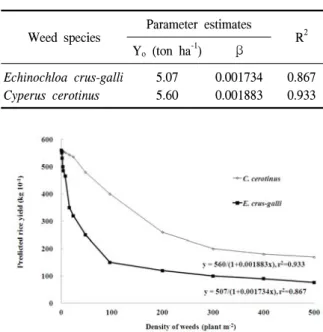
본 시험에서는 벼와 잡초와의 경합모델 가운데 Cousens에 의해 시도되었던 잡초의 밀도와 작물의 수 량 감소를 연계시킨 Rectangular hyperbola 모델을 이 용하여 추정하였다(Cousens 1985). 잡초 밀도에 따른 벼 수량 감소를 예측하기 위한 추정식을 작성하고자 재료 및 방법의 계산식(1)을 이용하여 추정한 피와 너 도방동사니 잡초를 완전 방제시의 벼 수량(Yo)과 잡초
의 벼에 대한 경합력(β) 둥은 표 5에 제시한 바와 같 다. 따라서 그림 1은 표 5에서 구해진 잡초 초종별 완 전 방제시 수량과 벼와의 경합력을 바탕으로 하여 잡 초 초종별 밀도에 따른 벼 수량 감소 예측식을 나타낸 것이다. 잡초를 완전 방제 했을 경우를 가상한 벼 수량 (ha당)은 피에서 5.07t, 너도방동사니에서 5.60t이었으 며, 벼와 잡초의 경합력은 피에서 0.001883, 너도방동 사니 0.001734로 피의 경합력이 너도방동사니보다 1.1 배 정도 큰 것으로 나타났다. 또한 여기에서 얻은 예측 모델식에 의해 잡초 발생밀도별로 쌀 수량을 예측한 결과, 그림 1에서와 같이 잡초발생밀도의 증가에 따라 쌀 수량은 현저히 감소하였는데 쌀수량 10% 감소를 유발하는 초종별 밀도는 피의 경우 m2당 1.2본, 너도 방동사니는 74.3m2당 본으로 추정할 수 있었다.
벼와 잡초의 경합력은 품종, 지역, 재배양식, 재배시 기, 시비조건, 잡초발생양상 등 여러 가지 요인들에 의 해 좌우되지만 담수직파재배보다 기계이앙재배에서 약 2~3배정도 높다고 보고되고 있으며(Won 등 2009;
Kwon 등 2007, 2009), 벼 담수직파 재배시 피의 경합 력은 0.03782, 사초과인 알방동사니의 경합력은 0.001134로 피의 경합력이 알방동사니보다 크다고 보 고하였다(Kwon 등 2009).
표 5에서 얻어진 자료를 바탕으로 그림 1에서 보는 바와 같이 잡초 초종별 밀도 증가에 따른 벼 수량 추 정식을 작성하였다. 피와 벼와의 밀도 경합에 따른 쌀 수량 예측식은 y=507kg/(1+0.001734x), R2=0.867이고, 너도방동사니는 y=560kg/(1+0.001883x), R2=0.933으 로 나타났다. 표 6은 재료 및 방법에 제시한 바와 같이 Cousens(1987)에 의해 개발된 계산식(2)을 이용하여 벼와 잡초와의 경합에 있어서 당해연도 경제적 한계 허용밀도를 산출하여 나타내었다. 그 결과, 제초제 구 입 비용은 ha당 150,280원(2010년)이었고, 제초제를 살포하는데 소요되는 인건비 등은 ha당 99,360원, 쌀 의 kg당 가격은 1,605원, 제초제의 방제가는 95%로 적 용하였을 때 경제적 한계 허용 밀도는 잡초 완전 방제 시 쌀 수량이 5.07톤이고 1본당 수량 감수 정도가 0.001734인 피는 평방미터당 2.3본, 잡초 완전 방제시 쌀 수량이 5.60톤이고 1본당 수량 감수 정도가 0.001883인 너도방동사니는 평방미터당 15.5본이었다.
이와 같은 결과로 볼 때 잡초의 벼에 대한 경합력이 높을수록 경제적 한계 허용 밀도의 본수는 줄어들었
Weed species
Parameter estimates and economic thresholds* Ch
(₩ ha-1)
Ca
(₩ ha-1)
Yo
(t ha-1)
P
(₩ ha-1) L H tE
(No. m-2) Echinochloa crus-galli
Cyperus cerotinus
150,280 150,280
99,360 99,360
5.07 5.60
1,605 1,605
0.001734 0.001883
0.95 0.95
2.3 15.5
*Y0, weed free rice yield; P, value per unit of crop; L, proportion of yield loss per unit weed density; H, herbicide efficacy calculated as (95/100); Ch, herbicide cost; Ca, application cost.
Table 6. Parameter estimates and economic thresholds(tE) of two different weed species in direct-seeding flooded rice cultivation.
고, 경합력이 다소 낮았던 너동방동사니는 경제적 한 계 허용밀도의 본수가 증가되는 경향을 보였다.
표 6에서 언급된 경제적 한계 허용밀도는 각 나라의 경제적 상황, 제초제 비용 및 노동비용에 따라 다르게 나타날 수 있어, 상대적으로 쌀값이 낮은 지역은 경제 적 한계 허용 밀도가 어느 정도까지 높아질 수 있으며, 노동 비용 및 제초제 가격이 낮은 지역은 경제적 한계 허용 밀도가 낮아 질수도 있을 것으로 사료되었다.
요 약
본 시험은 2010년 경상북도 농업기술원 벼 시험재 배 포장에서 잡초발생 예찰 시스템 구축의 일환으로 최근 담수 직파답이 늘어나면서 벼 재배시 문제잡초인 피와 너도방동사니를 대상으로 잡초 밀도별 벼와의 경 합력을 구명하고 Rectangular hyperbola 모델을 기초로 잡초의 밀도에 따른 쌀 수량 감소를 예측하고 경제적 인 방제 필요수준을 구명하고자 본 시험을 실시하게 되었다. 피와 벼와의 밀도 경합에 따른 쌀수량 예측식 은 y=507kg/(1+0.001734x), R2=0.867이고, 너도방동사 니는 y=560kg/(1+0.001883x), R2=0.933으로 나타났다.
표 6은 재료 및 방법에 제시한 바와 같이 Cousens (1987)에 의해 개발된 계산식(2)을 이용하여 벼와 잡 초와의 경합에 있어서 당해연도 경제적 한계 허용밀도 를 산출하여 나타내었다. 그 결과, 제초제 구입비용은 ha당 150,280원(2010년)이었고, 제초제를 살포하는데 소요되는 인건비 등은 ha당 99,360원, 쌀의 kg당 가격 은 1,605원, 제초제의 방제가는 95%로 적용하였을 때 경제적 한계 허용 밀도는 잡초 완전 방제시 쌀 수량이
5.07톤이고 1본당 수량 감수 정도가 0.001734인 피는 평방미터당 2.3본, 잡초 완전 방제시 쌀 수량이 5.60톤 이고 1본당 수량 감수 정도가 0.001883인 너도방동사 니는 평방미터당 15.5본이었다. 이와 같은 결과로 볼 때 잡초의 벼에 대한 경합력이 높을수록 경제적 한계 허용 밀도의 본수는 줄어들었고, 경합력이 낮았던 잡 초는 경제적 한계 허용 밀도의 본수가 증가되는 경향 이었다.
인 용 문 헌
Berti, A., and M. Sattin. 1996. Effect of weed position on yield loss in soybean and a comparison between relation weed cover and other regression models. Weed Research. 36:249-258.
Cho, Y. D., and M. H. Lee. 2004. Germination characteristics of Bidens tripartita and Bidens frondosa occurring in paddy fields. Korean J.
Weed Sci. 24:299-307.
Cousens, R. D. 1985. A simple model relating yield loss to weed density. Annals Applied Biology 107:239-252.
Cousens, R. D. 1987. Theory and reality of weed control thresholds. Plant Protection Quarterly 2:13-20.
Cowan, P., S. E. Weaver, and C. J. Swanton. 1998.
Interference between pigweed (Amaranthus spp.), barnyardgrass (Echinochloa crus-galli), and soybean (Glycine max.). Weed Sci. 46:533-539.
Kim, D. S., P. Brain, E. J. P. Marshall, and J. C.
Caseley. 2002. Modelling herbicide dose and weed density effects on crop-weed competition. Weed Research 42:1-13.
Kropff, M. J., and C. J. T. Spitters. 1991. A simple model of crop loss by weed competition from early observations on relative leaf area of weeds.
Weed Research 31:97-105.
Kropff, N. J., L. A. P. Lotz, S. E. Weaver, H. J. Bos, J. Wallinga, and T. Migo. 1995. A two-parameter model for prediction of crop loss by weed competition from early observations of relative area of weeds. Annals of Applied Biology 126:
329-346.
Kwon, O. D., Y. I. Kuk, D. J. Lee, H. R. Shin, I. J.
Park, E. B. Kim, and J. O. Guh. 2002. Growth and yield of rice as affected by competitive period of resistant Monochoria vaginalis biotype to sul- fonylurea herbicides. Korean J. Weed Sci. 22(2):
147-153.
Kwon, O. D., Y. I. Kuk, S. H. Cho, and B. C. Moon.
2007. Effect of densities of Echinochloa crus-galli and Cyperus difformis in transplanting rice cultivation on rice yield and rice quality, and economic threshold levels of the weeds. Korean J.
Weed Sci. 27:102-111.
Kwon, O. D., Y. I. Kuk, and B. C. Moon. 2008.
Economic threshold levels based on rice yield and rice quality as affected by densities of Scirpus planiculmis in transplanting rice cultivation.
Korean. J. Weed Sci. 28:255-253.
Kwon, O. D., B. C. Moon, K. N. An, H. G. Park, H.
R. Shin, and Y. I. Kuk. 2009. Prediction of rice yield loss and economic threshold level by densities of Cyperus difformis in wet-seeded rice.
Korean J. Weed Sci. 29:167-177.
Lee, S. G., D. S. Kim, I. B. Im, and J. Y. Pyon. 2005.
Growth and yield of rice as affected by different densities of perennial weeds and prediction of rice yield loss in paddy fields. Korean J. Weed Sci.
25(4):295-303.
Lee, S. G., I. B. Im, D. S. Kim, and J. Y. Pyon. 2006.
Competition effects of Echinochloa crus-galli and Monochoria vaginalis on rice growth and yield.
Korean J. Weed Sci. 26(3):262-269.
Lindquist, J. L., D. A. Mortensen, S. A. Clay, R.
Schmenk, J. I. Kells, K. Howatt, and P. Westra.
1996. Stability of corn (Zea mays)-velvetleaf (Abutilon theophrasti) interference relationships.
Weed Sci. 44:309-313.
Park, J. E., I. Y. Lee, B. C. Moon, T. S. Park, S. T.
Lim, J. R. Cho, Y. C. Ku, I. B. Im, and J. B.
Hwang. 2001. The occurrence characteristics of weed flora in rice paddy field of korea. Korean J.
Weed Sci. 21(4):327-334.
Song, S. B., J. B. Hwang, Y. K. Hong, S. T. Park, and H. Y. Kim. 2006. Loss of rice growth and yield affected by weed competition in machine trans- planted rice cultivation. Korean J. Weed Sci.
26(4):407-412.
Song, S. B., J. B. Hwang, Y. K. Hong, and H. W.
Kang. 2008. Effect of rice growth and yield affected by different densities of Ludwigia Pro- starata Roxb. In machine transplanted rice cul- tivation. Korean J. Weed Sci. 28(3):214-219.
Won, J. G., D. J. Ahn, S. J. Kim, O. D. Kwon, B. C.
Moon, and J. E. Park. 2009. Yield losses and economic thresholds by density of Bidens tripar- tita and Eclipta prostrata in transplanted rice field.
Korean J. Weed Sci. 29:328-335.