This is an Open Access article distributed under the terms of the Creative Commons Attribution License (http://creativecommons.org/licenses/by/4.0) which permits unrestricted use, distribution, and reproduction in any medium, provided the original work is properly cited.
Copyright © 2020 Korean Society of Women Health Nursing
Introduction
Prenatal care (PNC) is vital for healthy pregnancy outcomes [1].
Effective PNC has been reported to reduce maternal mortality and negative birth outcomes [2,3], and the World Health Organization (WHO) emphasizes timely, evidence-based, high-quality PNC [3].
Although healthcare providers and policy-makers have sought to increase engagement in PNC worldwide, participation in PNC remains poor [4,5]. Nurses play a unique role in conduct-
The purpose of this study was to describe prenatal nursing intervention studies on pregnant women and their families published in Korean nursing journals to identify research trends and to analyze the characteristics of intervention studies. This scoping review was conducted using Arksey and O’Mal- ley’s framework. We identified a research question and searched six domestic electronic databases for relevant articles. Forty-five references that met the inclusion and exclusion criteria were finally selected. We extracted the data using an analytic framework, and then collated and summarized the characteristics of the intervention studies. The most frequently used research designs were non-ran- domized controlled trials (91.1%), and only a few studies applied a specific theoretical framework (24.4%). The participants were mainly pregnant women only (64.4%) during the third trimester (35.6%) of pregnancy. Prenatal education was the most common type of intervention (48.9%), fol- lowed by complementary therapy (37.8%) and psychosocial support programs (13.3%). The most commonly used outcome variables were drawn from the psychological domain (44.5%), although distinct types of outcome variables—especially from the psychological and physical domains—
were used to measure the effectiveness of different types of prenatal interventions. This review sug- gests that further prenatal nursing intervention studies in Korea should expand the study partici- pants to include pregnant women’s family members, high-risk and vulnerable groups, and women throughout entire pregnancy. Furthermore, it is necessary to develop integrative prenatal nursing in- terventions that promote family support and participation by facilitating partnerships among wom- en, families, and nurses before, during, and after pregnancy.
Keywords: Nursing care; Nursing research; Pregnancy, Prenatal care; Review literature
Received: March 18, 2020 Revised: June 11, 2020 Accepted: June 12, 2020 Corresponding author:
Hae Won Kim
College of Nursing, Research Institute of Nursing Science, Seoul National University, 103 Daehak-ro, Jongno-gu, Seoul 03080, Korea Tel: +82-2-740-8820 Email: [email protected]
Prenatal nursing intervention studies published in Korean nursing journals: a scoping review
Seo Yun Kim
1, Hae Won Kim
1,21
College of Nursing, Seoul National University, Seoul, Korea
2
College of Nursing, Research Institute of Nursing Science, Seoul National University, Seoul, Korea pISSN 2287-1640 · eISSN 2093-7695
Korean J Women Health Nurs 2020;26(2):109-119 https://doi.org/10.4069/kjwhn.2020.06.12
ing PNC research and developing interventions for pregnant
women and their families [6]. To date, integrated research relat-
ed to prenatal or postpartum care in Korea has included a study
of the effect of intervention programs on improving maternal
adaptation among postpartum women, an integrative review of
the evidence regarding home care service interventions for
mothers and children in vulnerable groups, a review of current
quantitative research on maternal adaptation among married
immigrant women, and an analysis of research trends on preg-
nancy and childbirth among married immigrant women [7-10].
However, no study has comprehensively synthesized the results of prenatal nursing intervention (PNI) studies. In light of cur- rent social and cultural issues such as low birth rate, infertility, high-risk pregnancies, and increasing number of marriage immi- grants, a comprehensive understanding of PNI studies that have conducted to date will be helpful for planning tailored PNIs based on individuals’ specific nursing needs. Therefore, this scoping study aimed to identify research trends, to synthesize meaningful results from previous PNI studies on pregnant women and their families in Korea, and to suggest directions for the future development of PNIs.
Objectives
The purpose of this study was to identify trends in PNI research conducted among pregnant women and their families in Korea, and to analyze the characteristics of the studies to suggest future directions in PNI research. The specific goals of this study were 1) to assess the characteristics of the selected studies, 2) to ana- lyze the characteristics of the interventions and the outcome variables, and 3) to identify the effects of interventions.
Methods
Ethics statement: This study is a literature review of previous- ly published studies and was therefore exempt from approval of Institutional Review Board and informed consent from the subjects.
Study design
This study was conducted in five stages according to the scoping
Summary statement
• What is already known about this topic?
Various prenatal nursing intervention studies have been conducted among pregnant women, their spouses, and their families in Korea, but only the effects of individual studies have been presented.
• What this paper adds
This scoping review found that prenatal nursing intervention studies were conducted mainly among pregnant women during the third trimester. Prenatal education was the most common type of intervention, and outcome variables were mainly drawn from the psychological domain.
• Implications for practice, education, and/or policy
It is necessary to develop integrative prenatal nursing interventions that promote family support and participation by facilitat- ing partnerships among women, families, and nurses before, during, and after pregnancy.
review methodological framework suggested by Arksey and O’Malley [11] in 2005: 1) identifying the research question, 2) searching for relevant studies, 3) selecting studies for inclusion, 4) charting the data, and 5) collating, summarizing, and report- ing the results.
Search and selection of studies Identifying the research question
The research question was “What are the characteristics and ef- fects of intervention studies related to prenatal care published in Korean nursing journals?”
Searching for relevant studies Search strategy
The key question for the literature search was specified based on the population, intervention, comparisons, outcomes (PICO) framework, as follows: 1) pregnant women and families (P), 2) nursing interventions related to PNC (I), 3) a comparator group was not provided with PNI (C), and 4) one or more outcome variables showed statistically significant differences (O). No re- strictions were placed on the publication year of the studies. Only studies conducted in Korea and published in Korean nursing journals in Korean or English with accessible full texts were in- cluded in the analysis. Non-experimental studies were excluded.
Data collection
Data were collected in two stages. The primary search was con-
ducted between April 2 and April 15, 2019, using six Korean da-
tabases: Research Information Sharing Services (RISS), Korean
studies Information Service System (KISS), National Digital
Science Library (NDSL), DBpia, KMbase, and KoreaMed. The preliminary search was conducted based on the key question (PICO). After reviewing the retrieved abstracts, a comprehen- sive search strategy was established. The final selected search terms (“pregnant,” “pregnant women,” “prenatal,” “antenatal,”
“prepared childbirth,” “before childbirth,” “preconception,”
“pre-pregnancy,” “before pregnancy,” “healthy pregnancy”) and (“nursing,” “care,” “health promotion,” “health management,”
“education,” “counseling,” “program”) were combined and searched. The results were filtered by title, abstract, and key- word, and in KISS, DBpia, and RISS, the results were limited to the pharmaceutical and nursing fields. The search period includ- ed all studies published before April 2, 2019. Considering the time required for analysis and manuscript writing, it was decid- ed by the researchers that an additional search was necessary.
On January 8, 2020, a second search was conducted of 67 do- mestic nursing journals [12] in KMbase. All papers published from April to December 2019 were obtained and further re- viewed in the same manner.
Selecting studies to include
Duplicate exclusion and initial screening based on the title and abstract reduced the list of obtained papers from 2,514 to 1,027.
After excluding articles that did not meet the selection criteria, 52 full texts were reviewed. Thirty-five studies were selected, elimi-
nating five articles that did not deal with the relevant population, one that did not deal with PNI, 10 that were not experimental studies or were program development studies without research results, and one that was not conducted in Korea. Ten other arti- cles were added from the references in the selected literature. No papers were added in the second search, yielding a final 45 papers to be reviewed (Figure 1, Supplement 1). The selection and elimi- nation process was independently conducted by two researchers, and disagreements were resolved via discussion.
Charting the data
An analytical framework was developed to analyze and extract the characteristics of the analyzed studies based on criteria used in previous research (Supplement 2), including general charac- teristics (author, publication year, research design, type of re- search, use of theoretical framework), characteristics of the par- ticipants (intervention scope, primipara or multipara, pregnancy period, high-risk pregnancy factors, sample size) and the inter- vention (name of intervention, contents, setting, unit, methods, experimental period, number of sessions, time per session, fol- low-up period), and outcome variables.
To facilitate analyses of research trends over time, the studies were divided into 10-year units from 1980 to 2019. The study design was classified using the Study Design Algorithm for Medical Literature of Intervention (DAMI) tool [13].
Records identified through database searching
KMbase (132), KISS (252), NDSL (232), DBpia (283), RISS (1515), KoreaMed (100) Total (n=2,514)
Records after duplicates removed (n=1,027)
Records excluded after title/abstract screen
(n=975)
Full-text articles excluded, with reason (n=17)
Not relevant population (n=5) Not relevant intervention (n=1) Study design (n=10)
Not conducted in Korea (n=1) Records screened
(n=1,027)
Full-text articles assessed for eligibility (n=52)
Studies included in quantitative synthesis
(n=45) Full-text articles included
through hand search (n=10)
Figure. 1. Flow chart of study selection.
Interventions were classified as occurring in the first trimester (≤ 14 weeks), second trimester (15 to 26 weeks), third trimes- ter (27 to 42 weeks), or during labor and birth. High-risk preg- nancy factors were categorized as obstetric, medical, physical, and current pregnancy risk factors based on the Korean Society of Obstetrics and Gynecology classification [14]. Information on specific groups (cultural and racial groups or vulnerable groups) was also added.
PNIs were classified as health education, psychosocial sup- port, and complementary therapy [15]. The outcome variables were divided into five domains by adding the physiological do- main to the psychological, interpersonal, perceptual, and behav- ioral domains [9].
Collected data were analyzed by frequency and percentage using Excel 2016 (Microsoft, Redmond, WA, USA).
Results
General attributes of selected literature General characteristics of the selected studies
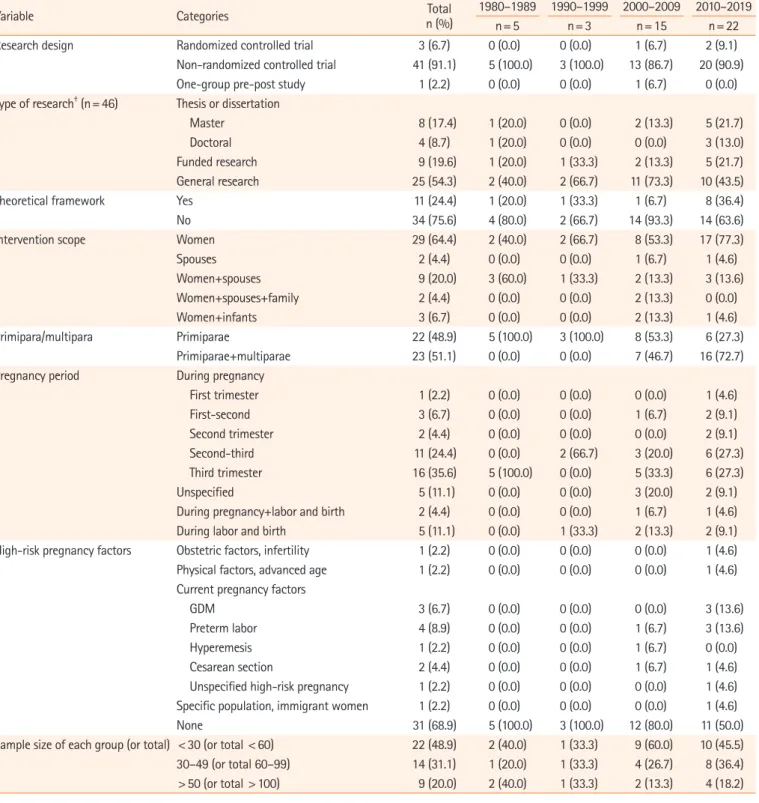
Of the 45 studies analyzed in this study, five were published be- tween 1980 and 1989, three between 1990 and 1999, 15, 22 2000 and 2009, and 22 between 2010 and 2019. The most com- mon study design was non-randomized controlled trials (n= 41, 91.1%). Only 11 studies (24.4%) applied a theoretical frame- work (Table 1).
Participant descriptions
Twenty-nine studies (64.4%) included pregnant women only, nine (20.0%) included pregnant women and spouses, and three (6.7%) included pregnant women and infants. Research with an expanded scope, including infants and families, has been pub- lished since 2000. Twenty-two articles (48.9%) were conducted among primiparae, while 23 (51.1%) included primiparae and multiparae. Since 2000, the participants have expanded to in- clude both primiparae and multiparae. Most interventions were performed during pregnancy (n= 38, 84.4%), five were during labor and birth (11.1%), and two were during both pregnancy and labor and birth (4.4%). The third trimester was the most common timing during pregnancy (n= 16, 35.6%). Since 2000, interventional studies have been conducted at other times, in- cluding the first trimester (Table 1).
The high-risk pregnancy factors of the participants included preterm labor (n=4, 8.9%), gestational diabetes (n=3, 6.7%), and cesarean section (n=2, 4.4%). One study dealt with immigrant women (2.2%). Eleven studies (24.4%) were conducted among
high-risk pregnant women and their families between 2010 and 2019.
Twenty-two studies (48.9%) had fewer than 30 participants in the experimental and control groups (Table 1).
Characteristics of PNIs and outcome variables Characteristics of PNIs
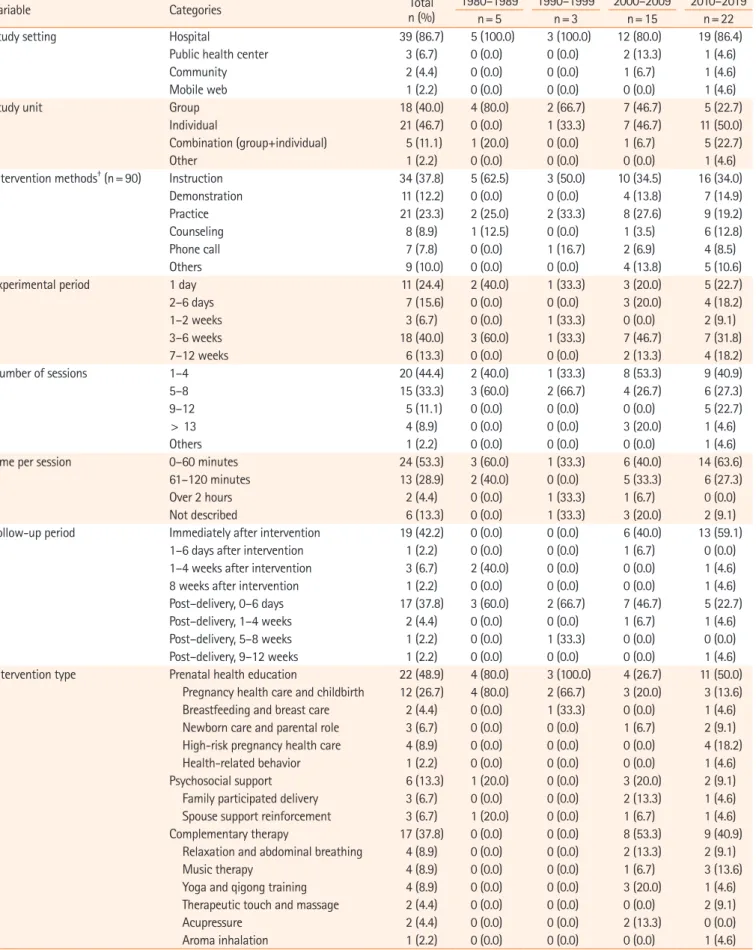
Interventions were performed in hospital settings in 39 studies (86.7%). Twenty-one studies (46.7%) used individualized inter- ventions, whereas 18 (40.0%) used group interventions, and five (11.1%) involved a combination. Instruction was the most fre- quent intervention method (n=34, 37.8%). The program dura- tion ranged from 1 day to 12 weeks; interventions were provided for 3 to 6 weeks in 18 studies (40.0%) and 1 day in 11 studies (24.4%). Twenty studies (44.4%) had 1 to 4 sessions. The most common duration was ≤60 minutes (n=24, 53.3%). Nineteen studies (42.2%) conducted follow-up immediately after the inter- vention (Table 2).
Intervention type
Prenatal health education was the most common intervention type (n =22, 48.9%), followed by complementary therapy (n =17, 37.8%) and psychosocial support (n=6, 13.3%) (Table 2). Prenatal education was classified into education on pregnancy-related health care and childbirth (n=12, 26.7%), high-risk pregnancy health care (n=4, 8.9%), newborn care and the parental role (n=3, 6.7%), breastfeeding and care (n=2, 4.4%); and health-related behavior (n=1, 2.2%). Complementary therapy was divided into relaxation/
abdominal breathing, music therapy and yoga/qigong training (each n=4, 8.9%), therapeutic touch/massage and acupressure (each n=2, 4.4%), and aromatherapy (n=1, 2.2%). Psychosocial support was classified as family participation in the delivery and re- inforcement of spousal support (each n=3, 6.7%) (Table 2).
Outcome variables
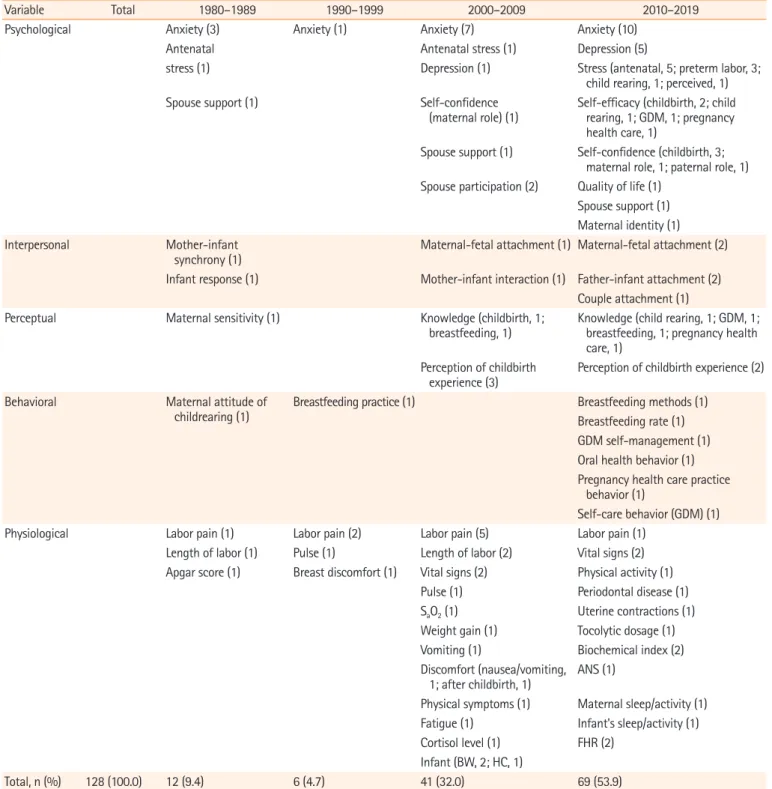
One to seven outcome variables were used to measure the effec-
tiveness of each PNI study. Of the 128 variables in total, there were
57 variables (44.5%) belonging to the psychological, 42 (32.8%)
in physiological domains. Anxiety was the most frequently mea-
sured variable (n=21) although studies have diversified to explore
depression, stress, confidence, and self-efficacy since 2000. In the
physiological domain, labor pain was the most commonly evaluat-
ed variable (n=9), although studies expanded to include physical
signs, symptoms, and biochemical parameters since 2000. Percep-
tions of childbirth experience (n=5), maternal-fetal attachment
(n=3), and breastfeeding-related variables (n=3) were the most
Table 1. General characteristics of the selected studies (N=45)
Variable Categories Total
n (%)
1980–1989 1990–1999 2000–2009 2010–2019
n= 5 n= 3 n= 15 n= 22
Research design Randomized controlled trial 3 (6.7) 0 (0.0) 0 (0.0) 1 (6.7) 2 (9.1)
Non-randomized controlled trial 41 (91.1) 5 (100.0) 3 (100.0) 13 (86.7) 20 (90.9)
One-group pre-post study 1 (2.2) 0 (0.0) 0 (0.0) 1 (6.7) 0 (0.0)
Type of research
†(n= 46) Thesis or dissertation
Master 8 (17.4) 1 (20.0) 0 (0.0) 2 (13.3) 5 (21.7)
Doctoral 4 (8.7) 1 (20.0) 0 (0.0) 0 (0.0) 3 (13.0)
Funded research 9 (19.6) 1 (20.0) 1 (33.3) 2 (13.3) 5 (21.7)
General research 25 (54.3) 2 (40.0) 2 (66.7) 11 (73.3) 10 (43.5)
Theoretical framework Yes 11 (24.4) 1 (20.0) 1 (33.3) 1 (6.7) 8 (36.4)
No 34 (75.6) 4 (80.0) 2 (66.7) 14 (93.3) 14 (63.6)
Intervention scope Women 29 (64.4) 2 (40.0) 2 (66.7) 8 (53.3) 17 (77.3)
Spouses 2 (4.4) 0 (0.0) 0 (0.0) 1 (6.7) 1 (4.6)
Women+spouses 9 (20.0) 3 (60.0) 1 (33.3) 2 (13.3) 3 (13.6)
Women+spouses+family 2 (4.4) 0 (0.0) 0 (0.0) 2 (13.3) 0 (0.0)
Women+infants 3 (6.7) 0 (0.0) 0 (0.0) 2 (13.3) 1 (4.6)
Primipara/multipara Primiparae 22 (48.9) 5 (100.0) 3 (100.0) 8 (53.3) 6 (27.3)
Primiparae+multiparae 23 (51.1) 0 (0.0) 0 (0.0) 7 (46.7) 16 (72.7)
Pregnancy period During pregnancy
First trimester 1 (2.2) 0 (0.0) 0 (0.0) 0 (0.0) 1 (4.6)
First-second 3 (6.7) 0 (0.0) 0 (0.0) 1 (6.7) 2 (9.1)
Second trimester 2 (4.4) 0 (0.0) 0 (0.0) 0 (0.0) 2 (9.1)
Second-third 11 (24.4) 0 (0.0) 2 (66.7) 3 (20.0) 6 (27.3)
Third trimester 16 (35.6) 5 (100.0) 0 (0.0) 5 (33.3) 6 (27.3)
Unspecified 5 (11.1) 0 (0.0) 0 (0.0) 3 (20.0) 2 (9.1)
During pregnancy+labor and birth 2 (4.4) 0 (0.0) 0 (0.0) 1 (6.7) 1 (4.6)
During labor and birth 5 (11.1) 0 (0.0) 1 (33.3) 2 (13.3) 2 (9.1)
High-risk pregnancy factors Obstetric factors, infertility 1 (2.2) 0 (0.0) 0 (0.0) 0 (0.0) 1 (4.6)
Physical factors, advanced age 1 (2.2) 0 (0.0) 0 (0.0) 0 (0.0) 1 (4.6)
Current pregnancy factors
GDM 3 (6.7) 0 (0.0) 0 (0.0) 0 (0.0) 3 (13.6)
Preterm labor 4 (8.9) 0 (0.0) 0 (0.0) 1 (6.7) 3 (13.6)
Hyperemesis 1 (2.2) 0 (0.0) 0 (0.0) 1 (6.7) 0 (0.0)
Cesarean section 2 (4.4) 0 (0.0) 0 (0.0) 1 (6.7) 1 (4.6)
Unspecified high-risk pregnancy 1 (2.2) 0 (0.0) 0 (0.0) 0 (0.0) 1 (4.6) Specific population, immigrant women 1 (2.2) 0 (0.0) 0 (0.0) 0 (0.0) 1 (4.6)
None 31 (68.9) 5 (100.0) 3 (100.0) 12 (80.0) 11 (50.0)
Sample size of each group (or total) < 30 (or total < 60) 22 (48.9) 2 (40.0) 1 (33.3) 9 (60.0) 10 (45.5)
30–49 (or total 60–99) 14 (31.1) 1 (20.0) 1 (33.3) 4 (26.7) 8 (36.4)
> 50 (or total > 100) 9 (20.0) 2 (40.0) 1 (33.3) 2 (13.3) 4 (18.2)
GDM: gestational diabetes mellitus.
†
Multiple response.
Table 2. Characteristics of prenatal nursing interventions (N=45)
Variable Categories Total
n (%) 1980–1989 1990–1999 2000–2009 2010–2019
n= 5 n= 3 n= 15 n= 22
Study setting Hospital 39 (86.7) 5 (100.0) 3 (100.0) 12 (80.0) 19 (86.4)
Public health center 3 (6.7) 0 (0.0) 0 (0.0) 2 (13.3) 1 (4.6)
Community 2 (4.4) 0 (0.0) 0 (0.0) 1 (6.7) 1 (4.6)
Mobile web 1 (2.2) 0 (0.0) 0 (0.0) 0 (0.0) 1 (4.6)
Study unit Group 18 (40.0) 4 (80.0) 2 (66.7) 7 (46.7) 5 (22.7)
Individual 21 (46.7) 0 (0.0) 1 (33.3) 7 (46.7) 11 (50.0)
Combination (group+individual) 5 (11.1) 1 (20.0) 0 (0.0) 1 (6.7) 5 (22.7)
Other 1 (2.2) 0 (0.0) 0 (0.0) 0 (0.0) 1 (4.6)
Intervention methods
†(n= 90) Instruction 34 (37.8) 5 (62.5) 3 (50.0) 10 (34.5) 16 (34.0)
Demonstration 11 (12.2) 0 (0.0) 0 (0.0) 4 (13.8) 7 (14.9)
Practice 21 (23.3) 2 (25.0) 2 (33.3) 8 (27.6) 9 (19.2)
Counseling 8 (8.9) 1 (12.5) 0 (0.0) 1 (3.5) 6 (12.8)
Phone call 7 (7.8) 0 (0.0) 1 (16.7) 2 (6.9) 4 (8.5)
Others 9 (10.0) 0 (0.0) 0 (0.0) 4 (13.8) 5 (10.6)
Experimental period 1 day 11 (24.4) 2 (40.0) 1 (33.3) 3 (20.0) 5 (22.7)
2–6 days 7 (15.6) 0 (0.0) 0 (0.0) 3 (20.0) 4 (18.2)
1–2 weeks 3 (6.7) 0 (0.0) 1 (33.3) 0 (0.0) 2 (9.1)
3–6 weeks 18 (40.0) 3 (60.0) 1 (33.3) 7 (46.7) 7 (31.8)
7–12 weeks 6 (13.3) 0 (0.0) 0 (0.0) 2 (13.3) 4 (18.2)
Number of sessions 1–4 20 (44.4) 2 (40.0) 1 (33.3) 8 (53.3) 9 (40.9)
5–8 15 (33.3) 3 (60.0) 2 (66.7) 4 (26.7) 6 (27.3)
9–12 5 (11.1) 0 (0.0) 0 (0.0) 0 (0.0) 5 (22.7)
> 13 4 (8.9) 0 (0.0) 0 (0.0) 3 (20.0) 1 (4.6)
Others 1 (2.2) 0 (0.0) 0 (0.0) 0 (0.0) 1 (4.6)
Time per session 0–60 minutes 24 (53.3) 3 (60.0) 1 (33.3) 6 (40.0) 14 (63.6)
61–120 minutes 13 (28.9) 2 (40.0) 0 (0.0) 5 (33.3) 6 (27.3)
Over 2 hours 2 (4.4) 0 (0.0) 1 (33.3) 1 (6.7) 0 (0.0)
Not described 6 (13.3) 0 (0.0) 1 (33.3) 3 (20.0) 2 (9.1)
Follow-up period Immediately after intervention 19 (42.2) 0 (0.0) 0 (0.0) 6 (40.0) 13 (59.1)
1–6 days after intervention 1 (2.2) 0 (0.0) 0 (0.0) 1 (6.7) 0 (0.0)
1–4 weeks after intervention 3 (6.7) 2 (40.0) 0 (0.0) 0 (0.0) 1 (4.6)
8 weeks after intervention 1 (2.2) 0 (0.0) 0 (0.0) 0 (0.0) 1 (4.6)
Post–delivery, 0–6 days 17 (37.8) 3 (60.0) 2 (66.7) 7 (46.7) 5 (22.7)
Post–delivery, 1–4 weeks 2 (4.4) 0 (0.0) 0 (0.0) 1 (6.7) 1 (4.6)
Post–delivery, 5–8 weeks 1 (2.2) 0 (0.0) 1 (33.3) 0 (0.0) 0 (0.0)
Post–delivery, 9–12 weeks 1 (2.2) 0 (0.0) 0 (0.0) 0 (0.0) 1 (4.6)
Intervention type Prenatal health education 22 (48.9) 4 (80.0) 3 (100.0) 4 (26.7) 11 (50.0)
Pregnancy health care and childbirth 12 (26.7) 4 (80.0) 2 (66.7) 3 (20.0) 3 (13.6)
Breastfeeding and breast care 2 (4.4) 0 (0.0) 1 (33.3) 0 (0.0) 1 (4.6)
Newborn care and parental role 3 (6.7) 0 (0.0) 0 (0.0) 1 (6.7) 2 (9.1)
High-risk pregnancy health care 4 (8.9) 0 (0.0) 0 (0.0) 0 (0.0) 4 (18.2)
Health-related behavior 1 (2.2) 0 (0.0) 0 (0.0) 0 (0.0) 1 (4.6)
Psychosocial support 6 (13.3) 1 (20.0) 0 (0.0) 3 (20.0) 2 (9.1)
Family participated delivery 3 (6.7) 0 (0.0) 0 (0.0) 2 (13.3) 1 (4.6)
Spouse support reinforcement 3 (6.7) 1 (20.0) 0 (0.0) 1 (6.7) 1 (4.6)
Complementary therapy 17 (37.8) 0 (0.0) 0 (0.0) 8 (53.3) 9 (40.9)
Relaxation and abdominal breathing 4 (8.9) 0 (0.0) 0 (0.0) 2 (13.3) 2 (9.1)
Music therapy 4 (8.9) 0 (0.0) 0 (0.0) 1 (6.7) 3 (13.6)
Yoga and qigong training 4 (8.9) 0 (0.0) 0 (0.0) 3 (20.0) 1 (4.6)
Therapeutic touch and massage 2 (4.4) 0 (0.0) 0 (0.0) 0 (0.0) 2 (9.1)
Acupressure 2 (4.4) 0 (0.0) 0 (0.0) 2 (13.3) 0 (0.0)
Aroma inhalation 1 (2.2) 0 (0.0) 0 (0.0) 0 (0.0) 1 (4.6)
†