Kor. J. Hort. Sci. Technol. 31(2):194-202, 2013 DOI http://dx.doi.org/10.7235/hort.2013.12151
딸기 품종의 성숙도, 저장온도 및 저장기간에 따른 과실 품질과 항산화 활성 변화
최효길1,2ㆍ강남준2*ㆍ문병용3ㆍ권준국1ㆍ노일래1ㆍ박경섭1ㆍ이선이1
1국립원예특작과학원 시설원예시험장, 2경상대학교 원예학과, 3인제대학교 생명과학부
Changes in Fruit Quality and Antioxidant Activity Depending on Ripening Levels, Storage Temperature, and Storage Periods in Strawberry Cultivars
Hyo Gil Choi
1,2, Nam Jun Kang
2*, Byoung Yong Moon
3, Joon Kook Kwon
1, Il Rae Rho
1, Kyoung Sub Park
1, and Sun Yi Lee
11
Protected Horticulture Research Station, National Institute of Horticultural & Herbal Science, Rural Development Administration, Busan 618-800, Korea
2
Department of Horticulture, Gyeongsang National University, Jinju 660-701, Korea
3
Department of Biological Sciences, Inje University, Gimhae 621-749, Korea
Abstract. The aim of this work was to study the changes in fruit quality and antioxidant activity depending on ripening levels, storage temperature and storage periods in two strawberry cultivars (Fragaria × ananassa cvs. Daewang and Seolhyang). Fully ripe strawberry fruits (100% colored fruits) and unripe strawberry fruits (50% colored fruits) were harvested and then stored at 4°C and 15°C for 10 days, respectively. Hardness, phytochemicals, sugars, organic acids and antioxidant activity of strawberry fruits were measured after storage for 5 and 10 days, respectively. When fruit hardness was compared between the two cultivars, ‘Daewang’
showed a greater degree of fruit hardness than ‘Seolhyang’. ‘Daewang’ also showed higher amounts of phenolic compounds and sucrose than ‘Seolhyang’. In contrary to this, ‘Daewang’ was shown to contain lower amounts of anthocyanin and fructose than ‘Seolhyang’. However, antioxidant activities of both cultivars were almost identical. When the effects of storage temperature were examined on fruit hardness, fruits stored at 4°C showed a higher degree of hardness than those stored at 15°C. During the period of fruit storage at 4°C or 15°C, both cultivars showed marked decline in the contents of phenolic compounds as well as sucrose. Contrastingly, they showed higher amounts of anthocyanin and glucose after 10 days of storage. On the other hand, the contents of organic acids in strawberry fruits were influenced only by the period of storage, not depending on cultivars or temperatures. Antioxidant activities of fully ripe fruits declined remarkably after 10 days of storage, as compared to unripe fruits which showed a minor decrease or increase. When fully ripe fruits of both cultivars were stored at different temperatures, those stored at 15°C showed a significant decrease in the antioxidant activity as compared to those stored at 4°C. However, changes of antioxidant activity in unripe fruits were minor. These observations in order to supply high quality strawberry suggest that fully ripe strawberry fruits should be harvested for the short-term storage and the appropriate ripe level fruit should be harvested for the long-term storage. Storage temperature is appropriate at 4°C.
Additional key words: anthocyanin, fruit hardness, organic acid, phenolic compounds, sugar
*Corresponding author: [email protected]
※ Received 27 July 2012; Revised 22 October 2012; Accepted 24 October 2012.
서 언
딸기(Fragaria × ananassa Duch.)는 주로 플라스틱하우 스에서 9월 말부터 5월 말까지 재배되는 대표적인 겨울 및
봄철 과채류로 생식용으로 소비되는 원예작물이다 . 2000년
이전에는 ‘레드펄’ 및 ‘아끼히메’ 등의 일본 딸기 품종이 주
종을 이루다 로열티 문제 해결을 위해 국가에서 주도적으로
딸기 품종 육성사업을 수행한 결과 현재 국내에서 재배되는
딸기는 72% 이상이 ‘설향’ 등의 국산 품종으로 대체되었다.
‘설향’은 높은 생산성을 바탕으로 전국적으로 재배되고 있 으며, 최근 육성된 ‘대왕’은 높은 경도 및 생산성과 저온에 강한 특성으로 인하여 경남 진주지역을 중심으로 한 수출딸 기농가에서 재배면적이 크게 증가하고 있다.
딸기는 안토시아닌, 비타민 C 및 페놀화합물 등의 항산화 물질을 다량 함유하고 있으며(Zheng et al., 2007), 특히, 페 놀화합물은 활성산소에 의해 생성되는 암세포를 억제하는 것으로 알려져 있다(Zhang et al., 2008). 이처럼 인체에 유 익한 딸기의 다양한 기능성 식물화합물(phytochemicals)은 과실의 익은 정도(Montero et al., 1996) 및 저장온도(Cordenunsi et al., 2005)에 따라 달라지며, 유통기간 경과에 따라서도 달라질 수 있다.
국산 딸기 품종의 고급화와 재배기술 향상에 힘입어 생산 량과 수출량은 계속적으로 증가하고 있지만 농가에서 수확 된 딸기는 도매시장과 소매상을 거쳐 최종 소비자에게 소비 되기까지 짧게는 3일, 길게는 10일 이상의 긴 유통기간이 소요되고 있다. 딸기의 유통 시 세포벽 성분의 변화로 인한 경도의 변화(Lee et al., 1998)와 딸기의 저장 중 살균제와 UV 살균처리에 따른 품질 변화(Kim et al., 2010) 등과 같은 수확 후 관리에 대한 연구는 지속적으로 이루어지고 있지만 최근 육성된 국산 딸기 품종의 수확 및 저장 조건에 따른 품질변화에 대한 연구는 미흡한 실정이다.
따라서 본 연구는 국내에서 육성되어 재배되고 있는 딸기 두 품종을 대상으로 성숙도, 저장온도 및 저장기간 경과에 따른 기능성 식물화합물, 유리당 함량 혹은 항산화 활성 등 의 과실특성 변화 양상을 구명하여 안전유통과 소비자에게 품질과 기능성이 우수한 딸기 과실을 공급하기 위한 기초자 료를 제공하고자 수행하였다.
재료 및 방법
실험재료
실험재료로는 ‘대왕’과 ‘설향’ 딸기 품종(Fragaria × ananassa Duch. cvs. Daewang and Seolhyang)을 이용하였고, 부산시 강서구에 소재한 국립원예특작과학원 시설원예시험장의 플 라스틱 하우스에서 2011년 9월 20일에 고설벤치 베드에 딸 기 모종을 정식하였다. 정식 초기에는 네덜란드 PBG 딸기 전용양액을 EC 0.4dS·m
-1농도로 공급하여 서서히 농도를 높여 수확시작기인 11월 21일부터는 EC 1.2dS·m
-1농도로 공급하였다. 2012년 2월에 3회에 걸쳐 50% 착색된 과실과 100% 착색된 과실을 수확하여 항온항습기(DS-53FBPL, Dasol Scientific Co., Korea) 내 상대습도 60 ± 5%에서 4 혹은 15℃
로 보관하였으며 수확당일 , 수확 후 5일 및 10일에 생과 100g 을 균질화(PT 3100, Kinematica AG Co., USA)한 후 원심 분리기(64R Centrifuge, Beckman Coulter Inc., USA)를 이 용하여 4°C에서 16,000×g로 30분 동안 원심 분리한 상등액 을 채취하여 Whatman No. 2 여과지로 여과한 후 냉동보관 하며 실험에 이용하였다.
딸기 과실의 특성 측정
딸기과실의 경도 측정은 경도계(FHM-1, Takemura Co., Japan)를 이용하여 측정한 후 단위면적당 압력의 단위로 환 산하였다.
페놀화합물은 Slinkard and Singleton(1977)의 방법을 이 용하여 시료용액과 2% Na
2CO
3및 50% Folin-Ciocalteu’s phenol reagent로 전처리한 후 분광광도계(Thermo, Co., USA) 로 750nm에서 측정하였고, gallic acid로 표준곡선을 작성하 여 함량을 계산하였다. 안토시아닌은 Kim et al.(2011)의 방법 을 이용하여 1% HCl과 MeOH으로 전처리한 후 530nm에 서 측정하였고, pelargonidin-3-glucoside의 표준곡선을 이 용하여 농도를 계산하였다.
유리당의 함량은 HPLC(YL9100, Younlin Co., Korea)로 분석하였다 . 분석조건은 Sugar-Pak(4.6mm × 250mm, Supelco, USA)을 column으로 이용하여 1mL·min
-1의 속도로 acetonitrile 과 water(75:25, v/v)을 이동상으로 하여 RI detector(YL9170, Younglic Co., Korea)로 검출하였으며, 표준물질은 fructose, glucose 그리고 sucrose를 이용하였다. 유기산은 IC(ICS 5000, Thermo Dionex Co., USA)로 분석하였다. 5.0mN tetrabuty lammonium hydroxide 용액과 5.0psi의 N
2기체를 suppressor (Amms ICE300, Dionex Co., USA)로 공급하면서 용리액인 0.4mM heptaflurobutyric acid를 1mL·min
-1의 속도로 흘리 며 Ion-Pac(9mm × 250mm ICE-AS6, Dionex Co., USA) column에 고착되어 있는 유기산을 용출하여 검출하였다. 표 준물질로는 oxalic, citric 그리고 malic acid를 이용하였다.
항산화 활성은 전자공여능(electron donating abilities, EDA)
을 이용한 Blois(1958)의 DPPH 라디칼 소거능 및 Re et
al.(1999)의 ABTS 라디칼 소거능을 측정하였다. DPPH 라
디칼 소거능은 4 × 10
-4M의 DPPH(1,1-diphenyl-2-picryl-
hydrazyl, Sigma-Aldrich Chemical, Co., USA)을 만든 후
517nm에서의 흡광도를 대조구로 정하고 이어서 시료와
DPPH 용액을 혼합하여 상온에서 30분 반응시킨 후 517nm
의 흡광도를 측정하였다 . ABTS 라디칼 소거능은 7.4mM ABTS
(2,2'-azino-bis (3-ethylbenzothiazoline-6-sulfonic acid)와 2.6mM
K
2S
2O
8을 1:1로 혼합하여 암실에서 여과지(Whatman No. 2)
로 여과하여 16시간 반응시킨 용액과 메탄올을 혼합하여
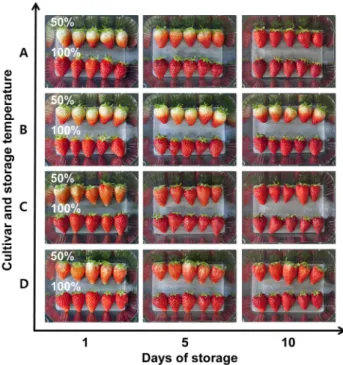
Fig. 1. Changes in the external quality of fruits depending on ripening levels, storage temperature and storage periods of two strawberry cultivars grown in plastic film house with raised bed on Busan area and harvested in Feb. 2011. (A) Seolhyang, 15°C; (B) Seolhyang, 4°C; (C) Daewang, 15°C; (D) Daewang, 4°C.
734nm에서 흡광도를 조정한 후 그 값을 대조구로 하였다.
이어서 조정된 ABTS 용액과 시료를 혼합하고 10분간 37°C 의 수조에서 반응시킨 후 734nm에서의 흡광도를 측정하였 다. DPPH와 ABTS 모두 대조구 흡광도와 시료액 흡광도의 차이를 백분율로 계산하였다.
통계분석
본 실험은 3반복으로 실시한 결과를 통계분석 SAS 프로 그램(SAS, 9.2, Institute Inc, USA)을 이용하여 95% 유의수 준에서 Duncan’s multiple range test로 분석하였다.
결과 및 고찰
딸기의 외관 특성
‘대왕’과 ‘설향’의 성숙도, 저장온도 및 저장기간에 따른 외관의 변화는 Fig. 1과 같다. 딸기의 경우 호흡 비급등형 (non-climacteric)의 과실이지만 수확 후에도 지속적으로 호 흡을 하는 과실로 익은 정도와 저장기간에 따라 품질이 변 화되는 것으로 알려져 있다(Nunes et al., 2006; Smith and Heinze, 1958). 딸기의 외관특성으로서, 과실의 착색은 ‘대 왕’ 품종의 경우 성숙 초기부터 과실 전체부위가 연하게 주 황색으로 착색되어, 성숙될수록 점점 색도가 진해지는데 비
해, ‘설향’은 성숙 초기에는 과실의 밑 부분만 착색되다가, 성숙되면서 과실 위쪽도 붉은 색으로 익어가는 양상을 보였 다(Fig. 1). 100% 착색된 과실은 저장온도에 관계 없이 ‘대 왕’과 ‘설향’ 모두 10일 후에는 유통하기 힘들 정도로 익어 버렸지만, 50% 착색된 과실은 4°C는 물론 15°C에서 10일 동안 저장하여도 충분히 생과로 판매 및 소비가 가능할 정 도의 외관을 유지하였다.
과실의 경도
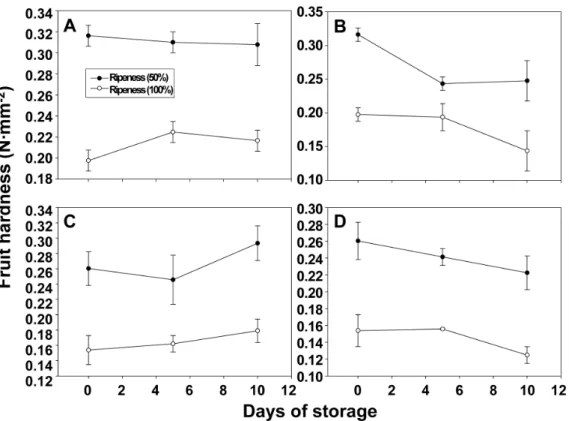
딸기 두 품종의 과실 경도는 성숙도에 따라 저장 온도와 기간을 달리하였을 때 변화 양상은 Fig. 2와 같다. 50% 착색 된 ‘대왕’과 ‘설향’ 과실을 15°C에서 10일 동안 저장하였을 때 과실경도는 0.25와 0.22N·mm
-2로 동일한 저장 조건의 100% 착색된 과실의 0.14와 0.13N·mm
-2보다 각각 72와 77% 높았으며, 100% 착색된 과실을 4℃에 저장하였을 때 0.23와 0.18N·mm
-2보다도 각각 10와 24% 높았다(Fig. 2).
이는 딸기 과실의 성숙 말기에 β-galactosidase의 작용이 왕 성하여 세포벽을 분해하기 때문에 완전히 성숙된 과실의 경 도가 아주 낮다는 연구(Ahmed and Labavitch, 1980; Lee et al., 1998)와 유사하였다. 또한 유통 및 저장에 있어 온도 는 중요하게 작용하며, 4와 10°C 저장 간에는 온도가 낮은 4°C의 딸기 과실 경도가 높다는 연구(Nunes et al., 2002)와 같이 본 연구에서도 4°C 저장 딸기 과실의 경도가 15°C에 서보다 월등히 높았다. 50와 100% 착색된 ‘대왕’의 수확 시 과실경도는 0.32과 0.25N·mm
-2으로 ‘설향’ 0.26과 0.15N·mm
-2보다 약 46와 61% 높게 나타났다(Fig. 2). 본 연구의 결과 딸기과실 경도가 0.14N·mm
-2보다 낮을 경우 유통하기 곤란 할 것으로 판단되었으며, 수출용 딸기로는 경도가 높은 ‘대 왕’ 품종이 유리할 것으로 판단된다.
총 페놀화합물 및 안토시아닌 함량
총 페놀화합물 함량은 0°C에서 보다 온도가 높은 5°C나
10°C에서 저장한 딸기과실에서 높게 나타났다는 보고
(Ayala-Zavala et al., 2004)와 같이 본 연구에서도 4°C에서
보관한 것보다 15°C에서 보관한 딸기과실에서 총 페놀화합
물 함량이 높았다 . 100% 착색된 ‘설향’은 15°C 저장 5일차
에 총 페놀화합물 함량이 소량 증가되었지만(Fig. 3D), 대체
적으로 저장기간이 길어질수록 감소하였다(Fig. 3). 이는 페
놀화합물이 식물체의 저항력 증대, 항산화 작용, 유전자발현
신호 혹은 세포벽의 코로크화에 관여하며, 특히 과실색 발
현에 영향을 준다는 보고(Treutter, 2010)처럼 딸기 과실이
익어갈수록 색이 진해질 때까지 페놀화합물이 작용하여 저
장기간이 길어짐에 따라 함량이 줄어든 것으로 판단되었다.
Fig. 2. Changes in fruit hardness depending on ripening levels, storage temperature and storage periods of two strawberry cultivars grown in plastic film house with raised bed on Busan area and harvested in Feb. 2011. (A) 4°C storage ‘Daewang’ cultivar;
(B) 15°C storage ‘Daewang’ cultivar; (C) 4°C storage ‘Seolhyang’ cultivar; (D) 15°C storage ‘Seolhyang’ cultivar. Vertical bars show standard deviation (n = 3).
Fig. 3. Changes in total phenolic compounds depending on ripening levels, storage temperature and storage periods of two strawberry cultivars grown in plastic film house with raised bed on Busan area and harvested in Feb. 2011. (A) 4°C storage ‘Daewang’
cultivar; (B) 15°C storage ‘Daewang’ cultivar; (C) 4°C storage ‘Seolhyang’ cultivar; (D) 15°C storage ‘Seolhyang’ cultivar. Vertical bars show standard deviation (n = 3).
Fig. 4. Changes in anthocyanin contents depending on ripening levels, storage temperature and storage periods of two strawberry cultivars grown in plastic film house with raised bed on Busan area and harvested in Feb. 2011. (A) 4°C storage ‘Daewang’
cultivar; (B) 15°C storage ‘Daewang’ cultivar; (C) 4°C storage ‘Seolhyang’ cultivar; (D) 15°C storage ‘Seolhyang’ cultivar. Vertical bars show standard deviation (n = 3).
딸기 과실을 붉게 착색하는 주요 성분은 안토시아닌이며, 여러 종류의 안토시아닌 중 pelargonidin-3-glucoside가 다 량 함유되어 있다(Andersen et al., 2004). 본 연구에서는 pelargonidin-3-glucoside의 표준곡선을 이용하여 안토시아 닌 함량을 측정하였으며 저장기간에 따른 그 함량 변화는 Fig. 4와 같다. 수확직후 50% 착색된 ‘대왕’과 ‘설향’의 안 토시아닌 함량은 43.9%와 61.8mg·kg
-1로 100% 착색된 과 실 내 함량인 133.5mg·kg
-1와 147.7mg·kg
-1의 33%와 42%
수준이었다. 그러나 4°C에서 저장한 ‘설향’을 제외하고는 50% 착색된 과실의 수확 10일 후 안토시아닌 함량은 수확 직후 100% 착색된 과실보다 높았다(Fig. 4C). 이는 수확 후 에도 안토시아닌 생합성 경로의 작용으로 안토시아닌의 함 량이 증가한다는 Holkroft and Kader(1999)와 Kalt and MacDonald(1996)의 보고처럼 딸기과실의 안토시아닌 생합 성경로가 작용하여 함량을 높인 것으로 추정되었다.
유리당 및 유기산 함량
소비자의 식감을 자극하는 과채류의 주요 성분은 유리당 과 유기산을 대표적으로 들 수 있다. 초기 국내 육성품종인
‘대학1호’, ‘조생홍심’, ‘수홍’ 등의 딸기는 경도가 약하며, 특히 당도가 낮아 일본품종에 밀려 재배되지 못하였다. 하 지만 본격적인 딸기 신품종 육성으로 선발된 ‘설향’은 수량
성이 높고 당도가 높아 딸기재배 농가들로부터 높은 호응을 얻었다(Rho, 2010). 이러한 식미의 척도로 이용되는 유리당 과 유기산의 저장조건에 따른 함량 변화를 확인하였다 (Tables 1 and 2). 딸기 과실이 익어감에 따라 과당, 포도당 그리고 자당의 함량이 증가되었다는 보고(Moing et al., 2001)처럼, 본 실험에서도 10일 동안 4°C와 15°C 저장한
‘대왕’의 경우 과당과 포도당 함량이 증가하였으나, 10일 동 안 15°C에 저장한 ‘설향’을 제외하고는 과실 내의 과당 함 량은 줄어들었다. 또한 두 품종 모두 과실 내의 자당 함량은 줄어드는 경향을 보였다. 특히 50% 착색된 과실 내의 자당 함량 감소폭은 크게 나타났다(Tables 1 and 2).
유기산 중 시트르산과 말산이 딸기에 다량 함유되어 있다 는 보고(Holcroft and Kader, 1999)와 같이, 본 연구에서도 시트르산과 말산이 딸기과실에 다량 함유되어 있었다. 시트 르산 , 말산 그리고 옥살산은 4°C에서 저장한 ‘설향’ 품종을 제외하고 5일 저장한 딸기과실에서 함유량이 가장 높았다 (Tables 1 and 2). 과실에 있어 유기산은 신맛을 나타내는 동시에 단맛에도 영향을 미치는 것으로 알려져 있다 (Lyon et al., 1993). 본 연구에서 ‘대왕’ 품종의 경우 자당 함량이 높으 면 비례적으로 말산 함량이 높은 경향을 보였다(Table 1).
Hamilton and Davies(1988)의 완두콩 실험에서 완두콩 과
실의 정아(apical bud)에 표지한
14CO
2방사선 동위원소가
Table 1. Levels of free sugars and organic acids contained in fruits depending on ripening levels, storage temperature and storage periods of ‘Daewang’ strawberry grown in plastic film house with raised bed on Busan area and harvested in Feb. 2011.
Treatment Sugar contents
(g·100g-1 FW)
Organic acid contents (mg·100g-1FW) Ripening
levels (%)
Storage temperature
(°C)
Storage period (days)
Fructose Glucose Sucrose Oxalic Citric Malic
50
control 0 3.41 baz 3.21 bc 2.69 ba 23.4 c 469.1 ba 194.8 a
4 5 2.63 bc 3.95 ac 2.33 bac 42.4 bac 503.1 a 97.8 bed
4 10 4.18 a 4.81 bac 0.53 d 39.4 bac 260.9 bc 60.8 ed
15 5 3.41 ba 5.66 a 0.80 d 49.9 bac 487.0 a 70.0 edc
15 10 3.77 a 3.99 bac 0.70 d 36.9 bc 319.1 bac 32.8 e
100
control 0 3.50 ba 2.57 c 2.81 ba 64.0 ba 376.3 bac 135.6 ba
4 5 2.53 c 2.48 c 3.50 a 72.7 a 358.2 bac 162.9 ba
4 10 3.60 a 3.68 bc 1.33 dc 37.4 bc 302.4 bac 59.3 ed
15 5 3.50 ba 4.58 ba 2.94 ba 73.3 a 415.5 bac 105.9 bdc
15 10 4.12 a 4.43 ba 1.68 bdc 45.7 bac 266.2 c 59.0 ed
zMean separation within columns by Duncan’s multiple range test at P = 0.05.
Table 2. Levels of free sugars and organic acids contained in fruits depending on ripening levels, storage temperature and storage periods of ‘Seolhyang’ strawberry grown in plastic film house with raised bed on Busan area and harvested in Feb. 2011.
Treatment Sugar contents
(g·100g-1 FW)
Organic acid contents (mg·100g-1FW) Ripening
levels (%)
Storage temperature
(°C)
Storage period (days)
Fructose Glucose Sucrose Oxalic Citric Malic
50
control 0 4.03 cz 3.27 b 0.67 a 34.2 ba 392.3 ba 137.2 ba
4 5 2.96 dc 3.97 ba 0.14 bc 38.6 a 447.9 ba 145.6 a
4 10 3.58 dc 3.67 ba 0.42 bac 39.1 a 451.3 ba 129.7 bac
15 5 3.11 dc 4.88 ba 0.05 c 36.3 a 480.8 ba 102.1 bac
15 10 3.99 c 4.52 ba 0.13 c 8.9 c 112.7 c 17.2 d
100
control 0 4.92 ba 4.11 ba 0.44 ba 44.5 a 353.2 ba 133.9 ba
4 5 3.80 dc 4.87 ba 0.37 bac 49.7 a 383.7 ba 113.8 bac
4 10 4.41 bc 5.20 ba 0.09 bc 39.7 a 421.2 ba 90.5 bc
15 5 4.11 bc 5.85 a 0.17 bc 44.3 a 503.1 a 84.2 c
15 10 5.42 a 5.61 a 0.21 bc 13.0 bc 124.8 c 16.3 d
zMean separation within columns by Duncan’s multiple range test at P = 0.05.
자당과 말산에 각각 76과 16% 함유되어 있다고 보고하였 다. 이는 생합성에 있어 자당과 말산의 밀접한 관련이 있을 것으로 사료된다. 하지만 ‘설향’의 경우 자당과 말산의 관계 가 명확하지 않으며, ‘대왕’에 비하여 과실 내의 자당 함량 이 월등히 낮았다.
항산화 활성
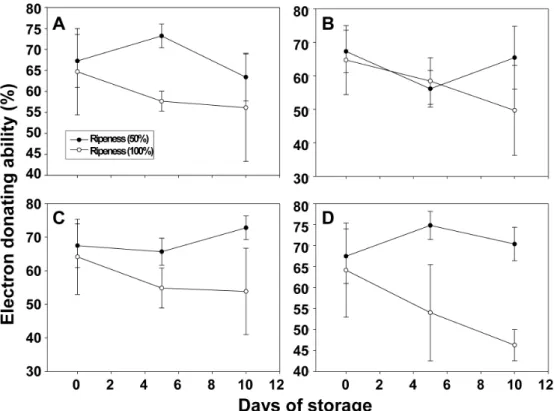
‘대왕’과 ‘설향’의 과실 성숙도, 저장온도 및 저장기간에 따른 DPPH 전자공여능(Fig. 5)과 ABTS 라디칼 양이온 수 소공여능(Fig. 6)의 변화를 측정하였다.
전자가 DPPH로부터 이탈하여 항산화 물질과 결합하는 원리를 이용하여 가상의 활성산소가 소거되었음을 나타내 는 DPPH 라디칼 소거 활성은 생 과채류의 신선도를 나타내 는 측도 중 하나로 이용되고 있다 . 수확직후 ‘대왕’과 ‘설향’
과실의 성숙도에 따른 DPPH 전자공여능 차이는 나타나지
않았으나, 저장 10일 후에는 50% 착색된 과실에 비하여
100% 착색된 과실이 저장일수가 길어짐에 따라 DPPH 라
디칼 소거활성이 떨어졌다(Fig. 5). 이는 저장 후 10일 정도
까지는 50% 착색된 딸기의 경우 항산화 활성에 있어 수확
직후의 과실과 유사한 능력을 가지나, 100% 착색된 딸기에
Fig. 5. Changes in DPPH free radical scavenging activity depending on ripening levels, storage temperature and storage periods of two strawberry cultivars grown in plastic film house with raised bed on Busan area and harvested in Feb. 2011. (A) 4°C storage ‘Daewang’ cultivar; (B) 15°C storage ‘Daewang’ cultivar; (C) 4°C storage ‘Seolhyang’ cultivar; (D) 15°C storage ‘Seolhyang’
cultivar. Vertical bars show standard deviation (n = 3).
Fig. 6. Changes in ABTS radical cation decolorization activity depending on ripening levels, storage temperature and storage periods of two strawberry cultivars grown in plastic film house with raised bed on Busan area and harvested in Feb. 2011. (A) 4°C storage ‘Daewang’ cultivar; (B) 15°C storage ‘Daewang’ cultivar; (C) 4°C storage ‘Seolhyang’ cultivar; (D) 15°C storage ‘Seolhyang’
cultivar. Vertical bars show standard deviation (n = 3).
서는 항산화 활성이 크게 감소된 것으로 사료된다. 저장온 도에 있어서는 15°C보다는 4°C에 저장한 딸기 과실의 항산 화 활성이 수확직후 과실과 비교하였을 때, 덜 감소하였다 (Fig. 5). ‘대왕’의 경우 50% 착색된 과실에서는 10일 동안 저장하였을 때 DPPH 전자공여능이 소폭 감소한 반면, ‘설 향’은 소폭 증가되었다(Fig. 5). 이는 Panico et al.(2009)의 딸기 품종 및 환경에 따라 DPPH 전자공여능이 다르다는 보 고와 같은 맥락이었다.
100% 착색된 ‘설향’은 저장 온도에 관계없이 저장기간이 증가할수록 ABTS 라디칼 양이온 수소공여능이 증가하였 다. 하지만 50% 착색된 ‘설향’과 50% 및 100% 착색된 ‘대 왕’의 ABTS 라디칼 양이온 수소공여능은 저장 5일에 감소 하였다가 저장 10일 후에 다시 증가하였다(Fig. 6). 토마토 를 이용한 수확 후 저장일수에 따른 ABTS 항산화 활성이 저장 초기에 소폭 감소한 후 저장 후기까지 계속하여 증가 된다는 Javanmardi and Kubota(2006)의 보고와 유사하였 다. 하지만 ABTS 라디칼 양이온 수소공여능의 경우 저장 10일 후에는 품종, 성숙도 및 저장 온도에 따른 항산화 활성 이 모두 비슷하게 나타나는 경향으로 보아 저장 조건에 따 른 항산화 활성을 확인하기에는 어려울 것으로 판단된다.
초 록
본 연구는 ‘대왕’과 ‘설향’ 딸기 두 품종의 성숙도, 저장온 도 및 저장기간에 따른 과실의 품질 변화를 구명하고자 하 였다. 100% 착색된 완숙 딸기 과실과 50% 착색된 미숙 딸 기 과실을 수확하여 4°C와 15°C에서 10일 동안 각각 저장 하였다. 딸기과실의 경도, 기능성 식물화합물, 유리당 함량, 유기산 함량 그리고 항산화 활성은 저장 5일과 10일 후에 각각 측정하였다. 두 품종의 과실 경도를 비교할 때, ‘대왕’
품종이 ‘설향’보다 높은 수준의 과실경도를 보였으며, 페놀 화합물과 자당 함량 또한 ‘대왕’이 ‘설향’보다 높았다. 그러 나 대조적으로 안토시아닌 및 과당 함량은 ‘대왕’이 ‘설향’
보다 낮았다. 두 품종의 항산화 활성은 거의 동일하였다. 저 장온도에 있어 과실경도는 4°C에 저장한 과실이 15°C에 저 장된 과실보다 높은 수준의 경도를 보였다. 4°C와 15°C에 저장되는 동안 두 품종의 과실 내 페놀화합물과 자당 함량 이 감소되었다. 반면, 10일 동안 저장된 과실 내의 안토시아 닌과 포도당 함량은 증가하였다. 딸기 과실에 함유되어 있 는 유기산의 함량은 품종이나 온도보다는 저장기간에 의존 적인 영향을 보였다. 10일 동안 저장된 미숙 과실의 항산화 활성이 미미하게 감소 또는 증가된 것에 비해, 완숙 과실의 항산화 활성은 현저하게 감소하였다. 서로 다른 온도에 저
장된 두 품종의 완숙 과실을 비교할 때, 4°C에서 저장된 과 실 보다 15°C에서 저장된 과실의 항산화 활성이 현저하게 감소되었다. 반면, 미숙 과실의 항산화 활성 변화는 미미하 였다. 본 연구 결과로 보아, 고품질의 딸기를 제공하기 위해 서는 단기저장 시에는 완숙과실을 수확하고 , 장기저장 시에 는 저장기간에 따른 적정 성숙 단계의 과일을 수확하여 4°C 에 저장하는 것이 타당하다고 사료된다.
추가 주요어: 안토시아닌, 과일 경도, 유기산, 페놀화합물, 당
인용문헌
Ahmed, A.E. and J.M. Labavitch. 1980. Cell wall metabolism in ripening fruit. 1. cell wall changes in the ripening ‘Bartlett’
pears. Plants Physiol. 65:1009-1013.
Andersen, Ø.M., T. Fossen, K. Torskangerpoll, A. Fossen, and U. Hauge. 2004. Anthocyanin from strawberry (Fragaria ananassa) with the novel aglycone, 5-carboxypyranopelargonidin.
Phytochemistry 65:405-410.
Ayala-Zavala, J.F., S.Y. Wang, C.Y. Wang, and G.A. González- Aguilar. 2004. Effect of storage temperatures on antioxidant capacity and aroma compounds in strawberry fruit. LWT - Food Sci. Technol. 37:687-695.
Blois, M.S. 1958. Antioxidant determination by the use of a stable free radical. Nature 181:1199-1120.
Cordenunsi, B.R., M.I. Genovese, J.R.O. do Nascimento, N.M.A.
Hassimotto, J.R. dos Santos, and F.M. Lajolo. 2005. Effects of temperature on the chemical composition and antioxidant activity of three strawberry cultivars. Food Chem. 91:113-121.
Hamilton, D.A. and P.J. Davies. 1988. Sucrose and malic acid as the compounds exported to the apical bud of pea following
14CO2 labeling of the fruit. Plant Physiol. 88:466-472.
Holcroft, D.M. and A.A. Kader. 1999. Controlled atmosphere- induced changes in pH and organic acid metabolism may affect color of stored strawberry fruit. Postharvest Biol. Technol.
17:19-32.
Javanmardi, J. and C. Kubota. 2006. Variation of lycopene, antioxidant activity, total soluble solids and weight loss of tomato during postharvest storage. Postharvest Biol. Technol.
41:151-155.
Kalt, W. and J.E. McDonald. 1996. Chemical composition of lowbush blueberry cultivars. J. Amer. Soc. Hort. Sci.
121:142-146.
Kim, J.Y., H.J. Kim, G.O. Lim, S.A. Jang, and K.B. Song. 2010.
Effect of combined treatment of ultraviolet-c with aqueous chlorine dioxide or fumaric acid on the postharvest quality of strawberry fruit “Flamengo” during storage. J. Korean Soc.
Food Sci. Nutr. 39:138-145.
Kim, S.K., R.N. Bae, and C.H. Chun. 2011. Changes in bioactive compounds contents of ‘Maehyang’ and ‘Seolhyang’ strawberry fruits by UV light illumination. Kor. J. Hort. Sci. Technol.
29:172-180.
Lee, K.H., K.S. Kim, M.H. Kim, S.R. Shin, and K.Y. Yoon.
1998. Studies on the softening of strawberry during circulation
and storage (1) changes of cell wall components, protein and emzymes during ripening. J. Korean Soc. Food Sci. Nutr.
27:29-34.
Lyon, B.G., J.A. Robertson, and F.I. Meredith. 1993. Sensory descriptive analysis of cv. Cresthaven peaches: Maturity, ripening, and storage effects. J. Food Sci. 58:177-181.
Moing, A., C. Renaud, M. Gaudillère, P. Raymond, P. Rpudeillac, and B. Denoyes-Rothan. 2001. Biochemical changes during fruit development of four strawberry cultivars. J. Amer. Soc.
Hort. Sci. 126:394-403.
Montero, T.M., E.M. Mollá, R.M. Esteban, and F.J. López- Andréu. 1996. Quality attributes of strawberry during ripening.
Scientia Hort. 65:239-250.
Nunes, M.C.N., A.M.M.B. Morais, J.K. Brecht, and S.A. Sargent.
2002. Fruit maturity and storage temperature influence response of strawberries to controlled atmospheres. J. Amer.
Soc. Hort. Sci. 127:836-842.
Nunes, M.C.N., J.K. Brecht, A.M.M.B. Morais, and S.A. Sargent.
2006. Physicochemical changes during strawberry development in the field compared with those that occur in harvested fruit during storage. J. Sci. Food. Agri. 86:180-190.
Panico, A.M., F. Garufi, S. Nitto, R. Di Mauro, R.C. Longhitano, G. Magri, A. Catalfo, M.E. Serrentino, and G. De Guidi. 2009.
Antioxidant activity and phenolic content of strawberry genotypes from Fragaria × ananassa. Pharmaceutical Biol.
47:203-208.
Rho, I.R. 2010. Origin and main varieties of strawberries. National institute of Hoticultural & Herbal Science, Suwon, Korea p.
3-44.
Re, R., N. Pellegrini, A. Proteggente, A. Pannala, M. Yang, and C. Rice-Evans. 1999. Antioxidant activity applying an improved ABTS radical cation decolorization assay. Free Radic. Biol.
Med. 26:1231-1237.
Slinkard, K. and V.L. Singleton. 1977. Total phenol analysis:
Automation and comparison with manual methods. Am. J.
Enol. Vitic. 28:49-55.
Smith, W.L. and P.H. Heinze. 1958. Effect of color development at harvest on quality of postharvest ripened strawberries. Proc.
Amer. Soc. Hort. Sci. 72:207-211.
Treutter, D. 2010. Managing phenol contents in crop plants by phytochemical farming and breeding-visions and constraints.
Int. J. Mol. Sci. 11:807-857.
Zhang, Y., N.P. Seeram, R. Lee, L. Feng, and D. Heber. 2008.
Isolation and identification of strawberry phenolics with antioxidant and human cancer cell antiproliferative properties.
J. Agric. Food Chem. 56:670-675.
Zheng, Y., S.Y. Wang, C.Y. Wang, and W. Zheng. 2007. Changes in strawberry phenolics, anthocyanins, and antioxidant capacity in response to high oxygen treatments. LWT 40:49-57.