• 검색 결과가 없습니다.

Effect of 1-methylcyclopropene on Postharvest Quality in 'Formosa' Plums (Prunus salicina L.) Harvested at Various Stages of Maturity

N/A
N/A
Protected

Academic year: 2021

Share "Effect of 1-methylcyclopropene on Postharvest Quality in 'Formosa' Plums (Prunus salicina L.) Harvested at Various Stages of Maturity"

Copied!
9
0
0

로드 중.... (전체 텍스트 보기)

전체 글

(1)

Kor. J. Hort. Sci. Technol. 29(6):583-591, 2011

Effect of 1-methylcyclopropene on Postharvest Quality in ‘Formosa’

Plums (Prunus salicina L.) Harvested at Various Stages of Maturity

Ji-Hyun Lee

1

, Rona Bae

2*

, and Seung-Koo Lee

3,4

1

National Instrumentation Center for Environmental Management, Seoul National University, Seoul 151-921, Korea

2

Analysis & Certification Division, Foundation of Agri. Tech. Commercialization & Transfer, Suwon 411-857, Korea

3

Department of Plant Science, Seoul National University, Seoul 151-921, Korea

4
Research Institute for Agriculture and Life Science, Seoul National University, Seoul 151-921, Korea

Abstract. ‘Formosa’ plums were picked at three maturity stages according to skin redness, treated with 1 μL・L

-1

1-MCP at 10℃ for 24 h and then stored for 21 days at 10℃. Ethylene production, respiration rate, firmness, color, TSS, TA, and ethanol concentration were determined. Total phenolic content, total flavonoid content, and antioxidant capacity were determined periodically by separating the flesh from the peel. Ethylene production and respiration rate were strongly inhibited in all stages of the 1-MCP-treated fruit, while ethylene production dramatically increased in all stages of non-treated fruit until 11 days after harvest, after which it decreased until the end of the experiment. The respiration rate of the stored fruit increased for 11 days in stages 1 and 2 and for 7 days in stage 3 and decreased after. 1-MCP-treated fruit in all stages showed delay in fruit quality changes such as firmness, TA, skin color, and ethanol concentration, but non-treated fruit did not. Total phenolic contents, total flavonoid contents and antioxidant capacity of ‘Formosa’ plums were not affected by 1-MCP treatment or maturity stage. However, those values were higher in the peel than in the flesh.

Additional key words: antioxidant activity, ethylene, respiration, total flavonoids, total phenolics

*Corresponding author: [email protected]

※ Received 18 July 2011; Accepted 18 September 2011.

Introduction

Plums are highly perishable and soften quickly after harvest, these characteristics are related to high ethylene production (Abdi et al., 1998). Softening is a serious problem for plum storage and transportation. Thus early harvest before skin color change is common in Korea to increase the shelf life. Historically, plums were harvested during the pre- climacteric stage, stored at 0℃ and then transferred to room temperature. Cold storage is effective for reducing ethylene production but causes chilling injury when the plums are stored for a long period of time (Crisosto et al., 1999).

Therefore, methods to decrease ethylene production without negative side effects would be useful to delay plum softening and postharvest ripening. 1-methylcyclopropene (1-MCP) is known to suppress ethylene production and delay postharvest ripening of fruit; thus, it has positive effects on the shelf life, shipping, and storage of horticultural crops. 1-MCP is a gaseous compound that binds irreversibly to the ethylene receptors and thereby prevents ethylene-dependent responses

(Serek et al., 1995; Sisler and Serek, 1997). There is ample evidence that suggests that 1-MCP application suppresses ethylene biosynthesis and maintains postharvest quality in plums (Khan and Singh, 2007; Martinez-Romero et al., 2003;

Oh et al., 2007), as well as many other fruits including apple, avocado, banana, mango, papaya, persimmon and many kinds of flowers and vegetables (Baritelle et al., 2001;

Blankenship and Dole, 2003; Feng et al., 2004; Hofman et al., 2001; Nakano et al., 2001; Pelayo et al., 2003; Watkins et al., 2006). Another notable finding is that no side effects have been detected from 1-MCP application.

There have been many studies on postharvest technology to prolong storage-life in plums due to their fast ripening rate. Fruit softening greatly affects the quality and causes many problems in shipping and storage. Fruit softening involves compositional and structural changes in cell wall carbohydrates due to the action of cell wall enzymes (Fischer and Bennett, 1991) and is related to ethylene production (Abdi et al., 1998). Because of rapid ripening, plums are often harvested before color change in the fruit skin.

However, fruits harvested when they are immature have

inferior quality when ripened compared to that of fruits

harvested when they are mature (Guerra and Casquero,

(2)

2008). In order to increase the postharvest storage life of fruits, techniques of cold storage (Robertson et al., 1991), preharvest calcium application, postharvest heat treatment, pre- or postharvest application of polyamines (Serrano et al., 2003) and 1-MCP (Khan and Singh, 2007), and edible coatings have been studied. However, the techniques that are actually used are very limited. Also, there is a danger of reducing the quality of plums when treatments are conducted prior to harvest in the immature stage.

The present study was carried out to investigate the postharvest aspect of ‘Formosa’ plums treated with 1-MCP harvested at various stages of maturity. Furthermore, the effects of fruit maturity stage, functional compounds like phenolics and flavonoids, and antioxidant capacity were investigated according to maturity stage of 1-MCP application.

Materials and Methods

Plant Material

‘Formosa’ plums were harvested in mid-July 2007 from a commercial orchard in Gimchoen, Korea. Fruit that was unblemished, uniform in size and free from symptoms of disease was harvested during the commercial harvest period and immediately transferred to the laboratory. Plums were classified according to maturity stage based on skin color.

The three maturity stages were as follows. Stage 1: less than 5% of the plum peel was red; stage 2: more than 5% but less than 30% of the plum peel was red; stage 3: more than 30% of the plum peel was red. The plums were placed in a ventilated plastic tray (525 × 375 × 370 mm) and stored at 10℃ in a temperature-controlled room after 1-MCP treatment. There would be rapid induced decay before the 1-MCP effect if the plums were stored above 10℃ as the chilling injury temperature was reported to be at 2-8℃ in plums (Crisosto et al., 1999). Three replicate trays were prepared for each condition, and 50 plums were placed in each tray. To assess quality, three replicate samples were removed from each tray on the specified days of storage.

All samples were prepared with three replicates, and results are shown as the mean with standard error.

1-MCP Treatment

The fruit was harvested and stored for 12 h at 10℃ until 1-MCP was applied. 1-MCP-releasing agent (Smart Fresh

TM

in powder form, 3.3% active ingredient, Rohm and Hass, USA) was weighed to produce a 1 μL・L

-1

concentration, and warm water was added to the desired volume. 1-MCP was applied to the plums at 10℃ for 24 h in 0.2 m

3

hermetically sealed containers.

Ethylene and Respiration Rate Determinations

The fruit was weighed and sealed in 1.6 L plastic jars for 1 h. Ethylene production was determined by injecting 1 mL of headspace gas into a gas chromatograph (Model 5890, Hewlett-Packard Corp., Boston, MA, USA) equipped with a 2 m × 1/8 inch alumina F1 column (Supelco Corp., St. Louis, MO, USA) and a flame ionization detector (FID).

Helium was used as the carrier gas, and the injector, oven and detector temperatures were 150℃, 70℃, and 200℃, respectively. CO

2

production was measured by injecting 1 mL of headspace gas into the same gas chromatograph equipped with a 2 m × 1/8 inch stainless steel column packed with activated carbon and a thermal conductivity detector (TCD). For this step, the detector temperature was changed to 150℃. Ethylene and CO

2

productions were expressed as μL・kg

-1

・h

-1

and mL・kg

-1

・h

-1

, respectively.

Fruit Quality Assessments

Skin color was determined using the Hunter L, a, b colorimeter system (CR300, Minolta Corp., Tokyo, Japan), and color change was investigated using ‘a’ values. Fruit firmness was assessed using a 5 mm diameter probe coupled with a texture analyzer (TA plus, Lloyd Instruments

TM

, Hants, UK). A small piece of fruit skin was removed, and the firmnesses of two sides of an individual plum fruit were recorded in Newtons (N). To determine the total acidity (TA), fruit juice was titrated with 0.1 N NaOH to a pH of 8.2, which is the end point of titration. The TA was calculated by the amount of 0.1 N NaOH, and was expressed as a percentage (%). The samples that experienced decay symptoms on their surfaces were removed from the storage room, and the amount of decay was expressed as a percentage of the total plum unit.

Ethanol Content

A 10 g sample was weighed in a Falcon tube and was then filled to 30 mL with distilled water. The samples were homogenized, and then 5 mL of the distilled sample was collected using distilling equipment. A 1-μL distilled sample was injected into a gas chromatograph (3900, Varian Corp., Palo Alto, CA, USA) equipped with an FID and a 30 m

× 25 mm Supelcowax capillary column (Supelco Corp., St.

Louis, MO, USA).

Total Phenolic and Total Flavonoid Content Determination

For the analysis of phenolic and flavonoid compounds

in plums, an extract was prepared from 1 g of ground

freeze-dried plum powder using 80% aqueous methanol in

a 50 mL falcon tube. The mixture of plum powder and

(3)

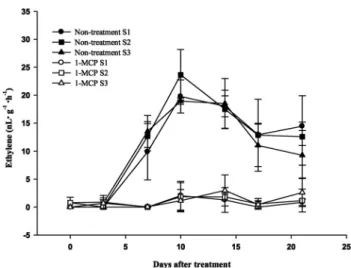
Fig. 1. Changes in ethylene production in ‘Formosa’ plums stored at 10℃. 1-MCP was treated with 1 μL・L

-1

content at 10℃ for 24 h after harvest. Bars represent SE of the mean from three replicates. S1, maturity level in which less than 5% of the peel red; S2, maturity level in which more than 5% but less than 30% of the peel was red; S3, maturity level in which more than 30% of the peel was red.

aqueous methanol was sonicated for 20 min and filtered through Whatman No. 2 filter paper (Whatman Intl. Ltd., Kent, UK). The final extract solution was stored at -70℃

until analysis. Total phenolic content was determined by the Folin–Ciocalteu’s method, which was adapted from Swain and Hillis (1959). The 150 mL extract, 2,400 mL of nanopure water, and 150 mL of 0.25 N Folin–Ciocalteu’s reagent were combined in a plastic vial and mixed well using a Vortex.

The mixture was allowed to react for 3 min, then 300 mL of 1N Na

2

CO

3

solution was added and mixed well. The solution was incubated at room temperature (23℃) in the dark for 2 h. The absorbance was measured at 725 nm using a spectrophotometer (Hewlett Packard 8452A, Diode Array, USA), and the results were expressed in gallic acid equivalents (GAE; mg・100 g

-1

fresh mass) using a gallic acid (0–0.1 mg・mL

-1

) standard curve. Additional dilution was performed if the measured absorbance value was greater than the linear range of the standard curve.

Total flavonoid content was measured using the colorimetric assay developed by Zhishen et al. (1999). Two mL of diluted extract was added to a 10 mL volumetric flask filled with 2 mL of distilled water. After 5 min, 0.3 mL of 5% NaNO

2

was added to the flask, followed by the addition of 0.3 mL of 10% AlCl

3

. After 6 min, 2 mL of 1 M NaOH was added and diluted to 10 mL with distilled water before being thoroughly mixed. A blank was prepared with distilled water.

The absorbance of the pink mixture was measured at 510 nm versus that of the prepared blank. The total flavonoid content of each plum was expressed on a dry weight basis as mg of catechin equivalent (CAE) 100 g.

Total Antioxidant Capacity Determination

Total antioxidant capacity was determined by the method developed by Kim et al. (2002). For the test, 1 mM 2, 2′-azino (2-amidino-propane) dihydrochloride was mixed with 2.5 mM 2, 2′-azino-bis (3-ethylbenzothiazoline-6sulfonic acid) (ABTS) as diammonium salt in phosphate buffered saline (PBS) solution (100 mM potassium phosphate buffer (pH 7.4) containing 150 mM NaCl). After the mixture was heated in a water bath at 68℃ for 13 min, the blue-green ABTS solution was adjusted with fresh PBS solution to an absorbance of 0.65 ± 0.02 at 734 nm. The sample solution of 40 μL was added to 1,960 μL of the ABTS radical solution and incubated in a water bath at 37℃ for 10 min. The decrease in absorbance at 734 nm was measured. The reference solution consisted of 40 μL of 50% methanol and 1960 μL of ABTS solution. The ABTS radical scavenging capacities of plum extracts were expressed on a dry weight basis as mg of vitamin C equivalent (ascorbic acid equivalent:

AAE) 100 g.

Results and Discussion

Ethylene Production and Respiration Rate

Ethylene production increased in the non-treated fruit harvested at various maturity stages until 11 days of storage and then decreased until the end of the experiment (Fig.

1). The amount of ethylene in non-treated plums increased

from approximately 0 nL・g

-1

・ h

-1

to a maximum of 20-24

nL・g

-1

・h

-1

at all maturity stages (Fig. 1). 1-MCP-treated fruit

of all maturity stages displayed very low ethylene production

until the end of storage. There was no difference in ethylene

production among maturity stages in either non-treated or

1-MCP-treated fruit. This result demonstrates that 1-MCP

effectively suppressed ethylene production. Reductions in

ethylene production and respiration rate after the postharvest

application of 1-MCP have been reported in plums and other

fruit including apples, bananas and avocados (Feng et al.,

2004.; Khan and Singh, 2007; Martinez-Romero et al.,

2003b; Oh et al., 2007; Pelayo et al., 2003; Watkins et al.,

2000). 1-MCP is thought to interact with ethylene receptors

to prevent ethylene-dependent responses (Sisler and Serek,

1997). Sensory evaluation studies in plums recommended

that, in order to increase fruit flavor, and therefore consumption,

plums should be harvested at more advanced maturity, when

higher quality characteristics have been developed (Crisosto

et al., 2004). Therefore, reduction in rapid softening should

be avoided during postharvest handling to protect fruit quality

and increase shelf life of delayed harvested fruit. In this study,

the effect of 1-MCP on plum quality was similar throughout

the maturity stages. Although there is a relationship between

(4)

Fig. 2. Changes in respiration in ‘Formosa’ plums stored at 10℃. 1-MCP was treated with 1 μL・L

-1

content at 10℃ for 24 h after harvest. Bars represent SE of the mean from three replicates. S1, maturity level in which less than 5% of the peel red; S2, maturity level in which more than 5% but less than 30% of the peel was red; S3, maturity level in which more than 30% of the peel was red.

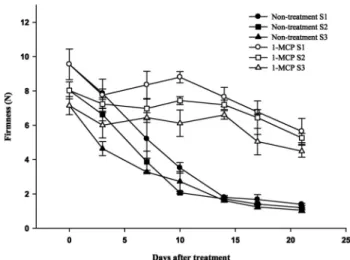
Fig. 3. Changes in firmness in ‘Formosa’ plums stored at 10℃.

1-MCP was treated with 1 μL・L

-1

content at 10℃ for 24 h after harvest. Bars represent SE of the mean from three replicates. S1, maturity level in which less than 5% of the peel red; S2, maturity level in which more than 5% but less than 30% of the peel was red; S3, maturity level in which more than 30% of the peel was red.

1-MCP and ethylene receptors, the effect of 1-MCP on ethylene synthesis is not clear.

Respiration rate gradually increased in both stages 1 and 2, but the respiration rate of 1-MCP non-treated fruit in stage 3 increased more rapidly until 7 days and then decreased (Fig. 2). Measurements of CO

2

evolution from ‘Formosa’

plums of stage 3 showed a climacteric respiration pattern, as described by Sekse (1998) for ‘Victoria’ plums. The amount of CO

2

in stage 3 ‘Formosa’ plums increased from approximately 10 mL CO

2

kg・h

-1

to a maximum of 20 mL CO

2

kg・h

-1

(Fig. 2). Maturity stages 1 and 2 displayed an increasing respiration pattern, but the slope was not as steep as that of maturity stage 3.

Respiration of 1-MCP-treated fruit in every stage was inhibited until the end of storage. There was also no difference in ethylene production among the different maturity stages in 1-MCP treated fruits. Inhibition of ethylene production and respiration rate through postharvest 1-MCP application was similar in effect in ‘Formosa’ plums regardless of maturity stage, similar to the results in ‘Ooishiwase’ plums (Oh et al., 2007).

Fruit Quality

Fruit firmness in non-treated fruit of every stage gradually decreased until 14 days after storage, reaching the lowest value after 22 days of storage (Fig. 3). Fruit firmness in 1-MCP treated fruit of every stage maintained values similar to that of the initial value until 14 days of storage and then gradually decreased until the end of the experiment. The firmness values were different among maturity stages in the

decreasing order of stage 1, stage 2, and stage 3 in both 1-MCP treated and non-treated fruit. However, firmness was better maintained in 1-MCP treated plums than in non-treated plums. 1-MCP is an effective compound that binds irreversibly to ethylene receptors. Therefore, it prevents fruit softening, an ethylene-dependent response (Serek et al., 1995; Sisler and Serek, 1997). There is much evidence that proves 1-MCP application suppresses ethylene biosynthesis and maintains fruit softening, one of the postharvest quality in plums (Khan and Singh, 2007; Martinez-Romero et al., 2003a; Oh et al., 2007). Thus, 1-MCP treatment resulted in more effective maintenance of firmness when the plums were harvested at an earlier maturity stage. The TA values of stage 1, stage 2, and stage 3 were reduced during the postharvest storage in both non-treated and 1-MCP-treated plums (Fig. 4). In particular, TA values were highest in 1-MCP-treated fruit at stage 1 and were lowest in non-treated fruit at stage 3.

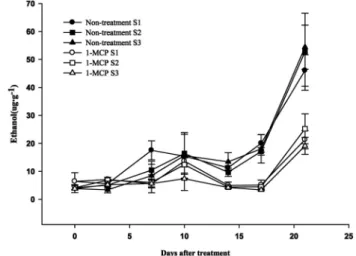
Stages 1 and 2 of 1-MCP-treated fruit preserved their initial values until 10 days of storage and then slowly decreased until the end of storage. Ethanol production dramatically increased after 17 days of storage in all treatments, displaying lower values in 1-MCP-treated fruits than in non-treated fruit (Fig. 5). High level of ethanol is usually related to off-flavors development (Ke and Kader, 1992). Therefore, postharvest application of 1-MCP in all three stages was a way to prevent plum’s flavor loss during storage. There was a report that color changes in fruit were ethylene-independent and not affected by 1-MCP (Dong et al., 2004). In this study the plums were harvested according to color development stages.

However, there was not much difference in ethylene production

(5)

Fig. 4. Changes in titratable acidity in ‘Formosa’ plums stored at 10℃. 1-MCP was treated with 1 μL・L

-1

content at 10℃

for 24 h after harvest. Bars represent SE of the mean from three replicates. S1, maturity level in which less than 5%

of the peel red; S2, maturity level in which more than 5%

but less than 30% of the peel was red; S3, maturity level in which more than 30% of the peel was red.

Fig. 5. Changes in ethanol content in ‘Formosa’ plums stored at 10℃. 1-MCP was treated with 1 μL・L

-1

content at 10℃

for 24 h after harvest. Bars represent SE of the mean from three replicates. S1, maturity level in which less than 5%

of the peel red; S2, maturity level in which more than 5%

but less than 30% of the peel was red; S3, maturity level in which more than 30% of the peel was red.

Fig. 6. Decay incidence in ‘Formosa’ plums stored at 10℃.

1-MCP was treated with 1 μL・L

-1

content at 10℃ for 24 h after harvest. S1, maturity level in which less than 5% of the peel red; S2, maturity level in which more than 5% but less than 30% of the peel was red; S3, maturity level in which more than 30% of the peel was red.

Fig. 7. Changes in Hunter ‘a’ value in ‘Formosa’ plums stored at 10℃. 1-MCP was treated with 1 μL・L

-1

content at 10℃

for 24 h after harvest. Bars represent SE of the mean from three replicates. S1, maturity level in which less than 5%

of the peel red; S2, maturity level in which more than 5%

but less than 30% of the peel was red; S3, maturity level in which more than 30% of the peel was red.

and respiration rate (Figs. 1 and 2), and there was no difference in ethanol production among harvest stages of fruit either (Fig. 5).

Decay incidence in both non-treated and 1-MCP-treated fruit was lowest in harvest stage 1 and highest in stage 3 (Fig. 6). However, there were no significant differences in decay incidence between non-treated and 1-MCP-treated fruits within the same harvest stages. Hunter ‘a’ values gradually increased in all treatments (Fig. 7). However, non-treated fruit in all harvest stages demonstrated a more rapid change

than 1-MCP-treated fruit. In harvest stage 1, 1-MCP-treated plums changed color slowly and did not reach full redness by the end of the experiment, and the highest Hunter ‘a’

values occurred in harvest stage 3 without 1-MCP treatment.

Postharvest application of 1-MCP was beneficial for maintaining

fruit quality at every maturity stage of harvest and was related

to inhibition of ethylene production. Similar results have been

reported in President and ‘Ooishiwase’ plums with various

maturity stages (Oh et al., 2007; Valero et al., 2003).

(6)

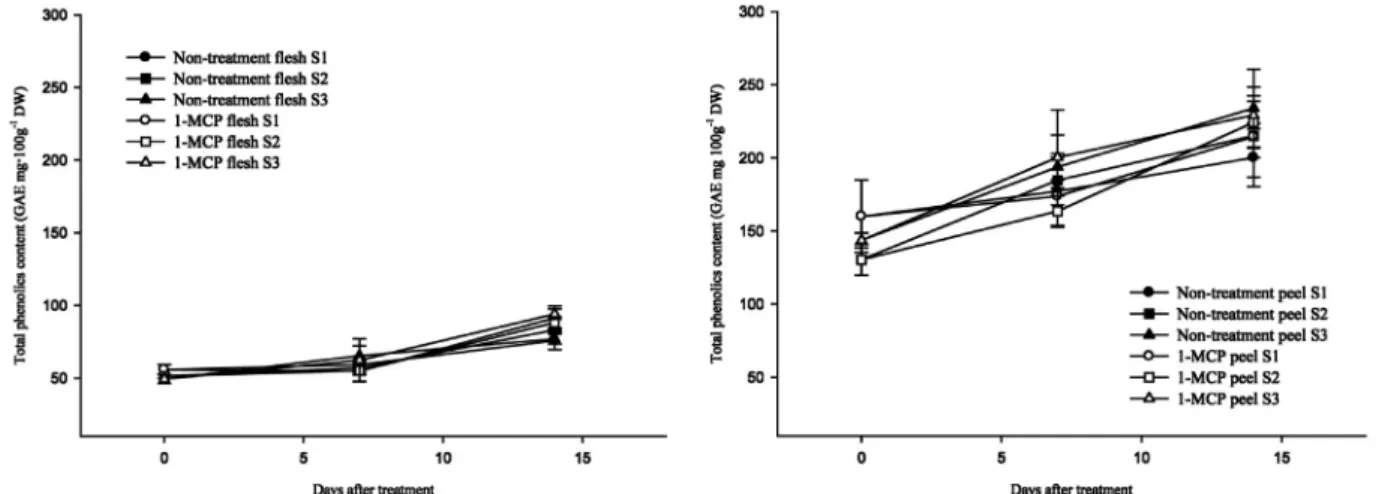
Fig. 8. Changes in total phenolic content in ‘Formosa’ plums stored at 10℃. 1-MCP was treated with 1 μL・L

-1

content at 10℃

for 24 h after harvest. The left is total phenolics content of flesh, and the right is that of peel. Bars represent SE of the mean from three replicates. S1, maturity level in which less than 5% of the peel red; S2, maturity level in which more than 5% but less than 30% of the peel was red; S3, maturity level in which more than 30% of the peel was red.

Total Phenolic Content, Total Flavonoid Content, and Total Antioxidant Capacity

Phenolic compounds frequently occur in foods such as fruits and vegetables and are routinely consumed in our diet.

They contribute to the sensory qualities (color, flavor, and taste) of fresh fruits, vegetables and their products. In addition, many phenolic phytochemicals have antioxidative, anticarcinogenic, antimicrobial, antiallergenic, antimutagenic and antiinflammatory activities (Cao and Cao, 1999; Eberhardt et al., 2000; Ito et al., 1998; Kawaii et al., 1999; Kim et al., 2000). Plums contain copious amounts of natural phytochemicals, such as flavonoids and phenolic acids, which may function as effective natural antioxidants in our daily diet. Wang et al. (1996) demonstrated that plums had a 4.4 times greater total antioxidant capacity than apples, the latter being one of the most commonly consumed fruits in our diet. The distribution and composition of phenolic phytochemicals are affected by maturity, cultivars, horticultural practices, geographic origin, growing season, postharvest storage conditions and processing procedures (Burda et al., 1990; Donovan et al., 1998; Kalt et al., 1999; Lee and Jaworski, 1987; Spanos and Wrolstad, 1990). Plums contain copious amounts of natural phytochemicals, such as flavonoids and phenolic acids, which may function as effective natural antioxidants in our daily diet. Wang et al. (1996) demonstrated that plums had a 4.4 times greater total antioxidant capacity than apples.

Total phenolic content, total flavonoid content, and total antioxidant capacity were assessed according to treatment of 1-MCP, harvest stage, and fruit part. Plums contain many functional compounds such as phenolic compounds (Gil et al., 2002), which have a close relationship with antioxidant capacity in plums (Kim et al., 2003). Several major phenolic compounds have been found in plums, such as chlorogenic

acid, cyanidine 3-rutinoside, and quercetin 3-rutinoside (Chun et al., 2003b). These phenolic compounds are reported to be found in fruit flesh and skin of dark colored plums (Chun et al., 2003a; Gil et al., 2002). Thus plums were separated as flesh and peel, and then the amount of total phenolics was assessed. Total phenolic content increased in both the peel and the flesh (Fig. 8), but the change was more rapid in the peel. The total phenolic content of the fresh plums per 100 g ranged from 48.44 ± 3.2 mg GAE・100 g to 93.76

± 3.0 mg GAE・100 g in the flesh and from 130.36 ± 10.6 mg GAE・100 g to 255.05 ± 34.0 mg GAE・100 g in the peel. The peel had 2-3 times more phenolics than the flesh.

The amount increased gradually after harvest with or without 1-MCP treatment in both the flesh and the peel. However, 1-MCP treatment had no effect on the preservation of total phenolics, as there was no difference in the amount of total phenolics between non-treated and 1-MCP-treated fruit in either the peel or the flesh of the plums. The total phenolic amount in this study was similar to that in a previous report, which ranged from 174 ± 1.5 mg GAE・100 g to 375 ± 3.8 mg GAE・100 g in the peel according to the cultivar (Chun et al., 2003; Marinova et al., 2005). The reason that total phenolic content was higher in the peel than in the flesh is because of the red anthocyanin in the peel. The main anthocyanin of plum, cyaniding-3-glucoside, is also a type of phenolic compound and flavonoid (Gross, 1987).

The total flavonoid content increased until 7 days of

storage in each treatment (Fig. 9). After that, the values

decreased until 14 days of storage in most of the treatments

except in the 1-MCP-treated peel when the plums were

harvested at stages 2 or 3. The flavonoid content of the fresh

plums per 100 g ranged from 19.92 ± 2.13 mg CAE・100

g to 39.52 ± 2.55 mg CAE・100 g in flesh and from 84.36

(7)

Fig. 9. Changes in flavonoid content in ‘Formosa’ plums stored at 10°C. 1-MCP was treated with 1 μL・L

-1

content at 10°C for 24 h after harvest. The left is total flavonoid content of flesh, and the right is that of peel. S1, maturity level in which less than 5% of the peel red; S2, maturity level in which more than 5% but less than 30% of the peel was red; S3, maturity level in which more than 30% of the peel was red.

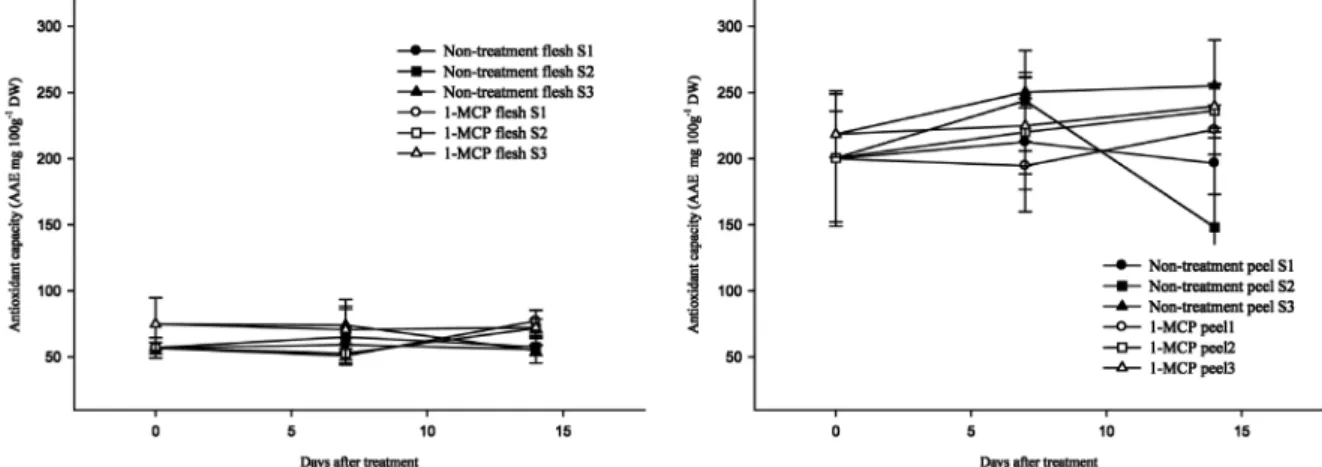
Fig. 10. Changes in antioxidant capacity in ‘Formosa’ plums stored at 10℃. 1-MCP was treated with 1 μL・L

-1

content at 10℃

for 24 h after harvest. The left is total antioxidant capacity of flesh, and the right is that of peel. Bars represent SE of the mean from three replicates. S1, maturity level in which less than 5% of the peel red; S2, maturity level in which more than 5% but less than 30% of the peel was red; S3, maturity level in which more than 30% of the peel was red.

± 10.6 mg CAE・100 g to 125.55 ± 24.0 mg CAE・100 g in peel. Fruit peel had a 3-4 times higher total flavonoid content than fruit flesh. Similar results have been reported in other plum cultivars (Gil et al., 2002).

Antioxidants are compounds that can delay or inhibit the oxidation of lipids or other molecules by inhibiting oxidizing chain reactions, playing an important role in health protection (Velioglu et al., 1998). The antioxidant activity in the peel was about 3-5 folds higher than that of the flesh in non-treated or 1-MCP-treated fruit (Fig. 10). However, the antioxidant values were not much different between non-treated and 1-MCP-treated fruit or among harvest periods. The color was more intense in the peel than in the flesh because of the presence of anthocyanin, a known antioxidant. Thus, antioxidant activity was higher in the peel than in the flesh (Rice-Evans et al., 1996). There was not much difference in total phenolic content, total flavonoid content, or total antioxidant capacity

between non-treated and 1-MCP-treated fruit or among the three different harvest maturity stages (Figs. 8, 9, and 10).

However, the values were different between the flesh and the peel, exhibiting higher values in the peel than in the flesh. It has been reported that dark-colored plums have a higher total phenolic content, total flavonoid content, and antioxidant capacity than light-colored plums because of the presence of anthocyanin (Chun et al., 2003). Therefore, these measures are not related to the color change following postharvest storage but are closely related to plum cultivar according to fruit peel and flesh color (Chun et al., 2003;

Gil et al., 2002).

There was a report about 1-MCP treatment to plums and

then the plums were stored at 20℃ (Jung et al., 2010). Fruit

were treated with 1 μL・L

-1

1-MCP 1 day after being harvest

and stored at ambient temperature (20℃). 1-MCP treatment

delayed fruit softening, weight loss, changes in skin color,

(8)

and TA during the shelf life period at ambient temperature (20℃). Although the results indicate that 1-MCP can be used to maintain the quality of non-refrigerated plums, these quality values of plums decreased more rapidly in 20℃

storage than in 10℃ storage in this study. Therefore, it would be better if plums were treated with 1-MCP and stored at low temperature (above chilling injury temperature) to maintain quality.

Literature Cited

Abdi, N., W.B. McGlasson, P. Holford, M. Williams, and Y.

Mizrahi. 1998. Responses of climacteric and suppressed-climacteric plums to treatment with propylene and 1-methylcyclopropene.

Postharv. Biol. Technol. 14:29-39.

Baritell, A.L., G.M. Hyde, J.K. Fellman, and J. Varith. 2001.

Using 1-MCP to inhibit the influence of ripening on impact properties of pear and apple tissue. Postharv. Biol. Technol.

23:153-160.

Blankenship, S.M. and J.M. Dole. 2003. 1-Methylcyclopropene:

A review. Postharv. Biol. Technol. 28:1-25.

Burda, S., W. Oleszek, and C.Y. Lee. 1990. Phenolic compounds and their changes in apples during aturation and cold storage.

J. Agr. Food Chem. 38:945-948.

Cao, Y. and R. Cao. 1999. Angiogenesis inhibited by drinking tea. Nature 398:391.

Chun, O.K., D.O. Kim, and C.Y. Lee. 2003. Superoxide radical scavenging activity of the major polyphenols in fresh plums.

J. Agr. Food Chem. 51:8067-8072.

Crisosto, C.H., F.G. Mitchell, and J.G. Ju. 1999. Susceptibility to chilling injury of peach, nectarine, and plum cultivars grown in California. HortScience 34:1116-1118.

Crisosto, C.H., D. Garner, G.M. Crisosto, and E. Bowerman.

2004. Increasing ‘Blackamber’ plum (Prunus salicina Lindell) consumer acceptance. Postharv. Biol. Technol. 34:237-244.

Dong, L, S. Lurie, and H.W. Zhou. 2004. Effect of 1-methylcyclopropene on ripening of ‘Canino’ apricots and

‘Royal Zee’ plums. Postharv. Biol. Technol. 24:135-145.

Donovan, J.L., A.S. Meyer, and A.L. Waterhouse. 1998. Phenolic composition and antioxidant activity of prunes andprune juice (Prunus domestica). J. Agr. Food Chem. 46:1247-1252.

Eberhardt, M.V., C.Y. Lee, and R.H. Liu. 2000. Antioxidant activity of fresh apples. Nature 405:903-904.

Feng, X.Q., A. Apelbaum, E.C. Sisler, and R. Goren. 2004.

Control of ethylene activity in various plant systems by structural analogues of 1-methylcyclopropene. Plant Growth Regulat. 42:29-38.

Fisher, R.L. and A.B. Bennett. 1991. Role of cell wall hydrolases in fruit ripening. Annu. Rev. Plant Physiol. Plant Mol. Biol.

42:675-703.

Gil, M.I., F.A. Tomas-Barberan, B. Hess-Pierce, and A.A. Kader.

2002. Antioxidant capacities, phenolic compounds, carotenoids, and vitamin C contents of nectarine, peach, and plum cultivars from California. J. Agr. Food Chem. 50:4976-4982.

Gross, J. 1987. Pigments in Fruit. Academic Press, Jerusalem, p. 246.

Guerra, M. and P.A. Casquero. 2008. Effect of harvest date on cold storage and postharvest quality of plum cv. Green Gage.

Postharv. Biol. Technol. 47:325-332.

Hofman, P.J., M. Jobin-Décor, G.F. Meiburg, A.J. Macnish, and D.C. Joyce. 2001. Ripening and quality responses of avocado, custard apple, mango, and papaya fruit to 1-methylcyclopropene.

Austral. J. Exp. Agr. 41:567-572.

Ito, A., L.A. Shamon, B. Yu, E. Mata-Greenwood, S.K. Lee, R.B. van Breemen, R.G. Mehta, N.R. Farnsworth, H.H.

Fong, J.M. Pezzuto, and A.D. Kinghorn. 1998. Antimutagenic constituents of Casimiroa edulis with potential cancer chemopreventive activity. J. Agr. Food Chem. 46:3509-3516.

Kalt, W., C.F. Forney, A. Martin, and R.L. Prior. 1999.

Antioxidant capacity, vitamin C, phenolics, and anthocyanins after fresh storage of small fruits. J. Agr. Food Chem.

47:4638-44.

Kawaii, S., Y. Tomono, E. Katase, K. Ogawa, and M. Yano.

1999. Antiproliferative effects of the readily extractable fractions prepared from various Citrus juices on several cancer cell lines. J. Agr. Food Chem. 47:2509-2512.

Ke, D. and A. A. Kader. 1992. External and internal factors influence fruit tolerance to low-oxygen atmospheres. J. Amer.

Soc. Hort. 117:913-918.

Khan, A.S. and Z. Singh. 2007. 1-MCP regulates ethylene biosynthesis and fruit softening during ripening of ‘Tegan Blue’ plum. Postharv. Biol. Technol. 43:298-306.

Kim, D.O., K.W. Lee, H.J. Lee, and C.Y. Lee. 2002. Vitamin C equivalent antioxidant capacity (VCEAC) of phenolic phytochemicals. J. Agr. Food Chem. 50:3713-3717.

Kim, D.O., O.K. Chun, Y.J. Kim, H.Y. Moon, and C.Y. Lee.

2003. Quantification of polyphenolics and their antioxidant capacity in fresh plums. J. Agr. Food Chem. 51:6509-6515.

Kim, M.Y., S.W. Choi, and S.K. Chung. 2000. Antioxidative flavonoids from the garlic (Allium sativum L.) shoot. Food Sci. Biotechnol. 9:199-203.

Marinova, D., F. Ribarova, and M. Atanassova. 2005. Total phenolics and total flavonoids in Bulgarian fruits and vegetables.

J. Univ. Chem. Technol. Metal. 40:255-260.

Lee, C.Y. and A.W. Jaworski. 1987. Phenolic compounds in white grapes grown in New York. Amer. J. Enol. Vitic.

38:277-281.

Martinez-Romero, D., E. Dupille, F. Guillen, J.M. Valverde, M.

Serrano, and D. Valero. 2003a. 1-Methylcyclopropene increases storability and shelf life in climacteric and nonclimacteric plums. J. Agr. Food Chem. 51:4680-4686.

Martinez-Romero, D., M. Serrano, F. Guillen, and D. Valero.

2003b. 1-methyleyclopropene (1-MCP) increased storability in plum (Prunus salicina Lindl. cv. Golden Japan). Proc. Intl.

Conf. Postharv. Unlimited 71-77.

Nakano, R., S. Harima, E. Ogura, S. Inoue, Y. Kubo, and A.

Inaba. 2001. Involvement of stress-induced ethylene biosynthesis in fruit softening of ‘Saijo’ persimmon. J. Japan Soc. Hort.

Sci. 70:581-585.

Oh, S., B. Lim, J. Lee, and K. Do. 2007. 1-Methylcyclopropene increases the shelf-life of ‘Ooishiwase’ plums (Prunus salicina L.). Kor. J. Hort. Sci. Technol. 25:369-374.

Pelayo, C., E.V.D. Vilas-Boas, M. Benichou, and A.A. Kader.

(9)

2003. Variability in responses of partially ripe bananas to 1-methylcyclopropene. Postharv. Biol. Technol. 28:75-85.

Rice-Evans, C.A., N.J. Miller, and G. Paganga. 1996. Structure- antioxidant activity relationships of flavonoids and phenolic acids. Free Radic. Biol. Med. 20:933-956.

Robertson, J.A., F.I. Meredith, B.G. Lyon, and J.D. Norton.

1991. Effect of cold storage on the quality characteristics of

‘Aurubrum’ plums. J. Food Qual. 14:107-117.

Sekse, L. 1998. Respiration of plum (Prunus domestica L.) and sweet cherry (P. avium L.) fruits during growth and ripening.

Acta Hort. 38:317-320.

Serek, M., E.C. Sisler, and M.S. Reid. 1995. 1-methylcyclopropene, a novel gaseous inhibitor of ethylene action, improves the life of fruits, cut flowers, and potted plants. Acta Hort.

394:337-345.

Serrano, M., D. Martinez-Romero, F. Guillen, and D. Valero.

2003. Effect of exogenous putrescence on improving shelf life of four plum cultivars. Postharv. Biol. Technol. 30:259-271.

Sisler, E.C. and M. Serek. 1997. Inhibitors of ethylene responses in plants at the receptor level: Recent developments. Physiol.

Plant 100:577-582.

Spanos, G.A. and R.E. Wrolstad. 1990. Influence of variety, maturity, processing and storage on the phenol composition of pear juice, J. Agr. Food Chem. 38:817-824.

Swain, T. and W.E. Hillis. 1959. The phenolic constituents of Prunus domestica I-the quantitative analysis of phenolic constituents. J. Sci. Food Agr. 10:63-68.

Valero, D., D. Martinez-Romero, J.M. Valverde, F. Guillen, and M. Serrano. 2003. Quality improvement and extension of shelf life by 1-methylcyclopropene in plum as affected by ripening stage at harvest. Innov. Food Sci. Emer. Technol.

4:339-348.

Velioglu, Y.S., G. Mazza, L. Gao, and B.D. Oomah. 1998.

Antioxidant activity and total phenolics in selected fruits, vegetables, and grain products. J. Agr. Food Chem. 46:4113-4117.

Wang, H., G. Cao, and R.L. Prior. 1996. Total antioxidant capacity of fruit. J. Agr. Food Chem. 44:701-705.

Watkins, C.B. 2006. The use of 1-methylcyclopropene (1-MCP) on fruits and vegetables. Biotechnol. Adv. 24:389-409.

Zhishen, A, T. Mengcheng, and W. Jianming. 1999. The

determination of flavonoid contents in mulberry and their

scavenging effects on superoxide radicals. Food Chem. 64:555-559.

수치

Fig. 1. Changes in ethylene production in ‘Formosa’ plums  stored at 10℃. 1-MCP was treated with 1 μL・L -1  content at  10℃ for 24 h after harvest
Fig. 2. Changes in respiration in ‘Formosa’ plums stored at  10℃. 1-MCP was treated with 1 μL・L -1  content at 10℃ for  24 h after harvest
Fig. 5. Changes in ethanol content in ‘Formosa’ plums stored  at 10℃. 1-MCP was treated with 1 μL・L -1  content at 10℃
Fig. 8. Changes in total phenolic content in ‘Formosa’ plums stored at 10℃. 1-MCP was treated with 1 μL・L -1  content at 10℃
+2

참조

관련 문서