Kor. J. Hort. Sci. Technol. 29(6):592-599, 2011
Improvement of Postharvest Fruit Quality in ‘Formosa’ Plums (Prunus salicina) after Treatment with 1-methylcyclopropene during Storage
Rona Bae
1, Ji-Hyun Lee
2*, and Seung-Koo Lee
3,41
Analysis & Certification Division, Foundation of Agri. Tech. Commercialization & Transfer, Suwon 411-857, Korea
2
National Instrumentation Center for Environmental Management, Seoul National University, Seoul 151-921, Korea
3
Department of Plant Science, Seoul National University, Seoul 151-921, Korea
4
Research Institute for Agriculture and Life Science, Seoul National University, Seoul 151-921, Korea
Abstract. Plum is a climacteric fruit and softening is a serious problem for storage and transportation. Thus 1 μL・L
-1of 1-methylcyclopropene (1-MCP) was applied to plums to prolong their shelf life and maintain quality. Japanese plums (Prunus salicina cv. Formosa) were stored at 20℃ and 0℃ for 14 days and 46 days respectively, with or without 1-MCP treatment. Fruits were treated with 1 μL・L
-11-MCP at 10℃ for 24 h. Ethylene production and respiration rate were strongly inhibited in 1-MCP-treated fruits at 20℃. It was also observed that there was less ethanol and acetaldehyde evaporation in 1-MCP-treated fruits stored at 20℃ compared to those in control fruits not treated with 1-MCP. Fruit qualities, such as firmness, titratable acidity (TA), skin color, and decay, changed more slowly in 1-MCP-treated fruits stored at 20℃ than in untreated fruits. There were no differences in the ethylene production or respiration rate between the groups of fruits stored at 0℃ throughout the experiment. Chilling injury was also inhibited by the application of 1-MCP during storage at 0℃. When the fruits stored at 0℃ with or without 1-MCP were transferred to 20℃ after 25 days, the differences in ethylene production and respiration rate, firmness, TA, TSS, and acetaldehyde and ethanol evaporation between the initial (after being stored at 0℃ for 25 days) and the final measurements (after being stored at 0℃ for 25 days and then transferred to 20℃ for three days) were lower in 1-MCP treated fruits than in non-treated fruits. The postharvest application of 1-MCP in Formosa plums showed positive effects at both 0℃ and 20℃ storage conditions with regard to quality, such as low ethylene production and low respiration rates, firmness, TA, ethanol, and acetaldehyde evaporation, chilling injury, and decay.
Additional key words: chilling injury, decay, ethanol, ethylene, softening, temperature
*Corresponding author: [email protected]
※ Received 25 July 2011; Accepted 18 September 2011.
Introduction
Plum (prunus salicina) cultivars in Korea are sweet, slightly sour, and very juicy. However, plums are highly perishable and quickly soften after harvest; these processes are related to ethylene (Abdi et al., 1998). Plum cultivars that possess high ethylene production abilities soften and ripen more quickly than do cultivars with low ethylene production (Abdi et al., 1998). Softening, which occurs due to ripening, which is a serious problem for plum storage and transportation. Due to these reasons, early harvesting before skin coloring is common in Korea to increase the fruit’s shelf life. Historically, plums were harvested during the pre-climacteric stage, stored at 0℃ and then transferred to room temperature. Cold storage is effective for reducing
ethylene production but causes chilling injury when the plums are stored for a long period of time (Crisosto et al., 1999). Therefore, technologies to decrease ethylene production without negative side effects would be useful to delay plum softening and postharvest ripening. 1-MCP is an effective inhibitor of ethylene as it binds irreversibly to ethylene receptors (Serek et al., 1995; Sisler and Serek, 1997), and delays ripening without negative side effects in fruits such as the apple, mango, persimmon, plum, and banana (Baritelle et al., 2001; Hofman et al., 2001; Nakano et al., 2001; Oh et al., 2007; Pelayo et al., 2003). In addition, 1-MCP has been reported to reduce the ethylene production and to increase shelf life in many kinds of fruits, vegetables and flowers (Blankenship and Dole, 2003; Watkin, 2006). The aim of this study was to estimate the effect of 1-MCP on Formosa plum quality with regard to the ripening process.
Therefore, we applied 1-MCP to plums in order to prolong
shelf life and maintain quality without producing chilling
injury when plums were stored at low temperature.
Materials and Methods
Plant Material
Formosa (Prunus salicina) plums were harvested in mid-July 2007 from a commercial orchard in Gimchoen, Korea. Fruits that were unblemished, uniform in size and free from symptoms of disease were harvested during the pre-climacteric and commercial harvest period and were transferred to the laboratory immediately after plums were manually picked at the commercial maturity stage to avoid mechanical damage. The plums were placed in a ventilated plastic tray (525 × 375 × 370 mm) and stored in a temperature-controlled storage room after either receiving 1-MCP treatment or no treatment. Three replicate trays were prepared for each condition, and 50 plums were placed in each tray. To assess quality, three replicate samples were removed from each tray on the specified days of storage.
All samples were prepared with three replicates, and results are shown as the mean with standard error.
Storage Conditions
The control samples were stored at room temperature (20
± 1℃) without 1-MCP treatment, and the test samples were stored at room temperature (20 ± 1℃) following 1-MCP treatment. The storage period was 14 days, after which the commercial quality is no longer present. A low temperature (0 ± 1℃) for 46 days with or without 1-MCP was used to compare the combined effect of low temperature and 1-MCP. The third experiment was designed to investigate fruit quality during transportation after low temperature storage. These samples were stored at a low temperature (0 ± 1℃) for 25 days with or without 1-MCP and were then transferred to room temperature (20 ± 1℃) and stored for three days to investigate the quality change.
1-MCP Treatment
Fruits were harvested and stored at 10℃ until 1-MCP was applied. AgroSmart
TMFresh (USA) supplied the 1-MCP (0.14%) in a powder form, which releases the active ingredient as a gas after it is added to warm water (40℃).
The powder was weighed to produce a 1 μL・L
-1concentration, and warm water was added to the desired volume. 1-MCP was applied to the plums (60.2 kg) at 10℃ for 24 h in 0.2 m
3hermetically sealed containers.
Ethylene and Respiration Rate Determination
Three fruits were weighed (403.4 g) and sealed in 1.6
L plastic jars for 1 h. Ethylene production was determined by injecting 1 mL of headspace gas into a gas chromatograph (Model 5890, Hewlett-Packard Corp., Boston, MA, USA) equipped with a 2 m × 1/8 inch alumina F1 column (Supelco Corp., St. Louis, MO, USA) and a flame ionization detector (FID). Helium was used as the carrier gas. The injector, oven and detector temperatures were 150℃, 70℃, and 20 0℃, respectively. CO
2production was measured by injecting 1 mL of headspace gas into the same gas chromatograph equipped with a 2 m × 1/8 inch stainless steel column packed with activated carbon and a thermal conductivity detector (TCD). For this step, the detector temperature was changed to 150℃. Ethylene and CO
2production were expressed as μ L・kg
-1・ h
-1and mL・kg
-1・ h
-1, respectively.
Fruit Quality Assessment
Skin color was determined using the Hunter Lab colorimeter system (CR300, Minolta Corp., Tokyo, Japan), and fruit firmness was investigated using a 5 mm-diameter probe coupled with a texture analyzer (TA plus, Lloyd Instruments
TM, Hants, UK). A small slice of fruit skin was removed, and the firmnesses of two sides of an individual plum fruit were recorded; means were calculated and expressed as Newtons (N). To determine the total soluble solids (TSS) of fruit juice, a digital refractometer (RA 520, Kyoto Electronic, Kyoto, Japan) was used, and TSS was expressed as the percent of the total soluble solids. To determine TA, fruit juice was titrated with 0.1 NaOH to a pH of 8.2, and the amount of TA was expressed as a percentage (%).
Ethanol and Acetaldehyde Determinations
A 10 g sample was weighed in a Falcon tube that was then filled to 30 mL with distilled water. All the samples of Falcon tubes were put in ice container during experiment and they were also homogenized with ice container, and then 5 mL of the distilled sample was collected using distilling equipment. A 1 μL liquid sample was injected into a gas chromatograph (3900, Varian Corp., Palo Alto, CA, USA) equipped with FID and a 30 m × 25 mm Supelco wax capillary column (Supelco Corp., St. Louis, MO, USA).
Chilling Injury and Decay Evaluations
The incidence of chilling injury was assessed on ten plums
immediately after removal from storage. Symptoms of flesh
chilling injury were visually assessed by checking for brown
flesh color after the fruit was cut in half along its equatorial
axis. The extent of browning was expressed as a percentage
of browning plums to the total fruits. Decay was investigated
using a similar method as that used for chilling injury. The
Fig. 1. Changes in ethylene production in ‘Formosa’ plums stored at 0℃ and 20℃ and that received either 1 μL・L
-11-MCP treatment or no treatment at 10℃ for 24 h immediately after harvest. The values represent the means of three replicates, and the bars reflect standard error.
Fig. 2. Changes in the respiration rate of ‘Formosa’ plums stored at 0℃ and 20℃ and that either received 1 μL・L
-11-MCP treatment or no treatment at 10℃ for 24 h immediately after harvest. The values are the means of three replicates, and the bars represent standard error.
Fig. 3. Changes in firmness in ‘Formosa’ plums stored at 0℃
and 20℃ either receiving 1 μL・L
-11-MCP treatment or no treatment at 10℃ for 24 h immediately after harvest. The values are means of three replicates, and the bars represent standard error.
samples that experienced decay symptoms on their surfaces were removed from the storage room, and the amount of decay was expressed as a percentage of decayed plums to the total plums.
Results and Discussion
Ethylene Production and Respiration Rate
Ethylene production significantly increased in control fruit, reaching a climacteric peak (75.9 ± 15.3 μL・kg
-1・ h
-1) after seven days of 20℃ storage, and then decreasing through the end of the storage period (Fig. 1). In 1-MCP-treated fruits stored at 20℃, ethylene was rarely detected through 14 days of storage. However, regardless of treatments, fruits stored at 0℃ did not produce ethylene through the 46 days of storage. It was obvious that ethylene production was suppressed by 1-MCP treatment at 20℃ storage compared with that of untreated one (Fig. 1).
The respiration rate of control fruits stored at 20℃
dramatically increased after seven days of storage, reaching the climacteric peak (49.1 ± 5.4 mL・kg
-1・h
-1), and then decreasing through the remainder of the study (Fig. 2). The respiration rate progressively increased until the end of the experiment in 1-MCP treated fruits stored at 20℃. However, the average respiration rate was lower in 1-MCP-treated fruits stored at 20℃ than it was in non-treated fruits at 20℃
storage. There was a very low respiration rate ranging from 2.2 ± 0.9 mL・kg
-1・h
-1to 6.2 ± 0.6 mL・kg
-1・h
-1throughout storage in both non-treated and 1-MCP-treated fruits at 0℃.
Reductions in ethylene production and respiration rate following the postharvest application of 1-MCP has been
reported in plums and many other fruits including apples, bananas and avocados (Feng et al., 2004; Khan and Singh, 2007; Martinez-Romero et al., 2003b; Oh et al., 2007; Pelayo et al., 2003; Wakin et al., 2000). 1-MCP is thought to interact with ethylene receptors and thereby prevent ethylene-dependent responses (Sisler and Serek, 1997). Although there is a relationship between 1-MCP and ethylene receptors, the effect of 1-MCP on ethylene synthesis is not clear.
Fruit Quality
Fruit firmness at harvest was 12.4 ± 1.6 N, when
diminished during postharvest storage (Fig. 3). Fruit firmness
abruptly decreased in control fruits in 20℃ storage from
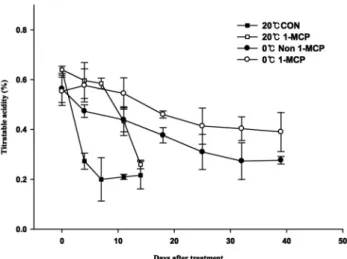
Fig. 4. Changes in titratable acidity in ‘Formosa’ plums stored at 0℃ and 20℃ with 1 μL・L
-11-MCP treatment or no treatment at 10℃ for 24 h immediately after harvest. Values were calculated as the mean of three replicates, and the bars indicate standard error.
Fig. 5. Changes in ethanol evaporation in ‘Formosa’ plums stored at 0℃ and 20℃ either with 1 μL・L
-11-MCP treatment or without treatment at 10℃ for 24 h immediately after harvest.
The values are the average of three replicates, and the bars represent standard error.
Fig. 6. Changes in acetaldehyde evaporation in ‘Formosa’
plums stored at 0℃ and 20℃ with 1 μL・L
-11-MCP treatment or without treatment at 10℃ for 24 h immediately after harvest. The values are the means of three replicates; the bars reflect standard error.
12.4 ± 1.6 N to 3.2 ± 1.7 N after four days of storage. While firmness was maintained at 11.4 ± 2.8 N through seven days of storage in 1-MCP-treated fruits at 20℃, it greatly decreased from seven days of storage to the end of the experiment. Fruit firmness in both non-treated and 1-MCP- treated fruit at 0℃ decreased slightly through the end of the experiment, and firmness was higher in 1-MCP-treated fruits than it was in non-treated fruits at 0℃ (Fig. 3).
The aspects of TA and fruit firmness were similar during the storage with or without 1-MCP treatment at both 0℃
and 20℃ storage temperatures, respectively (Figs. 3 and 4).
TA dramatically decreased from 0.64 ± 0.16% to 0.27 ± 0.03% in control fruits after four days of 20℃ storage, while 1-MCP-treated fruits retained the initial value (0.59 ± 0.02%) through seven days of storage before experiencing a decrease through the remainder of the experiment. TA in both non-treated and 1-MCP-treated fruits at 0℃ storage gradually decreased throughout the 46 days of storage used in the experiment. TA was higher in 1-MCP-treated fruit than it was in non-treated fruit at 0℃ storage (Fig. 4). The postharvest application of 1-MCP was advantageous to fruit quality, especially at 20℃. Similar results in many other plum cultivars and fruits have been reported (Dong et al., 2001; Khan and Singh et al., 2007; Kim and Lee, 2005;
Martinez-Romero et al., 2003a; Oh et al., 2007; Valero et al., 2003). This phenomenon seems to be a general effect of 1-MCP to delay senescence by inhibiting ethylene production (Sisler and Serek, 1997).
When fruit is overripe, the production of excess ethanol or acetaldehyde results in a distinctive smells (Ke and Kader, 1990; Mitcham and McDonald, 1993). In the present study, ethanol production in control fruits stored at 20℃ abruptly
increased up to 479.04 ± 66.09 mg・kg
-1, while 1-MCP- treated fruits at both storage temperatures showed low ethanol production throughout the experiment (Fig. 5).
Ethanol production of non-treated fruits in 0℃ storage
remained low until 32 days of storage and then increased
to 247 ± 90.4 mg・kg
-1. Production of acetaldehyde showed
a similar tendency to that of ethanol evolution in all samples
except the control fruits in 20℃ storage (Fig. 6). The highest
content (2.9 ± 0.21 mg・kg
-1) of acetaldehyde was observed
in control fruits at 20℃ storage after seven days, while the
1-MCP-treated fruits did not show any changes until near
the end of the storage period. Non-treated fruits at 0℃ storage
showed an increase in acetaldehyde content (10.5 ± 6.5 mg・kg
-1)
after 39 days of storage, but the standard error value was
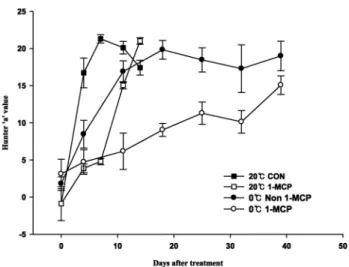
Fig. 7. Changes in Hunter ‘a’ value in ‘Formosa’ plums stored at 0℃ and 20℃ and either receiving 1 μL・L
-11-MCP treatment or no 1-MCP treatment at 10℃ for 24 h immediately after harvest. The values are the means of three replicates, and the bars represent standard error.
Fig. 8. Changes in chilling symptoms in ‘Formosa’ plums stored at 0℃ with 1 μL・L
-11-MCP treatment or without treatment at 10℃ for 24 h immediately after harvest. The values are the means of three replicates, and the bars indicate standard error.
high. 1-MCP-treated fruits at 0℃ storage did not show any changes throughout the storage period. High levels of ethanol and acetaldehyde are usually related to the development of overripe flavors (Hagenmaier and Baker, 1994), therefore, postharvest application of 1-MCP in plums is a way to prevent flavor loss during storage.
Exposure to 1-MCP also delayed changes in skin color (Fig. 7). The Hunter ‘a’ value dramatically increased in control fruit at 20℃ storage, achieving the highest value (21.3 ± 0.7) after seven days, while the Hunter ‘a’ value increased more slowly in 1-MCP-treated fruit, reaching the highest value (21.0 ± 0.9) after 13 days of storage at 20℃.
Fewer days were needed to reach the highest Hunter ‘a’
value in non-treated fruits compared to the number required in 1-MCP-treated fruit at 0℃. Fruit not treated with 1-MCP needed 25 days to reach the highest Hunter ‘a’ value, and fruit that did receive the treatment after 46 days in 0℃ storage still showed lower Hunter ‘a’ values compared to those of the non-treated fruits (Fig. 7). Abid et al. (1997) suggested that ethylene supported the formation of pigments in plums.
However, there was no ethylene production in either the non-treated and 1-MCP-treated fruit at 0℃ in the present study, although skin color change was observed (Fig. 1).
According to Oh et al. (2007) plum skin color can be changed abruptly with a very small amount of ethylene. It is also possible that factors other than ethylene effect fruit skin color.
Therefore, the plum color response to ethylene should be further investigated in the future.
Chilling injury occurred after 32 days in both the non- treated and 1-MCP-treated fruits at 0℃ (Fig. 8). Chilling injury was manifest as flesh browning due to internal decomposition.
The browning symptom occurs below the epidermis due to the enzymatic oxidation of polyphenols and tannins (Dodd, 1984). In our study, the incidence of chilling injury increased dramatically in both non-treated and 1-MCP-treated fruits after 32 days of 0℃ storage. In non-treated fruits, the chilling injury rate was 22% after 32 days of 0℃ storage, while the other 78% experienced chilling symptoms after 39 days.
The 1-MCP-treated fruits had a lower incidence of chilling injury than did the non-treated fruits. The chilling injury incidence values of 1-MCP-treated fruits in 0℃ storage were 11% and 43% after 32 days and 39 days of 0℃ storage, respectively (Fig. 8). Reduction of chilling injury incidence through postharvest application of 1-MCP has also been reported in ‘Fortune 2’ plums (Menniti et al., 2004). Decay which is induced by virus, bacteria, and fungi was affected by temperature, there was no difference in the decay incidences between non-treated and 1-MCP-treated fruits stored at 0℃;
both treatments showed few decay symptoms (Fig. 9). But at 20℃ storage temperature, decay was shown less in 1-MCP-treated fruits and 1-MCP treatment was effective to prevent decay. It was also reported that 1-MCP treatment for delaying decay was effective to maintain quality in plums (Oh et al., 2007).
We also found a contradictory result compared with that
of a previous report. In the present study, there was no
increase and no differences in respiration rate and ethylene
production between non-treated and 1-MCP-treated fruits at
0℃ at the early storage time. These results are different
from those with Tegan Blue Japanese plums, in which
ethylene increased in non-treated fruits at 0℃ storage
(Ahmad and Singh, 2008), some qualities of 1-MCP-treated
Table 1. Ethylene production and respiration rate in Formosa plums treated either with 1-MCP or without 1-MCP after 25 days of 0℃ storage, followed by three days of 20℃ storage.
Treatment Ethylene production
(μL・kg
-1・h
-1)
Respiration (CO
2mL・kg
-1・h
-1)
Non-treated Storage at 0℃ for 25 days 0 4.0 ± 0.33
zStorage at 0℃ for 25 days 20℃ for three days
10.3 ± 0.41
29.6 ± 0.93 Differences (△values)
= | A-B | 10.3 ± 0.41 25.6 ± 0.64
1-MCP-treated Storage at 0℃ for 25 days 0 2.2 ± 0.95
Storage at 0℃ for 25 days
20℃ for three days 0 18.7 ± 0.49
Difference (△values)
= | A-B | 0 16.4 ± 0.79
z
The values are the means of three replicates with standard errors.
Fig. 9. Changes in decay in ‘Formosa’ plums stored at 0℃ and 20℃ either with 1 μL・L
-11-MCP treatment or without treatment at 10℃ for 24 h immediately after harvest. The values are means of three replicates; the bars show standard error.
fruits, including firmness, TA, chilling injury, and production of ethanol and acetaldehyde, were better than those of fruits not treated with 1-MCP, which was similar to the results of a previous report (Ahmad and Singh, 2008).
Fruit Transportation
The 1-MCP effect was continuously investigated after storage at 0℃ for 25 days followed by transfer to 20℃ for three days during transportation. Ethylene production and respiration rates steeply increased to 10.3 ± 0.41 μL・kg
-1・h
-1and to 29.6 ± 0.93 mL・kg
-1・ h
-1, respectively, in the fruits without 1-MCP treatment, while 1-MCP-treated fruit did not show any ethylene production and had a lower respiration rate (18.7 ± 0.49 mL・kg
-1・h
-1) than did the non-treated fruits (Table 1). The differences in ethylene production and respiration rate between the initial (after being stored at 0℃
for 25 days) and the final times (being stored at 0℃ for 25 days then transferred to 20℃ for three days) were 10.3
± 0.41 μL・kg
-1・h
-1and 25.6 ± 0.64 mL・kg
-1・h
-1, respectively, in 1-MCP-treated samples and 0 μL・kg
-1・ h
-1and 16.4 ± 0.79 mL・kg
-1・h
-1, respectively, in non-treated samples. The values in the non-treated fruit were higher than those in samples treated with 1-MCP (Table 1), indicating that there was less metabolic activity occurring in 1-MCP-treated samples than there was in non-treated samples even at room temperature.
The quality values were more affected in non-treated fruits, possible due to the increased acetaldehyde and ethanol productions compared to those in the 1-MCP-treated fruits (Table 2). For non-treated fruits, firmness and TA decreased to 3.1 ± 0.77 N and 0.27 ± 0.04%, respectively, while those in the treated fruits were 8.01 ± 0.51 N and to 0.35 ± 0.07%, respectively. 1-MCP-treated fruits showed lower ethanol and acetaldehyde productions (8.1 ± 0.94 and 0.86 ± 0.11 μg・g
-1, respectively) compared to those of non-treated fruits (16.3
± 1.9 and 1.8 ± 0.23 μg・g
-1, respectively). The differences between the initial (after being stored at 0℃ for 25 days) and final values (being stored at 0℃ for 25 days then transferred to 20℃ for 3 days) are shown in Table 2.
‘Ooishiwase’ plums, which were stored at 0℃ for ten days before being kept at room temperature, showed similar results to those observed in the present study (Oh et al., 2007).
Therefore, the effect of 1-MCP endured even after the Formosa plums in the current study were transferred to room temperature for transportation if they had been first stored at 0℃ for 25 days.
It could be concluded 1-MCP treatment was more useful
to prolong shelf life and to maintain quality of plums at
20℃ than at 0℃ compared at the same temperature storage
by inhibiting ethylene production, respiration, softening,
decreasing of TA, ethanol production, increasing of color
Table 2. Hunter ‘a’ value, firmness, titratable acidity (TA), total soluble solids (TSS), and evaporation of ethanol and acetaldehyde after 25 days of 0℃ storage followed by three days of 20℃ storage in Formosa plums either treated with 1-MCP or receiving no treatment.
Treatment Firmness (N) TA (%) TSS (%) Acetaldehyde
(μg・g
-1)
Ethanol (μg・g
-1) Non-treated Storage at 0℃ for 25 days (A) 9.3 ± 0.93
z0.38 ± 0.03 11.5 ± 1.5 2.4 ± 0.87 168.9 ± 12.8
Storage at 0℃ for 25 days
20℃ for three days (B) 3.1 ± 0.77 0.27 ± 0.04 ± 0.29 18 ± 0.23 16.3 ± 1.9 Difference (△values)
= | A-B | 6.06 ± 0.80 0.11 ± 0.01 0.29 ± 0.05 1.15 ± 0.60 130.9 ± 7.0 1-MCP-treated Storage at 0℃ for 25 days (A) 11.6 ± 1.05 0.51 ± 0.08 11.4 ± 0.73 1.4 ± 0.25 6.2 ± 3.08
Storage at 0℃ for 25 days
20℃ㅋ for three days (B) 8.0 ± 0.51 0.35 ± 0.07 11.1 ± 0.70 0.86 ± 0.11 8.1 ± 0.94 Difference (△values)
= | A-B | 3.6 ± 0.29 0.16 ± 0.01 0.22 ± 0.75 0.34 ±0.06 10.1 ± 1.5
z