¶ Corresponding Author:Gil-Man Shin, Dept. of Tourism Management, Gwangju University, 277, Hyodeok-ro, Nam-gu, Gwangju 503-703, South Korea, Tel. +82-62-670-2965, Fax. +82-62-670-2864, E-mail: [email protected]
Culinary Science & Hospitality Research. 2016;22(1):42-51.
https://cshr.jams.or.kr/ ISSN 2466‐0752 (Print) ISSN 2466‐1023 (Online)
Quality Characteristics of Sponge Cake added with Pine Leaf Powder
Gil-Man Shin
¶Dept. of Tourism Management, Gwangju University
ABSTRACT: This study investigated the quality characteristics of sponge cake added with pine leaf pow- der. The pine leaf powder sponge cake was prepared with different ration of pine leaf powder(0, 10, 20, 30, 40%). The specific gravity, baking loss rate and cake weight increased significantly with increasing the levels of pine leaf powder. In terms of color, lightness and yellowness increased with increasing levels of pine leaf powder. The sponge cake added with ratio of 40% pine leaf powder appeared to be the highest. In terms of textual property evaluation, sponge cake were increased by the level of pine leaf powder. The substance's level of springiness, and cohesiveness decreased by increasing of the level of pine leaf powder. In sensory evaluation, 10% pine leaf e sponge cake was better on taste, overall accept- ability, and flavor. The results showed that sponge cake quality with 10% pine leaf powder was consi- dered the best.
Keywords: pine leaf powder, sponge cakes, quality characteristics, specific gravity, texture analysis, sen- sory evaluation
INTRODUCTION
Pine leaf, widely distributed softwood including Korea, Japan and China has been used for health since early years. The main bioactive ingredients of the pine leaf are pinene, b-pinene, camphene, bor- neol, phellandrene, etc and also contain quercertin, kaempferol of flavonoids[1]. Pine leaf has been re- ported that it had been used for making alcohol, tea and juice in chinese medicine or folk remedy and prevent pain, diabetes, high blood pressure, skin di- sorders, atherosclerosis, stroke, eczema, kidney di- sease, depression, stroke, colds, gastroenteritis. The- re are number of the studies of the addition of pine leaf powder; antioxidant activity of noodle with add- ed pine leaf powder[2], dough with added pine leaf powder[3], sausage with added pine leaf powder[4], the effect of pine leaf powder on blood and carcass
characteristic[5], noodle with added extract and pine leaf powder[6], rice madeleine with added pine leaf powder[7], tofu with added pine leaf powder[8], an- tioxidant activity of rice cupcake with added extract and pine leaf powder[9], physiological activity of Fomitella fraxinea mycelium cultured from brown rice with added rice bran, pine leaf and curcuma[10].
Eggs, flour and sugar is used as a basic ingredient to make sponge cake.
Fundamental Procedure
A typical sponge cake is made by beating the eggs with sugar until they are light and foamy, then carefully sieving and folding in the flour. There are two primary ways of making sponge cake; one way is to separate yolks from whites of eggs and whip each separately. The other way is to whipping the egg white and yolk at once[11]. Recently with in-
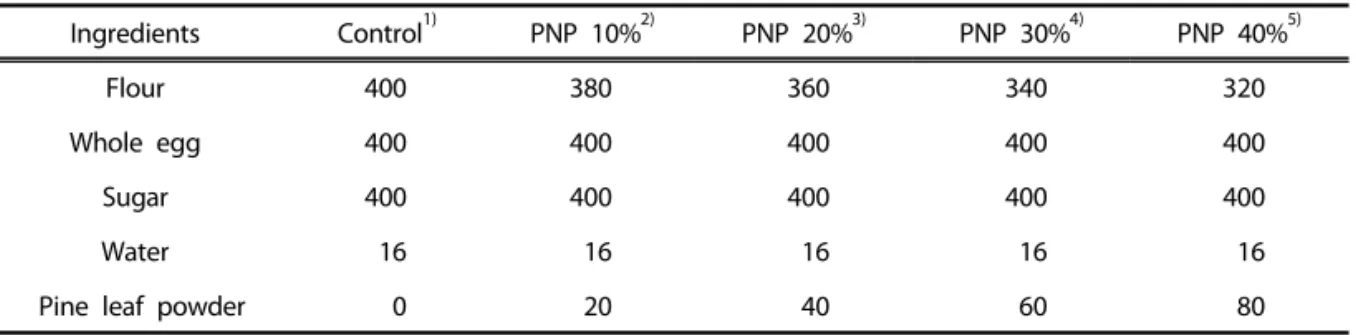
Ingredients Control1) PNP 10%2) PNP 20%3) PNP 30%4) PNP 40%5)
Flour 400 380 360 340 320
Whole egg 400 400 400 400 400
Sugar 400 400 400 400 400
Water 16 16 16 16 16
Pine leaf powder 0 20 40 60 80
1) Control: flour powder 100%.
2) PNP 10%: pine leaf powder 10% added.
3) PNP 20%: pine leaf powder 40% added.
4) PNP 30%: pine leaf powder 30% added.
5) PNP 40%: pine leaf powder 40% added.
Table 1. Standard formula for sponge cakes with pine leaf powder (g) creasing consumers’ interest and demand for func-
tional foods, it is current trend to add new materials on the sponge cake; rice sponge cake with added ar tuberosus powder[12], Sponge cake with added cinnamon powder[13], sponge cake with added pak- chio powder[14], sponge cake with added persim- mon leaves powder[15] sponge cake supplemented with soy fiber flour[16], sponge cake with added lav- er powder[17] As described above, sponge cake with added pine leaf powder also can be involved in the new product family. Therefore, the objective of this study was to examine the selected physicochemical properties such as pH, color, texture, flavor, weight, specific gravity, baking loss, and consumer accept- ances as influenced by the level of pine leaf powder incorporation(10, 20, 30, 40%) in cake making, and determine the appropriate level of incorporation based on the sensory acceptance.
MATERIAL AND METHOD
Materials
The materials used in the study were as follows : pine leaf powder(Chinese medicine store, Seoul, Korea), weak flour(KFMC Co., Dangjin, Korea) milled from American soft flour, eggs and sugar(Samyang, Co., Incheon, Korea), refined salt, water.
Material Mixing Ratio of Sponge Cake
The material ratio of the sponge cake used in this experiment is as follows in Table 1. Pine leaf powder were added at the level of flour 0%(control), 10%
(PNP10), 20%(PNP20), 30%(PNP30), 40%(PNP40). The material ratio of pine leaf powder and wheat flour was set through several preliminary experiments.
The sponge cake prepared without pine leaf powder was designated as control group. The sponge cake with added pine leaf powder by rate of 10, 20 30, 40% was designated as test group. The other materi- al ratio of sponge cake except for wheat flour and pine leaf powder were the same as in the control group.
Preparation of a Sponge Cake with the Addi- tion of Pine Needles Powder
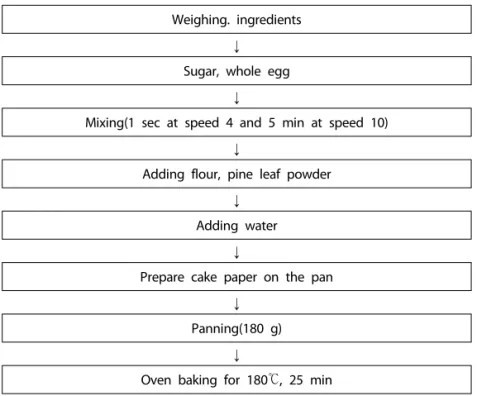
Method of producing a sponge cake with the ad- dition of pine leaf powder was prepared by the Hot sponge method which is the most common method on the shop floor. First, the eggs, sugar and salt was put into a stainless bowl, cooked in a double boiler at 45℃ and then, mixed with a Kenwoob mixer(Co., London United Kingdom) for 30seconds at dial 1, for 5 minutes at dial 4, for 5 minutes at dial 10 in sequence. The batter crust around mixing bowl was scraped out with a rubber spatula. Then, the batter mixture were further mixed for 30 seconds at dial 1. After that, water was added to the batter mixture, mixed well to the floor. Next, 180 g of the cake bat- ter was placed into No. 1 fan. The cakes were then transferred to a lightly greased baking tray and baked in an electric oven (Dae Yung Bakery, Machi- nery Co., Seoul) at upper temperature of 180℃ and lower temperature of 180℃ for 25 min. The baked cakes were removed from the baking pan, allowed to cool at room temperature for 1 hr before analysis.
Weighing. ingredients
↓
Sugar, whole egg
↓
Mixing(1 sec at speed 4 and 5 min at speed 10)
↓
Adding flour, pine leaf powder
↓ Adding water
↓
Prepare cake paper on the pan
↓ Panning(180 g)
↓
Oven baking for 180℃, 25 min
Figure 1. Diagram for making sponge cake containing pine leaf powder.
The Specific Gravity and pH of the Sponge Cake Batter with Added Pine Leaf Powder
The specific gravity of the sponge cake batter with added pine leaf powder was calculated using the equation below according to the AACC method 10~15[18].
Specific gravity(%)
W cup conaining — W cup
= ━━━━━━━━━━━━━━━━━━━━━ × 100 W cup conation water - W empty cup 10grams of cake batter and 45 mL of distilled water were mixed completely and the pH was measured 3 times using a pH meter (ORION Co., Ltd., Califor- nia, USA) as described in the [18].
Measurement of Height, Weight, Dough Yield and Baking Loss
The height of sponge cake was measured from 5 different points after cutting into pieces using tem- plate according to aacc 10~18[19]. The weight of sponge cake was measured with scale. The dough yield and baking loss were calculated with following equation.
Water holding capacity(%) W batter before baking
= ━━━━━━━━━━━━━━ × 100 W cake after baking
Baking loss(%)
W batter — W cake
= ━━━━━━━━━━━━ × 100 W batter
Measurement of Volume and Specific Volume
The volume of sponge cake prepared with differ- ent ration of pine leaf powder was measured by the method of seed substitution. The specific volume was calculated with following equation.Specific volume(mL/g) V sponge cake
= ━━━━━━━━━━ × 100 W sponge cake
Physicochemical Measurements of Sponge Cakes
The chromaticity of sponge cake (20×20×20 mm) was measured using a color meter (CE-7000, Mac- beth Spectrophotometer, New York, USA) calibrated with a white tile (Calibration palate CR-A43, L=95.91,Samples Specific gravity pH
Control 0.54±0.01a1) 6.91±0.10a
PNP 10%2) 0.54±0.00a 6.50±0.11b
PNP 20% 0.52±0.00b 6.43±0.05a
PNP 30% 0.50±0.02c 6.24±0.11b
PNP 40% 0.49±0.01d 5.90±0.01a
1) Values are mean±standard deviation(n+3).
2) Means with the same superscripts in the row are significantly different(p<0.05).
3) PNP : pine leaf powder.
Table 2. Specific gravity and pH added pine leaf powder a=0.00, b=2.27), and expressed as Hunter’s L(light- ness) a(redness) and b(yellowness) color values. The textural properties of cake (40×40×30 mm) were measured using a rheometer (Sun Scientific Co., Ltd., Tokyo, Japan). Operating conditions were as follows:
load cell: 2 kg, adaptor type: circle (diameter 20mm), table speed: 60 mm/min.
Sensory Evaluation
A panel of 20 assessors were selected from the students in the Department of Culinary Science at Gwangju University (Jeonnam, Korea) all assessors had been trained to get a taste of samples and ac- quainted with the method and properties of eva- luation. The assesors evaluated the appearance, col- or (internal and external), flavor, taste, texture, and overall acceptability (the level of preference from the customer’'s viewpoint) on a 5 point Likert scales.
All samples were presented to the size of 3×3×1 cm labeled with three-digit numbers in the white plate using a table of sampling digits. Evaluation items were color, appearance, flavor, taste, texture and overall acceptability.
Statistical Analysis
One-way analysis of variance (ANOVA) and Dun- can’'smultiple range test were performed for sig- nificant differences. The p-values less than 0.05 were considered statistically significant. One-way ANOVA, Pearson’'s correlation, and simple linear regression analyses were conducted using SPSS(SPSS 12.0 for windows, SPSS Inc., Chicago, IL, USA).
RESULT AND DISCUSSION
Specific Gravity and pH
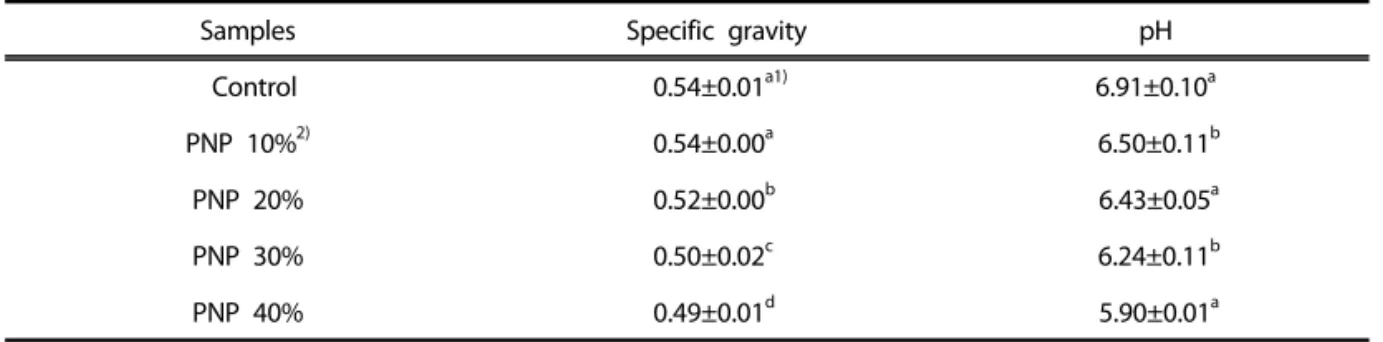
Table 2 shows the specific gravity and pH of the sponge cake batter with added pine leaf powder.
High specific gravity makes a compact and small vol- ume pole. In contrast, low specific gravity makes ri- gid internal injuries due to the lack of entrained air.
Specific gravity is influenced by the type of wheat flour, temperature, time and mixing conditions, mix- ing speed, existence and type of chemcal leavening agent. The specific gravity value of control group was 0.54 and gradually decreased as the added pine leaf powder increased, ranging from 0.50 to 0.54 in 10~40% sample groups. Similar result was reported for the rice cupcake prepared with pine leaf pow- der[20], sponge cake with added loutus root[21]. In terms of pH value, control group was measured to most lowest value of 6.91 and gradually increased as the added pine leaf powder increased, ranging from 5.90 to 6.50 in 10~40% sample groups. Other food ingredient such as yukwa prepared with Lycil fructus powder[22] caused similar increase in the pH value of sponge cake.
Cake Weight, Dough Yield and Baking Loss added Pine Leaf Powder
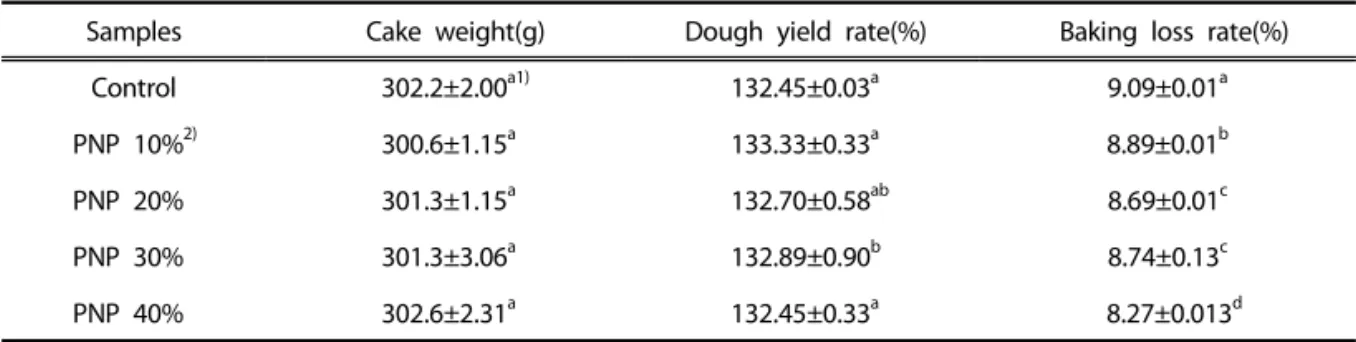
The weight of sponge cake batter with different ration of pine leaf powder(0, 10, 20, 30, 40%) be- fore/after baking, dough yield and baking loss is as follows in Table 3. There was no significant differ- ence in the weight of sponge cake batter among all
Samples Cake weight(g) Dough yield rate(%) Baking loss rate(%)
Control 302.2±2.00a1) 132.45±0.03a 9.09±0.01a
PNP 10%2) 300.6±1.15a 133.33±0.33a 8.89±0.01b
PNP 20% 301.3±1.15a 132.70±0.58ab 8.69±0.01c
PNP 30% 301.3±3.06a 132.89±0.90b 8.74±0.13c
PNP 40% 302.6±2.31a 132.45±0.33a 8.27±0.013d
1) Values are mean±standard deviation(n+3).
2) Means with the same superscripts in the row are significantly different(p<0.05).
3) PNP : pine leaf powder.
Table 3. Cake weight, dough yield and baking loss added pine leaf powder
samples. However, after baking, the control was measured to lowest value of 302.2 and those of 10~
40% samples ranged from 300.6 to 302.6. As the amount incorporated into the formulation increased, the weight of sponge cake significantly decreased (p<0.001). Similar decrease was observed for the sponge cake prepared with roasted black bean pow- der[23]. The dough yield of sponge cake in control group was 100.2% and gradually increased as the amount incorporated into the formulation increased, ranging 300.6% to 306.6% in 10~40% sample gr- oups. This result is considered to be due to the dif- ference between the weight of the samples. It was also reported baking loss is resulted from the dough puffed by the heat and water evaporation in the pores of the dough during baking process. In terms of baking loss, the control was 9.09% and tended to decrease as the pine leaf powder content in- creased, ranging from 8.89% to 8.27% in 10~40%
sample groups. Similar result was found for sponge cake made with pine leaf powder[24], sponge cake made with Ecklonia cava powder[25].
Cake Height, Volume and Specific Volume added Pine Leaf Powder
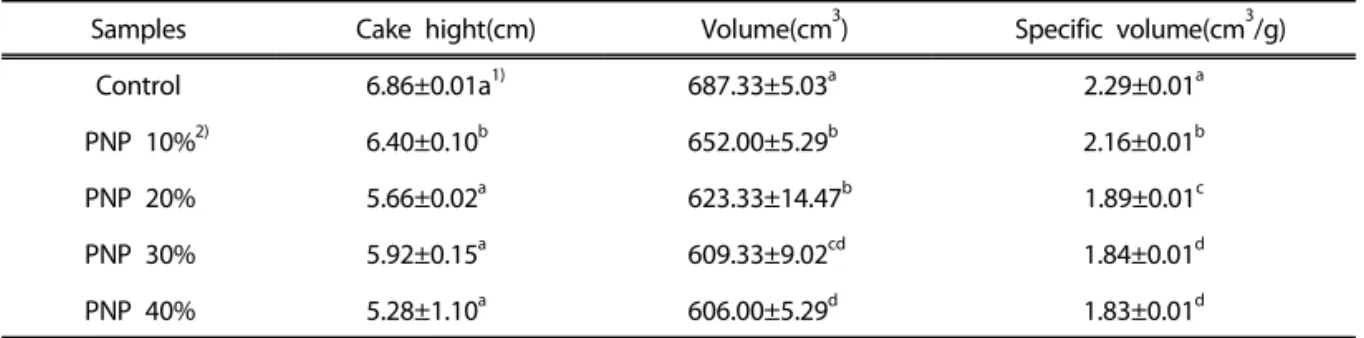
Table 4 shows cake was measured from 5 differ- ent point after cutting into pieces using template.
according to AACC(2000)10~15. The height value of sponge cake was highest for control group with 6.86cm and tended to decreased as pine leaf pow- der content increased, ranging from 5.28% to 6.40%
in 10~40% sample groups. Similar result was found for sponge cake made with beaknyuncho powder
[26]. Volume and specific volume added pine leaf powder were measured with the method of seed substitution. The volume was highest for the control cake with 687.33 cm3 and those of samples ranged from 652.00 to 606.00 cm3. As pine leaf powder con- tent increased, the volume tended to decreased significantly. In terms of specific volume, the value of control cake was observed to 2.29cm3/g and those of 10~40% sample groups ranged from 1.83 to 2.16 cm3/g. This indicates that the control cake had the highest specific volume, which decreased in proportion to the level of pine leaf powder(p<0.001).
It showed same result as the volume, which is con- sidered to be due to reduced flour content depend- ing on increased amount of added pine leaf powder.
A similar finding was reported for the sponge made with lotus leaf and lotus root powder[27].
Color Evaluation
The L(lightness) value of the sponge cake in- corporated with different levels of pine leaf powder was shown in Table 5. The L value of the control cake was observed to 49.68 and those of sample groups ranged from 35.18 to 46.79. This indicates that the control cake had the highest brightness, which decrease in proportion to the level of the pine leaf powder(p<0.001). Similar decreases in L are caused by the incorporation of other food in- gredient powders such as parprka[28] and laver[29].
Hunter a value (redness) of the control cake was 1.10 and gradually increased as the added pine leaf powder increased, resulting in the highest value of 6.42 for the cake containing 40% pine leaf powder.
Samples L a b
Control 49.68±0.33a1) 1.10±0.01a 34.32±0.10a
PNP 10%2) 46.79±0.28b 3.05±0.42c 24.04±0.05a
PNP 20% 45.19±0.66b 4.10±0.12a 23.97±0.33b
PNP 30% 37.93±1.30c 5.19±0.14c 22.77±0.66c
PNP 40% 35.18±0.43b 6.42±0.10c 22.37±1.05b
1) Values are mean±standard deviation(n+3).
2) Means with the same superscripts in the row are significantly different(p<0.05).
3) PNP : pine leaf powder.
Table 5. Hunter’s color value of sponge cake added pine leaf powder
Samples Cake hight(cm) Volume(cm3) Specific volume(cm3/g)
Control 6.86±0.01a1) 687.33±5.03a 2.29±0.01a
PNP 10%2) 6.40±0.10b 652.00±5.29b 2.16±0.01b
PNP 20% 5.66±0.02a 623.33±14.47b 1.89±0.01c
PNP 30% 5.92±0.15a 609.33±9.02cd 1.84±0.01d
PNP 40% 5.28±1.10a 606.00±5.29d 1.83±0.01d
1) Values are mean±standard deviation(n+3).
2) Means with the same superscripts in the row are significantly different(p<0.05).
3) PNP : pine leaf powder.
Table 4. Cake hight, volume and specific volume added pine leaf powder
Hunter b value (yellowness) of the control cake was the highest with 28.68 and decreased with the in- creasing level of the pine leaf powder, showing the value of 24.04~22.37 in 10~40% samples(p<0.001).
In a parallel study with red ginseng powder, as the amount incorporated into the formulation increased, b value decreased significantly. These result, the sig- nificant difference of L, a, b value between control group and pine leaf powder added groups are con- sidered to be attributable to the own color the pine leaf powder have itself. Formulation of the pine leaf powder with other food such as noodle[30] and ma- trimony vine caused similar result. As the amount in- corporated into the formulation increased, L de- creased while b increased significantly. Therefore, it could be stated that the L(lightness) value of the sponge cake was affected by the in coporation of pine leaf powder.
Texture Analysis
Previously reported, subsidiary ingredients affect the texture properties of sponge cake, and thus the textural characteristics of sponge cake with different ration of pine leaf powder(0, 10, 20, 30, 40%). The were determined as follows in Table 5. The hardness of the 10~40% samples group ranged 959.93 to 1156.75 was significantly higher than the control measured to 828.92 (g/cm2). In fact, the hardness value was significantly increased as the amount of pine leaf powder incorporated in the formulation increased. The hardness of the sponge cake was af- fected by moisture content of the cake, degree of pore development and volume. It was considered to be due to added pine leaf powder which interfered with bubble foaming, so that the batter was ob- structed to make the film of the bubble, resulting in the compact structure inside the cake. Similar re-
Samples Hardness(g/cm2) Springiness(%) Cohesiveness(%)
Control 828.92±2.26a1) 0.84.±0.04a 0.48±0.01a
PNP 10%2) 959.93±1.07b 0.80±0.01a 0.48±0.02a
PNP 20% 1,175.14±4.25c 0.83±0.06b 0.45±0.03b
PNP 30% 1,183.82±2.26a 0.74±0.09a 0.42±0.16c
PNP 40% 1,256.75±3.21c 0.73±0.01a 0.40±0.12b
1) Values are mean±standard deviation(n+3).
2) Means with the same superscripts in the row are significantly different(p<0.05).
3) PNP : pine leaf powder.
Table 6. Texture properties of sponge cake added pine leaf powder
Samples Appearance Flavor Taste Texture Overall
acceptability Control 4.9±1.50a1) 4.5±1.52a 4.5±1.80a 4.6±0.1a 4.7±1.51a PNP 10%2) 4.7±1.58a 4.6±1.58a 4.5±1.81a 4.5±0.5b 4.8±1.66a
PNP 20% 4.5±1.55a 4.3±1.54a 4.0±1.54ab 4.3±0.1b 4.1±1.70b
PNP 30% 4.3±1.70b 4.0±2.02ab 3.7±2.02b 4.0±0.1a 3.9±1.08b
PNP 40% 4.0±1.92b 3.7±2.09b 3.5±2.09b 3.9±0.2a 3.8±1.63b
1) Values are mean±standard deviation(n+3).
2) Means with the same superscripts in the row are significantly different(p<0.05).
3) PNP : pine leaf powder.
Table 7. Sensory properties of sponge cake added pine leaf powder sult was found for the sausage with added pine leaf
powder[31] and sponge cake with added Cudrania tricuspidata leaf powder[32]. The springiness value was highest for control group with 0.84 and sig- nificantly decreased, from 0.80 to 0.73 as added the pine leaf powder increased in the formulation. The cohesiveness value of control group was highest with 0.47 and gradually decreased with increasing the level of pine leaf powder, showing the value of 0.40~0.48 in 10~40% sample groups(p<0.001). The sponge cake with added pumpkin puree[33] and sponge cake with added artichoke powder[34] also caused similar decrease in the cohesiveness of sponge cakes.
Sensory Analysis
A 9-point hedonic scale was used to determine which sponge cake incorporated with different le-
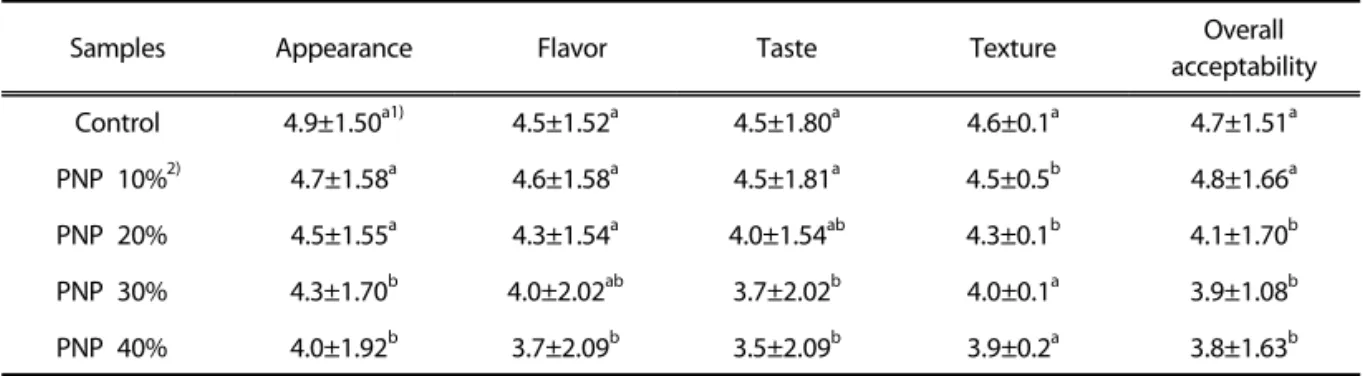
vels of pine leaf powder were preferred by the ma- jority of consumers. Table 7 shows the mean scores of consumer sensory results on the several attributes including appearance, taste, flavor, texture and over- all acceptability. In terms of appearance, the control received the most favorable mean scores of 4.9. and 10~40% sample ranged from 4.0 to 4.7 In fact, the appearance acceptance decreased as the percent of pine leaf powder incorporation increased in the formulation.
The consumer preferences on flavor were sig- nificantly affected by the amount of pine leaf pow- der incorporated in the sample. In the acceptability of flavor, the control received 4.5 and 10~40% sam- ple ranged 3.7 to 4.6 This result is consistent with the study of the rice cake with added pine leaf[34]
and cookie with added pine leaf powder[35].
In terms of taste, the control received the most
favorable mean scores of 4.5 and 10~40% sample received relatively low scores ranged 3.5 to 4.5.
There were significant differences found among the samples(p<0.001). In terms of texture, the control re- ceived 4.6 and 10~40% sample ranged from 3.9 to 4.5. In fact, as the amount incorporated into the for- mulation increased, the texture acceptance tend to decreased. Overall acceptability was the highest in control group with 4.6 and tended to decreased, from 4.5 to 3.9, with the increasing level of pine leaf powder. Similar result was found for the study on uniformity and moisture of pore, the importance of the cake with suitable volume, uniform organization, soft feel[36] and cookie made with lycii fructus[37].
Therefore, the results indicated that substituting 10% pine leaf powder to sponge cake is optimal for quality and provides a product with reasonable high overall acceptability.
RESULT AND DISCUSSION
This study was conducted to evaluate the effect of pine leaf powder on the quality characteristics of sponge cake. Pine leaf powder sponge cake was pre- pared with different ration of pine leaf powder(0, 10, 20, 30, 40%). The Specific gravity value of control group was 0.54 and gradually decreased as the add- ed pine leaf powder increased, ranging from 0.50 to 0.54 in 10~40% sample groups. In terms of pH val- ue, control group was measured to most lowest val- ue of 6.91 and gradually increased as the added pine leaf powder increased, ranging from 5.90 to 6.50 in 10~40% sample groups. However, after bak- ing, the control was measured to lowest value of 302.2 and those of 10~40% samples ranged from 300.6 to 302.6. As the amount incorporated into the formulation increased, the weight of sponge cake significantly decreased(p<0.001). The dough yield of sponge cake in control group was 100.2% and gra- dually increased as the amount incorporated into the formulation increased, ranging 300.6% to 306.6
% in 10~40% sample groups. This result is consid- ered to be due to the difference between the weight of the samples. In terms of baking loss, the control was 9.09% and tended to decrease as the pine leaf powder content increased, ranging from 8.89% to 8.27% in 10~40% sample groups.
The height value of sponge cake was highest for control group with 6.86cm and tended to decreased as pine leaf powder content increased, ranging from 5.28% to 6.40% in 10~40% sample groups. The vol- ume was highest for the control cake with 687.33 cm3 and those of samples ranged from 652.00 to 606.00 cm3. In terms of specific volume, the value of control cake was observed to 2.29cm3/g and those of 10~40% sample groups ranged from 1.83 to 2.16cm3/g. The L value of the control cake was observed to 49.68 and those of sample groups ranged from 35.18 to 46.79. Hunter a value (redness) of the control cake was 1.10 and gradually increased as the added pine leaf powder increased, resulting in the highest value of 6.42 for the cake containing 40% pine leaf powder. Hunter b value (yellowness) of the control cake was the highest with 28.68 and decreased with the increasing level of the pine leaf powder, showing the value of 24.04~22.37 in 10~
40% samples(p<0.001). The hardness of the 10~40%
samples group ranged 959.93 to 1,156.75 was sig- nificantly higher than the control measured to 828.92(g/cm2). In fact, the hardness value was sig- nificantly increased as the amount of pine leaf pow- der incorporated in the formulation increased. The springiness value was highest for control group with 0.84 and significantly decreased, from 0.80 to 0.73 as added the pine leaf powder increased in the formulation. The cohesiveness value of control gr- oup was highest with 0.47 and gradually decreased with increasing the level of pine leaf powder, show- ing the value of 0.40~0.48 in 10~40% sample groups(p<0.001). In terms of appearance, the control received the most favorable mean scores of 4.9. and 10~40% sample ranged from 4.0 to 4.7 In fact, the appearance acceptance decreased as the percent of pine leaf powder incorporation increased in the formulation.
The consumer preferences on flavor were sig- nificantly affected by the amount of pine leaf pow- der incorporated in the sample. In the acceptability of flavor, the control received 4.5 and 10~40% sam- ple ranged 3.7 to 4.6. In terms of taste, the control received the most favorable mean scores of 4.5 and 10~40% sample received relatively low scores ran- ged 3.5 to 4.5. In terms of texture, the control re- ceived 4.6 and 10~40% sample ranged from 3.9 to
4.5. In fact, as the amount incorporated into the for- mulation increased, the texture acceptance tend to decreased. Overall acceptability was the highest in control group with 4.6 and tended to decreased, from 4.5 to 3.9, with the increasing level of pine leaf powder. Therefore, the results indicated that sub- stituting 10% pine leaf powder to sponge cake is optimal for quality and provides a product with rea- sonable high overall acceptability.
ACKNOWLEDGEMENTS
This Study was conducted by research funds from Gwangju University in 2014(6).
REFERENCES
[1] Kim YS, Shin DH (2005). Volatile components and antibacterial effect of pine needle extracts. Kore- an J Food Microbiol 22(1):37-45.
[2] Kim IH, Ko YJ, Choi ID, Kim YG, Ryu CH, Shim KH (2012). Antioxidative activities of pine nee- dles and quality characteristics of Korean wheat noodle with pine needle powder. J Agriculture &
Life Sci 46(5):125-133.
[3] Shin GM (2015). Quality characteristics of sponge cakes occurred added with citrus peel powder.
Korean J Culinary Research 21(5):88-97.
[4] Guon SY, Shin MY, Iee KH (2012). Quality charac- teristics of sausage with added pine needle powder. J East Asian Soc Dietary Life 22(3):357- 364.
[5] Jin SY (2013). Quality characteristic and anti- oxidant activities of Majakgwa added pine nee- dle powder. J Korean Soc Food Nutr 44(2):150- 159.
[6] Jeon JR, Kim HH, Park GS (2005). Quality charac- teristics of noodles prepared with pine needle powder and extract during storage. J Korean Soc Food & Cookery Sci 21(1):685-692.
[7] Kim WJ, Kim JM, Cheong HS, Huh YR, Shin MS (2014). Antioxidative activity and quality charac- teristics of rice madeleine added with pine nee- dle powder and extract. J Korean Soc Food Sci Nutr 43(3):65-76.
[8] Chio GY, Kim HD, Bae JH (2007). Quality character- istics of sponge cakesoccurred with percentages
of persimmon leaves added with powedr added.
Korean J Culinary Research 13(4):269-278.
[9] Kim YJ (2011). Effects of dietary supplementation of pine needle powder on carcass characteristics and blood cholesterol contents of broiler chi- cken. Korean J Poultry Sci 38(1):51-57.
[10] Shin NG, Im JC (2008). Rheological properties of dough added with pine needle powder. Korean J Food Preserv 15(3):405-410.
[11] Shin GM, Shin SL, No HS (2005). Baeksan pu- blish. Seoul 35-37.
[12] Suh KH, Kim KH (2014). Quality characteristics of sponge cake added with Helianthus tuberosus powder. J East Asian Soc Dietary Life 29(2):195- 204.
[13] Lee SB, Lee JH (2013). Quality of sponge cakes supplemented with cinnamon. J Korean Soc Food Sci Nutr 42(4):650-654.
[14] Chung WG, Lee JH (2010). Quality characteristics sponge cake with containing sugar alcohols.
Korean J Culinary Research 16(4):305-311.
[15] Chio GY, Kim HD, Bae JH (2007). Quality charac- teristics sponge cake occurred with percentages of persimmon leaves powder added. Korean J Culinary Research 13(4):269-278.
[16] Park JY, Park YS, Chang HG. (2008). Quality char- acteristics of sponge cake supplemented with soy fiber flour. Korean J Food Sci Technology 40 (4): 412-418.
[17] Kweon BM, Jeon SW, Kim DS (2005). Quality characteristics sponge cake with addition of laver powder. J Korean Soc Food Sci Nutr 32 (2):1278-1284.
[18] AACC (1986). Official Method of the American Association of Cereal Chemists. 8th ed. Ameri- can Association of Cereal chemists St Paul MN U.S.A. 10-15.
[19] AACC (2000). Approved Method of the Ameri- can Association of Cereal Chemists. 10th ed.
American Association of Cereal Chemists St Paul MN U.S.A. 10-18.
[20] Kim WJ, Kim JM, Cheong HS, Huh YR, Shin MS (2012). Antioixdative activity and quality charac- teristics of rice cupcakes prepared with pine needle powder and extract. J Korean Soc Food Sci Nutr 28(5):31-39.
[21] Uoo IY, Kim CS, Chio HS, Song YS, Lee SG
(2006). Characteristics of sponge cake added with lotus root powders. J Korean Soc Food Sci Nutr 419(3):254-260.
[22] Park BH, Yang HH, Cho HS (2012). Quality char- acteristics and antioxidative effect of yukwa pre- pared with Lycii fructus powder. J Korea Soc Food Sci Nutr 41(6):741-751.
[23] Jung HA, Kim SH, Lee MA (2009). Storage qual- ity characteristics of sponge cake prepared with roasted black bean powder. Korean J Food Preserv 7(1):1139-1146.
[24] Lee JH, Lee SH (2013). Quality and antioxidant properties of sponge cakes incorporated with pine leaf powder. J Korean Soc Food Sci Nutr 45(1):53-5.
[25] Lee JH, Heo SA (2010) Physicochemical and sen- sory properties of sponge cakes incorporated with Ecklonia cava powder. Food Engineering Progress 14(3):222-228.
[26] Cho AR, Kim NY (2013). Quality characteristics of sponge cake containing beaknyuncho(Opun- tia ficus-indica var. saboten) powder. J East Asian Soc Dietary Life 23(1):107-118.
[27] Kwon MS (2015). Quality characteristics of sp- onge cake added with rice bran powedr. Kore- an J Culinary Research 21(3):168-180.
[28] Jeong CH, Kim JH, Cho JR, Ahn CG, Shin KH (2007). Quality characteristics sponge cake with upon addition of parprika powder. Korean J Food Preserv 14(1):281-287.
[29] Kim WJ, Kim JM, Huh YR, Shin MS (2012). An- tioxidant activities and quality characteristic of rice cupcakes prepared with pine needle pow- der and extract. Korean J Food Cookery 28(5):
613-622.
[30] Kim MK, Jeon TW, Chi HS, Kim JM (2011). Phy- siological activities of extracts from Fomitella fraxinea on brown rice added rice bran, pine needle and tumeric powder. Korean J Soc Food Cookery Sci 39(2):696-702.
[31] Lee JG, Seong YB, Teong BY, Yoon SJ, Lee IS, Jeong YH (2009). Characteristics of sponge cake added with black garlic powders. J Korean Soc Food Sci Nutr 38(9):1222-1228.
[32] Kim WJ, Chio HS (2001). Dry Spice. Hyoilbooks, Seoul Korea 161-167.
[33] Park BH, Yang HH, Cho HS (2012). Quality cha- racteristics and antioxidative effect of yukwa prepared with Lycii fructus power. J Korean Soc Food Sic Nutr 41(6):745-751.
[34] Lee HG, Han JY (2002). Sensory and textural characteristics of solsulgi using varied levels of pine leave powders and different type of sw- eetnes. Korean J Food Cookery Sci 18(1):164-172.
[35] Jeong HA, Kim SH, Lee MA (2009). Physicochemi- cal and consumer preference characteristics of tofu incorporated with pine needle powder.
Korean J Food Preserv 16(4):506-511.
[36] Mizukoshi M (1983). Model studies of cake bak- ing. Ⅲ. Effect of silicone on form stability of cake batter. American Cereal Chem 60(1):396- 400.
[37] Park YJ, Kim MH, Bea SJ (2002). Enhancement of anticarcinogenic effect by combination of Lycii fructus with vitamin c. J Korean Soc Food Sic Nutr 31(1):143-148.
Received: 16 DEC, 2015 Revised: 21 DEC, 2015 Accepted: 28 DEC, 2015