서 론 .
Ⅰ
, , ,
. , , ,
, , , , ,
, , , .
. ,
, 2 ,
,
[1-3], ,
, , , ,
[4-6], [7-9].
2005 ,
35.1%, 28.0% 1998 25.0%, 27.0%
[10],
. 23 (1979~2002)
, 1.7%
17.9% , 2.4% 10.9% , 1990
김응석1, 노연식1, 서광석1, 박성빈2, 윤형로1
1 ,2( )
The Novel Method of Segmental Bio-Impedance Measurement Based on Multi-Frequency for a Prediction of risk
Factors Life-Style Disease of Obesity
Eung-Seok Kim1, Yeon-Sik Noh1, Kwang-Seok Seo1, Sung-Bin Park2, Hyung-Ro Yoon1
1Dept. of Biomedical Engineering, Yonsei University
2Wonju Medical Industry TechnoVally (Received May 26, 2010. Accepted October 19, 2010)
The purpose of this study is to determine whether there is a correlation between the segmental bio-impedance measurement with the frequency modulations and the life-style disease of obesity. An obesity is not simply the factor for estimating the life-style disease of obesity, but also the risk factor occurring. There are many methods (BMI, WHR, Waist, CT, DEXA, BIA, etc.) for measuring a degree of obesity; the bio-impedance measurement is more economic and more effective than others.
The physical examination, the blood test, the medical imaging diagnosis and the bio-impedance measurements with multiple frequencies for each body parts have been conducted for 77 people. The estimated value has been calculated through a segmental bio-impedance model based on multi-frequency that was created to reflect the highest correlation by analyzing correlation with linear regression analysis method for the measured bio-impedance and the risk factors. Then we compared with the clinical diagnosis. In case of high level cholesterol, low HDL-C and high LDL-C for life-style disease, the sensitivity is 80~100% and the specificity is 83~100%. This study has shown conclusively that bio-impedance can be a possible predictor to analyze the disease risk rate of population and individual health maintenance. And also the multi-frequency segmental bio-impedance can be used as early predictor to estimate the life-style disease of obesity.
다중 주파수 (Multi-Frequency), 분할 체임피던스 (Segmental Bio-impedance), 비만 (Obesity), 생활습관병 (Life-style Disease)
Corresponding Author : 윤형로
강원도 원주시 흥업면 매지리234연세대학교 의공학과 Tel : +82-33-760-2431 / Fax : +82-33-763-1953 E-mail : [email protected]
.[11,12]. 10~13
80% [13],
. ,
.
, (CT), (DEXA),
,
, ,
,
BMI ,
,
.
.
. ,
.
,
, , ,
. ,
DEXA ,
, ,
. ,
.
,
.
,
.
시스템 설계 및 실험 .
Ⅱ
다중주파수 분할 체임피던스 분석을 위한 하드웨어 설계 A.
1)
, .
1kHz 500kHz
800uA
.
, DDS
.
. 1 . 2
.
. ,
· .
항목 사 양
입력 임피던스 80MΩ이상
고역 통과필터 80Hz 3dB cut-off
저역 통과필터 800kHz 3dB cut-off
측정 범위 0Ω~ 1kΩ의 측정 영역
표1. 전압검출 회로부의 사양
Table 1. Specification of voltage detection circuit part.
체임피던스 측정 시스템 설 명
선형전원 공급 장치
① 연결부 피검자 연결부
②
측정부위 선택장치부
③
절연 전원부
④
내부 래퍼런스 저항부
⑤ 통신부
⑥
전압 검출부
⑦
전류 인입장치부
⑧
위상 검출부
⑨ 표2. 제작된 체임피던스 측정 아날로그 시스템
Table 2. Analog system for measurement of bio-impedance.
.
2)
520MHz 32Bit Intel PXA270G
. ,
RTOS(Velos, MDS) .
7 UART, Ethernet / USB
Interface, Memory Card .
Interface .
Color 800x600 TFT-LCD , Touch screen
USB Mouse, Keyboard . 1
( ) .
3)
8 15 ~800 ,
좌측 사진 우측 사진
정면 사진 뒷면 사진
0.00 1000.00
기 준 장비 측 정값
800.00
600.00
400.00
200.00
0.00
200.00 400.00 600.00 800.00 1000.00 개발된 장비 측정 값
그림1. 개발된 장비 외형 모습 Fig. 1. External shape of Developed device
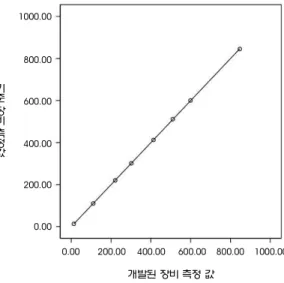
그림2. 체임피던스 측정 시스템의 선형성 Fig. 2. Linearity of bio-impedance measurement system
규격 시험 항목 시험 규격
IEC60601-1 전기적 기계적,
안전에 관한 규격
누설전류 시험 IEC60601-1 19. Continuous leakage currents and patient auxiliary currents
내전압 시험 IEC60601-1 20. Dielectric strength
접지저항 시험 IEC60601-1 18. Protective earthing,
functional earthing and potential equalization
과열 시험 IEC60601-1 42. Excessive temperatures
전원입력 시험 IEC60601-1 7. Power input
IEC60601-1-2 전자파 적합성에
관한 규격
Emission(Radiation) EN55011
Emission(Conduction) EN55011
Radiated Electric Field Immunity(RS) IEC61000-4-3
Conducted Disturbance(CS) IEC61000-4-6
lectrical Fast Transients / Burst IEC61000-4-4
Electrostatic discharge(ESD) IEC61000-4-2
Voltage DIP, Short interruption IEC61000-4-11 표3.안전성 검증을 위한 주요 규격 항목
Table 3. The principle Standard indices for validation of safety
1
. 15
~800 (50kHz)
2 .
4)
.
, IEC60601-1 IEC60601
-1-2 .
( 3)
, .
실험 대상 및 방법 B.
1)
77 ,
18 70
. ,
.
. ,
.
, , ,
, .
.
, ,
. 4 .
Total N=77
Female(N=42) Male(N=35)
Mean SD Min Max Mean SD Min Max
Age 47.19 14.5 18 74 47.26 15.35 23 70
Height(cm) 154.55 6.94 139.8 173 169.06 5.16 157.9 178.6
Weight(kg) 57.53 6.73 42.6 71 68.7 9.95 50.5 91.4
Waist(cm) 77.45 7.61 65 95 82.66 7.62 69 95.5
Hip(cm) 94.798 4.913 86 108 95.443 5.007 88 106
WHR 0.816 0.067 0.69 0.96 0.867 0.059 0.76 0.99
BMI 24.133 2.871 17 29.2 23.977 2.73 19 29.8
몸무게 신장
BMI = (kg) ÷ { (cm)}2 표4. 피검자 신체정보 기초통계 결과
Table 4. Basic statistics results for physical information of subjects
Total N=77 Female(N=42) Male(N=35)
Mean SD Min Max Mean SD Min Max
수축기 혈압(mmHg) 122.5* 6.91 92 170 131.2 19.31 94 192
이완기 혈압(mmHg) 75.5 10.71 52 100 79.71* 12.52 57 115
총콜레스테롤(mg/dL) 183.26 28.46 129 257 189.11 28.32 137 258
중성지방(mg/dL) 106.7* 97.1 32 680 130.5* 66.1 43 280
콜레스테롤
HDL- (mg/dL) 63.88 13.5 40 105 57.6 17.14 33 102
SGOT(mg/dL) 27.52* 8.72 15 61 29.14* 9.11 19 56
SGPT(mg/dL) 21.62* 11.92 6 55 27.43* 16.71 11 84
GT(mg/dL)
γ 20.36* 21.54 6 137 46.43* 46.73 11 192
공복혈당(mg/dL) 92.64 6.6 78 115 98.69* 26.14 33 195
* P < 0.1 표5.피검자 혈압 및 혈액검사 결과
Table 5. A Blood pressure and a Blood test results of subjects
2)
. .
, (TC), (TG),
(HDL), (LDL-C), SGOT
( ), SGPT, GT, hCRP γ , LDL-C
. 5 . ,
, .
3) -
.
. ,
.
[14]. -
.
. , [15,16].
4 4
전압 전극 전류 전극
오른팔 왼팔 몸통 오른다리 왼다리
그림3.분할 체임피던스 측정방법
Fig. 3. Method for bio-impedance measurements for each body parts
그림4.다중주파수 분할 체임피던스 측정 장면
Fig. 4. Scene of multi-frequency segmental bio-impedance measurement
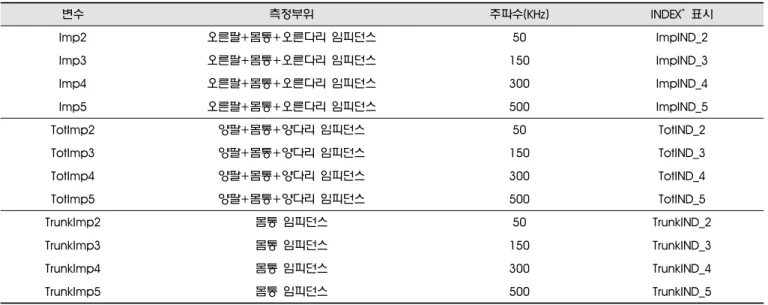
변수 측정부위 주파수(KHz) INDEX*표시
Imp2 오른팔 몸통 오른다리 임피던스+ + 50 ImpIND_2
Imp3 오른팔 몸통 오른다리 임피던스+ + 150 ImpIND_3
Imp4 오른팔 몸통 오른다리 임피던스+ + 300 ImpIND_4
Imp5 오른팔 몸통 오른다리 임피던스+ + 500 ImpIND_5
TotImp2 양팔 몸통 양다리 임피던스+ + 50 TotIND_2
TotImp3 양팔 몸통 양다리 임피던스+ + 150 TotIND_3
TotImp4 양팔 몸통 양다리 임피던스+ + 300 TotIND_4
TotImp5 양팔 몸통 양다리 임피던스+ + 500 TotIND_5
TrunkImp2 몸통 임피던스 50 TrunkIND_2
TrunkImp3 몸통 임피던스 150 TrunkIND_3
TrunkImp4 몸통 임피던스 300 TrunkIND_4
TrunkImp5 몸통 임피던스 500 TrunkIND_5
*INDEX =
×
표6.체임피던스 측정 변수 구성
Table 6. The composition of variables for bio-impedance measurements
.
.
.
, .
3 , 6
.
50KHz ~ 500KHz 4 (50, 150, 300, 500KHz) .
,
4
. 4
.
4)
, .
.
, BMI, WHR, ,
CT(LightSpeed VCT XTe, GE Healthcare Co., Ltd.), DEXA (Lunar Prodigy®, GE Healthcare Co., Ltd.)
.
구분 변수성격 변수
생활습관병의 위험인자 종속 혈압 공복혈당, , SGOT, SGPT, γGT,비만 콜레스테롤, , HDL-콜레스테롤, 콜레스테롤 중성지방
LDL- ,
생활습관병 종속 고혈압 당뇨병 고콜레스테롤혈증 저, , , HDL-콜레스테롤혈증,
고LDL-콜레스테롤혈증 중성지방혈증 간질환, ,
예측인자 비만평가법( ) 독립 BMI, WHR, WAIST, CT, DEXA,체임피던스
보정변수 독립 AGE, SEX, WEIGHT, HEIGHT
표8.분석변수의 종류
Table 8. The types of analysis variables
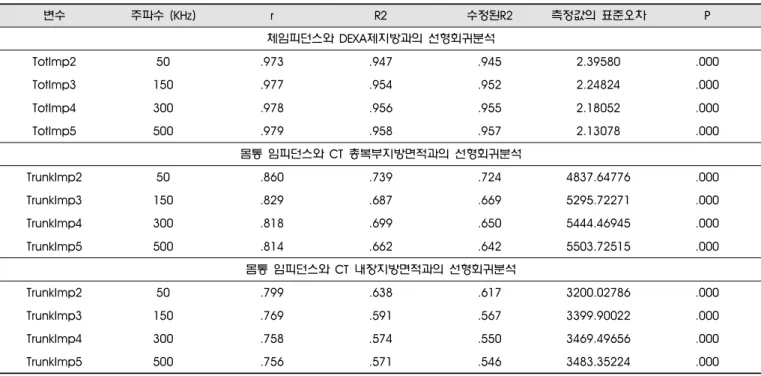
변수 주파수 (KHz) r R2 수정된R2 측정값의 표준오차 P
체임피던스와DEXA제지방과의 선형회귀분석
TotImp2 50 .973 .947 .945 2.39580 .000
TotImp3 150 .977 .954 .952 2.24824 .000
TotImp4 300 .978 .956 .955 2.18052 .000
TotImp5 500 .979 .958 .957 2.13078 .000
몸통 임피던스와CT 총복부지방면적과의 선형회귀분석
TrunkImp2 50 .860 .739 .724 4837.64776 .000
TrunkImp3 150 .829 .687 .669 5295.72271 .000
TrunkImp4 300 .818 .699 .650 5444.46945 .000
TrunkImp5 500 .814 .662 .642 5503.72515 .000
몸통 임피던스와CT내장지방면적과의 선형회귀분석
TrunkImp2 50 .799 .638 .617 3200.02786 .000
TrunkImp3 150 .769 .591 .567 3399.90022 .000
TrunkImp4 300 .758 .574 .550 3469.49656 .000
TrunkImp5 500 .756 .571 .546 3483.35224 .000
표7. 체임피던스와CT, DEXA의 상관성 분석
Table 7. Correlation analysis between bio-impedance and CT, DEXA
개발된 체임피던스 측정 시스템의 유효성 검증 C.
DEXA, CT . 8 ,
0.01 75.6%~ 97.9%
.
결 과 .
Ⅲ
분석 방법 A.
8 .
.
. 0.05
age, sex, height, weight .
SPSS(Ver. 12) .
생활습관병의 위험인자와 예측인자 간의 상관성 분석 B.
9 .
4 (50, 150, 300, 500 KHz)
.
.
. 9
.
50, 150KHz ,
. CT
DEXA ROI(Region of Interest) . CT
VSR 500KHz ,
CT .
4 .
,
[17,18] .
.
50KHz HDL, LDL
500KHz
DEXA BMI .
, .
[19-21]
BMI , CT
BMI WHR 허리
둘레
VSR (CT)
내장지방 (CT)
전체 지방량 (DEXA)
ROI
(DEXA) 체임피던스
R2 R2 R2 R2 R2 R2 R2 R2 사용변수
수축기혈압 .190** .150** .187** .081* .246** .211** .151** .253** TrunkImp3
이완기혈압 .100* .049 .062 .038 .048 .118 .105* .147* TrunkImp2
공복혈당 .033 .080* .067 .182** .120** .087 .036 .161* TrunkImp5
총콜레스테롤 .106* .089* .089* .012 .065 .102* .066 .185** TrunkImp2
콜레스테롤
HDL- .087* .090* .114* .091* .154** .142* .098* .164** Imp5
콜레스테롤
LDL- .165** .082* .127** .017 .090* .171** .089* .235** Imp5
중성지방 .023 .075 .042 .054 .073 .049 .042 .056 Imp3
SGOT .010 .068 .014 .121** .051 .107* .009 .114* TrunkImp4
SGPT .059 .089* .068 .182** .097** .056 .064 .054 TrunkImp5
rGT .127** .179** .132** .298** .202** .153** .139** .166* TrunkImp5 비만(DEXA) .744** .664** .776** .545 .726** .801** .835**
*p 0.05,≤ **p 0.01≤ 표9.위험인자들과 예측인자들 간의 설명력
Table 9. The interrelationship between the risk factors and the estimated values
, BMI DEXA
. CT
300KHz, 500KHz .
[22,23] .
CT VSR , WHR
SGOT, SGPT, GT γ
.
. CT
. [24] ,
WHR, BMI
, HDL , LDL ,
,
. ,
.
예측인자를 통한 비만관련 생활습관병 추정과 판정비교 C.
. 9
. 10 , LDL,
, HDL
SGPT
. ,
, ,
.
고 찰 .
Ⅳ
. ,
.
,
. ,
9 ,
, , HDL LDL
5 CT
, SGOT, SGPT γ GT 4 .
. , SGOT
.
.
. , , LDL
, HDL 80% 80%
. , ,
.
Sensitivity* (%) Specificity** (%)
고혈압 80 94
내당능장애이상 29 80
고TG혈증 80 83
고LDL혈증 86 100
저HDL혈증 100 99
고 중성지방혈증 25 98
간질환 59 73
*
**
표10.비만관련 생활습관병의 추정과 실제 판정 비교
Table 10. The comparison results between the clinical diagnoses and estimations of the life-style diseases of the obesity
.
.
.
. ,
.
.
,
. ROC
.
결 론 .
Ⅴ
,
. ,
.
참고문헌
[1] C.G. Solomon, and J.E. Manson, “Obesity and mortality: a review of the epidemiologic data,ˮ American Journal of Clinical Nutrition., vol.66, pp.1044S-1050S, 1997.
[2] A.R. Sinaiko, D.R. Jr Jacobs, J. Steinberger, A. Moran, R.
Luepker, and A. Rocchini, “Insulin resistance syndrome in childhood: associations of the euglycemic insulin clamp and fasting insulin with fatness and other risk factors,ˮ J Pediatr., vol.139, pp.700-707, 2001.
[3] J. Steinberger, and S.R. Daniels, “Obesity, Insulin resistance, Diabetes and Cardiovascular risk in children,ˮ Circulation., vol.107, pp.1448-1453, 2003.
[4] J.P. Despres, “Health consequences of visceral obesity,ˮ Ann Med., vol.33, pp.534-541, 2001.
[5] J.F. Ascaso, P. Romero, J.T. Real, R.I. Lorente, J. Martinez-Valls, and R. Carmena, “Abdominal obesity, insulin resistance, and metabolicsyndrome in a southern European population,ˮ Eur J
Intern Med., vol.14, pp.101-106, 2003.
[6] E.H. Kong, “Obesity and dyslipidemia,ˮ Journal of the Korean Academy of Family Medicine., Training course for a opening hospital, pp.55-59, 2005.
[7] J.P. Despres, “Is visceral obesity the cause of the metabolic syndrome?,ˮ Ann Med., vol.38, pp.52-63, 2006.
[8] D.B. Carr, K.M. Utzschneider, R.L. Hull, K. Kodama, B.M.
Retzlaff, J.D. Brunzell, “Intra-abdominal fat is a major determinant of the National Cholesterol Education Program Adult Treatment Panel III criteria for the metabolic syndrome,ˮ Diabetes., vol.53, pp.2087-2094, 2004.
[9] M.J. Williams, G.R. Hunter, T. Kekes-Sazabo, S. Snyder, and M.S. Treuth “Regional fat distribution in women and risk of cardiovascular disease,ˮ American Journal of Clinical Nutrition., vol.65, pp.613-617, 1997.
[10] Korea Center for Disease Control and Prevention “National health and nutrition survey 3rd(2005) Health Examination Survey, 2006ˮ
[11] Y. Matsuzawa, “White adipose tissue and cardiovascular disease,ˮ Best Prac Res Clin Endocrinol., vol.19, pp.637-647, 2005.
[12] A.L. Rosenbloom, J.R. Joe, R.S. Young, and N.E. Winter,
“Emerging epidemic of type2 diabetes in youth,ˮ Diabetes Care., vol.22, pp.345-354, 1999.
[13] K.M. Flegal, M.D. Carroll, R.J. Kuczmarski, and C.L. Johnson,
“Overweight and obesity in the United States: Prevalence and trends, 1960-1994,ˮ Int J Obes Relat Metab Disord., vol.22, pp.39-47, 1998.
[14] A. Pietrobelli, P. Morini, N. Battistini, G. Chiumello, C. Nunez, and S.B. Heymsfield, “Appendicular skeletal muscle mass:
prediction from muliple frequency segmental bioimpedance analysis,ˮ Eur. J . Clin. Nutr., vol.52(7), pp.507-511, 1998 [15] B.H. Cornish, A. Jacobs, B.J. Thomas, and L.C. Ward,
“Optimizing electrode sites for segmental bioimpedance measurements,ˮ Physiol. Meas., vol.20, pp.241-250, 1999.
[16] N.J. Fuller, and M. Elia, “Potential use of bioelectrical impedance of the 'whole body' and of body segments for the assessment of body composition: comparison with densitometry and anthropometry,ˮ Eur. J Clin. Nutr., vol.43, pp.779-791, 1991.
[17] N.M. Kaplan, “The Deadly Quartet,ˮ Arch Intern Med., vol.149, pp.1514-1520, 1989.
[18] P. Bjorntorp, “Abdominal obesity and metabolic syndrome,ˮ Ann Med., vol.24, pp.465-468, 1992.
[19] A.R. Folsom, L.H. Kushi, K.E. Anderson, P.J. Mink, J.E. Olson, C.P. Hong, T.A. Sellers, D. Lazovich, and R. Prineas,
“Associations of general and abdominal obesity with multiple health outcomes in older women: the Iowa Women's Health Study,ˮ Arch Intern Med., vol.160, pp.2117-2128, 2000.
[20] C. Bouchard, G.A. Bray, and V.S. Hubbard, “Basic and clinical aspects of regional fat distribution,ˮ Am J Clin Nutr., vol.52 pp.946-950, 1990.
[21] R.J. Prineas, A.R. Folsom, S.A. Kaye, “Central adiposity and increased risk of coronary artery disease mortality in older women,ˮ Ann Epidemiol., vol.3, pp.35-41, 1993.
[22] P. Angulo, “Nonalcoholic fatty liver disease,ˮ N Engl J Med., vol.346, pp.1221-1231, 2002.
[23] A. Schäffler, J. Schölmerich, and C. Büchler, “Mechanisms of disease: adipocytokines and visceral adipose tissue--emerging role in nonalcoholic fatty liver disease,ˮ Nat Clin Pract Gastroenterol Hepatol., vol.2, pp.273-280, 2005.
[24] E.D. Jung, H.S. Sohn, and J.H. Lee, “Original Articles : The
Correlation between Central Obesity and Glucose, Lipid Metabolism and Macrovascular Complication in Elderly Type 2 Diabetes,ˮ Korea Diabetes Association., vol.31(4), pp.343-50, 2007.