Characteristics of Static Balance in Patients With Adolescent Idiopathic Scoliosis
Seung-sub Shin, B.H.Sc., P.T.
Dept. of Physical Therapy, The Graduate School, Sahmyook University
Young-keun Woo, M.Sc., P.T.
Dept. of Physical Therapy, Andong Science College
Abstract 1)
The purpose of this study was to compare the static balance of standing position between adolescent idiopathic scoliosis (AIS) and a normal group that were aged-matched. There were forty subjects in- cluded in this study. Twenty-seven healthy subjects (age, 13.9±1.2 yrs; height, 161.9±7.5 ㎝; weight, 52.2±7.7 ㎏) and thirteen AIS subjects (age, 14.2±2.2 yrs; height, 161.5±8.7 ㎝; weight, 48.1±8.1 ㎏) were participated in the study. The thirteen subjects in the AIS group had a major Cobb angle between 20.1°
and 49°. Each group was tested with the Balance Performance Monitor (BPM). The parameters for static balance were sway area, sway path, max velocity, mean balance, anterior-posterior angle, and left-right angle of each group with their eyes opened and again with their eyes closed. Both sides of the forward reach test and the lateral reach test were also performed on each group. Results from the BPM tested showed significantly increases in all parameters of static balance with those patients with AIS under the conditions where eyes were opened and closed. In the right and left forward reach test, there was no significant difference between normal and AIS groups. However, in the lateral reach test with right and left direction, there were significant differences between normal and AIS groups. For the normal subjects, there were significant differences in the parameters with sway path and anterior-posterior sway angle between the eyes opened and closed. However, there were no significant differences in the all parameters between eyes opened and closed for the AIS subjects. These results suggest that, balance programs could be used in the rehabilitation setting for intervention of AIS and evaluation of AIS. Further study is need- ed to measure many patients with AIS and other functional balance scales for clinical application.
Key Words: Adolescent idopathic scoliosis; Balance control; Standing stability.
Introduction
The ability to balance requires that the body's center of gravity or mass lie over the base of support. Therefore, understanding the mechanisms involving balance impairment may lead to improve- ments in treatment and outcome in the rehabilitation population (Nashner, 1989). The continuous use of the information from somatosensory, proprioceptive, visual, and vestibular sources is critical for main- taining postural control in humans. This information is analyzed and integrated in the central nervous system, which then sends efferent signals to activate
appropriate postural muscles (Nashner and Peters, 1990). In the presence of disease or dysfunction in the relevant parts of the nervous and musculoskeletal system the ability to control balance may be im- paired (Maki and Mcllroy, 1996).
Adolescent idiopathic scoliosis (AIS) is a common
disorder that occurs within families for unknown
reasons (Mirovsky et al, 2006). AIS has been found
in the muscular imbalance between the two sides of
the spine (Ford et al, 1988). AIS sufferers have the
postural alterations in the orientation of the head,
shoulders, scapula, and pelvis within all three planes,
and rotations of body segments in the horizontal
Corresponding author: Young-keun Woo [email protected]
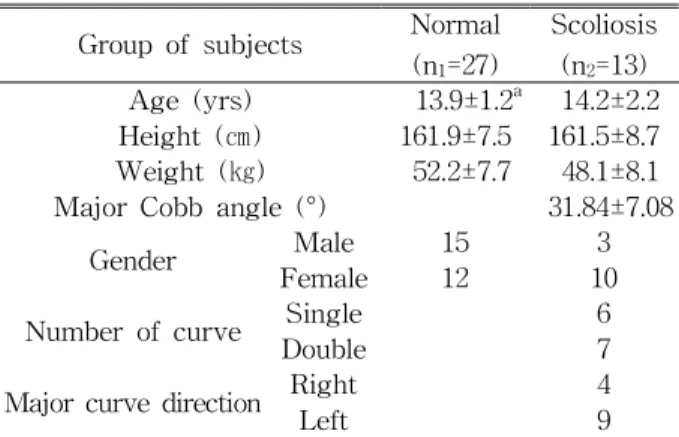
Group of subjects Normal (n
1=27)
Scoliosis (n
2=13) Age (yrs) 13.9±1.2
a14.2±2.2 Height (㎝) 161.9±7.5 161.5±8.7 Weight (㎏) 52.2±7.7 48.1±8.1 Major Cobb angle (°) 31.84±7.08
Gender Male 15 3
Female 12 10
Number of curve Single 6
Double 7
Major curve direction Right 4
Left 9
a
Mean±SD.
Table 1. Demographic data of study subjects (N=40) plane (Le Blanc et al, 1997). Simoneau et al (2006)
reported that AIS interferes with the neural mecha- nism that is necessary to maintain the balance commands. The remaining sensory information should come from the sole of the feet. And, AIS pa- tients have the body imbalances that are induced by disturbances in systems such as visual, vestibular and somatosensory systems might lead to scoliosis (Wiener-Vacher and Mazda, 1998). Byl et al (1997) and Lindstrom et al (1988) were reported that AIS is associated with disorders of parameters within pos- tural control and with an abnormal center of foot pressure position, it could be expected that this dis- ease may leads to impaired balance control.
Impairments in the structure and functioning of pe- ripheral systems are important and might explain the balance dysfunction observed in AIS (Simoneau et al, 2006). These postural changes in body attitude asso- ciated with scoliosis could be linked with standing instabilities (Nault et al, 2002). The criteria for a successful treatment methods in the AIS should be based on several body posture parameters and the quality of standing stability (Nault et al, 2002).
Many studies have been reported on age-related physiologic decline in multiple balance-associated sys- tems; this leads to significant balance and functional impairments in older adults (Bergin et al, 1995;
Grimston et al, 1993). In addition, researches have also reported results on comparisons in decreased ability of postural control between patients with neurological dis- orders, normal subjects or young people and the elderly (Grealy et al, 1999; Laughton et al, 2003; Tinetti et al, 1988). To our knowledge, in Korea, few investigators have reported on the balance deficit in AIS, and many studies have not been focused on rehabilitation includ- ing balance-training programs. Therefore, the objective of this study was to investigate the characteristics of static balance in patients with AIS and the importance of providing balance-training programs during the re- habilitation process.
Methods Subjects
Forty subjects were included in this study.
Twenty-seven healthy subjects, 15 males and 12 fe- males, volunteered as the normal group with age-matched AIS subjects. The mean age of the healthy subjects was 13.9±1.2 years, their height 161.9±7.5 ㎝, and their weight 52.2±7.7 ㎏. The thir- teen subjects with AIS were grouped as 3 males and 10 females, with a major Cobb angle between 20.1°
and 49°. Six subjects had single major curves, seven subjects had compensatory double curves, and four subjects' curves were directed to the right and nine subjects' curves were directed to the left. The same orthopedic surgeon evaluated all the stand-up radio- graphs to determine the location, direction and Cobb angles of each AIS subject’s spinal curve. The mean age of the AIS subjects was 14.2±2.2 years, their height 161.5±8.7 ㎝, and their weight 48.1±8.1 ㎏.
Subjects with scoliosis who displayed signs and
symptoms of headache, numbness or weakness of
one or more limbs, unsteadiness, loss of thermal
sensation, diploma, dysphasia, tinnitus, vomiting, and
dysarthria were excluded (Guo et al, 2006). Informed
consent was obtained from all the AIS subjects and
theirs parents before the data collection. No stat-
istical difference was found between the two groups
in terms of age, height, or weight (Table 1).
Measures
The Functional Reach Test (FRT)
The FRT test is used as a test of static balance.
The subject flexed one arm to an angle of 90°, while standing with legs about shoulder width apart, sub- jects are asked to reach as far forward as possible along a meter stick mounted at shoulder height. The tip of the subject’s middle finger in relation to the meter stick in both the starting position and ending position was evaluated. The distance between the starting and ending positions of the middle finger tip was recorded to the nearest .1 ㎝ as the magnitude of the subject’s reach. The FRT has been reported to have a correlation with the center of press excursion (r=.71) and the high inter-rater and test-retest reli- ability (Duncan et al, 1990). It was precise (coefficient of variation=2.5%) an inexpensive and re- liable and valid tool for measuring the limits of sta- bility in the forward direction with old adults (Duncan et al, 1990; Newton, 2001). The FRT is one of the most reliable and valid measures of balance disability for post stroke patients (Tyson and Desouza, 2004). We allowed one trial on each side of the arm. No practice session was allowed.
The Lateral Reach Test (LRT)
The LRT measures lateral postural stability. The subject abducted one arm to and angle of 90°, while standing with legs about shoulder width apart, the subject’s acromion is lined up with the edge of the meter stick and then reaches to the side as far as possible, while keeping both feet flat on the floor. No knee flexion was permitted and no trunk rotation or flexion was allowed (Brauer et al, 1999). The tip of the subject’s middle finger in relation to the meter stick in both the starting position and ending posi- tion was evaluated. The distance between the start- ing and ending positions of the middle finger tip was recorded to the nearest .1 ㎝ as the magnitude of the subject’s reach. A limitation is that the FRT meas-
ures only the limits of the anterior direction of the standing stability (Dewaard et al, 2002). Maki et al (1994) have shown the medial lateral postural stabil- ity was a significant factor at risk for falling in old adults. The LRT had high test-retest repeatability (r=.94) in healthy older women and a significant cor- relation with center of press excursion (r=.33) (Brauer et al, 1999). We allowed one trial on each side of the arm. No practice session was allowed.
Balance Performance Monitor (BPM)
2)The BPM
1)was used to measure postural sway of the static standing position. The BPM is a portable unit with three individual moveable footplates and one seat plate. In this study, only two footplates were used for data collection (Figure 1). The foot- plates were linked to a computer with SMS Dataprint software (version 5.3a). When the subject stood on the foot plates, postural sway was repre- sented by horizontal and vertical sets of colored lights on the display console. The green lights repre- sented that the body weight is distributed equally, the red lights represented it is unequal in the outer range of the base of support. The subject stood on the foot plates and made the weight distribution equal while watching the display console. The subject was asked to look forward and standing still for the duration of the 30 seconds static test. The display console was not in view during the recording. The subject performed 3 trials with two visual conditions, namely, eyes opened and eyes closed. After perform- ing 3 trials with one visual condition, the subject performed 3 trials with the other visual condition.
Approximately 3 seconds break was allowed between trials and a 1-minute break was allowed when the visual condition was changed. The visual condition was selected in no particular order and the mean value of 3 trials of each visual condition was used for data analysis.
The BPM provides data on standing balance for
mean balance, sway angle, sway area, sway path,
1) SMS Healthcare, Harlow, UK.
Figure 1. The Balance performance monitor.
and max velocity. The mean balance is calculated as the mean or average weight shift over the 30 sec- onds test. This is displayed as a percentage of total body weight. Left (L) or right (R) is used in in- dicating the greatest weight shift with percentages.
The sway angle is measured from the normal vertical to the patient center of gravity. It is displayed in de- grees and is shown as a maximum angle anterior, posterior and left, right as well as the total for lateral and anterior/posterior. The sway area is the area on an ellipse, which would encompass the maximum an- terior, posterior, left and right values of the sway path of the subject's center of gravity during a 30 seconds.
The value is expressed in millimeters squared (㎟).
The sway path is the distances the subject's center of gravity moves during a 30 seconds. The sway path length is expressed in millimeters (㎜). The max ve- locity of the subject center of gravity is expressed in
㎜/s. This is the maximum value detected for any .1-second period of the 30 seconds.
Previous studies have reported on the excellent re- liability and concurrent validity of the system in measuring postural sway measurements and weight distribution measures (Hass and Burden, 2000; Hass and Whitmarsh, 1998; Mudie et al, 2002). BPM offers visual and auditory feedback as an adjunct to therapy. After 12 weeks exercise a post study in sit- ting with stroke subjects 83% of the BPM training group, 38% of the task-specific reach group, 29% of the Bobath group and 0% of the untrained group were found to be distributing their weight to both sides (Mudie et al, 2002).
Data Analysis
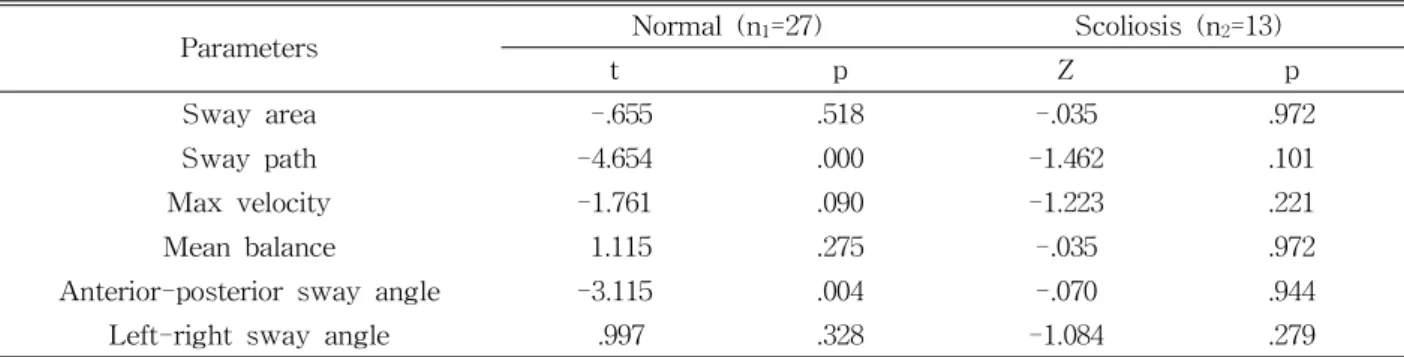
Statistical analysis was performed using Windows SPSS version 13.0. Demographic data of subjects was summarized using descriptive analysis. The Mann-Whitney U test was used for comparing the functional balance scales, static balance parameters with eyes opened and closed while standing. The Wilcoxon Matched-Pairs Signed-Ranks test was
used for comparing the static balance parameters be- tween eyes opened and eyes closed in the patients with scoliosis. The Paired t-test was used for com- paring the static balance parameters between eyes opened and eyes closed in the normal subjects. For all analyses, a significance level with an alpha less than .05 was adopted.
Results
Comparisons of balance between groups using functional balance scales
For the functional balance scales, the results of mean values and comparisons of scales between groups were shown in Table 2. In the lateral reach test with right and left direction, there were sig- nificant differences between normal and AIS groups.
However, there were no significant differences be- tween normal and AIS groups in the right and left forward reach.
Comparisons of static balance under eyes opened and eyes closed between groups
For the comparisons of static balance between
groups under eyes opened with standing, there were
significant increases with all parameters of standing
balance in the scoliosis patients (Table 3).
Parameters Normal (n
1=27) Scoliosis (n
2=13) Z p
Sway area (㎟) 258.65±263.50
a2134.38±2066.86 -4.028 .000
Sway path (㎜) 319.49±92.07 931.36±657.87 -3.653 .000
Max velocity (㎜/s) 59.33±55.05 425.59±271.22 -3.798 .000
Mean balance
b(%) 51.29±2.85 46.45±8.78 -2.325 .020
Anterior-posterior sway angle (°) 1.71±.51 4.37±2.41 -3.828 .000
Left-right sway angle (°) 1.28±3.40 2.11±1.35 -3.613 .000
a
Mean±SD.
b
Values mean the weight bearing percentage of the right foot during standing.
Table 3. Comparisons of static balance parameters under eyes opened between groups (N=40)
Parameters Normal (n
1=27) Scoliosis (n
2=13) Z p
Sway area (㎟) 284.25±215.19
a2113.92±1515.66 -3.971 .000
Sway path (㎜) 380.02±82.73 1138.92±542.23 -3.971 .000
Max velocity (㎜/s) 65.72±53.63 474.36±245.93 -3.871 .000
Mean balance
b(%) 50.91±3.08 46.02±7.01 -2.440 .015
Anterior-posterior sway angle (°) 2.05±.68 4.54±1.93 -3.944 .000
Left-right sway angle (°) .66±.25 2.95±2.53 -4.723 .000
a
Mean±SD.
b
Values mean the weight bearing percentage of the right foot during standing.
Table 4. Comparisons of static balance parameters under eyes closed between groups (N=40) Functional balance scales Normal (n
1=27) Scoliosis (n
2=13) Z p
Right forward reach (㎝) 33.26±8.42
a32.39±7.24 -.390 .697
Left forward reach (㎝) 31.08±4.73 32.40±8.35 -.939 .348
Right side reach (㎝) 23.04±5.10 18.72±4.99 -2.124 .034
Left side reach (㎝) 23.15±5.36 18.47±4.97 -2.557 .011
a