Article Info
Received September 18, 2020 Revised October 22, 2020 Accepted October 22, 2020 Corresponding Author Oh-yun Kwon
E-mail: [email protected] https://orcid.org/0000-0002-9699-768X
Key Words
Anterior cruciate ligament reconstruction Lower extremity
Postural balance
Background: Anterior cruciate ligament reconstruction (ACLR) causes a reduction in the balance of the lower extremities. Static and dynamic balance were evaluated separately to confirm the decrease in balance in patients underwent ACLR. The commonly used methods include the Biodex Balance System (BBS) for static balance and the Y balance test (YBT) for dynamic balance. No study has evaluated whether the static and dynamic balance of the in- volved side recovers as much as the uninvolved side one year after ACLR.
Objects: The purpose of this study was to investigate the recovery of static and dynamic bal- ance between the involved and the uninvolved sides.
Methods: The BBS (overall, anteroposterior index, and mediolateral index) and YBT (anterior, posterolateral, and posteromedial) of 58 patients underwent ACLR were measured one year postoperation. Both sides of the BBS and the YBT were compared using the paired t-test.
Results: All the index of the BBS showed no difference between the involved and the unin- volved sides, while all the scores of the YBT showed a significant difference in both sides. The YBT anterior result was 54.64 ± 5.62 cm in the involved side and 56.90 ± 5.41 cm in the un- involved side (p = 0.001). The YBT posterolateral results were 90.12 ± 10.51 cm and 92.34 ± 9.85 cm (p = 0.013). The YBT posteromedial results were 93.72 ± 8.84 cm and 96.14 ± 9.37 cm (p = 0.002).
Conclusion: A year after ACLR, the static balance showed no difference, while the dynamic balance showed a significant difference in the involved and the uninvolved sides. The static balance of the involved side recovered as much as the uninvolved side, but the dynamic bal- ance did not. Therefore, dynamic balance training should be considered in the rehabilitation program for patients underwent ACLR.
Copyright ⓒ Korean Research Society of Physical Therapy
This is an Open Access article distributed under the terms of the Creative Commons Attribution Non-Commercial License (http://creativecommons.org/licenses/by-nc/4.0) which permits unrestricted non-commercial use, distribution, and reproduction in any medium, provided the original work is properly cited.
INTRODUCTION
After anterior cruciate ligament (ACL) injury, reconstruction is usually performed to regain the preinjury activity level [1].
However, strength, functional outcome, and postural stability are reduced despite ACL reconstruction (ACLR) [1,2]. To recov- er the function of the lower extremities, clinical score, balance test, and functional performance test have been evaluated after ACLR in a clinical setting [3]. Due to a lack of proprioceptive information resulting from the substitution of ACL by the graft, sensory and motor behavior changes become visible [4]. The
change reduces the balance of the patients and results in a de- creased functional performance [5]. Therefore, it is important to measure the balance accurately and organize an appropriate neuromuscular training program following ACLR [6].
There are several assessment tools and methods to evaluate body balance, which include the Biodex Balance System (BBS) and Y balance test (YBT) [7]. The BBS is relatively easy to use and it is good for targeting large samples [8]. Previous studies related to ACL injury have used the BBS to evaluate body bal- ance [9-12]. The YBT is also relatively inexpensive, portable, and easy to administer, and it has shown good reliability [7,13].
Physical Therapy Korea
PTK https://doi.org/10.12674/ptk.2020.27.4.286 pISSN: 1225-8962 eISSN: 2287-982X Phys Ther Korea. 2020;27(4):286-291
Original Article
Static and Dynamic Balance Comparison Between the Involved and Uninvolved Sides in Patients Who had Anterior Cruciate Ligament Reconstruction: One- year Follow-up Study
Jin-seong Kim
1, PT, Moon-young Choi
1, AT, MSc, Doo-hwan Kong
1, AT, MSc, Kyu-sung Chung
2, MD, PhD, Ui-jae Hwang
3, PT, PhD, Oh-yun Kwon
3, PT, PhD
1
Sports Medical Center, Seoul Paik Hospital, Inje University College of Medicine,
2Department of Orthopedic Surgery, Seoul Paik Hospital,
Inje University College of Medicine, Seoul,
3Department of Physical Therapy, College of Health Science, Yonsei University, Wonju, Korea
The YBT is used to measure dynamic balance associated with lower extremity injuries such as ACL, patellofemoral pain syn- drome, and ankle instability [7,14,15].
Although BBS and YBT are classified as balance tests, the purpose of their evaluation is different. Because the BBS is used to measure static balance and the YBT is used to measure dynamic balance [7], it is necessary to apply both BBS and YBT separately. However, previous studies have reported each of BBS and YBT separately for comparison and correlation [12,15-17]. To the best of our knowledge, no study has con- firmed simultaneously whether the static and dynamic balance of the involved side recovers as much as the uninvolved side at one year postoperatively.
The purpose of this study was to investigate the recovery of static and dynamic balance between the involved and the uninvolved sides at one year after ACLR. We hypothesized that static and dynamic balance have no significant difference be- tween the involved and the uninvolved sides. Clinically, the re- sults of this study suggest that static and dynamic balance can be regained fully one year after ACLR.
MATERIALS AND METHODS
1. Patients
The study protocol was approved by Seoul Paik Institutional Review Board (PAIK 2020-06-002) and all the patients that participated in the study gave their informed consent. We re- viewed the patients’ medical records retrospectively to confirm the clinical characteristics between June 2016 and January 2019. Fifty-eight patients who had agreed to undergo all the required tests were followed up over one year postoperation.
Inclusion criteria included the following: (1) who had single-
bundle ACLR, (2) who used semitendinosus tendon autograft with an outside-in technique for the anatomic femoral tunnel (3) who were followed over 1 year. Exclusion criteria included the following: (1) a concomitant multiple ligament injury, (2) fracture, (3) meniscus root repair, (4) cartilage repair proce- dures, (5) osteotomy to correct mechanical alignment, (6) revi- sion ACL reconstruction, (7) subtotal or total meniscectomy, and (8) history of prior knee surgery. All the patients under- went an equal follow-up protocol. BBS and YBT were evaluated J.S.K. who was blind to the procedures following ACL recon- struction after one year.
2. Surgical Techniques
All surgical procedures were performed via the outside-in technique using a quadrupled semitendinosus tendon auto- grafts with remnant preservation. The reference points of the femoral tunnel and tibial tunnel were based on anatomic cen- ter. The femoral tunnel was made by drilling with a flip cutter.
After graft passage, the femoral fixation was achieved using tightrope RT (Arthrex, Naples, FL, USA). After 15 times of cy- clic loading of graft, a hydroxyapatite interference screw (S&N Corp., Andover, MA, USA) was used for tibial fixation. In all the cases, post-tie fixation was performed using a cortical screw for additional tibial fixation.
3. Postoperative Rehabilitation
Range of motion exercises were initiated at 3 –5 days after surgery and a full range of motion was achieved within six weeks. Tolerable weight-bearing began at one or two days after the surgery. Full weight-bearing was allowed at three weeks. The functional knee brace was worn full extension for three weeks and worn without a limited brace angle. After
A B C
Figure 1.
Figure 1. Y Balance Test directions. (A)
Anterior; (B) Posterolateral; (C) Postero-
medial.
then, the brace was taken off 4 –6 weeks progressively. The bal- ance training program was initiated progressively from three weeks. At six weeks after surgery, progressively weighted open kinetic chain exercises for quadriceps were allowed within 90° –45° flexion. Three months after the surgery, light running and functional training were initiated progressively. Six months after the surgery, a return to sports with no competition was allowed.
4. Y Balance Test
The YBT (Move2Perform, Evansville, IN, USA) was evaluated at one year postoperatively. The score (unit of measurement:
cm) was measured as the distance of anterior, posterolateral, and posteromedial (Figure 1). The patients stood barefoot on the involved limb and put both hands on their chest with crossing arms. The investigator recorded the third scores after two practices [18] and allowed 10 seconds rest between the tri- als.
5. The Biodex Balance System
The balance was evaluated using the BBS (Biodex Medical System, Shirley, NY, USA) at one year postoperatively (Figure 2). The stability index represents the variance of platform dis- placement in degrees from level in both the anteroposterior and mediolateral directions. A high number is indicative of poor neuromuscular control, which may increase the potential for orthopedic injury or falling. Overall index, anteroposterior index, and mediolateral index were measured. Level 1 was the
most unstable and level 12 was the most stable. Patients were instructed to stand barefoot with slight knee bent and their hands placed on their iliac crest and their unsupported limb behind the standing limb. They were then told to maintain their center of pressure on the BBS monitor. Three testing tri- als were measured for 30 seconds and 10 seconds rest was al- lowed between trials. The test proceeded at level 8 resistance [19]. During this test, an upright position was demanded on the unstable surface of the BBS.
6. Statistical Analysis
All statistical analyses were performed using the SPSS soft- ware (ver. 22.0 for Windows; IBM Co., Armonk, NY, USA). The sex, age, height, weight, body mass index, and average final follow-up period were calculated as average and standard deviation to identify the characteristics of the patients. The paired t-test was used to compare the continuous values of the involved and uninvolved sides within the same group. Statisti- cal significance was set at 5% (p < 0.05).
RESULTS
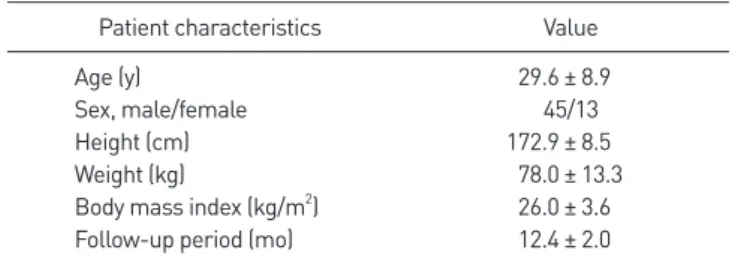
The study participants were 45 males and 13 females. Age was 29.6 ± 8.9 years. The body mass index was 26.0 ± 3.6 kg/m
2. The follow-up period was 12.4 ± 2.0 months (Table 1).
All index of the BBS showed no significant difference be- tween the involved and uninvolved sides at one year after ACLR. The BBS overall results were 1.54 ± 0.69 in the involved side and 1.54 ± 0.81 in the uninvolved side (p = 0.603). The BBS anteroposterior index results were 1.06 ± 0.51 in the in- volved side and 1.05 ± 0.61 in the uninvolved side (p = 0.912).
The BBS-mediolateral index results were 0.81 ± 0.44 in in- volved side and 0.86 ± 0.52 in the uninvolved side (p = 0.350) (Table 2).
All the scores of the YBT showed a significant difference
Figure 2.
Figure 2. Stability Index of the Biodex Balance System.
Table 1.
Table 1. General characteristics of included studies (N = 58)
Patient characteristics Value
Age (y) 29.6 ± 8.9
Sex, male/female 45/13
Height (cm) 172.9 ± 8.5
Weight (kg) 78.0 ± 13.3
Body mass index (kg/m
2) 26.0 ± 3.6
Follow-up period (mo) 12.4 ± 2.0
Values are expressed as mean ± standard deviation or number only.
between involved and uninvolved sides at one year following ACLR. The YBT anterior results were 54.64 ± 5.62 cm in the involved side and 56.90 ± 5.41 cm in the uninvolved side (p = 0.001). The YBT posterolateral results were 90.12 ± 10.51 cm in the involved side and 92.34 ± 9.85 cm in the uninvolved side (p = 0.013). The YBT posteromedial results were 93.72 ± 8.84 cm in the involved side and 96.14 ± 9.37 cm in the unin- volved side (p = 0.002) (Table 2).
DISCUSSION
Our study compared the involved and uninvolved sides of YBT and BBS that were measured in patients who had ACLR after a one-year follow-up. We found that there was no differ- ence in the static balance, while the dynamic balance showed a significant difference. The results would mean that the static balance of the involved side at one year following ACLR recov- ered as much as the uninvolved side, but the dynamic balance did not. Therefore, the dynamic balance could be included in the rehabilitation programs for patients with ACLR at a one- year follow-up.
The balance provides information about movement, inter- mediate joint position sense, and control muscle reflex stabi- lization [10,20]. However, after ACLR, decreased joint position perception, a higher threshold for detection of passive knee motion, longer latency of hamstring muscles, and decreased performance in postural control were shown due to the dam- age of the ACL mechanoreceptors [4]. Thus, because proprio- ception of damaged ACL could not recover fully, the training of balance recovery should be performed. Akbari et al. [9] report- ed that balance training should be part of the rehabilitation program following ACLR. In contrast, Cooper et al. [11] report- ed that there was no difference between balance training and
strength training in the early phase of rehabilitation following ACLR. Although still controversial, the importance of balance recovery has been increasingly emphasized, and it is important to accurately understand the patient’s condition. The BBS and YBT are commonly used as tools to evaluate balance. Both of them measure balance, but the purpose of their evaluation is different. Almeida et al. [7] reported that YBT does not corre- late with BBS because the YBT is a more dynamic test than the BBS. Therefore, when clinicians evaluate balance, both YBT and BBS need to be used.
The BBS is used to evaluate the balance of several diseases such as ACLR, patellar femoral pain syndrome, chronic lower back pain, and ankle instability [12,14,21,22]. BBS is particu- larly useful for patients who have undergone ACLR. Moham- madirad et al. [12] reported that BBS has high reliability as a postural stability measurement and is an appropriate balance test for patients who had ACLR. Thus, BBS has been used to confirm the recovery of static balance following ACLR. Matta- cola et al. [2] reported that the balance of the involved side in 20 patients who underwent ACLR at average 18 months follow- up was not significantly different compared to the control group and the uninvolved side, which is consistent with our findings. We found that there was no difference in BBS be- tween the involved and uninvolved sides at one year following ACLR. Therefore, it could be considered that the static balance of the involved side was restored as well as the uninvolved side at one year postoperatively.
Our study also found that YBT was significantly different for the involved and the uninvolved sides in patients who had ACLR after one year. The result could mean that the dynamic balance has not been regained yet. The hamstring muscles are synergistic to ACL and they increase dynamic stability. Thus, the muscles play a very important role in dynamic balance in rehabilitation following ACLR [23]. Recently, several surgeons have chosen hamstring autograft, which is the only semitendi- nosus tendon or semitendinosus and gracilis tendons, for ACLR [24]. Regeneration of the harvested hamstring is known to be approximately 80 percent [25]. Although the hamstring can be regenerated, knee flexion strength of the involved side using hamstring autograft is reduced compared to the uninvolved side and the involved side using allograft [24]. In our study, dy- namic balance did not recover after one year and this was the reason why patients who had ACLR using hamstring autograft had hamstring weakness, which decreases dynamic stability.
Table 2.
Table 2. Comparison of involved and uninvolved sides (N = 58)