• 검색 결과가 없습니다.

The Effects of Middle School Students' Participation Motivation in Judo as a Recreational Sport Activity on Exercise Flow and Psychological Happiness

N/A
N/A
Protected

Academic year: 2021

Share "The Effects of Middle School Students' Participation Motivation in Judo as a Recreational Sport Activity on Exercise Flow and Psychological Happiness"

Copied!
7
0
0

로드 중.... (전체 텍스트 보기)

전체 글

(1)

JKSCI

The Effects of Middle School Students’ Participation Motivation in Judo as a Recreational Sport Activity on Exercise Flow and

Psychological Happiness

1)

Cheol-Kyu Cho*, Min-Chul Shin**

*Professor, Dept. of Convergence, KwangJu Women's University, Gwangju, Korea

**Professor, Dept. of Aviation Safety Protection Science, Kyungwoon University, Gumi, Korea [Abstract]

The purpose of this study is to define how middle school students’ motivation of participation in Judo as a recreational sport activity influences their exercise flow and psychological happiness. To achieve that, this researcher conducted a questionnaire survey with middle school students who participated in 2020 National Amateur Judo Event held in Donghae-si, Gangwon-do from Jan. 18 to 20, 2020, for three days. Of the collected questionnaire copies, the questionnaire copies with insincere or insufficient answers were excluded, and 253 copies were used for data analysis. The results of the study are presented as follows: Firstly, middle school students’ participation motivation in Judo as a recreational sport activity positively influenced their exercise flow. Secondly, participation motivation in Judo as recreational sport activity positively affected psychological happiness. Thirdly, middle school students’ exercise flow to Judo as a recreational sport activity positively influenced their psychological happiness. Therefore, instructors for the recreational sport activity need to develop detailed methods or programs to improve students’ personality and leadership beyond Judo skills in order to achieve positive and smooth communication with participants.

▸Key words: Judo, recreational sports, participation motivation, exercise flow, psychological happiness

[요 약]

본 연구는 중학생의 유도 생활체육 참여동기가 운동몰입 및 심리적 행복감에 미치는 영향을 규명 하기 위한 목적이 있다 . 본 연구의 목적을 규명하기 위하여 2020년 1월 18일~20일(3일간) 강원도 동 해시에서 열리는 2020년 생활체육 전국유도대회에 참여한 중학생 270명을 대상으로 하였으며 내용

이 부실하거나 신뢰성이 없다고 판단되는 설문지를 제외한 총 253부를 사용하였다. 본 연구의 결과

를 제시하면 다음과 같다. 첫째, 중학생의 유도 생활체육 참여동기는 운동몰입에 정(+)의 영향을 미 치는 것으로 나타났다 . 둘째, 중학생의 유도 생활체육 참여동기는 심리적 행복감에 정(+)의 영향을

미치는 것으로 나타났다 . 셋째, 중학생의 유도 생활체육에 따른 운동몰입은 심리적 행복감에 정(+)의

영향을 미치는 것으로 나타났다. 따라서 일선 현장의 생활체육지도자들은 단순 유도기술 뿐만 아니 라 학생들의 인성과 리더십을 향상 시킬 수 있는 구체적인 방법이나 프로그램을 개발하여 서로 간의 의사소통이 긍정적이고 원활하게 이루어질 수 있도록 노력을 해야 할 것으로 사료된다 .

▸주제어: 유도, 생활체육, 참여동기, 운동몰입, 심리적 행복감

∙First Author: Cheol-Kyu Cho, Corresponding Author: Min-Chul Shin

*Cheol-Kyu Cho ([email protected]), Dept. of Convergence, KwangJu Women's University

**Min-Chul Shin ([email protected]), Dept. of Aviation Safety Protection Science, Kyungwoon University

∙Received: 2020. 09. 08, Revised: 2020. 09. 24, Accepted: 2020. 09. 24.

Copyright ⓒ 2020 The Korea Society of Computer and Information http://www.ksci.re.kr pISSN:1598-849X | eISSN:2383-9945
(2)

I. Introduction

In adolescence, teenagers experience large physical and psychological changes. Therefore, it is necessary to pay much heed attention to them in order to achieve their balance growth and development and make them mature. School and home have played crucial roles in adolescents’

growth and development, and their socialization. [1]

In today’s society, as the ills of individualism get worse, adolescents’ deviant behaviors reach a dangerous level and lead to school violence, bullying, and others.[2] In these circumstances, there are strong opinions that it will be necessary to encourage adolescents’ physical activities actively and continuously so as to improve their personality and sociality, and thereby to help them grow in a desirable direction.[3]

In order to develop adolescents’ personality in a positive direction, it is necessary to let them have experiences of making personal and social attitudes. These experiences can be improved through Judo training activities. Judo training not only helps them improve their health and learn leadership and communities, but serve as the roles and functions for leisure and cultural activities.

Therefore, Judo is judged to contribute to active school life and good peer relationship.

Judo, which is a sport of respecting manners highly, has an opponent knocked down with the use of the opponent’s power and central force. It is much related to the art of self-defence, By learning breakfall of Judo, it is possible to have the ability to protect the body. [4] For the purpose of securing private sports facilities for improving the quality of life of the people, or for improving the country’

standing in the world by obtaining more medals in international sports events, it is necessary to promote Judo actively.[5]

Unfortunately, Korean adolescents, or middle school students have difficulty participating in Judo or other sports activities under the current entrance examination-oriented educational system

In addition, there is not much research on their psychological happiness that arise through rule compliance, competitiveness, cooperation, and sportsmanship [6] that they find through the direct experience of sports activities.

Therefore, it is necessary to find middle school students’ participation motivation in Judo as a recreational sport activity, and analyze the effects of the participation motivation on exercise flow and psychological happiness. Th study aims to analyze relations between variables and look into the development of Korean Judo sport industry and its educational value in detail.

To achieve that, this researcher tries to examine the following hypotheses: <Hypothesis 1> middle school students’ participation motivation in Judo as a recreational sport activity will positively influences their exercise flow.

<Hypothesis 2> middle school students’

participation motivation in Judo as a recreational sport activity will positively influences their psychological happiness.

<Hypothesis 3> middle school students’ exercise flow to their Judo as a recreational sport activity will positively influence psychological happiness.

II. Theoretical background

1. Participation motivation

Recent studies on the motivation related to sports were based on theoretical frame and classified human behaviors into intrinsic motivation and extrinsic motivation. Up to now, intrinsic motivation of sports behaviors has been focused on in the sports psychology field. Since the instrument to measure intrinsic motivation, extrinsic motivation, and amotivation was developed, the three aspects of sports participation motivation have been applied. [7]

2. Exercise flow

Mihaly Csikszentmihalyi is credited with having

popularized the concept of flow. He defined flow as

(3)

‘the physical and mental state in which a person is engaged in an activity where they are fully immersed with a feeling of energized focus, involvement, and success in the process of the activity’. Flow is a positive sense like concentration, a sense of control or clear consciousness that a person feels in everyday life as well as in a particular situation. It is a state in which a person highly concentrates on an activity without being conscious of surroundings.[8]

3. Psychological happiness

Psychological happiness is defined as a feeling of giving a positive value to life through a pleasure, enjoyment or happiness in everyday life and of keeping a certain emotion or attitude. It has the meaning of the improvement in social skills for increasing individuals’ quality of life. It is referred to as a feeling of keeping the state in which there is no social problem in line with surroundings and of following individuals’ various desires.[9]

III. Study Methods

1. Study subject

The subjects of this study were 270 middle school students who participated in 2020 National Amateur Judo Event held in Donghae-si, Gangwon-do from Jan. 18 to 20, 2020, for three days. With the cooperation of their instructors and parents, the purpose of this study was explained and the students filled in a questionnaire in a form of self-evaluation. The questionnaire copies with insincere and insufficient answers were excluded.

Finally, 253 copies were used. According to sociodemographic characteristics, regarding gender, male students numbered 223(88.1%), and female students numbered 30(11.9); regarding a training period, 12 students were trained one year (4.7%), 48 were trained during the period between one and two years (18.9%), 55 were trained during the period between two and three years (21.8%),

102 were trained during the period between three and four years (40.4%), and 36 were trained more than our years (14.2%); regarding a degree of Judo, 38 students had no degree(15.0%), 152 had first degree(60.0%), and 63 (25.0%) had second degree.

2. Measurement instrument

In this study, a questionnaire was applied to measure the relations between middle school students’ participation motivation in Judo as a recreational sport activity, exercise flow and psychological happiness. The questionnaire was modified and redesigned in line with the purpose and procedure of the study. All the items of participation motivation, exercise flow, and psychological happiness were based on five-point Likert scale (very unlikely: 1 point, very likely: 5 points).

Firstly, regarding the items of participation motivation, the measurement scale used in the research by Kim Moo-jin (2004)[10], Jeong Hoon-in(2013)[11], et al., was modified and improved. As a result, twenty three items related to

‘attraction of Judo’, ‘mental exercise’, ‘enjoyment’,

‘the body/physical strength’, and ‘social gathering’

were designed.

Secondly, regarding the items of exercise flow, the measurement scale translated by Jeong Yong-ghak(1997)[12], which was used by Lee Jae-yong (2017)[13], etc., was modified and improved.

As a result, seventeen items related to ‘cognitive flow’, and ‘behavioral flow’ were designed.

Thirdly, regarding the items of psychological happiness, the measurement scale translated and modified by Yang Myeong-hwan (1998)[14] in line with Korean people’s emotions, which was used by Kim Young-dong (2016[15]), etc., was modified and improved. As a result, twenty items related to

‘self-actualization’, ‘pleasure’, ‘self-esteem’, and

‘engagement’ were designed.

Lastly, regarding sociodemographic characteristics, three items related to gender, a training period, a degree of Judo were designed.

The measurement instruments used in this study

(4)

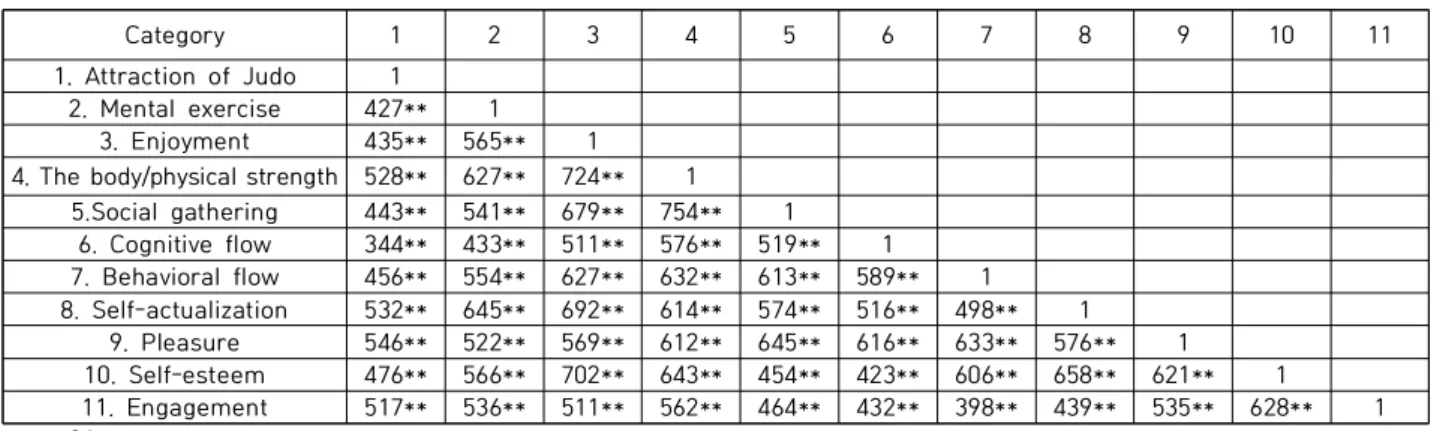
Category 1 2 3 4 5 6 7 8 9 10 11 1. Attraction of Judo 1

2. Mental exercise 427** 1

3. Enjoyment 435** 565** 1

4. The body/physical strength 528** 627** 724** 1 5.Social gathering 443** 541** 679** 754** 1

6. Cognitive flow 344** 433** 511** 576** 519** 1 7. Behavioral flow 456** 554** 627** 632** 613** 589** 1 8. Self-actualization 532** 645** 692** 614** 574** 516** 498** 1

9. Pleasure 546** 522** 569** 612** 645** 616** 633** 576** 1

10. Self-esteem 476** 566** 702** 643** 454** 423** 606** 658** 621** 1

11. Engagement 517** 536** 511** 562** 464** 432** 398** 439** 535** 628** 1

**p<.01

Table 1. Analysis of correlations between variables were reviewed and discussed by a group of experts, and the problems found in this process were rechecked and corrected before the measurement scales were applied.

3. Data analysis

For data analysis, SPSS 22.0 was used. To make the consistency of conceptual definitions of variables as analysis content, Content Validity was conducted. For the analysis of reliability of validity, exploratory factor analysis was conducted and Cronbach’s α in internal consistency method was drawn. For the analysis of sociodemographic characteristics of samples, frequency analysis was

conducted. For the analysis of correlations between measurement variables, correlation

analysis was conducted. were analyzed. To measure influential relations between variables, multiple regression analysis was conducted.

4. Reliability and validity analysis

In this study, in order to secure the validity and reliability of measurement instruments, exploratory factor analysis was conducted and a reliability coefficient was calculated with the use of Cronbach’s α. In exploratory factor analysis, the factors that interfere in redundancy of questions and complete inter-factor independence were removed, and reference factor loading was set to 0.7. In reliability analysis, relevance between questions was verified with the use of Cronbach’s α.

According to the reliability and validity analysis, the factor loading of participation motivation was .756~.897, and its Cronbach’s α was .845; the factor loading of exercise flow was .826~887, and its Cronbach’s α was .843; the factor loading of psychological happiness was .726~853, and its Cronbach’s α was .853. As a result, the questionnaire used in this study met reliability and validity evaluation criteria.

IV. Study Results

1. Correlation between variables

In this study, correlation analysis was conducted to find correlations between measurement variables. As a result, correlations between all the variables were significant. The result is shown in

<Table 1>.

2. The influence of participation motivation on exercise flow

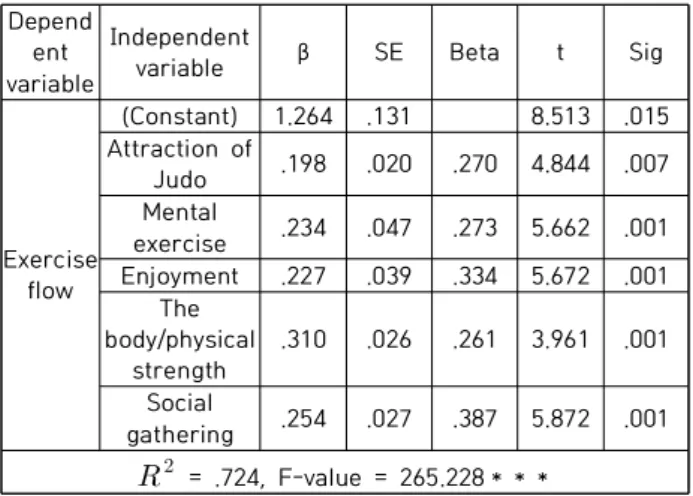
The influence of participation motivation on exercise flow was analyzed. As a result, the explanatory power  was .724. Regarding influential relations of variables, attraction of Judo (β=.198), mental exercise(β=.234), enjoyment (β

=.227), the body/physical strength(β=.310), and

social gathering(β=.254) significantly and positively

influenced exercise flow.

(5)

Depend ent variable

Independent

variable β SE Beta t Sig

Exercise flow

(Constant) 1.264 .131 8.513 .015

Attraction of

Judo .198 .020 .270 4.844 .007

Mental

exercise .234 .047 .273 5.662 .001 Enjoyment .227 .039 .334 5.672 .001

The body/physical

strength

.310 .026 .261 3.961 .001 Social

gathering .254 .027 .387 5.872 .001

= .724, F-value = 265.228***

Table 2. The influence of participation motivation on exercise flow

3. The influence of participation motivation on psychological happiness

Depend ent variable

Independent

variable β SE Beta t Sig

Psychol ogical happine

ss

(Constant) 1.475 .126 9.362 .015

Attraction of

Judo .270 .017 .258 5.371 .007

Mental

exercise .184 .043 .232 4.564 .001 Enjoyment .243 .035 .319 5.443 .006

The body/physical

strength .355 .022 .271 4.226 .001 Social

gathering .297 .021 .354 4.632 .001

= .523, F-value = 331.254***

Table 3. The influence of participation on psychological happiness

The influence of participation motivation on psychological happiness was analyzed. As a result, the explanatory power  was .523. Regarding influential relations of variables, attraction of Judo (β=.270), mental exercise(β=.184), enjoyment (β

=.243), the body/physical strength(β=.355), and social gathering(β=.297) significantly and positively influenced e psychological happiness.

4. The influence of exercise flow on psychological happiness

Depend ent variable

Independent

variable β SE Beta t Sig

Psychol ogical happine

ss

(Constant) 1.372 .124 8.542 .011

Cognitive

flow .270 .029 .170 5.371 .001

Behavioral

flow .223 .045 .273 4.774 .001

= .471, F-value = 207.416***

Table 4. The influence of exercise flow on psychological happiness

The influence of exercise flow on psychological happiness was analyzed. As a result, the explanatory power  was .471. Regarding influential relations of variables, cognitive flow(β

=.270) and behavioral flow(β=.223) significantly and positively influenced psychological happiness.

V. Conclusion

The main purpose of this study is to define the influential relations between middle school students’

participation motivation in Judo as a recreational sport activity, exercise flow and psychological happiness. Another one is to analyze the relevance of variables and thereby to provide a educationally useful material for developing Korean Judo sport industry and promoting recreational sports.

Firstly, middle school students’ participation motivation in Judo as a recreational sport activity significantly and positively influenced exercise flow.

It means that the more the students have

participation motivation, the more they have

exercise flow. The motivation factors of

participants seem to work as important leading

variables that enhance exercise flow. Lee

Gwang-woo(2019) also reported that sports

participation motivation positively influenced

exercise flow. The result is consistent with the

result of this study. Therefore, it is necessary to

develop Judo skills and various programs in line

(6)

with adolescents and middle school students in order to make Judo as a joyful and helpful recreational sport activity.

Secondly, middle school students’ participation motivation in Judo as a recreational sport activity significantly and positively influenced psychological happiness. According to the research on a club of badminton as a recreational sport activity, which was conducted by Choi Jin-ah(2019), participation motivation significantly and positively affected psychological happiness. The result is also consistent with the result of this study. Given that, Judo is judged to be a critical factor to improve concentration and self-esteem. The students seem to have psychological happiness in the way of recognizing their ability, drawing others’ attention, and establishing various interpersonal relationships through Judo training. Enjoyment, the body/physical strength improvement, and a diversity of Judo skills are factors that help middle school students perceive their exercise flow and competency. Therefore, it is necessary to provide environments and situations to promote recreational sport activities and maximize middle school students’ satisfaction with sport activities.

Thirdly, middle school students’ exercise flow to participation in Judo as a recreational sport activity significantly and positively influenced psychological happiness. The result means that their pleasure arising in a variety of physical activities plays a critical role to improve psychological happiness. In addition, in order to make Judo as a critical mean to keep their healthy through training and to help them participate in the sport, it is necessary to consider the factors triggering interest in Judo, which are developed from positive psychological factors like pleasure and interest that help them feel various aspects of Judo. Since the students feel psychological happiness through their positive emotional experiences of happiness, they seem to have flow to Judo as a recreational sport activity.

Lastly, given the results of this study, middle school students’ participation motivation in Judo as a recreational sport activity was the critical factor

that improved their exercise flow and psychological happiness. Therefore, instructors for the recreational sport activity need to develop detailed methods or programs to improve students’

personality and leadership beyond Judo skills in order to achieve positive and smooth communication with participants.

REFERENCES

[1] HgRyu, “The influence of mass culture on the culture of elementary school students”, master's degree, Graduate School of Sunchon National University. 2002.

[2] HyLee, “The influence of Sports activity on self-esteem of middle school student” master's degree, Graduate School of Kook Min University. 2004.

[3] MbChoi, hiLee, “The Relationship between Physical Self-Concept and Personality and Manners in Judo Youth”, Journal of Korean Society for Sport Anthropology, Vol. 12, No, 2, pp. 15-38, Dec.

2017.

[4] TiKwon, “A Study on Exploration of Meaning & Value for Participation in Judo Activity as Leisure Sports of Adolescent”, master's degree, Graduate School of Kong ju National University.

2015.

[5] KyChoi, hyJung, shJeon, “ Managerial Condition and Activated Scheme of Private Judo Club”, Korean journal of physical education, Vol. 43, No, 3, pp. 405-416, May. 2004.

[6] SwKwon, “Ju-Do training attendance affects life satisfaction”, master's degree, Graduate School of Keimyung University. 2006.

[7] DjHyun, “An Analysis of the Relationship of Life Sports Participation as to leisure satisfaction and life satisfaction”, master's degree, Graduate School of Jeju National of Education University. 2005.

[8] HmHa, “A Studyon the Correlation between Immersionin to Everyday Sports, Reliance on the Family and Successful Aging”, doctoral thesis, Graduate School of Physical Education KyungHee University. 2013.

[9] EsHyun, “A study on leisure satisfaction, psychological happiness as a function of leisure activities of a professional soldier”, master's degree, Graduate School of Sports Rehabilitation Science Hanshin University. 2008.

[10] MjKim “The Analysis of Social and Cultural Factors by Ken-Do Person's Motives of Participation”, master's degree, Graduate School of Dong-A University. 2003.

[11] HiJung “The effect of Judo gym participation motive on training

flow and repurchase intention”, master's degree, Graduate School

(7)

of Yong-in University. 2013.

[12] YkJong “The Influence of Leisure Exercise Participants' Motivation to Participate in Sports, Awakening Pursuit, and Emotion on Sports Commitment”, doctoral thesis, Graduate School of Pusan National University. 1997.

[13] JyLee, “Relation among judoists’ exercise commitment, tenacity and exercise adherence”, master's degree, Graduate School of Yong-in University. 2017.

[14] MhYang, “Addiction to Recreational Bowling Activity and Psychological Well - being”, Korean journal of physical education , Vol. 37, No, 4, pp. 217-222, Dec. 1998.

[15] YdKim, “A Study about the Influences of Exercise Flow and Tenacity of Judo Players on Psychological Happiness”, master's degree, Graduate School of Yong-in University. 2016.

[16] KwLee, “The Influence of Motivation for Participation in Sports Activities by the Physically Handicapped on Exercise Immersion and Psychological Well-being”, The Korean journal of Sport, Vol.

17, No, 1, pp. 275-284, Mar. 2019.

[17] JnChoi, “The Effect of Sport for All Badminton Club Member’s Motive to Participate on Confidence in Sports and Psychological Happiness”, The Journal of Humanities and Social science, Vol.

10, No, 6, pp. 1517-1531, Dec. 2019.

Authors

Cheol-Kyu Cho received the B.S. degrees in security science from Kyungwoon University, Korea, in 2009, M.S. degree in Physical education from Yongin University, Korea, in 2011, Ph.D. degrees in security science from

Yongin University, Korea, in 2015. Dr. Cho joined the faculty of the Department of Aviation Safety Protection Science at Kyungwoon University, Gumi, Korea, in 2015.

He is currently a Professor in the Dept. of Convergence at Kwangju Women's University. He is interested in security, safety, Crime prevention, Security policy and private security Leisure sports.

Min-Chul Shin received the B.S. degrees in social sports from Yongin University, korea, in 1996, M.S. degrees in sports management from Yongin University, Korea, in 1998, Ph D. degrees in Physical education from

Sejong University, Korea, in 2007. Dr. Shin is currently a

Professor in the Department Aviation Safety Protection

Science at Kyungwoon University. He is interested in

security, safety, Sports Marketing, Leisure sports.

수치

Table  1.  Analysis  of  correlations  between  variables were reviewed and discussed by a group of experts, and  the  problems  found  in  this  process  were rechecked  and  corrected  before  the  measurement scales  were  applied.
Table  2.  The  influence  of  participation  motivation  on  exercise  flow

참조

관련 문서

The purpose of this study is to examine the influence of PAPS essential evaluation factors by applying soccer programs to middle school students participating

The purpose of this study was to examine the effects of football on PAPS in sports club activity for 12 weeks in middle school boys.. The following

The results of analysis on the difference of psychological happiness according to frequency of participation of external physical activity of female middle school

The purpose of this study is to investigate the effect of peer-mentoring on the achievement and learning attitudes of middle school students toward

In this study, a family of middle school students the health, self-resilience, recreation and leisure satisfaction and satisfaction with school life were

The purpose of this study is to investigate the middle school students' motivation, self-confidence and attitude toward English learning in a team-teaching

The purpose of this study was to investigate the lower extremity muscle strength and student health of male middle school students. Twenty middle school

Based on the above results, participation in judo sports clubs has a positive effect on the body composition of elementary school students, which