1)
* Prof., Dept. of Fire Protection Engineering, Hoseo Univ., Dr. Eng.
2)
E-mail : refrete@lycos,co,kr 041-540-5734
•본 논문에 대한 토의를 2004년 3월 31일까지 학회로 보내 주시면 2004년 7월호에 토론결과를 게재하겠습니다.
Abstract
The maturity concept is based on the fact that concrete gains strength with time as a result of the cement hydration and, thus the strength of concrete is related to the degree of hydration of the cement in concrete. The rate of hydration, as in any chemical reaction, depends primarily on the concrete temperature during hydration. Therefore, the aim of the study is to investigate of the correlation between strength of high-strength concrete and maturity that is expressed as a function of an integral of the curing period and temperature.
요 지
적산온도은 시멘트 수화의 결과로서 시간이 경과함에 따라 콘크리트 강도가 얻어진다는 것으로 콘크리트 의 강도는 시멘트의 수화반응과 관계가 있다. 시멘트의 수화반응은 온도와 경과시간에 큰 영향을 받는다. 따 라서 본 연구에서는 콘크리트 강도예측에 있어서 양생시간과 온도의 함수인 적산온도와 고강도콘크리트 강도 의 상관성을 검토하고자 하였다.
Keywords : Maturity, Hydration, High strength concrete 핵심 용어 : 적산온도, 수화, 고강도콘크리트
적산온도기법에 의한 고강도콘크리트의 강도예측
A New Approach of Strength Prediction of High Strength Concrete by the Equivalent Age
권 영 진*
Kwon, Young-Jin
1. INTRODUCTION
Early age strength prediction in concrete is very useful in the reducing of construction cost and the securing of safety. Recent catastrophic construction failures have emphasized the need to estimate in-place strength of concrete during construction. Those are in part related to inadequate concrete strengths when loads are applied to the structure. Early age strength prediction have several practical applications. It can be used to determine safe stripping time, prestress release or post-tensioning time, to monitor strength development, particularly when concreting in cold weather, to check serviceability conditions or compliance and acceptability criteria, to ensure construction safety and generally to estimate the quality of construction and potential durability.
It is the aim of this study to improve the strength prediction in high-strength concrete through the investigation of the correlation between the strength of concrete and maturity, for its practical application.
2. BACKGROUND
2.1 Maturity Concept
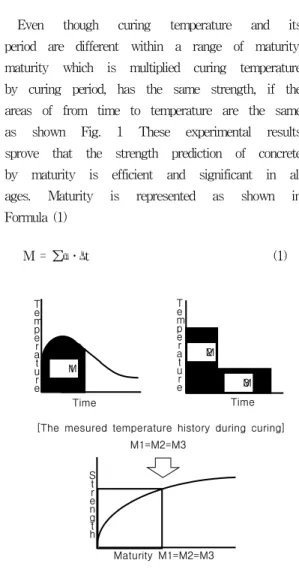
Maturity method has two theoretical assumptions, Nurse-Saul and Arrhenius: the former is that the rate of strength development is a linear function of temperature, and the latter is that the rate of strength development obeys the exponential Arrhenius equation. The function is expressed that the produce of time and temperature could be used to approximate the combined effects of these two factors on strength development.
Even though curing temperature and its period are different within a range of maturity, maturity which is multiplied curing temperature by curing period, has the same strength, if the areas of from time to temperature are the same as shown Fig. 1 These experimental results sprove that the strength prediction of concrete by maturity is efficient and significant in all ages. Maturity is represented as shown in Formula (1)
M = ∑α․Δt (1)
[The mesured temperature history during curing]
Fig. 1 Maturity function
M 1
Time
M1=M2=M3
Time M 2
M 3
Maturity M1=M2=M3 S t
e r n g h t T e
m p e r a t u r e
T e m p e r a t u r e
Here, α represents age conversion factor, and t represents age, lapsed time.
2.2 Strength Prediction
To predict the strength of structural concrete,
the most proper strength prediction formula is
needed by maturity through previous experiments,
and the temperature of concrete is measured by
Maturity meter. The maturity, M to the time of
structural concrete, T can be calculated by using
measured temperatures, which can be applied for the strength prediction formula to predict the strength of lapsed time, T. By this, the strength of structural concrete is predicted early, which can make prompt and proper decision in mix proportion and curing method.
Therefore, the strength management of concrete according to the variation of temperature can be done through the strength prediction by maturity.
2.2.1 Age Conversion Factor By Nurse-Saul Function
The basic maturity formula of Nurse-Saul which is a function of temperature and time is shown in Formula (2).
M = ⌠ ⌡
t
0
(T - T
0)⋅Δt (2)
M : maturity( ℃․h or ℃․day) at age t T : average temperature of the concrete
during time interval Δt
T
0: datum temperature (generally -10℃) Δt : time interval(hour or day)
= ( T - T
0)
( Tr - T
0) (3)
Tr standard reference temperature of : equivalent age
2.2.2 Age Conversion Factor By Arrhenius Fomula
The hardening speed of concrete is affected much by temperature. So to speak, it is accelerated if the temperature is high, and it is delayed if the temperature is low. The equivalent age on the base of it is made by Arrhenius, a type of chemical reaction speed formula in the correlation
between the hydration reaction speed of cement according to curing temperature and the revealment of strength. The reaction speed in 20℃ is assumed as 1 in the equivalent age. The excellency of it was proved by Freiesleben-Hansen and Pederson.
They presented that Arrhenius equation explained the effect of temperature on the strength of concrete in the ranges of from -10 to 80C more exactly than Saul-Nurse.
Arrhenius Formula is as follows:
α = exp[-E/R․(1/Ts-1/Ta)]dt (4)
α equivalent age at a specified : temperature Ts
T a specified temperature, 。K :
T s 273(。K)+20℃ :
E activation energy :
33.5+1.47(20-Ta)KJ/mol (Ta≦20℃) 33.5 KJ/mol (Ta≧20℃)
R 8.314J/mol(universal gas constant) :
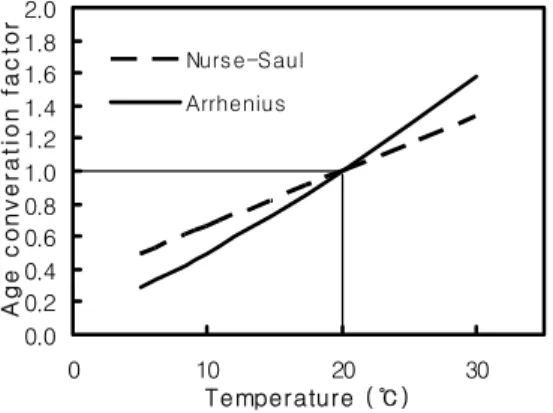
2.2.3 Comparison Of Age Conversion Factor The age conversion factors are shown in Table 1 and Fig. 2 being calculated by Formula (3) and Formula (4) and compared each other.
The age conversion factor by Nurse-Saul function represents the reaction speed of concrete according to temperature as a linear function. Formula (4) applied by Arrhenius function shows the form of exponential function.
Table 1 Age conversation factor vs. curing temperature Temp.
(℃) T+10
T+ 10
20 + 10
exp[- E R
(1 Ts
-1 Ta
)]0 10 0.333 0.151
5 15 0.500 0.292
25 35 1.167 1.260
30 40 1.333 1.574
40 50 1.667 2.408
3. EXPERIMENT OUTLINE
3.1 Experimental Plan
The experiments were performed under the condition of the same curing temperatures of 5
℃, 10℃, 20℃, and 30℃ as shown in Table 2 with the high-strength concretes of W/B 30%
and 35%, to get the exact strength prediction data. The functions by Nurse-Saul and Arrhenius were used as the equivalent age functions for the prediction of compressive strength through the correlation of maturity and the strength of high-strength concrete.
3.2 Used Materials
The materials used in the experiments are shown in Table 3.
3.3 Mixing Proportion
The mix proportion of high-strength concrete used in the experiments are shown in Table 4.
Fig. 2 The age conversation factor used to compute equivalent age 0.0
0.2 0.4 0.6 0.8 1.0 1.2 1.4 1.6 1.8 2.0
0 10 20 30
Temperature ( ℃)
A g e c o n v er a ti o n f a c to r
Nurse-Saul Arrhenius
Table 4 Mix Proportion of Concrete
Kind W/B
(%)
S.P (%)
S/A (%)
Unit water content (kg/m3)
Unit weight (kg/㎥)
C SF S G
Cylinder 35 2.3
40 160 411 46 693 1047
30 3.0 140 420 47 710 1073
Table 3 Material
Cement O.P.C Gravity : 3.15 Fineness : 3,200㎠/g
Fine Aggregate Liver sand Max size : 5㎜ Gravity : 2.55 F.M : 2.72 Coarse Aggregate Crushed stone Max size : 19㎜ Gravity : 2.57 F.M : 6.54
Super Plasticizer Pinciple component : Synthetic Poymer Gravity : 1.10 Silca Fume Gravity : 2.20 Fineness : 220,000㎠/g
Table 2 Experimental Program
Experimental part Analytical part
W/B(%) Curing temp.(℃) Item of test Using functions
35 30
5 10 20 30
Comp. strength
․Nurse-Saul → Rastrup
․Arrhenius → Friesleben Hansen
3.4 Experiment Method
The experiments were performed on the base of Korean Standard and other standards. The temperature of concrete was measured with Thermocouple connected with Maturity Meter.
4. RESULTS AND ANALYSIS
4.1 Revealment Of Strength In High-Strength Concrete
Fig. 3 shows each compressive strength in each curing temperature according to ages. In the same age, W/B 0.30 has higher revealment of strength than W/B 0.35. In early age, strength is getting higher as curing temperature is higher, and the strengths according to ages are very different according to curing temperatures.
0 10 20 30 40 50 60 70 80 90
0 1 10 100
Comp. strength (MPa)
30℃
20℃
10℃
5℃
W /B 30%
Eq. Ras trup
0 10 20 30 40 50 60 70 80 90
0 1 10 100
Comp. strength (MPa)
30℃
20℃
10℃
5℃
W /B 35%
Eq. Ras trup
0 10 20 30 40 50 60 70 80 90
0 1 10 100
E qu i v al e n t age at 20℃
Comp. strength (MPa)
Eq. Freies leben
0 10 20 30 40 50 60 70 80 90
0 1 10 100
E qu i v ale n t age at 20℃
Comp. strength (MPa)
Eq. Freies leben
(a) W/B-30% (b) W/B-35%
Fig. 4 Compressive strength of high-strength concrete according to equivalent age 0
10 20 30 40 50 60 70 80 90
0 10 20 30 40 50 60 70 80 90 100 110
Comp. strength (MPa)
W/ B 30%
0 10 20 30 40 50 60 70 80 90
0 10 20 30 40 50 60 70 80 90 100 110 Age ( days )
Comp. strength (MPa)
30℃ 20℃
10℃ 5℃
W/ B 35%
Fig 3 Compressive strength according to ages
4.2 Correlation of Maturity with Strength, and Its Application
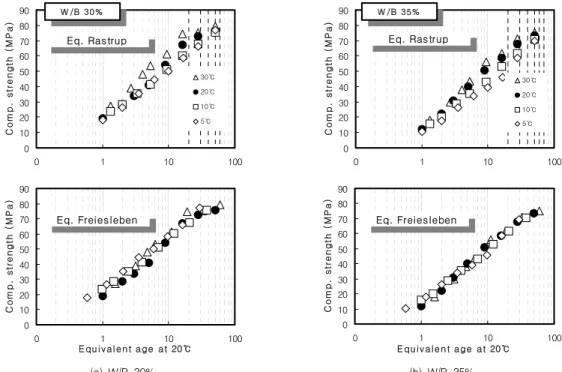
Fig. 4(a) and 4(b) represented by age conversion factor show the correlation of maturity with the strength of high-strength concrete according to curing temperature.
It is seen in W/B 30, 35% that the effect of temperature on the strength of high-strength concrete is explained well by Freiesleben function than Rastrup function. It indicates that Freiesleben function is better than Rastrup function.
Therefore, it is recommended to use activation energy value by Freiesleben function in the strength prediction of high-strength concrete.
4.3 Strength Prediction Of High-Strength Concrete
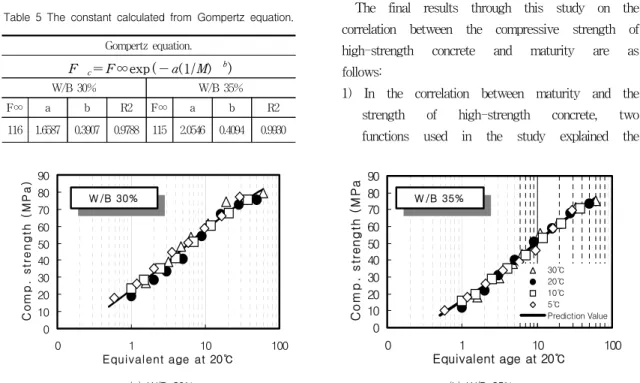
Table 5 presents the results of strength prediction according to gompertz equation. Fig. 5 shows the relations of predictive strength by prediction formula and strength measured actually. The strength prediction using maturity by Freiesleben function has high decisive factor value in every age through the experiments. It is therefore, recommended as a good method in strength prediction. Gompertz Curve shows S-formed developing curve and the highest decisive factor value. It can also be recommended to use in the strength prediction of high- strength concrete.
In addition, it is proved through the experiments that the strength prediction of high-strength concrete can be ranged from 1 day to 50 days.
5. Conclusions
The final results through this study on the correlation between the compressive strength of high-strength concrete and maturity are as follows:
1) In the correlation between maturity and the strength of high-strength concrete, two functions used in the study explained the
0 10 20 30 40 50 60 70 80 90
0 1 10 100
Equivalent age at 20℃
Co m p . s tr e n g th ( M P a )
W /B 30%
0 10 20 30 40 50 60 70 80 90
0 1 10 100
Equivalent age at 20℃
Co m p . s tr e ng th ( M P a
30℃
20℃
10℃
5℃
Prediction Value
W /B 35%
(a) W/B 30% (b) W/B 35%
Fig. 5 Relation between high-strength concrete and equivalent age according to gompertz quation Table 5 The constant calculated from Gompertz equation.
Gompertz equation.
F
c= F ∞ exp ( -a(1/M)
b)
W/B 30% W/B 35%
F∞ a b R2 F∞ a b R2
116 1.6587 0.3907 0.9788 115 2.0546 0.4094 0.9930
![Table 1 Age conversation factor vs. curing temperature Temp. (℃) T+10 T+ 10 20 + 10 exp[ - ER ( 1 Ts -1 Ta )] 0 10 0.333 0.151 5 15 0.500 0.292 25 35 1.167 1.260 30 40 1.333 1.574 40 50 1.667 2.408](https://thumb-ap.123doks.com/thumbv2/123dokinfo/5174720.594459/3.774.413.703.851.960/table-age-conversation-factor-curing-temperature-temp-exp.webp)