• 검색 결과가 없습니다.

IEG 환경지질연구정보센터

N/A
N/A
Protected

Academic year: 2021

Share "IEG 환경지질연구정보센터"

Copied!
11
0
0

로드 중.... (전체 텍스트 보기)

전체 글

(1)

Vol. 12, No. 2, p. 139 − 149, June 2008 DOI 10.1007/s12303-008-0015-8

What was the groundwater quality before mining in a mineralized region?

Lessons from the Questa Project

ABSTRACT: The U.S. Geological Survey, in cooperation with the New Mexico Environment Department and supported by Moly- corp, Inc (currently Chevron Minerals), has completed a 5-year investigation (2001-2006) to determine the pre-mining ground- water quality at Molycorp’s Questa molybdenum mine in north- ern New Mexico. Current mine-site ground waters are often con- taminated with mine-waste leachates and no data exists on pre- mining ground-water quality so that pre-mining conditions must be inferred. Ground-water quality undisturbed by mining is often worse than New Mexico standards and data are needed to help establish closure requirements. The key to determining pre-min- ing conditions was to study the hydrogeochemistry of a proximal natural analog site, the Straight Creek catchment. Main rock types exposed to weathering include a Tertiary andesite and the Tertiary Amalia tuff (rhyolitic composition), both hydrothermally altered to various degrees. Two types of ground water are common in mineralized areas, acidic ground waters in alluvial debris fans with pH 3-4 and bedrock ground waters with pH 6-8. Siderite, fer- rihydrite, rhodochrosite, amorphous to microcrystalline Al(OH)

3

, calcite, gypsum, barite, and amorphous silica mineral solubilities control concentrations of Fe(II), Fe(III), Mn(II), Al, Ca, Ba, and SiO

2

, depending on pH and solution composition. Concentrations at low pH are governed by element abundance and mineral weathering rates. Concentrations of Zn and Cd range from detec- tion up to about 10 and 0.05 mg/L, respectively, and are derived primarily from sphalerite dissolution. Concentrations of Ni and Co range from detection up to 1 and 0.4 mg/L, respectively, and are derived primarily from pyrite dissolution. Concentrations of Ca and SO

4

are derived from secondary gypsum dissolution and weathering of calcite and pyrite. Metal:sulfate concentration ratios are relatively constant for acidic waters, suggesting consistent weathering rates, independent of catchment. These trends, com- bined with lithology, mineralogy, and mineral solubility controls, provide useful constraints on pre-mining ground-water quality for the mine site where the lithology is known.

Key words: ground-water quality, pre-mining conditions, chemical weathering

1. INTRODUCTION

Active and inactive mine sites are challenging to reme- diate because of their complexity and scale. Regulations meant to achieve environmental restoration at mine sites are equally challenging to apply for the same reasons. The goal of environmental restoration is to restore contaminated mine sites, as closely as possible, to pre-mining conditions.

Metalliferous mine sites in the western U.S. are commonly located in hydrothermally altered and mineralized terrain in which pre-mining metal concentrations of soil, sediment, and water were already higher than unaltered areas. Unfor- tunately, those pre-mining concentrations were not nor- mally measured or documented but they can sometimes be reconstructed using scientific inference.

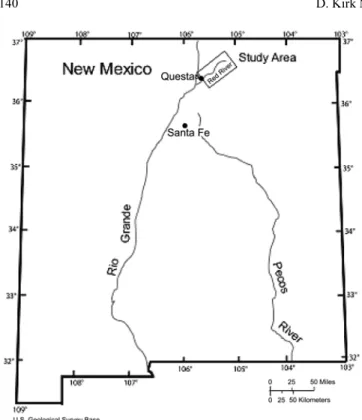
Molycorp’s Questa molybdenum mine in the Red River Valley, northern New Mexico, must meet several require- ments on closure including a return of ground-water quality to New Mexico’s ground-water quality standards unless it can be shown that concentrations before mining were higher than the standards. Ground waters at the mine site were not chemically analyzed before mining began. The U.S. Geological Survey (USGS), in cooperation with the New Mexico Environment Department, has completed a 5- year investigation (2001-2005) on the baseline and pre-min- ing ground-water quality at Molycorp’s Questa molybde- num mine site. The area of investigation, shown in Figure 1, included the Red River Valley from the town of Red River to the USGS streamflow gaging station at the US Forest Service District Ranger Station near the town of Questa. The aim of this investigation was to infer the pre- mining ground-water quality by examining the geologic, hydrologic, and geochemical controls on ground-water quality at a proximal analog site near the Questa Molyb- denum mine. Among several useful approaches that could be used to estimate pre-mining water quality (Runnells et al., 1992; Alpers and Nordstrom, 2000), the most direct one is the proximal analog. The most useful proximal analog should be similar to the mine site in lithology, geologic structure, topography, hydrology, climate, and ground-water characteristics. The site chosen for the proximal analog is the Straight Creek catchment, located within the study area approximately 3 miles to the east of the eastern boundary of the mine site (Fig. 2).

Geologic studies for this project include mapping of sur- face mineralogy by Airborne Visible-Infrared Imaging Spectrom- etry (AVIRIS; Livo and Clark, 2002); bedrock fractures and their potential effect on ground-water flow (Caine, 2003;

Caine, 2006); depth to bedrock measurements (Powers and Burton, 2004), leaching studies of scars and waste-rock piles (Smith, 2006); mineralogy and mineral chemistry and D. Kirk Nordstrom* U.S. Geological Survey, Boulder, Colorado 80303, USA

*Corresponding author: [email protected]

(2)

its potential effect on ground-water quality (Plumlee et al., 2005); environmental geology and debris-flow hazards of the Red River Valley (Ludington et al., 2004); lake sedi- ment chemistry (Church et al., 2005); and geomorphology and its effect on ground-water flow (Vincent, 2008). Hydro- logic studies for this project include compilations of histor- ical surface- and ground-water quality data (LoVetere et al., 2004; Maest et al., 2004); synoptic/tracer studies with mass loading and other water-quality trends of the Red River (McCleskey et al., 2003; Kimball, et al., 2006); reaction- transport modeling of the Red River (Ball et al., 2005);

hydrology and water balance for the Red River Valley (Naus and McAda, 2006); ground-water geochemistry of selected wells undisturbed by mining in the Red River Val-

ley (Naus et al., 2005; Nordstrom et al., 2005); and quality assurance and quality control of water analyses (McCleskey et al., 2004). A listing of Questa baseline and pre-mining ground-water quality reports is online (Questa, 2005). This paper focuses on the interpretation of natural ground-water quality in mineralized areas of the Red River Valley. Spe- cifically, the water-rock interactions that were found to gov- ern the composition of ground waters for mineralized areas in the Red River Valley also should apply to pre-mining ground-water quality at Molycorp’s Questa mine site.

The Red River Valley is located in the Taos Range of the Sangre de Cristo Mountains in northern New Mexico and southern Colorado. The main rock types are a basement of Precambrian granitic and metamorphic rocks, overlain by Tertiary andesite and the Tertiary Amaila Tuff, and intruded by granitic stocks that caused hydrothermal alteration of the volcanics (Meyer and Leonardson, 1990; Ludington et al., 2004). Hydrothermal alteration has resulted in potassic alter- ation, magnetite-hematite-quartz stockwork veining, fluorite- carbonate veining, quartz-sericite-pyrite alteration (QSP), quartz-sericite alteration (QS, sulfide-poor), argillic alter- ation, and propylitic alteration. Carbonate veining and alter- ation includes calcite, dolomite, rhodochrosite, and magnesite (Plumlee et al., 2005; Molycorp, oral communication, 2005).

The valley follows a portion of the Questa caldera margin and has extensive mineralized areas, steep topography, and rapidly forming debris fans. Many of these debris fans are forming from “scar” areas of intense QSP alteration with such rapid erosion rates that vegetation cannot grow. A three-dimensional view of the valley is shown in Figure 2 with the mine site and several scar areas shown as barren outcrops.

A detailed hydrogeochemical investigation was com- pleted on Straight Creek, a proximal analog site (Naus et al., 2005). Ground-water wells were completed in the Straight Creek debris fan, tapping both the alluvial and bedrock aquifers. The results from chemical analyses of these ground waters and the Straight Creek surface waters that feed the alluvial aquifer provided the framework for the fol- lowing interpretations, but additional water samples were collected from other mineralized catchments undisturbed by mining activities to broaden the applicability of the results.

2. METHODS

Ground-water samples were collected (2001-2003) using bladder pumps specifically designed for purging and sam- pling at low flow rates. For most wells, a unique stabiliza- tion/purging time was established by monitoring iron redox concentrations, pH, specific conductance, Eh, and dissolved oxygen (Naus et al., 2005; Nordstrom et al., 2005).

Field measurements were obtained by pumping water through a flow-through cell containing pH, Eh, tempera- ture, and dissolved oxygen electrodes and probes. Ground- Fig. 1. Location of the Red River, New Mexico.

Fig. 2. Three-dimensional natural color satellite image on a USGS

digital elevation model for the northern section of the Red River

Valley between Molycorp’s Questa mine site and the town of Red

River showing natural scars (from Caine, 2006).

(3)

water samples were routinely collected by filtering the water through a disposable capsule filter having a nominal pore size of 0.45 ìm (Naus et al., 2005; Nordstrom et al., 2005). Several sample splits were collected for analyses of inorganic constituents and redox species. Samples for the determination of major cations and trace metals (As, Al, B, Ba, Be, Bi, Ca, Cd, Ce, Co, Cr, Cs, Cu, Dy, Er, Eu, Fe, Gd, Hf, Ho, K, La, Li, Lu, Mg, Mn, Mo, Na, Nd, Ni, Pb, Pr, Rb, Re, Sb, Se, SiO

2

, Sm, Sr, Ta, Tb, Te, Th, Tl, Tm, U, V, W, Y, Yb, Zr, and Zn), major anions (Br, Cl, F, NO

3

, and SO

4

), alkalinity, and dissolved organic carbon (DOC) were fil- tered and then stabilizing reagents, if needed, were added.

Sample bottles were pre-rinsed with filtered water prior to sample collection. Analytical methods are described in Naus et al. (2005). Quality assurance and quality control of water analyses included duplicate sampling, sequential fil- tration studies, filter pore size comparisons, analyses of blanks, spike recoveries, analyses by different methods, and analyses by different laboratories (McCleskey et al., 2004).

3. RESULTS AND DISCUSSION

The Straight Creek alluvial aquifer is fed by acid rock drainage (pH 2.5 to 3) from the Straight Creek scar and is progressively diluted as it moves downgradient. Sulfate concentrations decreased from about 2,100 mg/L in the most upgradient well to less than 1,000 mg/L in the most down- gradient well as shown in Figure 3. This trend suggested that constituents with conservative (i.e., non-reactive) behav- ior could be distinguished from those that were reactive by plotting the concentration of each in relation to sulfate con- centration and testing the correlations for linear or non-lin-

ear trends. A strong linear correlation with sulfate should indicate the constituent was predominantly conservative and a poor correlation or non-linearity should indicate the constituent was predominantly non-conservative. A bedrock aquifer is also fed by infiltrating acid waters, but these are of circumneutral pH because they are anoxic and cannot oxidize pyrite and they are buffered by carbonate minerals, primarily calcite.

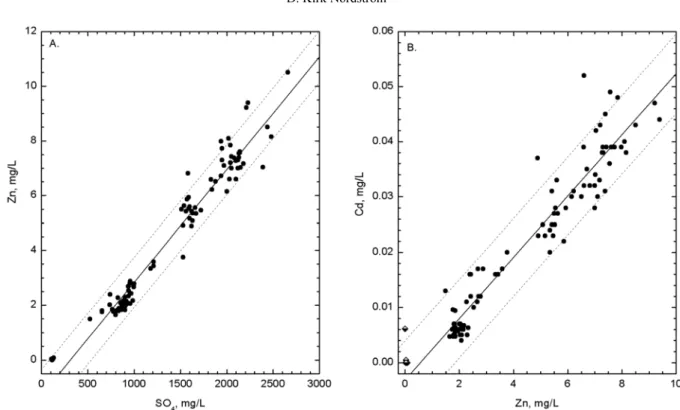
The primary determinant of whether a dissolved constit- uent behaves conservatively or non-conservatively is the pH because most metal solubilities are strongly affected by hydrolysis which is a function of pH. Mineral precipitation and sorption reactions are often inhibited at low pH. The correlations of constituent concentrations relative to sulfate concentrations demonstrated that most constituents behaved conservatively in the alluvial aquifer, not surprising for the pH range of 3 to 4. The trace elements zinc, cadmium, nickel, and cobalt behave conservatively. In Figure 4A, zinc concentrations are plotted relative to sulfate concentrations and in Figure 4B cadmium concentrations are plotted rel- ative to zinc concentrations. Both correlation coefficients are greater than 0.9 and the strong correlation between cad- mium and zinc (r

2

= 0.96) suggests they might be derived from the same mineral. Indeed, the dominant source for both cadmium and zinc is sphalerite, ZnS, and Zn:Cd weight ratios in sphalerite range typically from 50-200 (Fleischer, 1955). The same range of Zn:Cd weight ratios was found for sphalerites from mineralized areas in the Red River Val- ley (Plumlee et al., 2005) and the average weight ratio for the correlation trend in Figure 4B is 180. Hence, the avail- able evidence points to weathering of sphalerite as the pri- mary source of zinc and cadmium in the Red River Valley and in pre-mining acidic ground waters of Molycorp’s Questa mine site.

Another example of conservative behavior in acidic waters is shown for nickel and cobalt concentrations in Figure 5.

Nickel concentrations correlate strongly with sulfate con- centrations as shown in Figure 5A. The correlation of cobalt with nickel (r

2

= 0.98) is the second strongest of all corre- lations that have been obtained is shown in Figure 5B. The strongest correlation (r

2

= 0.99, data not shown) is between zinc and manganese. Studies on mineral chemistry indicate that the primary source of nickel and cobalt is from pyrite, especially pyrite found in altered andesite (Plumlee et al., 2005).

Several constituents show distinctly non-conservative behavior at pH values greater than 4 but iron shows non- conservative behavior at even lower pH values. The corre- lation between iron and sulfate concentrations is poor, but if ferric and ferrous iron concentrations are examined sepa- rately geochemical trends become apparent. Ferric iron con- centrations range widely from greater than 100 mg/L to less than 10 µg/L depending on pH. In the following plots, data from all wells are used so that the full range of pH can be Fig. 3. Ground-water elevation plotted relative to sulfate concen-

trations for the Straight Creek alluvial aquifer. Arrows indicate

direction of water flow.

(4)

seen. These samples include acidic alluvial well waters and neutral-pH bedrock well waters. Most of the trace elements have very low concentrations in the neutral-pH ground waters.

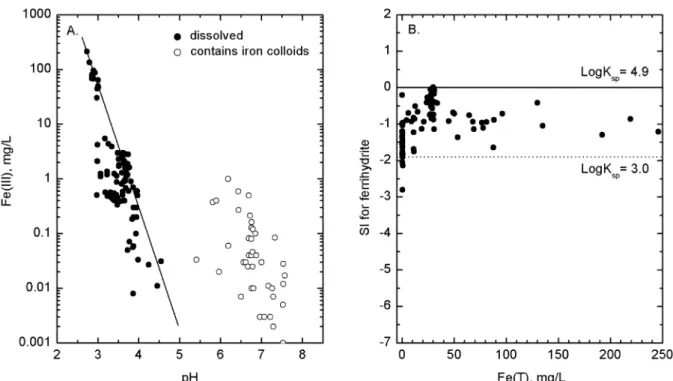
A log plot of ferric iron concentrations relative to pH (also a log scale) reflects an inverse linear trend (Fig. 6A).

Dissolved ferric iron concentrations for pH values greater than 5, although covering a range in concentration from 1 to 1,000 µg/L, have been shown to be below the detection limits of the colorimetric (FerroZine) method (To et al., 1999;

Nordstrom et al., 2005). In this circumneutral pH range, Fig. 4. A. Concentrations of zinc relative to sulfate for Straight Creek surface and alluvial ground waters (pH = 2.5 to 4). B. Concen- trations of cadmium relative to zinc for Straight Creek surface and alluvial ground waters.

Fig. 5. A. Concentrations of nickel relative to sulfate for Straight Creek surface and alluvial ground waters (pH = 2.5 to 4). B. Con-

centrations of cobalt relative to nickel for Straight Creek surface and alluvial ground waters.

(5)

iron colloids (hydrous ferric oxides or HFOs) are small enough to pass through filtration media and contribute to the apparent measurement of dissolved ferric iron. If these measurements are eliminated from the database and the sat-

uration indices (SI) for ferrihydrite (a proxy for a mixture of HFOs) are plotted relative to total dissolved iron concen- trations, a solubility control is maintained at ferrihydrite saturation (pK = 3 to 4.9, Fig. 6B). Hence, ferric iron con- Fig. 6. A. Logarithm of ferric iron concentration (Fe(III)) plotted relative to pH for both acidic and neutral-pH ground waters from the Red River Valley. The straight line is drawn through data points representing samples that have reached saturation with respect to fer- rihydrite. B. SI for ferrihydrite plotted relative to total dissolved iron concentration (Fe(T)).

Fig. 7. A. Ferrous iron concentration plotted relative to alkalinity (as HCO

3

). The line is drawn through data points representing samples

that are known to be saturated with respect to siderite. B. SI values for siderite plotted relative to pH. The horizontal lines indicate the

range of equilibrium solubility from disordered to crystalline siderite.

(6)

centrations appear to be controlled by ferrihydrite-like sol- ubility.

Ferrous iron concentrations have been shown to reach siderite, FeCO

3

, saturation in the study area (Nordstrom et al., 2005). If siderite saturation limits ferrous iron concen- trations because of the common-ion effect, a plot of ferrous iron concentrations relative to alkalinity should follow an inverse correlation and this trend is apparent in Figure 7A.

The slight increase in ferrous iron concentration shown at the highest concentrations of alkalinity may reflect forma- tion of a Fe(CO

3

)

22-

complex. Saturation indices for siderite plotted in Figure 7B show that saturation is reached only when pH values are at least 6. The highest SI values for sid- erite are those at the highest pH values, also consistent with the possible formation of a Fe(CO

3

)

22-

complex.

Similarly to siderite, manganese concentrations should vary inversely with increasing alkalinity concentrations and they do as shown in Figure 8A. Note that the trend is similar to that for ferrous iron concentrations in that the manganese concentrations are slightly higher at the highest alkalinities than at the medium range of alkalinities, suggesting the for- mation of a Mn(CO

3

)

22-

complex. Saturation indices for rhodochrosite (Fig. 8B) show that saturation is reached only when pH values are at least 6.

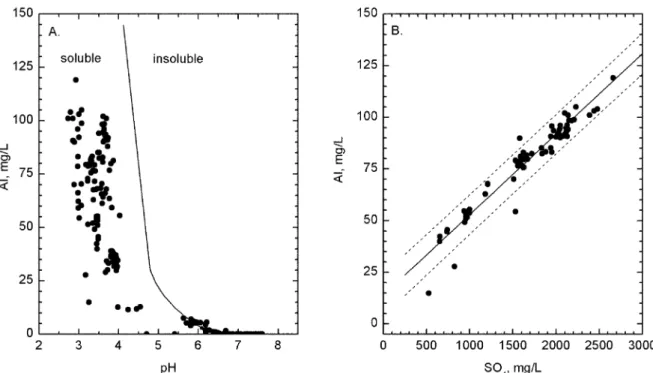
Aluminum portrays both conservative and non-conserva- tive behavior depending on pH. Nordstrom and Ball (1986) demonstrated that aluminum concentrations in many natural systems behave conservatively at pH values less than about

5, the pK value for the first hydrolysis constant. At or above a pH of 5, hydrolysis causes aluminum to precipitate as hydroxides and hydroxysulfates. The same behavior appears in the aluminum data from this project. Figure 9A shows the concentration of aluminum decreasing with increasing pH, similar to the trend for ferric iron, but the concentrations for pH values less than 5 are undersaturated with respect to amorphous Al(OH)

3

(left of the solid line).

Aluminum concentrations under acidic conditions are shown in Figure 9B in which a strong correlation with sulfate is obtained (r

2

= 0.93). The logarithm of the free aluminum ion activity is plotted relative to pH in Figure 10A and shows that the strongly decreasing activities at pH values greater than 5 correspond to the range for crystalline to amorphous Al(OH)

3

solubility. Figure 10B shows the sat- uration indices for amorphous Al(OH)

3

and the tendency for the SI values to be constrained to the range of crystalline gibbsite to amorphous Al(OH)

3

saturation for pH values greater than 5.

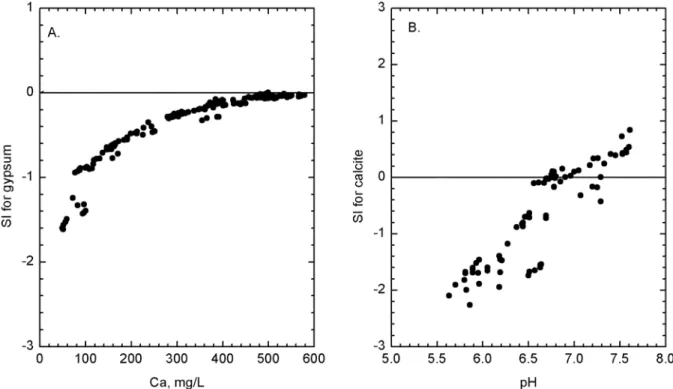
Concentrations of calcium are limited by gypsum and cal- cite mineral saturation. A plot of calcium relative to sulfate concentrations in Figure 11A indicates an upper limit to cal- cium concentrations from having reached gypsum saturation.

The plot of Ca:SO

4

molar ratios relative to pH in Figure

11B indicates that the water compositions range from those

predominantly affected by pyrite oxidation (pH values 2 to

5) to those predominantly affected by calcite and gypsum

dissolution (pH values > 5). In Figure 12A, the saturation

Fig. 8. A. Manganese concentrations plotted relative to alkalinity (as HCO

3

) with a line drawn through data points representing samples

for which rhodochrosite saturation was reached. B. SI values for rhodochrosite plotted relative to pH. The horizontal lines indicate the

range of equilibrium solubility from disordered to crystalline rhodochrosite.

(7)

indices for gypsum are plotted relative to calcium concen- trations and in Figure 12B the saturation indices for calcite are plotted relative to pH. Gypsum SI values reach satura- tion and are maintained at equilibrium, whereas calcite SI values go to supersaturation for two possible reasons. One reason is that at the high sulfate concentrations found in most of these ground waters, calcite precipitation is inhib-

ited. The other is that gypsum, being a more soluble salt, can likely dissolve more rapidly than calcite can precipitate.

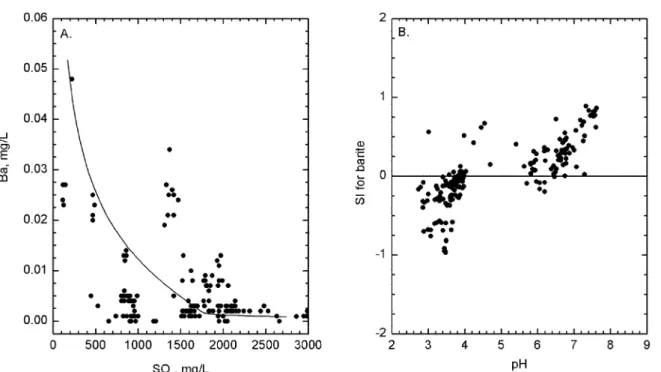
Barium concentrations are limited by the solubility of the mineral barite, BaSO

4

, independently of pH. Barium con- centrations are plotted relative to sulfate concentrations in Figure 13A. Many samples appear to be supersaturated.

The plot of barite SI values plotted in Figure 13B also Fig. 9. A. Aluminum concentrations plotted relative to pH with a line drawn for amorphous Al(OH)

3

solubility. B. Aluminum con- centrations plotted relative to sulfate concentrations for the acidic waters (pH < 4) of Straight Creek surface drainage and alluvial aquifer.

Fig. 10. A. Logarithm of the free aluminum ion activity plotted relative to pH with lines drawn for solubility limits of amorphous Al(OH)

3

at 5ºC for the maximum and crystalline gibbsite at 12ºC for the minimum. B. SI values for amorphous Al(OH)

3

and crystalline gibbsite.

(8)

shows many data points in the region of supersaturation.

One possible reason for supersaturation may be barite col- loids were not always filtered out.

Acidic waters typically have higher silica concentrations than circumneutral-pH ground waters, although this is not a

widely recognized fact. These higher concentrations occur because at low pH aluminosilicate minerals dissolve rapidly whereas silica polymerization and precipitation are slow processes (Dietzel, 2000; Icopini et al., 2005). Consequently, silica concentrations increase with decreasing pH (Fig.

Fig. 11. A. Calcium concentrations plotted against sulfate concentrations with the gypsum congruent dissolution line and the range for gypsum solubility. B. Ca:SO

4

molar ratio plotted against pH for gypsum stoichiometry (the solid line) bracketed by two dashed lines for gypsum dissolution predominance.

Fig. 12. A. SI values for gypsum plotted relative to calcium concentrations. B. SI values for calcite plotted relative to pH.

(9)

14A). A limit appears to be reached where saturation with respect to amorphous silica is approached at very low pH values (Fig. 14B).

4. CONCLUSIONS

A detailed hydrogeochemical investigation of ground

waters in the mineralized region of the Red River Valley of the Sangre de Cristo Mountains in northern New Mexico has resulted in identification of two main types of ground- water chemistry unaffected by mining or other anthropo- genic activities. One type is acidic (pH 3 to 4), which con- tains elevated concentrations of sulfate, iron, aluminum, manganese, zinc, cadmium, nickel, cobalt, chromium, copper, Fig. 13. A. Barium concentrations plotted relative to sulfate concentrations with a line showing the equilibrium solubility for barite. B.

SI values for barite plotted relative to pH.

Fig. 14. A. Silica concentrations plotted relative to pH. B. SI values for three varieties of silica, amorphous, chalcedony (microcrystalline

quartz), and quartz, plotted relative to pH.

(10)

calcium, magnesium, beryllium, and fluoride, and occurs primarily in debris fans formed from rapidly eroding scar areas containing high concentrations of pyrite in QSP-altered andesite. The other type is circumneutral in pH with ele- vated concentrations of sulfate, iron, manganese, calcium, and magnesium and occurs in bedrock. At low pH, most constituent concentrations correlate linearly with sulfate concentrations, indicating consistent weathering stoichiom- etries and conservative behavior during dilution with down- gradient transport. The main exception is iron which, when oxidized, hydrolyzes and precipitates hydrous ferric oxides (or hydroxysulfates) at pH values greater than 2.5. Alumi- num behaves conservatively at pH values less than 4 and non-conservatively at pH values greater than 5, with con- centrations limited by the solubility of crystalline gibbsite or amorphous Al(OH)

3

. Both ferric iron and aluminum con- centrations are controlled by pH because of their tendency to hydrolyze and precipitate.

At higher pH values, manganese and ferrous iron con- centrations are limited by saturation with respect to rhodo- chrosite and siderite, respectively. Carbonate buffering is available in the bedrock aquifer from carbonate mineraliza- tion (calcite, rhodochrosite, and dolomite) and anoxic con- ditions prevent pyrite oxidation. Calcite and gypsum saturations also are reached in the more mineralized ground waters, placing a limit on calcium, but not magnesium, con- centrations. Barium concentrations are limited by barite sat- uration. Silica concentrations increase at low pH but seem to be limited by an amorphous silica phase.

These geochemical trends and mineral solubility controls provide ranges of concentrations that can be expected for natural mineralized conditions, including estimates for pre- mining ground-water quality, in the Red River Valley and could provide a basis for establishing water-quality stan- dards. The pre-mining concentrations of contaminants of concern (Fe, Al, Mn, Cu, Zn, Cd, Be, F, Co, Ni, Cr, SO

4

, and pH) range anywhere from less than the New Mexico ground-water quality standards up to 250 times the standard in the case of Mn. Many of these constituents are 2-20 times the ground-water quality standards. Details of these results can be found in Nordstrom (2008). Current ground- water chemistry at the mine site ranges substantially from background concentrations up to 1-2 orders of magnitude greater than estimated pre-mining concentrations. The high- est metal concentrations are found in waste-rock piles con- taining substantial amounts of pyrite.

The regulatory agencies must decide how to apply the conclusions from this study for compliance requirements on closure and some negotiation between the regulators and the mining industry representatives will happen before final decisions are made. This process is still underway but the general consensus is satisfactory by all parties because the mining company does not have to clean up ground waters to New Mexico standards and the regulators have defensi-

ble scientific justification for applying more lenient stan- dards.

REFERENCES

Alpers, C.N. and Nordstrom, D.K., 2000, Estimation of pre-mining conditions for trace metal mobility in mineralized areas. In Proc.

Fifth Inter. Conf. Acid Rock Drainage, ICARD 2000, v. 1, Society for Mining, Metallurgy, and Exploration, Littleton, Colo., 463 −472.

Ball, J.W., Runkel, R.L., and Nordstrom, D.K., 2005, Questa baseline and pre-mining ground-water quality investigation. 12. Geochem- ical and reactive-transport modeling based on low-flow and snowmelt tracer studies for the Red River, New Mexico. U.S.

Geol. Survey Sci. Invest. Report 2005-5149.

Caine, J.S., 2003, Questa baseline and pre-mining ground-water quality investigation. Preliminary brittle structure geologic data, Questa mining district, southern Sangre de Cristo Mountains, New Mexico. U.S. Geol. Survey Open-File Report 03-280.

Caine, J.S., 2006, Questa baseline and pre-mining ground-water quality investigation. 18. Characterization of brittle structures in the Questa Caldera and their potential influence on bedrock ground-water flow, Red River Valley, New Mexico. U.S. Geol.

Survey Professional Paper1729.

Church, S.E., Fey, D.L., and Marot, M.E., 2005, Questa baseline and pre-mining ground-water quality investigation. 8. Lake-sediment geochemical record from 1960 to 2002, Eagle Rock and Fawn Lakes, Taos County, New Mexico. U.S. Geol. Survey Open-File Report 2005-5006.

Dietzel, M., 2000, Dissolution of silicates and the stability of poly- silicic acid. Geochimica et Cosmochimica Acta, 64, 3275 −3281.

Fleischer, M., 1955, Minor elements in some sulfide minerals. In Bateman, A.M., ed., Econ. Geol., Fiftieth Anniversary Volume, 1905-1955, Part II, Lancaster Press, Lancaster, Penn., 970 −1024.

Icopini, G.A., Brantley, S.L., and Heaney, P.J., 2005, Kinetics of silica oligomerization and noncolloid formation as function of pH and ionic strength at 25 ºC. Geochimica et Cosmochimica Acta, 69, 293 −303.

Kimball, B.A., Nordstrom, D.K., Runkel, R.L., Vincent, K.R., and Verplanck, PL., 2006, Questa baseline and pre-mining ground-water quality investigation. 23. Quantification of mass loading from mined and unmined areas along the red River, New Mexico. U.S.

Geol. Survey Sci. Invest. Report 2006-5004.

Livo, K.E. and Clark, R. N., 2002, Mapped Minerals at Questa, New Mexico, Using Airbourne Visible-Infrared Imaging Spectrometer (AVIRIS) Data--preliminary report. U.S. Geol. Survey Open-File Report 02-0026.

Lovetere, S.H., Nordstrom, D.K., Maest, A.S., and Naus, C.A., 2004, Questa baseline and pre-mining ground-water quality investiga- tion. 3. Historical ground-water quality for the Red River Valley, New Mexico. U.S. Geol. Survey Water-Resour. Invest. Report 03- 4186.

Ludington, S., Plumlee, G.S., Caine, J.S., Bove, D., Holloway, J.M., and Livo, K.E., 2004, Questa baseline and pre-mining ground- water quality investigation. 10. Geologic influences on ground and surface waters in the lower Red River watershed, New Mex- ico. U.S. Geol. Survey Sci. Invest. Report 2004-5245.

Maest, A.S., Nordstrom, D.K., and Lovetere, S.H., 2004, Questa baseline and pre-mining ground-water quality investigation. 4.

Historical surface-water quality for the Red River Valley, New Mexico. U.S. Geol. Survey Sci. Invest. Report 2004-5063.

McCleskey, R.B., Nordstrom, D.K., Steiger, J.I., Kimball, B.A.,and

(11)

Verplanck, P.L., 2003, Questa baseline and pre-mining ground- water quality investigation. 2. Low-flow (2001) and snowmelt (2002) synoptic/tracer water chemistry for the Red River, New Mexico. U.S. Geol. Survey Open-File Report 03-148.

McCleskey, R.B. Nordstrom, D.K., and Naus, C.A., 2004, Questa baseline and pre-mining ground-water quality investigation. 16.

Quality assurance and quality control of water analyses. U.S.

Geol. Survey Open-File Report 2004-1341.

Meyer, J. and Leonardson, R., 1990, Tectonic, hydrothermal and geo- morphic controls on alteration scar formation near Questa, New Mexico. In New Mexico Geol. Soc. Guidebook, 41st Field Con- ference, Southern Sangre de Cristo Mountains, 417 −422.

Naus, C.A., McAda, D.P., and Myers, N.C., 2006, Questa baseline and pre-mining ground-water quality investigation. 21. Hydrol- ogy and water balance of the Red River Basin, New Mexico 1930-2004. U.S. Geol. Survey Sci. Invest. Report 2006-5040.

Naus, C.A., McCleskey, R.B., Nordstrom, D.K., Donohoe, L.C., Hunt. A.G., Paillet, F., Morin, R.H., and Verplanck, P.L., 2005, Questa baseline and pre-mining ground-water quality investigation.

5. Well installation, water-level Data, and surface- and ground- water geochemistry in the Straight Creek Drainage Basin, Red River Valley, New Mexico, 2001-03. U.S. Geol. Survey Sci. Invest.

Report 2005-5088.

Nordstrom, D.K., 2008, Questa baseline and pre-mining ground- water quality investigation. 25. Summary of results and baseline and pre-mining ground-water geochemistry, Red River Valley, Taos County, New Mexico, 2001-2005. U.S. Geol. Survey Profes- sional Paper 1728.

Nordstrom, D.K., and Ball, J.W., 1986, The geochemical behavior of aluminum in acidified surface waters: Science, 232, 54 −56.

Nordstrom, D.K., McCleskey, R.B., Hunt, A.G., and Naus, C.A., 2005, Questa baseline and pre-mining ground-water quality investiga- tion. 14. Interpretation of ground-water geochemistry in catch- ments other than the Straight Creek catchment, Red River Valley, Taos County, New Mexico, 2002-2003. U.S. Geol. Survey Sci.

Invest. Report 2005-5050.

Plumlee, G.S., Lowers, H.A., Ludington, S.D., Koening, A.E., and Briggs, P.H., 2005, Questa baseline and pre-mining ground-water quality investigation. 13. Mineral microscopy and chemistry of mined and unmined porphyry molybdenum mineralization along the Red River, New Mexico – Implications for ground- and sur- face-water quality. U.S. Geol. Survey Sci. Invest. Report 2005- 1442.

Powers, M.H. and Burton, B.L., 2004, Questa baseline and pre-mining ground-water quality investigation. 1. Depth to bedrock determi- nations using shallow seismic data acquired in the Straight Creek Drainage near Red River, New Mexico. U.S. Geol. Survey Open- File Report 2004-1236.

Questa, 2005, Questa baseline and pre-mining ground-water quality investigation, Red River Valley Basin, New Mexico, available on the World Wide Web, accessed December 19, 2005, at URL http://wwwbrr.cr.usgs.gov/projects/GWC_chemtherm/questa.htm Runnells, D.D., Shepard, T.A., and Angino, E.E., 1992, Metals in

water–Determining natural background concentrations in miner- alized areas. Env. Sci. Technol., 26, 2316-2322.

Smith, K.S., Hageman, P.L., Briggs, P.H., Sutley, S.J., McCleskey, R.B., Livo, K.E., Verplanck, P.L., Adams, M.G., and Gemery-Hill, P.A., 2006, Questa baseline and pre-mining ground-water quality investigation. 19. Leaching characteristics of composited materials from mine waste-rock piles and naturally altered areas near Questa, New Mexico, U.S. Geol. Survey Sci. Invest. Report 2006-5165.

To, T.B., Nordstrom, D.K., Cunningham, K.M., Ball, J.W., and McCles- key, R.B., 1999, New method for the direct determination of dis- solved Fe(III) concentration in acid mine waters. Env. Sci. Technol., 33, 807 −813.

Vincent, K.R., 2008, Questa baseline and pre-mining ground-water quality investigation. 17. Geomorphology of the Red River Valley, Taos County, New Mexico, with emphasis on the shallow alluvial aquifer. U.S. Geol. Survey Sci. Invest. Report 2006 −5156.

Manuscript received March 5, 2007

Manuscript accepted March 6, 2008

수치

Fig. 2. Three-dimensional natural color satellite image on a USGS digital elevation model for the northern section of the Red River Valley between Molycorp’s Questa mine site and the town of Red River showing natural scars (from Caine, 2006).
Fig. 5. A. Concentrations of nickel relative to sulfate for Straight Creek surface and alluvial ground waters (pH = 2.5 to 4)
Fig. 7. A. Ferrous iron concentration plotted relative to alkalinity (as HCO 3 ). The line is drawn through data points representing samples that are known to be saturated with respect to siderite
Fig. 10. A. Logarithm of the free aluminum ion activity plotted relative to pH with lines drawn for solubility limits of amorphous Al(OH) 3
+3

참조

관련 문서

Near Nong Khai, on a terrace of the Mae Nam Khong, adequate water from shallow dug wells, 30 to 50 feet deep in alluvial sand and gravel, supply municipal

The “Asset Allocation” portfolio assumes the following weights: 25% in the S&amp;P 500, 10% in the Russell 2000, 15% in the MSCI EAFE, 5% in the MSCI EME, 25% in the

1 John Owen, Justification by Faith Alone, in The Works of John Owen, ed. John Bolt, trans. Scott Clark, &#34;Do This and Live: Christ's Active Obedience as the

Micro- and nano-sized pores were formed on the surface of the alloy using PEO and anodization methods, and the pore shape change according to the Zr

The data are corrected for temperature error due to solar radiation and the effect of low temperature on the anerod capsule and curvature of the surface of

Relationship between soil pH and phosphatase activity in volcanic ash soil of citrus orchards on the different surface soil management practices at

Figure 15 Tensile strength and modulus values for the MB-CNTFs after (a) chemical functionalization of the CNT surface with 4-iodoaniline under acidic

– Treat wastewater before it is discharged to maintain the water quality of the natural waters for the benefit of humans and aquatic ecosystem. • Wastewater management goal