저온변환에 따른 적철석의 자화안정도
Magnetic Stability of Hematite on Low-temperature Magnetic Phase Transition
장 수 진(Sujin Jang)⋅유 용 재(Yongjae Yu)*
충남대학교 지질환경과학과
(Department of Geology and Earth Environmental Sciences, Chungnam National University, Daejeon 305-764, Korea)
요약 :지난 10여 년간 미항공우주국 주도로 진행된 화성탐사 연구는 화성 암권의 주요 자성광물임을
적철석으로 판명하였다. 금번 연구에서는 적철석의 열잔류자화와 저온 실온포화잔류자를 이용하여 화 성 암권에 존재하는 적철석의 자화안정도 검증을 시도하였다. 적철석의 실온포화잔류자화는 모린변환 온도인 260 K를 기점으로 급격히 감소한다. 10 K까지 냉각시킨 적철석 시료를 가열하면 260∼265 K 에서 자화회복이 발생하며, 잔류자화기억도는 37%이다. 실제 화성지표의 일교차는 모린변환온도를 포함하므로, 화성 지표에서 적철석을 함유하는 암체의 자화는 모린변환에 의한 자화안정도가 고려되 어야 한다. 지표용암의 고결과 동시에 생성되는 열잔류자화의 강도는 50 µm 이하 크기에서 적철석 입자반경에 비례하며 증가한다. 화성의 온도구배가 관측된 적은 없지만, 지구의 온도구배를 기준으로 유추하면 대략 1.5 km 이하의 화성 암권은 모린변환온도와 무관하게 적철석의 자화보유가 상시 가능 하다. 따라서 행성의 진화가 멈춰진 대략 40억 년 이전에 존재하던 내부기원의 화성자기장 기록이 화 성의 암권에 현재까지 보전되어 화성 암권의 자기이상을 유지해온 것으로 해석된다.
주요어 :적철석, 화성, 포화잔류자화, 자화기억도, 모린변환
ABSTRACT : Recent progress in Martian exploration identified hematite as the major candidate for the strong magnetic anomalies observed in Martian lithosphere. In the present study, grain-size dependence of thermoremanent magnetization and low-temperature stability of room-temperature saturation isother- mal remanent magnetization (RTSIRM) were monitored using synthetic hematites. For hematite, the antiferromagnetic spin configuration is re-arranged from being perpendicular to the c-axis to be parallel to the c-axis below the Morin transition (=TM). A large fraction of RTSIRM is demagnetized at TM (=
260 K) during zero-field cooling from 300 K to 10 K. About 37% of the initial RTSIRM is recovered on warming from 10 K to 300 K. Shallow Martian subsurface at 1∼2 km depth would experience low-temperature cooling-warming of TM because average Martian surficial temperature is about 220 K.
However in most Martian lithosphere whose temperatures are higher than 260 K, the very stable magnetic memory of hematite could be a contributor to Martian magnetic anomalies.
Key words : hematite, mars, saturation remanent magnetization, remanence memory, morin transition
*Corresponding author: +82-41-821-6424, E-mail: [email protected]
장수진
⋅
유용재서 론
태양계 내행성의 지표는 용암이 식으며 결정화 된 화성암으로 구성되어 있다. 내행성 가운데 지구 는 생동하는 판의 유기작용으로 화성암뿐 아니라 퇴적암과 변성암이 지표에 존재한다. 지구를 포함 하는 태양계 내행성의 지표암석은 일반적으로 자 성광물을 일정부분 함유하고 있다.
화성암은 생성 당시 산소분압(Oxygen Fugacity)에 따라 적철석(Hematite, Fe2O3)-티탄철석(Ilmenite, FeTiO3)고용체와 자철석(Magnetite, Fe3O4)-울보스 피넬(Ulvöspinel, Fe2TiO4) 고용체를 선택적으로 생성한다. 지구의 암권에서는 자철석-울보스피넬 고용체가 상대적으로 더 풍부하지만, 달과 화성에 서는 티탄철석과 적철석이 주요 자성광물이다(Kle- tetschka et al., 2000). 특히 화성 적도 부근에 800 km 이상의 너비에 걸쳐 분포하는 적철석 평원의 존재는 화성의 진화사를 재구성하는데 많은 과학 적 진보를 유발하였다(Jeong and Yu, 2011).
적철석(Fe3+Fe3+O3)은 결정구조상 삼방정계(Tri- gonal Crystal System)에 속하며 능면체격자(Rhom- bohedral Lattice) 구조를 지닌다. 적철석은 심성암 에서 고용체 관계를 이루는 티탄철석(Ilmenite)과 용출(Exsolution)구조를 보이지만(Hwang and Kim, 2011), 상대적으로 냉각 속도가 빠른 화산암에서는 적철석과 티탄철석의 중간 성분이 관찰된다(Ozima and Funaki, 2001). 적철석은 산화환경이 우세한 지구와 화성에 분포하는 철산화물로, 지구환경의 변화를 반영하는 지시광물로 사용된다(Maher and Dennis, 2001). 또한 적철석은 토양의 발달(Jeong and Kim, 1990)이나 침전물오염(Kim and Kim, 2003) 을 평가하는데 활용되기도 한다. 적철석 함유량은 호성퇴적물과 천해성 퇴적물 내 풍성(Aeolian)기원 과 유수(Fluvial)기원 퇴적물의 상대부피비를 결정 하는 정량적 인자로 사용된다(Yamazaki and Ioka, 1997).
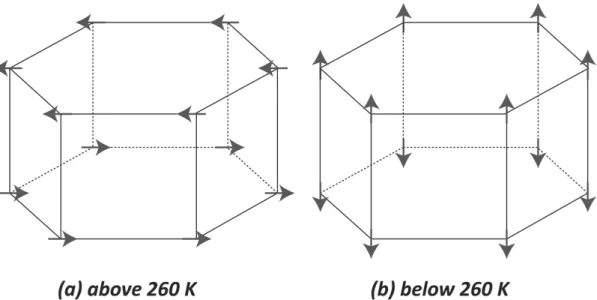
화성암 기원의 적철석은 판상이 우세하며, (0001) 면이 능면체격자의 기저면이다. 적철석은 반자성 (Antiferromagnetism)광물로 실온에서 자화스핀(Mag- netic Spin)이 모두 능면체격자의 기저면과 평행한 수평방향으로 배열한다(그림 1a). 기저면 각각의 자화스핀 방향은 기저면 별로 반대방향을 이루어, 궁극적으로 자화가 상쇄되는 반자성을 이룬다. 그 러나 반자성이 완벽하지 아니하여 스핀이 0.13° 어 긋나며 능면체기저면에 평행하게 2 kA/m의 약한
자화를 생성한다. 적철석의 자화는 반영구적으로 매우 안정하며 자화를 왜곡하려면 고온처리, 저온 처리, 혹은 자기장처리가 반드시 필요하다. 적철석 의 자화왜곡에 필요한 자기장은 최소 100 T로 지 표지구자기장의 백만 배 이상 강력한 자기장이 필 요하다(Néel and Pauthenet, 1952).
자성광물을 함유한 암석은 자화상실온도 이상의 고온변성에 노출되면 고유자화 정보가 모두 소멸 된다. 자철석과 적철석의 자화상실온도는 각각 853 K과 953 K이다(Chevallier, 1951). 일반적으로 반 자성과 강자성(Ferromagnetism)의 자화상실 온도 는 각 물성의 자화상실을 정립한 노벨상 수상자인 Louis Néel과 Pierre Curie의 성명을 따라 각각 TN
(=Néel temperature)과 TC (=Curie Point)라 한다.
적철석의 TN은 자철석의 TC보다 100 K 정도 높은 953 K이며, 적철석을 함유하는 암석의 자화가 왜 곡되려면 최소한 Granulite Facies 정도의 고온변 성이 필요하다.
자성광물을 함유한 암석은 일정 온도 이하의 저온 노출 시 자화정보의 부분적 상실이 발생한다. 자철 석은 대략 110 K인 버웨이변환온도(TV: Verwey Transition Temperature)보다 고온에서는 등축정계 이지만, 저온에서는 단사정계의 결정구조를 지닌다 (Verwey, 1939). 적철석은 대략 260 K에서 자화변 환을 보여주는데 이를 모린변환온도(TM: Morin Tran- sition Temperature)라 한다(Morin, 1950). 260 K 이상에서 능면체기저면에 평행하던 자화방향이, 260 K 이하에서 능면체기저면에 수직인 삼방정계의 장 축방향으로 돌아서게 된다(그림 1b). 이는 스핀의 자 화배열이 260 K 이상에서는 쌍극자스핀배열(Dipolar Spin Array) 경향에 지배되지만, 260 K 이하에서 는 개별스핀의 배열자유도가 증가하기 때문이다 (Dzyaloshinsky, 1958). 260 K 이상에서 형성된 자 화는 TM 이하에서 근본적으로 사라지지만(Muench et al., 1985), 일부 미약한 자화가 광물의 결점 (Defect)에 의해 삼방정계의 [111]에 약 10도 기운 방향으로 형성된다(Morrish et al., 1963). 합성적 철석의 경우 TM 이하의 자화는 TM 이상 자화의 2%
이하 수준이며, 일부 결점이 풍부한 자연산 적철석 에서는 감쇠 후의 저온자화가 실온자화의 10%에 이르기도 한다(Özdemir and Dunlop, 2005). 특히 화성 저위도 지역의 지표는 일교차만으로도 TM을 넘나들기에, 화성의 암권에 다량으로 분포하는 적 철석의 자화안정도에 관한 기초적인 연구가 시급 한 실정이다.
Fig. 1. Schematic configuration of magnetic spins (thick arrows) in hematite. (a) Above 260 K, magnetic spins array within the basal plane perpendicular to the rhombohedral c-axis. (b) Below 260 K, magnetic spins realign parallel to the c-axis.
Fig. 2. Temperature dependence of saturation magne- tization for hematite. Magnetization remained nearly unchanged from T
0to 873 K, then abruptly decrea- sed above 873 K, and entirely disappeared around 953 K.
시 료
암석에 존재하는 100 µm 이하 크기의 자연산 적철석을 모암으로부터 완벽히 분리하는 기술은 현재 존재하지 않는다. 따라서 금번 실험에서는 입 자크기의 조절이 가능한 합성적철석을 사용하였다.
서로 다른 평균 입도를 지니는 육면체모양의 상업 용 합성자철석 다섯 세트를 973 K에서 18시간 가 열하여 적철석으로 변환하였다. 주사전자현미경 (Scanning Electron Microscope)을 사용하여 측정 한 적철석 다섯 세트의 평균 입자크기는 각각 0.6, 1.5, 2.4, 3.6, 6.0 µm이다.
실험에 사용한 적철석 입자의 크기가 미세하여 미세탐침성분분석기(Electron Probe Micro-Analy- zer)를 사용한 성분분석이 불가능하다. 따라서 자 화특성을 이용하여 적철석의 순수도(Stoichiometry) 를 간접적으로 검증하였다. 온도 증가에 따른 포화 자화(Saturation Magnetization)의 감소도를 측정한 결과, 포화자화는 953 K에서 완전히 소멸된다(그 림 2). 자철석의 포화자화는 480 kA/m로 적철석의 포화자화 2 kA/m보다 200배 이상 강하므로, 변환 의 초기 상태인 자철석이 미량으로 존재하면 포화 자화 감소도가 853 K부근에서 미약한 자화변곡을 보여주게 된다. 실험결과 포화자화 감소도는 853 K에서 전혀 자화감소를 나타내지 않으므로, 변환
의 초기 상태인 자철석이 최종산물인 적철석으로 모두 변환되었음을 지시한다(그림 2).
장수진
⋅
유용재연구방법 및 결과
적철석의 자화변환 TM을 감지하기 위해 실온포 화잔류자화(Room-temperature Saturation Isother- mal Remanent Magnetization, RTSIRM) 냉각-가 열 실험을 수행하였다. 실온포화잔류자화의 냉각과 가열 실험은 MPMS (Magnetic Properties Mea- surement System)를 이용하여 측정한다. 우선 적철 석 시료를 실온에서 2 T의 자기장 환경에 노출시 켜 실온포화잔류자화를 획득시킨다. 시료를 300 K 부터 10 K로 냉각하며 5 K 간격으로, 그리고 10 K부터 300 K까지 가열하며 역시 5 K 간격으로 실온포화잔류자화의 변화를 측정한다. 실험의 신뢰 도를 높이기 위해 자기차폐 환경은 지구자기장의 약 0.5%인 250 nT 이하를 항시 유지하며, 급격한 온도 변화를 방지하기 위해 가열/냉각 시 온도 증 가/감소율은 4.5 K/min을 유지한다. 모든 저온실험 은 미국 미네소타대학 지질지구물리학과 부설 암 석자기연구소의 MPMS를 이용하여 수행하였다.
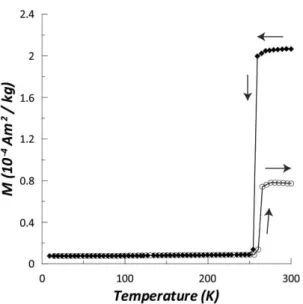
실온포화잔류자화는 연구 대상 시료를 실온에서 지표평균자기장의 10,000배를 상회하는 2 T의 강 한 자기장에 인위적으로 노출시켜 생성되는 잔류 자화이다. 실온포화잔류자화는 자기장에 평행한 방 향으로 시료 내의 자성광물을 최대한 배열시킬 수 있는 자화능력을 나타내며, 시료 내의 자성광물 함 량에 비례한다. 적철석의 실온포화잔류자화는 10 K까지 냉각시키는 동안 260 K에서 급격히 감소한 다(그림 3). 냉각 이후의 가열 과정에서 실온포화 잔류자화 잔류자화기억도는 대략 37%이다(그림 3).
특히 가열 시 나타나는 자화회복은 260∼265 K의 온도 구간에 국한된다(Bhowmik and Saravanan, 2010). TM이 260∼265 K에 국한됨은 실험에 사용 된 적철석이 3가철(Ferric Iron) 이외의 양이온을 함유하지 않음을 지시한다(Liu et al., 2010). 만약 3가철 이외의 양이온이 일부만 존재해도 가열의 자 화회복은 거의 감지되지 않는다(Liu et al., 2010).
TM에서의 급격한 자화감소는 적철석의 고유한 특 징으로, TM 이상에서 능면체기저면에 유도된 자화 가 TM 이하에서 능면체기저면에 수직인 방향으로 재배열되며 나타나는 자화상변화현상(Magnetic Phase Transition)이다(Özdemir and Dunlop, 2006). 반면 가열 시 발생하는 잔류자화의 부분회복은 격자결함 (Lattice Defect)에 기인한다(Haigh, 1957a, 1957b;
Özdemir et al., 2008).
열잔류자화(TRM)를 획득하기 위해 적철석 시료
를 0.1 mT의 자기장 환경에서 923 K부터 실온까 지 냉각시켰다. 상업용 열소자기는 973 K 이상의 고온 실험이 불가하여, 자체 제작한 열소자기를 사 용하였다. 실험을 위해 제작된 열소자기는 1073 K 까지 가열이 가능하고 자기차폐 능력이 50 nT 이 하이며 냉수냉각방식으로 빠른 냉각이 가능하지만, 소규모 기기라 매 실험 시 1개의 시료만 측정 가능 하므로 고전적인 고지자기학(Paleomagnetism) 연 구에는 부적합하다.
실험 결과와 기존에 보고된 적철석 열잔류자화 자료(Hartstra, 1982; Kletetschka et al., 2000; Özde- mir and Dunlop, 2005)를 종합하면, 대략 50 µm 이하의 적철석 입자크기에서 열잔류자화는 적철석 의 입자크기에 정비례한다(그림 4). 반면 50 µm 이상의 적철석 입자크기에 해당하는 다자기구역 (Multidomain)에서는 자화차폐(Screening Factor) 현상으로 열잔류자화가 입자크기에 무관하게 일정 한 자화강도(=1.41 kA/m)를 나타낸다(Dunlop and Kletetschka, 2001). 금번 실험에 사용된 자료에 국 한하면 열잔류자화가 적철석의 입자크기에 비례하 여 증가하는 경향성을 보인다(그림 4). 이는 단자 기구역(Single-domain) 입자의 열잔류자화 획득 과 정에서 열에너지와 자화에너지가 경합하는 열잔류 자화 이론식(Néel, 1949)과 정확히 일치한다.
토 의
지구 암권의 화성암 연구에서는 자철석이 적철 석보다 중요한 비중을 차지한다. 이는 적철석의 포 화자화(= 2 kA/m)가 자철석 포화자화(= 500 kA/m) 의 0.5% 수준으로 매우 낮기 때문이다. 따라서 지 구의 암권에서는 적철석 연구가 주로 2차 산화물 인 퇴적물이나 변성암의 부산물 연구에 이용된다.
그러나 0.1 mT 이하의 약한 자기장 세기에서는 다 자기구역 적철석이 포화잔류자화에 이르는 반면 자철석은 포화잔류자화에 미치지 못한다(Kletets- chka and Wasilewski, 2002). 따라서 행성의 지표 에서 관찰 가능한 0.1 mT 이하 수준의 내부기원 자기장 세기에서는 적철석의 중요도가 상대적으로 부각된다. 요약하면 자철석을 함유한 암석은 자화 를 획득하기 용이하지만 제한된 입자크기 조건 때 문에 자화의 유지가 어렵다. 반면 적철석의 포화잔 류자화는 상대적으로 미약하지만 유리한 입자크기 조건 때문에 자화의 유지가 자철석에 비해 용이하 다(Kletetschka and Wasilewski, 2002). 따라서 화
Fig. 3. Cooling and warming of saturation isother- mal remanent magnetization produced in a 2 T field. Nearly 37% of remanence was recovered on warming through the Morin transition at 260 K.
Fig. 4. Magnitude of thermoremanent magnetization (TRM) as a function of garin size in hematite. The dashed line is the TRM saturation at 1.41 kA/m, from theoretic estimation by Néel (1949).
성 암권에서 관측된 광역적인 자기 이상을 설명하 기에는 자철석보다 적철석이 적합한 대안으로 여 겨진다(Dunlop and Kletetschka, 2001). 실제 화성 탐사기기인 Opportunity와 Spirit 탐사에서도 적철 석의 존재가 증명되어, 화성 암권의 자기이상 설명 에 실질적인 해법으로 적철석이 제시되고 있다.
화성관측위성에 의해 감지되고 화성탐사기기에 의해 증명되었듯이, 적철석은 화성표면에 존재하는 가장 풍부한 자성광물이다(Glotch and Christensen, 2005). 특히 퇴적기원의 갈색 기반암에 존재하는 밀리미터 단위 구형 적철석의 존재는 화성 표면의 산화 정도를 대변한다. 화성의 평균 지표 온도는 220 K 정도로 지구에 비해 70 K 정도 낮지만, 저 위도 지역의 지표와 화성 전역의 천부지각은 매일 같이 TM을 넘나드는 일교차를 보인다. 또한 지구 와 유사한 온도/압력 구배를 가정하면 1.5 km 이 하의 지각은 TM과 무관하게 적철석의 자화보유가 상시 가능하다. 화성은 현재 심부기원의 자체 자기 장이 사라진 지 오래되었다(Acuña et al., 2001).
그러나 행성의 진화가 멈춰진 대략 40억 년 이전 에 존재하던 내부기원의 화성자기장 기록이 화성 암권의 적철석에 잔류자화로 기록되어(Purucker et al., 2000; Schubert et al., 2000), 현재까지 자기이 상을 생성한다고 판단된다.
결 론
21세기에 발사된 화성탐사체의 연구 자료를 토 대로, 화성의 암권에 존재하는 풍부한 자성광물은 적철석으로 판명되었다. 적철석의 실온포화잔류자 화는 모린변환온도인 260 K를 기점으로 급격히 감 소한다. 실온포화잔류자화를 냉각한 후 가열하면 260∼265 K에서 적철석의 자화회복이 기록되며, 잔류자화기억도는 37% 정도이다. 실제 화성지표의 일교차는 모린변환온도를 내포하므로, 화성 지표에 서 적철석을 함유하는 암체의 자화는 모린변환에 의한 자화안정도가 고려되어야 한다. 마그마가 냉 각되며 함유하는 자성광물이 획득하는 열잔류자화 의 세기는 50 µm 이하 크기에서 적철석 입자반경 에 비례하며 증가한다. 화성의 온도구배가 관측된 적은 없지만, 지구의 온도구배를 기준으로 유추하 면 대략 1.5 km 이하의 화성 암권은 모린변환온도 와 무관하게 적철석의 자화보유가 상시 가능하다.
따라서 행성의 진화가 멈춰진 대략 40억 년 이전 에 존재하던 내부기원의 화성자기장 기록이 화성 의 암권에 열잔류자화의 형태로 현재까지 보전된 것이라 판단된다.
사 사
이 논문은 2010년도 정부(교육과학기술부)의 재원으
장수진
⋅
유용재로 한국연구재단의 지원을 받아 수행된 기초연구사업임 (No. 2010-0020956). 창의적인 제안을 해주신 김영규 편집위원장님, 김원년 박사님, 그리고 익명의 심사위원 께 감사의 말씀을 드립니다.
참고문헌
Acuña, M.H., Connerney, J.E.P., Wasilewski, P., Lin, R.P., Mitchell, D., Anderson, K.A., Carlson, C.W., McFadden, J., Rene, H., Mazelle, C., Vignes, D., Bauer, S.J., Cloutier, P., and Ness, N.F. (2001) Magnetic field of Mars: Summary of results from the aerobraking and mapping orbits. Journal of Geophysical Research, 106(E10), 23403-23417.
Bhowmik, R.N. and Saravanan, A. (2010) Surface magnetism, Morin transition, and magnetic dynamics in antiferromagnetic hematite nanograins. Journal of Applied Physics, 107, 053916, 1-10.
Chevallier, R. (1951) Propriétés magnétiques de l’oxyde ferrique rhomboédrique hematite. Journal de Phy- sique et le Radium, 12, 172-188.
Dunlop, D.J. and Kletetschka, K. (2001) Multidomain Hematite: A source of planetary magnetic anoma- lies? Geophysical Research Letters, 28(17), 3345- 3348.
Dzyaloshinsky, I. (1958) A thermomagnetic theory of
“weak” ferromagnetism of antiferromagnetics. Jour- nal of Physics and Chemistry of Solids, 4, 241-255.
Glotch, T.D. and Christensen, P.R. (2005) Geologic and mineralogic mapping of Aram Chaos: Evidence for a water-rich history. Journal of Geophysical Research, 110, E09006, doi:10.1029/2004JE002389.
Haigh, G. (1957a) The effect of added titanium and aluminium on the magnetic behavior of alpha-ferric oxide. Philosophical Magazine, 2, 505-520.
Haigh, G. (1957b) Observation on the magnetic transi- tion in hematite at 258 K. Philosophical Magazine, 2, 877-890.
Hartstra, R.L. (1982) Some rock magnetic parameters for natural iron-titanium oxides. Ph. D. thesis, 145 pp., Univ. of Utrecht, Utrecht, Netherlands.
Hwang, G.C. and Kim. Y-H. (2011) Structure refine- ment and equation of state studies of the exsoluted Ilmenite-Hematite. Journal of the Mineralogical Society of Korea, 24(3), 195-204 (in Korean with English abstract).
Jeong. D., and Yu, Y. (2011) Magnetism of ferric iron oxide and its significance in Martian lithosphere.
Journal of the Mineralogical Society of Korea, 24(3), 189-194 (in Korean with English abstract).
Jeong. G-Y. and Kim S.J. (1990) Iron oxide minerals
in the Sancheng Kaolin deposits. Journal of the Mineralogical Society of Korea, 3(2), 79-88 (in Korean with English abstract).
Kim, J.J. and Kim. S.J. (2003) Mineralogy of ferrihy- drite and Schwertmannite from the acid mine drainage in the Donghae coal mine area. Journal of the Mineralogical Society of Korea, 16(2), 191-198 (in Korean with English abstract).
Kletetschka, G. and Wasilewski, P.J. (2002) Grain size limit for SD hematite. Physics of the Earth and Planetary Interiors, 129, 173-179.
Kletetschka, G., Wasilewski, P.J., and Taylor, P.T.
(2000) Hematite versus magnetite as the signature for planetary magnetic anomalies. Physics of the Earth and Planetary Interiors, 119, 239-267.
Liu, Q., Barrón, V., Torrent, J., Qin. H., and Yu, Y.
(2010) The magnetism of micro-sized hematite explain- ed. Physics of the Earth and Planetary Interiors, 183, 387-397.
Maher, B.A. and Dennis, P.F. (2001) Evidence against dust-mediated control of glacial-interglacial changes in atmosphere CO2. Nature, 411, 176-180.
Morin, F.J. (1950) Magnetic susceptibility of hematite with added titanium. Physical Review, 78, 819-820.
Morrish, A.H., Johnston, G.B., and Curry, N.A. (1963) Magnetic transition in pure and Ga doped hematite.
Physics Letters, 7, 177-178.
Muench, G.J., Arajs, S., and Matijević, E. (1985) The Morin transition in small hematite particles. Physica Status Solidi A, 92, 187-192.
Néel, L. (1949) Essai d’imterpretation des propriétés magnétiques du sesquioxyde de fer rhomboédrique.
Annals of Physics, 4, 249-268.
Néel, L. and Pauthenet, R. (1952) Étude thermomagné- tique d’un monocristal de hematite. Comptes Rendus de l’Académie des Sciences, 234, 2172-2174.
Özdemir, Ö. and Dunlop, D.J. (2005) Thermoremanent magnetization of multidomain hematite. Journal of Geophysical Research, 110, B09104, doi:10.1029/
2005JB003820.
Özdemir, Ö. and Dunlop, D.J. (2006) Magnetic memory and coupling between spin-canted and defect magne- tism in hematite. Journal of Geophysical Research, 111, B12S03, doi:10.1029/2006JB004555.
Özdemir, Ö., Dunlop, D.J., and Berquó, T.S. (2008) Morin transition in hematite: Size dependence and thermal hysteresis. Geochemistry Geophysics Geosys- tems, 9(10), Q10Z01, doi:10.1029/2008GC002110.
Ozima, M. and Funaki, M. (2001) Magnetic properties of hemoilmenite single crystals in Haruna dacite pumice revealed by the Bitter technique, with special reference to self-reversal of thermoremanent magne-
tization. Earth Planets Space, 53, 111-119.
Purucker, M., Ravat, D.T., Frey, H.V., Voorhies, C.V., Sabaka, T., and Acuña, M.H. (2000) An altitude- normalized magnetic map of Mars and its interpre- tation. Geophysical Research Letters, 27, 2449-2452.
Schubert, G., Russell, C.T., and Moore, W.B. (2000) Timing of the Martian dynamo. Nature, 408, 666-667.
Verwey, E.J.W. (1939) Electronic conduction of mag- netite and its transition point at low temperatures.
Nature, 144, 327-328.
Yamazaki, T. and Ioka, N. (1997) Environmental rock- magnetism of pelagic clay: Implications for Asian eolian input to the North Pacific since the Pliocene.
Paleoceanography, 12, 111-124.
접수일(2012년 11월 28일), 수정일(1차 : 2012년 12월 21일), 게재확정일(2013년 2월 5일), 책임편집위원 : 이영재