Vol. 38, No. 3, 335–339 (2010)
디젤 분해 세균 Gordonia sp. SD8 분리 및 특성
홍선화 · 김지영 · 조경숙*
이화여자대학교 환경공학과
Isolation and Characterization of a Diesel-Degrading Bacterium, Gordonia sp. SD8. Hong, Sunhwa, Ji- Young Kim, and Kyung-Suk Cho*. Department of Environmental Science and Engineering, Ewha Womans University, Seoul 120-750, Korea − A diesel-degrading bacterium, Gordonia sp. SD8, was isolated from soil contaminated with petroleum, and its diesel degradation was characterized in a soil as well as a liquid culture system. SD8 could grow in the mineral salt medium supplemented with diesel as a sole carbon and energy source. The maximum specific growth rate (0.67±0.05 d-1) and diesel degradation rate (1,727±145 mg-TPH L-1 d-1) of SD8 showed at 20,000 mg-TPH L-1 and 30oC, and then this bacterium could degrade high strength of diesel of 40,000 mg-TPH L-1. The residual diesel concentration in the inoculated soil with SD8 was 3,724 mg- TPH kg-dry soil-1 after 17 days, whereas the diesel concentration in the non-inoculated soil was 8,150±755 mg-TPH kg-dry soil-1. These results indicate that Gordonia sp. SD8 can serve as a promising microbial resource for the bioremediaion of contaminated soil with petroleum hydrocarbons including diesel.
Key wods: Bioremediation, Gordonia sp., diesel, soil contamination
석유화학산업의 발달에 따라 다양한 유기 및 무기오염물 질들이 환경에 유출되었고, 토양과 지하수 등의 자연환경을 오염시키고 있다[27]. 그 중에서 산업활동에 중요한 에너지 원으로 이용되는 석유계 탄화수소 화합물(Total petroleum hydrocarbon, TPH)은 수송, 저장 및 이용 과정을 통해 자연 환경으로 유입된다[16, 30]. 환경에 유입된 TPH는 물리·화 학적 방법에 의해 제거 가능하나[18], 이러한 방법은 처리 비용이 비싸고 오염물질의 분해가 불완전하며, 처리시간이 오래 걸린다는 단점을 가지고 있다[9, 15, 18, 23].
미생물을 이용하여 오염물질을 정화하는 bioremediation 기술은 TPH를 포함한 환경에 잔존하고 있는 오염물질을 제 거하는데 많이 이용되고 있다[18-20]. 미생물이 오염된 토양 에서 생존하기 위해서는 독성물질에 내성이 강하고 오염물 질을 유일 탄소원으로 이용하여 성장할 수 있어야 한다[18].
또한, 토양에서의 미생물 성장은 토양의 수분함량, pH, 온도 및 용존산소 농도 등에 매우 의존적이다[29].
Bioremediation에 사용하는 미생물은 오염된 지역에서 분 리한 미생물을 이용하는 경우가 많다[18, 29]. 예를 들어 석 유로 오염된 토양에서 분리한 Rhodococcus strain F9과 D79는 원유를 이용하여 성장하고, Pseudomonas strain JA5 와 B45도 탄화수소를 이용하여 성장할 수 있었으며[28], 유 류로 장기간 오염된 토양에서 분리한 Rhodococcus sp.
EH831는 다양한 종류의 TPH를 분해 할 수 있는 균주로 보
고 되고 있다[11, 12]. 그 외에도 유류로 오염된 토양에서 분 리한 Agrobacterium, Bacillus, Gordonia sp., Mycobacterium, 그리고 Sphingomonas sp. 등이 TPH를 분해 가능한 것으로 알려져 있다[4, 7, 22, 24, 25, 28, 31]. 지금까지 TPH를 분 해 가능한 세균에 대한 연구가 많이 진행되고 있으나, 오염 토양의 물리, 화학적 특성이 많이 다양하므로 bioremediation 의 광범위한 응용 및 효율 향상을 위해서는 다양한 특성을 가진 TPH 분해 세균에 대한 연구는 지속적으로 수행되어야 한다.
따라서, 본 연구에서는 디젤로 오염된 토양에서 디젤 분 해능이 우수한 Gordonia sp. SD8을 분리하였고, 유일 에너 지원과 탄소원으로 디젤을 첨가한 조건 하에서 이 세균의 성 장과 디젤 분해능에 미치는 디젤 농도 및 온도 영향을 조사 하였다. 또한, 디젤로 오염된 토양을 정화하는데 미치는 Gordonia sp. SD8의 접종 효과를 평가 하였다.
유류와 중금속으로 장기간 오염된 울산 소재 정유공장의 유류 저장 탱크 주변 토양을 사용하였으며, 채취 토양을 2 mm 체로 쳐서 돌과 이물질을 제거하였다. 이렇게 전처리한 토양 10 g에 멸균수 20 mL을 넣고 200 rpm 교반기에서 30분간 교반 한 후, 실온에서 30분간 정치시켰다. 상등액 10 mL를 10,000 mg/L 디젤이 첨가된 50 mL MSM(mineral salt medium)에 접종하여 30oC, 250 rpm의 배양기에서 일 주일 동안 배양 한 후에 배양액을 멸균수로 희석(10-5~10-8) 하였다. 각각의 희석용액을 LB-agar 배지(Difco, USA)에 100 µL씩 접종하여 도말 한 후, 30oC에서 3일간 배양하였 다. 배양액을 LB agar plate(Difco, USA)에 도말하여 30oC 에서 배양시킨 후, 형성된 colony의 색과 모양을 고려하여
*Corresponding author
Tel: 82-2-3277-2393, Fax: 82-2-3277-3275 E-mail: [email protected]
20개의 균주를 선별한 후, 10,000 mg/L의 디젤이 첨가된 MSM 배지에 접종하여 30oC, 250 rpm의 배양기에서 3일간 진탕 배양하였다. 배양액의 잔류디젤농도를 gas chromatog- raphy를 이용하여 분석한 뒤 디젤 분해능을 가진 균을 선별 하였다. MSM 배지의 조성은 MgSO4·7H2O 0.15 g, CaCl2 0.01 g, KH2PO4 1.5 g, Na2HPO4·12H2O 9.0 g, NH4NO 3.0 g 3, FeCl30.01 g(pH 7.0-7.2) 및 증류수 1 L 이다. 디젤 분해능을 조사한 균주 중에서 디젤 분해능이 가장 우수한 균 주를 선별하여 SD8 이라 명명하였다. 이 균주는 16S rDNA 부분 염기서열 분석을 통해 동정하였고, 염기서열 분석은 Koo와 Cho[10]가 이용한 방법을 사용하였다.
SD8 균주의 디젤 분해 특성은 다음과 같은 방법으로 조 사하였다. 18 mL-Screw type test tube에 MSM배지 5 mL 을 넣고 SD8을 100 µL(2%, v/v) 접종한 후(최종 OD600nm
= 0.2 정도), 디젤 농도가 5,000, 10,000, 20,000, 30,000, 그리고 40,000 mg/L가 되도록 디젤을 첨가 하였다. 배양 조 건은 30oC, 180 rpm으로 하였다. 균주 성장에 미치는 배양 온도의 영향을 규명하기 위해 15, 25, 30, 그리고 42oC의 조 건에서 디젤의 분해능을 조사하였다[8]. 배양액 중 잔류 TPH 농도는 18 mL-Screw type test tube에 배양액 5 mL와 추 출용매인 hexane 5 mL를 넣은 후 30oC, 200 rpm의 교반기 에서 30분간 교반하여 추출하였다. 그 후 test tubes를 실온 에서 30분간 정치한 후 상등액(hexane 용매층)을 채취하여 용매 속에 녹아있는 잔류 TPH의 농도를 불꽃 이온화 검출 기가 장착된 gas chromatography(5890 series, Hewlett Packard, USA)를 이용하여 분석하였다. GC 분석 조건은 오 븐 온도가 초기 40oC 에서 3분간 유지 후, 4oC/min으로 70oC까지 승온하고, 10oC/min으로 200oC까지 승온, 그리고 8oC/min으로 300oC까지 승온 한 후 15분간 유지하였다. 시 료 주입부와 검출기 온도는 각각 300과 320oC이고, column 은 HP-5 capillary column(0.25 mm×30 m, 0.25 µm)을 사 용하였으며, carrier gas는 N2를 사용하였다. 디젤의 농도가 0, 312.5, 625, 1,250, 10,000, 20,000, 그리고 40,000 mg/L 로 하여 검량선을 작성한 후, 검량식으로부터 TPH 농도를 환산하였다.
분리 균주를 이용한 디젤오염 토양 처리실험을 위해, 인 공오염토양은 서울 소재 이화여자대학교의 산림토양을 채취 하여 준비하였다. 채취한 토양은 2 mm 체로 쳐서 돌과 이 물질을 제거한 후, 산림토양과 마사를 2:1(w/w)로 섞어 준 후, 디젤(20,000 mg-TPH kg-dry soil-1)로 인공 오염 시킨 후, 4일간 서늘한 곳에 두고 하루에 한 번씩 토양을 위아래 로 섞어 주었다.
SD8 균주는 1 L의 DW에 LB(LB broth 25 g, Difco, USA)를 넣어 만든 배지에 30oC 에서 3일 동안 배양하였다.
배양액을 10,000 rpm에서 10분 동안 원심분리하여 균체를 회수한 후 멸균수를 첨가하여 현탁시켜 세정한 후 다시 동 일 조건으로 원심분리 하였다. 세정한 균체에 멸균수 50 mL 을 넣어 혼합하여 얻은 균체 현탁액을 디젤로 오염된 인공 오염토양 1 kg에 접종하여 균일하게 혼합한 후 실험에 사용 하였다.
SD8이 디젤로 오염된 토양에서 디젤 제거에 미치는 영향 을 조사하기 위해 디젤로 오염시킨 토양을 12개의 pot (120×80×73 mm)에 200 g/pot씩 넣었다. 그 중에서 6개의 pot에는 Gordonia sp. SD8을 3.5×10⁷ CFU/g로 넣어 주었 고, 나머지 6개의 pot에는 균주를 접종하지 않은 대조군을 준비하였다. 온도가 30o인 chamber에 pot을 36일 동안 넣고 7일에 한번씩 15 mL의 MSM 배지와 증류수를 격주로 교대 로 주입하여 토양이 건조해지지 않도록 하였다. 일정한 시 간 간격으로 대조군과 SD8 균주를 접종한 pot 한 개씩을 통 째로 꺼내, 토양 중의 잔류 TPH농도를 측정하였다. 잔류 TPH농도는 토양 5 g을 test tube에 넣고, hexane-acetone solution(1:1, v/v)을 5 mL넣어 준 후 30oC, 200 rpm의 교 반기에서 30분간 교반 하였다. 그 후 test tubes를 실온에서 30분간 정치한 후 상등액을 채취하여 용매 속에 녹아있는 잔 류 TPH의 농도를 gas chromatography(5890 series, Hewlett Packard, USA)를 이용하여 분석하였다.
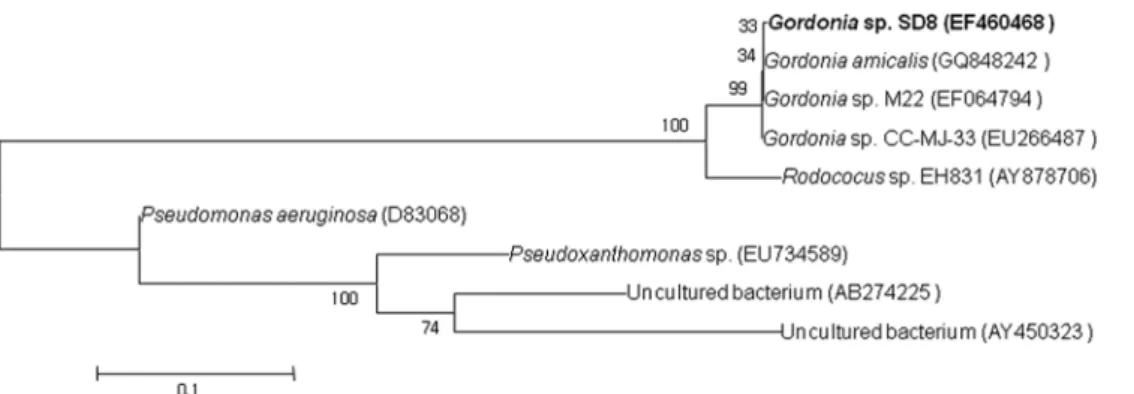
디젤 분해 세균인 SD8을 유류로 장기간 오염된 토양으로 부터 순수 분리하였다. 분리한 균주의 DNA 염기서열을 분 석한 후 phylogenetic tree를 작성하여 Fig. 1에 나타내었다.
분석된 SD8의 DNA 염기서열은 총 1030 bp였고, NCBI
Fig. 1. Phylogenetic tree of Gordonia sp. SD8.
Blast search한 결과 SD8은 파라핀계 탄화수소 또는 메탄 계 탄화수소라 불리는 알칸(alkane)을 분해하는 Gordonia sp. SG11와 1014/1019(99%), hexane을 분해하는 Gordonia sp. SP72와 1012/1019(99%)로 가장 유사하였다. 따라서 디젤분해 미생물인 SD8은 Gordonia sp.에 속함을 알 수 있었고 National Center for Biotechnology Information (NCBI)에 등록하였다(www.ncbi.nlm.nih.gov; accession num- ber, EF460468).
디젤을 분해 할 수 있는 미생물은 Mycobacterium, Nor- cardia, Rhodococcus, 그리고 Gordonia sp. 등이 있는 것으 로 알려져 있다[5-7, 13, 14, 21]. 그 중에서도 Gordonia sp.
는 TPH를 분해하는 세균으로 알려져 있으며[5, 6, 14], 외 부로부터 디젤과 같은 유기오염물질과 무기오염물질을 이용 해, 자신에게 필요한 화합물로 합성하는 작용(동화작용)을 할 수 있는 것으로 알려져 있다[1]. Phenanthrene으로 오염 된 토양에서 분리한 Gordonia sp. He4[14]와 장기간 디젤로 오염된 토양에서 분리한 Gordonia sp. M22, BS25와 BS29[5]는 디젤 분해능을 가지고 있었다. Franzetti 등[6]은 디젤 오염 토양에서 분리한 Gordonia sp. BS29을 이용하여, 지방족 탄화수소(n-hexadecane, n-heptadecane, pristane, n- eicosane, n-octacosan, squalene)와 방향족 탄화수소(phen- anthrene, anthracen, pyrene)의 제거에 관한 연구를 수행하 였다. 그 결과, 53일 동안 지방족 탄화수소는 균주에 의해 30-89% 제거 되었고, 특히 n-hexadecane과 같은 고분자의 탄화수소를 제거하는데 효과적이었다. 방향족 탄화수소는 76 일간 균주를 처리하였는데 anthracen과 pyrene의 제거에 효 과적이었다[6].
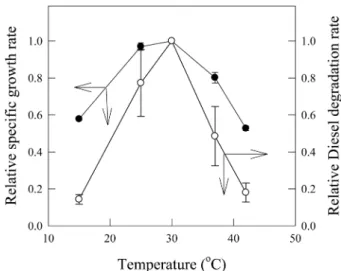
유류 분해 미생물의 생리적 특성을 알아보기 위하여 디젤 농도와 배양 온도별로 조건을 달리하여 실험을 수행한 결과 를 Fig. 2, 3에 도시하였다. 디젤 농도를 5,000, 10,000, 20,000, 30,000, 그리고 40,000 mg-TPH L-1로 각각 다르게
하여 SD8의 성장과 디젤 분해 속도를 비교하였다(Fig. 2).
그 결과, 디젤 농도가 20,000 mg-TPH L-1일 때 SD8는 가 장 잘 성장하였고(비성장속도는 0.67±0.05 d-1), 디젤 분해속 도도 가장 높았다(1,727±145 mg-TPH L-1 d-1). 또한, 배양 온도를 15, 25, 30, 37, 그리고 42oC로 달리하여 SD8 균주 의 비성장속도와 디젤 분해속도를 상대값을 이용하여 온도 의 영향을 비교하였다(Fig. 3). SD8 균주는 30oC에서 비성 장속도와 디젤분해속도가 가장 빨랐고, 25oC일 때의 SD8의 성장속도와 TPH 분해속도가 비슷했으며, 고온과 저온일 때 는 균주가 잘 성장하지 못했다.
디젤 오염 토양에서 분리한 Gordonia sp. LE31은 디젤 농도가 1,000 mg-TPH L-1인 조건에서는 배양 3일만에 100% 분해를 하였고, 5,000, 10,000, 그리고 15,000 mg- TPH L-1의 농도 조건에서는 배양 7일 후 각각 91, 76, 그리 고 57% 분해하였다. 그러나 20,000 mg-TPH L-1 일 때는 디젤을 분해하지 못했다[13]. Franzetti 등[6]은 디젤 오염 토 양에서 분리한 Gordonia sp. BS29의 디젤 생분해능을 조사 한 결과 53일 동안 탄화수소는 30-89%가 제거되었다. 본 연 구에서 분리한 디젤 분해 미생물인 Gordonia sp SD8 균주 는 TPH의 농도 30,000 mg-TPH L-1까지 빠른 속도로 디젤 을 분해를 하였고, 40,000 mg-TPH L-1의 고농도 디젤도 분 해할 수 있었다. 즉, SD8은 이전 연구자의 균주보다 고농도 에서도 디젤을 분해할 수 있음을 알 수 있었다.
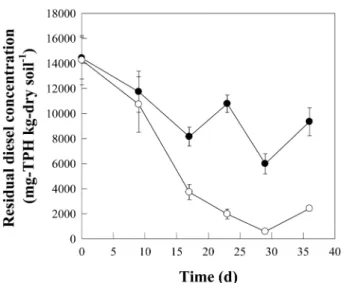
디젤로 오염된 토양 정화에 미치는 Gordonia sp. SD8 접 종 효과를 Fig. 4에 도시하였다. SD8균주를 접종하지 않은 대조군 조건에서도 시간이 경과함에 따라 토양의 디젤 잔류 농도가 감소하였는데 이는 휘발 등과 같은 물리적 작용과 토 양 미생물에 의한 생물학적 작용에 의한 결과로 생각된다.
대조군에 비해, SD8 균주를 접종한 조건에서 디젤 분해가 휠씬 빨리 진행되었다. 예를 들면 17일 경과 후, 대조군 토
Fig. 2. Effects diesel concentration on the specific growth rate and diesel degradation rate of SD8. ●, specific growth rate; ○, diesel degradation rate.
Fig. 3. Effects temperature on the specific growth rate and die- sel degradation rate of SD8. ●, specific growth rate; ○, diesel degradation rate.
양의 디젤 잔류 농도는 8,150±755 mg-TPH kg-dry soil-1이 었으나, SD8을 접종한 경우에는 3,724 mg-TPH kg-dry soil-1 이었다. 이러한 결과는 Gordonia sp. SD8의 디젤 분 해 활성이 토양에서도 발휘되는 것을 시사하며, SD8 균주는 향후 디젤 등을 포함한 석유계 탄화수소화합물로 오염된 토 양을 정화하는데 활용 가능한 미생물임을 보여주는 증거이다.
일반적으로 디젤을 분해하는 균주를 분리하기 위한 분리 원으로 디젤 오염 토양을 사용하는데[26], 이것은 분리 균주 를 오염 토양 정화에 유용하게 사용할 수 있기 때문이다[17, 18]. Ashock 등[2]은 방향족 탄화수소로 오염된 지역에서 PAH 분해 균주를 분리하여 오염된 지역에 이용하였고, Bento 등[3]은 bioremediation 기술(natural attenuation, biostimul- ation, 그리고 bioaugmentation)을 적용하는데 있어 오염된 토양에서 분리한 균주들이 대체적으로 높은 분해효율을 보 이는 것으로 보고 하였다. 본 연구에서는 유류로 장기간 오 염된 토양에서 Gordonia sp. SD8 균주를 분리하고 시험관 에서 뿐 만 아니라 토양에서 디젤 분해 활성이 발휘됨을 규 명함으로써, 오염 토양 정화에 활용 가능한 우수 미생물자 원을 확보하였다.
요 약
본 연구에서는 디젤로 오염된 토양에서 디젤 분해능이 우 수한 Gordonia sp. SD8을 분리하였고, 이 균주의 디젤 분해 특성을 액상과 토양에서 조사하였다. SD8은 유일 에너지원 과 탄소원으로 디젤을 이용하여 생장 가능하였다. SD8 균주 의 성장과 디젤 분해속도에 미치는 디젤 농도 영향을 조사 한 결과, 20,000 mg-TPH L-1농도에서 최대 비성장속도(0.67
±0.05 d-1)와 최대분해속도(1727±145 mg-TPH L-1 d-1)를 얻 을 수 있었다. 또한, 이 균주는 40,000 mg-TPH L-1의 고농
도 디젤을 분해할 수 있었으며, 30oC에서 비성장속도와 디 젤분해속도가 가장 빨랐다. 디젤로 오염된 토양 정화에 미 치는 Gordonia sp. SD8 접종 효과를 조사한 결과, 17일 경 과 후, SD8을 접종하지 않은 대조군 토양의 디젤 잔류 농도 는 8,150±755 mg-TPH kg-dry soil-1이었으나, SD8을 접종 한 경우에는 3,724 mg-TPH kg-dry soil-1이었다. 이러한 결 과는 Gordonia sp. SD8는 향후 디젤 등을 포함한 석유계 탄 화수소화합물로 오염된 토양을 정화하는데 활용 가능한 유 용 미생물 자원임을 의미한다.
감사의 글
본 연구는 2008년도 정부(교육과학기술부)의 재원으로 한 국과학재단 지정 차세대바이오환경기술연구센터(AEBRC,R11- 2003-006-06001-0)와 국가지정연구실사업의 지원을 받아 수 행된 연구이며(No. R0A-2008-000-20044-0), 이에 감사 드 립니다.
R
EFERENCES1. Arenskötter, M., D. Broker, and A. Steinbuchel. 2004.
Biology of the metabolically diverse genus Gordonia. Appl.
Environ. Microbiol. 70: 3195-3204.
2. Ashok, B. T., S. Saxena, and J. Mussarat. 1995. Isolation and characterization of four polycyclic aromatic hydrocar- bon degrading bacteria from soil near an oil refinery. Lett.
Appl. Microbiol. 21: 246-248.
3. Bento, F. M., F. A. O. Camargo, B. C. Okeke, and W. T.
Frankenberger. 2005. Comparative bioremediation of soils contaminated by natural attenuation, biostimulation and bioaugmentation. Bioresour. Technol. 96: 1049-1055.
4. Dean-Ross, D., J. Moody, and C. E. Cerniglia. 2002. Utilisa- tion of mixtures of Polycyclic aromatic hydrocarbons by bacteria isolated from contaminated sediment. FEMS Microbiol. Ecol. 41: 1-7.
5. Franzetti, A., G. Bestetti, P. Caredda, P. La-Colla, and E.
Tamburini. 2008. Surface-active compounds and their role in the access to hydrocarbons in Gordonia strains. FEMS Microbiol. Ecol. 63: 238-248.
6. Franzetti, A., P. Caredda, C. Ruggeri, P. La-Colla, E.
Tamburini, M. Papacchini, and G. Bestetti. 2009. Potential applications of surface active compounds by Gordonia sp.
strain BS29 in soil remediation technologies. Chemosphere 75: 801-807.
7. Haritash A. K. and C. P. Kaushik. 2009. Biodegradation aspects of Polycyclic Aromatic Hydrocarbons (PAHs): A review. J. Hazard. Mater. 169: 1-15, 2009.
8. Hong, J. H., J. S. Kim, O. K. Choi, K. S. Cho, and H. W.
Ryu. 2004. Characterization of a diesel-degrading bacterium, Pseudomonas aeruginosa IU5, isolated from oil-contaminat- ed soil in Korea. World J. Microb. Biot. 21: 381-384, 2004.
Fig. 4. Effects of the inoculation of Gordonia sp. SD8 on diesel removal in soil system. ●, without SD (control); ○, with SD8.
9. Huang, X. D., Y. El-Alawi, J. Gurska, B. R. Glick, and B.
M. Greenberg. 2005. A multi-process phytoremediation system for decontamination of persistent total petroleum hydrocarbons(TPHs) from soils. Microchem. J. 91: 139-147, 2005.
10. Koo, S. Y. and K. S. Cho. Isolation and characterization of a plant growth promoting rhizobacterium, Serratia sp. SY5. J.
Microbiol. Biotechn.19: 1431-1438.
11. Lee, E. H. and K. S. Cho. 2009a. Effect of substrate interac- tion on the degradation of methyl tert-butyl ether, benzene, toluene, ethylbenzene, and xylene by Rhodococcus sp. J.
Hazard. Mater. 167: 669-674.
12. Lee, E. H., J. Kim, K. S. Cho, Y. G. Ahn, and G. S. Hwang.
2009b. Degradation of hexane and other recalcitrant hy- drocarbons by a novel isolate, Rhodococcus sp. EH831.
Environ. Sci. Pollut. Res. 17: 64-77.
13. Lee, J. J., S. K. Rhee, and S. T. 2001. Degradation of 3- Methylpyridine and 3-Ethylpyridine by Gordonia nitida LE31. Appl. Environ. Microbiol.67: 4342-4345.
14. Liu, L., X. W. Li, S. J. Liu, and Z. P. 2007. Isolation and identification of a PAHs-degrading strain Gordonia sp. He4 and its dynamics during bioremediation of phenanthrene polluted soil. Huan. Jing. Ke. Xue. 28: 617-22.
15. Macek, T. M. and J. Kas. 2000. Exploitation of plants for the removal of organics in environmental remediation(research review paper). Biotechnol. Adv. 18: 23-34.
16. Margesin, R., D. Labbe, F. Schinner, C. W. Greer, and L. G.
Whyte. 2003. Characterization of hydrocarbon-degrading microbial populations in contaminated and pristine Alpine soils. Appl. Environ. Microbiol. 69: 3085-3092.
17. Margesin, R. and F. Schinner. 2001. Bioremediation (Natural Attenuation and Biostimulation) of Diesel-Oil-Contaminated Soil in an Alpine Glacier Skiing Area. Appl. Environ.
Microbiol. 67: 3127-3133.
18. Marques, A. V., S. C. Cunha des Santos, R. D. C. Casella, R.
L. Vital, C. V. Sebastin, and L. Seldin. 2008. Bioremediation potential of a tropical soil contaminated with a mixture of crude oil and production water. J. Microbiol. Biotechn. 18:
1966-1974.
19. Medina-Bellver, J. I., P. Marín, A. Delgado, A. Rodríguez- Sanches, E. Reyes, J. L. Ramos, and S. Marqués. 2005.
Evidence for in situ crude oil biodegradation after the Prestige oil spill. Environ. Microbiol. 7: 773-779.
20. Philp, J. C., S. M. Bamforth, I. Singleton, and R. M. Atlas.
2005. Environmental pollution and restoration: A role for bioremediation, In R. M. Atlas, and J. Philp (eds.). Bio- remediation. ASM Press, Washington, DC. U.S.A. pp. 1-48.
21. Prince, R. C. and M J. Grossman. 2003. Substrate Pre- ferences in Biodesulfurization of Diesel Range Fuels by Rhodococcus sp. Strain ECRD-1. Appl. Environ. Microbiol.
69: 5833-5838.
22. Rehmann, K., H. P. Noll, C. E. W. Steiberg, and A. A.
Kettrup. 1998. Pyrene degradation by Mycobacterium sp.
Strain KR2. Chemosphere 36: 2977-2992.
23. Reichenauer, T. G. and J. J. Germida. 2008. Phytoremedi- ation of Organic Contaminants in Soil and Groundwater.
Chem. Sus. 1: 708-717.
24. Romero, M. C., M. C. Cazau, S. Giorgieri, and A. M.
Arambarri. 1998. Phenanthrene degradation by microorgan- isms isolated from a contaminated stream. Environ. Pollut.
101: 355-359.
25. Tam, N. F. Y., C. L. Guo, W. Y. Yau, and Y. S. Wong. 2002.
Preliminary study on biodegradation of phenanthrene by bacteria isolated from mangrove sediments in Hong-Kong.
Mar. Poll. Bull. 42: 316-324.
26. Torsvik, V., L. Ovreas, and T. F. Thingstad. 2002. Prokaryo- tic diversity-magnitude, dynamics, and controlling factors.
Science 296: 1064-1066.
27. Valeria, P. A., R. B. Vieira, F. P. Franca, and V. L. Cardoso.
2007. Biodegradation of effluent contaminated with diesel fuel and gasoline. J. Hazard. Mater. 140: 52-59.
28. Van Hamme, J. D. and O. P. Ward. 2003. Physical and metabolic interactions of Pseudomonas sp. strain JA5-B45 and Rhodococcus sp. strain F9-D79 during growth on crude oil and effect of a chemical surfactant on them. Appl.
Environ. Microbiol.67: 4874-4879.
29. Watanabe, K. 2001. Microorganisms relevant to bioremedia- tion. Curr. Opin. Biotechnol. 12: 237-241.
30. Wei, Q. F., R. R. Mather, and A. F. Fotheringham. 2005. Oil removal from used sorbents using a biosurfactant. Bioresour.
Technol. 96: 331-334.
31. Yuan, S. Y., L. C. Shiung, and B. V. Chang. 2002. Biode- gradation of polycyclic aromatic hydrocarbons by inoculated microorganisms in soil. Bull. Environ. Contam. Toxicol. 69:
66-73.
(Received June 26, 2010/Accepted August 30, 2010)