한국의 신재생에너지 정책의 평가모델 개발 : RPS 및 FIT를 중심으로
최종재*․황찬규**․문채주***
Development of Evaluation Model for the Korean New & Renewable Energy Policies : Focusing on RPS & FIT
Jong-Jae Kim*․Chan-Gyu Hwang**․Chae-Joo Moon***
요 약
신재생에너지산업의 발전은 에너지원의 문제를 해결하기 위한 필수적인 과제라 할 수 있다. 이에 따라 세 계 각국에서 신재생에너지산업을 위해 적극적으로 움직이고 있다. 신재생에너지산업은 아직 산업기반이 약하 고, 산업의 특성상 규모의 경제 및 기술개발을 위한 초기 투자가 필요한 경우가 많다. 따라서, 신재생에너지산 업을 육성하기 위한 정책이 실행되고 있는데 우리나라 뿐만 아니라 많은 나라에서 대표적으로 실행하는 정책 이 RPS와 FIT 정책이다. 신재생에너지산업은 다양한 이해관계와 경제, 사회, 환경, 국제 등의 변수를 동시에 가지고 있으므로 이를 종합적으로 고려한 정책이 필요하다. 신재생에너지산업의 경우 평가의 지표에 해당하 는 부분이 많고 고려되어야 할 변수가 많으나, 이를 모두 고려하기 힘들고 고려한다 하더라도 일관된 기준이 마련되어 있지 않은 상황이다. 따라서, 본 연구에서는 신재생에너지정책을 평가하기 위한 평가지표를 개발, 제 시한다.
ABSTRACT
New & renewable energy becomes a crucial subject to solve the problems inherent in the current energy resources, which results in the fast development of the new & renewable energy industry worldwide. However, not only its base is still weak but the high initial investment for technology development and certain scale of an energy market are required in many cases. For this reason, many countries in the world, including Korea, run the energy policies to foster the new & renewable energy industry such as RSP and FIT. In general, a policy should be established to take various, intertwined interests as well as a number of variables related to economic, social, environmental, and international matters into comprehensive consideration. For new & renewable energy industry, there are many variables to be considered and indexes necessary for evaluation but it is hard to take all of them into account. Even though they were considered, no criteria are available for use in a consistent manner. Therefore, this study plans to develop an evaluation model for the Korean new & renewable energy policy.
키워드
New & Renewable Energy, Energy Policy, Policy Evaluation Model, FIT, RPS 신재생에너지, 에저지정책, 정책평가모델, 발전차액지원제도, 공급의무할당제도
* 서울벤처대학원대학교 경영학과([email protected])
** 서울벤처대학원대학교 경영학과([email protected])
*** 교신저자(corresponding author) : 목포대학교 전기공학과([email protected])
접수일자 : 2013. 07. 20 심사(수정)일자 : 2013. 08. 23 게재확정일자 : 2013. 09. 23
Ⅰ. 서 론
21세기를 맞이하여 온실가스로 인한 지구 기상변화 가 심화되고, 화석에너지의 보존량이 감소하는 등 실 질적인 대체에너지의 수급이 필수적으로 요구되고 있 는 실정이다. 우리나라는 1960년대 이후 경제개발 정 책을 추진함으로써 고도의 경제 성장을 이루었고 , 그 결과 도시와 산업화가 이루어졌으며[1] 산업발전에 따 른 에너지소비량의 기하급수적인 증가를 가져왔다. 또 한, 인류 생활의 기반 시설 들이 고도화 , 복잡화되어 가고 있으며, 자연훼손에 의한 자연재해들이 빈발하고 있다. 이러한 상황에서 발생하는 재해 및 재난은 복잡 하고 다양한 양상을 띠고 인류의 생존을 위협하고 있 다.[2] 기존에 가장 효율적인 대체에너지로 평가되었 던 원자력에너지가 그 안정성에서 지속적으로 의심을 받고 있고, 폐기물 처리와 건설장소의 문제가 발생하 는 등 제약이 심해지고 있어 또 다른 에너지원에 대 한 모색이 필요하다. 이러한 상황에서 신재생에너지산 업의 발전은 이러한 에너지원의 문제를 해결하기 위 한 필수적인 과제라 할 수 있다.
그러나, 신재생에너지산업은 아직 산업기반이 약하 고, 산업의 특성상 규모의 경제 및 기술개발을 위한 초기 투자가 필요한 경우가 많다.
일반적인 경제원리로는 이러한 투자를 기대하기 어 려우며, 초기 산업활성화를 위한 기초지원이 필요하 다. 기존의 경제적 이해에서 환경 및 미래가치는 평가 절하된 경우가 많이 있으므로, 이를 정확히 평가하기 위한 정책이 필요하다.
신재생에너지산업은 다양한 이해관계와 경제, 사회, 환경, 국제 등의 변수를 동시에 가지고 있으므로 이를 종합적으로 고려한 정책이 필요하다.
정책의 방향은 신재생에너지산업의 발전에 긍정적 인 영향을 미쳐야 하며, 그 영향정도가 큰 정책이 더 옳은 정책으로 평가될 수 있을 것이다.
Ⅱ 이론적 배경 2.1. 신재생에너지정책에 대한 연구 2.1.1. 신재생에너지산업 발전의 당위성
지구온난화는 1972년 로마클럽 보고서에서 처음 공 식적으로 지적된 이후 1985년 세계기상기구(WMO)와 국제연합환경계획(UNEP)이 이산화탄소가 온난화의 주범임을 공식으로 선언하면서 세계적인 현안이 되었 다. 이러한 온실가스에 대한 우려는 1997년 12월 일 본 교토에서 개최된 기후변화협약 제3차 당사국 총회 에서 채택되어 2005년 2월 16일 공식 발효되었다. 그 결과 선진 38개국은 1990년을 기준으로 2008∼2012년 까지 평균 5.2%의 온실가스를 감축해야 한다. 우리나 라는 애초에 2013년부터 의무감축 대상국으로 선정될 것이 유력했으나 2020년부터 전세계 모든 국가가 적 용받는 ‘단일 의정서’의 대상이 될 것으로 보인다.
따라서, 국내의 온실가스는 2020년부터 의무적으로 감축시킬 준비를 해야 할 의무가 발생하였다.
또한, 신재생에너지는 자원의 고갈과 사라지지 않 는 위험이라는 수정 불가능한 다른 에너지의 단점에 비하여, 비용의 문제라는 상대적으로 해결 가능한 문 제점을 가지고 있다. 이러한 상황에서 신재생에너지의 확대·보급의 필요성은 당연한 것으로 여겨진다.
2.1.2. 신재생에너지정책의 필요성
신재생에너지산업에서 정책이 문제가 되는 것은 신 재생에너지산업에 대한 요구와 압박은 지속적으로 증 가하고 있으나, 신재생에너지산업의 현재 기술수준에 서는 기존 발전단가보다 생산비가 상대적으로 높아 시장보급 확대를 위해서는 정부의 지원이 필요한 현 실 때문이다.[3]
현재 전 세계는 단일국가 뿐만 아니라 초국가 수준 에서 신재생에너지 확대의 필요성이 강조되고 있고, 이는 크게 3가지 환경보호, 에너지안보, 산업경쟁력 차원에서 제시되고 있다.[4] 특히, 화석연료가 가져오 는 환경파괴로 인한 비용이 포함될 경우, 신재생에너 지는 가격적인 측면에서도 경쟁력을 가질 수 있을 것 이라는 기대가 있다. 따라서, 정부의 정책이 신재생에 너지산업에 주는 영향력은 막대하다.
2.2. FIT와 RPS에 대한 연구 고찰
2.2.1. FIT와 RPS의 개념 가. FIT
FIT(Feed-In-Tariff, 발전차액지원제도)는 1978년
Compa rison Sectors
RPS FIT
Mecha nism
-The amount of electricity generation is decided in advance.
-Once the compulsory amount assigned, the price is automatically fixed.
-Generated electricity is purchased in a standard price.
-The amount of electricity generation is determined by licensee.
Target setting
Due to allocation of compulsory amount, it is easy to achieve the target amount.
The scale of supply is uncertain to predict.
Price setting
Depending on supply and demand condition, the price is fixed or changed (or fluctuated).
-Estimating exact supply price is difficult.
-Licensee’s windfall profit.
Power selec tion
For each kind of power, the target of power supply is possible to set.
All generated electricity of subject power source need to be purchased.
Benefit (Stren gth)
-It has flexibility in the sense of price.
-It promotes competition between licensees, so it derives the price reduction.
-Since the price is fixed in the market, it eases the financial burden of government.
-The price is guaranteed in the medium and long term –Certainty of investment, Simplicity
-Stable investment environment –Development of technology, it has big effect on creating new job positions.
-It is possible to secure diversity of technology.
-Since the risk of the business is low, compare to RPS, PF loaning is easy to get.
Weak ness
-There is strong possibility of only focusing on a certain energy which has economically profitable.
Construction of infrastructure has to be preceded in advance.
-Since, comparing to FIT, RPS has higher risk, in fact PF loan is impossible to get.
Once entering into global market, foreign technologies or products may dominate the market.
-Due to uncertainty of investment, there is high possibility that the percentage of entry of small and medium enterprises
-It brings great financial burden of government.
-Due to absence of competition between companies, the inducement for reducing the price for generation is scarce.
-It is hard to fix a proper price, and licensee shows sensitive reaction to the price.
-Effect of the program or the budget required is hard to estimate.
-Once investment to renewable energy which has low economical efficiency is dramatically increased, it brings inefficient allocation of resources.
미국에서 화석에너지에 대한 가격보장에서 비롯된 이 후, 1990년 중반부터 덴마크와 독일 등지에서 신재생 에너지에 적용되기 시작하였다. 동 제도는 신재생에너 지를 통한 전력생산자에게 정부가 일정한 수준의 가 격을 일정한 기간 동안 보장해 주는 것으로 전력 생 산기반, 가격 지향적인 인센티브라 할 수 있다.
즉, 신재생에너지 발전전력 가격이 기존의 화석원 료나 원자력 등을 이용한 에너지원에 비해 높음에 따 라 이러한 가격 차이를 정부의 재정을 통해 보전해 주는 것이다.[4]
이러한 FIT는 일반적으로 신재생에너지 전력생산 에 지불하는 양을 고정시킨 형태와 추가적인 프리미 엄을 제공하는 형태로 구분된다.
손실보상이란 공익사업 등을 시행함에 있어 공공필 요에 의한 적법한공권력행사로 인하여 개인에게 가하 여진 “특별한 희생”에 대하여 사유재산권의 보장과 전체적인 공평부담의 견지에서 행정주체가 이를 조정 하기 위하여 행하는 재산적 보전을 말한다[1]. 일반적 으로 손실보상은 토지에 대한 보상으로 많이 쓰이고 있다. 그러나 헌법 제23조에 공공필요에 의한 재산권 의 수용·사용·제한에 대한 정당한 보상을 규정하고 있다는 점에서 살펴보면, FIT 또한 공공의 필요에 의 한 재산권의 사용의 견지에서 손실보상의 의미로 해 석할 수 있다.
나. RPS
RPS(Renewable Portfolio Standard, 공급의무할당 제도)는 정부가 신재생에너지원을 통한 전력의 일정 비율을 생산자, 소비자, 공급자에게 강제로 할당하는 것으로, 일반적으로 신재생에너지 거래제도 (REC:
Renewable Energy Certificate)를 포함한다. 구체적으 로 일정규모 이상의 발전사업자에게 총 발전량 중 일 정량 이상을 신재생에너지 전력으로 공급토록 의무화 하는 제도이다.
RPS 정책으로 인한 공급의무자는 설비규모(신재생 에너지설비 제외) 500MW 이상의 발전사업자 및 수 자원공사, 지역난방공사로 현재 한국수력원자력, 남동 발전, 중부발전, 서부발전, 남부발전, 동서발전, 지역난 방공사, 수자원공사, SK E&S, 포스코에너지, GS EPS, GS파워, MPC 율촌전력 등 13개 발전회사를 대 상으로 한다
2.2.2. FIT와 RPS간의 비교
RPS와 FIT의 특성을 비교한 표 1을 살펴보면 두 정책의 목적과 배경이 명확하게 드러난다.
표 1. RPS와 FIT의 비교 Table 1. Comparison of RPS and FIT
would be pretty low, and conglomerate would be dominant in the market.
Introdu ction nations
U.S., England, Australia, Japan, etc.
Total 16 Countries.
Germany, Spain, France, Denmark, etc.
Total 34 Countries.
출처 : 이희선 외[5]
RPS와 FIT의 이러한 직접적인 차이에 대한 인식 이외에도 신재생에너지정책을 평가하기 위해서는 다 양한 기준이 요구된다. 우선 환경적인 문제를 고려하 지 않을 수 없다. 신재생에너지의 경우 그 에너지원의 특성상 이동이 불가능하거나 사용에 시간, 공간적 제 약을 받는 경우가 많다. 따라서 각 지역적 특색 및 에 너지원에 대한 특색을 충분히 고려해야 한다.
반면, FIT정책에서 RPS 정책으로 신재생에너지 정 책을 선회하게 된 동기가 정부의 예산부족에 기인한 것이라는 일부 학자들의 견해가 있다. 특히, 딜레마 이론으로 분석한 신재생에너지정책 결정과정에서는 RPS로의 이행이 늘어나는 정부지출의 압박과 신재생 에너지 생산성 증대라는 서로 상충되는 목표에서 딜 레마가 발생하게 되었고, 이에 비일관적 대응과 딜레 마 전가가 나타난 현상이라고 이야기하고 있다.[4]
RPS 일관적인 신재생에너지정책 수립의 지표가 필 요한 중요한 이유이다.
Ⅲ 신재생에너지 정책 및 동향 3.1. 국내 정책 고찰
3.1.1. 국내 신재생에너지 정책 동향
신재생에너지시장에 대한 정부의 개입은 다양한 형 식으로 이루어지는데 신재생에너지 시장보급 지원정 책은 가격정책과 수량정책으로 크게 구분된다. 가격정 책은 FIT가 대표적이고, 수량정책은 RPS가 대표적인 데, RPS는 신재생에너지 공급인증서 거래제도와 동시 에 시행되는 경우가 많다.
한국의 신재생에너지정책 역시 이러한 정책 사이에 서 다양한 고민을 가지고 있는데, 2002년 이후 FIT제 도를 계속 시행해 오며 많은 성과가 있었다. 특히, 태 양광에너지는 2008년부터 정부의 적극적인 지원정책 에 힘입어 폭발적으로 증가했으며 현재는 1,000여 개
의 태양광발전소가 국내에서 운영되고 있다[6]. 이후 2012년부터 RPS제도가 새로이 시행되었다. 공급의무 화제도의 도입이유는 발전차액지원을 위한 재정소요 가 급격히 증가하고 있고, 또 신재생에너지 발전업자 간의 시장경쟁을 강화하기 위함이라[3]는 평가가 지배 적이다.
FIT제도는 산업의 규모를 키우는 것을 목적으로 하는 반면 RPS제도는 비화석연료의 일정 사용량 달 성을 목적으로 하기 때문에 두 산업의 지향점이 서로 반대 방향이 될 수 있다. 이에 따라 기존의 FIT와 RPS 제도의 차이점이 강조되어 왔으며, 2013년 현재 RPS 시행 2년차를 맞이하고 있다.
3.1.2. 국내 신재생에너지 정책에 대한 연구 동향 국내의 신재생에너지 산업에 대한 선행연구를 살펴 보면 국내의 신재생에너지정책은 값싸고 안정적인 에 너지공급의 불가능을 인식하고 국가적인 자원배분의 효율성과 지속가능한 발전을 위한 에너지정책이 필요 하게 되었으며, 이에 따라 에너지정책은 환경보전과 경제적인 수익을 병행할 수 있는 환경효율성으로부터 사회적인 형평성을 동시에 추구하는 지속가능한 발전 을 추구하는 방향으로 전환되어야 할 필요성이 강조 되기 시작했다.[7] 이러한 연구 흐름을 살펴보면 대략 국내의 신재생에너지 정책은 21세기를 맞이하면서 무 분별한 에너지 사용에 대한 경계가 발생하고, 1997년 의 교토의정서를 중심으로 온실가스에 대한 통제움직 임이 일어나고 있으며, 이에 따라 신재생에너지라는 새로운 에너지원에 대한 관심이 시작되었다. 실질적으 로 이 시기부터 에너지정책은 신재생에너지의 개발과 도입이라는 측면에서 연구되기 시작하였으며, 신재생 에너지사업의 특징인 초기투입비용대비 초기효과가 미흡하다는 점이 상당부분 걸림돌로 작용하고 있음을 관찰할 수 있다. 따라서, 많은 선행연구들은 이러한 두 마리의 토끼를 어떻게 효율적으로 잡을 것인가에 집중하여 있다.
3.2. 해외 사례 고찰
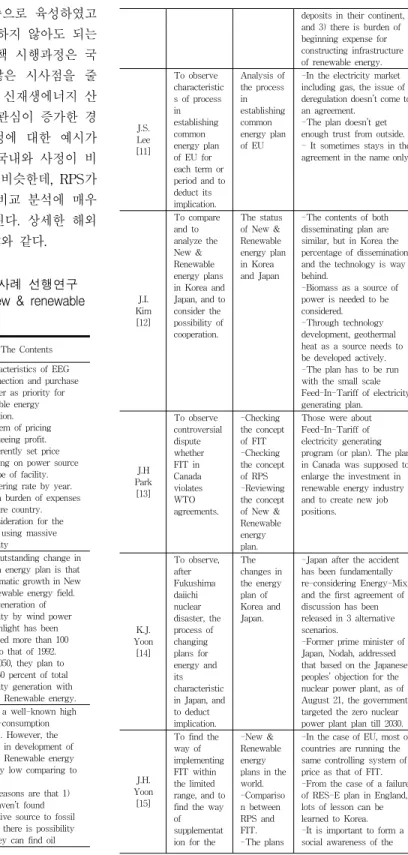
각 나라 들은 신재생에너지정책을 자신의 정책목표 에 맞추어 RPS와 FIT 두가지 정책 중 한 가지 정책 을 선택하여 사용하고 있음을 알 수 있다. 특히, 독일 의 경우 신재생에너지산업에 적극적으로 국가가 개입
Author Purpose Subject The Contents
S.Y.
Gong
& S.H.
Kim [8]
To observe renewable energy dissemination plan in Germany, after observing
‘renewable energy law,’
to deduct implication
-History of energy plan in Germany -‘Renewabl e energy law’ in Germany
- Characteristics of EEG 1. Connection and purchase of power as priority for renewable energy connection.
2. System of pricing guaranteeing profit.
3. Differently set price depending on power source and type of facility.
4. Lowering rate by year.
5. Even burden of expenses for entire country.
6. Consideration for the facility using massive electricity
S.J.
Leem [9]
To analyze German New
& Renewable energy plan whose government proclaimed anti-nuclear energy
‘New &
Renewable Energy Plan’ in Germany
-The outstanding change in German energy plan is that the dramatic growth in New
& Renewable energy field.
-The generation of electricity by wind power and sunlight has been developed more than 100 times to that of 1992.
-Till 2050, they plan to cover 50 percent of total electricity generation with New & Renewable energy.
K.H.
Yoon [10]
To analyze the process of change in New &
Renewable energy plan in U.S. from passive to active due to high oil price.
‘New &
Renewable Energy Plan’ in U.S.
U.S. is a well-known high energy-consumption country. However, the interest in development of New & Renewable energy is pretty low comparing to Europe.
-The reasons are that 1) they haven’t found alternative source to fossil fuel, 2) there is possibility that they can find oil
표 2. 신재생에너지정책 관련 해외사례 선행연구 Table 2. Foreign case analysis of new & renewable
energy
deposits in their continent, and 3) there is burden of beginning expense for constructing infrastructure of renewable energy.
J.S.
Lee [11]
To observe characteristic s of process in establishing common energy plan of EU for each term or period and to deduct its implication.
Analysis of the process in establishing common energy plan of EU
-In the electricity market including gas, the issue of deregulation doesn’t come to an agreement.
-The plan doesn’t get enough trust from outside.
- It sometimes stays in the agreement in the name only.
J.I.
Kim [12]
To compare and to analyze the New &
Renewable energy plans in Korea and Japan, and to consider the possibility of cooperation.
The status of New &
Renewable energy plan in Korea and Japan
-The contents of both disseminating plan are similar, but in Korea the percentage of dissemination and the technology is way behind.
-Biomass as a source of power is needed to be considered.
-Through technology development, geothermal heat as a source needs to be developed actively.
-The plan has to be run with the small scale Feed-In-Tariff of electricity generating plan.
J.H Park [13]
To observe controversial dispute whether FIT in Canada violates WTO agreements.
-Checking the concept of FIT -Checking the concept of RPS -Reviewing the concept of New &
Renewable energy plan.
Those were about Feed-In-Tariff of electricity generating program (or plan). The plan in Canada was supposed to enlarge the investment in renewable energy industry and to create new job positions.
K.J.
Yoon [14]
To observe, after Fukushima daiichi nuclear disaster, the process of changing plans for energy and its characteristic in Japan, and to deduct implication.
The changes in the energy plan of Korea and Japan.
-Japan after the accident has been fundamentally re-considering Energy-Mix, and the first agreement of discussion has been released in 3 alternative scenarios.
-Former prime minister of Japan, Nodah, addressed that based on the Japanese peoples’ objection for the nuclear power plant, as of August 21, the government targeted the zero nuclear power plant plan till 2030.
J.H.
Yoon [15]
To find the way of implementing FIT within the limited range, and to find the way of supplementat ion for the
-New &
Renewable energy plans in the world.
-Compariso n between RPS and FIT.
-The plans
-In the case of EU, most of countries are running the same controlling system of price as that of FIT.
-From the case of a failure of RES-E plan in England, lots of lesson can be learned to Korea.
-It is important to form a social awareness of the
하여, 신재생에너지산업을 높은 수준으로 육성하였고 현재는 대체에너지로 원자력에 의존하지 않아도 되는 수준에 이르렀다. 독일의 이러한 정책 시행과정은 국 내 신재생에너지산업 발전정책에 많은 시사점을 줄 것으로 기대된다. 또한, 미국의 경우 신재생에너지 산 업에 대한 관심이 부족하다가 최근 관심이 증가한 경 우로, 신재생에너지 담론의 형성과정에 대한 예시가 되어 줄 수 있으며, 일본의 경우는 국내와 사정이 비 슷하고, 정책의 적용에 대한 목적도 비슷한데, RPS가 아닌 FIT를 적용하고 있어 국내와 비교 분석에 매우 적합한 대상이 되어줄 것으로 기대된다. 상세한 해외 사례에 관한 선행연구의 분석은 표 2와 같다.
efficient implementati on of RPS for the small scale New &
Renewable energy power generation facility
in Europe.
-The reviews in the failure of RES-E plan in England.
efficiency of RPS program and so on.
H.S. Ha [16]
To analyze political and systematical causes as the cause of incentive and selecting regulation reforms, and also to analyze the effects on regional development, preserving environment, andontheorga nization
-The factors (or causes) of incentive and regulation reforms.
-Analysis based on the research of the state of Florida in U.S.
The selection of strategies for the purpose of developing New &
Renewable energy is political, and various stakeholders can be the crucial factor for making decisions.
Ⅳ 평가 설계의 필요성과 방향
4.1. 평가모델 설계의 필요성
신재생에너지산업은 환경, 경제, 정치적 배경, 국제 사회와의 연계성 등 다양한 방면에 걸쳐서 복합적인 주체와 목적을 가지는 산업이다. 이는 신재생에너지산 업에 대한 예측 및 평가가 단순한 기준에 의하여 이 루어질 수 없음을 의미한다. 신재생에너지산업은 개발 과 보전을 양립시키기 위한 정치. 경제. 사회. 문화적 측면에서 지속 가능한 개발임과 동시에 종합적이고 체계적인 관리이어야 한다.[17] 무엇보다도 신재생에 너지 산업은 환경파괴의 비용뿐만 아니라, 고갈위험 성, 산업활성화, 소비에 미치는 영향, 수출가능성, 수 입원자재 절약가능성 등 다양한 분야에서 신재생에너 지는 기존의 화석연료 등에 비해 경쟁력을 가질 것으 로 기대되지만, 일반적인 산업경쟁력 분석에서는 적절 하게 반영되지 못한 실정이다. 이에 따라 신재생에너 지정책에 대한 다양한 선행연구는 신재생에너지정책 의 평가에 반영되어야 할 다양한 요소들에 대해서 제 각기 설정하여 반영하고 있으며, 이들의 논의는 경제 적 변수, 정치적 변수, 환경적 변수, 집행적 변수 등 다양한 변수들로 나뉘어 있다. 따라서, 신재생에너지 정책의 목적에 부합하며 다양한 변수를 통합 반영하
며 신재생에너지산업 육성의 근본취지와 부합하는 평 가지표를 개발할 필요가 있다 하겠다. 본 연구는 기존 의 신재생에너지정책의 평가기준들을 제시한 연구들 을 반영하여 그 평가의 지표와 항목들을 개발한다.
4.2. 신재생에너지와 정책 목적 분석
현재 전 세계는 단일국가뿐만 아니라 초국가 수준(
예, UN, EU 등)에서 신재생에너지 확대 필요성이 강 조되고 있다. 이는 크게 3가지, 즉, 환경보호, 에너지 안보, 산업경쟁력 차원에서 제시되고 있다.[4] 우리나 라 역시 이러한 범주내의 목적을 가지고 신재생에너 지 법이 제정되었다.
2006년 발표된 ‘신에너지 및 재생에너지 개발‧이용
‧보급 촉진법’의 목적을 살펴보면
제1조(목적) 이 법은 신에너지 및 재생에너지의 기 술개발·이용·보급촉진과 신에너지 및 재생에너지산업 의 활성화를 통하여 에너지원을 다양화하고, 에너지의 안정적인 공급, 에너지 구조의 환경친화적 전환 및 온 실가스 배출의 저감을 추진함으로써 환경의 보전, 국 가경제의 건전하고 지속적인 발전 및 국민복지의 증 진에 이바지함을 목적으로 한다. <개정 2006.9.27>로 명시되어 있다.
Ⅴ 평가문항 설계
5.1. 평가지표 도출
평가지표의 도출은 제 1조 목적에서 궁극적 목적을 바탕으로 추출하였으며 a) 환경의 보전, b) 국가경제 의 지속적인 발전, c) 국민복지 증진이 그 것이다
이 세가지 지표를 바탕으로 평가항목을 도출하기 위한 세부 평가지표를 도출하였다.
즉, a) 환경의보전 - 친환경성, b) 국가경제의 건전 하고 지속적인 발전 - 에너지산업 육성, 대체에너지 로의 효과성, 기술발전 가능성 c) 국민복지 증진 - 공 공성으로 하였다.
세부평가지표를 도출하는 기준은 기존의 선행연구 들과 신재생에너지정책의 핵심적인 요소에 입각하여 분류하였다. 또한, 선행연구들에서 직접적으로 추출한 목적 이외에도, 정부의 신재생에너지관련 설문, 기타 연구의 횡단적 종합 등에서 일반적으로 유추될 수 있
Specific Evaluation Classification
Evaluation Questions Reference
Energy Industry Promotion
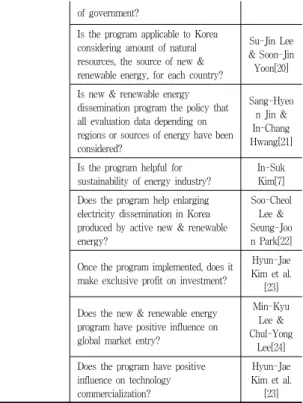
How much are the efficiency of promoting energy industry affected due to windfall profit made by intervention
Tea-Hyoun g Kwon[4]
of government?
Is the program applicable to Korea considering amount of natural resources, the source of new &
renewable energy, for each country?
Su-Jin Lee
& Soon-Jin Yoon[20]
Is new & renewable energy dissemination program the policy that all evaluation data depending on regions or sources of energy have been considered?
Sang-Hyeo n Jin &
In-Chang Hwang[21]
Is the program helpful for sustainability of energy industry?
In-Suk Kim[7]
Does the program help enlarging electricity dissemination in Korea produced by active new & renewable energy?
Soo-Cheol Lee &
Seung-Joo n Park[22]
Once the program implemented, does it make exclusive profit on investment?
Hyun-Jae Kim et al.
[23]
Does the new & renewable energy program have positive influence on global market entry?
Min-Kyu Lee &
Chul-Yong Lee[24]
Does the program have positive influence on technology commercialization?
Hyun-Jae Kim et al.
[23]
는 기준들이 몇가지 존재하는데
① 해당 신재생에너지 정책이 국제시장의 진입에 긍정적인 영향을 주는 정도(에너지 안보, 에너지 산업 육성), ② 정책이 기술의 상업화에 긍정적인 영향을 주는 정도(기술발전 가능성, 에너지산업 육성), ③ 해 당 정책이 환경문제 해결을 위해 기여하는 정도(예:
온실가스 감축의 효과성, 환경친화성), ④ 환경문제의 발생가능성을 더 감소시키는데 도움을 주고 있는 정 도(환경친화성)가 그것이다.
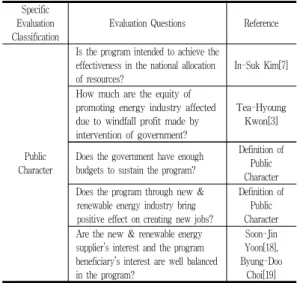
또한, 신재생에너지정책은 그것의 본질이 정책이기 에 공공성이란 영역에서도 접근할 필요성이 생기는 데 이때 공공성의 영역에서 고려되고 있는 질문은 ① 정부는 해당 정책을 지속하기에 적절한 예산의 준비 여부, ② 정책이 신재생에너지사업을 통해 국내 고용 창출에 효과성을 미치는 정도(예: 정책이 고용 혹은 신규사업의 참여를 의무화할 경우 고용이 창출됨), ③ 신재생에너지 생산자와 수혜자(정책 수혜자)의 이해 관계가 반영된 정도가 그것이다. 이러한 질문과 관련 된 연구[18]는 형평성과 민주성의 원칙을 바탕으로 재 생가능에너지의 확대, 에너지효율성 향상, 에너지절약 을 위한 정책수단 도입의 필요성 검토을 제안하고 있 다.
또한, 신자유주의적 자본주의체제로의 해석을 거부 하며, 거버넌스의 차원에서 다양한 이해관계자가 정책 결정에 반영되었는지에 대한 판단이 필요, 즉 수혜자 의 참여 가능성이 중요한 평가기준임을 주장한 연구 [19]도 있다.
5.2. 평가지표에 따른 평가문항 구성
앞선 선행연구에 대한 분석을 신재생에너지의 정책 목표에 적용하여 명제화하면 다음과 같다.
5.2.1. 에너지산업 육성
표 3. 에너지산업육성관련 평가문항 추출 Table 3. Evaluation questions of promoting energy
industry
5.2.2. 대체에너지로의 효과성
표 4. 대체에너지로의 효과성관련 평가문항 추출 Table 4. Evaluation questions of effectualness of
alternative energy
Specific Evaluation Classification
Evaluation Questions Reference
Effectualness of Alternative
Energy
How effectual is the alternative energy when comparing construction and management cost for producing energy with the sum of FIT and RPS program?
Hyeong-seok Lee &
Seung-Ryong Yang[25]
Does the program help justifying price of energy?
Hwa-Jin Han et al.[26]
Does it help enlarging electricity dissemination produced by active new & renewable energy in Korea?
Soo-Cheol Lee &
Seung-Joon Park[22]
Does the program, comparing to fossil fuel, guarantee the stability of cost and supply in the long term?
In-Suk Kim[7]
Specific Evaluation Classification
Evaluation Questions Reference
Environment Friendliness
Is new & renewable energy dissemination program the policy that all evaluation data depending
Sang-Hyeon Jin &
In-Chang
on regions or environmental
condition have been considered? Hwang[21]
Does the program have great impacts on resolving environmental problems for example the intensity of effect on mitigating greenhouse gas?
Definition of Environment Friendliness Is the program is appropriate to
decrease possibility of causing environmental problem?
Ddefinition of Environment Friendliness
5.2.3. 기술발전 가능성
표 5. 기술발전 가능성 관련 평가문항 추출 Table 5. Evaluation questions of possibility of technical
development
Specific Evaluation Classification
Evaluation Questions Reference
Possibility of Technical Development
Are the characteristics of Korean natural resources are considered in the program in the sense of possibility of technical development?
In-Suk Kim[7]
Does it increase investment costs for technical development?
Hyun-Jae Kim et
al.[23]
Does the program through technology commercialization make the possibility of technical development increase?
In-Suk Kim[7]
5.2.4. 에너지 안보
표 6. 에너지안보 관련 평가문항 추출 Table 6. Evaluation questions of energy security
Specific Evaluation Classification
Evaluation Questions Reference
Energy Security
Does the program have a big chance to be suffered from restriction as per the scope of global legislations such as WTO agreement?
Ji-Hyun Park[13]
When global energy supply is fluctuated (boom or depression), can the program adequately cope with the situation?
Hwa-Jin Han et
al.[26]
Does the program guarantee the supply of energy in Korea exclusively apart from global energy market?
Definition of Energy Security
5.2.5. 환경친화성
표 7. 환경친화성 관련 평가문항 추출 Table 7. Evaluation questions of environment
friendliness
5.2.6. 공공성
표 8. 공공성관련 평가문항 추출 Table 8. Evaluation questions of public character
Specific Evaluation Classification
Evaluation Questions Reference
Public Character
Is the program intended to achieve the effectiveness in the national allocation of resources?
In-Suk Kim[7]
How much are the equity of promoting energy industry affected due to windfall profit made by intervention of government?
Tea-Hyoung Kwon[3]
Does the government have enough budgets to sustain the program?
Definition of Public Character Does the program through new &
renewable energy industry bring positive effect on creating new jobs?
Definition of Public Character Are the new & renewable energy
supplier’s interest and the program beneficiary’s interest are well balanced in the program?
Soon-Jin Yoon[18], Byung-Doo
Choi[19]
Ⅵ. 결 론
국내 신재생에너지정책은 2012년 FIT에서 RPS로 변화하였으며 이로 인하여 다양한 변화와 문제점들이 발생하는 상황이다. 따라서, 이들 문제점에 대한 전반 적인 모색과, 더 나은 정책의 도입 가능성을 검토하기 위한 적용 가능한 평가지표를 개발하기 위하여 신재 생에너지 발전에 대한 선행연구의 다양한 기준들과 정책의 목적을 분석하고 명제화하여 평가모델을 개발 하였다.
이와 같이 개발된 평가모델은 신재생에너지정책의 근간이 되고 있는 FIT와 RPS 정책의 비교평가에 활 용될 수 있도록 개발되었으나 다양한 에너지정책의 평가 모델로도 응용될 수 있을 것으로 판단된다.
그리고, 본 논문에서 개발된 평가항목들은 정책 시 행 당시의 에너지산업 여건 및 정책목표에 따라 우선 순위화하여 적용 가능할 것으로 보이나, 보다 객관성 있는 평가지표 제공을 위해 2차 연구를 통해 전문가 들의 의견을 수렴하여 각가의 항목들의 가중치를 부 여하는 방식으로 연구하여 더 정교화 해 나갈 예정이 다. 이러한 명제화 및 가중치 부여를 통하여, 신재생 에너지 발전에 대한 종합적인 지표를 수집할 수 있을 것으로 기대한다.
참고 문헌
[1] Yong-Han Park, "A Study on Problems and Improvment of Living Measure System -Focused on SH'MoonJung Project" The Journal of the Korea Institute of Electronic Communication Sciences Vol. 7, No. 6, pp. 1505, 2012.
[2] Hun-il Moon & Wan-pyo Hong, "Political consideration issues for the exclusive pos- session protection and localization of TETRA system in Korea", The Journal of the Korea Institute of Electronic Communication Sciences Vol. 3, No. 4, pp. 221, 2008.
[3] Tae-Hyung Kwon, "A Comparation of Policy Means for Expansion of New & Renewable Energy Market-Focusing on Dealing Cost", Governmental Study Journal of Korea University Vol. 18, No. 1, pp. 217-239. 2012.
[4] Tae-Eun Kim, "A Study on the Growth Factors of New and Renewable Energy- Focusing on Validation of the Effectiveness of FIT and RPS", Journal of the Korean Association for Administration Vol. 45, No. 3, pp. 305-333. 2011.
[5] Hee-Seon Lee, "wa-Jin Lee, "An Effect on Implementation of RPS and Activation of Renewable Energ", The Environment Forum of Korea Environment Institute No. 165, 2011 [6] Kyoung-Wook Park & Kyeong-Jin ban &
Seung-Heon Song & Eung-Kon Kim, "Cloud based Intelligent Management System for Photovoltaic Power Plants", The Journal of the Korea Institute of Electronic Communication Sciences Vol. 7, No. 3, pp. 591, 2012.
[7] In-Suk Kim, "Energy Policy to Sustainable
Development". Social Research, 2003(2): pp.
79-99. 2003.
[8] Seong-Yong Gong & Sang-Heon Kim,
"German Renewable Energy Plan-Focusing on Amendment of EEG", Environment Forum Vol. 9, No. 4, pp. 1-8. 2005.
[9] Sung-Jin Leem. "Energy Policy of Germany for the Prevention of Global Warming". Journal of International Politics Vol. 45, No. 3, pp.
287-311. 2005.
[10] Kyoung Ho Yoon, "A Study of the Changes of the US Energy Policy and the Expansion of the New and Renewable Energy". Local development Review. Vol. 8, No. 1, pp.
151-179. 2008.
[11] Jae-Seung Lee, "The Evolution of EU's Common Energy Policy". International Rela- tionship Review Vol. 16, No. 1, pp. 31-68.
2011.
[12] Jeong-In Kim & Jong-Suk Choi. "Comparition of Korean and Japanese Renewable Energy Policies". Economy Research of Northeast Asia Vol. 24, No. 1, pp. 79-105. 2012.
[13] Ji-Hyun Park, "New and Renewable Energy Policy of EU and Trade Issues on FIT".
Hongik Law Review Vol. 13, No. 1, pp.
771-796. 2012.
[14] Kyung-Jun Yoon. "Japanese Changing Plan for Energy post Fukushima Daiichi Disaster".
Autumn Conference Journal of the Korean Association for Policy Studies 2012(0), pp.
443-464. 2012.
[15] Ji-Hee Youn & Sang-Chul Shin, "Policy Trend of New & Renewable Energy in EU", Environment Forum Vol. 16, No. 9, pp. 1-16.
2012.
[16] Hyun-Sang Ha. "Politics and Economy in the Selection of Strategies for Developing New &
Renewable Energy- Focusing on Florida Case in U.S.". Journal of the Korean Association for Policy Studies Vol. 21, No. 1, 363-395. 2012.
[17] Kwi-Taek Lee & Guy-Sik Min, "A study about the Improvement of State-Owned Properties Management-With a Focus on State-Owned Land", The Journal of the Korea Institute of Electronic Communication Sciences Vol. 6, No.
5, pp. 745, 2011.
[18] Soon-Jin Yoon, "Improvement Plan of Energy
Policiy to Ttransform into a Sustainable Energy Syste", Seoul Association for Public Administration News & Platform Vol. 14, No.
1, pp. 269-299, 2003.
[19] Byung-Doo Choi, "Neoliberal Energy Policy and the Limits to Green Growth". Journal of Geography Society Vol. 45, No. 1, pp. 26-48.
2010.
[20] Soo-Jin Lee & Soon-Jin Yoon 'Theory and Practice of Renewable Portfolio Standard System - Based on the Case Analysis of Imp- lementing Countries", Environmental Policy Vol. 19, No. 3, 2011.
[21] Sang-Hyeon Jin & In-Chang Hwang. "An Analysis on Policy Performance of New Renewable Energy Dissemination by Region and by Energy Sources". Korea Community Development Review Vol. 23, No. 1, pp. 15- 32. 2011.
[22] Soo-Cheol Lee & Seung-Joon Park, "Renewable Electricity Promotion Policy in Korea".
Environment Policy Review Vol. 7, No. 4. pp.
1-34. 2008.
[23] Hyun-Jae Kim & Gyeong Lyeob Cho,
"Economic Impacts of Renewable Portfolio Sta- ndard on Domestic Industry". Environmental and Resource Economics Review Vol. 19, No.
4, pp. 805-828. 2010.
[24] Min-Kyu Lee & Chul-Yong Lee, "Analysis of National Competitive Power of Wind and Solar Power" The Journal of Posri Vol. 12, No. 3, pp. 44-75, 2012.
[25] Hyeong-seok Lee & Seung-Ryong Yang, "A Sstudy on the Successful Introduction of Renewable Portfolio Standards Using Linear Programming Models". Environmental and Resource Economics Review Vol. 19, No. 1, pp. 159-198. 2010.
[26] Hwa-Jin Lee, "IEA's Evaluation and Reco- mmendation of Korean Energy Policy" The Environment Forum of Korea Environment Institute, Vol. 8, No. 3, 2004.
저자 소개
최종재(Jong-Jae Choi)
1981년 고려대학교 전기공학과 졸 업(공학사)
1984년 고려대학교 공과대학원 전 기공학과 졸업(공학석사)
2011년∼현재 서울벤처대학원대학교 대학원 경영 학 과 박사과정
현) 한국전력기술 부장, 포항공대 엔지니어링대학원 겸직교수
※ 관심분야 : 원자력 및 전력설비 제어기술, 컴퓨터 제어기술, 신재생에너지 정책 및 기술
황찬규(Chan-Gyu Hwang)
1988년 서울대학교 토목공학과 졸 업(공학사)
1990년 서울대학교 공과대학원 토 목공학과 졸업(공학석사)
1999년 미 코넬대학교 대학원 토목환경공학과 졸업 (공학박사)
약력) KIST 위촉연구원, 미 선급협회 ABS 구조 엔지 니어
2004년∼현재 서울벤처대학원대학교 교수
※ 관심분야 : 유비쿼터스 및 IT기술, 유비쿼터스 도시
문채주(Chae-Joo Moon)
1981년 전남대학교 계측공학과 졸 업(공학사)
1981년 전남학교 대학원 전기공학 과 졸업(공학석사)
1994년 전남대학교 대학원 전기공학과 졸업(공학박사) 1997년∼현재 목포대학교 공과대학 전기공학과 교수, 前한국전력기술 책임연구원, 목포대학교 스마트그리 드연구소장 및 풍력시험센터장
※ 관심분야 : 스마트그리드, 신재생에너지 정책 및 기술, 전력변환기술