디지털 스포츠 중독의 비선형 거동 해석
배영철*
Analysis of Nonlinear Behavior for Addiction in Digital Sport
Young-Chul Bae* 요 약
최근에 ICT(information communication technology)의 발달과 더불어 스포츠를 ICT와 융합하고자 하는 노 력이 지속되고 있다. 이러한 대표적인 것이 게임을 들 수 있다. 또한 스크린 골프, 스크린 볼링과 같은 스포츠와 디지털을 혼합한 형태의 디지털 스포츠가 발달하고 있다. 일반 스포츠에도 중독 문제가 있듯이 디지털 스포츠에 도 중독 문제가 존재한다. 본 논문에서는 디지털 스포츠에서의 중독 모델을 분수차수(fractional-order)로 제시하 고 이 모델로부터 비선형 거동을 시계열과 위상 공간으로 나타내고, 이들 사이의 차이점을 확인한다.
ABSTRACT
Recently, the effort that converge the sport and ICT continues together with developing ICT. The game is a representative example. The digital sport is developing as mixed type that are composed with sport and digital such as screen golf and screen bowling. The addiction problem exist in the digital sport like the addiction problem exist in general sport.
In this paper, we propose the addiction model in the digital sport as fractional-order. We represent time series and phase portrait for nonlinear behavior from proposed fractional-order model and we confirms the difference between them.
키워드
Addiction Model, Mathematical Model, Chaos, Behavior Analysis, Fractional Differential Equation 중독 모델, 수학적 모델, 카오스, 거동 해석, 부분 차수 미분 방정식
* 교신저자 : 전남대학교 전기·전자통신·컴퓨터공학 부([email protected])
ㆍ접 수 일 : 2017. 09. 27 ㆍ수정완료일 : 2017. 10. 02 ㆍ게재확정일 : 2017. 10. 18
ㆍReceived : Sep 27, 2017, Revised : Oct 02, 2017, Accepted : Oct 18, 2017 ㆍCorresponding author : Young-Chul Bae
Division of Electrical · Electronics Communication and Computer Engineering, Chonnam National University
Email : [email protected]
І. 서 론
스포츠의 세계는 많은 사람을 열광시키고 흥분에 휩 싸이게 하는 매력이 있다. 특별히 축구, 야구, 농구, 배 구 등의 구기 종목과 격투기 등의 스포츠는 심신을 안 정시키고, 만족감, 마음의 치료 등에 도움을 준다. 최근 에는 ICT(information communication technology)의 발달과 더불어 스포츠를 ICT와 융합하고자 하는 노력 이 지속되고 있다. 이러한 대표적인 것이 게임을 들 수
있다. 또한 스크린 골프, 스크린 볼링과 같은 스포츠와 디지털을 혼합한 형태의 디지털 스포츠가 발달하고 있 다. 일반 스포츠에도 중독 문제가 있듯이 디지털 스포 츠에도 중독 문제가 존재한다.
많은 연구자들은 중독을 생물학 또는 생리학적인 관 점에서 다룬다. 그러나 디지털과 혼합한 디지털 스포츠 에서의 중독은 생물학, 생리적인 관점과 더불어 감정적 인 관점과 철학적, 윤리적, 종교적 관점에서 접근해야만 중독 문제를 해결할 수 있다. 최근에서 중독문제를 디 http://dx.doi.org/10.13067/JKIECS.2017.12.5.977
지털 레저에서의 중독[1], 사이버 중독[2], 담배 중독[3], 운동 중독[4], 체육에서의 심신일여[5], 기타 운동 및 중 독, 행복, 사랑[6-24] 등이 연구되었으나 디지털 스포츠 에 대한 연구가 없었다.
이상의 연구들은 2차원 미분 방정식으로 중독 모델 을 정의하고 여기에서 비선형적인 특성을 제시하였다.
그러나 2차원 미분 방정식으로는 정확한 중독 모델을 표현하기 어려워 이들 연구들은 모두 시간 변화량에 대 한 지각 등의 변화량을 중심으로 중독과 행복에 대한 정의를 한 후 이 정의로부터 2차원의 미분 방정식을 유 도하여 이들 거동으로부터 비선형적인 특성이 있음을 보였다.
본 논문에서는 디지털 스포츠에서의 중독 모델을 분수차수(fractional-order)로 제시하고 이 모델로부터 비선형 거동을 시계열과 위상 공간으로 나타내고, 이들 사이의 차이점을 확인한다.
Ⅱ. 디지털 스포츠에서의 중독 모델
디지털 스포츠에 있어서 중독 문제를 수식으로 표현 한다는 것은 쉬운 일은 아니다. 본 논문에서는 디지털 스포츠에서 중독 문제를 분수 차수를 가진 방정식으로 식(1), 식(2)과 같이 표현한다.
(1)
(2)
여기서 는 각각 통제계수(control), 소망계수 (desire), 감수성계수(sensitivity)를 나타내며, F(t)는 외부 자극을 나타낸다. 은 분수차수로서 이다.
Ⅲ. 디지털 스포츠 중독 모델에서의 비선형 거동 해석
디지털 스포츠의 중독모델에서 비선형 거동을 해석하기 위해 식(1)과 식(2)에서 파라미터를 d=0.5, c=0.2, s=2, sin로 정해놓고
의 계수 값을 변화시켰을 때 값의 변화에 따 라 시간 차이에 대한 비선형 거동을 위상공간으 로 알아본다.
3.1 일 때
일 경우 그림 1의 시계열과 그림 2의 위상공간을 얻는다.
그림 1. 일 때 시계열 Fig. 1 Time series when
그림 2. 일 때 위상공간 Fig. 2 Phase portrait when
3.2 일 때
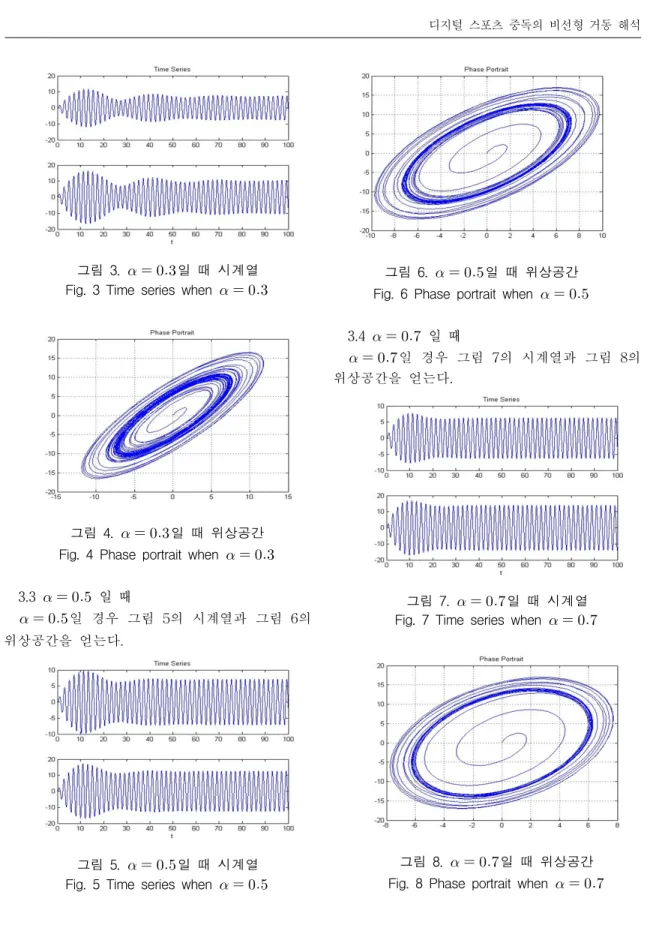
일 경우 그림 3의 시계열과 그림 4의 위상공간을 얻는다.
그림 3. 일 때 시계열 Fig. 3 Time series when
그림 4. 일 때 위상공간 Fig. 4 Phase portrait when
3.3 일 때
일 경우 그림 5의 시계열과 그림 6의 위상공간을 얻는다.
그림 5. 일 때 시계열 Fig. 5 Time series when
그림 6. 일 때 위상공간 Fig. 6 Phase portrait when
3.4 일 때
일 경우 그림 7의 시계열과 그림 8의 위상공간을 얻는다.
그림 7. 일 때 시계열 Fig. 7 Time series when
그림 8. 일 때 위상공간 Fig. 8 Phase portrait when
3.5 일 때
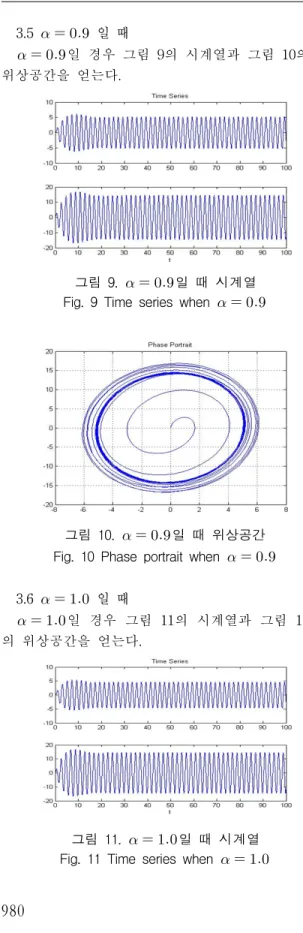
일 경우 그림 9의 시계열과 그림 10의 위상공간을 얻는다.
그림 9. 일 때 시계열 Fig. 9 Time series when
그림 10. 일 때 위상공간 Fig. 10 Phase portrait when
3.6 일 때
일 경우 그림 11의 시계열과 그림 12 의 위상공간을 얻는다.
그림 11. 일 때 시계열 Fig. 11 Time series when
그림 12. 일 때 위상공간 Fig. 12 Phase portrait when
그림 1 - 그림 12의 시계열데이터와 위상 공간을 살펴보면 값이 낮을 때의 패턴과 높을 때의 패 턴이 다름을 알 수 있다. 만약 값이 낮은 상태 를 중독이 덜 된 경우라고 가정하면 그림 1 - 그 림 12로부터 중독의 상태가 단순화된 패턴을 가 지고 중독이 되지 않은 상태가 복잡한 상태를 가진다고 볼 수 있다.
Ⅵ. 결론 및 향후 과제
본 논문에서는 디지털 스포츠에서의 중독 모델을 분 수차수(fractional-order)로 제시하고 이 모델로부터 비 선형 거동을 시계열과 위상 공간으로 나타내고, d=0.5, c=0.2, s=2, sin로 정해놓고 이들 사이의 차이점을 값의 변화에 따라 확인하였다. 확인 결과 값이 낮은 경우 복잡한 상태를 높은 경우 단순한 상태 를 나타내어, 낮은 값의 상태를 중독되지 않은 상태, 높 은 값의 상태를 중독된 상태로 정의하였다. 따라서 중 독 상태의 정확한 모델은 값을 어떻게 선택하는가에 달려있으며 어디서부터 중독인지를 확인하기 위한 적 정한 값을 선정하는 것이 앞으로의 과제로 남는다.
References
[1] Y. Bae, "Chaotic Phenomena in Addiction Model for Digital Leisure," Int. J. of Fuzzy Logic and Intelligent Systems, vol. 13, no. 4, Dec. 2013, pp.
291-297.
[2] M. Kim and Y. Bae, “Mathematical Modelling and Chaotic Behavior Analysis of Cyber Addiction,” J. of Korean Institute of Intelligent Systems, vol. 24, no. 3, June 2014, pp. 245-250.
[3] Y. Bae, “Chaotic Dynamics in Tobacco’s Addiction Model,” Int. J. of Fuzzy Logic and Intelligent Systems, vol. 14, no. 4, Dec. 2014, pp.
322-331.
[4] Y. Bae, “Mathematical Modelling and Behavior Analysis of Addiction of Physical Exercise,” J. of Korean Institute of Intelligent Systems, vol. 24, no.
6, Dec. 2014, pp. 615-621.
[5] M. Kim, “Analysis of Nonlinear Behavior in Idea of Physical Exercise with Unification of Mind and Body,”
J. of the Korea Institute of Electronic Communication Sciences, vol. 11, no. 6, 2016, pp. 645-651.
[6] M. Kim, K. Kim and Y. Shon, “Information Analysis as Keyword of integrated IoT and Advanced Leisure Sport,” J. of the Korea Institute of Electronic Communication Sciences, vol. 9, no. 5, 2014, pp. 609-615.
[7] M. Kim, “Establishment of the Digital Era Elderly by Lifelong Educational Leisure Sports ,”
J. of the Korea Institute of Electronic Communication Science, vol. 8, no. 6, 2013, pp. 933-940.
[8] M. Kim, “Digital Leisure, Sericeous Leisure, Leisure Measurement, Leisure Dysfunction, Information Society,” J. of the Korea Institute of Electronic Communication Science, vol. 8, no. 12, 2013, pp. 1979-1984.
[9] M. Kim and Y. Kim, “ Idea of physical education of unification for body and mind in digital age,” in proceeding of spring conf. of the Korea Institute of Electronic Communication Science, vol. 7, no. 1, 2013, pp. 335-338.
[10] Y. Bae, “ Synchronization of Dynamical Hap- piness Model,” Int. J. of Fuzzy Logic and Intelligent Systems, vol. 13, no. 4, 2013, pp.
291-297.
[11] S. Kim, S. Choi, Y. Bae, and Y. Park, “Math- ematical Modelling of Happiness and its nonlinear Analysis,” J. of the Korea Institute of Electronic Communication Science, 2013, vol. 9, no.
6, pp. 711-717.
[12]Y. Bae, “Synchronization of Dynamical Happiness Model,” Int. J. of Fuzzy Logic and Intelligent Systems, vol. 14, no. 2, June. 2014, pp.
91-97.
[13] Y. Bae, “Behavior Analysis of Dynamic Love Model with Time Delay,”J. of the Korea Institute of Electronic Communication Sciences, vol. 10, no.
2, 2015, pp. 253-260.
[14] Y. Bae, “Modified Mathematical Modelling of Love and its Behaviour Analysis,” J. of the Korea Institute of Electronic Communication Sciences, vol.
9, no. 12, 2014, pp. 1441-1446.
[15] L. Hyang and Y. Bae, “Behavior Analysis in Love Model of Romeo and Juliet with Time Delay”, J. of Korean Institute of Intelligent Systems, vol. 25, no. 2, April 2015, pp. 155-160.
[16] L. Hyang and Y. Bae, “Comparative Behavior Analysis in Love Model with Same and Different Time Delay”, J. of Korean Institute of Intelligent Systems, vol. 25, no. 3, April 2015, pp. 210-216.
[17] L. Hyang and Y. Bae, “Behavior analysis in love model of Romeo and Juliet with time delay”, J.
of Korean Institute of Intelligent Systems, vol. 25, no. 2, 2015, pp. 155-160.
[18] Y. Bae, "Nonlinear behavior in love model with discontinuous external force," Int. J. of Fuzzy Logic and Intelligent Systems, vol. 16, no. 1, 2016.
pp. 64-71.
[19] Y. Bae, "Chaotic behavior in dynamic love model with different external force," Int. J. of Fuzzy Logic and Intelligent Systems, vol. 15, no. 4, 2015, pp. 283-288.
[20] Y. Shon, J. Lee and Y, Bae, “Behavior Analysis in Love Model with applying Conscious and Nonconscious,” J. of the Korea Institute of Electronic Communication Sciences, vol. 11, no. 5, 2016, pp. 523-529.
[21] L. Hyang S. Hwang and Y. Bae, “Chaotic Behavior in Model with a Gaussian Function as External Force,“ Int. J. of Fuzzy Logic and Intelligent Systems, vol. 16, no. 4, 2016, pp.
262-269.
[22] Y. Bae, “Nonlinear Behavior Analysis in Love Model with closing awareness of Human,“ J. of the Korea Institute of Electronic Communication Science, vol. 12, no. 1, 2017, pp. 201-208.
[23] Y. Bae, “Analysis of Nonlinear Behavior in Love Model as External Force with Gaussian Fuzzy Membership Function “ J. of Korean Institute of Intelligent Systems, vol. 27, no. 1, 2017, pp. 29-34.
[24] Y. Bae, “Nonlinear Analysis in Love Dynamics with Triangular Membership Function as External Force, “ J. of Digital Contents Society, vol.
18, no. 1, 2017, pp. 217-224.
저자 소개
배영철(Young-Chul Bae) 1984년 광운대학교 전기공학과 (공학사)
1986년 광운대학교대학원 전기공 학과 (공학석사)
1997년 광운대학교대학원 전기공학과(공학박사) 1986년~1991년 한국전력공사
1991년~1997년 산업기술정보원 책임연구원 1997년~현재 전남대학교 전기․전자통신․컴퓨터 공학부 교수
2002년~2002년 Brigham Young University 방문교수 2011년~2011년 University of Utah 방문교수
※ 관심분야 : Chaos Control and Chaos Robot, Robot control etc.