• 검색 결과가 없습니다.

Effects of Operational Parameters on the Removal of Acid Blue 25 Dye from Aqueous Solutions by Electrocoagulation

N/A
N/A
Protected

Academic year: 2021

Share "Effects of Operational Parameters on the Removal of Acid Blue 25 Dye from Aqueous Solutions by Electrocoagulation"

Copied!
7
0
0

로드 중.... (전체 텍스트 보기)

전체 글

(1)

1. Introduction 1)

Dyes normally exist in wastewaters from dyeing industrial complex which is the remarkable major source for color in its effluents[1-4].

Over 100,000 numbers of commercially available dyes have been pro- duced[5]. The volume of water used in the textile industries has in- creased due to the expansion of the textile industries[6]. According to an estimate, about 40~65 L of wastewater is generated to produce 1 kg fabric[7]. Thus, considerable amount of wastewater including dye is directly discharged into streams and rivers through aqueous effluent[5].

Dye is major organic compounds which increase environmental is- sue[3,4]. The effluents containing dyes include chemicals and sus- pended solids which could be toxic materials[6]. The toxic materials can harm the aesthetic environment and can be toxic to aquatic life[2].

For instance, the dyes in the water can change the photosynthetic activ- ity due to declining transparency of the water, resulting in affecting aquatic life[8]. Furthermore, the dyes could be carcinogenic and muta- genic; so, the dyes can damage internal organs, brain, and central nerv- ous system[9].

† Corresponding Author: M. J. Shim, Catholic Kwandong University, Department of Environmental Engineering, Gangneung 25601, Korea; S. M. Lee, Catholic Kwandong University, Department of Environmental Engineering, Gangneung 25601, Korea

Tel: +82-33-649-7535 e-mail: [email protected], [email protected]

pISSN: 1225-0112eISSN: 2288-4505 @ 2019 The Korean Society of Industrial and

Engineering Chemistry. All rights reserved.
The chemicals in the dyes are harmful for humans as well as for the aquatic environment. Therefore, dyes should not be discharged into rivers or any water bodies directly. It is difficult to remove dye from wastewater by conventional methods including chemical coagulation and flocculation, adsorption, ozonation, and fungal decolonization [10,11]. Electrochemical technique is alternative when removal of pol- lutants by chemical coagulation becomes difficult or impossible.

Electrochemical technique such as electrocoagulation (EC) has several advantages compared to the other conventional methods. Firstly, sup- plementary equipment of EC is relatively cheaper compared to the oth- er techniques. Second, there are small production of total dissolved sol- ids and harmful substances during removal process[12,13]. Third, col- loidal particles are also removed as dyes are eliminated[12,13]. Finally, EC reduces the amount of sludge which should be disposed [14].

There are more strong points described somewhere[13]. Generally, aluminum (Al) and iron (Fe) are used for electrode materials during EC process. When Al electrode is used, the electrolytic reactions cause metal dissolution and water reduction during EC[15-17]:

Anode: Al → Al

+3

+ 3e

-

(1)

Cathode: 3H

2

O + 3e

-

 H

 g

+ 3OH

-

(2)

Al

3+

and OH

-

ions are generated by equation (1) and (2), and these ions react to form final products, Al(OH)

3

(s), by following reaction:

Solutions by Electrocoagulation

Davoud Balarak, Fatemeh Ganji * , Suk Soon Choi ** , Seung Mok Lee ***

,†

, and Moo Joon Shim ***

,†

Department of Environmental Health, Health Promotion Research Center, Zahedan University of Medical Sciences, Zahedan, Iran

* Department of Environmental Health, Student Research Committee, Zahedan University of Medical Sciences, Zahedan, Iran

** Department of Biological and Environmental Engineering, Semyung University, Jecheon 27136, Korea

*** Department of Environmental Engineering, Catholic Kwandong University, Gangneung 25601, Korea (Received November 11, 2019; Revised November 14, 2019; Accepted November 21, 2019)

Abstract

Influence of several experimental parameters (e.g., initial dye concentration, pH, distance between electrodes, applied voltage, electrical conductivity, current density, and reaction time) on the performance of electrocoagulation (EC) process for the removal of acid blue 25 (AB25) was studied. A bipolar batch reactor was used to test the impact of the parameters. The removal efficiency (RE) of AB25 dye was promoted by increasing the contact time, voltage, electrical conductivity, and applied current density. In contrast, RE of AB25 decreased with higher level of AB25 and the longer distance between electrodes. The re- moval efficiency increased consistently until pH 7, but decreased above pH 7. The maximum efficiency of AB25 removal above 90% was obtained at a voltage of 60 V, reaction time of 90 min, distance between electrodes of 0.5 cm, initial concen- tration of 25 mg/L, conductivity of 3,000 µS/cm and pH of 7. These results imply that the high RE of AB25 dye from the aqueous solution can be achieved by EC process.

Keywords: Electrocoagulation, Acid blue 25, Aluminum electrodes

(2)

Figure 1. Molecular structure of AB25 dye.

Al

+3

+ 3H

2

O → Al(OH)

3

(s) + 3H

+

(3)

Al(OH)

3

(s) exists as a gelatinous suspension which can eliminate dye from wastewater by coagulation[17]. Sedimentation or electro- flotation can remove the flocs from aqueous solution[18,19]. There are some factors that regulates the removal efficiency (RE) during dye re- moval process using the EC techniques. Initial dye concentration, pH, current density, applied voltage, distance between electrodes, con- ductivity and reaction time are ones of the examples. It has been re- ported that EC process had provided high RE for various dyes from wastewater[12,13].

Acid Blue 25 (AB25) has been used for dyeing wool, silk, and mixed fabric in dyeing industry which is the reason there have been many studies to remove AB25 from wastewater. However, usually ad- sorption has been used as removal mechanism for AB25, suggesting that there is lack of information about removal of AB25 by EC.

Therefore, the objective of this study is to investigate various operating conditions to achieve higher removal capacity using EC. This study could allow us to design better dye removal system in the field.

2. Experimental

2.1. Materials

All of the chemicals were used without further purification in this study. The high pure AB25 (C

20

H

13

N

2

NaO

5

S, molecular weight: 416.38) was purchased from Alvan Co. (Hamedan, Iran), and the chemical structure is displayed in Figure 1. Hydrochloric acid (HCl) (0.1 mol/L) and sodium hydroxide (NaOH) (0.1 mol/L) were used to adjust pH of the solutions and purchased from Merck Co. (Darmstadt, Germany).

2.2. Experiments

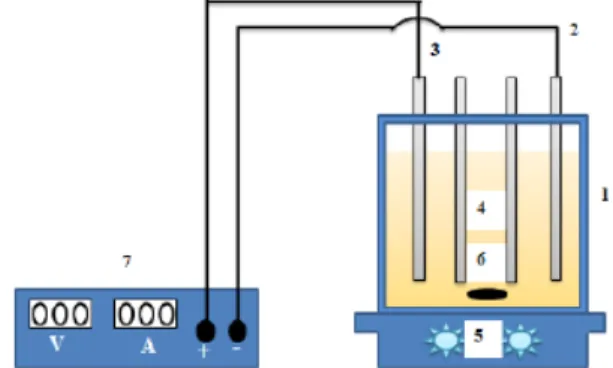
The experiments were conducted using a bipolar batch reactor (2 L of volume), with four Al electrodes with 0.2 cm × 8 cm × 12 cm in- stalled parallel to each other (Figure 2). The Al electrodes were placed in 2 cm distance, having a monopole electrode configuration. The elec- tronic which can adjust the voltage from 0 to 60 V was supplied to the EC reactor. The 1.5 L of wastewater containing AB25 dye was in- troduced to the reactor and mixed by a magnetic stirrer. The waste- water of the reactor was settled for 45 minutes after each experiment, and then the dye concentrations were determined by UV-visible spec- trophotometer (Shimadzu UV-2101PC) at the λ

max

value, which is 602 nm for AB25.

RE was calculated by following equation:

RE (%) = (C

i

- C

o

) / C

i

× 100 (4)

Figure 2. Bench-scale EC reactor with bipolar electrodes in parallel connection (1. EC reactor, 2. anode, 3. cathode, 4. bipolar electrodes, 5. magnetic stirrer, 6. DC power supply).

Where C

i

and C

o

stand for AB25 dye concentrations pre and post re- moval, respectively.

The electrodes were cleaned with deionized water to remove solid particles on the surface of the electrodes when each test was over. The effect of electrochemical factors (e.g., initial dye concentration, pH, electrical conductivity, voltage, distance between electrodes, current density and electrolysis time) on the AB25 dye RE were investigated with two replicates. The range of each condition was indicated in Table 1.

3. Results and Discussion

3.1. Effect of reaction time and initial dye concentrations Reaction time is one of the important parameters which affects the performance of EC process[20]. Besides the reaction time and AB25 dye concentrations, the other conditions were fixed: current density of 3 mA/cm

2

, distance between electrodes of 2 cm, voltage of 40 V, con- ductivity of 2,500 µS/cm, and pH 7. The range of the operating con- ditions and RE with the conditions are indicated in Table 1.

The highest REs were reached after 90 min of the reaction time and maintained until 120 minutes (Figure 3). These trends occurred at all different AB25 dye solutions. It was reported that production rate of hydroxyl and metal ions on the electrodes increased with reaction time[19,20]. However, there was no increase observed in the RE after 90 min of the reaction time. Therefore, the most favorable condition is 90 min and our results were similar with previous studies[19,20].

Taheri et al. (2015) also reported that RE by EC increased with the increase of reaction time and reaction time was one of the most im- portant parameter to remove acid azo dyes. Larue et al. (2003) also concluded that removal of the organic matter by EC was improved when the reaction time was increased from 10 to 60 minutes.

The RE decreased as the initial AB25 dye concentrations were in- creased (Figure 3). It is known that amounts of coagulant are not changed even though initial dye concentrations were increased[16].

Thus, the coagulation capacity of sweep flocs decreases, and because

of this reduction of dye RE occurs[16]. A similar result was previously

reported[21,22]. For instance, besides AB25 dye removal, orange II re-

moval was affected with the increased initial dye concentration[21].

(3)

25

15 45.9 10 15 26.2 0.5 95.2

30 60.8 30 40.7 1.0 92.4

45 67.9 45 51.3 1.5 88.5

60 81.3 60 58.3 2.0 86.1

75 89.5 75 63.1 2.5 80.2

90 95.5 90 69.0 3.0 71.5

105 95.8 105 69.4

120 95.9   120 69.8    

50

15 40.3 20 15 29.9 Current density RE (%)

30 51.8 30 44.4 1 72.3

45 64.3 45 55.1 2 78.3

60 75.4 60 66.7 3 85.2

75 81.4 75 72.5 4 89.2

90 89.8 90 78.4 5 91.8

105 89.9 105 78.9 6 93.2

120 90.1   120 79.2    

100

15 34.2 40 15 34.2 pH RE (%)

30 47.4 30 49.4 3 82.2

45 55.5 45 59.5 5 93.4

60 69.3 60 69.3 7 98.2

75 77.2 75 77.2 9 79.4

90 86.1 90 86.1

105 86.3 105 86.3

120 86.3   120 86.3    

150

15 31.4 60 15 41.9 Conductivity RE (%)

30 45.2 30 57.8 500 70.7

45 54.4 45 65.9 1000 78.8

60 66.2 60 79.3 1500 86.5

75 75.4 75 89.5 2000 91.3

90 80.1 90 93.5 2500 93.5

105 80.3 105 93.8 3000 95.7

120 80.4   120 94.1    

200

15 30.2

30 41.2

45 48.6

60 62.2

75 68.4

90 70.4

105 70.6

120 71.7          

(4)

Figure 3. The RE of AB25 dye with reaction time and dye concen- trations (distance between electrodes: 2 cm; voltage: 40 V, pH 7;

conductivity: 2,500 µS/cm).

Figure 4. Influence of electrodes distance on RE of AB25 dye (voltage:

60 V, pH 7; conductivity: 2,500 µS/cm; reaction time: 90 min; dye concentration: 100 mg/L).

Mohammad et al. (2004) reported that the RE decreased by 34% when the initial orange II dye concentration increased from 10 to 100 mg/L.

3.2. Influence of the distance between electrodes

Usually, it is known that a closer distance between electrodes is ad- vantageous for EC because the electrical resistance increases with inter electrode distance. To test influence of the distance between electrodes on AB25 dye removal, the other conditions were fixed: voltage of 60 V, pH 7, conductivity of 2,500 µS/cm, and AB25 dye concentration of 100 mg/L. Figure 4 shows that a decrease in removal of AB25 dye was observed when the distance between electrodes was increased.

Similar phenomena were described previously[12,23].

Due to electrostatic effects of electrodes distance, dye removal de- creases with the distance between electrodes[24]. That is, if distance between electrodes increases, the movement of Al

+3

hydroxides can be

Figure 5. The effect of current density on AB25 dye RE (voltage: 60 V, pH 7; conductivity: 2,500 µS/cm; reaction time: 90 min; dye con- centration: 100 mg/L; distance between electrodes: 2 cm).

slow down, and resulting in the reduction of mixing with the dye mol- ecules and coagulant.

3.3. Influence of current density

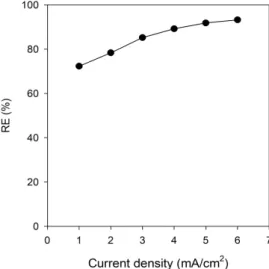
Current density can play an important role in controlling electro- chemical rate[12]. Besides current density, the other conditions were fixed: voltage of 60 V, distance between electrodes of 2 cm, con- ductivity of 2,500 µS/cm, AB25 dye concentration of 100 mg/L, and pH 7. Figure 5 displays the effect of current density on AB25 dye re- moval, suggesting that the RE increased with the current density. Other studies also reported a similar trend[12,23,25,26]. Increase in current density can increase the amount of Al oxide and coagulation of the matrix; therefore, removal of dye can be improved[27,28].

3.4. Effect of initial pH

It is known that pH is a significant parameter affecting dye removal by EC[12,23,25,29,30]. pH can influence the ionic characteristic of Al hydroxides and the dye molecule in wastewater and hence affect dye RE[25]. To determine the effect of pH on AB25 dye removal, the oth- er conditions were kept fixed: voltage of 60 V, distance between elec- trodes of 2 cm, conductivity of 2,500 µS/cm, reaction time of 90 min, and AB25 dye concentration of 25 mg/L.

The RE was highest at pH 7, and the RE was decreased at pH 9 (Figure 6). Many investigators have also reported that RE is found the highest at neutral pH[12,23,25,31,32]. At acidic, neutral, and basic con- ditions, Al(OH)

2+

, Al(OH)

3

, Al(OH)

4-

are the dominant species in the solutions, respectively[23,33-35]. As mentioned above, Al(OH)

3

has large surface areas which is available to adsorb dye molecule. This is because of the highest removal of AB25 dye which was observed at neutral pH in many studies including this study.

In contrast at low pH, Al(OH)

2+

and Al

3+

were found dominated and

are not beneficial in the dye removal[31]. Likewise, at high pH, the

Al hydroxide is oxidized at anode; therefore, Al(OH)

3

is not pro-

(5)

Figure 6. Effect of pH on the AB25 RE (voltage: 60 V, pH 7; con- ductivity: 2,500 µS/cm; reaction time: 90 min; dye concentration: 25 mg/L; distance between electrodes: 2 cm).

Figure 7. Effect of conductivity on RE of AB25 dye and energy con- sumption (voltage: 60 V, pH 7; conductivity: 2,500 µS/cm; reaction time: 90 min; dye concentration: 100 mg/L; distance between electrodes:

2 cm).

duced[23]. That is why AB25 dye REs was declined under alkaline pH[33,34].

3.5. Effect of electrical conductivity

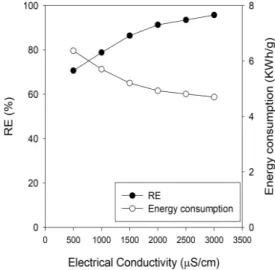
To test the effect of electrical conductivity on AB25 dye removal, the other conditions were fixed: voltage of 60 V, distance between electrodes of 2 cm, reaction time of 90 min, and AB25 dye concen- tration of 100 mg/L. The RE of AB25 dye increased with electrical conductivity of the reactor (Figure 7). Our results also showed that de- crease in the energy consumption was correlated to increase in elec- trical conductivity (Figure 7). For instance, when electrical conductivity increased from 500 to 3,000 µS/cm, energy consumption was reduced from 6.4 to 4.7 KWh/g (Table 1). The current flow increases with elec- trical conductivity of the solution during EC process. As a result of in-

Figure 8. The RE of AB25 dye with voltage (distance between elec- trodes: 2 cm, pH 7; conductivity: 2,500 µS/cm; dye concentration:

100 mg/L).

crease in the current flow, dye removal performance was enhanced.

Increase in electrical conductivity results in decreasing in the cell voltage at fixed current density, declining the power consumption in electrolytic cells[25]. Our result was similar with previous reports [32,36,37]. For instance, Bazrafshan et al. (2012) highlighted that in- crease in the electrical conductivity by addition of chloride potassium significantly enhanced the RE of humic acid because the formation of coagulator materials and the size of flocs was increased[36]. The study of Chafi et al. (2011) is another example to represent positive correla- tion between electrical conductivity and dye removal. It was also showed that energy consumption was decreased with the increase in electrical conductivity.

3.6. Effect of voltage

Besides voltage, the other conditions were fixed: current density of 3 mA/cm

2

, distance between electrodes of 2 cm, pH 7, conductivity of 2,500 µS/cm, and AB25 dye concentration of 100 mg/L. The applied voltage ranged from 10 to 60 V to study influence of voltage on AB25 dye removal from the wastewater. AB25 dye removal increased with the increased voltage (Figure 8). This could be ascribed to the in- creased amount of metal hydroxide at high current which leads to great- er amount of precipitates and removal of AB25 dye molecules[35].

4. Conclusion

Our results showed that the efficiency of the system can be pro-

moted by increasing the contact time, voltage, electrical conductivity,

and the applied current density. However, the efficiency of EC process

decreased when higher level of AB25 ions and longer distance between

electrodes were presented in the aqueous phase. In contrast, a con-

sistent increase appeared until there was a prominent decrease after the

high at pH 7. Based on our results, the maximum efficiency of AB25

removal was obtained with voltage of 60 V, reaction time of 90 min,

(6)

distance between electrodes of 0.5 cm, initial concentration of 25 mg/L, conductivity of 3,000 µS/cm and pH 7. Under these conditions, the RE surpassed 90%. Therefore, these results showed that EC proc- ess can effectively reduce the dye contaminant at a very low level.

Acknowledgements

The authors are grateful for financial support from the Zahedan Uni- versity of Medical Sciences. We also thank Ms. Seemi Tasnim Alam for comments to improve the manuscript.

References

1. A. Assadi, A. Soudavari, and M. Jan, Comparison of electro- coagulation and chemical coagulation processes in removing re- active red 196 from aqueous solution, J. Hum. Environ. Health Promot., 1(3), 172-182 (2016).

2. R. Sanghi and B. Bhattacharya, Review on decolonization of aque- ous dye solutions by low cost adsorbents, Coloration Technol., 118, 256-269 (2002).

3. M. A. Zazouli, J. Y. Cherati, M. Ebrahimi, and Y. Mahdavi, Investigating the removal rate of Acid Blue 113 from aqueous sol- ution by canola (Brassica napus), J. Mazandaran Univ. Med. Sci., 22, 70-78 (2013).

4. B. Zohra, K. Aicha, S. Fatima, B. Nourredine, and D. Zoubir, Adsorption of direct red 2 on bentonite modified by cetyltrimethyl- ammonium bromide, Chem. Eng. J., 136, 295-305 (2008).

5. S. Kara, C. Aydiner, E. Demirbas, M. Kobya, and N. Dizge, Modeling the effects of adsorbent dose and particle size on the ad- sorption of reactive textile dyes by fly ash, Desalination, 212, 282-293 (2007).

6. A. Mahvi, M. Ghanbarian, S. Nasseri, and A. Khairi, Mineraliza- tion and discoloration of textile wastewater by TiO

2

nanoparticles, Desalination, 239(1), 309-316 (2009).

7. S. T. Yang, S. Chen, Y. Chang, A. Cao, and Y. Liu, Removal of methylene blue from aqueous solution by graphene oxide, J. Colloid Interface Sci., 359, 24-29 (2011).

8. D. Balarak, J. Jaafari, G. Hassani, Y. Mahdavi, I. Tyagi, S. Agarwal, and V. K. Gupta, The use of low-cost adsorbent (Canola residues) for the adsorption of methylene blue from aqueous solution: Iso- therm, kinetic and thermodynamic studies, Colloid Interface Sci.

Commun., 7, 16-19 (2015).

9. S. P. Moussavi and F. M. Mohammadian, Acid violet 17 dye de- colonization by multi-walled carbon nanotubes from aqueous sol- ution, J. Hum. Environ. Health Promot., 1(2), 110-117 (2016).

10. D. Balarak, Y. Mahdavi, E. Bazrafshan, and A. H. Mahvi, Kinetic, isotherms and thermodynamic modeling for adsorption of Acid Blue 92 from aqueous solution by modified Azolla filicoloides, Frese- nius Environ. Bull., 25(5), 1321-1330 (2016).

11. D. Balarak, F. K. Mostafapour, and A. Joghataei, Adsorption of Acid Blue 225 dye by multi walled carbon nanotubes: Determina- tion of equilibrium and kinetics parameters, Der Pharma Chemica, 8(8), 138-145 (2016).

12. R. Kamaraj and S. Vasudevan, Evaluation of electrocoagulation process for the removal of strontium and cesium from aqueous sol- ution, Chem. Eng. Res. Des., 93, 522-530 (2015).

13. M. Y. Mollah, R. Schennach, J. R. Parga, and D. L. Cocke, EC science and applications, J. Hazard. Mater., 84, 29-41 (2001).

14. S. Barışçı and O. Turkay, Optimization and modeling using the re- sponse surface methodology (RSM) for ciprofloxacin removal by electrocoagulation, Water Sci. Technol., 73, 1673-1679 (2016).

15. N. Daneshvar, A. R. Khataee, A. R. Amani Ghadim, and M. H.

Rasoulifard, Decolonization of C.I. Acid Yellow 23 solution by electrocoagulation process: Investigation of operational parameters and evaluation of specific electrical energy consumption (SEEC), J. Hazard. Mater., 148(3), 566-572 (2007).

16. J. B. Parsa, T. M. Panah, and F. N. Chianeh, Removal of cipro- floxacin from aqueous solution by continuous flow electro-coagu- lation process, Korean J. Chem. Eng., 33, 893-901 (2016).

17. I. A. Sengil and M. Ozacar, The decolonization of C.I. Reactive Black 5 in aqueous solution by electrocoagulation using sacrificial iron electrodes, J. Hazard. Mater., 161(2-3), 1369-1376 (2009).

18. O. T. Can, M. Bayramoglu, and M. Kobya, Decolonization of re- active dye solutions by electro-coagulation using aluminum elec- trodes, Ind. Eng. Chem. Res., 42(14), 3391-3396 (2003).

19. O, Larue, E. Vorobiev, C. Vu, and B. Durand, Electrocoagulation and coagulation by iron of latex particles in aqueous suspensions, Sep. Purif. Technol., 31(2), 177-192 (2003).

20. M. Taheri, M. R. A. Moghaddam, and A. Arami, Improvement of the Taguchi design optimization using artificial intelligence in three acid azo dyes removal by electrocoagulation, Environ. Prog.

Sustain. Energy, 34, 1568-1575 (2015).

21. Y. A. Mohammad, R. Saurabh, K. Prashanth, V. Madhavi, S. Tejas, A, G. Jewel, K. Mehmet, and L. David, Treatment of orange II azo-dye by electrocoagulation (EC) technique in a continuous flow cell using sacrificial iron electrodes, J. Hazard. Mater., 109, 165-171 (2004).

22. J. B. Parsa, H. R. Vahidian, A. R. Soleymani, and M. Abbasi, Removal of Acid Brown 14 in aqueous media by electrocoagulation:

Optimization parameters and minimizing of energy consumption, Desalination, 278(1-3), 295-302 (2011).

23. N. Daneshvar, H. Ashassi-Sorkhabi, and A. Tizpar, Decolorization of orange II by electrocoagulation method, Sep. Purif. Technol., 31(2), 153-162 (2003).

24. M. Kobya, M. Bayramoglu, and M. Eyvaz, Techno-economical evaluation of electrocoagulation for the textile wastewater using different electrode connections, J. Hazard. Mater., 148(1-2), 311-318 (2007).

25. B. K. Nandi and S. Patel, Effects of operational parameters on the removal of brilliant green dye from aqueous solutions by electro- coagulation, Arab. J. Chem., 10, S2961-S2968 (2017).

26. M. Saravanan, N. P. Sambhamurthy, and M. Sivarajan, Treatment of Acid Blue 113 solution using iron electroagulation, Clean (Weinh), 38, 565-571 (2010).

27. N. M. A. Ghalwa, A. M. Saqer, and N. B. Farhat, Removal of re- active Red 24 dye by clean electrocoagulation process using iron and aluminum electrodes, J. Chem. Eng. Process Technol., 18, 195-204 (2016).

28. V. Khatibikamal, A. Torabian, F. Janpoor, and G. Hoshyaripour, Fluoride removal from industrial wastewater using electrocoagu- lation and its adsorption kinetics, J. Hazard. Mater., 179(1), 276-280 (2010).

29. N. Daneshvar, A. Oladegaragoze, and N. Djafarzadeh, Decoloriza-

tion of basic dye solutions by electrocoagulation: An investigation

(7)

(2008).

31. E. S. Z. El-Ashtoukhy and N. K. Amin, Removal of acid green dye 50 from wastewater by anodic oxidation and electrocoagulation - A comparative study, J. Hazard. Mater., 179(1), 113-119 (2010).

32. S. Song, Z. He, J. Qiu, L. Xu, and J. Chen, Ozone assisted electro- coagulation for decolonization of CI Reactive Black 5 in aqueous solution: An investigation of the effect of operational parameters, Sep. Purif. Technol., 55(2), 238-245 (2007).

33. N. Drouiche, S. Aoudj, M. Hecini, N. Ghaffour, H, Lounici, and N. Mameri, Study on the treatment of photovoltaic wastewater us- ing electrocoagulation: Fluoride removal with aluminium electrodes

Fauduet, Removal of acid dye from aqueous solutions by electro- coagulation/GAC adsorption coupling: Kinetics and electrical oper- ating costs, J. Taiwan Inst. Chem. Eng., 43(5), 767-775 (2012).

36. E. Bazrafshan, A. J. Jaafari, F. K. Mostafapour, and H. Biglari, Humic acid removal from aqueous environments by electrocoagu- lation process duad with adding hydrogen peroxide, Iran. J. Health Environ., 5(2), 211-224 (2012).

37. M. Chafi, B. Gourich, A. H. Essadki, C. Vial, and A. Fabregat,

Comparison of electrocoagulation using iron and aluminum elec-

trodes with chemical coagulation for the removal of a highly solu-

ble acid dye, Desalination, 281, 285-292 (2011).

수치

Figure 1. Molecular structure of AB25 dye.
Figure 4. Influence of electrodes distance on RE of AB25 dye (voltage:
Figure 8. The RE of AB25 dye with voltage (distance between elec-  trodes: 2 cm, pH 7; conductivity: 2,500 µS/cm; dye concentration:

참조

관련 문서

Determined parameters was used for the implementation of side-processed POF with the CO 2 laser, and measured experimental results of the illumination proved

Noorul Haq : Effect of friction welding parameters on mechanical and metallurgical properties of ferritic stainless steel, The international journal of

The removal efficiency of nitrate was increased with increasing of dosage of adsorbents. The NO 3 - -N removal was not affected by the pH under the experiment range of pH. The

The corrosion potential(E corr ), corrosion current density(I corr ), and corrosion rate of Ni-Ti files obtained from anodic polarization curves after electrochemical

In order to investigate the effects of process parameters on qualities of the drilled hole quantitatively, laser drilling experiments were carried out using

The effects of the acceleration voltage, the probe current and the travel speed on the formation, the ingredient variation and the surface roughness of the deposited

From the results of the linear cutting tests, the effects of the process parameters on the kerfwidth and characteristics of the cut section, including

The present work considers the effect of different system parameters (orifice diame- ter, orifice number and spacing between orifices) on bubble for- mation, bubble