Effect of Essential Oil from San-Jo-In ( Zizyphus jujuba Mill. seeds) on Human Electroencephalographic Activity
Haeme Cho
1, Byoungsun Yu
1, Kandhasamy Sowndhararajan
1, Ji-Wook Jung
2, Jin-Woo Jhoo
3and Songmun Kim
1*
1
Department of Biological Environment, Kangwon National University, Chuncheon 200-701, Korea
2
Department of Herbal Medicinal Pharmacology, Daegu Haany University, Kyungsan 712-715, Korea
3
Department of Animal Products and Food Science, Kangwon National University, Chuncheon 200-701, Korea
Received August 12, 2013 /Revised September 16, 2013 /Accepted September 23, 2013Essential oils have been used to treat psychophysiological disorders, but their effects on human elec- troencephalographic (EEG) activity have not been thoroughly investigated. We evaluated the effects of essential oil of Zizyphus jujuba seeds, a Korean folk medicine known as San-Jo-In, on human EEG activity. For this purpose, essential oil was extracted from San-Jo-In by the supercritical carbon dioxide extraction method. The effect of its inhalation on EEG activity was evaluated by measuring the EEG power spectrum (25 indices) in 20 healthy participants. The results of the EEG power spectrum in- dicated that the values of the theta wave decreased significantly (p<0.05) in the left (from 17.277 to 13.854 µV) and right parietal (from 15.324 to 13.020 µV) regions compared to the other regions. During the inhalation of San-Jo-In oil, the EEG spectrum values of fast alpha, relative gamma, and spectral edge frequency increased 50% compared to those before inhalation. The values of the fast alpha wave increased significantly (p<0.05) in the left prefrontal (from 0.063 to 0.085 µV), right prefrontal (from 0.064 to 0.085 µV), and left frontal (from 0.073 to 0.100 µV) regions following inhalation of the San-Jo-In essential oil. The changes in the EEG activities following inhalation of San-Jo-In suggest that the oil can improve psychological well-being by increasing attention and relaxation.
Key words : Aromatherapy, electroencephalogram, essential oil, San-Jo-In, Zizyphus jujuba
*Corresponding author
*Tel : +82-33-250-6447, Fax : +82-33-241-6440
*E-mail : [email protected]
This is an Open-Access article distributed under the terms of the Creative Commons Attribution Non-Commercial License (http://creativecommons.org/licenses/by-nc/3.0) which permits unrestricted non-commercial use, distribution, and reproduction in any medium, provided the original work is properly cited.
Journal of Life Science 2013 Vol. 23. No. 9. 1170~1176 DOI : http://dx.doi.org/10.5352/JLS.2013.23.9.1170
Introduction
The therapeutic use of aromatic plants has a long tradition and their pharmaceutical properties are mostly ascribed to its essential oils. Essential oils are natural, complex, mul- ti-component systems mainly composed of terpenes in addi- tion to some other non-terpene components [3]. Aromather- apy is the therapeutic use of essential oils from plants. One of the methods used in the aromatherapy is release of odor to a particular environment. The sense of smell plays an im- portant role in the psychophysiological function of human beings. A number of studies have found that olfactory stim- ulation by inhalation of essential oils produces immediate changes in physiological parameters such as blood pressure,
muscle tension, pupil dilation, skin temperature, pulse rate and brain activity [8, 9, 17]. Moreover, fragrance molecules have the advantage of acting through olfactory pathways without decomposition in the digestive organs [25]. Previous studies have indicated that the fragrance molecules absorbed by inhalation, are able to cross the blood-brain barrier and interact with receptors in the central nervous system [5, 22].
In this context, investigations of essential oils on EEG activ- ity of human brain have also become important and worth- while for the treatment of physiological disorders.
Zizyphus jujuba Mill. is a perennial tree in the Rhamnaceae
family and has a wide natural distribution in tropical and
subtropical parts of the world [21]. The jujube fruits are edi-
ble and have been used in Korean folk medicine as San-Jo-In
and in Chinese folk medicine as Suan-Zao-Ren or Suan-
Zao-He with high sugar content and high levels of vitamin
A, B and C complexes, phosphorus and calcium [24]. This
plant possesses various pharmacological properties such as
liver problems, insomnia and anxiety [13, 28]. Kim [14] re-
ported that the jujube seeds improve the blood glucose level
and lipid profile in serum of dietary hyperlipidemic rats.
Al-Reza et al. [1, 2] reported that the essential oil of jujube seed registered potent anti-oxidant, anti-listerial and anti-in- flammatory activities. However, there is no study related to the effects of its essential oil on EEG activity of human brain.
Hence, the present study was carried out to evaluate the EEG activity of human brain with respect to fragrance in- halation of essential oil of Z. jujuba seeds.
Materials and Methods Plant material
The dried San-Jo-In were purchased from BN Herb Inc., Pyeongchang, Korea. The plant material was dried at room temperature, ground to a powder using a blender and stored at -20
oC prior to use.
Essential oil
Extraction of essential oil from San-Jo-In was ex- perimentally determined using supercritical fluid extraction equipment (ILSHIN Autoclave Co. Ltd., Korea) at the tem- perature of 60
oC and pressure of 400 bar with carbon dioxide flow rate of 30 ml/min.
Effect of inhalation of San-Jo-In essential oil on EEG activity
Participants
We investigated the effects of essential oil from San-Jo-In on EEG findings in twenty right-handed healthy volunteers (10 men and 10 women) aged 20-30 years. None of the partic- ipants had olfactory diseases, smoked or abused drugs. The purpose and schedule of the experiments were explained to participants and received written informed consent before participation.
EEG recordings
EEGs signals were recorded using QEEG-8 system (LXE3208, LAXTHA Inc., Daejeon, Korea) from 8 grounding electrodes placed on the scalp at left prefrontal (Fp1), right prefrontal (Fp2), left frontal (F3), right frontal (F4), left tem- poral (T3), right temporal (T4), left parietal (P3) and right parietal (P4) according to the International 10-20 System. All electrodes were referenced to the ipsilateral earlobe electrode.
Fragrance administration
The essential oil of San-Jo-In was used as the fragrance
stimulus. The stimulus was presented to the subjects in a randomized sequence. EEG measurement sites maintain a constant temperature (23°C) and humidity (50%) to 32.5 m
2size of the laboratory. The subjects were instructed to sit quietly, close their eyes and to breathe normally during the measurement. The fragrance stimulus was dipped in a filer paper (1 cm
2) then placed about 3 cm in front of the subject's nose. EEG was recorded before and during the fragrance exposure for 30 seconds.
Data analysis
The mean power values (µV) calculated for 25 EEG analy- sis indicators (Table 1). The t-mapping of EEG waves was constructed by using Telescan software package (LXSMD61, LAXTHA Inc., Daejeon, Korea). The SPSS statistical package 18 (SPSS, Inc., Chicago, IL, USA) used for data analysis on EEG activity before and during the exposure of the essential oil of San-Jo-In by a paired t-test based on the EEG power spectrum values.
Results and Discussion
Aromatherapy is a kind of alternative medicine that uses essential oils for psychological and physical wellbeing of hu- mans through fragrance inhalation. Fragrance inhalation of essential oils has a substantial role in controlling the func- tions of central nervous system. In Chinese folk medicine, the fragrance inhalation of essential oils of Storax pill and Acorus gramineus rhizome are used for the treatment of epi- lepsy [15, 16]. In an animal study, Koo et al. [15] stated that the inhibitory effect on the central nervous system by essen- tials oils through the gamma-aminobutyric acid-ergic neuro- modulation system. Yamada et al. [26] studied that the fra- grance inhalation of lavender essential oil is effective in re- ducing tension. Fragrance inhalation of essential oils of lav- ender, peppermint, rosemary and clary-sage were sig- nificantly reduced the anxiety and stress states of brain func- tion [11].
The objective of this study was to understand the effect
of inhalation of San-Jo-In essential oil on the activities of
human brain using EEG. The EEG power spectrum values
recorded for 8 electrode sites (Fp1, Fp2, F3, F4, T3, T4, P3
and P4) of the international 10-20 system. In the present
study, a total of 25 EEG indices analyzed for 8 electrode
sites. Among the 25 indices analyzed, significant changes
(p<0.05) observed in the EEG power spectrum values with
Table 1. EEG power spectrum indicators used in this study
S. No. Analysis
Indicators The full name of the EEG power spectrum indicators Wavelength range (Hz) 1
23 45 67 89 10 1112 1314 1516 1718 19 2021 2223 2425
AT AAAB AFAAG ASAALB AMBAHB RT RARB RFARG RSARLB RMBRHB RST RSMTRMT RAHBSEF50 SEF60 ASEF
Absolute theta Absolute alpha Absolute beta Absolute gamma Absolute slow alpha Absolute fast alpha Absolute low beta Absolute mid beta Absolute high beta Relative theta Relative alpha Relative beta Relative gamma Relative slow alpha Relative fast alpha Relative low beta Relative mid beta Relative high beta Ratio of SMR to theta Ratio of mid beta to theta Ratio of SMR~mid beta to theta Ratio of alpha to high beta Spectral edge frequency 50%
Spectral edge frequency 90%
Spectral edge frequency 50% of alpha
4~8 8~1313~30 30~50 8~11 11~13 12~15 15~20 20~30 (4~8) / (4~50) (8~13) / (4~50) (13~30) / (4~50) (30~50) / (4~50) (8~11) / (4~50) (11~13) / (4~50) (12~15) / (4~50) (15~20) / (4~50) (20~30) / (4~50) (12~15) / (4~8) (15~20) / (4~8) (12~20) / (4~8) (8~13) / (20~30) 4~50
4~508~13
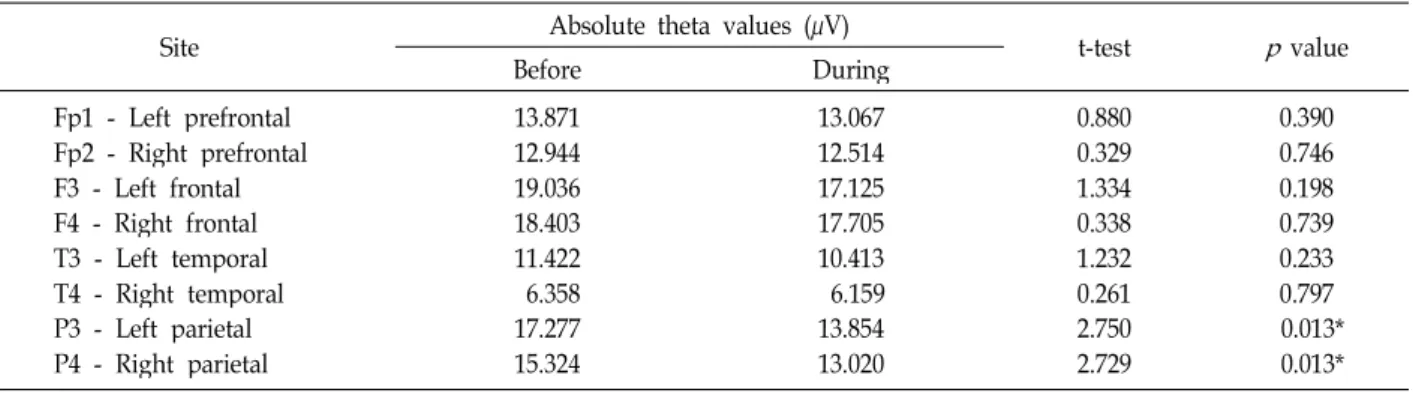
Table 2. Changes of absolute theta power spectrum values before and during the inhalation of essential oil of San-Jo-In (
Z. jujube
seeds)Site Absolute theta values (µV)
t-test
p
valueBefore During
Fp1 - Left prefrontal Fp2 - Right prefrontal F3 - Left frontal F4 - Right frontal T3 - Left temporal T4 - Right temporal P3 - Left parietal P4 - Right parietal
13.871 12.944 19.036 18.403 11.422 6.358 17.277 15.324
13.067 12.514 17.125 17.705 10.413 6.159 13.854 13.020
0.880 0.329 1.334 0.338 1.232 0.261 2.750 2.729
0.390 0.746 0.198 0.739 0.233 0.797 0.013*
0.013*
*Significant difference (
p
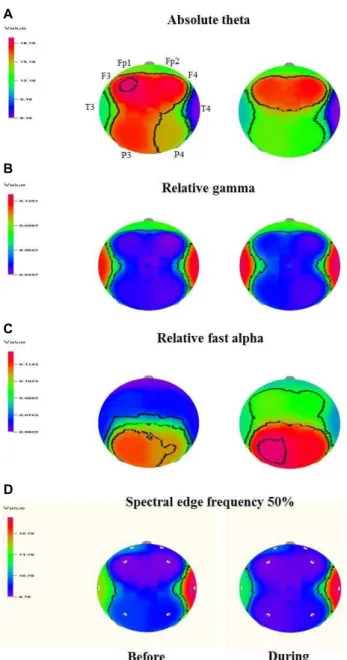
<0.05)increase of absolute theta, relative gamma, relative fast alpha and decrease of spectral edge frequency 50% during in- halation when compared to before inhalation, but had no effect on other EEG indices. The changes in the values of EEG power spectrum of human brain before and during the inhalation of San-Jo-In oil are presented in Table 2-5. Figure 1 also illustrates the differences in the t-mapping of absolute theta, relative gamma, relative fast alpha and spectral edge
frequency 50% waves before and during the inhalation of San-Jo-In oil.
The values of theta waves decreased significantly (p<0.05)
in the regions of left (from 17.277 to 13.854 μV) and right
parietal (from 15.324 to 13.020 μV), however, there were no
significant effects in the frontal and temporal regions (Table
2). On the other hand, the values of fast alpha waves in-
creased significantly (p<0.05) in the left prefrontal (from
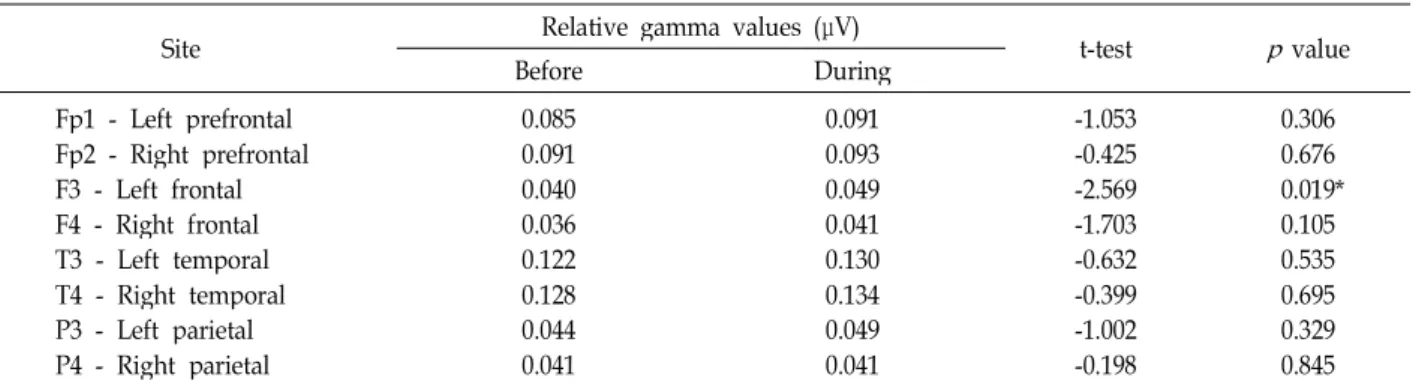
Table 3. Changes of relative gamma power spectrum values before and during the inhalation of essential oil of San-Jo-In (
Z. jujube
seeds)Site Relative gamma values (μV)
t-test
p
valueBefore During
Fp1 - Left prefrontal Fp2 - Right prefrontal F3 - Left frontal F4 - Right frontal T3 - Left temporal T4 - Right temporal P3 - Left parietal P4 - Right parietal
0.085 0.091 0.040 0.036 0.122 0.128 0.044 0.041
0.091 0.093 0.049 0.041 0.130 0.134 0.049 0.041
-1.053 -0.425 -2.569 -1.703 -0.632 -0.399 -1.002 -0.198
0.306 0.676 0.019*
0.105 0.535 0.695 0.329 0.845
*Significant difference (
p
<0.05)Table 4. Changes of relative fast alpha power spectrum values before and during the inhalation of essential oil of San-Jo-In (
Z.
jujube
seeds)Site Relative fast alpha values (µV)
t-test
p
valueBefore During
Fp1 - Left prefrontal Fp2 - Right prefrontal F3 - Left frontal F4 - Right frontal T3 - Left temporal T4 - Right temporal P3 - Left parietal P4 - Right parietal
0.063 0.064 0.073 0.071 0.072 0.070 0.115 0.109
0.085 0.085 0.100 0.095 0.088 0.080 0.125 0.120
-2.167 -2.133 -2.151 -1.949 -2.398 -1.165 -0.761 -0.872
0.043*
0.046*
0.045*
0.066 0.027 0.258 0.456 0.394
*Significant difference (
p
<0.05)Table 5. Changes of spectral edge frequency 50% power spectrum values before and during the inhalation of essential oil of San-Jo-In (
Z. jujube
seeds)Site Spectral edge frequency 50% values (µV)
t-test
p
valueBefore During
Fp1 - Left prefrontal Fp2 - Right prefrontal F3 - Left frontal F4 - Right frontal T3 - Left temporal T4 - Right temporal P3 - Left parietal P4 - Right parietal
10.447 11.059 9.619 9.619 12.950 12.650 9.988 9.888
10.519 11.153 9.884 9.709 13.316 12.797 10.106 10.081
-0.520 -0.760 -2.332 -0.716 -0.694 -0.166 -1.109 -1.591
0.609 0.457 0.031*
0.482 0.496 0.870 0.281 0.128
*Significant difference (
p
<0.05)0.063 to 0.085 μV), right prefrontal (from 0.064 to 0.085 μV) and left frontal (from 0.073 to 0.100 μV) regions due to the inhalation of essential oil of San-Jo-In (Table 4). Further, the values of relative gamma waves (from 0.040 to 0.049 μV) and spectral edge frequency 50% (from 9.619 to 9.884 μV) increased significantly in the region of left frontal during inhalation of San-Jo-In oil when compared with before in-
halation (Table 3 and 5). Based on the results, the essential
oil of San-Jo-In highly alters the EEG power spectrum values
in the regions of parietal and frontal regions and did not
significantly alter the values in the temporal regions. Craig
[7] suggested that the front lobes of human brain are im-
portant in the regulation of emotional feelings. Especially,
left frontal region is involved in the management of arousal
A
B
C
D
Fig. 1. t-Mapping of absolute theta (A), relative gamma (B), rela- tive fast alpha (C) and spectral edge frequency 50% (D) before and during the inhalation of essential oil of
Z. juju- ba
seeds. Fp1, left prefrontal; Fp2, right prefrontal; F3, left frontal; F4, right frontal; T3, left temporal; T4, right temporal; P3, left parietal; P4, right parietal.and stress. These findings indicate that aromatic compounds emitted from the essential oil of San-Jo-In may influence in the changes of EEG power spectrum values of human brain.
Similar to our report, Iijima et al. [12] studied that the inhalation of agarwood incense significantly increased the fast alpha activity. Previous studies demonstrated that the effects of fragrance inhalation of lavender oil increased alpha activity and these changes afforded the relaxation of brain function [8, 17]. Inhalation of essential oils of eucalyptus,
lavender and spiced oil have been found to possess potent and positive effects on EEG activity [10]. In contrary to our results, Masumoto et al. [18] reported that the inhalation of aroma of spearmint oil significantly decreased alpha and in- creased theta activities. Then the authors suggested that the spearmint oil induced arousal effects. Some authors have de- noted that alpha and theta waves are related to hypnagogic state, and are modulated by behavior and brain state [6].
Matsubara et al. [19] studied that the essential oil of Abies sibirica leaves decreases arousal level by significant increase of theta power at the recovery period compared with at working period. Borbely et al. [4] reported that the values of alpha waves gradually decrease and theta waves gradu- ally increase, when the eyes are closed. From the results, it could be stated that the essential oil of San-Jo-In has poten- tial to prevent the mental health problems in related to anxiety.
Al-Reza et al. [1] studied that the essential oil composition of San-Jo-In contains 23 compounds, representing 91.59% of the total oil and the major compounds are eugenol (48.3%), isoeugenol (11.83%), caryophyllene (9.16%), eucalyptol (3.27
%), and caryophyllene oxide (3.14%). The major component, eugenol also found high concentration in the essential oils of many aromatic plants such as Ocimim basilicum, O. tenui- florum and Eugenia caryophyllata [20, 23, 27]. In the present investigation, the effect of San-Jo-In on EEG activity of hu- man brain is may be attributed to the major component, eu- genol and other aromatic components.
In conclusion, it is suggested that the essential oil of San-Jo-In are able to alter the EEG activity and might be contribute to the positive effects on mood and cognitive functions of brain. Further studies are warranted to under- stand the actual mechanism behind the action of essential oils on EEG activity of human brain.
References
1. Al-Reza, S. M., Bajpai, V. K. and Kang, S. C. 2009.
Antioxidant and antilisterial effect of essential oil and organ- ic extracts from
Zizyphus jujuba
.Food Chem Toxicol
47, 2374-2380.2. Al-Reza, S. M., Yoon, J. I., Kim, H. J., Kim, J. S. and Kang, S. C. 2010. Anti-inflammatory activity of seed essential oil from
Zizyphus jujuba
.Food Chem Toxicol
4, 639-643.3. Bakkali, F., Averbeck, S., Averbeck, D. and Idaomar, M.
2008. Biological effects of essential oils–A review.
Food Chem Toxicol
46, 446-475.4. Borbely, A. A., Baumann, F., Brandeis, D., Strauch, I. and
Lehmann, D. 1981. Sleep deprivation: effect on sleep stages and EEG power density in man.
Electroencephalogr Clin Neurophysiol
51, 483-495.5. Buchbauer, G. and Jirovetz, L. 1994. Aromatherapy use of fragrances and essential oils as medicaments.
Flavour Fragr J
9, 217-222.6. Cantero, J. L, Atienza, M., Stickgold, R., Kahana, M. J., Madsen, J. R. and Kocsis, B. 2003. Sleep-dependent theta oscillations in the human hippocampus and neocortex.
J Neurosci
23, 10897-10903.7. Craig, A. D. 2005. Forebrain emotional asymmetry: a neuro- anatomical basis.
Trends Cogn Sci
9, 566-571.8. Diego, M. A., Jones, N. A., Field, T., Hernandez-Reif, M., Schanberg, S., Kuhn, C., McAdam, V., Galamaga, R. and Galamaga, M. 1998. Aromatherapy positively affects mood, EEG patterns of alertness and math computations.
Int J Neurosci
96, 217-224.9. Field, T., Diego, M., Hernandez-Reif, M., Cisneros, W., Feijo, L., Vera, Y., Gil, K., Grina, D. and Claire He, Q. 2005.
Lavender fragrance cleansing gel effects on relaxation.
Int J Neurosci
115, 207-222.10. Gerbard, B., Leopold, J., Walter, J., Christine, P. and Hermanri, D. 1993. Fragrance compounds and essential oils with sedative effects upon inhalation.
Am Pharm Assoc
82, 660-664.11. Haze, S., Sakai, K. and Gozu, Y. 2002. Effects of fragrance inhalation on sympathetic activity in normal adults.
Jpn J Pharmacol
90, 247-253.12. Iijima, M., Osawa, M., Nishitani, N. and Iwata, M. 2009.
Effects of incense on brain function: evaluation using elec- troencephalograms and event related potentials.
Neuropsy- chobiology
59, 80-86.13. Khare, C. P. 1995.
Encyclopedia of Indian Medicinal Plants,
pp.493-498, Springer: NY, USA.
14. Kim, H. S. 2002. Effects of the
Zizyphus jujuba
seed extract on the lipid components in hyperlipidemic rats.J Food Sci Nutr
7, 72-77.15. Koo, B., Park, K., Ha, J., Park, J., Lim, J. and Lee, D. 2003.
Inhibitory effects of the fragrance inhalation of essential oil from
Acorus gramineus
on central nervous system.Biol Pharm Bull
26, 978-982.16. Koo, B., Lee, S., Ha, J. and Lee, D. 2004. Inhibitory effects of the essential oil from SuHeXiang Wan on the central nervous system after inhalation.
Biol Pharm Bull
27, 515-519.17. Lorig, T. S. and Schwartz, G. E. 1988. Brain and odor: I.
Alteration of human EEG by odor administration.
Psychobiology
16, 281-284.18. Masumoto, Y., Motinushi, T., Kawasaki, H., Ogura, T. and Takigawa, M. 1999. Effects of three principal constituents in chewing gum on electroencephalographic activity.
Psych- iat Clin Neurosci
53, 17-23.19. Matsubara, E., Fukagawa, M., Okamoto, T., Ohnuki, K., Shimizu, K. and Kondo, R. 2011. The essential oil of
Abies sibirica
(Pinaceae) reduces arousal levels after visual display terminal work.Flavour Fragr J
26, 204-210.20. Miele, M., Dondero, R., Ciarallo, G. and Mazzei, M. 2001.
Methyleugenol in
Ocimum basilicum
L. Cv. Genovese Gigante.J Agric Food Chem
49, 517-521.21. Mukhtar, H. M., Ansari, S. H., Ali, M. and Naved, T. 2004.
New compounds from
Zizyphus vulgaris
.Pharm Biol
42, 508-511.22. Purohit, P. and Kapsner, T. R. 1994. Natural essential oils;
functional benefits.
Cosmet Toiletries
109, 51-55.23. Raina, A. P., Kumar, A. and Dutta, M. 2013. Chemical char- acterization of aroma compounds in essential oil isolated from ‘‘Holy Basil’’ (
Ocimum tenuiflorum
L.) grown in India.Genet Resour Crop Evol
60, 1727-1735.24. San, B. and Yildirim, A. N. 2010. Phenolic, alpha-tocopherol, beta-carotene and fatty acid composition of four promising jujube (
Ziziphus jujuba
Miller) selections.J Food Compos Anal
23, 706-710.25. Shepherd, G. M. 2006. Smell images and the flavour system in the human brain.
Nature
444, 316-321.26. Yamada, K., Miura, T., Mimaki, Y. and Sashida, Y. 1996.
Effects of inhalation of chamomile oil vapours on plasma ACTH level in ovariectomized rat under restriction stress.
Biol Pharm Bull
19, 1244-1246.27. Yoo, C. B., Han, K. T., Cho, K. S, Ha, J., Park, H. J., Nam, J. H., Kil, U. H. and Lee, K. T. 2005. Eugenol isolated from the essential oil of
Eugenia caryophyllata
induces a reactive oxygen species-mediated apoptosis in HL-60 human pro- myelocytic leukemia cells.Cancer Lett
225, 41-52.28. Yoon, W. K., Han, M. H., Lee, H., Han, S. B., Lee, K., Park, S. K., Lee, S. H., Yang, K. H., Moon, E. Y. and Kim, H.
M. 2007. Topical application of a novel ceramide derivative, K6PC-9, inhibits dust mite extract-induced atopic dermati- tis-like skin lesions in NC/Nga mice.